Overview
Support relationships form the backbone of logical reasoning on the LSAT. Every argument presented in the Logical Reasoning section relies on premises that are intended to support a conclusion, and understanding how these support structures work is fundamental to success on the exam. When examining any argument, the critical skill is identifying not just what the author claims, but how the author attempts to justify that claim through evidence, reasoning, and logical connections.
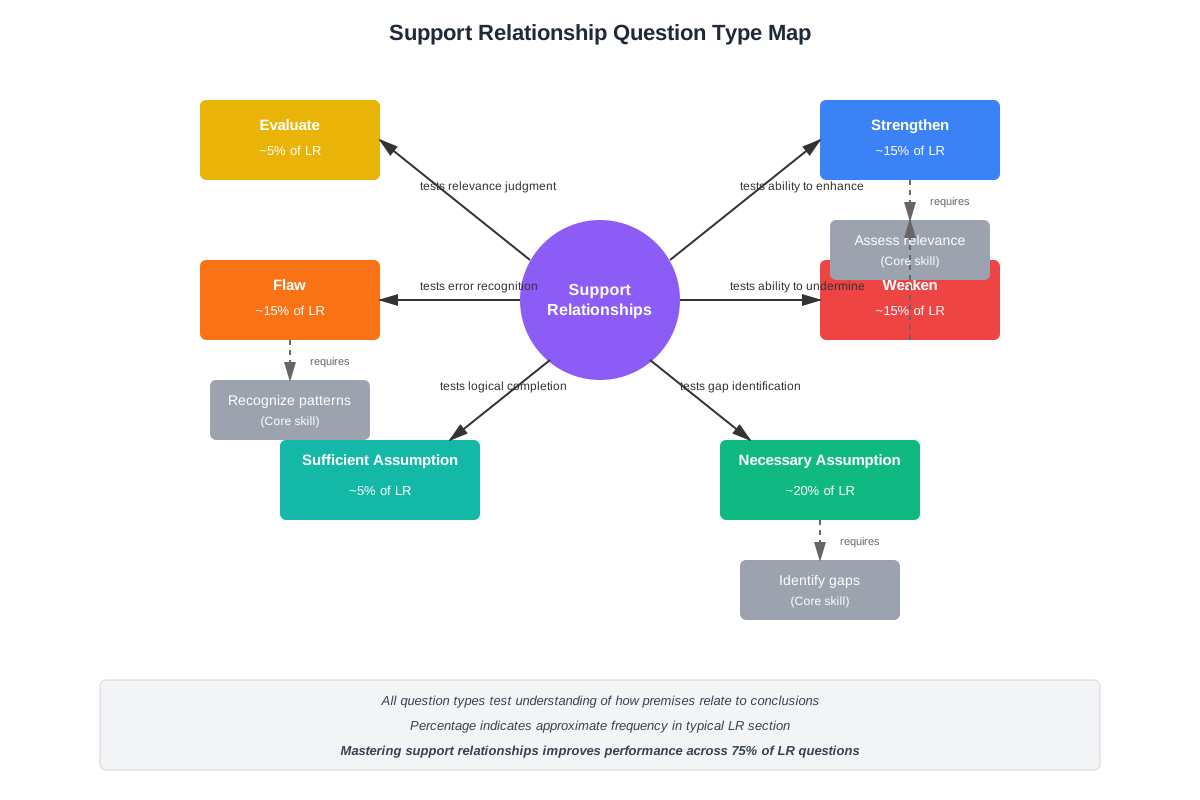
The concept of lsat support relationships encompasses the various ways that premises can provide justification for conclusions. These relationships range from strong, definitive support to weak, circumstantial support. Mastering this topic enables test-takers to quickly dissect arguments, identify logical gaps, evaluate the strength of reasoning, and predict what additional information would strengthen or weaken an argument. This skill is tested directly in question types such as Strengthen, Weaken, Necessary Assumption, Sufficient Assumption, and Flaw questions—collectively representing over 60% of all Logical Reasoning questions.
Within the broader framework of argument fundamentals, support relationships connect directly to premise and conclusion identification, assumption recognition, and argument structure analysis. Understanding support relationships is the bridge between simply identifying the components of an argument and evaluating whether those components actually accomplish what the author intends. This topic is essential groundwork for advanced logical reasoning skills including formal logic, causal reasoning, and conditional reasoning patterns.
Learning Objectives
- [ ] Identify how Support relationships appears in LSAT questions
- [ ] Explain the reasoning pattern behind Support relationships
- [ ] Apply Support relationships to solve LSAT-style problems accurately
- [ ] Distinguish between different degrees of support (strong, moderate, weak)
- [ ] Recognize when premises fail to adequately support their intended conclusion
- [ ] Evaluate whether additional information would strengthen or weaken existing support relationships
- [ ] Diagram support structures to visualize argument flow
Prerequisites
- Basic argument structure: Understanding what constitutes a premise and conclusion is essential because support relationships describe how these components interact
- Indicator words: Familiarity with conclusion indicators (therefore, thus, hence) and premise indicators (because, since, for) helps identify the direction of support
- Critical reading skills: The ability to parse complex sentences and identify main ideas enables recognition of support structures embedded in dense text
Why This Topic Matters
Support relationships appear in virtually every Logical Reasoning question on the LSAT. Understanding these relationships is not merely helpful—it is absolutely essential for achieving a competitive score. The LSAT tests analytical reasoning skills that lawyers use daily: evaluating whether evidence actually supports a legal claim, identifying weaknesses in opposing arguments, and determining what additional evidence would strengthen a case.
On the LSAT, approximately 15-18 of the 24-26 Logical Reasoning questions per section directly test understanding of support relationships. These include:
- Strengthen questions (3-4 per section): Require identifying what would enhance support
- Weaken questions (3-4 per section): Require identifying what would undermine support
- Assumption questions (4-5 per section): Require identifying unstated premises necessary for support
- Flaw questions (3-4 per section): Require recognizing inadequate support
- Evaluate questions (1-2 per section): Require determining what information would affect support strength
Beyond direct testing, support relationships underlie every argument-based question. Even Main Point questions require understanding which statements support which conclusions. Method of Reasoning questions explicitly ask how premises relate to conclusions. Parallel Reasoning questions require matching support structures across different contexts.
In real-world applications, lawyers constantly evaluate support relationships when assessing case strength, judges evaluate them when weighing evidence, and legal scholars evaluate them when analyzing precedent. The LSAT tests these skills because they predict success in legal reasoning.
Core Concepts
Definition of Support Relationships
A support relationship exists when one or more statements (premises) are offered as justification, evidence, or reasons for accepting another statement (conclusion). The fundamental question in any support relationship is: "Do these premises, if true, give us good reason to believe the conclusion?" This relationship is directional—premises support conclusions, not the reverse—and can vary dramatically in strength.
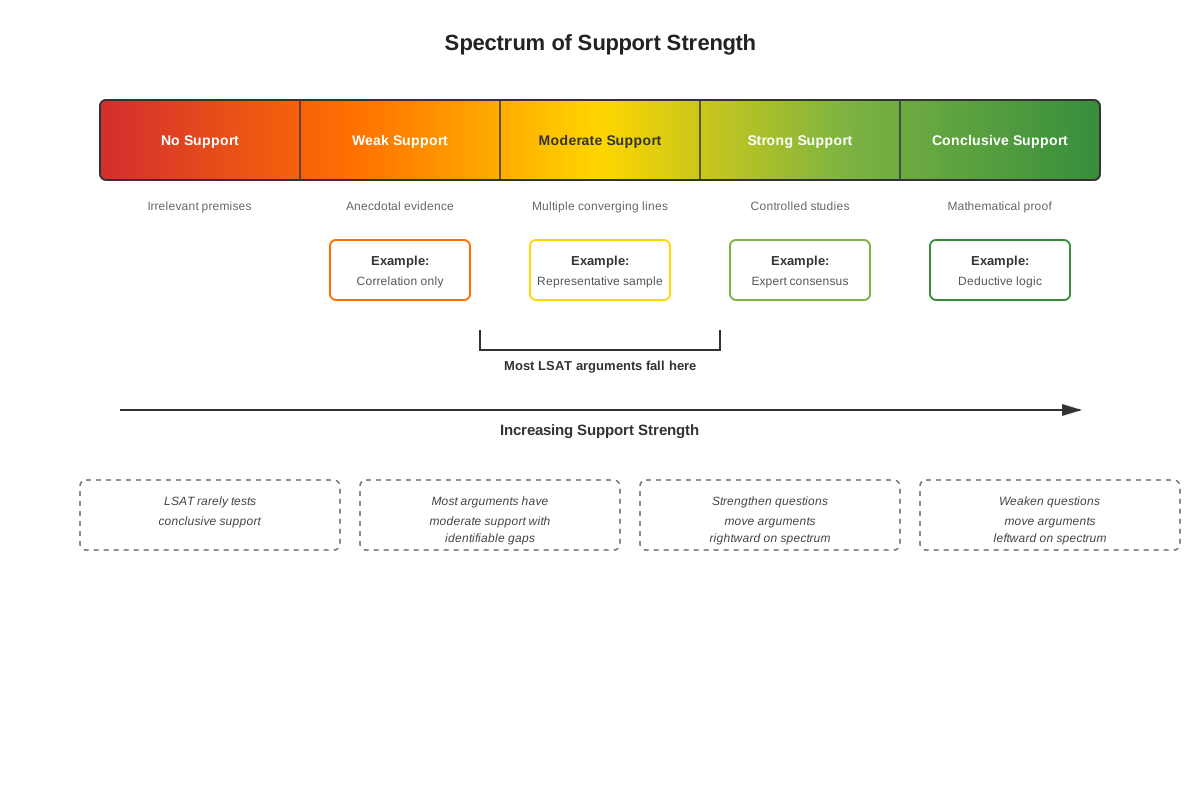
Support is not binary; it exists on a spectrum. Strong support means the premises, if true, make the conclusion highly probable or certain. Weak support means the premises provide some reason to believe the conclusion but leave substantial doubt. No support means the premises are irrelevant to the conclusion or actually undermine it.
Types of Support Strength
| Support Level | Description | Example |
|---|---|---|
| Deductive/Definitive | Premises guarantee the conclusion if true | All mammals are warm-blooded. Whales are mammals. Therefore, whales are warm-blooded. |
| Strong Inductive | Premises make conclusion highly probable | 95% of students who score 170+ on practice tests score 165+ on the real LSAT. Sarah scored 172 on practice tests. Therefore, Sarah will likely score 165+ on the real test. |
| Moderate | Premises provide reasonable but not overwhelming support | Most lawyers work long hours. James is a lawyer. Therefore, James probably works long hours. |
| Weak | Premises provide minimal support | Some politicians are dishonest. Therefore, this particular politician is dishonest. |
| No Support/Irrelevant | Premises don't support the conclusion | The sky is blue. Therefore, democracy is the best form of government. |
Identifying Support Relationships in LSAT Arguments
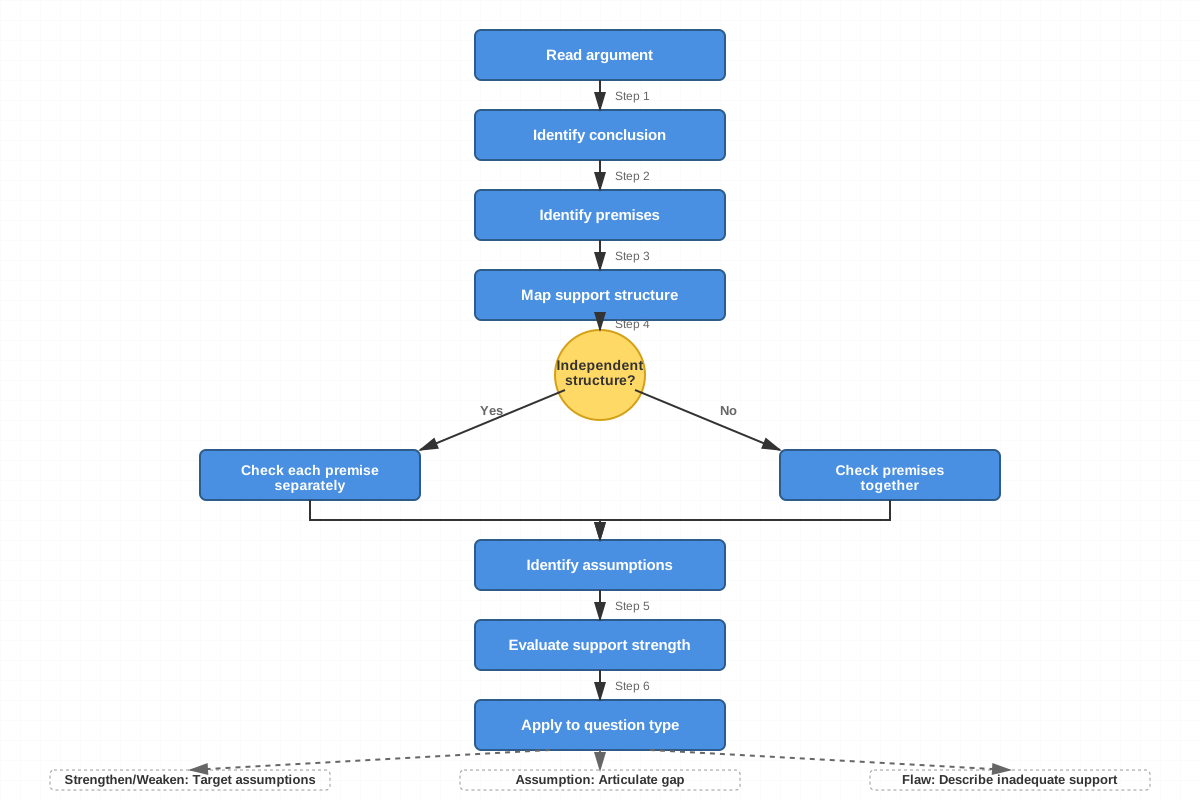
The LSAT presents arguments in dense, complex prose where support relationships may not be immediately obvious. The key steps for identification are:
- Locate the conclusion: Find the main claim the author wants you to accept
- Identify the premises: Find all statements offered as evidence for that conclusion
- Map the support structure: Determine how each premise relates to the conclusion
- Evaluate support strength: Assess whether the premises actually justify the conclusion
Consider this example: "The new policy will reduce costs because it eliminates redundant processes, and any policy that eliminates redundant processes saves money."
Breaking this down:
- Conclusion: The new policy will reduce costs
- Premise 1: It eliminates redundant processes
- Premise 2: Any policy that eliminates redundant processes saves money
- Support structure: Premise 1 + Premise 2 → Conclusion (deductive support)
Gaps in Support Relationships
Most LSAT arguments contain gaps—logical spaces between premises and conclusions where unstated assumptions are necessary for the support to work. Recognizing these gaps is crucial for Assumption, Flaw, Strengthen, and Weaken questions.
A gap exists when premises don't fully connect to the conclusion without additional information. For example: "Sales increased after we hired a new marketing director. Therefore, the new marketing director caused the sales increase."
The gap here is the assumption that no other factors caused the sales increase (perhaps the economy improved, or a competitor went out of business). The premises don't rule out alternative explanations, creating a support gap.
Support Chains and Complex Structures
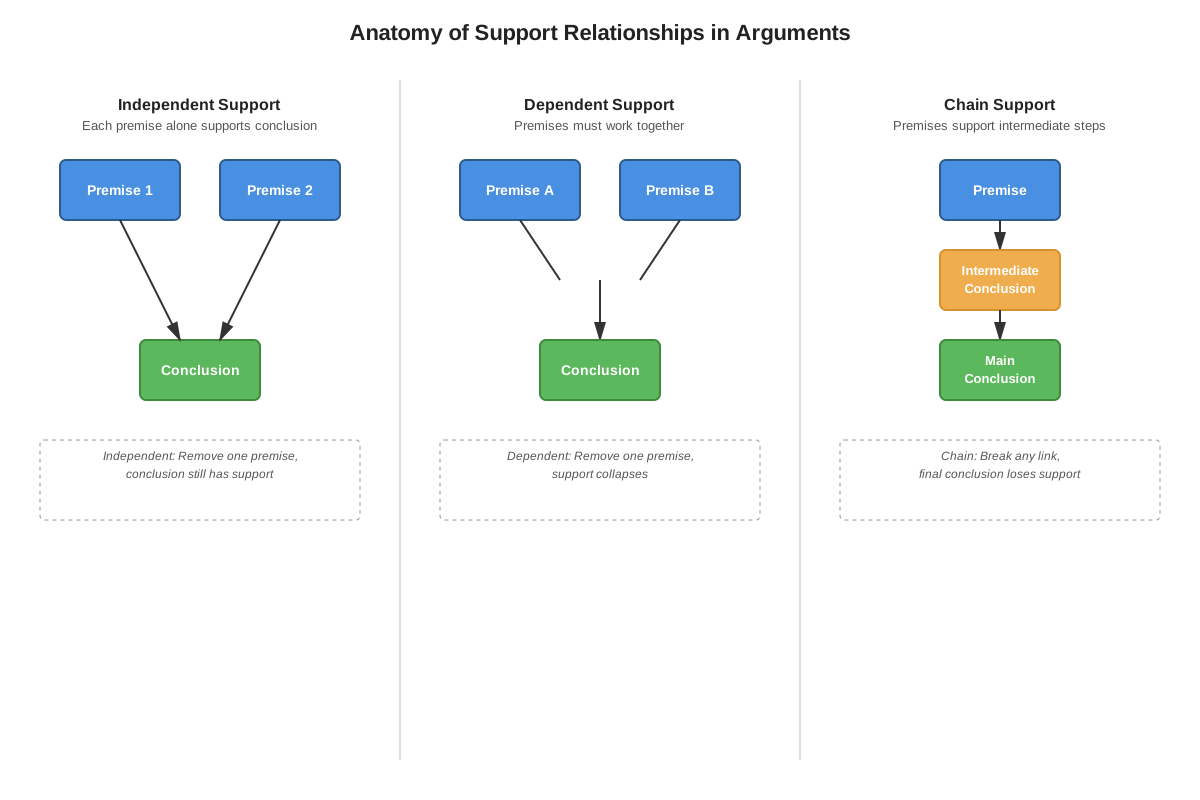
Arguments often contain support chains where one conclusion serves as a premise for another conclusion. These intermediate conclusions (also called sub-conclusions) create layered support structures:
Premise A → Intermediate Conclusion B → Final Conclusion C
Example: "Studies show meditation reduces stress [Premise A]. Since reduced stress improves health [Premise connecting to B], meditation must improve health [Intermediate Conclusion B]. Therefore, employers should offer meditation programs [Final Conclusion C]."
Understanding these chains is essential because a weakness anywhere in the chain undermines the entire argument.
Sufficient vs. Necessary Support
An important distinction in support relationships is between sufficient support (premises that, if true, guarantee or strongly establish the conclusion) and necessary support (premises without which the conclusion cannot be established).
- Sufficient: "If the defendant's fingerprints are on the weapon, that's sufficient to place him at the crime scene"
- Necessary: "For the defendant to be convicted of murder, it's necessary to prove he caused the death"
Many LSAT questions test whether students understand what's required (necessary) versus what would be enough (sufficient) to support a conclusion.
Relevance vs. Strength
A premise can be relevant to a conclusion (connected to the topic) without providing strong support. The LSAT frequently includes answer choices that are relevant but don't actually strengthen or weaken the argument significantly.
Example argument: "This medication should be approved because clinical trials showed it was safe."
- Relevant but weak support: "The medication is affordable" (relevant to approval but doesn't address efficacy)
- Relevant and strong support: "Clinical trials showed the medication effectively treats the target condition" (directly addresses a key approval criterion)
Concept Relationships
Support relationships serve as the central organizing principle for understanding arguments. The relationship map flows as follows:
Premise Identification → Support Relationships → Conclusion Evaluation
Within support relationships themselves, several concepts interconnect:
- Support Strength determines how well premises justify conclusions, which directly affects Argument Evaluation
- Support Gaps reveal where Assumptions are needed to complete the logical connection
- Support Chains show how Complex Arguments build through multiple layers of reasoning
- Relevance is a prerequisite for Support—irrelevant premises cannot support conclusions regardless of other factors
Support relationships connect backward to prerequisite topics:
- Understanding Argument Structure enables identification of what supports what
- Recognizing Indicator Words helps trace support direction
Support relationships connect forward to advanced topics:
- Causal Reasoning is a specific type of support relationship where premises support causal conclusions
- Conditional Reasoning involves support relationships with if-then structures
- Formal Logic provides tools for evaluating support strength in complex arguments
The progression is: Identify components → Understand support relationships → Evaluate argument quality → Apply to specific question types
High-Yield Facts
⭐ Support relationships describe how premises provide justification for conclusions, and this concept underlies 60-70% of all Logical Reasoning questions
⭐ Support exists on a spectrum from deductive (guarantees conclusion) to weak inductive (provides minimal support) to irrelevant (provides no support)
⭐ Most LSAT arguments contain gaps—logical spaces where unstated assumptions are necessary for premises to fully support conclusions
⭐ A premise can be relevant to a conclusion without providing strong support; relevance and support strength are distinct concepts
⭐ Support chains involve intermediate conclusions that serve as premises for final conclusions; weakness anywhere in the chain undermines the entire argument
- Support relationships are directional: premises support conclusions, not vice versa
- Strengthen questions ask what would enhance existing support; Weaken questions ask what would undermine it
- Necessary assumptions are required for support to work; sufficient assumptions would guarantee the conclusion
- Multiple premises can work together (convergent support) or independently (independent support) to support a conclusion
- The LSAT tests whether students can distinguish between what an argument assumes versus what it explicitly states
- Conditional statements (if-then) create specific support relationships where the sufficient condition supports the necessary condition
- Analogical reasoning involves support relationships where similarity between cases supports similar conclusions
- Statistical evidence provides probabilistic support that can be strong or weak depending on sample size and relevance
Quick check — test yourself on Support relationships so far.
Try Flashcards →Common Misconceptions
Misconception: If premises are true, the conclusion must be true.
Correction: Only deductive arguments guarantee conclusions. Most LSAT arguments are inductive, where true premises make conclusions probable but not certain. The strength of support varies dramatically.
Misconception: More premises always mean stronger support.
Correction: Support strength depends on premise quality and relevance, not quantity. Five irrelevant premises provide no support, while one highly relevant premise can provide strong support.
Misconception: If a statement is related to the topic, it supports the conclusion.
Correction: Relevance is necessary but not sufficient for support. A statement must not only relate to the topic but actually provide evidence for the specific conclusion. Many wrong answers on Strengthen/Weaken questions are topically relevant but don't affect the argument's support structure.
Misconception: Assumptions are flaws in arguments.
Correction: All arguments contain assumptions—unstated premises necessary for support. Assumptions become problematic only when they're questionable or unjustified. Valid arguments can have reasonable assumptions.
Misconception: Support relationships are always explicitly stated with indicator words.
Correction: While indicator words help identify support relationships, many LSAT arguments present support implicitly. Test-takers must infer relationships from context and logical structure, not just rely on keywords.
Misconception: Weakening an argument means proving the conclusion false.
Correction: Weakening means reducing support strength—making the conclusion less likely to follow from the premises. The conclusion could still be true even if the argument is weakened.
Misconception: Background information in an argument provides support for the conclusion.
Correction: Arguments often include context or background that doesn't support the conclusion but merely sets up the discussion. Only statements offered as evidence or reasons constitute support.
Worked Examples
Example 1: Identifying Support Structure and Gaps
Argument: "The city's new recycling program will significantly reduce landfill waste. After all, the program makes recycling more convenient for residents, and when recycling is convenient, people recycle more. Studies show that increased recycling rates correlate with reduced landfill waste."
Analysis:
Step 1 - Identify the conclusion: "The city's new recycling program will significantly reduce landfill waste"
Step 2 - Identify the premises:
- Premise 1: The program makes recycling more convenient
- Premise 2: When recycling is convenient, people recycle more
- Premise 3: Increased recycling rates correlate with reduced landfill waste
Step 3 - Map the support structure:
Premise 1 + Premise 2 → Intermediate conclusion (people will recycle more) + Premise 3 → Final conclusion (landfill waste will be reduced)
Step 4 - Identify gaps:
- Gap 1: Assumes convenience is the main barrier to recycling (what if people don't recycle for other reasons?)
- Gap 2: Assumes correlation between recycling and reduced landfill waste indicates causation
- Gap 3: Assumes the program will actually make recycling more convenient (not just claim to)
- Gap 4: Assumes no other factors will increase landfill waste simultaneously
Step 5 - Evaluate support strength: Moderate support. The premises provide a logical chain, but multiple assumptions are necessary, and the correlation-causation issue weakens the support.
Application to question types:
- Assumption question: "Which of the following is assumed?" → Answer: "Convenience is a significant factor in residents' recycling decisions"
- Weaken question: "Which of the following would most weaken?" → Answer: "Most residents already find recycling convenient but choose not to recycle"
- Strengthen question: "Which of the following would most strengthen?" → Answer: "Studies show that increased recycling directly causes reduced landfill waste, not merely correlating with it"
Example 2: Evaluating Support Strength
Argument: "The defendant must be guilty of the robbery. Three eyewitnesses identified him, his fingerprints were found at the scene, and he had no alibi for the time of the crime."
Analysis:
Step 1 - Identify support type: This argument presents convergent support—multiple independent premises each support the conclusion.
Step 2 - Evaluate each premise's support strength:
- Premise 1 (eyewitness identification): Moderate support (eyewitnesses can be mistaken)
- Premise 2 (fingerprints at scene): Strong support (physical evidence is reliable)
- Premise 3 (no alibi): Weak support (absence of alibi doesn't prove presence at crime)
Step 3 - Identify gaps:
- Gap 1: Assumes fingerprints at the scene prove presence during the robbery (what if he was there legitimately at another time?)
- Gap 2: Assumes eyewitness reliability (what if lighting was poor or witnesses were far away?)
- Gap 3: Assumes no alternative explanation for the evidence
Step 4 - Overall support evaluation: Strong but not definitive support. Multiple pieces of evidence converge, but gaps remain. This is typical of LSAT arguments—strong enough to be persuasive but with identifiable weaknesses.
Application to question types:
- Flaw question: "The reasoning is flawed because it..." → Answer: "assumes that presence at the scene at some point proves presence during the crime"
- Necessary assumption: "The argument depends on assuming..." → Answer: "the defendant's fingerprints were not at the scene for legitimate reasons unrelated to the robbery"
Exam Strategy
Approaching Support Relationship Questions
When encountering any Logical Reasoning question, follow this systematic approach:
- Read the question stem first: Knowing whether you'll need to strengthen, weaken, identify an assumption, or find a flaw focuses your reading
- Identify the conclusion immediately: Underline or mentally note the main claim
- Map the support structure: Quickly note how premises connect to the conclusion
- Identify the gap: Determine what's assumed but not stated
- Predict the answer: Before looking at choices, anticipate what would strengthen/weaken/assume
- Eliminate systematically: Remove answers that are irrelevant, out of scope, or opposite to what's needed
Trigger Words and Phrases
Strong support indicators:
- "proves that," "demonstrates conclusively," "establishes that"
- "must be," "cannot be otherwise," "necessarily"
- Watch for these in answer choices—they often indicate the choice goes too far
Moderate support indicators:
- "suggests that," "indicates," "supports the view"
- "likely," "probably," "reasonable to conclude"
- These are often correct for strengthen/support questions
Weak or no support indicators:
- "might," "could possibly," "cannot rule out"
- "is consistent with" (consistency ≠ support)
- These often appear in incorrect answer choices
Gap indicators in arguments:
- Shifts in terminology between premises and conclusion
- Causal language ("causes," "leads to," "results in") without causal evidence
- Generalizations from limited examples
- Comparisons without establishing comparability
Process of Elimination Tips
For Strengthen questions:
- Eliminate answers that are irrelevant to the conclusion
- Eliminate answers that weaken rather than strengthen
- Eliminate answers that address a different gap than the one in the argument
- Choose the answer that most directly addresses the argument's central assumption
For Weaken questions:
- Eliminate answers that strengthen the argument
- Eliminate answers that are consistent with the argument but don't undermine it
- Eliminate answers that attack a premise rather than the support relationship
- Choose the answer that most directly challenges a key assumption
For Assumption questions:
- Use the negation test: If negating the answer choice destroys the argument, it's a necessary assumption
- Eliminate answers that are too strong (sufficient assumptions when necessary is asked)
- Eliminate answers that are irrelevant to connecting premises to conclusion
- Choose the answer that fills the most critical gap
Time Allocation
- Initial read: 30-45 seconds to understand the argument
- Question stem analysis: 5-10 seconds to know what you're looking for
- Answer choice evaluation: 30-45 seconds, eliminating systematically
- Total per question: 1:20-1:40 on average
If an argument's support structure is complex, invest extra time mapping it clearly—this prevents costly mistakes and actually saves time on answer evaluation.
Memory Techniques
The SUPPORT Acronym
Strength - Evaluate how strongly premises support the conclusion
Unstated - Identify what assumptions are unstated but necessary
Premises - Locate all evidence offered
Point - Find the main conclusion (the point being argued)
Order - Map the logical order of support
Relevance - Check that premises are actually relevant
Test - Test whether support actually works or contains gaps
Visualization Strategy
Picture arguments as bridges: premises are the support beams, the conclusion is the destination, and gaps are missing sections. When evaluating support:
- Strong support = solid bridge with all beams in place
- Weak support = rickety bridge with questionable beams
- Gaps = missing sections you must assume are there
- Strengthen answers = adding reinforcing beams
- Weaken answers = removing or damaging existing beams
The Three-Question Test
For any argument, quickly ask:
- What's the point? (conclusion)
- Why should I believe it? (premises and support)
- What's missing? (gaps and assumptions)
This rapid-fire sequence ensures you've identified all components of the support relationship.
Summary
Support relationships form the foundation of logical reasoning on the LSAT, describing how premises provide justification for conclusions. These relationships exist on a spectrum from deductive certainty to weak inductive support to complete irrelevance. Mastering support relationships requires identifying argument components, mapping how premises connect to conclusions, recognizing gaps where unstated assumptions are necessary, and evaluating whether the support actually works. The LSAT tests this understanding through multiple question types including Strengthen, Weaken, Assumption, and Flaw questions, which collectively represent the majority of Logical Reasoning questions. Success requires systematic analysis: identify the conclusion, locate supporting premises, map the support structure, find the gaps, and evaluate strength. Understanding that relevance doesn't equal strong support, that most arguments contain necessary assumptions, and that support can be undermined without proving conclusions false are critical insights for LSAT success.
Key Takeaways
- Support relationships describe how premises justify conclusions and appear in 60-70% of Logical Reasoning questions
- Support exists on a spectrum from deductive (guarantees conclusion) to weak inductive to irrelevant
- Most LSAT arguments contain gaps—logical spaces requiring unstated assumptions for support to work
- Relevance and support strength are distinct; a premise can be topically relevant without providing strong support
- Systematic analysis (identify conclusion → locate premises → map support → find gaps → evaluate strength) is essential for accuracy
- Strengthen and weaken questions test understanding of what would enhance or undermine support relationships
- The negation test helps identify necessary assumptions: if negating a statement destroys the argument, it's a necessary assumption
Related Topics
Causal Reasoning: Builds on support relationships by examining arguments where premises support causal conclusions. Understanding basic support relationships is essential before tackling the specific challenges of causal arguments, including alternative causes and correlation-causation issues.
Conditional Reasoning: Involves support relationships with if-then structures. Mastering basic support relationships enables understanding how sufficient and necessary conditions create specific support patterns.
Argument Evaluation: Applies support relationship understanding to assess overall argument quality. Once support relationships are mastered, students can evaluate whether arguments succeed or fail in their persuasive goals.
Formal Logic: Provides advanced tools for analyzing support relationships in complex arguments with multiple conditional statements and quantifiers. Strong foundation in basic support relationships is prerequisite for formal logic success.
Assumption Questions: Directly test understanding of support gaps. Mastering support relationships enables quick identification of what's unstated but necessary for premises to support conclusions.
Practice CTA
Now that you understand support relationships, it's time to apply this knowledge to actual LSAT questions. The practice questions and flashcards will reinforce your ability to quickly identify support structures, recognize gaps, and evaluate argument strength. Remember: understanding the theory is just the first step—consistent practice with real LSAT arguments transforms this knowledge into the automatic analytical skills that produce top scores. Each practice question you work through strengthens your ability to see support relationships instantly, setting you up for success on test day. Start practicing now to cement these critical skills!
Sign up free to keep reading
Create a free AnvayaPrep account to finish this LSAT guide on Support relationships — plus flashcards and practice questions.