Overview
Assumption answer prediction is one of the most critical skills for mastering LSAT Logical Reasoning sections. This technique involves actively anticipating what the correct answer will look like before examining the answer choices—a proactive approach that dramatically improves both accuracy and speed. Rather than passively reading through five answer choices and hoping to recognize the right one, skilled test-takers identify the logical gap in an argument and formulate their own prediction of what assumption must be true for the argument to hold together.
The LSAT tests assumption questions more frequently than almost any other question type, appearing 4-6 times per Logical Reasoning section. These questions ask test-takers to identify unstated premises that the argument depends upon—the hidden connections between evidence and conclusion that the author takes for granted. Without the ability to predict answers, students often fall into trap answers that sound plausible but don't actually bridge the specific logical gap in the argument. Lsat assumption answer prediction transforms assumption questions from time-consuming puzzles into manageable, systematic exercises.
Within the broader landscape of logical reasoning, assumption answer prediction connects directly to argument analysis, conditional reasoning, and causal reasoning. It requires understanding how conclusions are built from premises and recognizing where those connections remain incomplete. This skill serves as a foundation for related question types including Strengthen, Weaken, and Flaw questions, all of which require identifying the vulnerable points in an argument's logical structure. Mastering this predictive approach creates a competitive advantage that extends throughout the entire Logical Reasoning section.
Learning Objectives
- [ ] Identify how Assumption answer prediction appears in LSAT questions
- [ ] Explain the reasoning pattern behind Assumption answer prediction
- [ ] Apply Assumption answer prediction to solve LSAT-style problems accurately
- [ ] Distinguish between sufficient assumptions and necessary assumptions in argument structures
- [ ] Generate precise predictions for assumption answers before reviewing answer choices
- [ ] Recognize common assumption patterns that repeatedly appear across LSAT questions
- [ ] Evaluate answer choices efficiently by comparing them against pre-formulated predictions
Prerequisites
- Argument structure identification: Understanding how to break arguments into premises and conclusions is essential because assumption prediction requires identifying what's missing between these components.
- Conditional logic fundamentals: Basic knowledge of if-then relationships helps recognize when arguments assume conditional connections that aren't explicitly stated.
- Causal reasoning basics: Many assumptions involve unstated causal relationships, so recognizing cause-and-effect claims is necessary for predicting what the argument takes for granted.
- Question stem recognition: Distinguishing assumption questions from other question types ensures the correct strategic approach is applied.
Why This Topic Matters
In legal practice, attorneys must identify unstated assumptions in opposing arguments to expose weaknesses and build counterarguments. Judges evaluate whether legal reasoning rests on sound foundations or questionable assumptions. The LSAT tests this skill because it directly correlates with success in law school case analysis and legal writing. Beyond legal applications, assumption identification is fundamental to critical thinking in business negotiations, policy analysis, and scientific reasoning.
On the LSAT, assumption questions constitute approximately 12-15% of all Logical Reasoning questions, making them one of the most frequently tested question types. They appear in two primary forms: "necessary assumption" questions (asking what the argument requires or depends upon) and "sufficient assumption" questions (asking what would guarantee the conclusion). The vast majority are necessary assumption questions, typically identified by stems like "Which one of the following is an assumption required by the argument?" or "The argument depends on assuming which one of the following?"
These questions commonly appear in passages involving causal claims, comparative arguments, plans and proposals, and arguments that shift terminology between premises and conclusion. Test-makers deliberately create arguments with subtle logical gaps, then offer four attractive wrong answers alongside one correct answer that precisely fills that gap. Without prediction skills, students waste valuable time evaluating each answer choice and frequently select answers that seem relevant but don't actually connect the specific elements of the argument.
Core Concepts
Understanding Assumption Questions
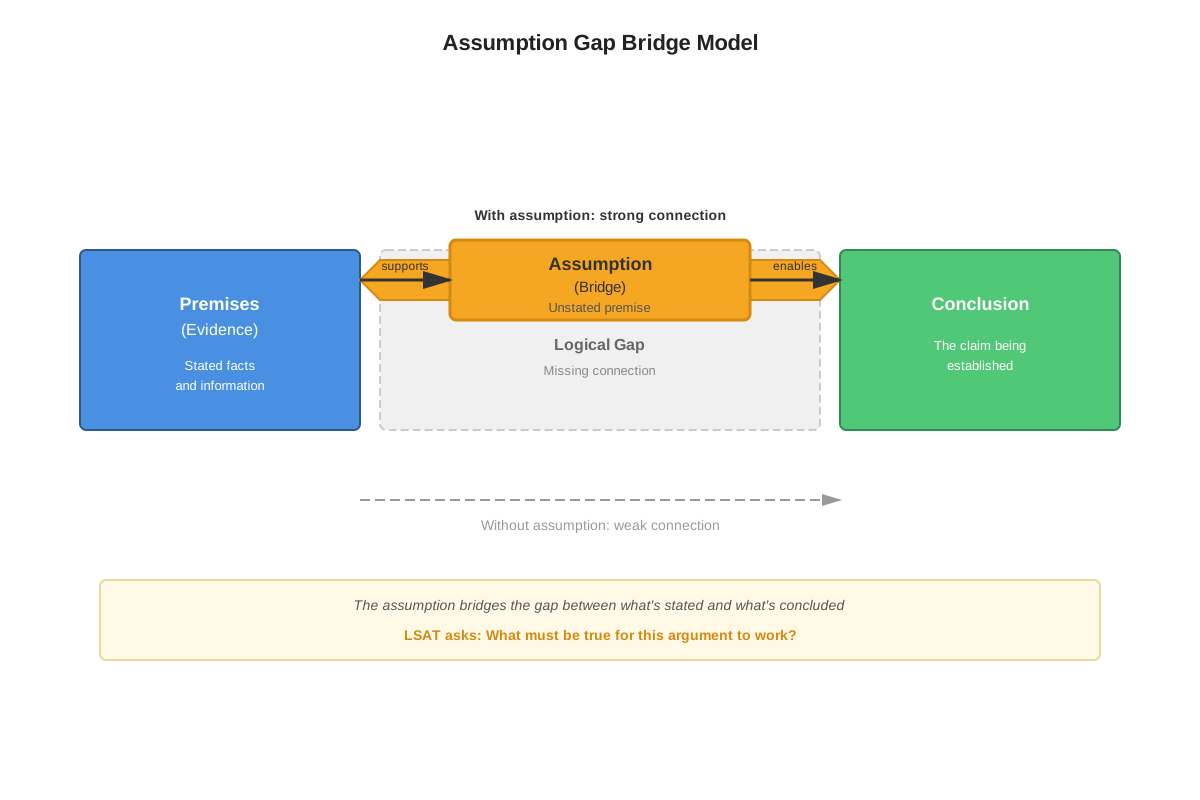
An assumption is an unstated premise that must be true for an argument's conclusion to follow logically from its stated evidence. Every LSAT argument with a logical gap contains at least one assumption—something the author believes but hasn't explicitly said. Assumption questions test whether students can identify these hidden premises that bridge the gap between evidence and conclusion.
The fundamental principle behind assumption answer prediction is that every argument can be analyzed as a logical structure: premises lead to a conclusion, but the connection between them often requires additional unstated support. The assumption is precisely that missing support. By identifying what's stated (premises and conclusion) and recognizing what's missing (the logical gap), test-takers can predict what must be assumed.
The Two Types of Assumptions
| Assumption Type | Definition | Question Stem Language | Strategic Approach |
|---|---|---|---|
| Necessary Assumption | A premise that must be true for the conclusion to be valid; without it, the argument falls apart | "requires," "depends on," "assumes," "presupposes" | Use negation test: if you negate the answer, does the argument collapse? |
| Sufficient Assumption | A premise that, if true, guarantees the conclusion follows logically | "allows the conclusion to be properly drawn," "enables the conclusion to be inferred" | Look for answer that completely fills the logical gap, often using formal logic |
Most LSAT assumption questions test necessary assumptions. These are the minimum requirements for the argument to work—the assumptions without which the reasoning completely breaks down.
The Assumption Prediction Process
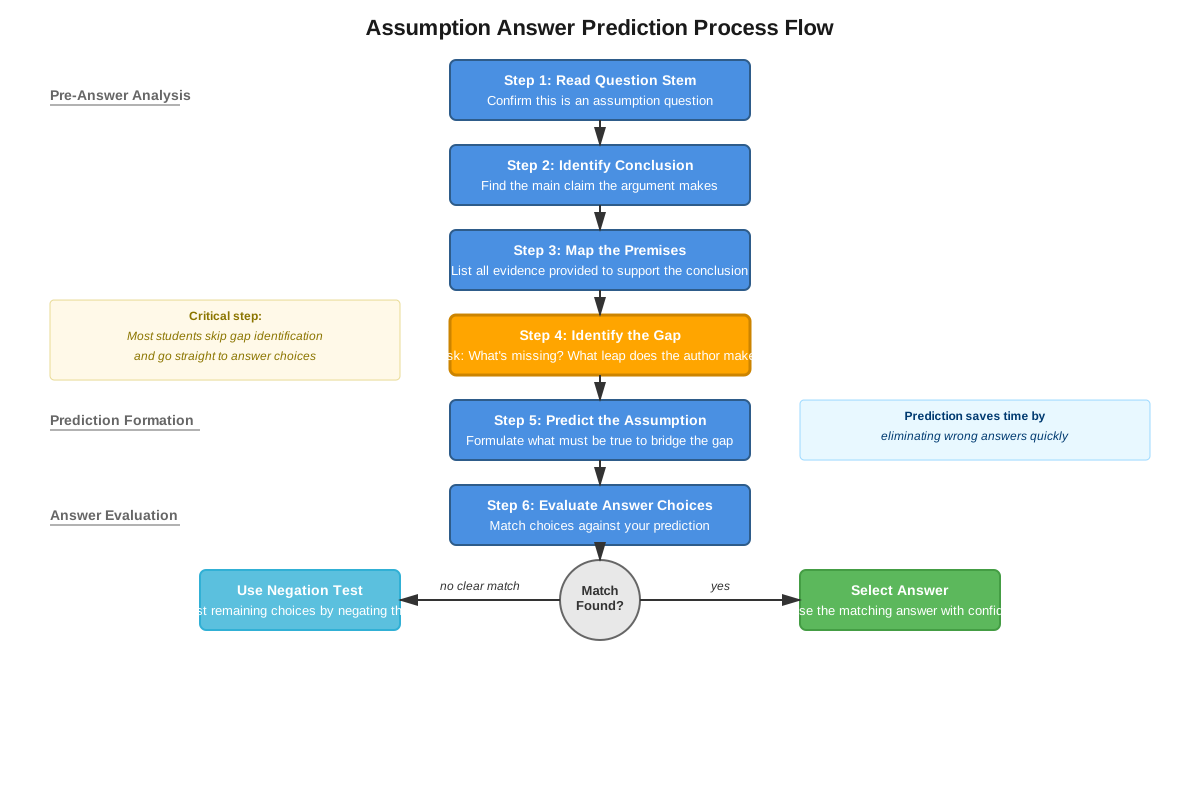
Lsat assumption answer prediction follows a systematic five-step process:
- Identify the conclusion: Determine exactly what the argument is trying to prove. Look for conclusion indicators like "therefore," "thus," "consequently," or "clearly."
- Identify the premises: Find all the evidence offered in support of the conclusion. These are the stated reasons the author provides.
- Spot the gap: Recognize the disconnect between premises and conclusion. Ask: "What's missing? What leap in logic has the author made? What connects these specific pieces of evidence to this specific conclusion?"
- Predict the assumption: Formulate in your own words what must be true to bridge that gap. This prediction should connect the specific terms or concepts that appear in the premises to those that appear in the conclusion.
- Match to answer choices: Find the answer choice that most closely matches your prediction, using your prediction as a filter to eliminate wrong answers quickly.
Common Assumption Patterns
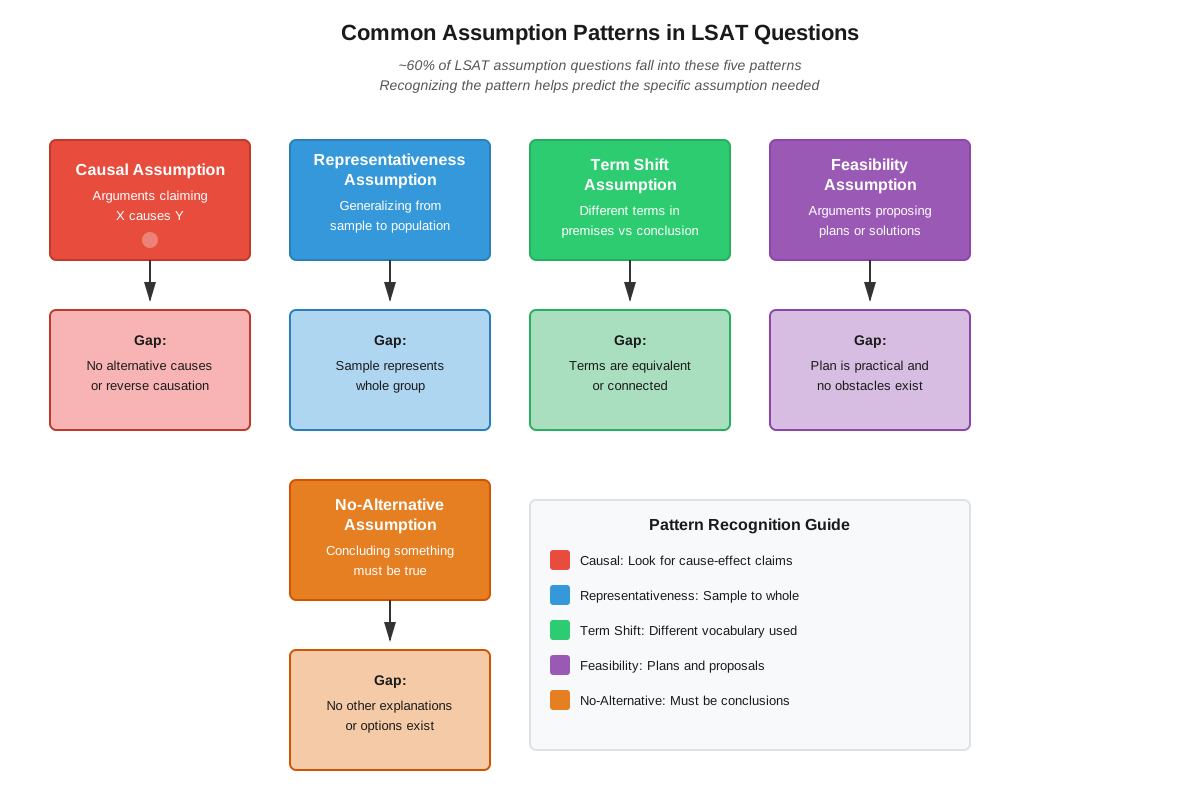
Certain logical gaps appear repeatedly on the LSAT, allowing for pattern recognition:
Concept Shift Assumptions: The argument uses one term in the premises and a different (but related) term in the conclusion. The assumption connects these terms.
- Example: Premises discuss "economic growth" but conclusion references "improved quality of life" → Assumption: economic growth leads to improved quality of life
Causal Assumptions: The argument claims one thing causes another. The assumption rules out alternative explanations or reverse causation.
- Example: "Sales increased after the advertising campaign, so the campaign caused increased sales" → Assumption: something else didn't cause the sales increase
Comparison Assumptions: The argument compares two things. The assumption establishes that they're comparable in relevant ways.
- Example: "This medication worked in rats, so it will work in humans" → Assumption: rats and humans are similar in relevant biological ways
Plan/Proposal Assumptions: The argument proposes a solution. The assumption addresses feasibility or rules out problems.
- Example: "We should reduce prices to increase revenue" → Assumption: lower prices won't decrease profit margins more than increased volume compensates
Representativeness Assumptions: The argument generalizes from a sample to a population. The assumption establishes that the sample is representative.
- Example: "Our survey of 100 customers showed satisfaction, so all customers are satisfied" → Assumption: the 100 surveyed customers represent the broader customer base
The Negation Technique
For necessary assumption questions, the negation technique provides a powerful verification tool. If you negate (reverse) a necessary assumption, the argument should fall apart. This technique helps distinguish correct answers from attractive wrong answers:
- Take the answer choice and negate it (make it say the opposite)
- Ask: "If this negated statement were true, would the argument still work?"
- If the argument falls apart, the original statement is a necessary assumption
- If the argument still works, it's not a necessary assumption
This technique is particularly useful when choosing between two seemingly correct answers or when your prediction doesn't perfectly match any answer choice.
Recognizing What Assumptions Are NOT
Understanding what doesn't qualify as an assumption is equally important:
- Assumptions are not additional support: They don't strengthen an already complete argument; they complete an incomplete one
- Assumptions are not background information: They specifically connect the given premises to the stated conclusion
- Assumptions are not extreme statements: LSAT assumptions are typically modest claims that minimally bridge the logical gap
- Assumptions are not the conclusion restated: They provide new information that the conclusion depends upon
Concept Relationships
The assumption prediction process builds directly on argument structure analysis. Before predicting assumptions, students must accurately identify conclusions and premises—the foundational skill of all logical reasoning. Once the argument structure is clear, the gap-spotting phase requires understanding different reasoning patterns (causal, conditional, comparative), which are prerequisite concepts.
The relationship flows as follows:
Argument Structure Identification → Gap Recognition → Assumption Prediction → Answer Evaluation
Within assumption questions themselves, understanding necessary versus sufficient assumptions determines which prediction strategy to employ. Necessary assumptions connect to the negation technique, while sufficient assumptions connect to formal logic and conditional reasoning.
Assumption prediction also serves as a foundation for related question types. Strengthen questions ask what additional evidence would support an argument—often by confirming an assumption. Weaken questions ask what would undermine an argument—often by attacking an assumption. Flaw questions identify reasoning errors—often by pointing out questionable assumptions. Thus, mastering assumption prediction creates transferable skills across multiple question types.
The concept map looks like this:
Conditional Logic + Causal Reasoning → Argument Analysis → Gap Identification → Assumption Prediction → (branches to) Strengthen/Weaken/Flaw Questions
High-Yield Facts
⭐ Assumption questions constitute 12-15% of all Logical Reasoning questions, making them one of the most frequently tested question types on the LSAT.
⭐ The correct assumption answer will always connect specific elements from the premises to specific elements in the conclusion—look for this bridge.
⭐ Necessary assumptions can be verified using the negation technique: if negating the statement destroys the argument, it's a necessary assumption.
⭐ The most common logical gap involves a shift in terminology between premises and conclusion—the assumption links these different terms.
⭐ Correct assumption answers are typically modest claims that minimally bridge the gap, not extreme or sweeping statements.
- Assumption question stems almost always include words like "assumes," "depends on," "requires," or "presupposes" for necessary assumptions.
- Sufficient assumption questions are less common and typically ask what would "allow the conclusion to be properly drawn" or "enable the conclusion to be logically inferred."
- Wrong answers in assumption questions often present statements that are true or reasonable but don't specifically connect the argument's premises to its conclusion.
- Causal arguments typically assume that no alternative explanation exists for the observed effect and that correlation indicates causation.
- Plan and proposal arguments typically assume feasibility, lack of negative side effects, and that the plan will actually achieve its intended goal.
- Arguments involving surveys or studies assume the sample is representative and the methodology is sound.
- Comparison arguments assume the compared items are similar in all relevant respects.
- The assumption is always something the author believes to be true but hasn't explicitly stated—it's never something that contradicts the argument.
Quick check — test yourself on Assumption answer prediction so far.
Try Flashcards →Common Misconceptions
Misconception: The assumption is just additional evidence that would strengthen the argument.
Correction: An assumption is not extra support for an already-complete argument; it's a missing piece that the argument requires to work at all. Strengtheners add support to arguments that already have their logical foundations; assumptions provide those foundations.
Misconception: The correct assumption answer will be something obviously true or common sense.
Correction: While assumptions may seem reasonable, the correct answer must specifically bridge the logical gap in this particular argument. Many wrong answers are true statements that don't connect the specific premises to the specific conclusion.
Misconception: Extreme or strongly worded answers are always wrong in assumption questions.
Correction: While correct assumptions are typically modest, occasionally the argument does require a strong claim. The key is whether the statement is necessary for the argument's logic, not whether it sounds extreme. However, be suspicious of extreme answers and verify them carefully.
Misconception: The assumption will introduce completely new information not mentioned in the argument.
Correction: Assumptions connect elements already present in the argument. They bridge existing concepts rather than introducing entirely new topics. If an answer choice discusses something totally unrelated to the argument's terms, it's likely wrong.
Misconception: If an answer choice is true, it must be the assumption.
Correction: An answer can be true without being what the argument assumes. The correct answer must be specifically required by this argument's logical structure. Many wrong answers are true statements that are irrelevant to the argument's reasoning.
Misconception: Predicting the exact wording of the correct answer is necessary.
Correction: Prediction involves identifying the logical gap and the general nature of what would fill it, not guessing the precise wording. The correct answer may be phrased differently than your prediction while still serving the same logical function.
Misconception: The negation technique works for all assumption questions.
Correction: The negation technique is specifically designed for necessary assumption questions. It doesn't work well for sufficient assumption questions, which require a different approach focused on formal logic and complete gap-filling.
Worked Examples
Example 1: Concept Shift Assumption
Argument: "The city's new recycling program has significantly increased the amount of material collected for recycling. Therefore, the program has been successful in reducing environmental waste."
Question: Which one of the following is an assumption required by the argument?
Step 1 - Identify the Conclusion: "The program has been successful in reducing environmental waste."
Step 2 - Identify the Premises: "The recycling program has significantly increased the amount of material collected for recycling."
Step 3 - Spot the Gap: The premises discuss "material collected for recycling" while the conclusion discusses "reducing environmental waste." These aren't the same thing. What if the collected material isn't actually being recycled? What if it's just being collected and then thrown away?
Step 4 - Predict the Assumption: The argument must assume that the collected material is actually being recycled (not just collected and discarded) and that recycling this material actually reduces environmental waste. The assumption bridges "collected for recycling" to "reducing environmental waste."
Step 5 - Evaluate Answer Choices:
(A) The city's previous waste management system was inadequate.
- This is irrelevant to whether collecting more material reduces waste. Eliminate.
(B) Most of the material collected through the program is actually recycled rather than discarded.
- This matches our prediction! It bridges the gap between collection and waste reduction. This is likely correct.
(C) Residents are more environmentally conscious than before the program began.
- This might explain why collection increased, but doesn't connect collection to waste reduction. Eliminate.
(D) The program costs less than alternative waste management approaches.
- Cost isn't relevant to whether the program reduces waste. Eliminate.
(E) Other cities have implemented similar recycling programs.
- What other cities do doesn't affect whether this program reduces waste. Eliminate.
Verification using Negation: If we negate (B): "Most of the material collected is NOT actually recycled but is discarded." If this were true, the argument falls apart—collecting material that gets discarded wouldn't reduce environmental waste. This confirms (B) is a necessary assumption.
Answer: (B)
Connection to Learning Objectives: This example demonstrates identifying assumption questions (objective 1), explaining the concept-shift reasoning pattern (objective 2), and applying the prediction process to solve the problem (objective 3).
Example 2: Causal Assumption
Argument: "After the company implemented flexible work schedules, employee productivity increased by 15%. Clearly, the flexible schedule policy caused the productivity increase."
Question: The argument depends on assuming which one of the following?
Step 1 - Identify the Conclusion: "The flexible schedule policy caused the productivity increase."
Step 2 - Identify the Premises: "After implementing flexible schedules, productivity increased by 15%."
Step 3 - Spot the Gap: This is a classic causal reasoning gap. The argument observes a correlation (flexible schedules came first, then productivity increased) and concludes causation. But correlation doesn't prove causation. What if something else caused the productivity increase? What if productivity was already increasing before the policy? The argument assumes no alternative explanation exists.
Step 4 - Predict the Assumption: The argument must assume that nothing else caused the productivity increase—no other factor was responsible. It assumes the flexible schedule policy was the actual cause, not just something that happened to occur before the increase.
Step 5 - Evaluate Answer Choices:
(A) Employees prefer flexible schedules to fixed schedules.
- Employee preference doesn't address whether flexible schedules caused the productivity increase. Eliminate.
(B) No other significant changes that could affect productivity occurred during the same period.
- This matches our prediction perfectly! It rules out alternative explanations. This is likely correct.
(C) The 15% increase represents a substantial improvement in productivity.
- Whether the increase is "substantial" doesn't affect whether flexible schedules caused it. Eliminate.
(D) Most companies that implement flexible schedules see productivity increases.
- What happens at other companies doesn't prove causation at this company. Eliminate.
(E) Flexible schedules allow employees to work during their most productive hours.
- This might explain how flexible schedules increase productivity, but the argument doesn't need to assume this specific mechanism. The argument only needs to assume flexible schedules actually caused the increase, not how they did so. This is tempting but not necessary.
Verification using Negation: If we negate (B): "Other significant changes that could affect productivity DID occur during the same period." If this were true, we couldn't conclude that flexible schedules caused the increase—it might have been these other changes. The argument falls apart, confirming (B) is necessary.
Answer: (B)
Connection to Learning Objectives: This example shows how to identify causal reasoning patterns (objective 2), generate precise predictions for common assumption types (objective 5), and distinguish necessary assumptions from explanatory details (objective 4).
Exam Strategy
When approaching assumption questions on the LSAT, implement this strategic framework:
Trigger Words to Identify Assumption Questions:
- "assumes," "assumption"
- "depends on," "relies on"
- "requires," "required"
- "presupposes," "presupposition"
- "takes for granted"
Exam Tip: As soon as you see these trigger words, shift into assumption prediction mode. Don't passively read the answer choices—actively predict the gap first.
Time Management Approach:
Spend 15-20 seconds on prediction before looking at answers. This upfront investment saves 30-45 seconds on answer evaluation. Students who skip prediction often spend 60+ seconds reading all five answers multiple times, while those who predict can eliminate wrong answers in 5-10 seconds each.
Process-of-Elimination Strategy:
- Eliminate answers that introduce completely new topics not mentioned in the argument's premises or conclusion
- Eliminate answers that are irrelevant to the connection between the specific premises and specific conclusion
- Eliminate answers that go in the wrong direction, contradicting the argument or weakening it
- Between two remaining answers, use the negation technique to verify which is truly necessary
Common Wrong Answer Patterns:
- True but irrelevant: The statement might be true but doesn't bridge the logical gap
- Reversal: The answer reverses the required relationship
- Extreme when modest is needed: The answer makes a stronger claim than the argument requires
- Explains but isn't required: The answer explains why the conclusion might be true but isn't necessary for the argument's logic
Strategic Shortcuts:
- If the argument shifts terminology between premises and conclusion, predict an assumption that connects those specific terms
- If the argument makes a causal claim, predict an assumption that rules out alternative causes
- If the argument proposes a plan, predict an assumption about feasibility or lack of negative consequences
- If the argument involves a comparison, predict an assumption that the compared items are similar in relevant ways
Exam Tip: Write down your prediction in the margin before looking at answers. This prevents answer choices from influencing your thinking and helps you stay focused on what the argument actually requires.
Memory Techniques
GAPS Acronym for Assumption Prediction Process:
- Get the conclusion and premises
- Analyze the disconnect
- Predict what bridges the gap
- Select the matching answer
The "Bridge Builder" Visualization:
Picture the premises as one side of a river and the conclusion as the other side. The assumption is the bridge connecting them. If the bridge (assumption) collapses, you can't get from premises to conclusion. This mental image helps remember that assumptions must specifically connect the argument's components.
SCAN for Common Gaps:
- Shift in concepts/terminology
- Causation claimed from correlation
- Alternative explanations not ruled out
- New terms in conclusion not in premises
Negation Technique Reminder - "NOT Test":
If you make it NOT true, does the argument NOT work? If yes, it's a necessary assumption.
The "Minimum Bridge" Principle:
Remember: assumptions are the minimum required for the argument to work, not the maximum support possible. Think "just enough" not "as much as possible."
Summary
Assumption answer prediction is a systematic approach to one of the LSAT's most frequently tested question types. By identifying the logical gap between an argument's premises and conclusion before examining answer choices, test-takers dramatically improve both accuracy and efficiency. The core skill involves recognizing that arguments contain unstated premises—assumptions—that must be true for the reasoning to hold. The prediction process requires breaking down arguments into their components, spotting the disconnect between evidence and conclusion, formulating what must bridge that gap, and then matching predictions to answer choices. Common assumption patterns include concept shifts, causal claims, comparisons, and plans, each with predictable logical gaps. The negation technique provides a verification tool: if negating an answer choice destroys the argument, that choice states a necessary assumption. Success requires distinguishing assumptions from mere additional support, recognizing that correct answers specifically connect the argument's elements rather than introducing new topics, and understanding that assumptions are typically modest claims that minimally complete the argument's logic.
Key Takeaways
- Assumption answer prediction involves identifying logical gaps and predicting what bridges them before reviewing answer choices, dramatically improving speed and accuracy
- Necessary assumptions can be verified using the negation technique: if negating the statement destroys the argument, it's a necessary assumption
- The most common logical gap involves terminology shifts between premises and conclusion—the assumption connects these different concepts
- Correct assumptions specifically bridge the argument's premises to its conclusion, while wrong answers are often true but irrelevant statements
- Common assumption patterns include concept shifts, causal claims (ruling out alternative explanations), comparisons (establishing relevant similarity), and plans (addressing feasibility)
- Spend 15-20 seconds predicting the assumption before examining answers to save time and avoid trap answers
- Assumptions are modest claims that minimally complete the argument's logic, not extreme statements or additional strengthening evidence
Related Topics
Strengthen and Weaken Questions: These question types build directly on assumption identification skills. Strengthen questions often ask for evidence that confirms an assumption, while Weaken questions ask for evidence that undermines an assumption. Mastering assumption prediction makes these related question types significantly easier.
Flaw Questions: These questions ask test-takers to identify reasoning errors in arguments. Many flaws involve questionable assumptions—recognizing what an argument assumes helps identify when those assumptions are problematic. The gap-spotting skills developed through assumption prediction transfer directly to flaw identification.
Sufficient Assumption Questions: While this guide focuses primarily on necessary assumptions, sufficient assumption questions require similar gap-identification skills but different prediction strategies. These questions involve more formal logic and ask what would guarantee the conclusion follows.
Conditional Logic and Formal Logic: Advanced assumption questions often involve conditional relationships and formal logical structures. Deepening knowledge of conditional reasoning enhances the ability to predict assumptions in complex arguments involving if-then relationships.
Practice CTA
Now that you understand the systematic approach to assumption answer prediction, it's time to apply these skills to actual LSAT questions. The practice questions and flashcards will reinforce the prediction process, help you recognize common assumption patterns, and build the speed necessary for test day success. Remember: assumption questions are highly learnable—consistent practice with the prediction method transforms them from challenging puzzles into reliable points. Each practice question is an opportunity to strengthen your gap-spotting skills and build confidence in one of the LSAT's most frequently tested question types. Start practicing now to make assumption questions your competitive advantage!
Sign up free to keep reading
Create a free AnvayaPrep account to finish this LSAT guide on Assumption answer prediction — plus flashcards and practice questions.