Overview
Assumption diagramming is a critical analytical technique within LSAT logical reasoning that enables test-takers to visualize the logical structure of arguments and identify unstated premises necessary for conclusions to follow. This method transforms abstract reasoning into concrete visual representations, making it easier to spot gaps between evidence and conclusions—gaps that represent the assumptions the argument depends upon.
On the LSAT, assumption questions constitute approximately 15-20% of all Logical Reasoning questions, making them one of the most frequently tested question types. These questions require test-takers to identify what must be true for an argument to work, even though the author never explicitly states it. Assumption diagramming provides a systematic approach to these questions by mapping out the logical flow from premises to conclusion, revealing where the argument makes logical leaps. This technique is particularly valuable because it converts the often-confusing task of "reading between the lines" into a methodical process of identifying missing links in logical chains.
Within the broader landscape of Logical Reasoning, assumption diagramming serves as a foundational skill that connects to multiple question types including Strengthen, Weaken, Flaw, and Evaluate questions. All of these question types require understanding what an argument assumes, making this diagramming technique a high-leverage skill. Mastering lsat assumption diagramming not only improves performance on assumption questions directly but also enhances overall logical reasoning ability by training test-takers to automatically identify the structure underlying any argument they encounter.
Learning Objectives
- [ ] Identify how Assumption diagramming appears in LSAT questions
- [ ] Explain the reasoning pattern behind Assumption diagramming
- [ ] Apply Assumption diagramming to solve LSAT-style problems accurately
- [ ] Construct visual diagrams that represent the logical structure of complex arguments
- [ ] Distinguish between sufficient assumptions and necessary assumptions in diagrammed arguments
- [ ] Evaluate answer choices by testing whether they bridge identified gaps in argument diagrams
- [ ] Recognize common assumption patterns that recur across different LSAT passages
Prerequisites
- Basic conditional logic: Understanding "if-then" statements is essential because assumption diagramming often involves identifying conditional relationships between premises and conclusions
- Argument structure identification: Recognizing premises, conclusions, and evidence allows students to properly map the components that assumption diagrams visualize
- Logical indicators and keywords: Familiarity with conclusion indicators (therefore, thus, hence) and premise indicators (because, since, given that) enables accurate parsing of argument structure before diagramming
- Formal logic notation: Basic understanding of logical symbols (→, ¬, ∧, ∨) facilitates more efficient diagramming, though not strictly required
Why This Topic Matters
Assumption diagramming represents one of the most practical and immediately applicable skills for LSAT success. In real-world contexts, the ability to identify unstated assumptions underlies critical thinking in law, business, medicine, and policy-making. Lawyers must identify assumptions in opposing counsel's arguments to effectively challenge them; business leaders must recognize assumptions in strategic plans to assess risk; medical professionals must understand assumptions underlying treatment recommendations to make informed decisions.
On the LSAT specifically, assumption questions appear in two primary forms: Necessary Assumption questions (asking what must be true for the argument to work) and Sufficient Assumption questions (asking what, if added, would make the argument logically complete). Together, these question types account for 6-8 questions per test section, representing roughly 25-30% of Logical Reasoning questions. Given that most LSAT tests include two Logical Reasoning sections, mastering assumption diagramming can directly impact 12-16 questions on test day—a significant portion of the overall score.
Assumption questions commonly appear in passages discussing causal relationships, comparative claims, statistical reasoning, and plan/proposal arguments. The LSAT frequently tests whether students can identify assumptions about: alternative explanations being ruled out, representativeness of samples, validity of analogies, feasibility of plans, and consistency of terms throughout an argument. Assumption diagramming provides a systematic method to handle all these variations by making the logical structure explicit and visible.
Core Concepts
The Fundamental Structure of Arguments
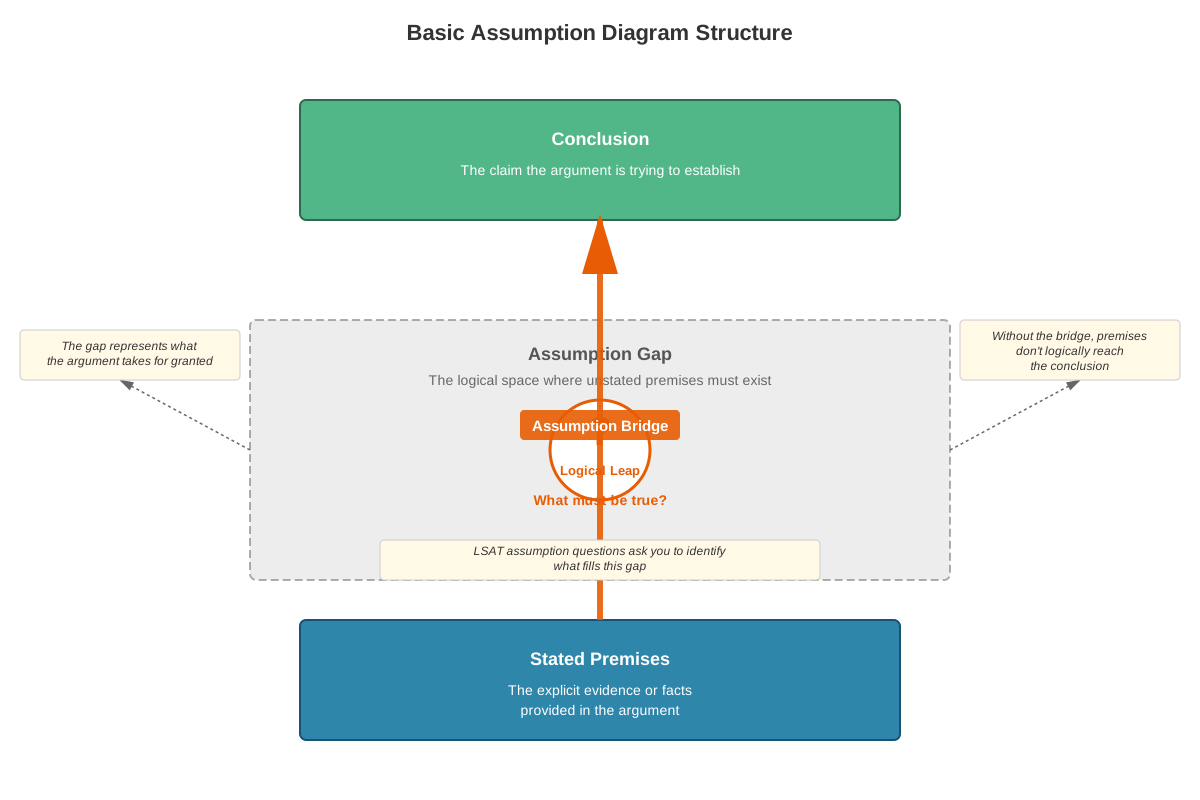
Every LSAT argument that requires assumption analysis contains three essential components: premises (stated evidence), a conclusion (the claim being argued for), and assumptions (unstated premises that must be true for the conclusion to follow from the stated premises). The relationship can be expressed as:
Premises + Assumptions → Conclusion
Assumption diagramming makes this relationship visual by creating a map that shows what is stated and what logical connections are missing. The core insight is that arguments rarely state everything necessary for their conclusions to be valid; they rely on the audience accepting certain unstated propositions. The LSAT tests whether students can identify these hidden dependencies.
Creating Basic Assumption Diagrams
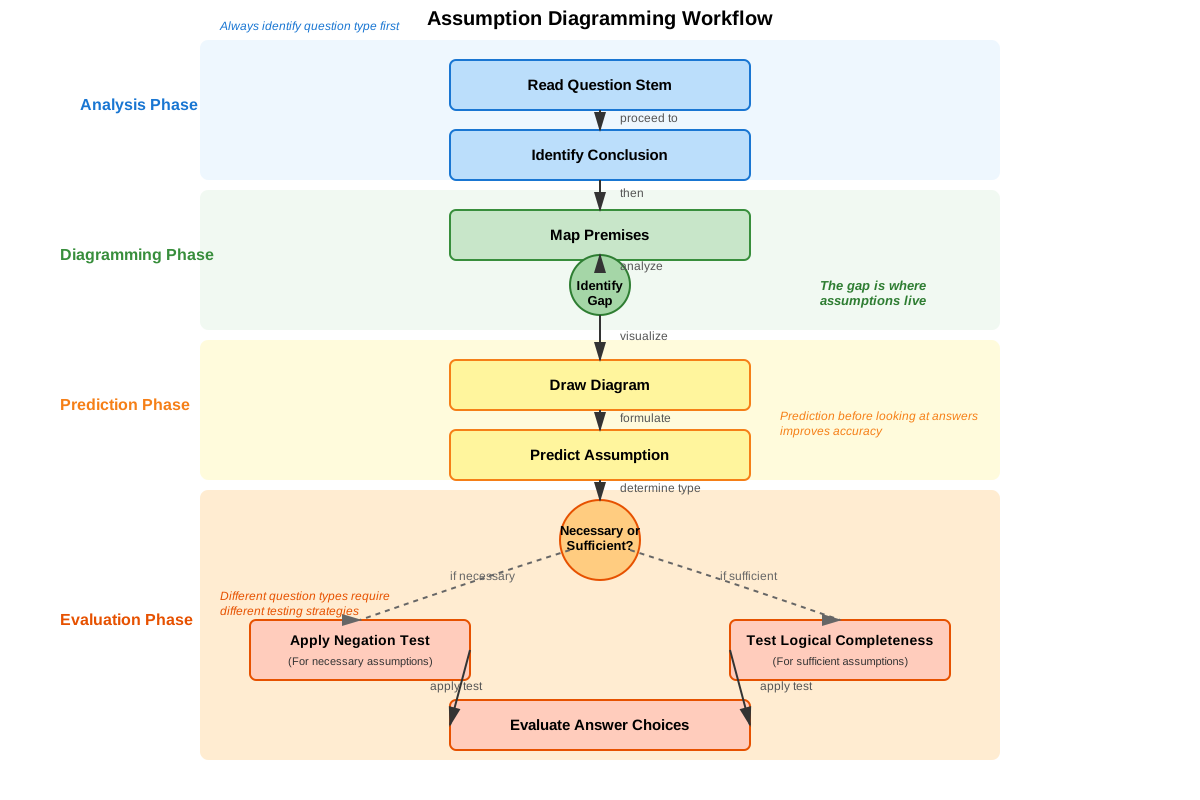
The process of assumption diagramming follows a systematic five-step approach:
- Identify the conclusion: Locate the main claim the argument is trying to establish
- Identify the premises: Find all stated evidence supporting the conclusion
- Map the logical structure: Draw arrows showing how premises are supposed to lead to the conclusion
- Identify gaps: Look for logical leaps where the connection isn't fully supported
- Articulate the assumption: State what must be true to bridge each gap
For example, consider this argument:
"All the employees who received bonuses this year had excellent performance reviews. Therefore, Sarah must have had an excellent performance review."
A basic diagram would show:
Premise: Sarah received a bonus
         ↓
         ? (GAP)
         ↓
Conclusion: Sarah had an excellent performance review
The gap reveals the assumption: Sarah is an employee (not a contractor or other category that might receive bonuses under different criteria). The diagram makes visible what the argument takes for granted.
Types of Assumptions in LSAT Arguments
LSAT arguments rely on several categories of assumptions, each requiring slightly different diagramming approaches:
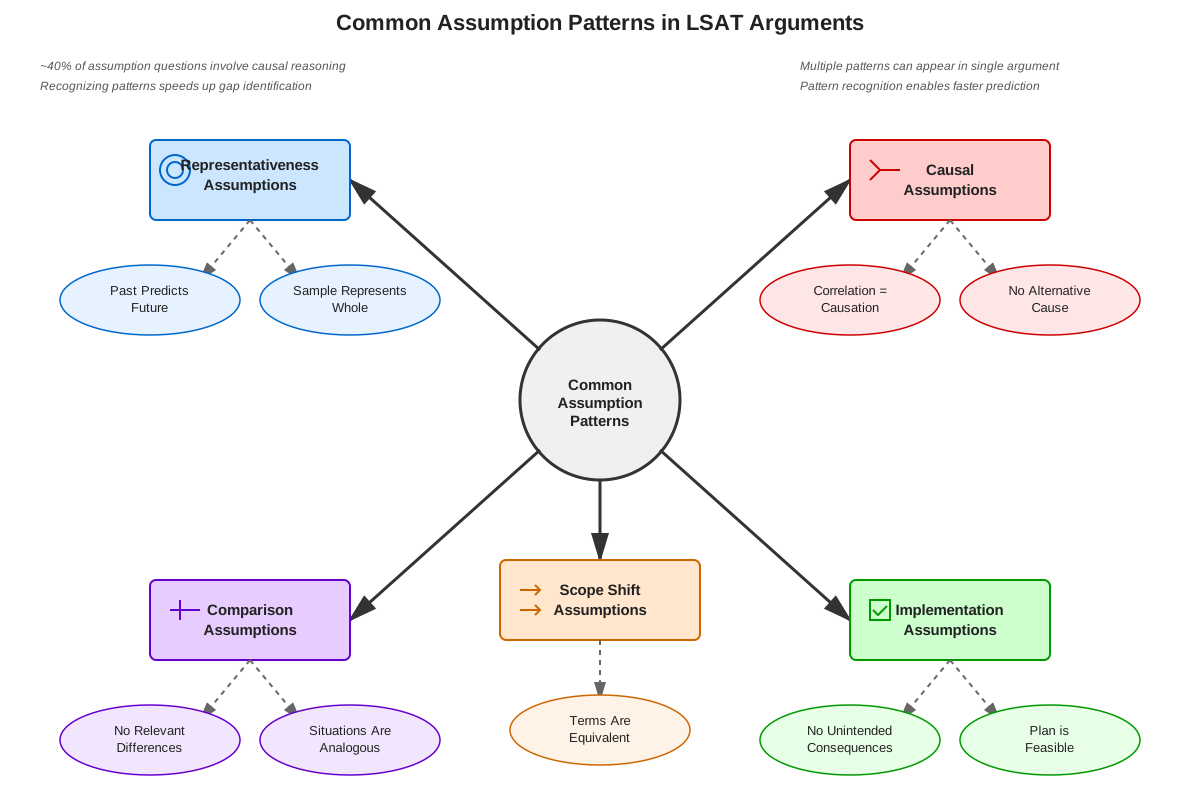
| Assumption Type | Description | Diagramming Focus |
|---|---|---|
| Logical Connection | Links premise terms to conclusion terms | Map term relationships and identify missing links |
| Causal | Assumes cause-effect relationship or rules out alternative causes | Diagram causal chain and show alternative paths not addressed |
| Representativeness | Assumes sample/example is typical or relevant | Show scope of premise vs. scope of conclusion |
| Feasibility | Assumes a plan or action is possible | Map preconditions and identify unstated requirements |
| Definitional | Assumes consistent meaning of terms | Track term usage and identify shifts |
Necessary vs. Sufficient Assumptions
A critical distinction in assumption diagramming involves understanding two types of assumptions:
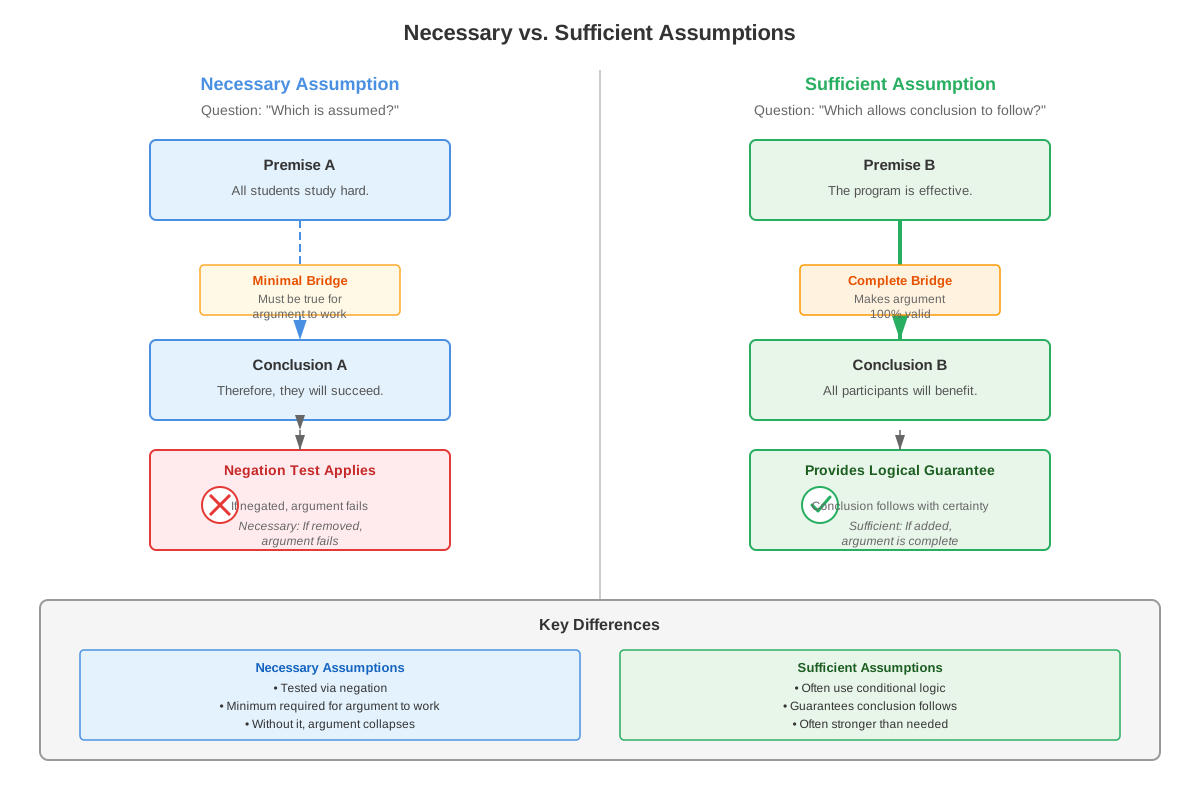
Necessary assumptions are conditions that must be true for the argument to work. Without them, the argument completely falls apart. These are the minimum requirements. In diagramming terms, necessary assumptions fill gaps that, if unfilled, would break the logical chain entirely.
Sufficient assumptions are conditions that, if true, would guarantee the conclusion follows from the premises. These often go beyond what's minimally required. In diagramming terms, sufficient assumptions create complete logical bridges that may be stronger than necessary.
For example, returning to the bonus argument:
- Necessary assumption: Sarah is in the category of people for whom the stated rule applies (she's an employee)
- Sufficient assumption: Everyone who received a bonus this year is an employee who had an excellent performance review (this guarantees the conclusion but states more than minimally required)
When diagramming, necessary assumptions appear as minimal bridges across gaps, while sufficient assumptions appear as complete logical pathways that may include additional elements.
Advanced Diagramming: Complex Arguments
More sophisticated LSAT arguments contain multiple premises, intermediate conclusions, or compound logical structures. Advanced assumption diagramming handles these by:
Layering: Creating multiple levels showing how sub-conclusions depend on premises before leading to the main conclusion
Branching: Showing multiple independent lines of reasoning that converge on a single conclusion
Conditional chains: Mapping sequences of if-then relationships where assumptions may hide in any link
For instance, a complex argument might diagram as:
Premise 1 + Premise 2 → Intermediate Conclusion 1
         ↓ (assumption A)
Premise 3 + Intermediate Conclusion 1 → Intermediate Conclusion 2
         ↓ (assumption B)
Intermediate Conclusion 2 → Final Conclusion
This reveals that the argument depends on multiple assumptions at different logical levels, and the LSAT might test any of them.
Scope Shifts and Assumption Identification
One of the most common sources of assumptions in LSAT arguments involves scope shifts—changes in the breadth, specificity, or category of terms between premises and conclusion. Diagramming makes these visible by explicitly noting the scope of each component:
Premise: Some X are Y [limited scope]
         ↓
         ? (scope expansion assumption needed)
         ↓
Conclusion: All X are Y [broader scope]
The diagram immediately reveals that the argument assumes something about the X's not mentioned in the premise. Recognizing scope shifts through diagramming is essential because the LSAT frequently tests whether students notice when conclusions claim more than premises support.
Concept Relationships
Assumption diagramming connects to and builds upon several foundational logical reasoning concepts. The technique directly applies argument structure identification by requiring students to parse premises and conclusions before mapping them. Without this prerequisite skill, creating accurate diagrams would be impossible.
The relationship flows as follows:
Argument Structure Identification → enables → Assumption Diagramming → reveals → Logical Gaps → which inform → Answer Choice Evaluation
Additionally, assumption diagramming connects bidirectionally with conditional logic. Understanding conditional statements enhances diagramming ability (allowing more precise mapping of if-then relationships), while practicing diagramming reinforces conditional logic skills (by repeatedly working with logical relationships).
Within the topic itself, concepts build hierarchically:
- Basic structure understanding (premises + assumptions → conclusion) forms the foundation
- Gap identification builds on structure understanding by locating missing links
- Assumption type recognition refines gap identification by categorizing what kind of assumption fills each gap
- Necessary vs. sufficient distinction adds precision to assumption identification
- Complex argument diagramming integrates all previous concepts to handle multi-layered reasoning
Assumption diagramming also connects forward to other question types. The same diagrams used for assumption questions can be adapted for:
- Strengthen questions: What fills the gap most effectively?
- Weaken questions: What attacks the assumption bridging the gap?
- Flaw questions: What type of gap does the argument fail to address?
This interconnectedness makes assumption diagramming a high-leverage skill with applications across the entire Logical Reasoning section.
High-Yield Facts
⭐ Assumption diagramming reveals unstated premises by visually mapping the logical structure from stated evidence to conclusion, making gaps explicit
⭐ Every LSAT argument with a gap between premises and conclusion relies on at least one assumption that test-takers must identify
⭐ Necessary assumptions are the minimum required for an argument to work; removing them causes the argument to fail completely
⭐ Sufficient assumptions guarantee the conclusion follows from premises but often include more than the minimum required
⭐ Scope shifts between premises and conclusions are the most common source of assumptions in LSAT arguments
- Logical connection assumptions link different terms or concepts that appear in premises versus conclusions
- Causal assumptions either assert a cause-effect relationship or rule out alternative explanations for observed phenomena
- Representativeness assumptions claim that a sample, example, or analogy is relevant and typical of the broader category
- Feasibility assumptions assert that proposed plans or actions are actually possible to implement
- The LSAT tests assumption identification in approximately 15-20% of all Logical Reasoning questions
- Diagramming complex arguments with multiple premises requires identifying both primary and intermediate conclusions
- Answer choices for assumption questions often include premises (already stated), irrelevant information, or statements that go beyond what's necessary
- The Negation Test for necessary assumptions: if negating an answer choice destroys the argument, it's a necessary assumption
- Sufficient assumption questions often require formal logic skills to construct complete conditional chains
- Assumption questions appear more frequently in the first Logical Reasoning section than the second on most LSAT administrations
Quick check — test yourself on Assumption diagramming so far.
Try Flashcards →Common Misconceptions
Misconception: Assumptions are the same as premises
Correction: Premises are explicitly stated in the argument, while assumptions are unstated propositions that the argument depends on. Diagramming helps distinguish between what's given (premises) and what's taken for granted (assumptions).
Misconception: Every argument has only one assumption
Correction: Most LSAT arguments rely on multiple assumptions at different logical levels. Complex arguments may have assumptions connecting premises to intermediate conclusions and separate assumptions connecting intermediate conclusions to the final conclusion. Comprehensive diagramming reveals all assumption points.
Misconception: The correct answer to an assumption question must be something that proves the conclusion
Correction: Necessary assumptions don't prove conclusions; they merely prevent the argument from failing. A necessary assumption is the minimum required, not a guarantee. Sufficient assumptions prove conclusions, but necessary assumption questions (more common on the LSAT) only require identifying what must be true, not what would be conclusive.
Misconception: Assumption diagramming only works for formal logic arguments
Correction: While diagramming is particularly powerful for conditional logic arguments, it applies equally well to causal arguments, analogical reasoning, statistical arguments, and plan/proposal arguments. The diagram format adapts to the argument type, always serving to make logical structure visible.
Misconception: If an answer choice is true, it must be the assumption
Correction: Many true statements are irrelevant to an argument. An assumption must be both true (or assumed true) AND necessary for the specific logical connection between the argument's premises and conclusion. Diagramming helps test relevance by showing whether a statement bridges an identified gap.
Misconception: Longer, more complex answer choices are more likely to be correct assumptions
Correction: The LSAT often includes complex, sophisticated-sounding wrong answers to trap test-takers. The correct assumption is frequently simple and direct—it's just the missing link the diagram reveals. Complexity doesn't correlate with correctness.
Misconception: Assumption diagramming takes too much time to be practical during the test
Correction: With practice, basic diagramming becomes nearly automatic and takes 10-15 seconds. Even for complex arguments, a quick visual map (which can be mental rather than written) significantly improves accuracy, making it time-efficient overall by reducing the need to re-read or reconsider answer choices.
Worked Examples
Example 1: Basic Necessary Assumption
Argument: "The new traffic light at the intersection has reduced accidents by 40% compared to last year. Therefore, installing traffic lights at other dangerous intersections will reduce accidents at those locations as well."
Step 1 - Identify the conclusion: Installing traffic lights at other dangerous intersections will reduce accidents at those locations
Step 2 - Identify the premises: The new traffic light at one intersection reduced accidents by 40%
Step 3 - Create the diagram:
Premise: Traffic light at Intersection A → 40% accident reduction
         ↓
         ? (GAP: What makes this generalizable?)
         ↓
Conclusion: Traffic lights at other intersections → accident reduction
Step 4 - Identify the gap: The argument moves from one specific case to a general principle about other intersections. This requires assuming the first intersection is representative.
Step 5 - Articulate the assumption: The intersection where the traffic light was installed is similar in relevant ways to other dangerous intersections, OR the factors that made the traffic light effective at the first intersection are present at other dangerous intersections.
Testing with answer choices:
- (A) "Traffic lights are the most cost-effective safety measure" - Irrelevant; the argument isn't about cost
- (B) "The intersection where the light was installed was previously dangerous" - Already implied; doesn't bridge the gap
- (C) "The conditions that made the traffic light effective at the first intersection exist at other dangerous intersections" - CORRECT; bridges the representativeness gap
- (D) "Accidents at the first intersection will continue to decline" - Irrelevant; about future of first intersection, not others
- (E) "No other factors contributed to the accident reduction" - Too strong; the argument allows other factors as long as the light contributed
Connection to learning objectives: This example demonstrates how assumption diagramming reveals scope shifts (one intersection → other intersections) and helps eliminate wrong answers by testing whether they bridge the identified gap.
Example 2: Sufficient Assumption with Conditional Logic
Argument: "Every member of the committee voted for the proposal. Therefore, the proposal must have been unanimous."
Step 1 - Identify conclusion: The proposal vote was unanimous
Step 2 - Identify premises: Every committee member voted for the proposal
Step 3 - Create the diagram:
Premise: All committee members → voted FOR
         ↓
         ? (GAP: What about non-members?)
         ↓
Conclusion: Vote was unanimous (everyone who voted → voted FOR)
Step 4 - Identify the gap: "Unanimous" means everyone who voted agreed. The premise tells us about committee members, but what if non-members could also vote?
Step 5 - Articulate the assumption: Only committee members voted on the proposal (no non-members participated in the vote).
Formal logic representation:
Given: Committee member → Voted FOR
Need: Voted → Voted FOR (for unanimity)
Gap: Voted → Committee member (only committee members voted)
Testing with answer choices:
- (A) "The committee has at least five members" - Irrelevant to unanimity
- (B) "No one abstained from voting" - Doesn't address whether non-members voted
- (C) "Only committee members were allowed to vote on the proposal" - CORRECT; ensures everyone who voted was a committee member, and we know all committee members voted FOR
- (D) "The proposal required unanimous approval" - Reverses the logic; we're concluding it was unanimous, not that it needed to be
- (E) "All committee members attended the meeting" - Doesn't address whether non-members could vote
Advanced insight: This is a sufficient assumption question. The correct answer creates a complete logical chain: Only committee members voted + All committee members voted FOR → Everyone who voted voted FOR (unanimous). Notice how the diagram reveals that we need to close the loop between "committee members" and "everyone who voted."
Connection to learning objectives: This example shows how assumption diagramming handles conditional logic, distinguishes between necessary and sufficient assumptions, and reveals definitional issues (what "unanimous" requires).
Exam Strategy
When approaching assumption questions on the LSAT, implement this systematic process:
Recognition triggers: Watch for question stems containing:
- "Which one of the following is an assumption required by the argument?"
- "The argument depends on assuming which one of the following?"
- "Which one of the following, if assumed, allows the conclusion to be properly drawn?"
- "The argument presupposes which one of the following?"
The first two phrasings indicate necessary assumption questions; the third typically indicates a sufficient assumption question. This distinction matters because necessary assumptions need only be minimally true, while sufficient assumptions must guarantee the conclusion.
Time-efficient diagramming approach:
- Read the argument once for comprehension (15-20 seconds)
- Identify conclusion and underline it (5 seconds)
- Identify premises and bracket them (5 seconds)
- Create a mental or quick written diagram showing the logical flow (10-15 seconds)
- Identify the most obvious gap (5 seconds)
- Predict what would fill the gap before looking at answers (10 seconds)
- Evaluate answer choices against your prediction (20-30 seconds)
Total time: 70-90 seconds for most assumption questions
Process of elimination strategies specific to assumption questions:
Eliminate answer choices that:
- Restate premises: If it's already said in the argument, it's not an assumption
- Address irrelevant scope: If your diagram shows a gap between X and Y, answers about Z are wrong
- Reverse causation or logic: Watch for answers that flip the direction of the relationship
- Go too far: For necessary assumptions, eliminate anything stronger than required
- Are too weak: For sufficient assumptions, eliminate anything that doesn't guarantee the conclusion
The Negation Test for necessary assumptions: If you're stuck between two answers, negate each one (assume it's false) and see which negation destroys the argument. The one that ruins the argument when negated is the necessary assumption. This test is particularly valuable when your diagram reveals multiple potential gaps.
Pattern recognition: After diagramming 50+ assumption questions, you'll notice recurring patterns:
- Causal arguments almost always assume no alternative causes
- Statistical arguments almost always assume representativeness
- Plan arguments almost always assume feasibility
- Comparative arguments almost always assume relevant similarity
Recognizing these patterns allows faster gap identification and prediction.
Memory Techniques
The GAPS acronym for types of assumptions commonly tested:
- Generalization (sample to population)
- Alternative causes (ruling them out)
- Plan feasibility (can it actually work?)
- Scope shift (terms changing meaning or breadth)
The "Bridge Builder" visualization: Picture the argument as two cliffs—the premise cliff and the conclusion cliff. The assumption is the bridge connecting them. If the bridge is missing or weak, the argument fails. This mental image helps remember that assumptions connect what's stated to what's concluded.
The Three-Question Method for quick assumption identification:
- "What does the conclusion claim?" (identify the destination)
- "What does the premise establish?" (identify the starting point)
- "What's missing between them?" (identify the gap)
This sequence becomes automatic with practice and ensures systematic gap identification.
The "Must Be True" mantra: For necessary assumptions, repeat: "This MUST be true, or the argument fails." This helps distinguish necessary assumptions from merely helpful or related statements.
Conditional chain visualization: For arguments with conditional logic, visualize a chain where each link is an if-then statement. Assumptions are missing links. If you can't trace a complete chain from premise to conclusion, you've found where the assumption hides.
Summary
Assumption diagramming is a systematic technique for visualizing the logical structure of LSAT arguments, making explicit the unstated premises that arguments depend upon. By mapping premises, conclusions, and the connections between them, test-takers can identify gaps where assumptions hide. The technique applies to all assumption question types, including both necessary assumptions (minimum requirements for arguments to work) and sufficient assumptions (conditions that guarantee conclusions follow). Effective assumption diagramming requires identifying argument components, creating visual or mental maps of logical flow, recognizing common assumption patterns (causal, representativeness, feasibility, scope shifts), and testing answer choices against identified gaps. This skill is high-yield because assumption questions constitute 15-20% of Logical Reasoning questions and because the same analytical approach applies to strengthen, weaken, and flaw questions. Mastery requires understanding that assumptions bridge the distance between what's stated and what's concluded, and that the LSAT tests whether students can identify these unstated but essential logical connections.
Key Takeaways
- Assumption diagramming transforms abstract logical reasoning into concrete visual analysis by mapping premises, conclusions, and the gaps between them
- Every LSAT argument with a logical gap depends on assumptions—unstated premises necessary for the conclusion to follow from the evidence
- The fundamental pattern is: Premises + Assumptions → Conclusion; diagramming makes the assumptions visible
- Necessary assumptions are minimum requirements (argument fails without them); sufficient assumptions guarantee conclusions (but may include more than necessary)
- Common assumption types include logical connections, causal relationships, representativeness claims, feasibility assertions, and scope consistency
- Effective exam strategy involves identifying the conclusion first, mapping the logical structure, predicting the gap before reading answer choices, and using the negation test when uncertain
- Assumption diagramming skills transfer to multiple question types, making it one of the highest-leverage techniques for LSAT Logical Reasoning success
Related Topics
Strengthen and Weaken Questions: Once you can identify assumptions through diagramming, strengthen questions ask what evidence would support those assumptions, while weaken questions ask what would undermine them. Mastering assumption diagramming makes these question types significantly easier.
Flaw Questions: These questions ask test-takers to identify reasoning errors, which are often unwarranted assumptions. The same diagramming technique reveals flaws by showing where arguments make unjustified logical leaps.
Conditional Logic and Formal Logic: Advanced assumption questions often involve complex conditional chains. Deepening formal logic skills enhances diagramming precision and speed, particularly for sufficient assumption questions.
Argument Evaluation Questions: These ask what additional information would help assess an argument's strength. Assumption diagrams reveal exactly what information matters—whatever would confirm or disconfirm the identified assumptions.
Parallel Reasoning: Understanding argument structure through diagramming helps identify arguments with similar logical patterns, a key skill for parallel reasoning questions.
Practice CTA
Now that you understand the systematic approach to assumption diagramming, it's time to apply these techniques to actual LSAT questions. The practice questions and flashcards will reinforce your ability to quickly identify argument structure, spot logical gaps, and select correct answers with confidence. Remember: assumption diagramming is a skill that improves dramatically with deliberate practice. Each question you diagram strengthens your pattern recognition and speeds up your analysis. Start with the practice materials, focusing on creating clear diagrams before evaluating answer choices. Your investment in mastering this technique will pay dividends across the entire Logical Reasoning section. You've got this!
Sign up free to keep reading
Create a free AnvayaPrep account to finish this LSAT guide on Assumption diagramming — plus flashcards and practice questions.