Overview
Assumption in analogy represents one of the most sophisticated and frequently tested patterns within LSAT Logical Reasoning sections. This question type challenges test-takers to identify unstated premises that must be true for an analogical argument to hold valid. When an LSAT argument draws a comparison between two situations, claiming that because they share certain characteristics, they likely share additional characteristics, the argument rests on critical assumptions about the relevance and sufficiency of the similarities cited.
Understanding LSAT assumption in analogy questions is essential because they appear regularly throughout both Logical Reasoning sections, often in medium-to-difficult questions that separate high scorers from average performers. These questions test not merely reading comprehension but the ability to analyze argument structure, identify logical gaps, and recognize what must be true for reasoning by comparison to succeed. Mastery of this topic directly impacts performance on assumption questions broadly, as analogical reasoning represents a distinct pattern requiring specific analytical skills.
Within the broader landscape of Logical Reasoning, assumption in analogy connects intimately with other core concepts including sufficient assumptions, necessary assumptions, strengthen/weaken questions, and flaw identification. Arguments by analogy inherently contain logical vulnerabilities—the compared situations might differ in relevant ways, or the cited similarities might be insufficient to support the conclusion. Recognizing these gaps and the assumptions that bridge them forms a critical skill that transfers across multiple question types and strengthens overall logical analysis capabilities.
Learning Objectives
- [ ] Identify how Assumption in analogy appears in LSAT questions
- [ ] Explain the reasoning pattern behind Assumption in analogy
- [ ] Apply Assumption in analogy to solve LSAT-style problems accurately
- [ ] Distinguish between relevant and irrelevant differences in analogical arguments
- [ ] Evaluate the strength of analogical reasoning based on the scope and nature of similarities
- [ ] Predict common wrong answer patterns in assumption in analogy questions
- [ ] Construct the logical bridge between compared situations in analogical arguments
Prerequisites
- Basic argument structure identification: Understanding premises, conclusions, and how they connect is essential for recognizing where assumptions operate within analogical reasoning.
- Necessary vs. sufficient assumptions: Distinguishing these assumption types helps identify what the argument requires versus what would guarantee its validity.
- Conditional reasoning fundamentals: Many analogical arguments contain implicit conditional relationships that assumptions must support.
- Strengthen and weaken question mechanics: These question types share structural similarities with assumption questions, as assumptions strengthen arguments when added.
Why This Topic Matters
Analogical reasoning pervades legal thinking, making it a natural focus for the LSAT. Attorneys regularly argue that precedent cases should apply to current situations based on relevant similarities, making the ability to analyze assumptions in analogies directly relevant to legal practice. Beyond professional application, this reasoning pattern appears throughout policy debates, scientific reasoning, and everyday decision-making where past experiences inform future choices.
On the LSAT itself, assumption in analogy questions appear with remarkable consistency. Approximately 15-20% of assumption questions involve analogical reasoning, translating to roughly 2-4 questions per test. These questions typically carry medium-to-difficult ratings, appearing more frequently in the latter portions of Logical Reasoning sections where question difficulty increases. The LSAT tests this pattern because it requires sophisticated analysis—test-takers must simultaneously track multiple situations, identify relevant comparison points, and recognize unstated premises about similarity.
Common manifestations include arguments comparing business strategies across companies, policy implementations across jurisdictions, scientific studies across species or populations, historical situations across time periods, and legal precedents across cases. The test writers favor scenarios where surface-level similarities exist but deeper differences might undermine the analogy, creating opportunities for nuanced assumption identification.
Core Concepts
The Structure of Analogical Arguments
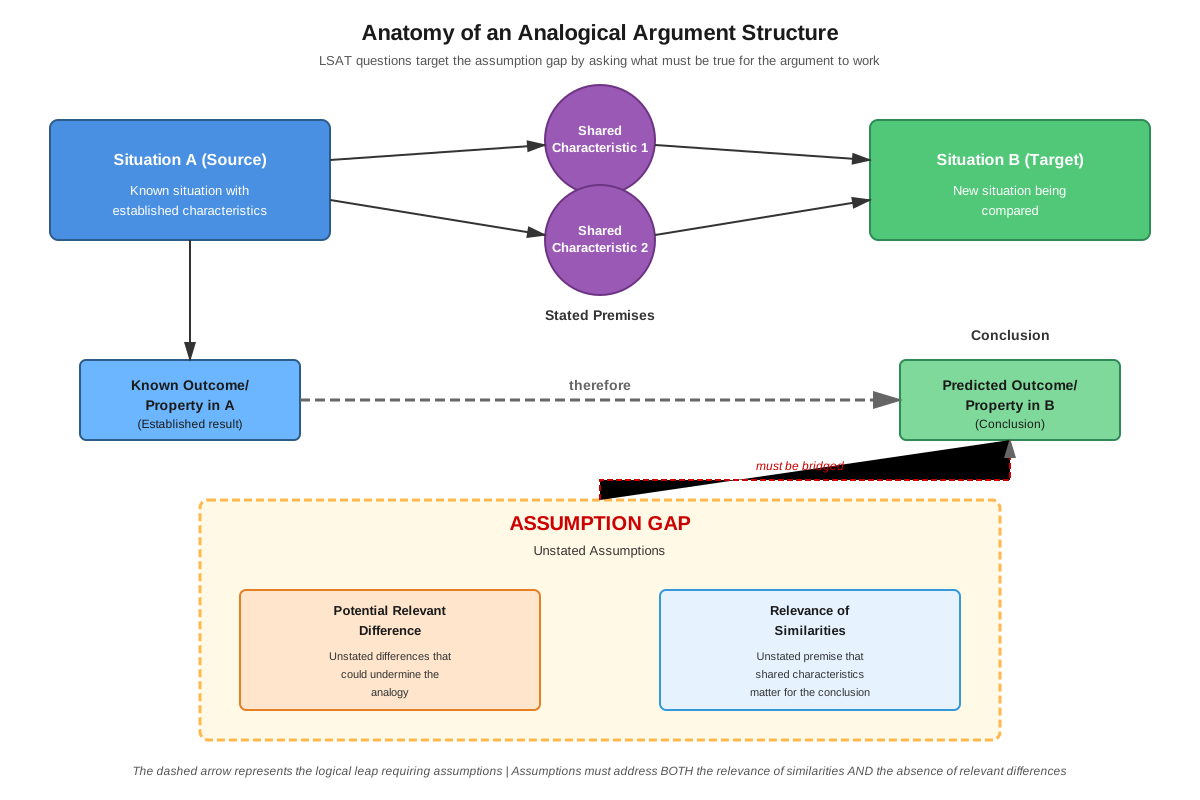
An analogical argument follows a predictable pattern: Situation A has characteristics X, Y, and Z, and also has outcome or characteristic Q. Situation B has characteristics X, Y, and Z. Therefore, Situation B will also have outcome or characteristic Q. The argument's validity depends entirely on whether the shared characteristics (X, Y, Z) are actually relevant to the outcome (Q) and whether any unmentioned differences between A and B might prevent B from having Q.
The assumption in analogy fills the logical gap between the stated similarities and the conclusion. It addresses two critical questions: (1) Are the cited similarities actually relevant to the predicted outcome? (2) Are there no relevant differences between the situations that would prevent the analogy from holding? Every analogical argument on the LSAT contains at least one unstated premise addressing these questions.
Types of Assumptions in Analogical Arguments
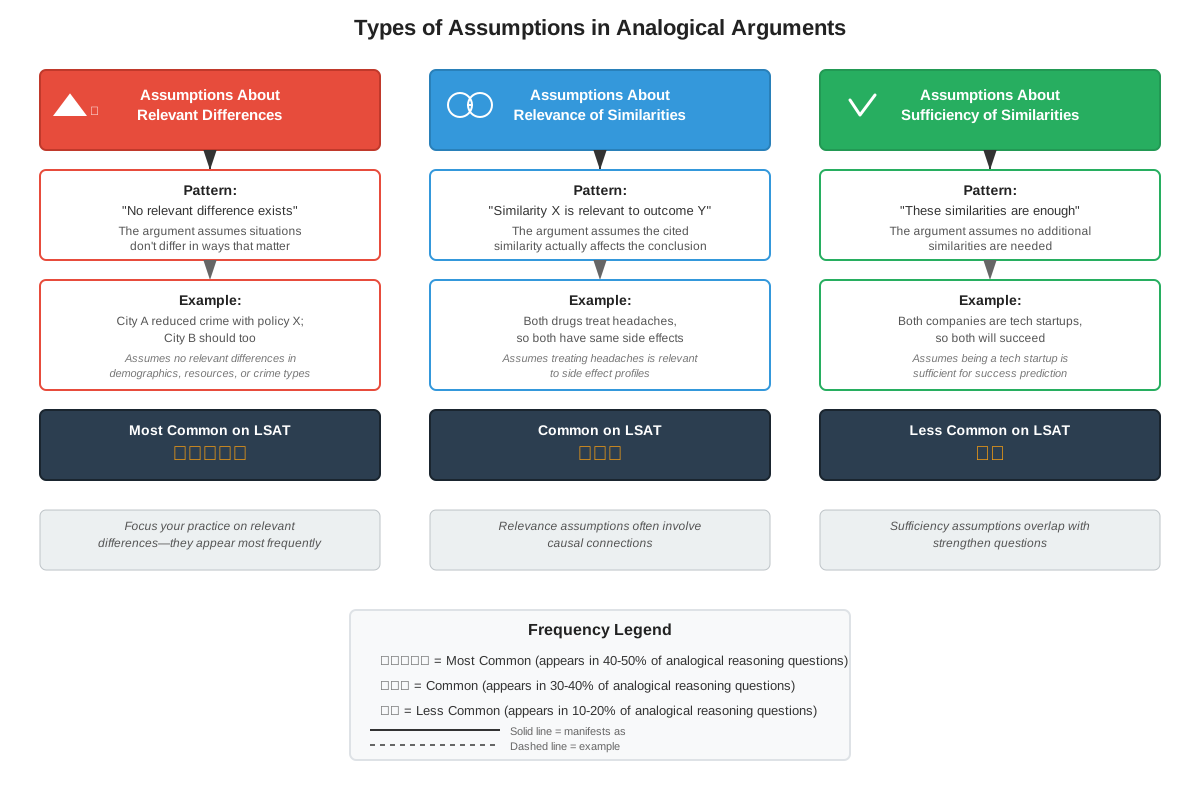
Relevance assumptions assert that the similarities cited actually matter for the conclusion drawn. If an argument claims two companies will achieve similar success because both have charismatic CEOs and aggressive marketing, the assumption is that charismatic leadership and aggressive marketing are actually relevant factors in determining business success. Without this assumption, the analogy collapses—the shared characteristics might be coincidental rather than causally connected to the outcome.
No-relevant-difference assumptions assert that the situations don't differ in ways that would undermine the analogy. Even if the cited similarities are relevant, unstated differences might prevent the conclusion from following. If Company A succeeded in a growing market while Company B operates in a declining market, this difference might overwhelm the cited similarities. The argument assumes no such defeating differences exist.
Sufficiency assumptions claim that the cited similarities are enough to support the conclusion. An argument might correctly identify relevant similarities but fail if those similarities are insufficient without additional factors. If Company A's success required both charismatic leadership AND proprietary technology, but Company B only has the charismatic leadership, the analogy fails. The assumption is that the cited factors are sufficient.
Identifying Assumption Gaps in Analogies
The systematic approach to finding assumption gaps involves three steps:
- Map the analogy structure: Identify Situation A (the source), Situation B (the target), the cited similarities, and the predicted outcome for B based on A's outcome.
- Question the connection: Ask whether the cited similarities actually relate to the outcome. Consider alternative explanations for A's outcome that don't depend on the cited similarities.
- Search for relevant differences: Brainstorm ways A and B might differ that could affect the outcome. The most important differences are those that interact with the causal mechanism producing the outcome.
| Analogy Component | Analytical Question | Assumption Type Revealed |
|---|---|---|
| Cited similarities | Do these actually matter for the outcome? | Relevance assumption |
| Unstated differences | Could these prevent the predicted outcome? | No-relevant-difference assumption |
| Scope of comparison | Are the similarities sufficient? | Sufficiency assumption |
| Causal mechanism | Does the same process operate in both situations? | Mechanism assumption |
Common Patterns in LSAT Analogy Questions
Historical/temporal analogies compare past and present situations, assuming conditions haven't changed in relevant ways. An argument might claim a policy that succeeded in the 1950s will succeed today, assuming economic conditions, social attitudes, or technological contexts haven't changed in ways that matter.
Cross-domain analogies compare situations from different fields or contexts, assuming principles transfer across domains. An argument might claim a management technique that works in manufacturing will work in healthcare, assuming the relevant organizational dynamics are similar despite different industries.
Scale analogies compare situations of different sizes or scopes, assuming relationships hold across scales. An argument might claim a program successful in a small pilot will succeed when implemented nationally, assuming no relevant complications arise from scaling up.
Species/population analogies compare different groups, assuming relevant biological or social similarities. An argument might claim a drug effective in mice will work in humans, assuming the relevant physiological mechanisms are similar enough.
Concept Relationships
The core concepts within assumption in analogy form an interconnected analytical framework. The structure of analogical arguments provides the foundation, establishing the pattern that all other concepts analyze. From this structure emerge the three primary types of assumptions—relevance, no-relevant-difference, and sufficiency—each addressing a distinct logical gap. These assumption types guide the identification process, which systematically questions each component of the analogy. Finally, recognizing common patterns allows rapid categorization of specific LSAT questions into familiar templates.
This topic connects to prerequisite knowledge through multiple pathways: Basic argument structure → Analogical argument structure (applying general principles to a specific pattern); Necessary assumptions → Assumption types in analogy (recognizing what must be true for the argument to work); Strengthen/weaken mechanics → Identifying assumption gaps (understanding what would make the argument better or worse reveals what it assumes).
The relationship map flows: Analogical Argument Structure → Assumption Gap Identification → Assumption Type Classification → Answer Choice Evaluation → Correct Answer Selection. Each stage depends on the previous, creating a systematic approach that transforms complex reasoning into manageable steps.
High-Yield Facts
⭐ Every analogical argument assumes the cited similarities are relevant to the predicted outcome—if the similarities don't actually matter, the analogy fails regardless of how many similarities exist.
⭐ The correct answer to an assumption question must be necessary for the argument—negating the correct answer should damage or destroy the argument's reasoning.
⭐ Analogical arguments are vulnerable to relevant differences between compared situations—even one critical difference can undermine an otherwise strong analogy.
⭐ The LSAT frequently includes wrong answers that strengthen the argument but aren't necessary—these sufficient but not necessary assumptions are tempting distractors.
⭐ Assumptions in analogy often address unstated factors rather than stated similarities—the argument explicitly mentions some similarities but assumes other factors don't differ in relevant ways.
- Analogical arguments never explicitly state all their assumptions—identifying unstated premises is the core skill tested.
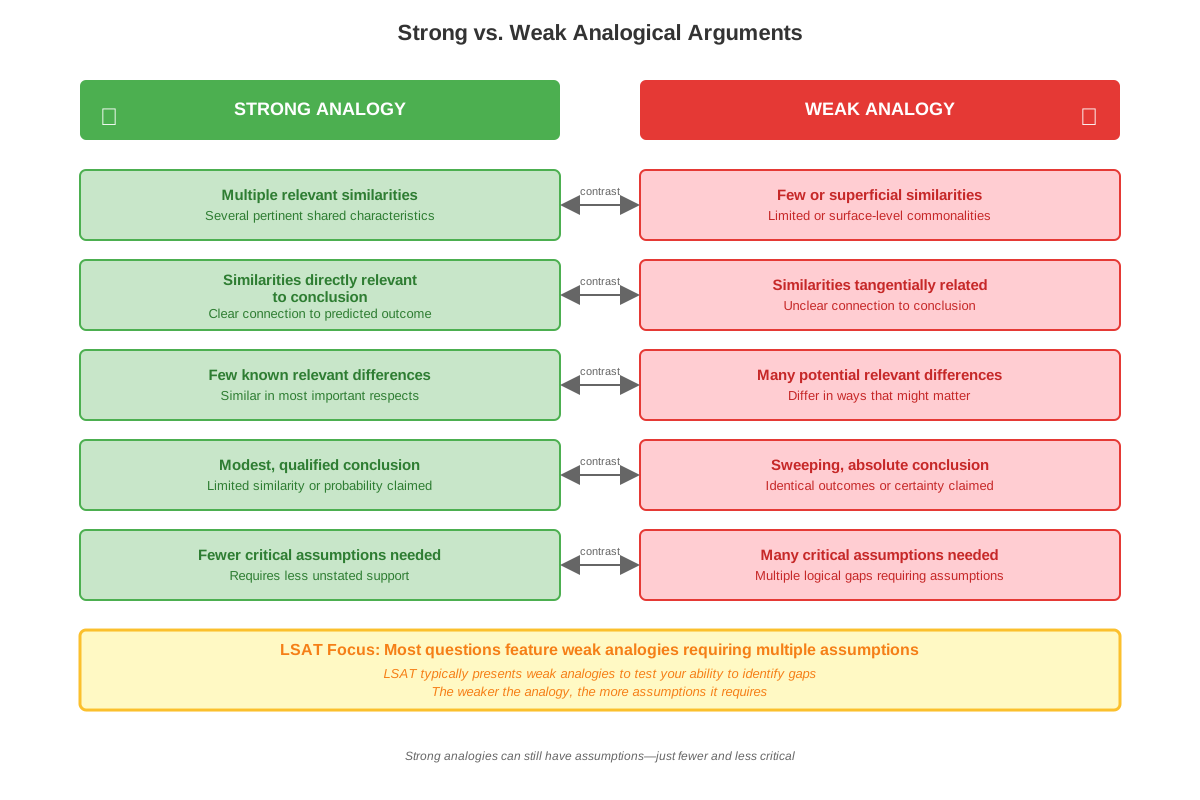
- The strength of an analogy depends on both the number and relevance of similarities—many irrelevant similarities provide less support than few relevant ones.
- Temporal analogies particularly assume conditions haven't changed between time periods in ways that matter to the outcome.
- Cross-domain analogies assume the underlying mechanisms or principles operate similarly across different contexts.
- The correct assumption often addresses the most obvious potential objection to the analogy—what would a skeptic immediately question?
Quick check — test yourself on Assumption in analogy so far.
Try Flashcards →Common Misconceptions
Misconception: Any similarity between two situations strengthens an analogical argument. → Correction: Only relevant similarities strengthen analogies. Two companies might both have red logos, but this similarity is irrelevant to predicting business success. The LSAT tests whether students can distinguish relevant from irrelevant similarities.
Misconception: The correct assumption must make the argument's conclusion certain. → Correction: Assumptions in analogy questions are necessary assumptions, not sufficient ones. The correct answer must be required for the argument to work, but it doesn't need to guarantee the conclusion. The argument can still have weaknesses even with the assumption in place.
Misconception: If the argument mentions a similarity, that similarity doesn't need to be assumed. → Correction: Even stated similarities require assumptions about their relevance. An argument might state that two situations share characteristic X, but it still assumes X is relevant to the predicted outcome—this relevance assumption remains unstated.
Misconception: The correct answer will introduce new information not mentioned in the argument. → Correction: While assumptions are unstated, they connect directly to the argument's existing elements. The correct answer bridges the gap between stated premises and conclusion rather than introducing entirely new concepts. It makes explicit what the argument implicitly requires.
Misconception: Longer, more complex answer choices are more likely to be correct. → Correction: The LSAT often makes wrong answers verbose and complicated while keeping correct answers relatively simple and direct. Complexity doesn't indicate correctness—logical necessity does.
Misconception: If an answer choice would strengthen the argument, it must be an assumption. → Correction: Many things would strengthen an argument without being necessary for it. The correct assumption must be required—the argument fails without it. Use the negation test: if negating the answer choice doesn't damage the argument, it's not a necessary assumption.
Worked Examples
Example 1: Business Strategy Analogy
Argument: "TechCorp increased its market share by 15% after implementing a four-day workweek for all employees. RetailCo should implement a four-day workweek, as this will likely increase RetailCo's market share as well."
Question: Which of the following is an assumption required by the argument?
Analysis Process:
- Map the structure: Situation A (TechCorp) has characteristic X (four-day workweek) and outcome Q (15% market share increase). Situation B (RetailCo) will implement X, so it should achieve Q.
- Identify the gap: The argument assumes the four-day workweek actually caused TechCorp's success (relevance) and that no relevant differences between TechCorp and RetailCo would prevent similar results (no-relevant-difference).
- Predict the assumption: The argument must assume factors like industry type, company size, or market conditions don't differ in ways that would prevent RetailCo from achieving similar results. It also assumes the four-day workweek was actually responsible for TechCorp's gains rather than other factors.
Correct Answer: "The factors responsible for TechCorp's market share increase would operate similarly in RetailCo's business context."
Why this is correct: This assumption is necessary because if the factors that drove TechCorp's success wouldn't work in RetailCo's context (perhaps due to industry differences, customer expectations, or operational requirements), the analogy fails. Negating this—"The factors responsible for TechCorp's success would NOT operate similarly in RetailCo's context"—destroys the argument.
Wrong Answer Analysis:
- "RetailCo's employees would prefer a four-day workweek" → This would strengthen the argument but isn't necessary. The market share increase might occur regardless of employee preference.
- "TechCorp is larger than RetailCo" → This states a potential difference but doesn't establish whether that difference is relevant to the outcome.
- "Four-day workweeks always increase productivity" → This is too strong (sufficient rather than necessary) and goes beyond what the argument requires.
Example 2: Policy Implementation Analogy
Argument: "When Riverside implemented a congestion pricing system for downtown traffic, air quality improved by 20% within six months. Lakeside should implement a similar congestion pricing system, which will likely produce comparable air quality improvements."
Question: The argument depends on assuming which of the following?
Analysis Process:
- Map the structure: Riverside (A) implemented congestion pricing (X) and achieved 20% air quality improvement (Q). Lakeside (B) should implement X to achieve Q.
- Question the connection: Did congestion pricing actually cause the air quality improvement? Could other factors explain it? Are there relevant differences between Riverside and Lakeside?
- Search for defeating differences: Consider traffic patterns, geography, existing pollution sources, public transportation alternatives, population density, and climate—any of these could differ in ways that affect whether congestion pricing would work similarly.
Correct Answer: "Lakeside's air quality problems stem primarily from vehicle emissions rather than from other pollution sources."
Why this is correct: If Lakeside's air pollution comes mainly from industrial sources, power plants, or other non-traffic sources, reducing traffic through congestion pricing wouldn't produce similar air quality improvements. The argument assumes the pollution source is similar in both cities. Negating this assumption—"Lakeside's air quality problems do NOT stem primarily from vehicle emissions"—undermines the predicted outcome.
Connection to Learning Objectives: This example demonstrates how assumptions in analogy address unstated differences between compared situations. The argument explicitly mentions the congestion pricing policy and the outcome but assumes the underlying problem (pollution source) is similar in both cities.
Exam Strategy
Recognition Triggers
Watch for these linguistic markers that signal analogical reasoning:
- "Similarly," "likewise," "in the same way," "just as"
- "When X did Y, Z resulted, so..."
- Comparisons between two situations, time periods, or entities
- Arguments predicting outcomes based on past examples
- References to precedent, prior success, or historical parallels
Systematic Approach
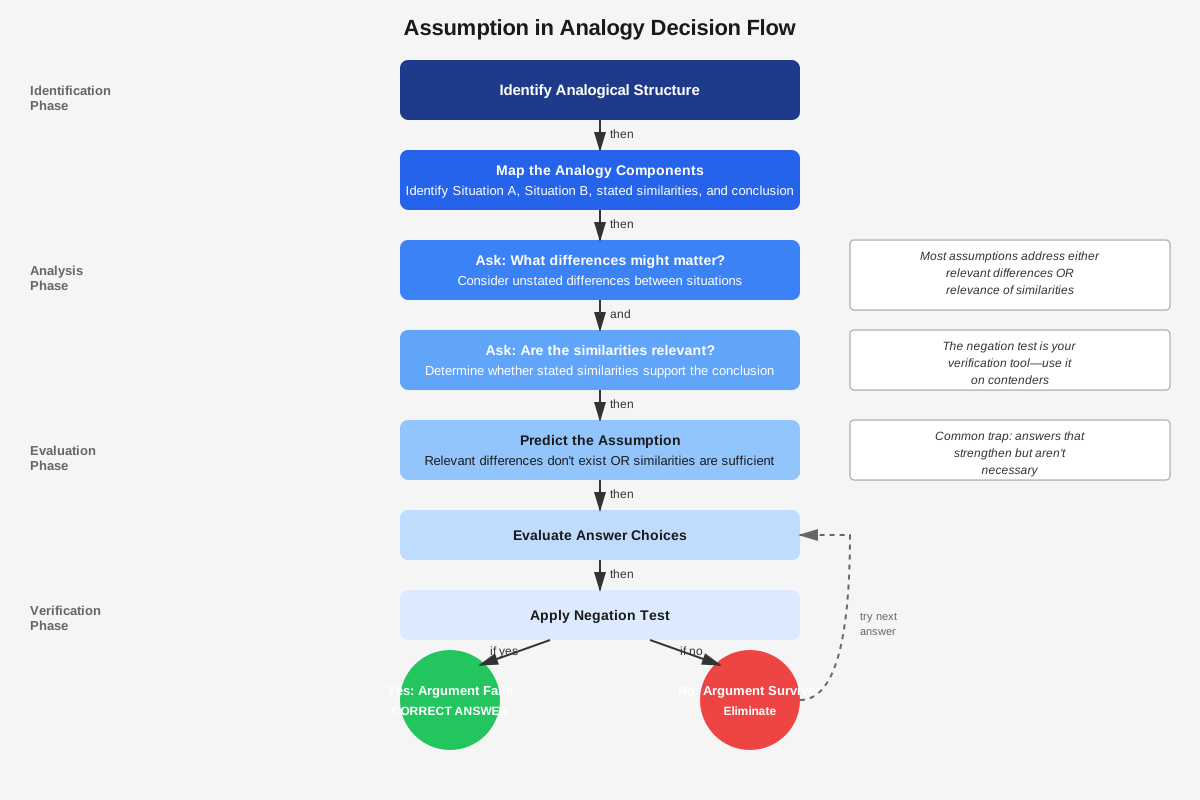
Step 1: Identify the analogy structure (15 seconds)
Quickly note: What's being compared? What similarities are cited? What outcome is predicted?
Step 2: Find the logical gap (15 seconds)
Ask: Why might this analogy fail? What could be different? Are the cited similarities actually relevant?
Step 3: Predict the assumption (10 seconds)
Before looking at answers, articulate what the argument must assume. This prediction prevents wrong answer contamination.
Step 4: Evaluate answer choices (30 seconds)
Use the negation test on promising answers: If you negate this choice, does the argument fall apart? If yes, you've found the necessary assumption.
Exam Tip: The negation test is your most powerful tool. The correct assumption, when negated, should make the argument's reasoning fail. Practice negating answer choices quickly and accurately.
Process of Elimination
Eliminate answers that:
- Introduce completely new concepts unrelated to the analogy's core elements
- Are sufficient but not necessary (would guarantee the conclusion but aren't required)
- Address irrelevant similarities or differences
- Are too extreme or absolute when the argument requires only moderate assumptions
- Reverse the logic or address the wrong direction of reasoning
Keep answers that:
- Address the relevance of cited similarities
- Rule out defeating differences between compared situations
- Connect the shared characteristics to the predicted outcome
- Pass the negation test (negating them damages the argument)
Time Allocation
For assumption in analogy questions, allocate approximately 1:20-1:30 (80-90 seconds):
- 15 seconds: Read and map the argument structure
- 15 seconds: Identify the assumption gap
- 10 seconds: Predict the assumption type
- 40-50 seconds: Evaluate answer choices using negation test
These questions merit slightly more time than average assumption questions due to their structural complexity, but don't exceed 90 seconds unless it's a particularly difficult question late in the section.
Memory Techniques
RADAR Acronym for analyzing analogies:
- Relevance: Are the cited similarities relevant to the outcome?
- Alternatives: Could alternative factors explain the outcome?
- Differences: What unstated differences might defeat the analogy?
- Assumption: What must be true for the reasoning to work?
- Required: Is this assumption necessary (use negation test)?
The Bridge Visualization: Picture the analogy as two islands (the compared situations) with a bridge between them (the cited similarities). The assumption is the hidden support structure beneath the bridge. If that support fails, the bridge collapses. This visualization helps remember that assumptions support the connection between situations.
The "What Could Go Wrong?" Question: For any analogy, immediately ask "What could go wrong with this comparison?" The answer typically reveals the assumption—the argument assumes that thing won't go wrong.
Similarity vs. Relevance Distinction: Remember "SIMILAR ≠ SIGNIFICANT." Two things can be similar in many ways, but only significant (relevant) similarities matter. This helps avoid wrong answers that cite true but irrelevant similarities.
Summary
Assumption in analogy questions test the ability to identify unstated premises that analogical arguments require to succeed. These arguments compare two situations, claiming that because they share certain characteristics, they will share additional characteristics or outcomes. The critical assumptions address whether cited similarities are relevant to the predicted outcome and whether unstated differences might prevent the analogy from holding. Success requires systematically mapping the analogy structure, identifying logical gaps, and applying the negation test to determine which assumptions are necessary rather than merely helpful. The LSAT favors scenarios where surface similarities exist but deeper analysis reveals potential weaknesses, rewarding test-takers who can distinguish relevant from irrelevant comparisons and recognize what must be true for reasoning by analogy to succeed. Mastery involves recognizing common patterns (historical, cross-domain, scale, and population analogies), understanding the three main assumption types (relevance, no-relevant-difference, and sufficiency), and efficiently applying a systematic approach within strict time constraints.
Key Takeaways
- Analogical arguments assume cited similarities are relevant to predicted outcomes—irrelevant similarities, no matter how numerous, don't support the conclusion.
- The negation test is essential for assumption questions—the correct answer, when negated, must damage or destroy the argument's reasoning.
- Assumptions address both what's similar and what's different—arguments assume cited similarities matter AND that unstated differences don't defeat the analogy.
- Necessary assumptions differ from sufficient ones—the correct answer must be required for the argument but doesn't need to guarantee the conclusion.
- Common wrong answers strengthen without being necessary—eliminate choices that would help the argument but aren't required for its basic reasoning.
- Systematic analysis beats intuition—map the structure, identify gaps, predict assumptions, then evaluate choices rather than jumping directly to answer choices.
- Time management matters—allocate 80-90 seconds per question, using the structured approach to maintain efficiency while ensuring accuracy.
Related Topics
Strengthen and Weaken Questions with Analogies: Understanding assumptions in analogy directly enables success on strengthen/weaken questions involving analogical reasoning, as strengthening an analogy often means confirming its assumptions while weakening means showing assumptions are false.
Flaw Questions—False Analogy: Recognizing assumptions in analogy prepares students to identify when arguments commit the false analogy flaw by comparing situations that differ in relevant ways or where cited similarities are irrelevant.
Parallel Reasoning Questions: These questions require identifying arguments with similar logical structures, building on the ability to analyze analogical patterns and recognize when reasoning patterns match.
Sufficient Assumption Questions: After mastering necessary assumptions in analogy, students can progress to sufficient assumptions, which guarantee rather than merely enable the argument's conclusion.
Practice CTA
Now that you understand the core principles of assumption in analogy, it's time to apply this knowledge to actual LSAT questions. The practice questions and flashcards will reinforce your ability to quickly identify analogical reasoning patterns, spot logical gaps, and select correct assumptions under timed conditions. Remember: understanding the theory is just the beginning—consistent practice with real LSAT questions transforms knowledge into the automatic pattern recognition and efficient analysis that produces top scores. Each practice question you work through strengthens your ability to see these patterns instantly on test day. Start practicing now to build the skills that will set you apart!
Sign up free to keep reading
Create a free AnvayaPrep account to finish this LSAT guide on Assumption in analogy — plus flashcards and practice questions.