Overview
Assumption in moral arguments represents a critical intersection of ethical reasoning and logical structure that appears frequently on the LSAT Logical Reasoning section. Moral arguments differ from purely factual or empirical arguments because they involve normative claims—statements about what should be done, what is right or wrong, or what obligations exist. These arguments require test-takers to identify unstated premises that bridge the gap between descriptive facts and prescriptive conclusions.
Understanding how assumptions function in moral contexts is essential for LSAT success because the exam regularly presents arguments that move from factual observations to ethical conclusions, or from one moral principle to another. The logical reasoning required to identify these assumptions demands recognition that moral arguments often rely on implicit value judgments, ethical principles, or normative frameworks that the arguer takes for granted. Without these unstated premises, the argument would fail to establish its conclusion.
This topic builds directly upon fundamental assumption questions skills while adding the complexity of normative reasoning. Mastering assumptions in moral arguments strengthens overall performance on Necessary Assumption, Sufficient Assumption, and Strengthen/Weaken questions, particularly when these questions involve ethical, policy, or prescriptive content. The ability to identify what moral principles an argument depends upon—even when unstated—is a high-yield skill that distinguishes top-scoring test-takers from average performers.
Learning Objectives
- [ ] Identify how Assumption in moral arguments appears in LSAT questions
- [ ] Explain the reasoning pattern behind Assumption in moral arguments
- [ ] Apply Assumption in moral arguments to solve LSAT-style problems accurately
- [ ] Distinguish between descriptive premises and normative conclusions in moral arguments
- [ ] Recognize common moral principles that serve as unstated assumptions
- [ ] Evaluate whether a proposed assumption is necessary or sufficient for a moral argument's validity
- [ ] Identify the "is-ought" gap in arguments that move from facts to moral conclusions
Prerequisites
- Basic understanding of assumption questions: Necessary for recognizing the general structure of arguments with missing premises and how assumptions connect evidence to conclusions
- Familiarity with necessary vs. sufficient assumptions: Essential for determining whether an assumption must be true for the argument to work (necessary) or would guarantee the conclusion (sufficient)
- Understanding of argument structure: Required to identify premises, conclusions, and logical gaps in reasoning
- Recognition of conditional reasoning: Helpful for understanding how moral principles often function as conditional statements (if X, then one ought to do Y)
Why This Topic Matters
Moral arguments appear in approximately 15-20% of Logical Reasoning questions on the LSAT, making them a high-frequency topic that directly impacts test scores. These questions appear across multiple question types, including Necessary Assumption, Sufficient Assumption, Strengthen, Weaken, Flaw, and Principle questions. The ability to identify unstated moral premises is particularly valuable because moral arguments often contain subtle logical gaps that less-prepared test-takers overlook.
In real-world applications, the skill of identifying assumptions in moral arguments is fundamental to legal reasoning, policy analysis, and ethical decision-making—all core competencies for law school and legal practice. Attorneys regularly construct and evaluate arguments about what should be done, what rights exist, or what obligations apply, making this a professionally relevant skill beyond test preparation.
On the LSAT, moral arguments typically appear in contexts involving: policy recommendations (what a government or organization should do), ethical obligations (what individuals or groups ought to do), rights and responsibilities, fairness and justice, and evaluations of actions as right or wrong. Common scenarios include business ethics, environmental policy, criminal justice, professional responsibilities, and social obligations. Recognizing these contexts helps test-takers activate the appropriate analytical framework when encountering moral reasoning on test day.
Core Concepts
The Structure of Moral Arguments
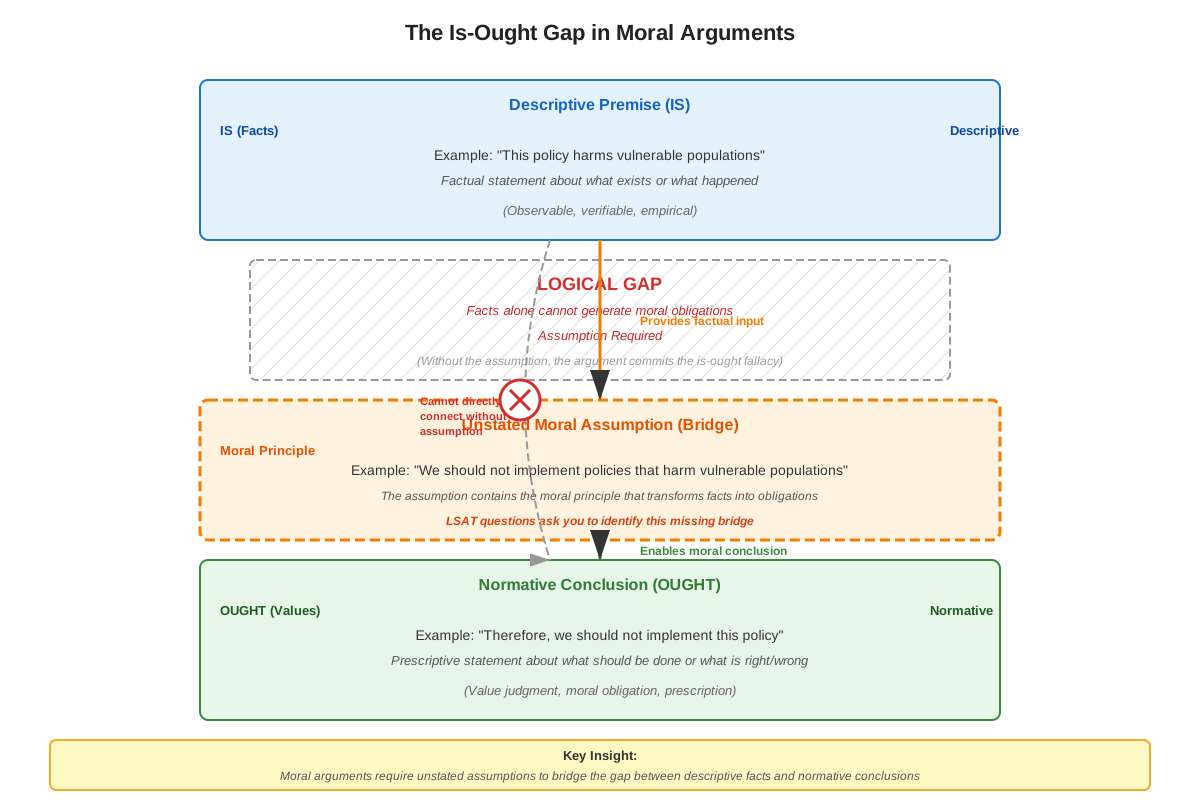
A moral argument is any argument that reaches a normative conclusion—a claim about what should be done, what is right or wrong, or what obligations exist. These arguments typically contain both descriptive premises (factual claims about what is) and normative premises (claims about values, principles, or what ought to be). The assumption in moral arguments most commonly involves an unstated normative premise that bridges factual observations to moral conclusions.
The basic structure follows this pattern:
- Descriptive premise(s): factual claims about the world
- Normative premise (often unstated): a moral principle or value judgment
- Normative conclusion: a claim about what should be done or what is right/wrong
For example: "This policy would reduce unemployment by 5%. Therefore, we should implement this policy." The unstated assumption is a normative premise: "We should implement policies that reduce unemployment" or "Reducing unemployment is a sufficiently important goal to justify this policy."
The Is-Ought Gap
The is-ought gap, identified by philosopher David Hume, represents the logical distinction between descriptive statements (what is) and prescriptive statements (what ought to be). This gap is central to understanding assumptions in moral arguments on the LSAT. An argument cannot validly move from purely descriptive premises to a normative conclusion without at least one normative premise—and this normative premise is often the unstated assumption.
LSAT questions frequently exploit this gap by presenting arguments that jump from facts to moral conclusions without explicitly stating the moral principle that justifies the leap. Test-takers must identify what normative assumption would be necessary to bridge this gap. For instance, an argument might state: "Studies show that capital punishment does not deter crime more effectively than life imprisonment. Therefore, capital punishment is unjustified." The assumption involves a moral principle about what justifies punishment—perhaps that punishment is only justified if it serves as an effective deterrent.
Common Types of Moral Assumptions
Value Priority Assumptions: These assumptions establish that one value or goal takes precedence over others. When an argument recommends an action based on achieving one outcome, it often assumes that outcome is more important than competing considerations. Example: "This regulation would improve safety but increase costs. We should implement it." Assumption: Safety considerations outweigh cost considerations in this context.
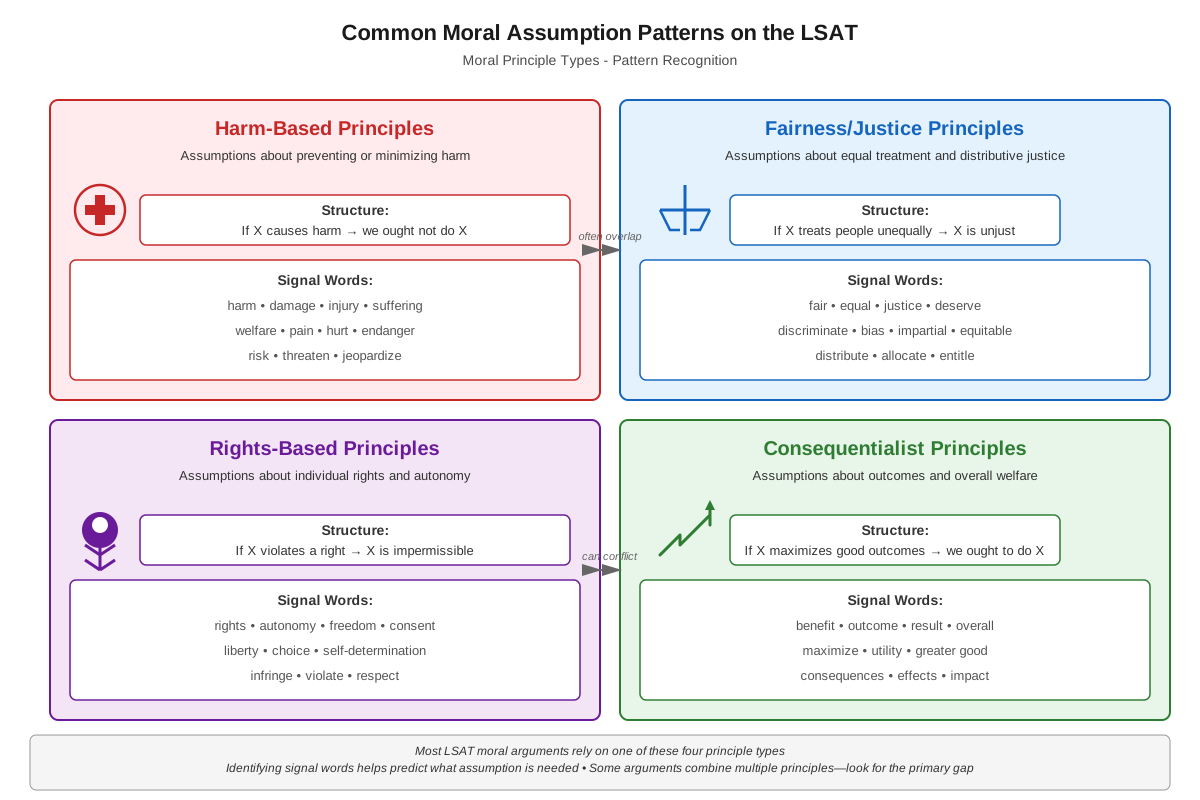
Moral Principle Assumptions: These involve unstated ethical rules or principles that the argument depends upon. Common principles include: consequences determine rightness (consequentialism), certain actions are inherently right or wrong regardless of outcomes (deontology), fairness requires equal treatment, rights should be protected, or obligations arise from certain relationships or roles.
Scope Assumptions: These assumptions establish that a moral principle applies to the specific case under discussion. An argument might assume that a general moral rule extends to a particular situation, or that a principle applicable in one domain also applies in another. Example: "Lying is wrong in personal relationships. Therefore, corporations should not make false advertising claims." Assumption: The moral principle against lying applies equally to corporate communications.
Identifying Assumptions in Moral Arguments
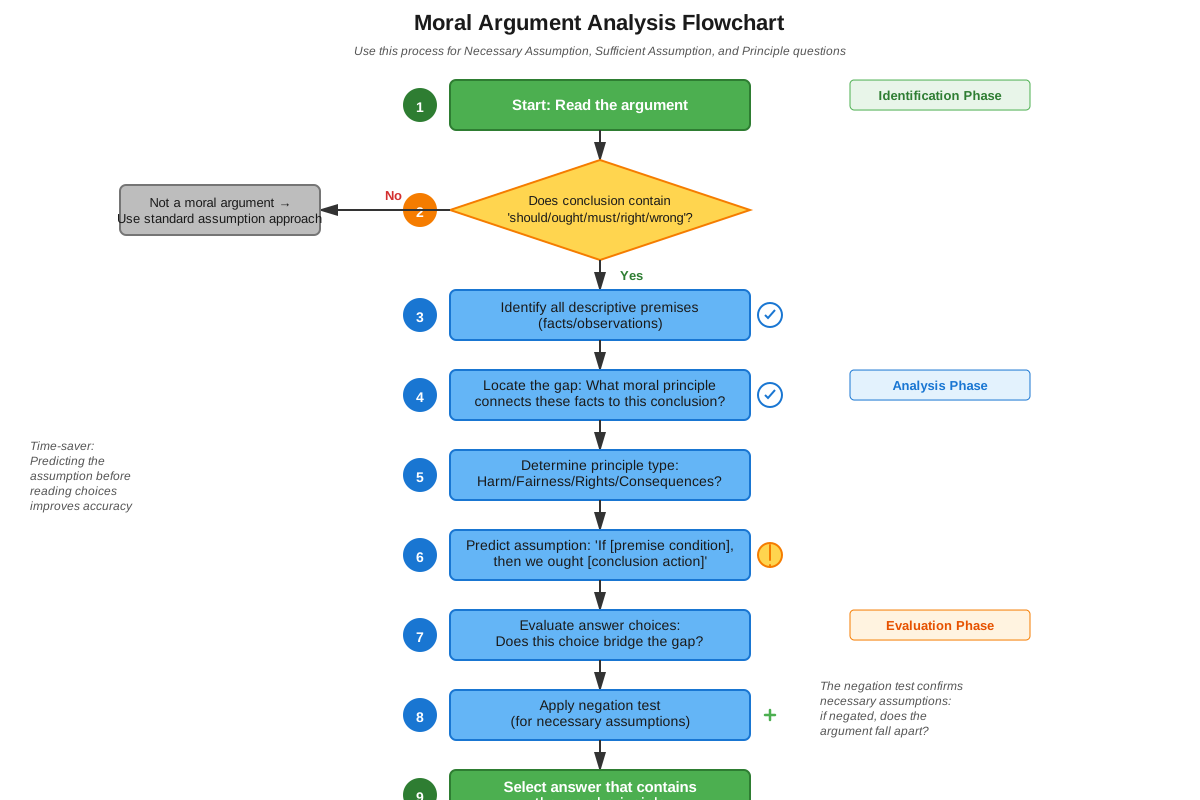
To identify the assumption in a moral argument, follow this systematic approach:
- Identify the conclusion: Determine what normative claim the argument is making (what should be done, what is right/wrong)
- Identify the premises: Note what factual or normative claims are explicitly stated
- Locate the gap: Determine what logical connection is missing between premises and conclusion
- Formulate the assumption: State what normative principle or value judgment must be true for the argument to work
- Test the assumption: Use the negation test—if the assumption were false, would the argument fall apart?
The negation test is particularly powerful for necessary assumptions in moral arguments. If negating a statement causes the argument to fail, that statement is a necessary assumption. For example, if an argument concludes "We should ban this practice because it causes harm," and you negate the assumption "We should ban practices that cause harm" to get "We need not ban practices merely because they cause harm," the argument collapses, confirming this is a necessary assumption.
Moral Arguments vs. Factual Arguments
| Aspect | Factual Arguments | Moral Arguments |
|---|---|---|
| Conclusion type | Descriptive (what is) | Normative (what ought to be) |
| Premise types | Primarily factual | Mix of factual and normative |
| Assumption focus | Factual connections, causal links | Moral principles, value judgments |
| Evaluation criteria | Empirical evidence | Both evidence and ethical principles |
| Common gaps | Causal assumptions, representativeness | Is-ought gap, value priorities |
Context-Dependent Moral Reasoning
LSAT moral arguments often involve context-specific considerations that affect what assumptions are necessary. An argument might assume that a moral principle applies differently in different contexts, or that certain circumstances create special obligations. For example, professional roles (doctors, lawyers, teachers) might create obligations that don't apply to ordinary citizens, or emergency situations might justify actions that would normally be wrong.
Test-takers must recognize when an argument assumes that context matters morally, or conversely, when it assumes that a moral principle applies universally regardless of context. These assumptions about the scope and application of moral principles are frequently tested on the LSAT.
Concept Relationships
The concepts within this topic form an interconnected framework: The is-ought gap creates the fundamental need for moral assumptions, which typically take the form of moral principles or value priorities. These assumptions function as normative premises that bridge descriptive facts to prescriptive conclusions. The structure of moral arguments provides the framework for identifying where assumptions are needed, while context-dependent reasoning determines which specific assumptions apply in particular cases.
This topic connects to prerequisite knowledge of assumption questions by applying general assumption-identification skills to the specific domain of normative reasoning. The necessary vs. sufficient assumption distinction remains crucial—necessary assumptions are required for the argument to work, while sufficient assumptions would guarantee the conclusion. The negation test from general assumption questions becomes particularly powerful in moral contexts for testing whether a proposed assumption is truly necessary.
Relationship map: Descriptive premises → require → Normative assumptions (to bridge the is-ought gap) → which establish → Moral principles or value priorities → that support → Normative conclusions → which can be tested using → Negation test → within → Context-dependent frameworks
High-Yield Facts
⭐ Moral arguments require at least one normative premise to reach a normative conclusion—purely factual premises cannot logically establish what ought to be done.
⭐ The is-ought gap is the most common source of unstated assumptions in moral arguments—watch for arguments that jump from facts to moral conclusions.
⭐ Value priority assumptions establish that one consideration outweighs competing considerations—these are frequently tested when arguments recommend actions with both benefits and costs.
⭐ The negation test is the most reliable method for identifying necessary assumptions—if negating a statement destroys the argument, it's a necessary assumption.
⭐ Moral principles often function as conditional statements—"If X has property Y, then we ought to do Z" or "Actions with characteristic A are wrong."
- Scope assumptions establish that a moral principle applies to the specific case under discussion—don't assume principles automatically extend to new contexts.
- Context-dependent assumptions involve claims that circumstances affect moral obligations—professional roles, emergencies, or special relationships may create unique duties.
- Consequentialist assumptions focus on outcomes—these arguments assume that the rightness of actions depends on their consequences.
- Deontological assumptions involve inherent rightness or wrongness—these arguments assume certain actions are right or wrong regardless of consequences.
- Fairness assumptions often involve equal treatment—arguments may assume that similar cases should be treated similarly or that benefits and burdens should be distributed equitably.
Quick check — test yourself on Assumption in moral arguments so far.
Try Flashcards →Common Misconceptions
Misconception: All moral arguments are subjective opinion, so there are no right or wrong answers about assumptions.
Correction: While moral conclusions may be debatable, the logical structure of moral arguments can be objectively analyzed. An assumption is necessary for an argument if and only if the argument fails without it, regardless of whether you agree with the moral conclusion.
Misconception: If an argument mentions a moral principle explicitly, it doesn't have any unstated moral assumptions.
Correction: Even arguments with explicit moral premises often contain unstated assumptions about value priorities, scope, or how principles apply in specific contexts. The stated principle may not be sufficient to reach the conclusion without additional normative assumptions.
Misconception: Assumptions in moral arguments are always about fundamental ethical theories (consequentialism, deontology, etc.).
Correction: While some assumptions involve broad ethical frameworks, most LSAT moral assumptions are more specific—they concern particular value priorities, the application of principles to specific cases, or context-dependent obligations rather than comprehensive moral theories.
Misconception: If a moral principle seems obviously true or widely accepted, it doesn't need to be stated as an assumption.
Correction: The LSAT tests logical structure, not moral consensus. Even if a moral principle seems obvious, if the argument depends on it and doesn't state it explicitly, it's still an assumption that must be identified. The test evaluates whether the argument logically requires the assumption, not whether the assumption is controversial.
Misconception: Moral arguments only appear in questions explicitly about ethics or morality.
Correction: Moral reasoning appears in diverse contexts including business decisions, policy recommendations, legal obligations, and professional responsibilities. Any argument with a normative conclusion (what should be done) involves moral reasoning, even if it doesn't use explicitly ethical language.
Misconception: The assumption in a moral argument is always the most general moral principle you can identify.
Correction: The correct assumption is the one that's necessary and sufficient to connect the specific premises to the specific conclusion. Overly general principles may be true but not necessary for the particular argument, while overly specific assumptions may go beyond what the argument requires.
Worked Examples
Example 1: Policy Recommendation
Argument: "A recent study found that implementing a four-day work week increases employee productivity by 15% and reduces burnout. Therefore, all companies should adopt a four-day work week."
Question: Which of the following is an assumption required by the argument?
Analysis:
- Conclusion (normative): All companies should adopt a four-day work week
- Premises (descriptive): Four-day work weeks increase productivity by 15% and reduce burnout
- Gap: The argument moves from facts about positive outcomes to a universal recommendation
Step-by-step reasoning:
- The argument presents factual benefits (increased productivity, reduced burnout)
- It concludes with a normative claim about what companies should do
- This crosses the is-ought gap—we need a normative premise connecting these benefits to the obligation to adopt the policy
- The argument assumes that benefits of this magnitude are sufficient to justify the policy
- It also assumes there are no countervailing considerations that outweigh these benefits
Necessary assumptions include:
- Increasing productivity and reducing burnout are sufficiently important goals to justify changing work schedules
- The benefits of a four-day work week outweigh any costs or drawbacks
- What works in the studied cases will work for all companies
- There are no other considerations (cost, feasibility, industry-specific factors) that would make the policy inappropriate for some companies
Testing with negation: If we negate "The benefits outweigh any costs," we get "The costs might outweigh the benefits." This would destroy the argument for universal adoption, confirming this is a necessary assumption.
Connection to learning objectives: This example demonstrates how to identify the is-ought gap (descriptive premises to normative conclusion), recognize value priority assumptions (benefits outweigh costs), and apply the negation test to confirm necessary assumptions.
Example 2: Professional Ethics
Argument: "Dr. Martinez disclosed confidential patient information to the patient's family members without the patient's consent. The patient suffered no harm from this disclosure, and the family members used the information to provide better care. Nevertheless, Dr. Martinez acted wrongly."
Question: The argument's conclusion follows logically if which one of the following is assumed?
Analysis:
- Conclusion (normative): Dr. Martinez acted wrongly
- Premises (descriptive): Disclosed confidential information without consent; no harm resulted; information was used beneficially
- Gap: The argument acknowledges positive consequences but still concludes the action was wrong
Step-by-step reasoning:
- The premises establish that the consequences were actually positive (no harm, better care)
- Despite positive consequences, the conclusion claims the action was wrong
- This suggests a deontological assumption—that the action is wrong regardless of consequences
- The argument must assume that violating confidentiality without consent is inherently wrong
- It assumes that good consequences don't justify violating this professional obligation
Necessary assumptions include:
- Healthcare professionals have an obligation to maintain patient confidentiality that doesn't depend solely on consequences
- Obtaining patient consent before disclosing information is a requirement that cannot be overridden merely by beneficial outcomes
- Professional ethical obligations can make actions wrong even when they produce good results
- The duty of confidentiality applies even when disclosure would benefit the patient
Testing with negation: If we negate "Healthcare professionals must maintain confidentiality regardless of beneficial consequences," we get "Healthcare professionals may violate confidentiality when doing so produces beneficial consequences." This would undermine the conclusion that Dr. Martinez acted wrongly despite the good outcomes, confirming this is a necessary assumption.
Connection to learning objectives: This example illustrates context-dependent moral reasoning (professional obligations), demonstrates how to identify deontological assumptions (inherent rightness/wrongness independent of consequences), and shows how assumptions can establish that certain principles override consequentialist considerations.
Exam Strategy
When approaching assumption questions involving moral arguments on the LSAT, begin by identifying whether the conclusion is normative (contains "should," "ought," "must," "right," "wrong," "justified," "obligated"). This signals that you're dealing with a moral argument and should look for normative assumptions.
Trigger words and phrases to watch for:
- Normative conclusions: "should," "ought to," "must," "is obligated to," "has a duty to," "is required to," "is justified," "is wrong," "is right," "is unethical"
- Value language: "important," "significant," "outweighs," "priority," "more valuable than"
- Principle language: "always," "never," "in all cases," "regardless of," "no matter what"
- Scope indicators: "all," "every," "any," "in this case," "under these circumstances"
Process-of-elimination strategy:
- Eliminate answer choices that are purely descriptive (factual claims with no normative content)—these cannot be assumptions in moral arguments
- Eliminate choices that are irrelevant to the specific conclusion—even if they're moral principles, they must connect to this particular argument
- Eliminate choices that are too extreme or too weak—the assumption must be strong enough to support the conclusion but not stronger than necessary
- Use the negation test on remaining choices—the correct answer will destroy the argument when negated
- Watch for choices that reverse the logic or address the wrong gap
Time allocation advice: Spend extra time identifying the precise conclusion and the exact gap between premises and conclusion. Many test-takers rush this step and select assumptions that seem morally relevant but don't actually connect the specific premises to the specific conclusion. The 10-15 seconds spent clearly articulating the gap will save time by making the correct answer obvious and preventing reconsideration.
Exam Tip: When stuck between two answer choices, ask yourself: "If this were false, would the argument completely fall apart?" For necessary assumptions, the answer must be yes. For sufficient assumptions, ask: "If this were true, would the conclusion definitely follow?" This distinction helps eliminate attractive wrong answers.
Common trap answers in moral assumption questions:
- Statements that are true but not necessary for this specific argument
- Moral principles that are too general to connect these specific premises to this specific conclusion
- Assumptions that address a different gap than the one in the argument
- Statements that strengthen the argument but aren't required for it to work
- Reverse logic (assuming the conclusion instead of supporting it)
Memory Techniques
Mnemonic for identifying moral assumptions: "BRIDGE"
- Bridge the is-ought gap (connect facts to moral conclusions)
- Recognize value priorities (what matters most?)
- Identify the principle (what moral rule is assumed?)
- Determine scope (does the principle apply here?)
- Gap analysis (what's missing between premises and conclusion?)
- Eliminate with negation (test if assumption is necessary)
Visualization strategy: Picture moral arguments as a bridge spanning a river. The descriptive premises are on one bank (the "is" side), the normative conclusion is on the other bank (the "ought" side), and the assumption is the bridge connecting them. If you remove the bridge (negate the assumption), you can't get from one side to the other—the argument collapses.
Acronym for common moral assumption types: "VPS"
- Value priorities (which goals/values take precedence?)
- Principles (what moral rules apply?)
- Scope (does the principle extend to this case?)
Memory aid for the negation test: "If NOT, then SHOT" (If the assumption is NOT true, then the argument is SHOT/destroyed). This reminds you that negating a necessary assumption must destroy the argument.
Summary
Assumptions in moral arguments represent a high-yield LSAT topic that requires understanding how normative conclusions depend on unstated moral premises. The fundamental challenge involves recognizing the is-ought gap—the logical distinction between descriptive facts and prescriptive conclusions—and identifying what normative assumptions bridge this gap. Moral arguments typically contain both factual premises and value-based conclusions, with the unstated assumption providing the moral principle or value priority that connects them. Success on these questions requires systematic analysis: identify the normative conclusion, locate the descriptive premises, determine what moral principle is needed to connect them, and test the assumption using negation. The most common types of moral assumptions involve value priorities (which considerations outweigh others), moral principles (what rules determine right and wrong), and scope (whether principles apply to specific cases). Mastering this topic strengthens performance across multiple question types and provides essential skills for legal reasoning beyond the LSAT.
Key Takeaways
- Moral arguments require at least one normative premise to reach normative conclusions—the is-ought gap cannot be crossed with purely factual premises
- The negation test is the most reliable method for confirming necessary assumptions: if negating a statement destroys the argument, it's a necessary assumption
- Value priority assumptions establish that one consideration (safety, fairness, efficiency) outweighs competing considerations in the specific context
- Moral assumptions often involve unstated principles about what makes actions right or wrong, what obligations exist, or what goals should be prioritized
- Context matters in moral reasoning—assumptions may involve claims that professional roles, special circumstances, or particular relationships create specific obligations
- Watch for arguments that jump from beneficial consequences to normative conclusions—these assume that the benefits are sufficient to justify the action and outweigh any costs
- Scope assumptions establish that a moral principle applies to the case under discussion—don't assume principles automatically extend to new contexts without justification
Related Topics
Sufficient Assumption Questions: Building on necessary assumptions in moral arguments, sufficient assumptions provide principles that, if true, would guarantee the conclusion. Understanding moral assumptions prepares students for identifying moral principles that would make arguments valid.
Principle Questions: These questions explicitly ask for moral or general principles that justify reasoning or apply to situations. Mastering assumptions in moral arguments provides the foundation for both Principle-Support and Principle-Application questions.
Strengthen and Weaken Questions with Moral Content: Many strengthen/weaken questions involve moral arguments. Understanding what assumptions these arguments depend on helps identify what information would support or undermine them.
Flaw Questions Involving Normative Reasoning: Common flaws include failing to establish that a moral principle applies, ignoring relevant moral considerations, or assuming value priorities without justification. Recognizing moral assumptions helps identify these logical errors.
Parallel Reasoning with Moral Arguments: Some parallel reasoning questions involve matching the structure of moral arguments, requiring recognition of how normative premises connect to normative conclusions across different contexts.
Practice CTA
Now that you've mastered the core concepts of assumptions in moral arguments, it's time to apply this knowledge to LSAT-style practice questions. The skills you've developed—identifying the is-ought gap, recognizing value priorities, applying the negation test, and distinguishing necessary from sufficient assumptions—will become automatic only through deliberate practice. Challenge yourself with the practice questions and flashcards to reinforce these high-yield concepts. Each question you work through strengthens your ability to quickly identify moral assumptions under timed conditions, building the confidence and competence needed for test day success. Remember: understanding the theory is just the beginning—mastery comes from application.
Sign up free to keep reading
Create a free AnvayaPrep account to finish this LSAT guide on Assumption in moral arguments — plus flashcards and practice questions.