Overview
Conditional assumptions represent one of the most frequently tested and strategically important concepts in LSAT Logical Reasoning. These assumptions form the invisible bridge between conditional statements in an argument's premises and its conclusion, making them essential for success on assumption questions. Unlike sufficient assumptions that guarantee an argument's validity, conditional assumptions specifically address the logical connections between "if-then" relationships that the argument relies upon but never explicitly states.
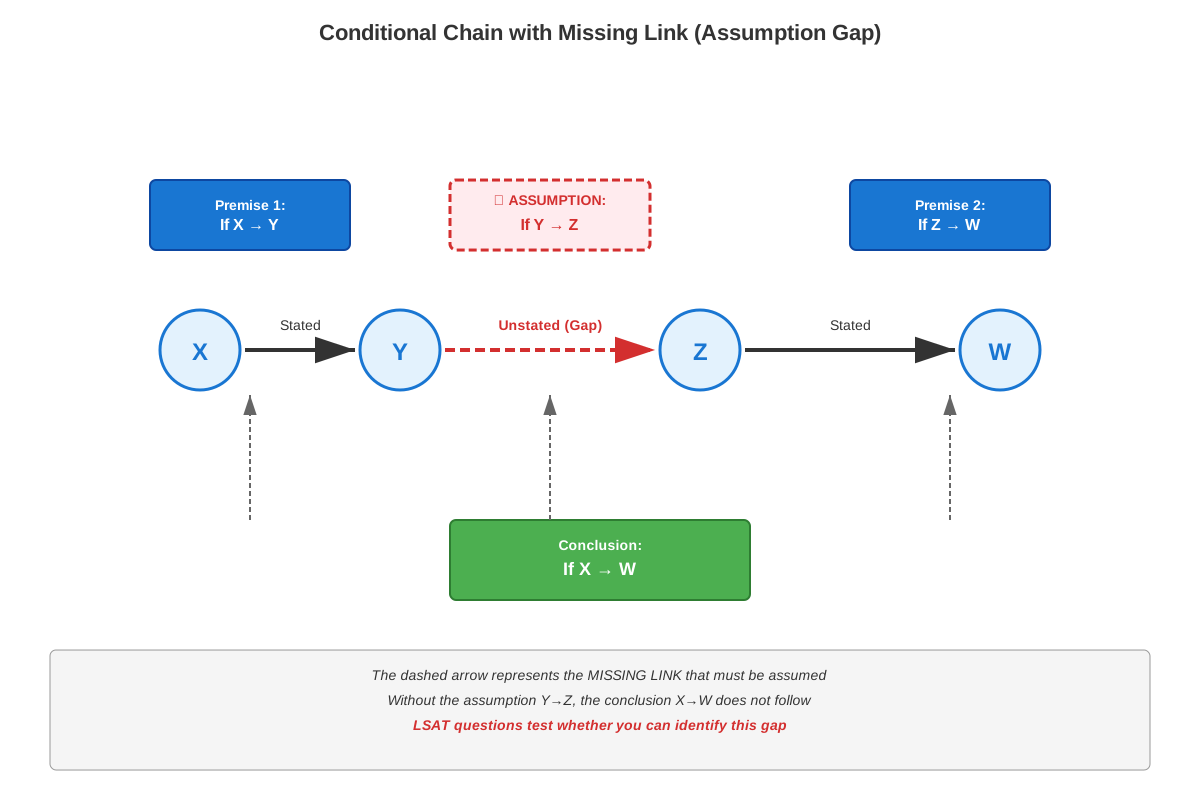
Understanding LSAT conditional assumptions requires recognizing that arguments often present conditional reasoning with gaps in their logical chain. An author might establish that "if X, then Y" and conclude "if Y, then Z," but the argument's validity depends on unstated connections between these conditional relationships. The test-maker expects students to identify these hidden conditional links that must be true for the argument to hold together. This skill appears across multiple question types, including Necessary Assumption, Sufficient Assumption, and Strengthen questions, making it a high-yield area for score improvement.
Mastering conditional assumptions builds directly on foundational logical reasoning skills while serving as a gateway to more complex argument analysis. This topic intersects with formal logic, argument structure analysis, and critical reasoning—all core competencies measured throughout the LSAT. Students who develop expertise in identifying and analyzing conditional assumptions gain a significant advantage, as these questions often separate mid-range scorers from those achieving elite scores in the 170+ range.
Learning Objectives
- [ ] Identify how Conditional assumptions appears in LSAT questions
- [ ] Explain the reasoning pattern behind Conditional assumptions
- [ ] Apply Conditional assumptions to solve LSAT-style problems accurately
- [ ] Distinguish conditional assumptions from other assumption types (sufficient, necessary, causal)
- [ ] Diagram conditional relationships to reveal unstated assumptions
- [ ] Predict conditional assumptions before reviewing answer choices
- [ ] Evaluate answer choices using the negation technique for conditional statements
Prerequisites
- Basic conditional logic notation: Understanding "if-then" statements, sufficient and necessary conditions, and contrapositive formation is essential because conditional assumptions build upon these logical structures
- Argument structure identification: Recognizing premises, conclusions, and intermediate conclusions matters because conditional assumptions connect these argument components
- Necessary vs. sufficient conditions: Distinguishing between what must be true versus what guarantees truth is crucial because conditional assumptions often involve necessary conditions within conditional chains
- Basic assumption question mechanics: Familiarity with how assumption questions function provides the foundation for understanding the specific role conditional assumptions play
Why This Topic Matters
Conditional assumptions appear with remarkable frequency on the LSAT, showing up in approximately 15-20% of all Logical Reasoning questions across both scored sections. This translates to roughly 8-10 questions per test—a substantial portion of the exam that can significantly impact overall scores. The LSAT specifically tests conditional assumptions because legal reasoning heavily relies on understanding unstated logical connections between rules, precedents, and their applications.
In real-world legal practice, attorneys must constantly identify the conditional assumptions underlying statutes, contracts, and judicial opinions. A law might state "if a person commits act X, then penalty Y applies," but its application often depends on unstated assumptions about what constitutes "committing" the act or when exceptions apply. Similarly, contract interpretation requires recognizing the conditional assumptions parties make about triggering events and obligations.
On the LSAT, conditional assumptions most commonly appear in Necessary Assumption questions (40% of conditional assumption questions), followed by Sufficient Assumption questions (30%), Strengthen questions (20%), and occasionally in Flaw and Weaken questions (10%). The test presents these through arguments that establish conditional relationships in premises but leap to conclusions that require additional conditional links. Recognizing this pattern allows students to anticipate the logical gap and predict correct answers before reviewing choices—a critical time-saving strategy.
Core Concepts
Understanding Conditional Assumptions
A conditional assumption is an unstated conditional statement (if-then relationship) that an argument requires to be true for its conclusion to follow logically from its premises. Unlike general necessary assumptions, conditional assumptions specifically involve the logical connectors "if," "then," "only if," "unless," and their equivalents. These assumptions bridge gaps in conditional reasoning chains, connect separate conditional statements, or establish that certain conditions trigger specific consequences.
The fundamental structure involves an argument presenting conditional premises that don't directly connect to the conclusion. For example:
- Premise: If the company expands (E), it will hire more staff (H)
- Conclusion: If the company expands (E), profits will increase (P)
The conditional assumption here is: If the company hires more staff (H), then profits will increase (P). This unstated conditional link (H → P) is necessary for the argument's conditional chain to reach its conclusion.
The Conditional Chain Pattern
Most conditional assumption questions follow a conditional chain pattern where the argument presents disconnected conditional statements that require an intermediate link. The pattern typically appears as:
- Premise establishes: A → B
- Conclusion claims: A → C
- Required assumption: B → C
This creates a complete chain: A → B → C, where the middle link (B → C) was unstated but necessary. Recognizing this pattern allows rapid identification of the logical gap.
Consider this structure in a table format:
| Argument Component | Conditional Statement | Role |
|---|---|---|
| Premise | If rain (R) → game cancelled (C) | Establishes first link |
| Conclusion | If rain (R) → refunds issued (F) | Claims final outcome |
| Required Assumption | If game cancelled (C) → refunds issued (F) | Bridges the gap |
Conditional Assumptions vs. Other Assumption Types
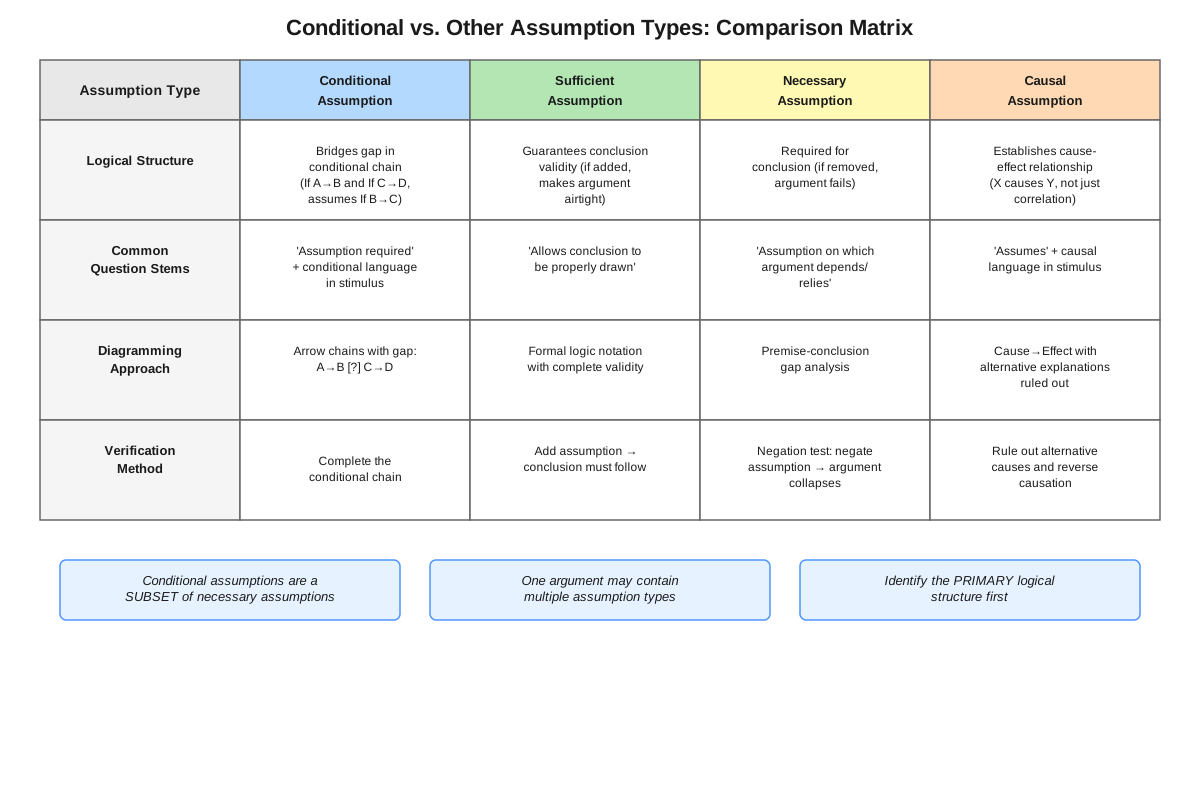
Understanding how conditional assumptions differ from other assumption types prevents confusion and improves accuracy:
Conditional assumptions specifically involve if-then relationships and create logical bridges between conditional statements. They can be diagrammed using conditional logic notation (arrows, contrapositives).
Causal assumptions address cause-and-effect relationships, assuming that one event causes another rather than simply establishing a conditional relationship. While causation can be expressed conditionally, causal assumptions involve temporal sequence and mechanism.
Sufficient assumptions guarantee the conclusion's truth when added to the premises, often "proving too much" by establishing more than necessary. Conditional assumptions may be sufficient, but they're specifically focused on conditional logic gaps.
Necessary assumptions are required for the argument but don't guarantee its validity. Conditional assumptions are a subset of necessary assumptions—specifically those involving conditional relationships.
Identifying Conditional Assumptions in Arguments
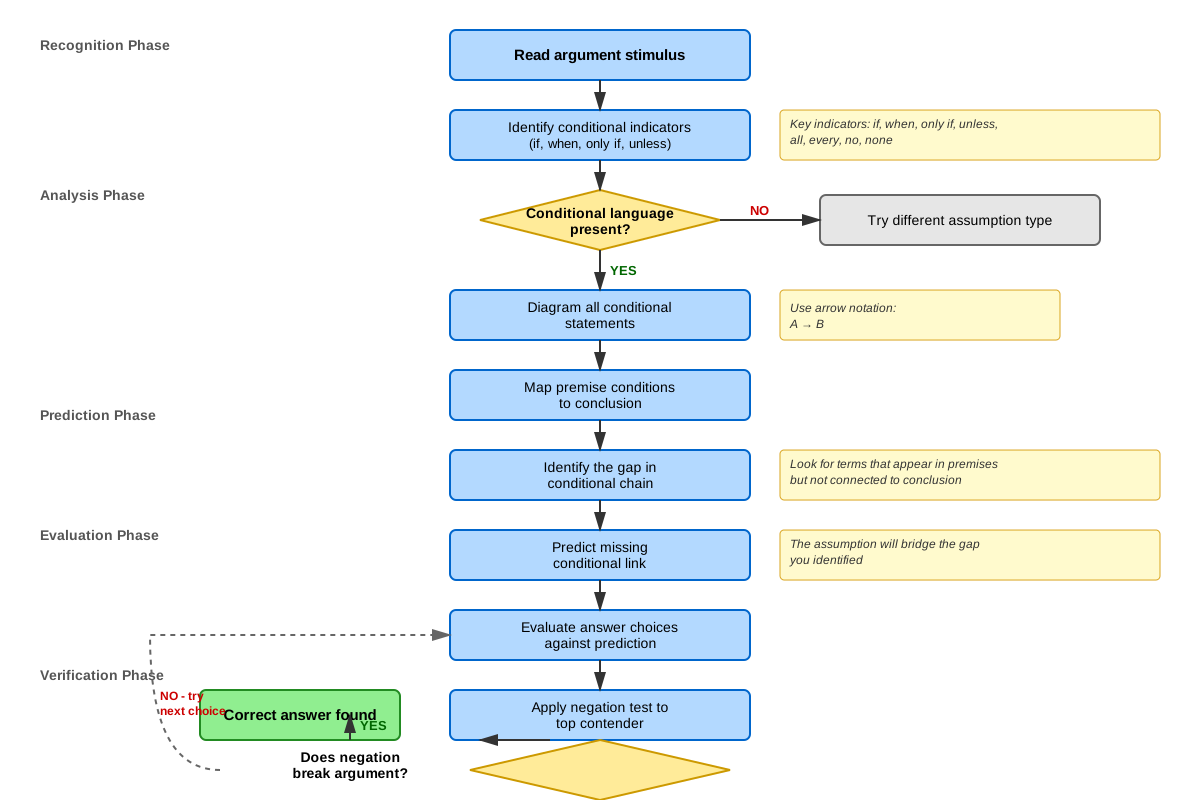
The process of identifying conditional assumptions follows a systematic approach:
- Locate conditional indicators: Identify words like "if," "when," "whenever," "only if," "unless," "provided that," "assuming that" in both premises and conclusion
- Diagram the conditional relationships: Convert each conditional statement into logical notation (A → B format)
- Map the logical chain: Determine what conditional links exist and what links are missing
- Identify the gap: Recognize which conditional connection would complete the chain from premises to conclusion
- Predict the assumption: Formulate the missing conditional statement before reviewing answer choices
The Contrapositive Connection
Conditional assumptions must maintain logical consistency with their contrapositives. If an argument assumes "If A, then B" (A → B), it simultaneously assumes "If not B, then not A" (~B → ~A). LSAT questions sometimes present the assumption in contrapositive form, testing whether students recognize logically equivalent statements.
For example, if an argument requires the assumption "If the policy is implemented, costs will decrease," the contrapositive "If costs don't decrease, the policy wasn't implemented" is logically equivalent and might appear as the correct answer choice.
Conditional Assumptions with Multiple Conditions
More complex arguments involve conditional assumptions with compound conditions—multiple sufficient conditions, multiple necessary conditions, or both. These appear as:
- Multiple sufficient conditions: "If A or B, then C" (A → C and B → C)
- Multiple necessary conditions: "If A, then B and C" (A → B and A → C)
- Conditional chains with branches: Multiple pathways requiring different assumptions
For instance, an argument might conclude that a policy will succeed if implemented, but the premises only establish that the policy addresses one of several necessary factors. The conditional assumption must account for all necessary conditions being met.
Negation Testing for Conditional Assumptions
The negation technique helps verify conditional assumptions. A true necessary assumption, when negated, destroys the argument. For conditional assumptions, negation means asserting that the conditional relationship doesn't hold:
- Original assumption: "If A, then B"
- Negation: "A can occur without B" or "A doesn't guarantee B"
If negating the conditional assumption makes the argument fall apart, it confirms the assumption was necessary. This technique proves especially valuable when choosing between similar answer choices.
Concept Relationships
Conditional assumptions exist within a hierarchical relationship to broader logical reasoning concepts. At the foundation lies basic conditional logic (if-then statements, sufficient/necessary conditions), which provides the notation and rules for manipulating conditional statements. This foundation supports conditional assumptions, which represent unstated conditional links in arguments.
Conditional assumptions connect laterally to argument structure analysis—the skill of identifying premises, conclusions, and gaps. Both skills work together: structure analysis reveals where gaps exist, while conditional logic identifies what type of assumption fills those gaps.
The relationship flows as: Basic Conditional Logic → Conditional Assumptions → Complex Argument Evaluation. Mastering conditional assumptions enables students to tackle more sophisticated argument patterns, including those with multiple conditional chains, nested conditions, and conditional reasoning combined with causal or comparative reasoning.
Conditional assumptions also relate to formal logic questions (a less common LSAT question type) where conditional reasoning appears in its purest form. The skills developed for identifying conditional assumptions transfer directly to these questions, though formal logic questions typically involve more explicit conditional structures.
Within assumption questions specifically, the progression moves from identifying that an assumption exists → determining it's a conditional assumption → predicting the specific conditional relationship → selecting the correct answer. Each step builds on the previous one, creating an integrated skill set.
Quick check — test yourself on Conditional assumptions so far.
Try Flashcards →High-Yield Facts
⭐ Conditional assumptions bridge gaps between conditional statements in premises and conclusions by providing unstated if-then links
⭐ The most common pattern is: Premise (A → B) + Conclusion (A → C) requires assumption (B → C)
⭐ Conditional assumptions can appear in their contrapositive form and remain logically equivalent
⭐ Negating a conditional assumption means asserting the conditional relationship doesn't hold, which should destroy the argument if the assumption is necessary
⭐ Approximately 15-20% of Logical Reasoning questions involve conditional assumptions, making them high-yield for score improvement
- Conditional assumptions differ from sufficient assumptions because they may not guarantee the conclusion but are still necessary for the argument
- Multiple conditional statements in an argument often signal that a conditional assumption question is present
- The words "if," "only if," "unless," "when," "whenever," and "provided that" are key indicators of conditional reasoning
- Conditional assumptions must be consistent with all stated premises and cannot contradict any given information
- Diagramming conditional relationships reveals gaps more clearly than analyzing arguments in prose form alone
Common Misconceptions
Misconception: All assumption questions involve conditional assumptions → Correction: Conditional assumptions are a specific subset of assumption questions that involve if-then relationships. Many assumption questions involve causal assumptions, definitional assumptions, or assumptions about scope and relevance that don't involve conditional logic.
Misconception: The conditional assumption must appear in the exact same form as the conclusion → Correction: Conditional assumptions often appear in contrapositive form or with different wording that expresses the same logical relationship. Students must recognize logically equivalent statements rather than looking for identical phrasing.
Misconception: Sufficient assumptions and conditional assumptions are the same thing → Correction: While some sufficient assumptions involve conditional statements, sufficient assumptions prove the conclusion definitively, often going beyond what's necessary. Conditional assumptions are necessary but may not be sufficient on their own.
Misconception: If an argument contains conditional statements, the assumption must be conditional → Correction: Arguments with conditional premises might require non-conditional assumptions about definitions, scope, or causation. The assumption type depends on the specific gap between premises and conclusion.
Misconception: Conditional assumptions always follow the simple A → B → C chain pattern → Correction: While this is the most common pattern, conditional assumptions can involve compound conditions, multiple necessary conditions, or more complex logical structures. Students must be prepared for variations on the basic pattern.
Misconception: The negation of "If A, then B" is "If A, then not B" → Correction: The proper negation of a conditional statement is "A can occur without B" or "A doesn't necessarily lead to B." This is not the same as the contrapositive (~B → ~A) or the inverse (~A → ~B).
Worked Examples
Example 1: Basic Conditional Chain
Argument: "All students who study diligently pass the LSAT. Therefore, students who study diligently will gain admission to law school."
Analysis:
Step 1: Identify conditional statements
- Premise: If study diligently (D) → pass LSAT (P)
- Conclusion: If study diligently (D) → gain admission (A)
Step 2: Diagram the logical structure
- Given: D → P
- Conclude: D → A
- Missing link: P → A
Step 3: Identify the gap
The argument jumps from "passing the LSAT" to "gaining admission" without establishing the connection. The conditional assumption must link these two concepts.
Step 4: Predict the assumption
"If a student passes the LSAT, then that student will gain admission to law school" (P → A)
Step 5: Verify with negation
Negation: "Students can pass the LSAT without gaining admission to law school"
If this is true, the argument falls apart because studying diligently would lead to passing the LSAT but not necessarily to admission. This confirms our assumption is necessary.
Correct Answer Pattern: "Students who pass the LSAT will gain admission to law school" or its contrapositive "Students who don't gain admission to law school didn't pass the LSAT."
Example 2: Complex Conditional with Contrapositive
Argument: "The new environmental regulation will be enforced only if it receives funding from the legislature. Since the regulation will be enforced, we can conclude that public health will improve."
Analysis:
Step 1: Identify and translate conditional statements
- Premise: Enforced (E) → Funded (F) [from "only if" construction]
- Implicit premise: The regulation will be enforced (E)
- Conclusion: Public health will improve (H)
Step 2: Diagram the structure
- Given: E → F (and we know E is true)
- Conclude: H is true
- Missing link: E → H (or F → H, since we can derive F from E)
Step 3: Identify the gap
The argument establishes that enforcement requires funding and assumes enforcement will occur, but never connects enforcement (or funding) to public health improvement.
Step 4: Predict the assumption
"If the environmental regulation is enforced, then public health will improve" (E → H)
Step 5: Consider contrapositive presentations
The assumption might appear as: "If public health doesn't improve, the regulation wasn't enforced" (~H → ~E)
Step 6: Verify with negation
Negation: "The regulation can be enforced without public health improving"
This destroys the argument's conclusion, confirming the assumption is necessary.
Correct Answer Pattern: "Enforcement of the regulation will lead to improved public health" or "If public health doesn't improve, the regulation wasn't truly enforced."
Exam Strategy
When approaching conditional assumption questions on the LSAT, implement this systematic strategy:
Recognition Phase: Identify that you're dealing with a conditional assumption question by spotting conditional indicators ("if," "only if," "unless," "when") in both the stimulus and question stem. Necessary Assumption questions asking "Which one of the following is an assumption required by the argument?" combined with conditional premises signal this question type.
Diagramming Phase: Immediately diagram all conditional relationships using arrow notation. Write out:
- Each premise with conditional structure
- The conclusion
- The gap between them
This visual representation makes the missing link obvious and prevents errors from trying to track complex logic mentally.
Prediction Phase: Before reading answer choices, predict the conditional assumption by identifying what conditional statement would bridge the gap. Write down your prediction in simple terms (e.g., "needs to connect B to C").
Elimination Phase: Use these specific strategies:
Trigger words to watch for: "if," "only if," "unless," "when," "whenever," "provided that," "assuming that," "given that"
Red flags in wrong answers: Answers that reverse the conditional relationship (confusing sufficient and necessary conditions), answers that introduce new conditional relationships unrelated to the gap, answers that are too strong (sufficient assumptions when a necessary assumption is requested)
Process-of-elimination tips:
- Eliminate answers with no conditional structure when the gap clearly requires one
- Eliminate answers that connect the wrong terms (e.g., connecting A to C when you need B to C)
- Eliminate contrapositives of wrong relationships (they're still wrong)
- Use negation testing on remaining choices to verify necessity
Time allocation: Spend 15-20 seconds diagramming, 10-15 seconds predicting, and 30-40 seconds on answer choices. Conditional assumption questions reward upfront investment in analysis, as prediction makes answer selection rapid and confident.
Common trap patterns: The LSAT frequently includes wrong answers that present the inverse (~A → ~B) instead of the contrapositive (~B → ~A), or that reverse sufficient and necessary conditions. Always verify the direction of the conditional relationship.
Memory Techniques
The CHAIN mnemonic for conditional assumptions:
- Conditional indicators present
- Hypothetical relationships (if-then)
- Arrow notation helpful
- Intermediate link missing
- Necessary for conclusion
Visualization strategy: Picture conditional assumptions as literal chain links. The premises are links at one end, the conclusion is the link at the other end, and the assumption is the missing middle link. If the middle link is absent, the chain breaks and the conclusion doesn't connect to the premises.
The "Bridge Builder" metaphor: Think of conditional assumptions as bridges spanning a river. The premises are on one bank, the conclusion on the other. The assumption is the bridge structure that must exist for anyone to cross from premises to conclusion. Without the bridge, there's no way to reach the conclusion.
Acronym for negation testing - SNAP:
- State the assumption
- Negate it (assert the conditional doesn't hold)
- Apply to the argument
- Prove it destroys the conclusion
Directional reminder: "Sufficient points TO necessary" - in A → B, A is sufficient and points to B (necessary). This prevents confusion about conditional direction.
Summary
Conditional assumptions represent unstated if-then relationships that arguments require to connect conditional premises to conditional conclusions. These assumptions appear in approximately 15-20% of Logical Reasoning questions, making them essential for LSAT success. The core pattern involves arguments presenting disconnected conditional statements (A → B and a conclusion about A → C) that require an intermediate conditional link (B → C) to be valid. Mastering conditional assumptions requires recognizing conditional indicators, diagramming logical relationships, identifying gaps in conditional chains, and predicting the missing link before evaluating answer choices. Students must distinguish conditional assumptions from other assumption types, understand that assumptions can appear in contrapositive form, and apply negation testing to verify necessity. Success on these questions comes from systematic analysis: diagram the conditional structure, identify the gap, predict the assumption, and eliminate answers that don't bridge the specific logical gap. This methodical approach transforms conditional assumption questions from challenging obstacles into reliable scoring opportunities.
Key Takeaways
- Conditional assumptions are unstated if-then relationships that bridge gaps between conditional premises and conclusions
- The most common pattern is a conditional chain with a missing middle link: Premise (A → B) + Conclusion (A → C) requires assumption (B → C)
- Always diagram conditional relationships using arrow notation to visualize gaps clearly
- Conditional assumptions can appear in contrapositive form and remain logically equivalent to the original statement
- Predict the conditional assumption before reading answer choices to avoid trap answers and save time
- Use negation testing to verify that an assumption is necessary: negating it should destroy the argument
- Approximately 15-20% of Logical Reasoning questions involve conditional assumptions, making them high-yield for score improvement
Related Topics
Sufficient Assumptions: While conditional assumptions are necessary for arguments, sufficient assumptions guarantee conclusions. Understanding the distinction helps students recognize when an answer choice provides more than necessary versus exactly what's required. Mastering conditional assumptions provides the foundation for recognizing when sufficient assumptions involve conditional logic.
Formal Logic Questions: These less common LSAT questions present pure conditional reasoning without the argument structure wrapper. Skills developed for conditional assumptions transfer directly, as both require diagramming conditional relationships and identifying logical implications.
Strengthen and Weaken Questions with Conditional Reasoning: Many strengthen/weaken questions involve conditional logic where adding or removing conditional assumptions affects argument strength. Understanding conditional assumptions enables students to recognize how conditional relationships impact argument force.
Parallel Reasoning with Conditional Structure: Parallel reasoning questions often feature conditional logic, requiring students to match conditional patterns across arguments. Expertise in conditional assumptions helps identify these patterns quickly and accurately.
Practice CTA
Now that you've mastered the conceptual framework for conditional assumptions, it's time to cement your understanding through active practice. Attempt the practice questions designed specifically for this topic, focusing on applying the systematic approach outlined in this guide: diagram the conditional relationships, identify the gap, predict the assumption, and verify through negation. Each practice question you complete strengthens your pattern recognition and increases your speed on test day. Remember, conditional assumptions appear in roughly 8-10 questions per LSAT—mastering this topic directly translates to significant score improvement. Review the flashcards to reinforce key concepts and ensure rapid recognition of conditional patterns. Your investment in deliberate practice now will pay dividends when you encounter these high-yield questions under timed conditions.
Sign up free to keep reading
Create a free AnvayaPrep account to finish this LSAT guide on Conditional assumptions — plus flashcards and practice questions.