Overview
Justify the conclusion questions represent one of the most challenging and frequently tested question types within LSAT Logical Reasoning sections. These questions ask test-takers to identify an answer choice that, when added to the argument's premises, guarantees the conclusion is true with absolute certainty. Unlike assumption questions that merely fill logical gaps, justify questions demand a complete bridge that makes the argument's reasoning airtight and deductively valid.
Understanding justify the conclusion questions is essential for LSAT success because they appear consistently across both Logical Reasoning sections, typically comprising 2-4 questions per test. These questions test a student's ability to recognize logical gaps, understand conditional reasoning, and identify the precise missing link that transforms an argument from potentially flawed to logically bulletproof. Mastery of this question type directly impacts overall LSAT performance and demonstrates the analytical reasoning skills law schools seek in candidates.
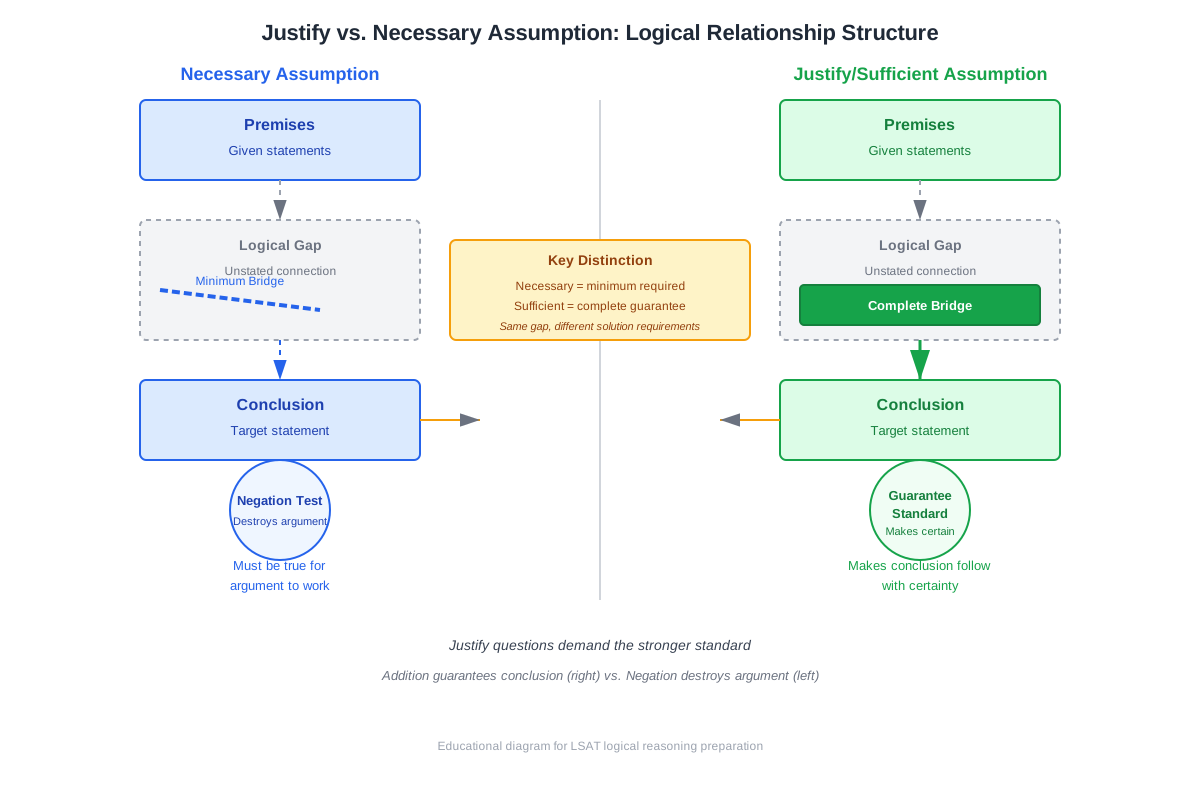
Within the broader landscape of assumption questions, justify questions occupy a unique position. While necessary assumption questions ask what must be true for an argument to work, justify questions ask what would be sufficient to make the conclusion follow with certainty. This distinction places justify questions at the intersection of assumption identification, conditional logic, and deductive reasoning—making them a cornerstone skill that reinforces understanding across multiple Logical Reasoning question types including strengthen, flaw, and sufficient assumption questions.
Learning Objectives
- [ ] Identify how justify the conclusion appears in LSAT questions by recognizing characteristic question stems and language patterns
- [ ] Explain the reasoning pattern behind justify the conclusion by articulating the relationship between premises, gaps, and sufficient conditions
- [ ] Apply justify the conclusion strategies to solve LSAT-style problems accurately within time constraints
- [ ] Distinguish between necessary assumptions and sufficient assumptions in argument analysis
- [ ] Evaluate answer choices using the negation test and sufficiency standard
- [ ] Construct logical bridges that connect premises to conclusions with deductive certainty
- [ ] Recognize common argument structures that appear in justify questions and their corresponding solution patterns
Prerequisites
- Basic argument structure: Understanding premises, conclusions, and how to identify each component is fundamental because justify questions require precise analysis of what the argument states versus what it assumes
- Conditional reasoning: Familiarity with if-then statements, necessary and sufficient conditions enables recognition of the logical relationships that justify questions exploit
- Logical gaps and assumptions: Ability to spot unstated connections between premises and conclusions provides the foundation for identifying what would make an argument complete
- Deductive versus inductive reasoning: Distinguishing between arguments that guarantee conclusions versus those that merely support them clarifies the standard justify questions demand
Why This Topic Matters
Justify the conclusion questions appear with remarkable consistency on the LSAT, typically accounting for 3-5% of all Logical Reasoning questions. This translates to approximately 2-4 questions per test administration, making them a reliable component of the exam. Given that Logical Reasoning comprises roughly 50% of the total LSAT score, mastering justify questions can directly impact performance by 2-3 raw points—often the difference between score bands that significantly affect law school admissions outcomes.
Beyond test performance, the analytical skills developed through justify question practice have profound real-world applications. Legal reasoning frequently requires identifying what additional evidence or legal principle would conclusively establish a claim. Attorneys must determine what facts, when proven, would guarantee a favorable verdict. Contract negotiators identify terms that would ensure specific outcomes. Policy analysts determine what conditions would definitively achieve desired results. The ability to recognize sufficient conditions for conclusions represents a core competency in legal practice and critical thinking generally.
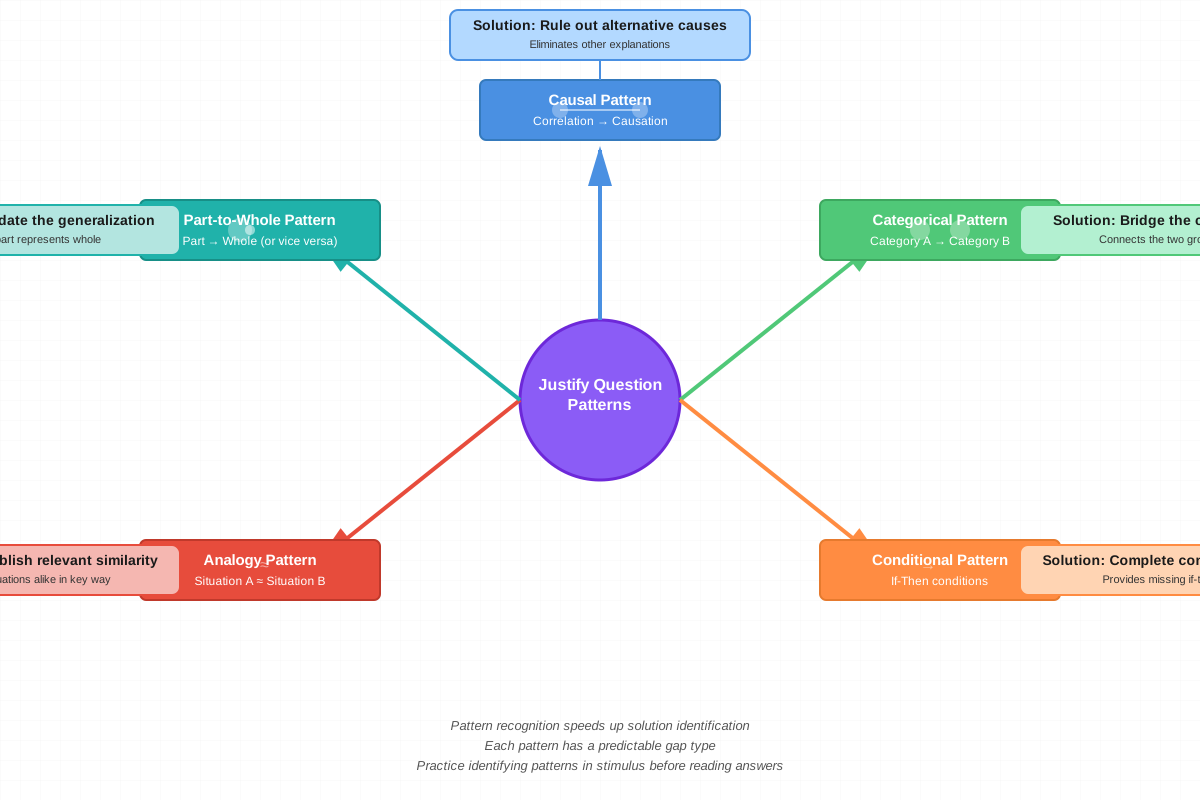
On the LSAT, justify questions appear in predictable patterns. They commonly test arguments involving causal reasoning (what would prove X caused Y), categorical logic (what would establish membership in a category), analogical reasoning (what would make two situations truly comparable), and prescriptive conclusions (what would justify a recommendation or course of action). The LSAT frequently embeds these questions in contexts involving scientific studies, business decisions, policy recommendations, and historical explanations—requiring students to navigate complex content while maintaining focus on logical structure.
Core Concepts
The Sufficiency Standard
The defining characteristic of justify the conclusion questions is the sufficiency standard they impose. An answer choice must provide information that, when combined with the existing premises, makes the conclusion follow with absolute logical certainty. This differs fundamentally from strengthen questions, which merely require making the conclusion more likely, or necessary assumption questions, which identify what must be true but may not alone guarantee the conclusion.
The sufficiency standard means the correct answer creates a deductively valid argument. If the premises and the correct answer are all true, the conclusion must be true—no exceptions, no probability, no room for doubt. This is the highest logical bar the LSAT sets for any question type. Test-takers must evaluate each answer choice by asking: "If I add this to the argument, does the conclusion become absolutely certain, or merely more probable?"
Identifying Justify Questions
Justify questions use distinctive language in their question stems that signals the sufficiency requirement. Common phrasings include:
- "Which one of the following, if assumed, allows the conclusion to be properly drawn?"
- "The conclusion follows logically if which one of the following is assumed?"
- "Which one of the following principles, if valid, most helps to justify the reasoning?"
- "The argument's conclusion can be properly inferred if which one of the following is assumed?"
- "Which one of the following, if true, enables the conclusion to be properly drawn?"
The key indicators are phrases like "properly drawn," "properly inferred," "follows logically," and "enables the conclusion." These signal that the answer must provide complete logical justification, not merely support. The word "assumed" appears frequently because the correct answer supplies an unstated premise that bridges the logical gap.
The Logical Gap
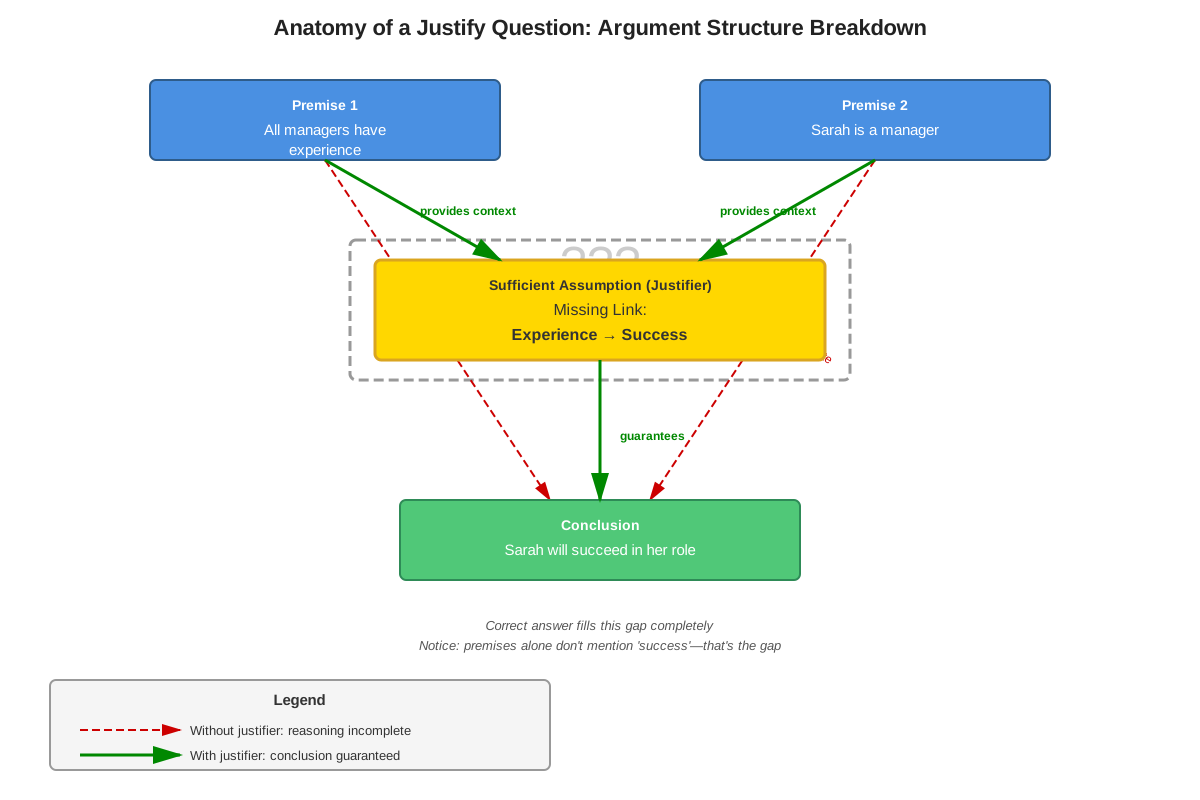
Every justify question presents an argument with a logical gap—a disconnect between what the premises establish and what the conclusion claims. Identifying this gap is the critical first step in solving these questions efficiently. The gap represents the conceptual distance the argument leaps without explicit justification.
Common types of logical gaps include:
| Gap Type | Description | Example Pattern |
|---|---|---|
| Categorical | Premises discuss one category, conclusion another | Premises about "students" → Conclusion about "all young people" |
| Causal | Premises show correlation, conclusion claims causation | Premises show X and Y occur together → Conclusion that X causes Y |
| Temporal | Premises about past/present, conclusion about future | Premises about historical trends → Conclusion about what will happen |
| Scope shift | Premises limited in scope, conclusion broader | Premises about one city → Conclusion about entire nation |
| Evaluative | Premises descriptive, conclusion prescriptive | Premises about what is → Conclusion about what should be |
The Bridge Concept
The correct answer to a justify question functions as a logical bridge that spans the identified gap. This bridge connects the premises to the conclusion by providing a principle, fact, or relationship that makes the inferential leap valid. Visualizing this relationship helps:
Premises → [LOGICAL GAP] → Conclusion
         ↓
    [BRIDGE/ANSWER]
         ↓
Premises + Bridge → Conclusion (guaranteed)
The bridge must be precisely calibrated. If it's too narrow (doesn't fully close the gap), the conclusion still doesn't follow with certainty. If it's too broad (introduces unnecessary information), it may still work but often signals a wrong answer designed to be tempting. The correct bridge is typically the minimal sufficient condition—just enough to guarantee the conclusion, nothing more.
Conditional Logic in Justify Questions
Many justify questions involve conditional reasoning, where the correct answer establishes an if-then relationship that links premises to conclusion. Understanding conditional logic is crucial:
- Sufficient condition: If this is true, the conclusion must follow
- Necessary condition: This must be true for the conclusion to be possible (but doesn't guarantee it)
Justify questions seek sufficient conditions. The correct answer often takes the form: "If [premise concept], then [conclusion concept]." When the argument's premises establish the "if" part, the "then" part (the conclusion) automatically follows.
For example, if an argument concludes "The policy will succeed" based on premises about the policy's features, the correct answer might state: "Any policy with these features will succeed." This conditional statement, combined with the premises confirming the policy has those features, guarantees the conclusion.
The Prephrase Strategy
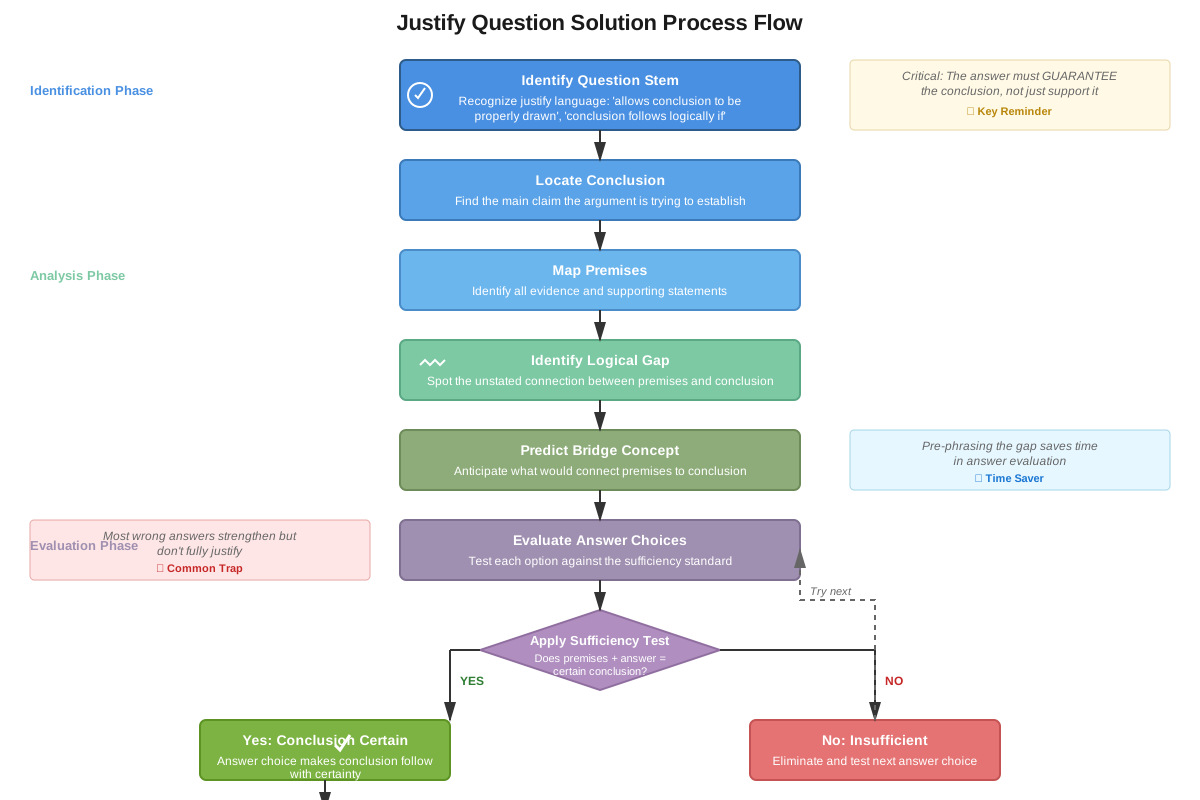
Before examining answer choices, effective test-takers prephrase the logical gap and potential bridges. This involves:
- Identifying the conclusion precisely
- Cataloging what the premises establish
- Articulating the gap: "The premises tell us X, but the conclusion claims Y"
- Predicting what would bridge this gap: "We'd need to know that X guarantees Y"
Prephrasing prevents falling for attractive wrong answers and accelerates answer choice evaluation. Even an imprecise prephrase focuses attention on the logical structure rather than content details.
Wrong Answer Patterns
Justify questions feature predictable wrong answer types:
- Necessary but insufficient: States something that must be true but doesn't guarantee the conclusion
- Strengtheners: Makes the conclusion more likely but not certain
- Irrelevant: Addresses concepts not in the logical gap
- Reversed logic: Provides the conclusion as a premise for something else
- Scope mismatch: Too narrow or too broad to bridge the specific gap
Recognizing these patterns enables efficient elimination and confirms the correct answer by contrast.
Concept Relationships
The concepts within justify the conclusion questions form an interconnected system. The sufficiency standard defines the goal, which requires identifying the logical gap between premises and conclusion. This gap identification enables effective prephrasing of what bridge would close it. Understanding conditional logic provides the framework for constructing and recognizing valid bridges. Knowledge of wrong answer patterns sharpens the ability to distinguish sufficient from merely necessary or strengthening conditions.
This topic connects deeply to prerequisite knowledge. Basic argument structure enables parsing premises from conclusions, which is essential before identifying gaps. Conditional reasoning provides the logical machinery that many justify questions exploit. Assumption identification skills transfer directly, though justify questions demand a higher standard—not just what's assumed, but what would make the assumption sufficient for the conclusion.
Justify questions also relate to other Logical Reasoning question types. They share DNA with necessary assumption questions (both identify unstated premises) but differ in the sufficiency requirement. They connect to strengthen questions (both add support) but demand certainty rather than increased probability. They relate inversely to weaken questions (which identify what would undermine rather than guarantee conclusions). Understanding these relationships creates a comprehensive framework for Logical Reasoning mastery.
The progression flows: Argument Structure → Gap Identification → Assumption Recognition → Sufficiency Evaluation → Answer Selection. Each concept builds on the previous, creating a systematic approach to these challenging questions.
High-Yield Facts
⭐ Justify questions require the answer to make the conclusion follow with absolute certainty, not merely make it more likely—this is the sufficiency standard that distinguishes them from strengthen questions.
⭐ The correct answer to a justify question, when combined with the premises, creates a deductively valid argument—if premises and answer are true, the conclusion must be true.
⭐ Common question stem language includes "properly drawn," "properly inferred," "follows logically," and "enables the conclusion"—these phrases signal the sufficiency requirement.
⭐ Identifying the logical gap between premises and conclusion is the critical first step—the gap reveals what the correct answer must bridge.
⭐ Prephrasing the gap before reading answer choices significantly improves accuracy and speed—articulate what's missing before evaluating options.
- Justify questions typically appear 2-4 times per LSAT, making them a reliable component worth mastering.
- The correct answer often establishes a conditional relationship (if-then) that links premise concepts to conclusion concepts.
- Wrong answers frequently provide necessary conditions that don't guarantee the conclusion or strengthen without ensuring certainty.
- Scope shifts between premises and conclusion create common logical gaps that justify questions exploit.
- The minimal sufficient condition is typically correct—just enough to guarantee the conclusion without excess information.
- Causal arguments (correlation in premises, causation in conclusion) represent a high-frequency justify question pattern.
- Categorical gaps (premises about subset, conclusion about broader category) require answers that establish membership or equivalence.
- The negation test, useful for necessary assumptions, doesn't apply to justify questions—focus instead on sufficiency.
- Time-efficient test-takers spend more time analyzing the argument structure than reading answer choices in justify questions.
- Justify questions reward precision—the correct answer fits the exact gap without introducing irrelevant concepts.
Quick check — test yourself on Justify the conclusion so far.
Try Flashcards →Common Misconceptions
Misconception: Any answer that strengthens the argument is correct for justify questions.
Correction: Justify questions require complete logical certainty, not mere strengthening. An answer might make the conclusion more likely (strengthen) without guaranteeing it follows (justify). The sufficiency standard is absolute—the conclusion must be certain given the premises plus the answer.
Misconception: The correct answer must be realistic or practically true in the real world.
Correction: Justify questions test logical relationships, not factual accuracy. The correct answer might state something unrealistic or even absurd in reality, but if it logically bridges the gap, it's correct. Evaluate answers based on whether they make the conclusion follow, not whether they're believable.
Misconception: Longer, more detailed answer choices are more likely to be correct because they provide more justification.
Correction: The correct answer is typically the minimal sufficient condition—just enough to bridge the gap. Longer answers often introduce irrelevant information or overreach beyond what's needed. Concise answers that precisely address the logical gap are frequently correct.
Misconception: If an answer is necessary for the argument, it must also justify the conclusion.
Correction: Necessary and sufficient conditions are distinct. Something can be necessary (must be true) without being sufficient (guarantees the conclusion). Justify questions seek sufficiency. An answer might be necessary but still leave the conclusion uncertain, making it wrong for justify questions.
Misconception: The correct answer will always use the same terminology as the argument.
Correction: While the correct answer must address the concepts in the logical gap, it may use different words or rephrase ideas. Focus on conceptual relationships rather than exact word matching. The LSAT often tests whether students understand concepts deeply enough to recognize them in varied language.
Misconception: Justify questions and assumption questions are essentially the same and use identical strategies.
Correction: While related, these question types differ fundamentally. Necessary assumption questions ask what must be true (necessary condition), while justify questions ask what would guarantee the conclusion (sufficient condition). The negation test works for assumptions but not justify questions. Justify questions demand a higher logical standard.
Worked Examples
Example 1: Causal Reasoning Gap
Argument:
"A recent study found that employees who work from home three days per week report higher job satisfaction than those who work in the office full-time. The company should therefore implement a hybrid work policy to improve employee morale."
Question:
Which one of the following, if assumed, allows the conclusion to be properly drawn?
Analysis:
- Identify the conclusion: "The company should implement a hybrid work policy to improve employee morale."
- Identify the premises:
- Study shows correlation between working from home three days/week and higher job satisfaction
- Implicit premise: Higher job satisfaction relates to employee morale
- Identify the logical gap:
- Premises show correlation in a study
- Conclusion makes causal claim (policy will improve morale) and prescriptive recommendation (should implement)
- Gaps: (a) correlation doesn't prove causation, (b) study results may not apply to this company, (c) no guarantee the policy would produce the same effect
- Prephrase: We need something establishing that implementing this policy at this company will definitely improve morale—not just that there's a correlation elsewhere.
Answer Choices:
(A) Employee morale is important for company productivity.
(B) Most employees at the company would prefer a hybrid work arrangement.
(C) Implementing policies that increase job satisfaction will improve employee morale at this company.
(D) The employees in the study are similar to employees at this company.
(E) Job satisfaction and employee morale are related concepts.
Evaluation:
(A) Irrelevant: This addresses why morale matters but doesn't bridge the gap between the policy and improved morale. Even if morale is important, we don't know this policy will improve it.
(B) Insufficient: Employee preference doesn't guarantee the policy will improve morale. They might prefer it but still not experience morale improvements, or the preference might not translate to the satisfaction increase.
(C) CORRECT: This provides the bridge. The premises establish that working from home three days/week correlates with increased job satisfaction (in the study). If we assume that implementing policies that increase job satisfaction will improve morale at this company, and if we assume the hybrid policy would increase job satisfaction, then the conclusion follows. This answer provides the causal link and company-specific application needed.
(D) Insufficient: Similarity helps but doesn't guarantee the policy will work the same way at this company. Even with similar employees, other factors might prevent morale improvement.
(E) Insufficient: This is likely necessary (if they're unrelated, the argument fails), but it doesn't guarantee that this specific policy will improve morale at this company.
Key Lesson: The correct answer (C) bridges multiple gaps simultaneously—it establishes causation (policies that increase satisfaction will improve morale), makes it company-specific (at this company), and creates the conditional relationship needed (if satisfaction increases, morale improves).
Example 2: Categorical Scope Shift
Argument:
"All the award-winning novels published this year featured complex, morally ambiguous protagonists. Therefore, readers today prefer stories with morally ambiguous main characters."
Question:
The conclusion follows logically if which one of the following is assumed?
Analysis:
- Identify the conclusion: "Readers today prefer stories with morally ambiguous main characters."
- Identify the premises:
- All award-winning novels this year had morally ambiguous protagonists
- Identify the logical gap:
- Premises: about award-winning novels (subset)
- Conclusion: about what readers prefer (general preference)
- Gaps: (a) award-winning novels may not reflect reader preference, (b) awards may be based on criteria other than reader preference, (c) novels are only one type of story
- Prephrase: We need something establishing that award-winning novels reflect what readers prefer, or that the characteristics of award-winning novels indicate reader preferences.
Answer Choices:
(A) Award-winning novels are always the most popular with readers.
(B) Novels that win awards reflect the preferences of readers generally.
(C) Morally ambiguous protagonists make novels more likely to win awards.
(D) Most novels published this year featured morally ambiguous protagonists.
(E) Readers' preferences determine which novels win awards.
Evaluation:
(A) Overreach but potentially sufficient: This is stronger than needed but would work. If award-winners are always most popular, and they all have morally ambiguous protagonists, readers must prefer this feature. However, "always" is extreme, and (B) or (E) might be more precise.
(B) CORRECT: This directly bridges the gap. If award-winning novels reflect reader preferences generally, and all award-winners this year had morally ambiguous protagonists, then readers must prefer this characteristic. This establishes the connection between the subset (award-winners) and the general category (readers' preferences).
(C) Reversed logic: This explains why novels with this feature win awards, but doesn't establish that awards reflect reader preference. Awards might be based on critic opinion, not reader preference.
(D) Insufficient: Even if most novels had this feature, that doesn't tell us readers prefer it. Publishers might be pushing this trend regardless of reader preference.
(E) Close but insufficient: This establishes that preferences determine awards, but doesn't specify that award-winners reflect those preferences. Preferences might determine awards through complex mechanisms that don't make award-winners representative of general preferences.
Key Lesson: The correct answer (B) precisely bridges the categorical gap between the specific subset (award-winning novels) and the general category (reader preferences). It establishes that the subset is representative of the whole, making the inference valid.
Exam Strategy
Systematic Approach
Adopt this five-step process for every justify question:
- Identify and isolate the conclusion (5-10 seconds): Find the main claim the argument makes. Circle or mentally note it.
- Map the premises (10-15 seconds): Quickly catalog what evidence the argument provides. Don't get lost in details—focus on main concepts.
- Articulate the gap (10-15 seconds): State in your own words what's missing. "The premises tell us X, but the conclusion claims Y. We need to know that X guarantees Y."
- Prephrase the bridge (5-10 seconds): Predict what would close the gap. Even a rough prephrase focuses your evaluation.
- Evaluate answers systematically (30-40 seconds): Test each answer by asking: "If I add this to the premises, does the conclusion become absolutely certain?"
This structured approach should take 60-90 seconds total, keeping you on pace for the section.
Trigger Words and Phrases
Watch for these indicators in question stems:
- "Properly drawn/inferred": Signals deductive validity requirement
- "Follows logically": Demands certainty, not probability
- "Enables the conclusion": The answer must make the conclusion possible with certainty
- "If assumed": The answer provides an unstated premise
- "Principle, if valid": Often indicates a broader rule that would justify the specific conclusion
In arguments, watch for:
- Scope shifts: Different categories or groups in premises versus conclusion
- Causal language: "Causes," "leads to," "results in" in conclusions with only correlational premises
- Prescriptive conclusions: "Should," "must," "ought to" require normative bridges
- Temporal shifts: Past/present evidence for future conclusions
- Absolute language: "All," "none," "always," "never" in conclusions require strong justification
Process of Elimination Tips
Eliminate answers that:
- Address the wrong gap: If the gap is causal but the answer addresses scope, eliminate immediately
- Use the negation test: If negating the answer doesn't destroy the argument, it might be insufficient (though this test is less reliable for justify than assumption questions)
- Strengthen without guaranteeing: Ask "Could the premises and this answer be true while the conclusion is false?" If yes, eliminate
- Introduce new concepts: Answers that bring in ideas unrelated to the premise-conclusion gap are typically wrong
- Are too narrow: If the answer addresses only part of the gap, it's insufficient
Time Allocation
Justify questions warrant slightly more time than average Logical Reasoning questions due to their complexity:
- Fast questions (clear gap, simple structure): 60-75 seconds
- Average questions: 75-90 seconds
- Complex questions (multiple gaps, abstract concepts): 90-120 seconds
If a question exceeds 2 minutes, make your best guess and move on. The time investment in mastering the systematic approach pays dividends in accuracy and speed over time.
Confidence Checks
Before selecting an answer, verify:
- ✓ Does this answer address the specific gap I identified?
- ✓ If the premises and this answer are true, must the conclusion be true?
- ✓ Am I confusing "makes more likely" with "guarantees"?
- ✓ Does this answer introduce unnecessary information beyond bridging the gap?
If you can confidently answer yes to the first two questions and no to the last two, select the answer and move forward.
Memory Techniques
The BRIDGE Acronym
Remember the systematic approach with BRIDGE:
- Break down the argument (identify conclusion and premises)
- Recognize the gap (what's missing?)
- Imagine the connection (prephrase)
- Distinguish sufficient from necessary (sufficiency standard)
- Guarantee test (does this make conclusion certain?)
- Eliminate insufficient answers
The Certainty Mantra
When evaluating answers, repeat: "Not just likely—CERTAIN." This mental reminder prevents the common error of selecting strengtheners instead of justifiers.
The Gap Categories Mnemonic: CASTE
Remember common gap types with CASTE:
- Causal (correlation → causation)
- Analogy (comparison gaps)
- Scope (subset → broader category)
- Temporal (past/present → future)
- Evaluative (descriptive → prescriptive)
Visualization: The Bridge Over Troubled Logic
Picture the argument as two cliffs (premises and conclusion) with a chasm between them (the logical gap). The correct answer is a bridge that completely spans the gap—not a rope that gets you partway across (strengthener) or a support beam that's necessary but doesn't complete the bridge (necessary assumption). You need the full bridge to cross with certainty.
The Sufficiency Question
Before selecting an answer, ask yourself: "If this is true, is the conclusion GUARANTEED, or just more likely?" This single question, consistently applied, dramatically improves accuracy.
Summary
Justify the conclusion questions demand that test-takers identify answer choices that, when combined with an argument's premises, make the conclusion follow with absolute logical certainty. These questions test the sufficiency standard—the highest logical bar on the LSAT—requiring deductive validity rather than mere strengthening. Success requires a systematic approach: identify the conclusion, map the premises, articulate the logical gap between them, prephrase what would bridge that gap, and evaluate answers by whether they guarantee the conclusion. Common gaps involve scope shifts, causal reasoning, temporal projections, and evaluative leaps. The correct answer functions as a logical bridge, providing the minimal sufficient condition that makes the conclusion certain. Distinguishing justify questions from related types—particularly necessary assumptions and strengthen questions—is crucial, as is recognizing that sufficiency differs fundamentally from necessity. Mastery comes from recognizing gap patterns, understanding conditional logic, and consistently applying the certainty standard when evaluating answer choices.
Key Takeaways
- Justify questions require absolute certainty: The correct answer must guarantee the conclusion follows, not merely make it more likely—this sufficiency standard distinguishes them from strengthen questions
- Identify the logical gap first: Before examining answers, articulate what's missing between premises and conclusion—this gap reveals what the correct answer must bridge
- Prephrase the bridge: Predict what would close the gap before reading answer choices to avoid attractive wrong answers and improve efficiency
- Common gaps follow patterns: Scope shifts, causal reasoning, temporal projections, and evaluative leaps appear frequently—recognizing these patterns accelerates analysis
- The minimal sufficient condition wins: The correct answer typically provides just enough to guarantee the conclusion without introducing unnecessary information
- Distinguish necessary from sufficient: Something can be necessary for an argument without being sufficient to justify the conclusion—justify questions demand sufficiency
- Apply the certainty test: Before selecting an answer, verify that if the premises and answer are true, the conclusion must be true with no exceptions
Related Topics
Necessary Assumption Questions: These questions ask what must be true for an argument to work, testing necessary rather than sufficient conditions. Mastering justify questions provides the foundation for understanding assumptions, as both require gap identification, but necessary assumptions use the negation test while justify questions demand sufficiency evaluation.
Strengthen Questions: These questions ask what makes a conclusion more likely without requiring certainty. Understanding the distinction between strengthening (increasing probability) and justifying (guaranteeing) is crucial for avoiding confusion between these related question types.
Conditional Logic and Formal Logic: Advanced study of if-then relationships, contrapositives, and logical operators deepens understanding of how justify questions construct valid arguments. Many justify questions explicitly test conditional reasoning.
Flaw Questions: These questions identify logical errors in arguments, often highlighting the same gaps that justify questions ask you to bridge. Understanding flaws illuminates what's missing in arguments, making gap identification more intuitive.
Principle Questions: These questions ask for general rules that justify specific conclusions or identify principles underlying arguments. They represent an application of justify reasoning to broader contexts, requiring similar analytical skills.
Practice CTA
Now that you've mastered the core concepts behind justify the conclusion questions, it's time to put your knowledge into action. Attempt the practice questions designed for this topic, focusing on applying the systematic BRIDGE approach to each question. Pay special attention to identifying logical gaps and distinguishing sufficient from merely necessary conditions. Use the flashcards to reinforce key concepts like the sufficiency standard, common gap types, and wrong answer patterns. Remember: justify questions reward precision and systematic thinking. Each practice question you complete strengthens your pattern recognition and builds the confidence needed to tackle these high-value questions efficiently on test day. Your investment in mastering this challenging question type will pay dividends across your entire LSAT performance!
Sign up free to keep reading
Create a free AnvayaPrep account to finish this LSAT guide on Justify the conclusion — plus flashcards and practice questions.