Overview
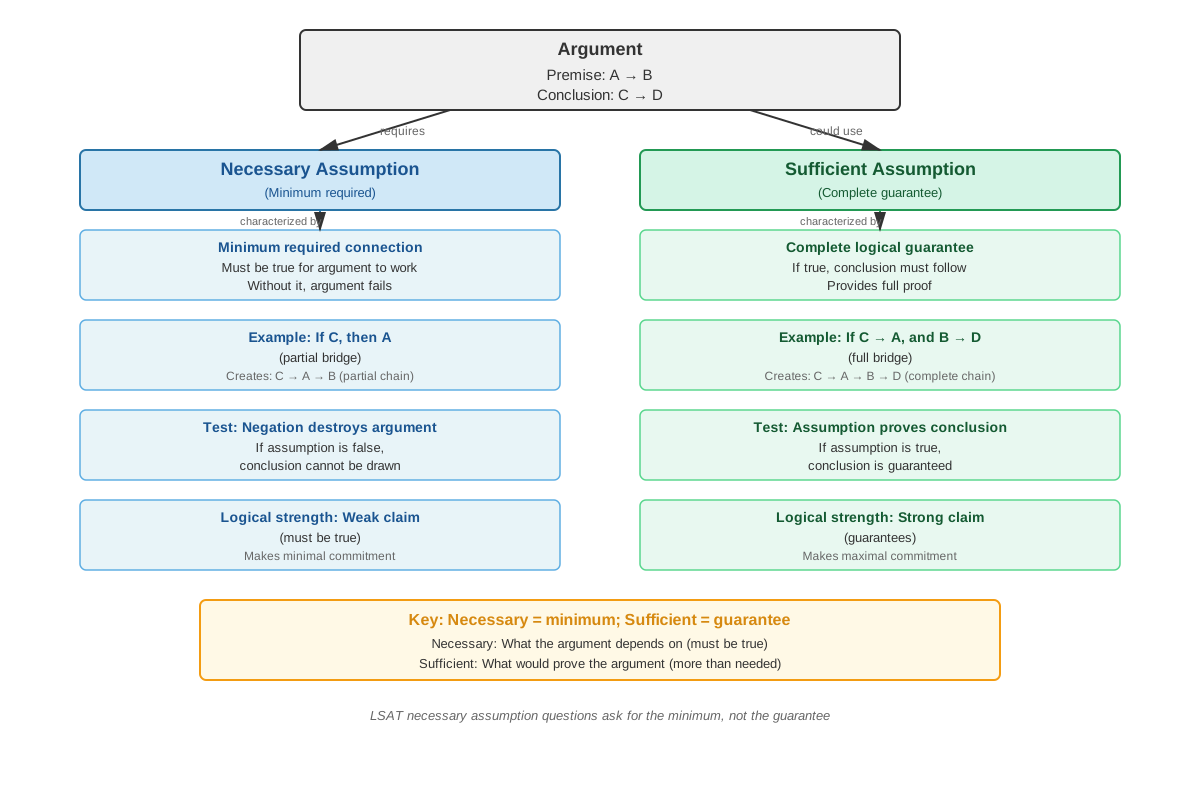
Necessary assumption with formal logic represents one of the most challenging and high-yield question types on the LSAT Logical Reasoning section. These questions combine the abstract rigor of formal logic—including conditional statements, contrapositives, and logical operators—with the critical thinking skills required to identify unstated premises that an argument depends upon. Unlike sufficient assumption questions that ask what would guarantee a conclusion, necessary assumption questions require test-takers to identify what must be true for an argument to work, even if that assumption alone doesn't prove the conclusion.
The LSAT frequently tests this concept because it mirrors the analytical reasoning skills essential for legal practice: identifying the hidden premises underlying legal arguments, recognizing logical gaps in reasoning, and understanding the conditional relationships that structure legal rules and precedents. When formal logic enters the picture, these questions become particularly demanding because they require fluency in translating everyday language into logical notation, manipulating conditional statements, and recognizing when an argument illegitimately moves from one logical category to another.
Mastering necessary assumption with formal logic builds directly upon foundational skills in both assumption questions generally and formal logic specifically. This topic sits at the intersection of two major Logical Reasoning skill sets: the ability to identify logical gaps (tested in all assumption questions) and the ability to work with conditional reasoning (tested across multiple question types including Must Be True, Sufficient Assumption, and Flaw questions). Success with these questions demonstrates advanced logical reasoning capabilities and typically correlates with scoring in the upper percentiles on the LSAT.
Learning Objectives
- [ ] Identify how Necessary assumption with formal logic appears in LSAT questions
- [ ] Explain the reasoning pattern behind Necessary assumption with formal logic
- [ ] Apply Necessary assumption with formal logic to solve LSAT-style problems accurately
- [ ] Translate conditional statements from natural language into formal logic notation
- [ ] Recognize illegal conditional reversals and negations that create logical gaps
- [ ] Apply the negation test to verify necessary assumptions in formal logic contexts
- [ ] Distinguish between necessary and sufficient assumptions when formal logic is present
Prerequisites
- Basic conditional logic: Understanding "if-then" statements, sufficient and necessary conditions, contrapositives, and logical operators is essential because formal logic questions build directly on these structures
- Standard necessary assumption questions: Familiarity with identifying logical gaps and applying the negation test provides the foundation for recognizing what makes formal logic versions more complex
- Argument structure analysis: The ability to identify premises, conclusions, and logical gaps enables students to spot where formal logic creates specific vulnerabilities in reasoning
- Logical indicators: Recognition of conclusion indicators ("therefore," "thus") and premise indicators ("because," "since") helps parse arguments before applying formal logic analysis
Why This Topic Matters
In legal reasoning, arguments frequently depend on conditional relationships: "If a contract lacks consideration, then it is unenforceable" or "All defendants have the right to counsel." Attorneys must identify when these conditional claims contain hidden assumptions—when the logical structure doesn't quite connect premises to conclusions. The LSAT tests this skill intensively because it predicts success in law school case analysis and legal writing.
Necessary assumption with formal logic questions appear in approximately 15-20% of Logical Reasoning questions across both LR sections, making them among the most frequent question types. They typically appear as medium to difficult questions, often positioned in the second half of each section. The LSAT has increasingly emphasized formal logic in recent years, with many test-takers reporting 3-5 questions per test that require explicit conditional reasoning within assumption contexts.
These questions commonly appear in several formats: arguments that move from a conditional statement in the premises to a categorical conclusion; arguments that chain multiple conditional statements together with a missing link; arguments that confuse necessary and sufficient conditions; and arguments that apply a general conditional rule to a specific case without establishing that the case meets the triggering condition. Recognizing these patterns enables efficient question analysis and accurate answer selection.
Core Concepts
Understanding Necessary Assumptions in Formal Logic Contexts
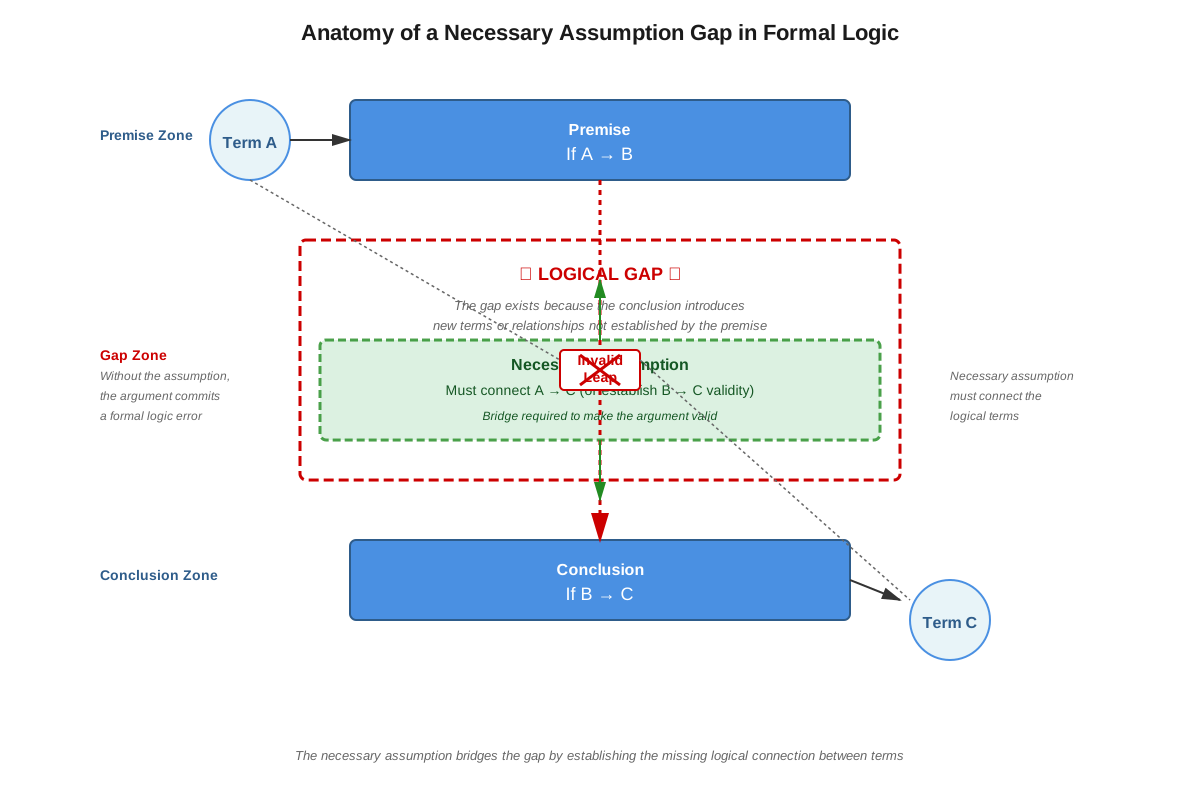
A necessary assumption is an unstated premise that must be true for an argument's conclusion to follow logically from its stated premises. In formal logic contexts, these assumptions typically involve conditional relationships—statements of the form "If A, then B" (symbolized as A → B). The lsat necessary assumption with formal logic questions test whether students can identify when an argument's conditional reasoning contains a logical gap that requires an additional conditional link or clarification.
The key distinction in formal logic contexts is that the assumption must preserve or establish proper conditional relationships. Common gaps include: moving from a sufficient condition to a necessary condition without justification, applying a conditional rule without establishing its trigger condition is met, or chaining conditionals together without the proper connecting link.
The Structure of Conditional Statements
Conditional statements form the backbone of formal logic on the LSAT. A conditional has two parts: the sufficient condition (the "if" part, which is enough to guarantee the result) and the necessary condition (the "then" part, which must occur whenever the sufficient condition occurs).
For example: "If someone is a lawyer, then they passed the bar exam" (Lawyer → Passed Bar). Here, being a lawyer is sufficient to know they passed the bar, and passing the bar is necessary to be a lawyer.
The contrapositive is the logically equivalent statement formed by negating both conditions and reversing their order: "If someone did not pass the bar exam, then they are not a lawyer" (~Passed Bar → ~Lawyer). The contrapositive is always true when the original conditional is true.
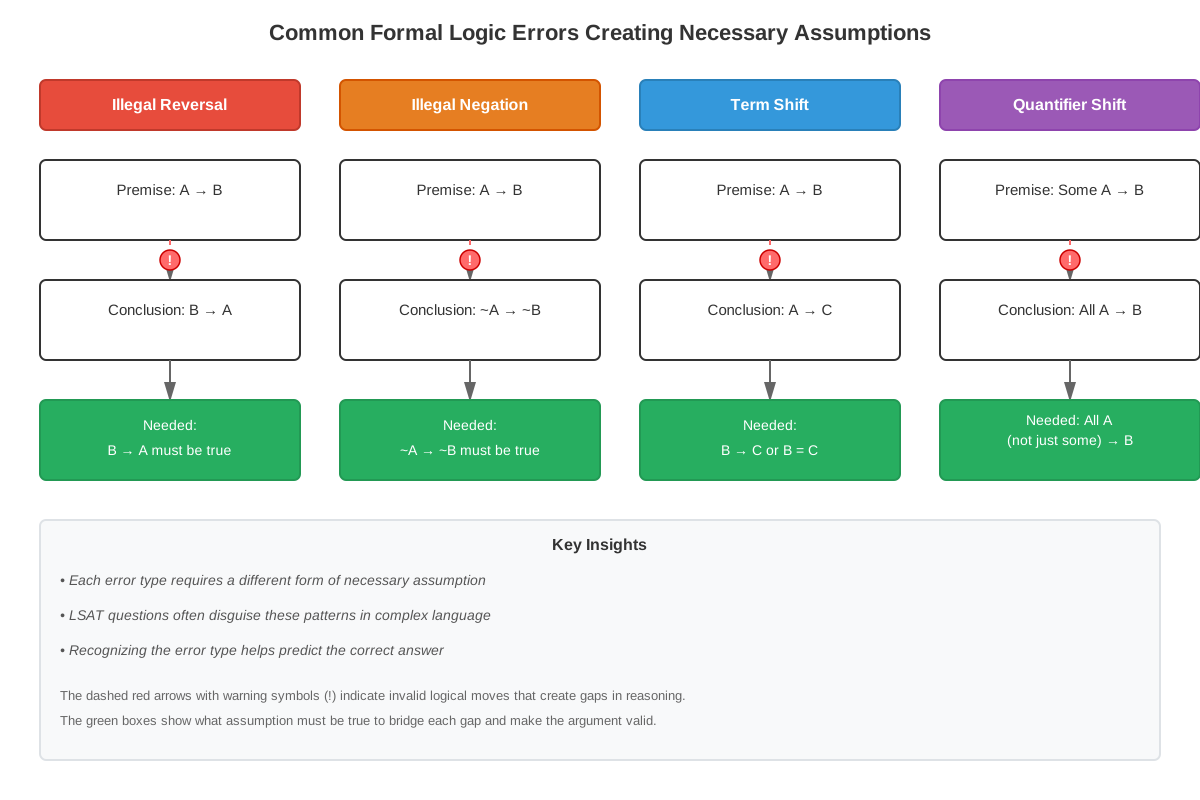
Invalid transformations create logical gaps that necessary assumptions must fill:
- Illegal reversal: "If passed the bar, then a lawyer" (Passed Bar → Lawyer) - NOT valid
- Illegal negation: "If not a lawyer, then did not pass the bar" (~Lawyer → ~Passed Bar) - NOT valid
Common Formal Logic Gaps Requiring Assumptions
| Gap Type | Structure | Required Assumption Type |
|---|---|---|
| Missing conditional link | Premise: A → B; Conclusion: A → C | Must assume B → C to complete chain |
| Illegal reversal | Premise: A → B; Conclusion: B → A | Must assume the reverse relationship holds |
| Unestablished trigger | Premise: A → B; Conclusion: B | Must assume A is true (trigger is met) |
| Category confusion | Premise: All X are Y; Conclusion: All Y are Z | Must establish connection between Y and Z |
| Scope shift | Premise: Some A → B; Conclusion: All A → B | Must assume no exceptions exist |
The Negation Test for Formal Logic Assumptions
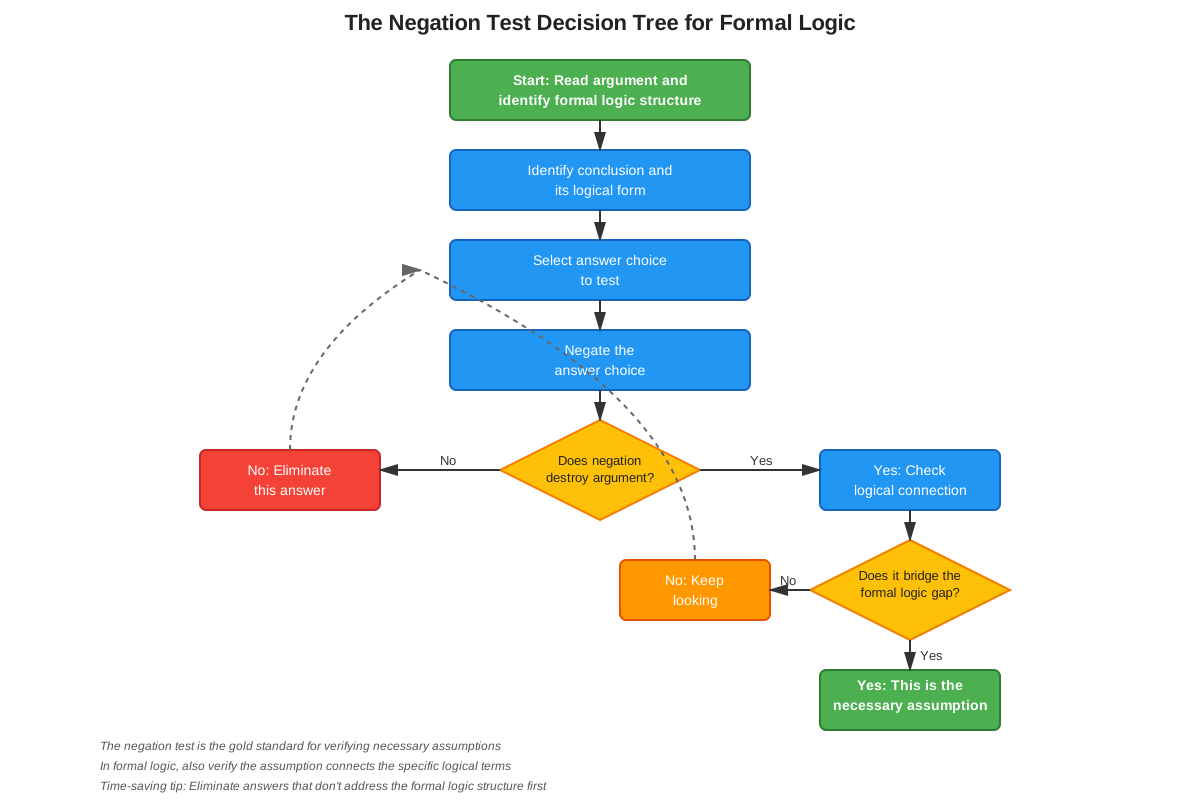
The negation test is the gold standard for verifying necessary assumptions: if you negate a necessary assumption, the argument must fall apart. In formal logic contexts, this means negating the conditional relationship or the existence of a required logical link.
For example, if an argument requires the assumption "All board members are elected officials" (Board Member → Elected), negating this produces "Some board members are not elected officials" or "Board Member → ~Elected is possible." If this negation destroys the argument's reasoning, the original statement is indeed a necessary assumption.
The negation test is particularly powerful for formal logic because it helps distinguish between:
- Necessary assumptions: Without them, the conclusion cannot follow
- Sufficient assumptions: They guarantee the conclusion but aren't required
- Strengtheners: They make the argument better but aren't essential
Translating Natural Language into Formal Logic
LSAT arguments rarely present formal logic in symbolic notation. Instead, they use natural language that must be translated into conditional form. Key translation patterns include:
Sufficient condition indicators (these introduce the "if" part):
- If, when, whenever, every time
- All, any, each, every
- People who, those who
Necessary condition indicators (these introduce the "then" part):
- Then, must, requires, needs
- Only, only if, only when
- Unless (special case: "A unless B" means "If not B, then A")
For example: "Every student who graduates with honors receives a scholarship" translates to: Graduate with Honors → Receives Scholarship.
Recognizing Conditional Reasoning Patterns in Arguments
Assumption questions involving formal logic typically follow predictable patterns:
- Conditional chain with missing link: The argument presents A → B and concludes A → C, requiring the assumption B → C
- Application without established trigger: The argument states "If X, then Y" and concludes Y, requiring the assumption that X is true
- Reversal requiring justification: The argument uses a conditional in one direction but needs it to work in reverse
- Quantifier shift: The argument moves from "some" to "all" or vice versa without justification
Recognizing these patterns allows for rapid identification of the logical gap and prediction of the correct answer before reviewing answer choices.
Concept Relationships
The concepts within necessary assumption with formal logic form an interconnected system. Understanding conditional statements (sufficient and necessary conditions) provides the foundation for recognizing when arguments contain illegal reversals or negations, which in turn reveals the logical gaps that necessary assumptions must fill. The negation test serves as the verification mechanism, confirming whether an identified assumption is truly necessary by demonstrating that its negation destroys the argument.
This topic connects backward to prerequisite knowledge of basic conditional logic—students must fluently work with contrapositives and recognize valid versus invalid conditional transformations. It connects forward to sufficient assumption questions (where the goal is to guarantee rather than merely enable the conclusion) and flaw questions (where the task is to identify rather than fix the conditional reasoning error).
The relationship map flows as follows:
Conditional Statement Structure → enables recognition of → Valid vs. Invalid Transformations → reveals → Logical Gaps in Arguments → which require → Necessary Assumptions → verified by → Negation Test → distinguishing them from → Sufficient Assumptions and Strengtheners
Within the broader assumption questions family, formal logic versions represent a specialized subset where the gap is specifically about conditional relationships rather than causal reasoning, representativeness, or other logical connections.
High-Yield Facts
⭐ A necessary assumption, when negated, must destroy the argument's reasoning—this is the definitive test for necessary assumptions in formal logic contexts
⭐ The contrapositive (negating both parts and reversing) is the only valid transformation of a conditional statement; reversals and negations without both operations are invalid
⭐ When an argument chains conditionals (A → B, therefore A → C), the missing link (B → C) is virtually always the necessary assumption
⭐ "Only if" introduces a necessary condition (the "then" part), not a sufficient condition: "X only if Y" means X → Y
⭐ Unless statements require special translation: "A unless B" means "If not B, then A" (~B → A)
- Necessary assumptions must be true for the conclusion to follow, but they don't have to guarantee the conclusion (that's sufficient assumptions)
- When an argument applies a general conditional rule to a specific case, the necessary assumption typically establishes that the case meets the trigger condition
- Formal logic necessary assumptions often involve establishing that categories overlap or connect in ways the premises don't explicitly state
- The correct answer to a necessary assumption question will often feel "too weak" compared to wrong answers that are actually sufficient assumptions
- Extreme language ("all," "every," "never") in answer choices is often wrong for necessary assumptions because the argument doesn't require such strong claims
Quick check — test yourself on Necessary assumption with formal logic so far.
Try Flashcards →Common Misconceptions
Misconception: Necessary assumptions must be sufficient to prove the conclusion → Correction: Necessary assumptions only need to be required for the argument to work; they can be true while the argument still has other problems. Sufficient assumptions guarantee the conclusion, but necessary assumptions merely enable it.
Misconception: Reversing a conditional statement is valid if it "makes sense" in context → Correction: Conditional logic is formal and context-independent. "If lawyer, then passed bar" does NOT mean "if passed bar, then lawyer"—many non-lawyers pass the bar. Only the contrapositive is valid.
Misconception: The negation test means choosing the opposite extreme → Correction: Negating "all" produces "some are not" (not "none"), and negating "some" produces "none" (not "all"). Proper logical negation is precise, not simply flipping to the opposite extreme.
Misconception: "Only" and "only if" mean the same thing in formal logic → Correction: "Only X are Y" means Y → X (being Y is sufficient for being X), while "X only if Y" means X → Y (being X is sufficient for being Y). These are converses of each other.
Misconception: If an answer choice strengthens the argument, it must be a necessary assumption → Correction: Many statements strengthen an argument without being necessary. The negation test distinguishes necessary assumptions (negation destroys the argument) from mere strengtheners (negation weakens but doesn't destroy the argument).
Misconception: Formal logic questions require memorizing complex symbolic notation → Correction: While notation can be helpful, the LSAT tests logical reasoning, not symbolic manipulation. Understanding the relationships (sufficient/necessary, contrapositive, valid/invalid transformations) matters more than formal symbols.
Worked Examples
Example 1: Conditional Chain with Missing Link
Argument: "All members of the ethics committee have legal training. Therefore, all members of the ethics committee understand judicial precedent."
Analysis:
- Premise (translated): Ethics Committee Member → Legal Training
- Conclusion (translated): Ethics Committee Member → Understands Judicial Precedent
- Logical gap: The argument chains from ethics committee membership to legal training, then to understanding precedent, but the connection between legal training and understanding precedent is unstated
Applying the negation test: The necessary assumption must be "Legal Training → Understands Judicial Precedent" (or in natural language: "Anyone with legal training understands judicial precedent" or "Legal training is sufficient for understanding judicial precedent").
If we negate this: "Some people with legal training do NOT understand judicial precedent," the argument falls apart. Even though all ethics committee members have legal training, we can no longer conclude they understand judicial precedent.
Wrong answer trap: "Understanding judicial precedent requires legal training" (Understands Precedent → Legal Training). This is the illegal reversal—it's the contrapositive of what we need. This would be necessary if the argument went the other direction.
Connection to learning objectives: This example demonstrates identifying the formal logic pattern (conditional chain), explaining the reasoning gap (missing middle link), and applying the negation test to verify the necessary assumption.
Example 2: Application Without Established Trigger
Argument: "The museum's acquisition policy states that any artwork donated by a board member will be displayed in the main gallery. The sculpture by Chen will be displayed in the main gallery."
Analysis:
- Premise (translated): Donated by Board Member → Displayed in Main Gallery
- Conclusion: Chen's sculpture will be displayed in main gallery
- Logical gap: The argument concludes that Chen's sculpture will be displayed, but never establishes that the sufficient condition (donation by a board member) is met
Applying the negation test: The necessary assumption must be "Chen's sculpture was donated by a board member" (or "Chen is a board member who donated the sculpture").
If we negate this: "Chen's sculpture was NOT donated by a board member," the argument fails. The conditional rule doesn't apply, and we have no basis for concluding the sculpture will be displayed in the main gallery. Other artworks might be displayed there for different reasons, but this particular argument depends on the rule stated in the premise.
Wrong answer trap: "Only artworks donated by board members are displayed in the main gallery" (Displayed in Main Gallery → Donated by Board Member). This is the illegal reversal and is far too strong—it's actually a sufficient assumption that would guarantee the conclusion, but the argument doesn't require this strong claim.
Additional consideration: Notice that the necessary assumption doesn't need to explain WHY Chen's sculpture will be displayed—it only needs to establish that the stated rule applies to this case. This illustrates how necessary assumptions in formal logic contexts are often narrowly focused on the logical structure rather than broader explanatory factors.
Exam Strategy
When approaching necessary assumption with formal logic questions on the LSAT, follow this systematic process:
Step 1: Identify the question type. Look for language like "assumption required," "depends on assuming," or "presupposes which one of the following." The presence of conditional language in the stimulus signals a formal logic approach.
Step 2: Translate conditionals into clear logical form. As you read the argument, identify conditional statements and mentally note (or physically diagram) their structure. Watch for sufficient condition indicators (if, all, every) and necessary condition indicators (then, only, requires).
Step 3: Identify the conclusion and map the logical path. Determine what the argument is trying to prove and trace how the premises connect (or fail to connect) to that conclusion. Look for gaps in conditional chains, applications without established triggers, or illegal reversals.
Step 4: Predict the assumption before reviewing answers. Based on the logical gap, formulate what must be true. This prediction acts as a filter for evaluating answer choices efficiently.
Step 5: Apply the negation test to contenders. For any answer choice that seems possible, negate it and ask: "Does this negation destroy the argument?" If yes, it's necessary. If the argument merely becomes weaker but could still work, it's not necessary.
Exam Tip: Trigger phrases that signal formal logic necessary assumptions include: "all," "every," "any," "only," "unless," "requires," "must," and "necessary." When you see these in the stimulus, immediately shift to formal logic analysis mode.
Time allocation: Spend 1:15-1:30 on these questions. The additional 15-30 seconds beyond the standard 1:00 per question is justified because formal logic questions reward careful analysis and the negation test, which prevents costly errors. However, if you're stuck after 1:30, make your best guess and move on—no single question is worth derailing your timing.
Process of elimination tips specific to formal logic:
- Eliminate answer choices that are illegal reversals or negations of stated premises
- Eliminate answer choices with extreme language ("all," "never," "only") unless the argument's logic absolutely requires that strength
- Eliminate answer choices that would be sufficient assumptions (they guarantee the conclusion) when the question asks for necessary assumptions
- Eliminate answer choices that address the wrong part of the conditional chain or apply to the wrong terms
Memory Techniques
Mnemonic for valid conditional transformations: "COP" - Contrapositive Only Permitted. Only the contrapositive (negate both, reverse order) is a valid transformation of a conditional statement.
Visualization for conditional chains: Picture a chain with links. Each conditional is a link (A → B is one link, B → C is another). If the argument jumps from A to C without the B → C link, visualize the broken chain—that missing link is your necessary assumption.
Acronym for "only if" translation: "ONIT" - Only Necessary Introduces Then. "Only if" introduces the necessary condition (the "then" part), so "X only if Y" means X → Y.
Memory device for the negation test: "NADA" - Negate Assumption, Does Argument collapse? If negating the assumption makes the argument fall apart, it's necessary.
Visualization for necessary vs. sufficient: Picture necessary assumptions as the foundation of a building—without them, the structure (argument) collapses. Sufficient assumptions are like a crane that lifts the conclusion into place—helpful and powerful, but the building could potentially stand without that particular crane if other support exists.
Summary
Necessary assumption with formal logic questions test the ability to identify unstated premises required for arguments containing conditional reasoning. These questions combine two critical LSAT skills: recognizing logical gaps in arguments and working fluently with conditional statements (if-then relationships). The key to mastering this topic is understanding that necessary assumptions in formal logic contexts typically involve establishing missing conditional links, confirming that trigger conditions are met, or justifying transformations of conditional statements. The negation test—checking whether negating an assumption destroys the argument—provides the definitive method for verifying necessary assumptions. Common patterns include conditional chains with missing links, applications of rules without established triggers, and illegal reversals requiring justification. Success requires translating natural language into clear conditional form, recognizing valid transformations (only the contrapositive), and distinguishing necessary assumptions (required for the argument to work) from sufficient assumptions (guarantee the conclusion) and mere strengtheners (improve but aren't essential to the argument).
Key Takeaways
- Necessary assumptions must be true for the argument to work, verified by the negation test: if negating the assumption destroys the argument, it's necessary
- Conditional chains with missing links are the most common formal logic pattern—when premises give A → B and the conclusion claims A → C, the assumption is virtually always B → C
- Only the contrapositive (negate both parts and reverse) is a valid transformation of conditionals; reversals and simple negations create logical gaps
- "Only if" introduces the necessary condition (then part): "X only if Y" translates to X → Y, not Y → X
- Necessary assumptions often feel "weaker" than wrong answers because they only need to enable the conclusion, not guarantee it—extreme language is usually wrong
- Translate conditional language systematically: identify sufficient condition indicators (if, all, every) and necessary condition indicators (then, only, requires) to map the logical structure
- Distinguish necessary assumptions from sufficient assumptions and strengtheners by applying the negation test—only necessary assumptions, when negated, make the argument completely fail
Related Topics
Sufficient Assumption Questions with Formal Logic: These questions ask what would guarantee the conclusion rather than what's merely required. Mastering necessary assumptions provides the foundation for understanding sufficient assumptions, as both involve identifying logical gaps, but sufficient assumptions require stronger, more complete logical bridges.
Flaw Questions Involving Conditional Reasoning: Instead of fixing the logical gap (as in assumption questions), flaw questions ask students to identify and describe the error. Understanding necessary assumptions helps recognize when arguments commit conditional reasoning flaws like illegal reversals or negations.
Must Be True Questions with Conditional Logic: These questions test the ability to derive valid inferences from conditional statements. The same formal logic skills—working with contrapositives, chaining conditionals, and avoiding invalid transformations—apply to both assumption questions and inference questions.
Parallel Reasoning with Formal Logic: These questions require matching the logical structure of arguments, often involving conditional reasoning patterns. Mastery of formal logic in assumption contexts transfers directly to recognizing and matching conditional structures in parallel reasoning questions.
Practice CTA
Now that you've mastered the core concepts of necessary assumption with formal logic, it's time to put your knowledge into practice. Work through the practice questions systematically, applying the negation test and translating conditional statements as you've learned. Use the flashcards to reinforce your recognition of conditional patterns and valid transformations. Remember: these questions are highly learnable—the patterns repeat, and with deliberate practice, you'll develop the instinct to spot logical gaps and predict necessary assumptions before even looking at the answer choices. Each practice question you complete builds the pattern recognition and logical fluency that translates directly into points on test day. You've got this!
Sign up free to keep reading
Create a free AnvayaPrep account to finish this LSAT guide on Necessary assumption with formal logic — plus flashcards and practice questions.