Overview
The negation test is one of the most powerful and reliable techniques for solving assumption questions on the LSAT's Logical Reasoning section. This method provides a systematic approach to identifying necessary assumptions—those unstated premises that an argument absolutely requires to reach its conclusion. When students master the negation test, they gain a decisive advantage on one of the most frequently tested question types in Logical Reasoning, transforming what many consider challenging questions into straightforward, methodical exercises.
At its core, the negation test operates on a simple but profound logical principle: if an assumption is truly necessary for an argument, then denying that assumption must cause the argument to fall apart. This technique is particularly valuable because it eliminates the ambiguity that often plagues assumption questions. Rather than relying on intuition about what "seems" necessary, students can apply a concrete test that definitively reveals whether a statement is required for the argument's validity. The negation test serves as both a verification tool for answer choices that appear promising and a elimination mechanism for attractive distractors.
Understanding the lsat negation test connects directly to broader concepts in formal logic and critical reasoning. Assumption questions themselves bridge the gap between recognizing argument structure and evaluating argument validity—two fundamental skills tested throughout the LSAT. The negation test specifically reinforces understanding of necessary versus sufficient conditions, the distinction between premises and conclusions, and the concept of logical dependency. Mastering this technique not only improves performance on assumption questions but also strengthens analytical skills applicable to strengthen/weaken questions, flaw questions, and even Reading Comprehension passages that require identifying implicit reasoning.
Learning Objectives
- [ ] Identify how Negation test appears in LSAT questions
- [ ] Explain the reasoning pattern behind Negation test
- [ ] Apply Negation test to solve LSAT-style problems accurately
- [ ] Distinguish between necessary and sufficient assumptions using the negation test
- [ ] Correctly negate complex statements including those with conditional logic
- [ ] Evaluate answer choices systematically by applying the negation test to eliminate incorrect options
Prerequisites
- Argument structure identification: Recognizing premises, conclusions, and the logical relationship between them is essential because the negation test requires understanding what the argument claims and what evidence supports it.
- Basic formal logic: Familiarity with conditional statements, necessary versus sufficient conditions, and logical operators enables proper negation of complex answer choices.
- Assumption question recognition: Understanding what constitutes an assumption (an unstated premise required for the argument) provides the foundation for knowing when to apply the negation test.
- Answer choice analysis skills: The ability to parse answer choices carefully and understand their precise meaning is crucial for correctly negating statements and evaluating their impact on arguments.
Why This Topic Matters
The negation test represents one of the highest-yield techniques for LSAT preparation because assumption questions appear with remarkable consistency across every administration of the exam. Logical Reasoning sections typically contain 24-26 questions each, and assumption questions (including both "necessary assumption" and "sufficient assumption" variants) account for approximately 4-6 questions per section. This translates to roughly 8-12 questions across the two Logical Reasoning sections—representing nearly 20% of the entire Logical Reasoning score. Given that Logical Reasoning comprises half of the total LSAT score, mastering the negation test directly impacts performance on approximately 10% of the entire exam.
Beyond raw frequency, assumption questions tend to appear at medium to high difficulty levels, making them critical for score differentiation. Students aiming for scores in the 160+ range must consistently answer these questions correctly, as they often separate good performances from excellent ones. The negation test provides the methodological rigor needed to achieve this consistency, reducing reliance on intuition that can fail under test pressure.
In practical terms, the negation test appears most commonly in questions with stems like "Which one of the following is an assumption required by the argument?" or "The argument depends on assuming which one of the following?" The technique also proves valuable for evaluating answer choices in strengthen/weaken questions, where understanding necessary assumptions helps predict which statements would most impact an argument. Real-world applications extend beyond standardized testing: the logical reasoning skills developed through the negation test enhance critical thinking in legal analysis, policy evaluation, scientific reasoning, and any field requiring rigorous argument assessment.
Core Concepts
The Fundamental Logic of the Negation Test
The negation test operates on a foundational principle of logical necessity: if Statement X is necessary for Argument Y to be valid, then the denial of Statement X must cause Argument Y to fail. This relationship defines what philosophers call a necessary condition—something that must be true for something else to be true. When applied to LSAT assumption questions, this principle provides a definitive method for testing whether an answer choice represents a necessary assumption.
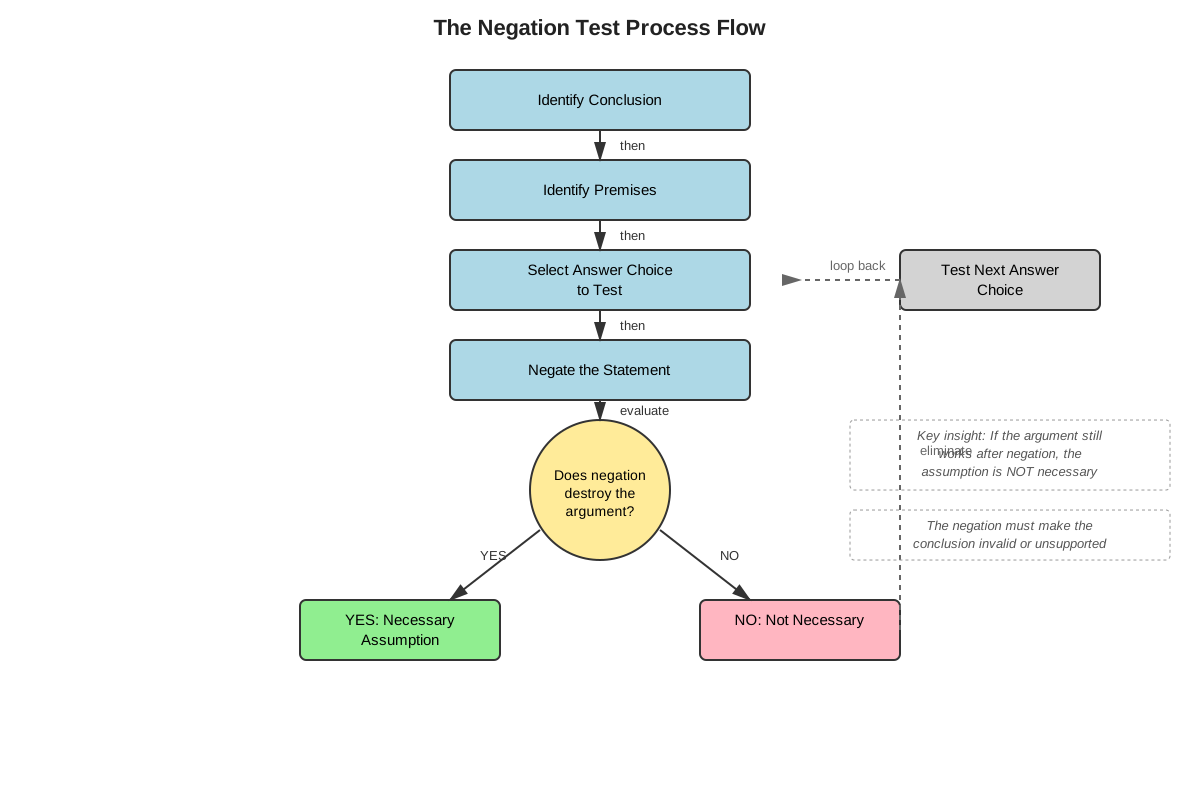
The test follows a three-step process:
- Identify the argument's conclusion and premises: Clearly understand what the argument claims and what evidence supports that claim.
- Negate the answer choice: Reverse the meaning of the statement being tested, creating its logical opposite.
- Evaluate the impact: Determine whether the negated statement destroys, seriously weakens, or has no effect on the argument's reasoning.
If negating an answer choice causes the argument to collapse—meaning the conclusion can no longer be reasonably drawn from the premises—then that answer choice states a necessary assumption. If the argument remains intact or only slightly weakened after negation, the answer choice is not a necessary assumption and can be eliminated.
Proper Negation Technique
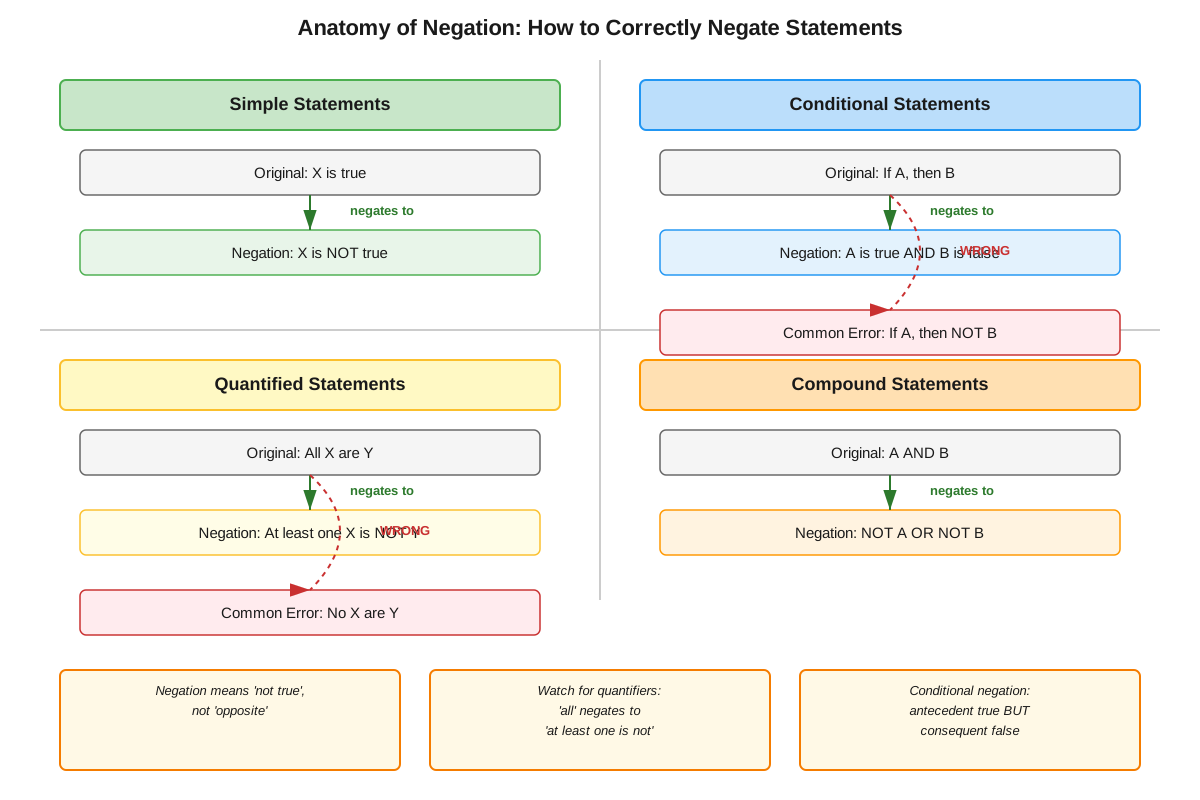
Correctly negating statements represents the most critical skill for applying the negation test effectively. Many students struggle with this step because negation in formal logic differs from casual contradiction. The goal is not to create the extreme opposite but rather to deny the truth of the original statement in the most minimal way possible.
Basic negation rules:
| Original Statement Type | Negation Method | Example |
|---|---|---|
| All X are Y | Some X are not Y | All dogs are loyal → Some dogs are not loyal |
| Some X are Y | No X are Y | Some cats are friendly → No cats are friendly |
| No X are Y | Some X are Y | No birds are mammals → Some birds are mammals |
| X will happen | X will not happen | Sales will increase → Sales will not increase |
| X is necessary | X is not necessary | Training is necessary → Training is not necessary |
| X is sufficient | X is not sufficient | This evidence is sufficient → This evidence is not sufficient |
For complex statements, focus on negating the main claim rather than individual components. For instance, "Most employees prefer remote work" negates to "Most employees do not prefer remote work" or "It is not the case that most employees prefer remote work"—not "Most employees prefer office work," which introduces new information.
Conditional statements require special attention. The statement "If A, then B" does not negate to "If A, then not B." Instead, it negates to "A can occur without B" or "A is possible while B does not occur." This distinction proves crucial for LSAT questions involving conditional reasoning.
Identifying Necessary Versus Sufficient Assumptions
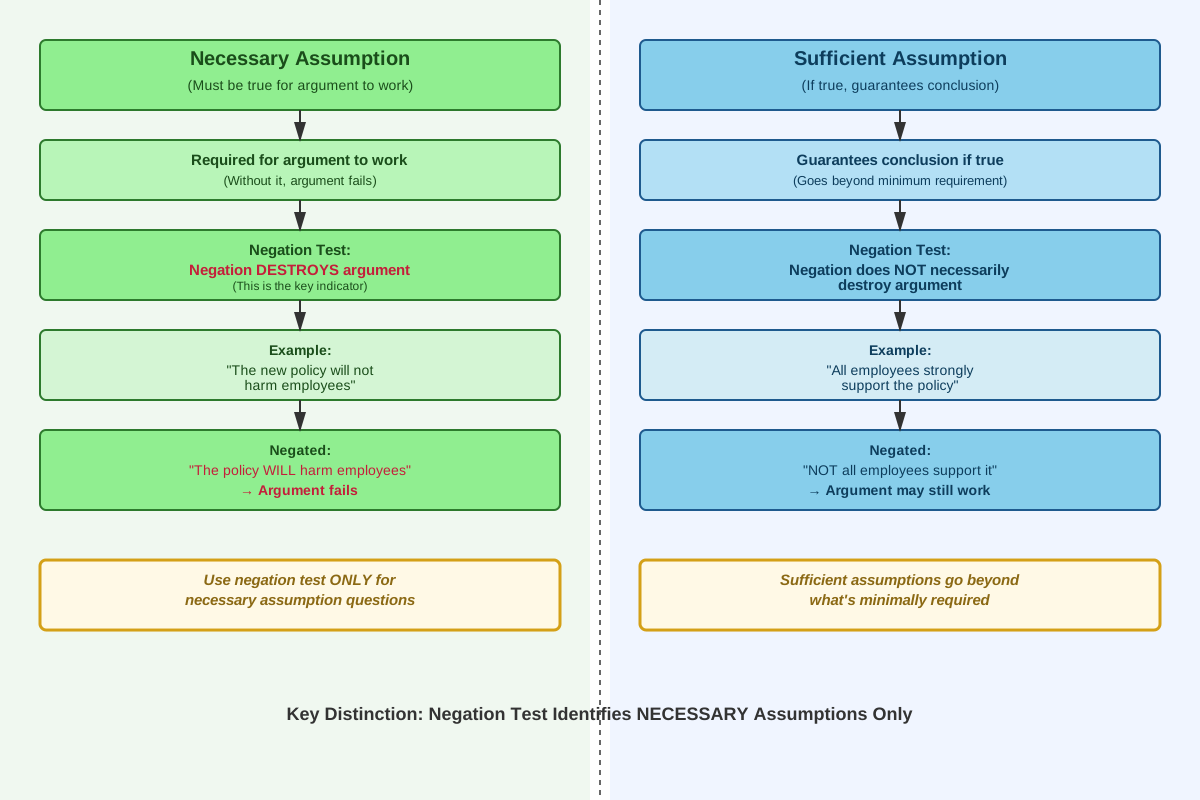
The LSAT tests two distinct types of assumptions, and the negation test applies primarily to necessary assumptions. Understanding this distinction prevents misapplication of the technique.
Necessary assumptions are statements that must be true for the argument to work. They represent minimum requirements—without them, the argument fails. These assumptions often bridge gaps between premises and conclusions, rule out alternative explanations, or establish the relevance of evidence. The negation test definitively identifies necessary assumptions because negating them destroys the argument.
Sufficient assumptions, by contrast, are statements that, if true, would guarantee the conclusion follows from the premises. They provide more than the minimum required—they make the argument airtight. Sufficient assumptions typically appear in questions asking what would "enable the conclusion to be properly drawn" or what "allows the conclusion to be logically inferred." The negation test does not work for sufficient assumption questions because negating a sufficient assumption does not necessarily destroy the argument; it merely removes one possible way to make the argument valid.
Recognizing When Arguments Fail
Applying the negation test requires clear judgment about what constitutes argument failure. An argument "fails" when the conclusion can no longer be reasonably drawn from the premises—when the logical connection breaks down. This failure can manifest in several ways:
- Gap exposure: The negated assumption reveals an unbridged logical gap between premise and conclusion
- Alternative explanation: The negated assumption introduces a plausible alternative that undermines the argument's reasoning
- Relevance destruction: The negated assumption shows that the premises are actually irrelevant to the conclusion
- Contradiction creation: The negated assumption directly contradicts a claim necessary for the conclusion
Students must distinguish between arguments that fail completely and those that merely weaken. If negating an answer choice makes the argument less persuasive but the conclusion could still potentially follow from the premises, that answer choice is not a necessary assumption. Only complete logical breakdown indicates necessity.
Common Assumption Patterns on the LSAT
LSAT assumption questions follow recognizable patterns that help students anticipate what types of assumptions to look for:
Causal reasoning assumptions: When arguments claim one thing causes another, they assume no alternative causes exist, the correlation reflects genuine causation, and the causal relationship operates in the direction claimed.
Representativeness assumptions: When arguments generalize from samples or examples, they assume the sample represents the broader population and no relevant differences exist between the sample and the group.
Comparison assumptions: When arguments compare two things, they assume the comparison is valid, relevant factors are similar, and no crucial differences undermine the comparison.
Plan/prediction assumptions: When arguments propose that an action will achieve a goal, they assume no obstacles will prevent success, necessary conditions will be met, and no side effects will undermine the intended outcome.
Term shift assumptions: When different terms appear in premises versus conclusions, arguments assume these terms relate in the way the reasoning requires—often that they're equivalent, overlapping, or connected in specific ways.
Concept Relationships
The negation test connects to multiple concepts within Logical Reasoning, forming a web of interrelated skills. At the foundation, argument structure analysis enables identification of premises and conclusions, which the negation test requires to evaluate whether negated statements destroy the logical connection between them. This structural understanding flows directly into assumption identification, where students recognize gaps in reasoning that assumptions must fill.
The negation test itself branches into two applications: necessary assumption questions (its primary use) and answer choice elimination in other question types. For necessary assumptions, the test provides definitive verification. For strengthen/weaken questions, understanding what assumptions an argument requires helps predict which statements would most impact it.
Formal logic skills support the negation test by enabling correct negation of complex statements, particularly those involving quantifiers (all, some, most, none) and conditional relationships (if-then structures). Without proper negation technique, the test cannot function reliably.
The relationship map flows as follows:
Argument Structure Analysis → Assumption Identification → Negation Test Application → Answer Verification → Correct Answer Selection
Parallel path: Formal Logic Mastery → Proper Negation Technique → Negation Test Application
The negation test also connects forward to advanced Logical Reasoning skills. Mastering it builds the analytical precision needed for flaw questions (which often involve identifying missing assumptions as flaws) and principle questions (which require recognizing unstated general rules that arguments depend upon).
Quick check — test yourself on Negation test so far.
Try Flashcards →High-Yield Facts
⭐ The negation test applies specifically to necessary assumption questions, not sufficient assumption questions.
⭐ If negating an answer choice causes the argument to fail completely, that answer choice is a necessary assumption.
⭐ Proper negation means denying the statement's truth in the most minimal way, not creating an extreme opposite.
⭐ "All X are Y" negates to "Some X are not Y," not "No X are Y" or "All X are not Y."
⭐ The negation test works because necessary assumptions are required for arguments to succeed—removing them causes logical breakdown.
- Necessary assumptions often bridge gaps between premises and conclusions that use different terms or concepts.
- An answer choice that strengthens an argument is not necessarily a necessary assumption—it must be required, not merely helpful.
- When an argument remains intact after negating an answer choice, that choice can be confidently eliminated.
- Causal arguments typically assume no alternative explanations exist for observed correlations.
- Conditional statements ("If A, then B") negate to "A can occur without B," not "If A, then not B."
- The negation test provides objective verification, reducing reliance on intuition that can fail under time pressure.
- Arguments can have multiple necessary assumptions, but LSAT questions ask for only one per question.
- Negating an answer choice should not introduce entirely new information—it should simply deny what the original stated.
Common Misconceptions
Misconception: The negation test works for all assumption questions, including sufficient assumptions.
Correction: The negation test specifically identifies necessary assumptions—those required for arguments to work. Sufficient assumption questions ask what would guarantee the conclusion, and negating sufficient assumptions does not necessarily destroy arguments because other paths to validity may exist.
Misconception: Negating a statement means creating its extreme opposite (e.g., "All dogs are friendly" becomes "No dogs are friendly").
Correction: Proper negation denies the truth of a statement minimally. "All dogs are friendly" negates to "Some dogs are not friendly" or "Not all dogs are friendly"—just enough to make the original statement false without introducing extreme claims.
Misconception: If negating an answer choice weakens the argument at all, that answer choice is a necessary assumption.
Correction: Necessary assumptions must be required for the argument to work. If negating an answer choice only weakens the argument but the conclusion could still potentially follow from the premises, the assumption is not necessary. The argument must fail completely or have its logical foundation destroyed.
Misconception: The correct answer to assumption questions is always the statement that most strengthens the argument.
Correction: While necessary assumptions do strengthen arguments when added, the strongest strengthener is not always a necessary assumption. Necessary assumptions are specifically those without which the argument cannot succeed—they represent minimum requirements, not maximum support.
Misconception: Negating conditional statements follows the pattern "If A, then B" becomes "If A, then not B."
Correction: Conditional statements negate to "A can occur without B" or "It's possible for A to be true while B is false." The original conditional claims B must follow from A; negating this means B is not guaranteed by A.
Misconception: The negation test is too time-consuming to use on every assumption question.
Correction: With practice, the negation test becomes rapid and intuitive, often taking only seconds per answer choice. The time invested prevents costly errors and actually saves time by providing definitive answers rather than uncertain guessing between close options.
Worked Examples
Example 1: Basic Negation Test Application
Argument: "The new marketing campaign will increase sales because it targets younger consumers, and younger consumers have more disposable income than older consumers."
Question: Which of the following is an assumption required by the argument?
Answer Choice to Test: "Younger consumers are interested in the products being marketed."
Step 1 - Identify the argument structure:
- Premise: The campaign targets younger consumers
- Premise: Younger consumers have more disposable income
- Conclusion: The campaign will increase sales
Step 2 - Negate the answer choice:
Original: "Younger consumers are interested in the products being marketed."
Negation: "Younger consumers are NOT interested in the products being marketed."
Step 3 - Evaluate the impact:
If younger consumers are not interested in the products, then targeting them will not increase sales, regardless of their disposable income. Having money to spend is irrelevant if they have no interest in spending it on these particular products. The argument completely falls apart—the conclusion cannot be drawn from the premises.
Conclusion: This is a necessary assumption. The negated version destroys the argument's logic by revealing that the argument assumes interest in the products, not merely purchasing power.
Example 2: Distinguishing Necessary from Strengthening
Argument: "City officials should install more streetlights in the downtown area. A recent study showed that increased lighting in parking garages reduced theft by 40%."
Question: Which of the following is an assumption required by the argument?
Answer Choice A: "Increased lighting in outdoor public spaces will have effects similar to increased lighting in parking garages."
Answer Choice B: "Installing more streetlights would reduce crime in the downtown area by at least 40%."
Testing Answer Choice A:
Negation: "Increased lighting in outdoor public spaces will NOT have effects similar to increased lighting in parking garages."
Impact: If outdoor lighting doesn't produce similar effects to garage lighting, then the study about garages provides no reason to think streetlights will help downtown. The argument's reasoning—using garage data to support a streetlight recommendation—completely breaks down. This is a necessary assumption.
Testing Answer Choice B:
Negation: "Installing more streetlights would NOT reduce crime in the downtown area by at least 40%."
Impact: If streetlights reduce crime by only 30%, or 20%, or even 10%, the argument for installing them could still be valid. The argument claims streetlights should be installed based on the garage study, but it doesn't require a specific percentage reduction. The argument survives this negation, merely becoming less strong. This is not a necessary assumption—it's a strengthener, but not required.
Conclusion: Answer Choice A is correct. This example demonstrates that necessary assumptions bridge logical gaps (connecting garage data to outdoor recommendations) rather than merely strengthening conclusions with additional support.
Exam Strategy
When approaching assumption questions on the LSAT, implement a systematic process that maximizes accuracy while managing time effectively:
Trigger word recognition: Immediately identify assumption questions through stems containing phrases like "assumes," "depends on assuming," "requires the assumption," or "presupposes." These signals indicate that the negation test will be your primary tool.
Pre-phrase before reading choices: After analyzing the argument, spend 5-10 seconds identifying the logical gap or unstated premise. Ask yourself: "What must be true for this conclusion to follow from these premises?" This pre-phrasing helps recognize correct answers quickly and avoid attractive distractors.
Strategic answer choice evaluation: Rather than negating all five choices systematically, use a two-pass approach:
- First pass: Quickly eliminate obviously wrong answers—those that are irrelevant to the argument, go beyond the scope, or address issues the argument doesn't depend on
- Second pass: Apply the negation test to remaining contenders (typically 2-3 choices)
Negation shortcuts: For simple statements, negate mentally without writing. For complex statements with multiple clauses or conditional logic, jot down a brief negation to ensure accuracy. The few seconds spent ensuring correct negation prevent errors that waste far more time.
Failure threshold calibration: Train yourself to recognize complete argument failure versus mere weakening. Ask: "Can the conclusion still be reasonably drawn from the premises after this negation?" If any plausible path remains, the assumption is not necessary.
Time allocation: Budget approximately 1:20-1:30 per assumption question. The negation test itself should take 10-15 seconds per answer choice once mastered. If spending more than 2 minutes on a question, select your best answer and move forward—returning if time permits.
Common trap avoidance: Watch for answer choices that:
- Strengthen the argument but aren't required (test by negation)
- Restate premises or conclusions rather than providing unstated assumptions
- Address tangential issues that seem related but don't affect the core reasoning
- Use extreme language ("always," "never," "only") that makes them unlikely to be necessary
Exam Tip: If two answer choices both seem to destroy the argument when negated, re-examine your negations. Often, one is negated incorrectly or the perceived destruction is actually just significant weakening rather than complete failure.
Memory Techniques
The "NERD" Acronym for Negation Test Steps:
- Negate the answer choice
- Evaluate the argument's survival
- Required if argument fails
- Discard if argument survives
Negation Quantifier Rhyme:
"All becomes some not, none becomes some,
Some becomes none—the negation's done!"
Visual Metaphor: Picture the argument as a bridge between premises (one side) and conclusion (other side). Assumptions are invisible support cables. The negation test cuts a cable—if the bridge collapses, that cable was necessary. If the bridge stands (perhaps sagging slightly), that cable was helpful but not required.
The "Opposite Trap" Reminder: Remember "NOT-opposite" by thinking: Negation is NOT about creating the opposite extreme. "All" doesn't become "none"—it becomes "not all."
Conditional Negation Memory Aid: For "If A, then B," remember "A without B"—A can happen without B following. This phrase captures the negation more intuitively than formal logical notation.
Failure Test Phrase: When evaluating impact, ask: "Does this negation make the argument FAIL or just FLAIL?" Fail means complete breakdown (necessary assumption). Flail means weakened but surviving (not necessary).
Summary
The negation test provides a systematic, reliable method for identifying necessary assumptions in LSAT Logical Reasoning questions. By negating answer choices and evaluating whether the argument survives or fails, students can definitively determine which unstated premises an argument requires. The technique rests on the logical principle that necessary conditions, when removed, cause the things that depend on them to fail. Proper application requires three core skills: accurate identification of argument structure, correct negation of statements (particularly quantifiers and conditionals), and sound judgment about whether negated statements destroy arguments completely versus merely weakening them. The negation test applies specifically to necessary assumption questions, not sufficient assumptions, and distinguishes between statements that are required versus those that merely strengthen arguments. Mastering this technique transforms assumption questions from subjective interpretation exercises into objective, methodical problems with clear right answers, directly improving performance on approximately 10% of the entire LSAT.
Key Takeaways
- The negation test definitively identifies necessary assumptions by testing whether their denial causes arguments to fail completely
- Proper negation means minimally denying a statement's truth, not creating extreme opposites (e.g., "all" becomes "some not," not "none")
- If an argument survives negation of an answer choice, that choice is not a necessary assumption and can be eliminated
- The technique applies to necessary assumption questions specifically, not sufficient assumption questions or other question types
- Necessary assumptions bridge logical gaps, rule out alternatives, or establish relevance—they represent minimum requirements for arguments to work
- Pre-phrasing the logical gap before reading answer choices improves efficiency and accuracy
- With practice, the negation test becomes rapid and intuitive, providing objective verification that reduces errors under time pressure
Related Topics
Sufficient Assumption Questions: These questions ask what would guarantee an argument's conclusion follows from its premises. Unlike necessary assumptions (tested by negation), sufficient assumptions provide complete logical bridges. Mastering necessary assumptions through the negation test builds the foundation for recognizing what would make arguments airtight.
Strengthen and Weaken Questions: Understanding necessary assumptions directly enhances performance on these question types. Statements that provide necessary assumptions strengthen arguments significantly, while statements that contradict necessary assumptions weaken them maximally. The analytical skills developed through the negation test transfer directly to predicting argument vulnerabilities.
Flaw Questions: Many argument flaws involve missing necessary assumptions. Recognizing what arguments fail to establish—essentially, identifying unstated necessary assumptions—enables accurate flaw identification. The negation test mindset of asking "what must be true for this to work?" applies directly to spotting reasoning errors.
Conditional Logic: Advanced assumption questions often involve conditional statements requiring sophisticated negation. Deepening understanding of conditional relationships, contrapositives, and logical chains builds on the negation skills developed for the negation test.
Practice CTA
Now that you understand the negation test's logic and application, the path to mastery requires deliberate practice. Work through the practice questions systematically, applying the three-step process to each assumption question: identify the argument structure, negate answer choices, and evaluate whether arguments fail. Use the flashcards to reinforce proper negation of different statement types until the technique becomes automatic. Remember that the negation test transforms assumption questions from intimidating challenges into straightforward, methodical exercises—but only through consistent application. Each practice question you complete builds the pattern recognition and analytical speed that will serve you on test day. You have the technique; now develop the fluency that makes it effortless.
Sign up free to keep reading
Create a free AnvayaPrep account to finish this LSAT guide on Negation test — plus flashcards and practice questions.