Overview
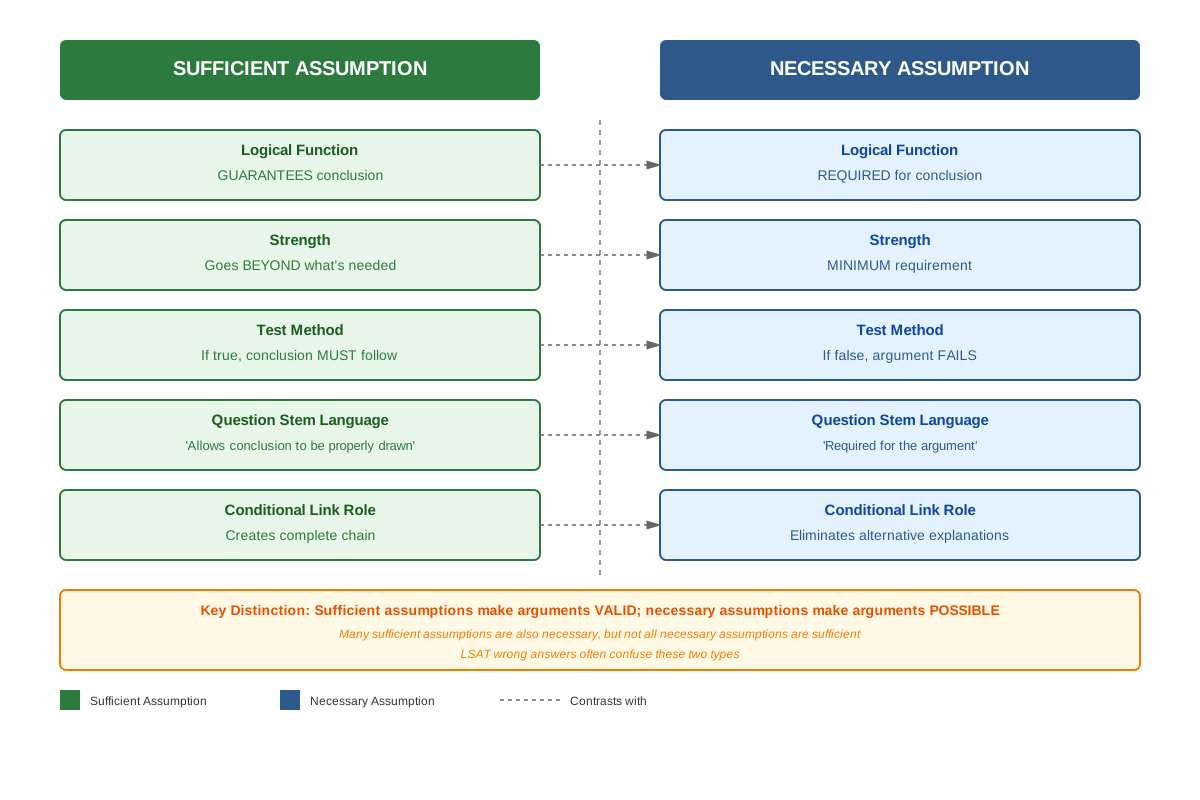
Sufficient assumption and conditional links represent one of the most powerful and frequently tested concepts in LSAT Logical Reasoning. These questions ask test-takers to identify an assumption that, if added to an argument, would make the conclusion follow with absolute certainty—creating what logicians call a "valid" argument. Unlike necessary assumptions (which must be true for an argument to work), sufficient assumptions go beyond what's minimally required and guarantee the conclusion's truth.
The key to mastering sufficient assumption questions lies in understanding conditional logic and how to bridge gaps between premises and conclusions using conditional statements. Most sufficient assumption questions involve identifying missing logical links in chains of conditional reasoning. When an argument moves from discussing one concept to concluding about another, the LSAT expects you to recognize the logical gap and select the answer choice that perfectly connects these ideas through conditional relationships.
This topic sits at the intersection of several critical LSAT skills: conditional reasoning, formal logic, argument structure analysis, and gap identification. Mastering sufficient assumptions strengthens your ability to handle not only assumption questions but also strengthen/weaken questions, inference questions, and parallel reasoning questions. The conditional logic skills developed here transfer directly to Logic Games and even Reading Comprehension, making this one of the highest-yield topics in your entire LSAT preparation.
Learning Objectives
- [ ] Identify how sufficient assumption and conditional links appears in LSAT questions
- [ ] Explain the reasoning pattern behind sufficient assumption and conditional links
- [ ] Apply sufficient assumption and conditional links to solve LSAT-style problems accurately
- [ ] Construct conditional chains that reveal logical gaps in arguments
- [ ] Distinguish between sufficient and necessary assumptions in complex arguments
- [ ] Recognize common conditional link patterns that appear repeatedly on the LSAT
- [ ] Evaluate answer choices by testing whether they guarantee the conclusion
Prerequisites
- Basic conditional logic notation: Understanding "if-then" statements and their contrapositives is essential because sufficient assumptions almost always involve conditional relationships
- Argument structure identification: Recognizing premises, conclusions, and intermediate conclusions allows you to map where logical gaps exist
- Necessary vs. sufficient conditions: Distinguishing these concepts prevents confusion about what makes an assumption "sufficient" rather than merely "necessary"
- Formal logic fundamentals: Familiarity with logical operators (all, some, none) helps translate LSAT language into workable logical structures
Why This Topic Matters
Sufficient assumption questions appear with remarkable consistency on every LSAT administration, typically comprising 2-4 questions per test across both Logical Reasoning sections. This represents approximately 8-15% of all Logical Reasoning questions, making it one of the most frequently tested question types. More importantly, these questions often appear in the medium-to-difficult range, meaning they serve as score differentiators between good and exceptional performances.
In real-world applications, sufficient assumption reasoning mirrors the logical structure of legal arguments, contracts, and statutory interpretation. Lawyers must constantly identify what additional premises would guarantee particular legal conclusions, making this skill directly relevant to law school and legal practice. When a prosecutor argues that certain evidence proves guilt, or when a defense attorney claims that missing evidence undermines the prosecution's case, they're engaging in sufficient assumption reasoning.
On the LSAT, sufficient assumption questions appear with distinctive question stems such as: "Which one of the following, if assumed, allows the conclusion to be properly drawn?" or "The conclusion follows logically if which one of the following is assumed?" These questions typically feature arguments with clear logical gaps—often involving conditional chains where the middle link is missing, or where terms in the conclusion don't appear in the premises. Recognizing these patterns allows for rapid, accurate responses even under time pressure.
Core Concepts
Understanding Sufficient Assumptions
A sufficient assumption is a statement that, when added to an argument's premises, guarantees the truth of the conclusion. The term "sufficient" means "enough"—the assumption provides enough logical support to make the argument airtight. Unlike necessary assumptions (which identify what must be true for an argument to possibly work), sufficient assumptions often go beyond the minimum requirement and create logical certainty.
Consider this simple argument: "All lawyers are professionals. Therefore, Sarah is a professional." The sufficient assumption here would be "Sarah is a lawyer." This assumption is sufficient because, combined with the premise, it guarantees the conclusion. Notice that this might not be the only way to reach the conclusion (Sarah could be a doctor, accountant, or other professional), but it's enough to guarantee it.
Conditional Logic Foundations
Conditional statements form the backbone of sufficient assumption questions. A conditional statement establishes a relationship where one condition guarantees another. The standard form is: "If A, then B" (symbolized as A → B). The first part (A) is the sufficient condition—its presence is enough to guarantee B. The second part (B) is the necessary condition—it must be present whenever A is present.
Every conditional statement has a contrapositive, which is logically equivalent: If A → B, then NOT B → NOT A. Understanding contrapositives is crucial because LSAT arguments often use them implicitly. For example, "All successful applicants have high LSAT scores" (Successful → High LSAT) has the contrapositive "Anyone without high LSAT scores is not a successful applicant" (NOT High LSAT → NOT Successful).
Conditional Chains and Missing Links
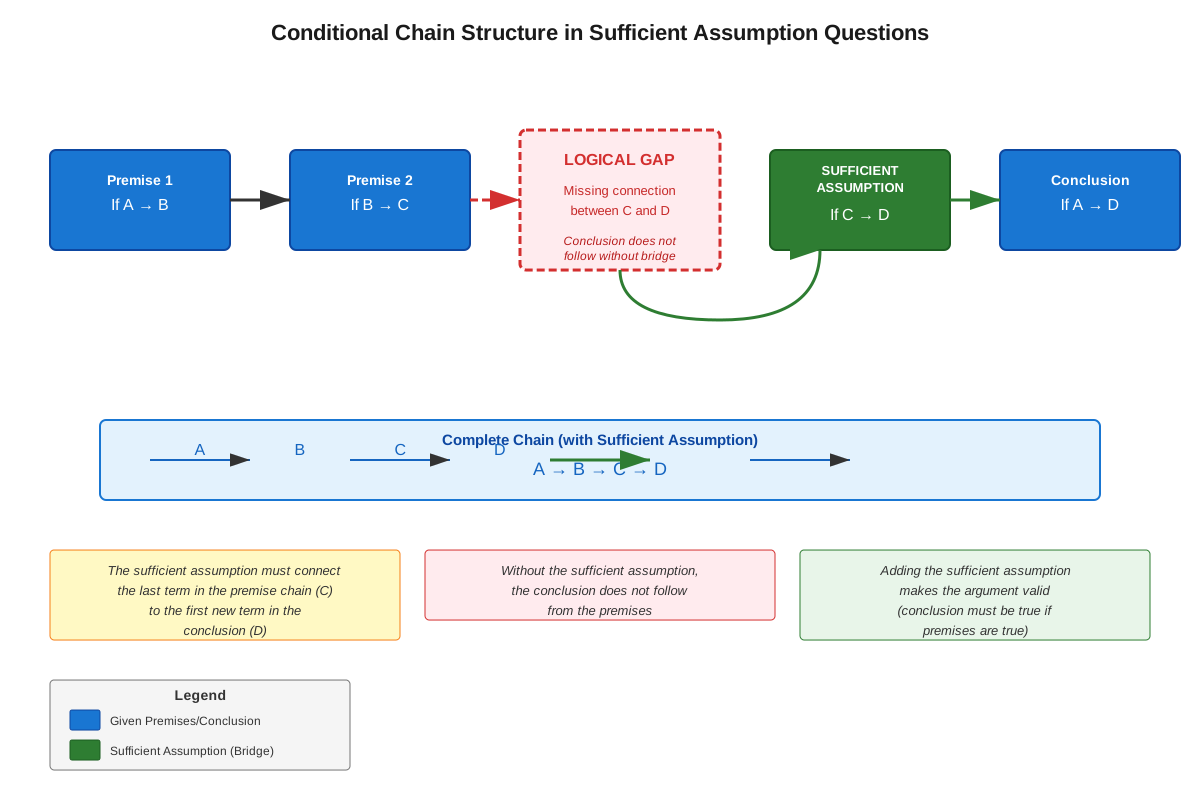
Many sufficient assumption questions involve conditional chains—sequences of conditional statements linked together. When you have A → B and B → C, you can conclude A → C. The LSAT frequently presents arguments where this chain is incomplete, and your task is to identify the missing link.
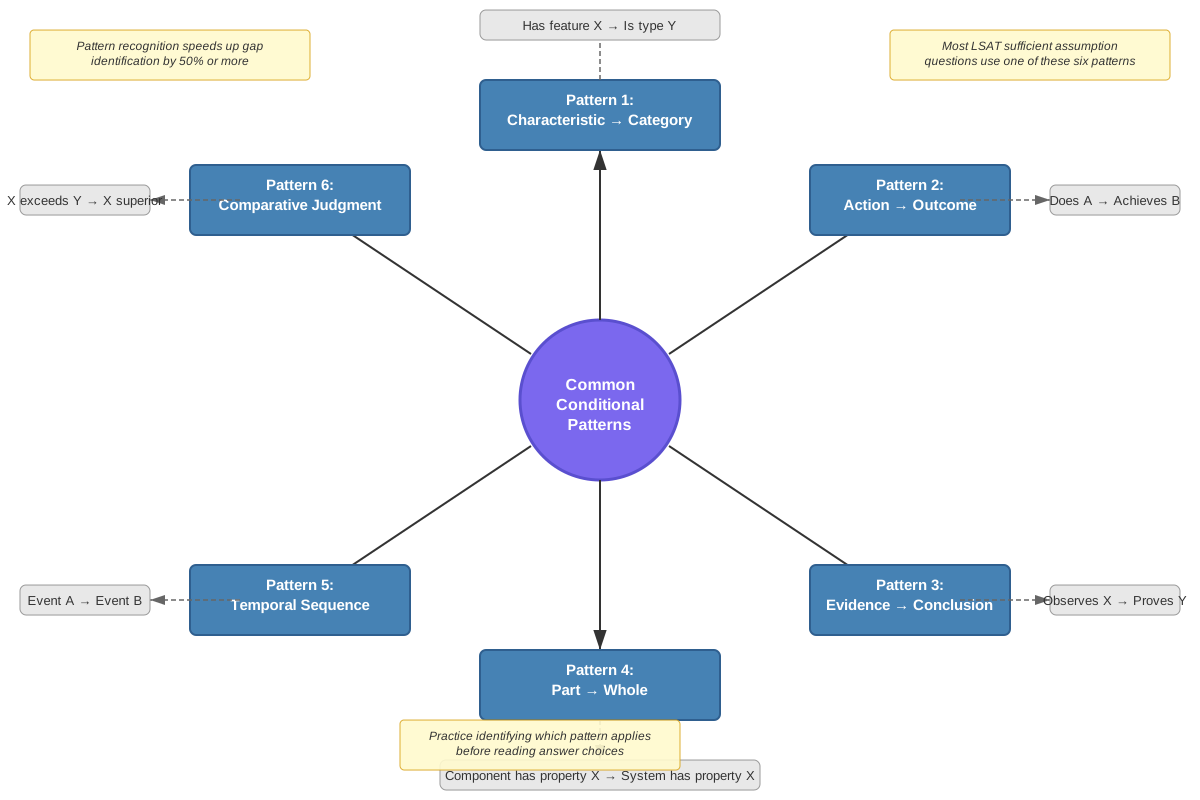
Pattern 1: The Missing Middle Link
- Premise: A → B
- Conclusion: A → C
- Missing link: B → C
Pattern 2: The Disconnected Terms
- Premise: Discusses concept X
- Conclusion: Discusses concept Y
- Missing link: A conditional connecting X to Y
Pattern 3: The Reversed Conditional
- Premise: A → B
- Conclusion: C → A
- Missing link: C → A (or its equivalent)
The Sufficient Assumption Question Type
Lsat sufficient assumption and conditional links questions have distinctive characteristics that set them apart from other assumption questions. The question stem typically includes words like "allows the conclusion to be properly drawn," "enables the conclusion to be properly inferred," or "justifies the conclusion." These phrases signal that you need an assumption that makes the argument valid, not just stronger.
The correct answer to a sufficient assumption question will always make the argument's conclusion follow with 100% certainty. This is a higher standard than strengthen questions (which only require making the conclusion more likely) or necessary assumption questions (which identify what must be true but might not guarantee the conclusion).
Identifying Logical Gaps
The first step in solving sufficient assumption questions is identifying the logical gap—the disconnect between premises and conclusion. This gap typically appears in one of several forms:
- Term shift: The conclusion introduces a term not mentioned in the premises
- Scope shift: The conclusion makes a broader or narrower claim than the premises support
- Conditional gap: The premises establish part of a conditional chain, but a link is missing
- Quantifier mismatch: The premises discuss "some" while the conclusion claims "all" (or vice versa)
The Mechanistic Approach
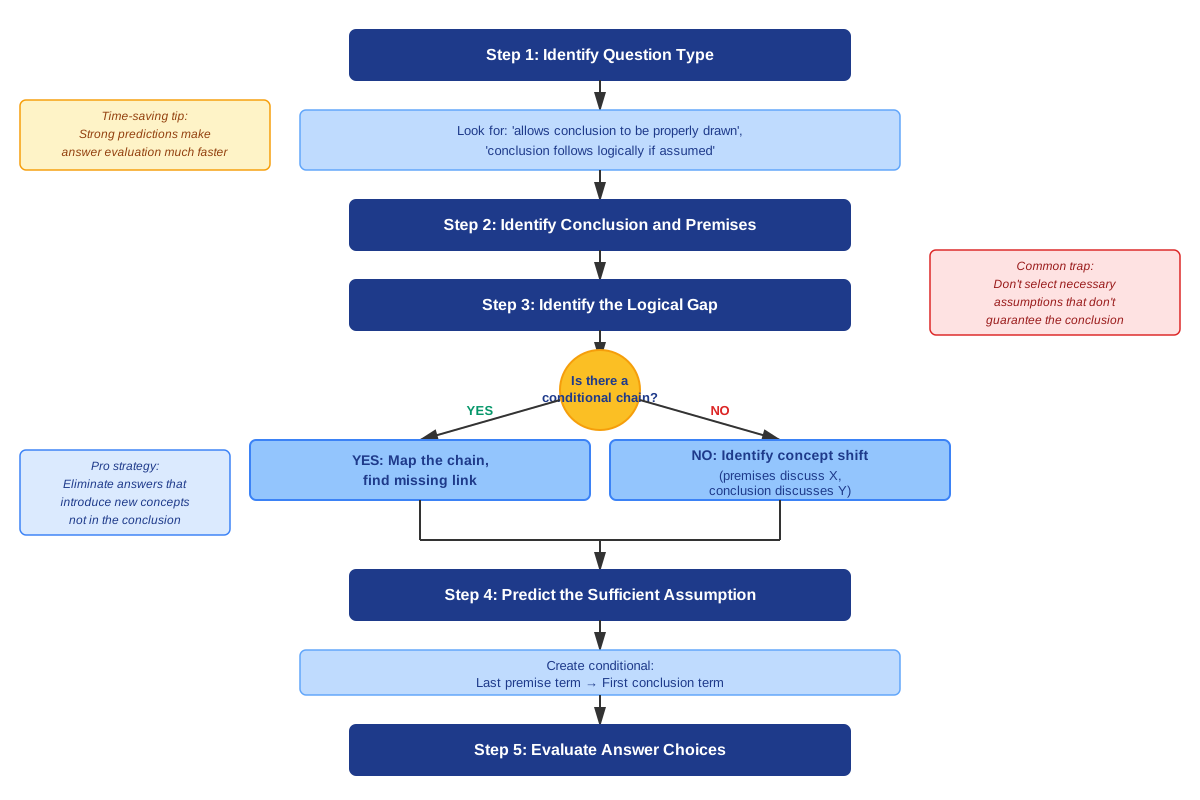
To solve sufficient assumption questions systematically:
- Identify the conclusion: What is the argument trying to prove?
- Identify the premises: What evidence is provided?
- Map the logical structure: Convert key statements into conditional form if applicable
- Spot the gap: What's missing between premises and conclusion?
- Predict the answer: What statement would bridge this gap?
- Evaluate choices: Test each answer by adding it to the premises and checking if the conclusion must follow
Common Conditional Patterns
| Argument Pattern | Premises | Conclusion | Required Link |
|---|---|---|---|
| Simple chain | A → B | A → C | B → C |
| Reverse chain | B → C | A → C | A → B |
| Term introduction | Discusses X | Concludes Y | X → Y or Y → X |
| Contrapositive gap | A → B | ¬C → ¬A | B → C |
| Multiple conditions | A → B and C → D | A → D | B → C |
Concept Relationships
The concepts within sufficient assumption questions form an interconnected logical system. Conditional logic serves as the foundation, enabling the construction of conditional chains. These chains reveal logical gaps when links are missing or terms are disconnected. The sufficient assumption itself functions as the missing piece that completes the chain, allowing the conclusion to follow necessarily from the premises.
This topic connects directly to necessary assumptions through contrast—while necessary assumptions identify what must be true for an argument to work, sufficient assumptions identify what would guarantee it works. Both require gap identification skills, but sufficient assumptions demand a higher standard of proof.
The relationship to formal logic is bidirectional: formal logic provides the tools (conditional statements, contrapositives, logical operators) needed to analyze sufficient assumption questions, while practicing these questions reinforces formal logic skills. Similarly, argument structure analysis enables gap identification, which in turn sharpens argument structure recognition.
Relationship map: Formal Logic → Conditional Statements → Conditional Chains → Gap Identification → Sufficient Assumption Selection → Argument Validation
High-Yield Facts
⭐ Sufficient assumptions make arguments valid (conclusion must be true), not just stronger (conclusion more likely true)
⭐ The most common pattern involves missing links in conditional chains: if you have A → B and conclude A → C, you need B → C
⭐ When the conclusion introduces a new term not in the premises, the sufficient assumption must connect that new term to something in the premises
⭐ The correct answer to a sufficient assumption question often appears too strong or extreme—this is expected because it must guarantee the conclusion
⭐ Contrapositives are logically equivalent to their original statements; recognizing contrapositive forms prevents missing correct answers
- Sufficient assumption questions typically ask what "allows," "enables," or "justifies" the conclusion, distinguishing them from necessary assumption questions
- The sufficient assumption doesn't need to be realistic or likely true in the real world—it only needs to make the logic work
- Wrong answers often provide necessary but insufficient assumptions, or assumptions that strengthen without guaranteeing the conclusion
- Conditional chains can be extended indefinitely: A → B → C → D → E, and any missing link breaks the chain
- When an argument moves from discussing a category to concluding about a specific member (or vice versa), look for the connecting assumption
Quick check — test yourself on Sufficient assumption and conditional links so far.
Try Flashcards →Common Misconceptions
Misconception: Sufficient assumptions must be realistic or plausible in the real world.
Correction: Sufficient assumptions only need to make the logic work, regardless of real-world plausibility. An answer can be factually absurd yet logically correct if it guarantees the conclusion.
Misconception: The correct answer will be the weakest or most moderate statement.
Correction: Sufficient assumptions often appear extreme or overly strong because they must guarantee the conclusion with 100% certainty. Don't eliminate answers for being "too strong."
Misconception: If an assumption is necessary, it must also be sufficient.
Correction: Necessary and sufficient are distinct concepts. An assumption can be necessary (required for the argument) without being sufficient (enough to guarantee the conclusion). Many necessary assumptions don't make arguments valid.
Misconception: You should look for assumptions that make the argument more believable or persuasive.
Correction: Sufficient assumption questions test logical validity, not persuasiveness. The correct answer makes the conclusion follow with logical necessity, even if the resulting argument seems strange or unconvincing.
Misconception: Conditional statements can be reversed freely (if A → B, then B → A).
Correction: Conditionals cannot be reversed. Only the contrapositive (¬B → ¬A) is logically equivalent to the original statement. Reversing conditionals is a logical fallacy that the LSAT frequently exploits in wrong answers.
Misconception: The sufficient assumption should address the most obvious weakness in the argument.
Correction: While sufficient assumptions do fill logical gaps, they specifically must connect premises to conclusion in a way that makes the conclusion necessarily true. Sometimes this means addressing a subtle logical gap rather than the most glaring weakness.
Misconception: Longer, more complex answer choices are more likely to be correct.
Correction: Correct sufficient assumptions can be simple or complex. The LSAT often uses complexity to disguise wrong answers. Focus on logical function, not length or sophistication.
Worked Examples
Example 1: Classic Conditional Chain
Argument: "All members of the debate team have strong analytical skills. Therefore, all members of the debate team will succeed in law school."
Analysis:
- Conclusion: All debate team members → succeed in law school
- Premise: All debate team members → strong analytical skills
- Logical structure: We have A → B (debate team → analytical skills) and need A → C (debate team → law school success)
- Gap identified: Missing link between "analytical skills" and "law school success"
- Sufficient assumption needed: Strong analytical skills → succeed in law school (B → C)
Correct answer: "Everyone with strong analytical skills succeeds in law school."
Why this works: Adding this assumption creates a complete conditional chain:
- Debate team → analytical skills (given premise)
- Analytical skills → law school success (sufficient assumption)
- Therefore: Debate team → law school success (conclusion now follows necessarily)
Wrong answer example: "Most people who succeed in law school have strong analytical skills."
Why it's wrong: This reverses the conditional (success → analytical skills) and only claims "most," not "all." This doesn't guarantee that debate team members will succeed.
Example 2: Term Introduction Pattern
Argument: "The proposed legislation will reduce carbon emissions by 30%. Any policy that significantly reduces carbon emissions should be implemented. Therefore, the proposed legislation should be implemented."
Analysis:
- Conclusion: Proposed legislation should be implemented
- Premises:
1. Legislation reduces emissions by 30%
2. Policies that significantly reduce emissions should be implemented
- Gap identified: The premises discuss "30% reduction" and "significant reduction" as if they're the same, but this connection isn't established
- Sufficient assumption needed: A 30% reduction qualifies as "significant"
Correct answer: "A 30% reduction in carbon emissions constitutes a significant reduction."
Why this works:
- Legislation reduces emissions by 30% (premise)
- 30% reduction = significant reduction (sufficient assumption)
- Significant reductions should be implemented (premise)
- Therefore: Legislation should be implemented (conclusion follows)
Learning objective connection: This example demonstrates how sufficient assumptions bridge terminology gaps, showing the reasoning pattern behind conditional links where terms must be explicitly connected.
Exam Strategy
Approaching Sufficient Assumption Questions
Step 1: Identify the question type immediately. Look for keywords: "allows the conclusion to be properly drawn," "enables the conclusion to follow logically," "justifies the conclusion," or "conclusion can be properly inferred if which one of the following is assumed." These phrases distinguish sufficient from necessary assumption questions.
Step 2: Read the conclusion first. Knowing what the argument is trying to prove helps you identify relevant premises and spot gaps more quickly. Underline or mentally note the conclusion's key terms.
Step 3: Map the logical structure. For arguments involving conditional logic, quickly sketch the conditional chain using arrows. For other arguments, note which concepts appear in premises versus the conclusion.
Step 4: Predict the gap. Before looking at answer choices, articulate what's missing: "The premises talk about X, but the conclusion is about Y, so I need something connecting X to Y." This prediction prevents wrong answers from seeming attractive.
Trigger Words and Phrases
Watch for these indicators in question stems:
- "allows the conclusion to be properly drawn"
- "enables the conclusion to follow logically"
- "justifies the conclusion"
- "conclusion is properly inferred if"
- "argument's conclusion follows logically if"
In arguments, watch for:
- Conditional indicators: "all," "every," "any," "only," "if," "when," "requires"
- Term shifts: New vocabulary appearing in the conclusion
- Scope shifts: "Some" in premises, "all" in conclusion (or vice versa)
- Causal language: "causes," "leads to," "results in" (often requiring conditional links)
Process of Elimination Tips
Eliminate answers that:
- Reverse necessary conditionals: If you need A → B, eliminate B → A
- Use "some" or "most": Sufficient assumptions typically require universal claims ("all," "every") to guarantee conclusions
- Address irrelevant concepts: If the gap is between X and Y, eliminate answers discussing Z
- Merely strengthen: Ask "Does this guarantee the conclusion or just make it more likely?" Eliminate the latter
- State necessary but insufficient conditions: An answer might be required for the argument but still not guarantee the conclusion
Keep answers that:
- Complete conditional chains: Connect the missing links between premises and conclusion
- Seem too strong: Remember, sufficient assumptions often appear extreme
- Directly bridge term gaps: Connect new conclusion terms to premise terms
- Make you think "Well, if that's true, the conclusion must follow": This is exactly what sufficient assumptions do
Time Allocation
Sufficient assumption questions typically require 60-90 seconds:
- 15-20 seconds: Read and identify question type
- 20-30 seconds: Analyze argument structure and identify gap
- 10-15 seconds: Predict the answer
- 20-30 seconds: Evaluate answer choices
If you're spending more than 90 seconds, you likely haven't clearly identified the gap. Return to the argument structure, map it more explicitly, and try again. These questions reward systematic analysis over prolonged deliberation.
Memory Techniques
BRIDGE Acronym for sufficient assumption approach:
- Break down the argument structure
- Recognize the conclusion
- Identify the gap
- Draw the conditional chain (if applicable)
- Guarantee test: Does the answer make the conclusion certain?
- Eliminate insufficient answers
The Chain Visualization: Picture conditional statements as physical chain links. When you see A → B in premises and A → C in the conclusion, visualize a chain with a missing middle link. Your job is to find the B → C link that completes the chain.
The "If This, Then That" Mantra: When evaluating answer choices, explicitly state: "If I add this assumption to the premises, then does the conclusion absolutely follow?" This forces you to test sufficiency rather than mere relevance.
The New Term Alert: Train yourself to immediately notice when the conclusion introduces terms not in the premises. Mentally highlight these new terms and remember: the correct answer must connect them back to premise terms.
CAST for Common Patterns:
- Chain completion (missing conditional links)
- All from some (quantifier shifts)
- Scope expansion (broader conclusions than premises support)
- Term introduction (new concepts in conclusion)
Summary
Sufficient assumption questions test your ability to identify and fill logical gaps in arguments, primarily through conditional reasoning. These questions ask you to find an assumption that, when added to the premises, guarantees the conclusion with absolute certainty—making the argument logically valid. The key skill involves recognizing patterns in conditional chains, identifying where links are missing, and selecting the answer that completes the logical connection. Unlike necessary assumptions (which identify minimum requirements), sufficient assumptions provide enough support to make conclusions follow necessarily. Success requires systematic analysis: identify the conclusion, map the logical structure, spot the gap between premises and conclusion, predict what would bridge that gap, and test answer choices for whether they guarantee (not merely strengthen) the conclusion. Most sufficient assumption questions involve either missing links in conditional chains or disconnections between terms in premises versus conclusions. The correct answer often appears strong or extreme because it must create logical certainty, not just plausibility.
Key Takeaways
- Sufficient assumptions make arguments valid (conclusion must be true), not just strong (conclusion likely true)—this is the fundamental distinction from other assumption types
- The most common pattern involves missing conditional links: when premises establish A → B and the conclusion claims A → C, you need B → C to complete the chain
- New terms in conclusions signal gaps—the sufficient assumption must connect these new terms back to concepts in the premises
- Correct answers often seem too strong or extreme—this is expected and correct because they must guarantee conclusions with 100% certainty
- Use the contrapositive to recognize logically equivalent statements; many correct answers appear in contrapositive form
- Systematic analysis beats intuition: map the argument structure, identify the specific gap, predict the answer, then evaluate choices methodically
- Eliminate answers that merely strengthen rather than guarantee, or that provide necessary but insufficient support
Related Topics
Necessary Assumption Questions: Understanding the contrast between necessary and sufficient assumptions deepens comprehension of both. Necessary assumptions identify what must be true for an argument to work; sufficient assumptions identify what would guarantee it works. Mastering sufficient assumptions makes necessary assumption questions easier by clarifying the different standards of proof.
Conditional Logic in Logic Games: The conditional reasoning skills developed through sufficient assumption questions transfer directly to Logic Games, where conditional rules form the foundation of most game setups. The ability to construct and manipulate conditional chains is essential for both sections.
Strengthen and Weaken Questions: Sufficient assumption questions represent the extreme end of the strengthening spectrum—they strengthen arguments to the point of validity. Understanding this relationship helps calibrate your evaluation of strengthen/weaken answer choices.
Formal Logic and Quantifiers: Advanced sufficient assumption questions often involve complex quantifier relationships (all, some, most, none). Deepening your formal logic knowledge enables faster, more accurate analysis of these challenging questions.
Parallel Reasoning Questions: These questions require recognizing logical structures, including conditional patterns. The structural analysis skills from sufficient assumption questions directly support parallel reasoning success.
Practice CTA
Now that you've mastered the core concepts of sufficient assumptions and conditional links, it's time to put your knowledge into action. Work through the practice questions systematically, applying the BRIDGE approach to each one. Pay special attention to mapping conditional chains and identifying gaps before looking at answer choices—this disciplined approach will become faster and more intuitive with practice. The flashcards will help reinforce the key patterns and common structures you'll encounter on test day. Remember: sufficient assumption questions are highly learnable and predictable. With focused practice, these questions can become some of your most reliable points on the LSAT. You've got this!
Sign up free to keep reading
Create a free AnvayaPrep account to finish this LSAT guide on Sufficient assumption and conditional links — plus flashcards and practice questions.