Overview
Weak answer traps represent one of the most insidious challenges students face when tackling assumption questions on the LSAT Logical Reasoning section. These trap answers are deliberately crafted to appear correct at first glance, often because they relate to the argument's topic or seem to strengthen the reasoning in some way. However, they fail the fundamental test of being necessary assumptions—the argument could still function without them. Understanding weak answer traps is crucial because they exploit the natural tendency to select answers that "sound good" rather than those that are logically required by the argument's structure.
The LSAT test makers design weak answer traps with surgical precision, knowing that students under time pressure will gravitate toward answers that feel supportive or relevant. These answers typically provide additional support to the argument but aren't essential to its logical foundation. The distinction between "helpful" and "necessary" becomes the critical dividing line between correct answers and these seductive traps. Students who cannot reliably identify weak answer traps will consistently miss assumption questions, even when they understand the argument's core reasoning.
Mastering the identification and elimination of weak answer traps connects directly to broader logical reasoning skills essential throughout the LSAT. This topic builds upon understanding argument structure, recognizing gaps in reasoning, and applying the negation test. It also prepares students for related question types like Strengthen and Weaken questions, where the distinction between sufficient and necessary conditions becomes equally important. The ability to spot weak answer traps demonstrates sophisticated logical thinking—the exact skill the LSAT aims to measure and law schools value in prospective students.
Learning Objectives
- [ ] Identify how weak answer traps appear in LSAT questions
- [ ] Explain the reasoning pattern behind weak answer traps
- [ ] Apply weak answer traps recognition to solve LSAT-style problems accurately
- [ ] Distinguish between necessary assumptions and merely supportive statements
- [ ] Execute the negation test to eliminate weak answer traps systematically
- [ ] Recognize the common linguistic patterns that signal weak answer traps
- [ ] Develop time-efficient strategies for avoiding weak answer traps under exam conditions
Prerequisites
- Argument structure identification: Understanding premises, conclusions, and the logical connections between them is essential because weak answer traps exploit gaps in this structural analysis
- Basic conditional logic: Recognizing sufficient and necessary conditions helps distinguish between what must be true (necessary) versus what could help (sufficient)
- Assumption question fundamentals: Knowing what constitutes a necessary assumption provides the baseline against which weak answer traps are measured
- The negation test: This technique is the primary tool for exposing weak answer traps by revealing whether an answer choice is truly necessary
Why This Topic Matters
Weak answer traps appear with remarkable consistency across LSAT administrations, making them one of the highest-yield topics for score improvement. Research on LSAT performance indicates that assumption questions constitute approximately 12-15% of all Logical Reasoning questions, and weak answer traps appear in roughly 60-70% of these questions as incorrect answer choices. This means that on a typical LSAT with 50 Logical Reasoning questions, students will encounter 6-8 assumption questions, and nearly all of them will feature at least one weak answer trap among the incorrect options.
The practical significance extends beyond mere frequency. Weak answer traps are specifically designed to catch students who have partial understanding—those who recognize the argument's topic and can identify relevant information but haven't mastered the precise logical requirements of assumption questions. This makes them particularly dangerous because they create false confidence. Students often select weak answer traps feeling certain they've found the right answer, only to discover later that they've fallen into a predictable pattern.
In real-world legal reasoning, the ability to distinguish between necessary and merely supportive elements of an argument proves invaluable. Attorneys must identify the essential assumptions underlying opposing counsel's arguments, recognizing which points must be challenged versus which are merely decorative. Law school professors expect students to demonstrate this same precision in case analysis and legal writing. The LSAT's emphasis on weak answer traps thus serves as both a predictor of law school success and a training ground for essential legal thinking skills.
Core Concepts
Defining Weak Answer Traps
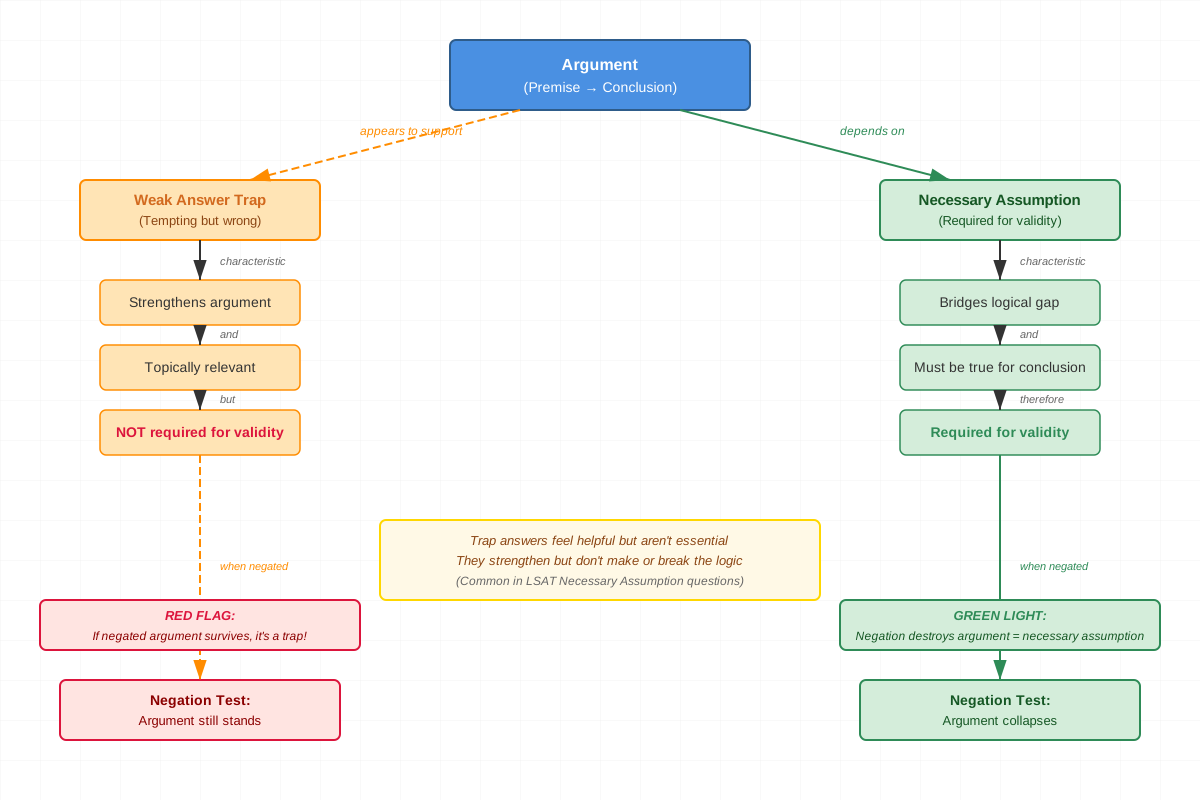
Weak answer traps are incorrect answer choices in assumption questions that appear attractive because they relate to the argument's subject matter or provide some degree of support, but fail to identify a truly necessary assumption. The term "weak" refers not to the strength of support these answers provide, but to their failure to meet the specific logical requirement of necessity. An answer choice can strengthen an argument considerably while still being a weak answer trap if the argument doesn't depend on it.
The fundamental characteristic distinguishing weak answer traps from correct answers is the necessity criterion. A necessary assumption must satisfy this test: if the assumption were false, the argument would fall apart or become significantly less valid. Weak answer traps, by contrast, can be negated without destroying the argument's logical foundation. They might make the argument less persuasive or remove additional support, but the core reasoning remains intact.
The Psychology Behind Weak Answer Traps
LSAT test makers exploit several cognitive biases when crafting weak answer traps. First, they leverage confirmation bias—the tendency to favor information that confirms existing beliefs. When students read an argument about, say, environmental policy, they naturally gravitate toward answer choices that align with common environmental concerns, even if those concerns aren't logically necessary to the specific argument presented.
Second, weak answer traps exploit topical relevance bias. Students often mistake relevance for necessity, selecting answers that discuss the same subject matter as the argument without verifying that the argument actually depends on the statement. An argument about reducing carbon emissions might include a weak answer trap about renewable energy costs, which feels relevant but may not be necessary to the argument's specific reasoning chain.
Third, these traps capitalize on time pressure and satisficing. Under exam conditions, students often select the first answer that seems reasonable rather than rigorously testing each option. Weak answer traps are typically positioned to catch this behavior, appearing early in the answer sequence and using language that creates an immediate sense of correctness.
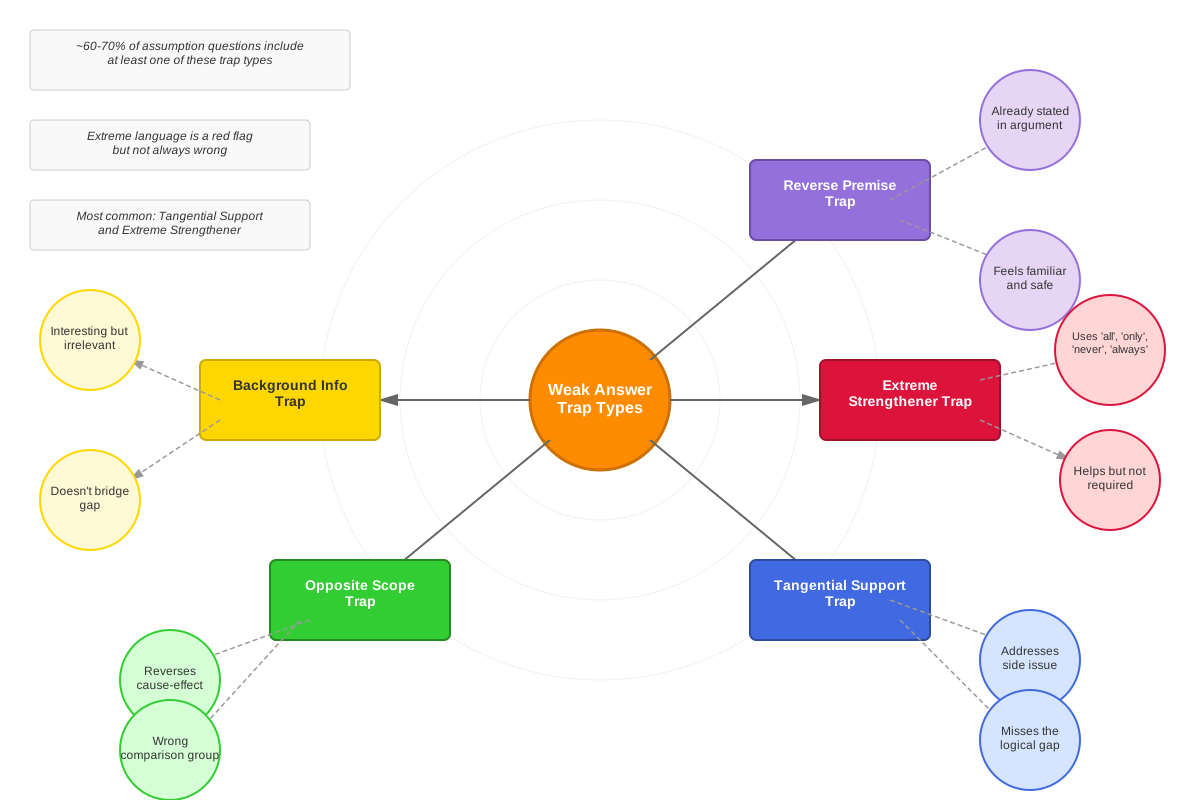
Categories of Weak Answer Traps
Type 1: The Strengthener
This category includes answers that would strengthen the argument if true but aren't required for the argument to work. For example, if an argument concludes that a new teaching method will improve student performance based on a pilot study, a weak answer trap might state: "The teachers implementing the new method received extensive training." While this would strengthen confidence in the conclusion, the argument doesn't depend on it—the pilot study results could still support the conclusion even with minimally trained teachers.
Type 2: The Background Assumption
These traps provide general context or widely accepted background information that doesn't specifically bridge the gap in the argument. For instance, an argument about increasing library funding might include a trap answer stating: "Books are important educational resources." While true and relevant, this doesn't address the specific logical leap the argument makes—perhaps from "increased funding" to "improved educational outcomes."
Type 3: The Extreme Supporter
This type takes the argument's reasoning and amplifies it beyond what's necessary. If an argument concludes that reducing sugar intake will improve health outcomes, a weak answer trap might state: "Sugar is the primary cause of all modern health problems." The argument only needs to assume that sugar reduction has some positive health effect, not that sugar is the primary cause of all health issues.
Type 4: The Reversed Conditional
These traps present a conditional relationship that's related to the argument but has the logical direction reversed or slightly altered. An argument might reason: "If we implement policy X, outcome Y will occur." A weak answer trap might state: "Outcome Y cannot occur without policy X," which is a much stronger claim than the argument requires.
Type 5: The Subsidiary Concern
This category addresses a potential objection or alternative explanation but goes beyond what the argument actually needs to assume. For example, an argument about a new drug's effectiveness might include a trap stating: "No other factors could possibly explain the observed improvements." The argument typically only needs to assume that the drug played a significant role, not that it's the only possible explanation.
The Negation Test Applied to Weak Answer Traps
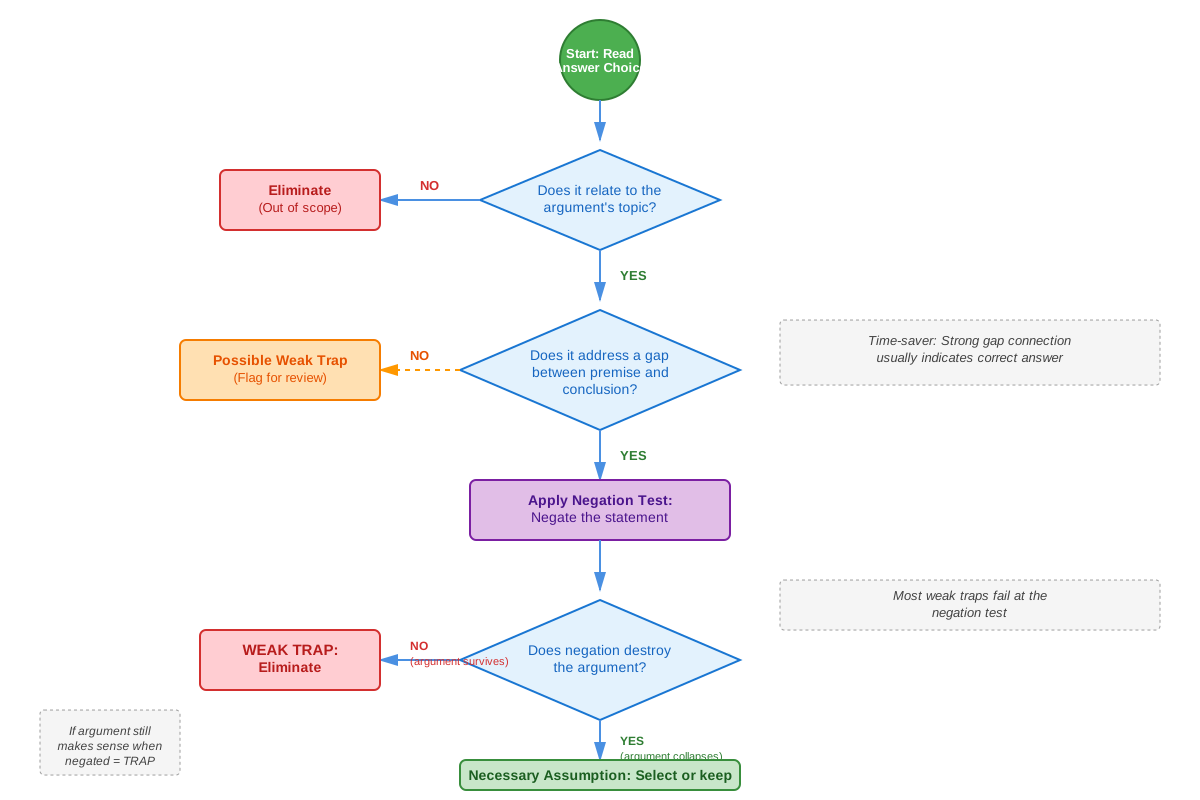
The negation test serves as the most reliable tool for identifying weak answer traps. This technique involves negating an answer choice and asking: "Does this negation destroy or seriously weaken the argument?" For correct answers, the negation will devastate the argument. For weak answer traps, the negation will have minimal impact or merely reduce additional support.
Consider this application: If an answer choice states "The study participants were representative of the general population," negating it yields "The study participants were not representative of the general population." If the argument can still function with unrepresentative participants (perhaps because it only claims results for that specific group), this reveals a weak answer trap. The argument might be less persuasive, but it isn't logically destroyed.
The key distinction lies in understanding degrees of impact. Weak answer traps, when negated, might make the argument weaker or less convincing, but they don't eliminate the logical connection between premises and conclusion. Correct assumptions, when negated, create a logical chasm that cannot be bridged without additional information.
Linguistic Markers of Weak Answer Traps
Certain language patterns frequently signal weak answer traps:
- Extreme quantifiers: Words like "all," "every," "never," "always," "only," or "must" often indicate claims stronger than the argument requires
- Comparative absolutes: Phrases like "the best," "the most important," or "the primary factor" typically exceed necessity
- Scope expansion: Language that broadens the argument's scope beyond its specific claims
- Causal certainty: Statements that assert definitive causal relationships when the argument only requires correlation or tendency
However, these markers aren't foolproof—correct answers can occasionally use strong language when the argument genuinely requires it. The linguistic pattern serves as a red flag for additional scrutiny, not an automatic elimination criterion.
The Relationship Between Weak Answer Traps and Argument Gaps
Every assumption question contains a logical gap—an unstated connection between premises and conclusion. Weak answer traps often address the general area of this gap without precisely filling it. They might provide information about adjacent issues or offer support that's tangentially related to the gap without being necessary to bridge it.
Understanding this relationship requires precise gap identification. Students must first articulate exactly what logical leap the argument makes, then evaluate whether each answer choice is necessary to justify that specific leap. Weak answer traps succeed when students identify the gap's general vicinity but lack the precision to recognize that the answer choice doesn't quite bridge it.
Concept Relationships
The concept of weak answer traps sits at the intersection of multiple logical reasoning skills. At its foundation, argument structure analysis enables students to identify the premises and conclusion, which then allows recognition of the logical gap requiring an assumption. This gap identification directly leads to understanding what makes an assumption necessary versus merely supportive.
The negation test serves as the primary diagnostic tool, connecting directly to weak answer trap identification. When students apply the negation test systematically, they can distinguish between answers that destroy the argument (correct assumptions) and those that merely weaken it (weak answer traps). This relationship flows as: Argument Structure → Gap Identification → Negation Test Application → Weak Answer Trap Elimination.
Weak answer traps also connect forward to other question types. The distinction between necessary and sufficient conditions learned here applies directly to Strengthen questions (where weak answer traps become potentially correct answers) and Weaken questions (where understanding what's necessary helps identify what would undermine the argument). Additionally, Flaw questions often test whether students can recognize when an argument fails to establish a necessary assumption, making weak answer trap recognition a prerequisite skill.
The relationship map flows as follows:
Conditional Logic → Argument Structure → Gap Identification → Assumption Recognition → Negation Test → Weak Answer Trap Identification → Application to Strengthen/Weaken Questions → Mastery of Logical Reasoning Section
High-Yield Facts
⭐ Weak answer traps appear in approximately 60-70% of assumption questions as incorrect answer choices, making them one of the most common wrong answer patterns on the LSAT
⭐ The negation test is the most reliable method for distinguishing weak answer traps from correct assumptions—if negating an answer merely weakens rather than destroys the argument, it's a trap
⭐ Weak answer traps often strengthen the argument but aren't necessary for it, exploiting the confusion between "helpful" and "required"
⭐ Answer choices using extreme language ("all," "only," "never," "must") are more likely to be weak answer traps because arguments rarely depend on such absolute claims
⭐ Weak answer traps frequently address the general topic area of the argument's gap without precisely bridging the specific logical leap required
- Weak answer traps positioned early in the answer sequence (A or B) catch students who select the first plausible option without testing all choices
- The most dangerous weak answer traps are those that would strengthen the argument significantly, making them feel correct despite not being necessary
- Recognizing weak answer traps requires distinguishing between what the argument assumes and what would make the argument more persuasive
- Time pressure increases susceptibility to weak answer traps by encouraging satisficing behavior rather than rigorous logical testing
- Weak answer traps in assumption questions often become correct answers in strengthen questions, highlighting the importance of question type recognition
- Background assumptions that are generally true but not specific to the argument's reasoning chain constitute a major category of weak answer traps
- The correct assumption in an assumption question is often more modest and specific than weak answer traps, which tend toward broader or stronger claims
Quick check — test yourself on Weak answer traps so far.
Try Flashcards →Common Misconceptions
Misconception: If an answer choice strengthens the argument, it must be a necessary assumption.
Correction: Strengthening and necessity are distinct concepts. Many statements can strengthen an argument without being necessary for it. A necessary assumption is specifically something the argument depends upon—without it, the argument fails. The negation test reveals this distinction: necessary assumptions, when negated, destroy the argument, while mere strengtheners, when negated, only reduce its persuasiveness.
Misconception: Weak answer traps are always obviously wrong or irrelevant to the argument.
Correction: Weak answer traps are deliberately designed to appear correct and are typically highly relevant to the argument's subject matter. They succeed precisely because they seem right to students who haven't mastered the distinction between relevance and necessity. The most dangerous weak answer traps are those that would genuinely help the argument but aren't required for it to function.
Misconception: The correct assumption will always be the strongest or most comprehensive answer choice.
Correction: Correct assumptions are often more modest and specific than weak answer traps. LSAT arguments typically require narrow, precise assumptions that bridge a specific gap, while weak answer traps often make broader claims that exceed what's necessary. Students should be suspicious of answer choices that seem to "do too much" or make claims beyond the argument's immediate needs.
Misconception: If an answer choice addresses a potential objection to the argument, it must be a necessary assumption.
Correction: Addressing potential objections doesn't automatically make something a necessary assumption. The argument must actually depend on that objection being invalid. Many weak answer traps present statements that would defend against possible criticisms without being logically required by the argument's structure. The negation test reveals whether the argument truly depends on the objection being addressed.
Misconception: Extreme language ("all," "only," "never") always indicates a wrong answer in assumption questions.
Correction: While extreme language often signals weak answer traps because arguments rarely depend on absolute claims, this isn't a universal rule. Some arguments do require strong assumptions, particularly when the conclusion itself makes an absolute claim. Students should use extreme language as a trigger for extra scrutiny rather than automatic elimination, always confirming with the negation test.
Misconception: The correct assumption will introduce completely new information not mentioned in the argument.
Correction: While assumptions are unstated, they typically connect concepts already present in the argument rather than introducing entirely new topics. Weak answer traps sometimes bring in tangentially related new information that seems relevant but doesn't bridge the specific gap in the argument. Correct assumptions usually link existing elements of the argument in a way that makes the reasoning valid.
Worked Examples
Example 1: Environmental Policy Argument
Argument: "The city should implement a new recycling program because studies show that cities with comprehensive recycling programs reduce landfill waste by 30%. Our city's landfills are approaching capacity, so we need to reduce the amount of waste we send to them."
Question: Which of the following is an assumption required by the argument?
Answer Choices:
A) Recycling programs are the most cost-effective way to reduce landfill waste
B) The city has sufficient funding to implement a comprehensive recycling program
C) A 30% reduction in landfill waste would meaningfully address the capacity problem
D) Residents will participate in the recycling program if it's implemented
E) Other cities' recycling programs are comparable to what this city would implement
Analysis:
Let's examine each answer using the negation test:
Choice A (Weak Answer Trap - Type 3: Extreme Supporter): Negation: "Recycling programs are not the most cost-effective way to reduce landfill waste." Does this destroy the argument? No. The argument only needs recycling to be effective at reducing waste, not necessarily the most cost-effective option. The argument could still work even if other methods were more cost-effective. This is a classic weak answer trap that makes a stronger claim than necessary.
Choice B (Weak Answer Trap - Type 1: Strengthener): Negation: "The city does not have sufficient funding to implement a comprehensive recycling program." This would make the recommendation impractical, but it doesn't destroy the logical connection between the premises and conclusion. The argument is about whether the city should implement the program based on its benefits, not whether it can. This strengthens the argument but isn't logically necessary.
Choice C (Correct Answer): Negation: "A 30% reduction in landfill waste would not meaningfully address the capacity problem." This destroys the argument completely. If a 30% reduction doesn't help with the capacity problem, then the entire reasoning chain falls apart—there's no longer a logical connection between implementing recycling (which achieves 30% reduction) and solving the stated problem (landfill capacity). This is necessary.
Choice D (Weak Answer Trap - Type 2: Background Assumption): Negation: "Residents will not participate in the recycling program if it's implemented." While this seems important, the argument is based on what happens in cities with comprehensive recycling programs—presumably, those programs achieve participation somehow. The argument doesn't need to assume anything specific about this city's participation rates beyond what's typical for comprehensive programs. This is a subtle trap.
Choice E (Weak Answer Trap - Type 5: Subsidiary Concern): Negation: "Other cities' recycling programs are not comparable to what this city would implement." This weakens the argument by questioning the relevance of the studies, but doesn't destroy it. The argument could still work if there's reasonable similarity, even if not perfect comparability. This addresses a potential objection but isn't strictly necessary.
Key Takeaway: The correct answer (C) bridges the specific gap between "30% reduction" and "solving our capacity problem." The weak answer traps either make stronger claims than necessary (A), address practical rather than logical concerns (B), or deal with subsidiary issues (D, E) that don't bridge the core logical gap.
Example 2: Medical Research Argument
Argument: "Dr. Martinez's study concludes that the new medication reduces symptoms in patients with chronic pain. The study followed 200 patients for six months, and 75% reported significant symptom improvement. Therefore, the medication is effective for treating chronic pain."
Question: The argument depends on assuming which of the following?
Answer Choices:
A) The 75% improvement rate is higher than what would occur without treatment
B) No other medication currently available is more effective than the new medication
C) The six-month study period was sufficient to assess long-term effectiveness
D) Chronic pain is a condition that requires medical intervention
E) The 200 patients in the study had similar types of chronic pain
Analysis:
Applying the negation test systematically:
Choice A (Correct Answer): Negation: "The 75% improvement rate is not higher than what would occur without treatment." This completely destroys the argument. If 75% of patients would improve anyway without the medication, then the study results don't demonstrate that the medication is effective—the improvement could be entirely due to placebo effect, natural recovery, or other factors. The argument absolutely depends on the improvement being attributable to the medication rather than occurring spontaneously.
Choice B (Weak Answer Trap - Type 3: Extreme Supporter): Negation: "Other medications currently available are more effective than the new medication." Does this destroy the argument that the new medication is effective? No. Something can be effective even if other options are more effective. The argument concludes the medication "is effective," not that it's "the most effective." This trap exploits the tendency to think effectiveness requires superiority.
Choice C (Weak Answer Trap - Type 5: Subsidiary Concern): Negation: "The six-month study period was not sufficient to assess long-term effectiveness." This might limit the scope of the conclusion, but the argument only claims the medication "is effective," not that it's effective long-term. The study could still demonstrate effectiveness for the six-month period studied. This addresses a potential limitation but isn't necessary for the argument as stated.
Choice D (Weak Answer Trap - Type 2: Background Assumption): Negation: "Chronic pain is not a condition that requires medical intervention." This is a general statement about chronic pain that doesn't affect the specific logical connection in this argument. Even if chronic pain could be managed without medical intervention, the study could still demonstrate that this particular medication is effective when used. This is background information that feels relevant but isn't necessary.
Choice E (Weak Answer Trap - Type 1: Strengthener): Negation: "The 200 patients in the study had different types of chronic pain." This would make the results less generalizable and weaken confidence in the conclusion, but it doesn't destroy the argument. The medication could still be effective for treating chronic pain generally, even if the study included varied types. This strengthens the argument but isn't strictly necessary.
Key Takeaway: The correct answer (A) addresses the fundamental logical gap: attributing the observed improvement to the medication rather than other factors. Without this assumption, there's no logical basis for concluding the medication is effective. The weak answer traps either make claims beyond what's necessary (B, C), provide general background (D), or strengthen without being required (E).
Exam Strategy
Systematic Approach to Avoiding Weak Answer Traps
When approaching assumption questions on the LSAT, implement this four-step process to systematically eliminate weak answer traps:
Step 1: Identify the Conclusion and Premises (15 seconds)
Read the argument carefully and explicitly identify what the author is trying to prove (conclusion) and what evidence is provided (premises). Write down or mentally note the conclusion in your own words.
Step 2: Articulate the Gap (15 seconds)
Ask yourself: "What logical leap does this argument make? What unstated connection is required for the premises to support the conclusion?" Be as specific as possible about the exact nature of the gap.
Step 3: Predict the Answer (10 seconds)
Before looking at answer choices, formulate your own statement of what the argument must assume. This prediction doesn't need to match the correct answer exactly, but it focuses your attention on the logical requirement rather than topical relevance.
Step 4: Apply the Negation Test (60-90 seconds)
For each answer choice, negate it and ask: "Does this negation destroy the argument or merely weaken it?" Eliminate choices where the negation has minimal impact or only reduces additional support.
Exam Tip: Spend more time on Step 4 than students typically do. The negation test is time-consuming but dramatically improves accuracy. Missing an assumption question costs the same as missing any other question, so invest the time to get it right.
Trigger Words and Phrases
Watch for these linguistic patterns that frequently signal weak answer traps:
Red Flag Phrases:
- "The only way..." or "The best method..."
- "All," "every," "never," "always" (when the argument doesn't require such absolutes)
- "The primary cause" or "the main reason"
- "Cannot possibly" or "must certainly"
- "More important than" or "less significant than"
Green Light Phrases (often in correct answers):
- "At least some" or "in general"
- "Plays a role" or "contributes to"
- "Is not the case that" (modest negative claims)
- Specific connections between concepts already in the argument
Process of Elimination Strategy
Eliminate answer choices in this order:
- First Pass: Eliminate choices that are completely irrelevant or discuss topics not mentioned in the argument (rare in assumption questions, but quick to spot)
- Second Pass: Eliminate choices that make claims obviously stronger than the conclusion requires (extreme supporters)
- Third Pass: Apply the negation test to remaining choices, eliminating those where negation doesn't destroy the argument
- Final Decision: Between two remaining choices, select the one that more precisely bridges the specific gap you identified in Step 2
Time Allocation
For a typical assumption question:
- Reading and understanding the argument: 30 seconds
- Identifying gap and predicting answer: 25 seconds
- Evaluating answer choices: 75-90 seconds
- Total: 2:10-2:30 per question
If you find yourself spending more than 3 minutes on an assumption question, you're likely overthinking. Make your best choice using the negation test and move forward. The LSAT rewards efficient decision-making under uncertainty.
Common Timing Traps
Weak answer traps create specific timing challenges:
- The Early Trap: Weak answer traps often appear as choices A or B, catching students who select the first plausible answer. Force yourself to read all five choices before deciding.
- The Confidence Trap: When an answer "feels right" immediately, that's often a weak answer trap exploiting topical relevance. Apply the negation test even when you feel confident.
- The Paralysis Trap: When multiple answers seem potentially correct, students waste time re-reading the argument repeatedly. Instead, systematically apply the negation test to each remaining choice.
Memory Techniques
The SWAN Acronym
Remember SWAN to identify weak answer traps:
- Strengtheners (not necessary)
- Wider scope than needed
- Absolute language (often too extreme)
- Negation doesn't destroy argument
When evaluating an answer choice, run through SWAN. If any element applies, scrutinize the choice more carefully as a potential weak answer trap.
The Bridge Visualization
Visualize the argument as two islands (premises and conclusion) with a gap between them. The correct assumption is the specific bridge needed to cross that exact gap. Weak answer traps are:
- Boats that could help you cross but aren't necessary (strengtheners)
- Bridges to different islands (wrong scope)
- Bridges that are much wider than the gap requires (extreme supporters)
- Materials for building bridges but not the bridge itself (background assumptions)
This visualization helps maintain focus on what's specifically necessary versus what's merely helpful.
The Negation Destruction Test
Create a memorable phrase: "Negate and Devastate." The correct assumption, when negated, should devastate the argument. If negation merely dents or weakens it, you've found a weak answer trap. This rhyming phrase helps recall the key test under pressure.
The Necessity vs. Sufficiency Distinction
Remember: "Necessary = Need; Sufficient = Succeed"
- Necessary assumptions are what the argument needs to work at all
- Sufficient conditions are what would make the argument succeed better
Weak answer traps often provide sufficient conditions (things that would help) rather than necessary conditions (things that are required). This mnemonic reinforces the critical distinction.
Summary
Weak answer traps represent one of the most consistent and predictable wrong answer patterns in LSAT assumption questions, appearing in the majority of these questions as carefully crafted incorrect choices. These traps succeed by exploiting the natural tendency to select answers that seem relevant, supportive, or topically connected to the argument without meeting the specific logical requirement of necessity. The fundamental distinction students must master is between statements that would strengthen or support an argument and those that the argument actually depends upon for its logical validity. The negation test serves as the primary diagnostic tool: correct assumptions, when negated, destroy the argument's logical foundation, while weak answer traps, when negated, merely reduce additional support or weaken persuasiveness without eliminating the core reasoning. Common categories of weak answer traps include strengtheners that help but aren't required, background assumptions that provide general context, extreme supporters that make claims beyond what's necessary, and subsidiary concerns that address potential objections without being logically essential. Mastering weak answer trap identification requires systematic application of the negation test, precise gap identification, and resistance to the psychological pull of topical relevance over logical necessity—skills that translate directly to improved performance across the entire Logical Reasoning section.
Key Takeaways
- Weak answer traps appear in 60-70% of assumption questions and are designed to catch students who confuse relevance with necessity
- The negation test is the most reliable method for identifying weak answer traps: if negating an answer merely weakens rather than destroys the argument, it's a trap
- Correct assumptions bridge the specific logical gap in the argument, while weak answer traps often address the general topic area without precisely connecting premises to conclusion
- Strengthening an argument and being necessary for an argument are distinct concepts—many weak answer traps would strengthen the argument but aren't required for it to function
- Extreme language and absolute claims often signal weak answer traps because arguments rarely depend on such strong conditions, though this isn't a universal rule
- Systematic application of a four-step process (identify structure, articulate gap, predict answer, apply negation test) dramatically improves accuracy in avoiding weak answer traps
- Time investment in rigorous testing of answer choices pays dividends in accuracy—assumption questions reward careful analysis over speed
Related Topics
Sufficient Assumption Questions: While necessary assumption questions ask what must be true for the argument to work, sufficient assumption questions ask what would guarantee the conclusion. Understanding weak answer traps in necessary assumptions helps distinguish between these question types, as answers that are weak answer traps in necessary assumption questions might be correct in sufficient assumption questions.
Strengthen Questions: Weak answer traps in assumption questions often become correct answers in strengthen questions. Mastering the distinction between necessary and merely supportive statements enables efficient transition between these related question types, improving overall Logical Reasoning performance.
Flaw Questions: Many flaw questions test whether students can recognize that an argument fails to establish a necessary assumption. Understanding weak answer traps helps identify what assumptions an argument actually requires, making it easier to spot when those assumptions are missing.
Conditional Logic Advanced Applications: The distinction between necessary and sufficient conditions underlies weak answer trap identification. Advanced study of conditional logic deepens understanding of why certain statements are required while others merely provide additional support.
Practice CTA
Now that you understand the mechanics and patterns of weak answer traps, the next critical step is deliberate practice. Attempt the practice questions specifically designed to test your ability to identify and eliminate weak answer traps in assumption questions. As you work through these problems, consciously apply the negation test to each answer choice and articulate why wrong answers are weak answer traps rather than necessary assumptions. The flashcards will help reinforce the key distinctions and patterns you've learned, building the automatic recognition skills essential for success under timed conditions. Remember: understanding weak answer traps intellectually is only the first step—mastery comes through repeated, mindful application. Each practice question you complete strengthens the neural pathways that will serve you on test day, transforming conscious analysis into intuitive recognition. Your investment in practice now will pay dividends in points on the LSAT.
Sign up free to keep reading
Create a free AnvayaPrep account to finish this LSAT guide on Weak answer traps — plus flashcards and practice questions.