Overview
Alternative cause reasoning is one of the most frequently tested patterns in LSAT Logical Reasoning sections, appearing in approximately 15-20% of all causation-related questions. This concept challenges test-takers to recognize when an argument incorrectly assumes that one factor caused an outcome while ignoring other plausible explanations. Understanding alternative cause reasoning is essential because the LSAT consistently tests the ability to identify logical vulnerabilities in causal arguments—a skill that mirrors the analytical thinking required in legal practice.
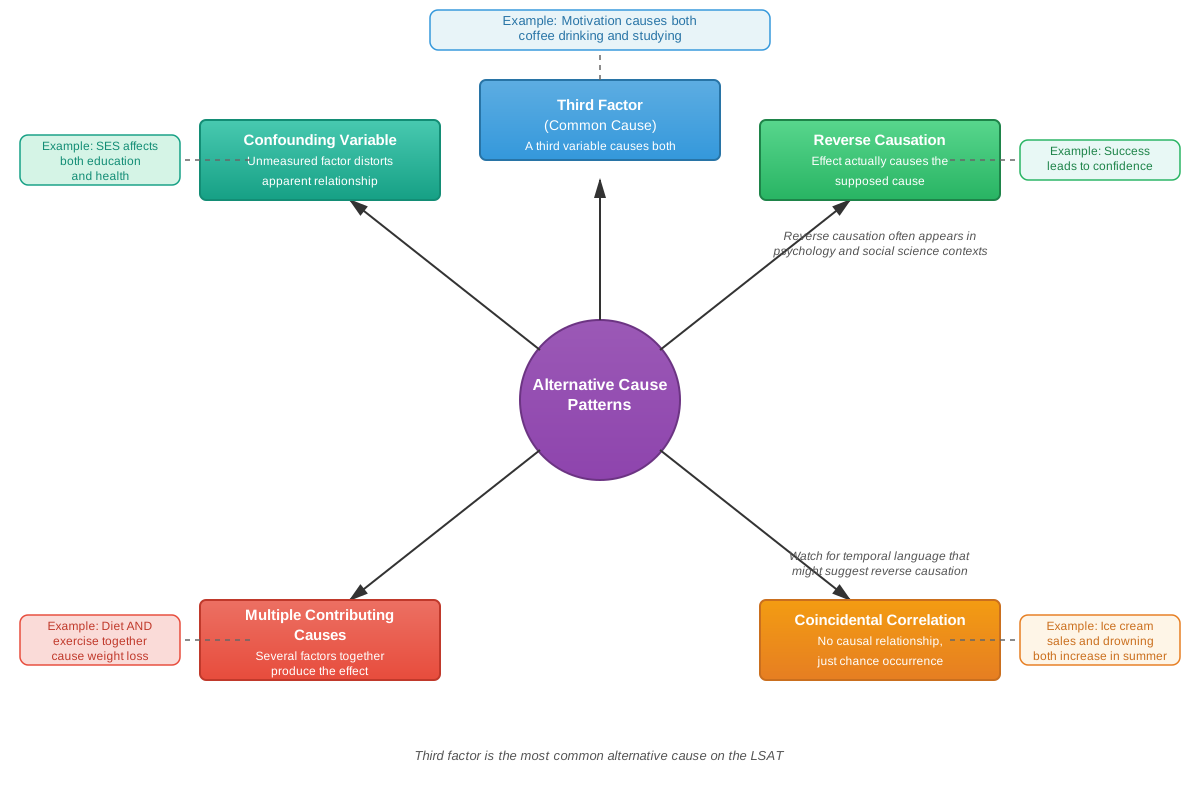
In the context of causation and explanation, alternative cause represents a fundamental flaw in reasoning: when an argument observes a correlation or temporal sequence between two events and concludes that one caused the other, it often fails to consider that a different factor might be the true cause. For instance, if a study finds that students who drink coffee score higher on exams, an argument might conclude that coffee improves test performance. However, this reasoning is vulnerable to an alternative cause objection—perhaps more motivated students both drink coffee and study harder, making motivation (not coffee) the actual cause of higher scores.
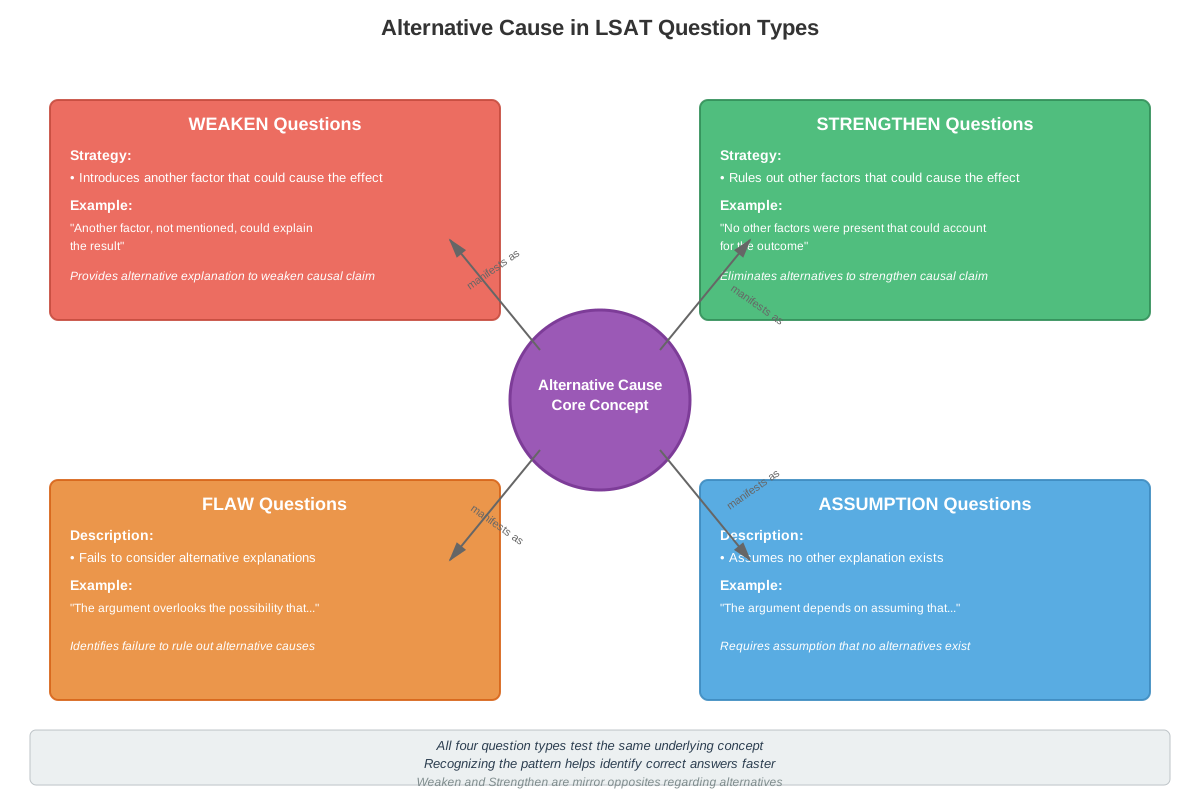
The LSAT alternative cause pattern connects directly to other logical reasoning concepts including correlation versus causation, sufficient versus necessary conditions, and argument evaluation. Mastering this topic provides the foundation for understanding how arguments can be strengthened, weakened, or evaluated for logical soundness. Because alternative cause reasoning appears across multiple question types—including Weaken, Strengthen, Flaw, and Assumption questions—developing expertise in this area yields significant score improvements across the entire Logical Reasoning section.
Learning Objectives
- [ ] Identify how Alternative cause appears in LSAT questions
- [ ] Explain the reasoning pattern behind Alternative cause
- [ ] Apply Alternative cause to solve LSAT-style problems accurately
- [ ] Distinguish between alternative cause objections and other types of causal reasoning flaws
- [ ] Recognize the structural indicators that signal vulnerability to alternative cause objections
- [ ] Evaluate answer choices that introduce alternative causes to weaken or strengthen arguments
- [ ] Construct alternative cause explanations when analyzing argument assumptions
Prerequisites
- Basic understanding of causal reasoning: Recognizing when arguments claim that one event or factor causes another is essential for identifying where alternative causes might apply
- Familiarity with argument structure: Understanding premises, conclusions, and the gap between them helps identify where alternative explanations could undermine an argument's logic
- Knowledge of correlation versus causation: Distinguishing between events that merely occur together versus events where one produces the other provides the foundation for alternative cause analysis
- Experience with conditional reasoning: Understanding sufficient and necessary conditions helps differentiate between causal claims and other logical relationships
Why This Topic Matters
Alternative cause reasoning appears throughout legal practice, making it a natural focus for the LSAT. Attorneys must regularly evaluate whether evidence truly supports a causal claim or whether alternative explanations better account for observed facts. In litigation, establishing causation requires ruling out alternative causes—whether determining liability in a tort case or proving that a defendant's actions caused specific harm.
On the LSAT, alternative cause questions appear in approximately 8-12 questions per test, distributed across Weaken (most common), Strengthen, Flaw, and Assumption question types. This frequency makes alternative cause one of the highest-yield topics in Logical Reasoning. Questions testing this concept typically present arguments that observe a correlation or temporal relationship and conclude a causal connection exists, creating an opportunity for test-takers to identify the logical gap.
The LSAT presents alternative cause reasoning in several characteristic ways: arguments about policy effectiveness (a new policy correlates with improved outcomes, but other factors might explain the improvement), scientific studies (observed correlations that might have alternative explanations), historical explanations (events that coincide temporally but might not be causally connected), and business decisions (outcomes attributed to one factor when multiple factors changed simultaneously). Recognizing these patterns enables rapid identification of alternative cause vulnerabilities during timed test conditions.
Core Concepts
The Alternative Cause Pattern
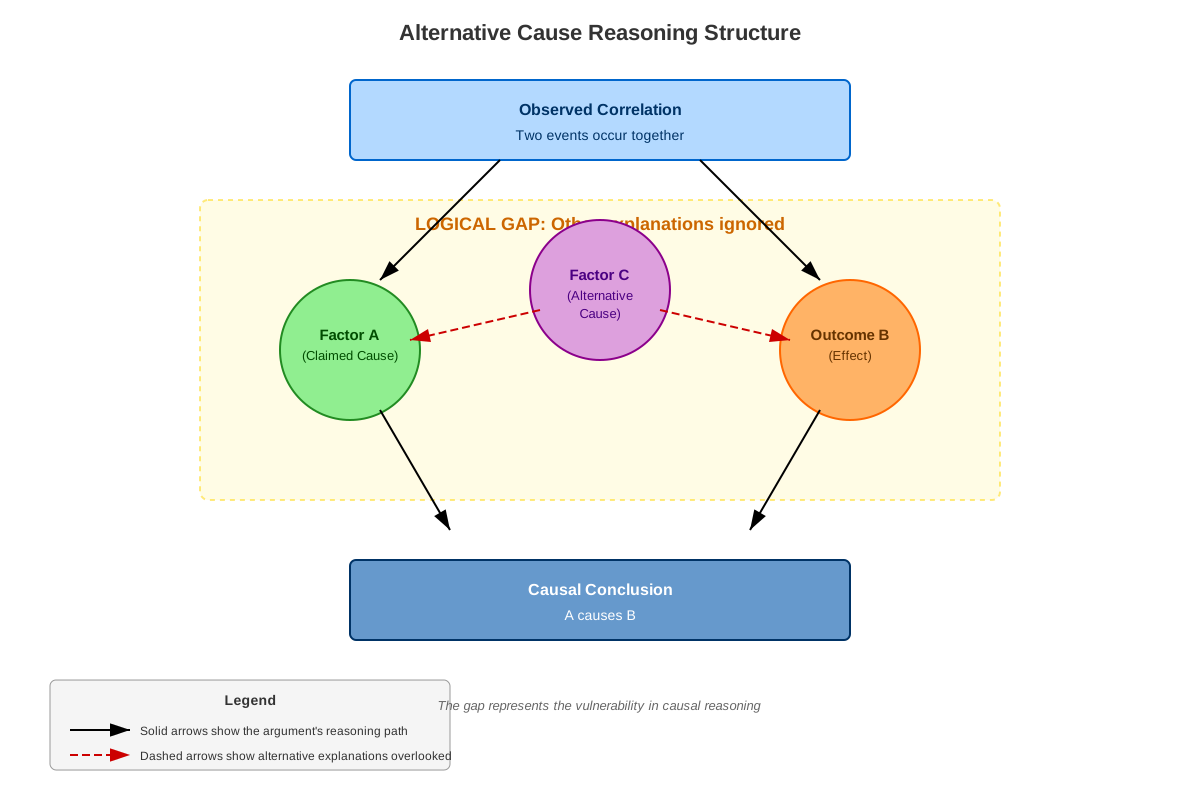
An alternative cause objection challenges an argument by proposing that a different factor—not the one identified in the conclusion—actually caused the observed effect. This reasoning pattern exploits a fundamental logical gap: when an argument moves from observing that two things are correlated or temporally related to concluding that one caused the other, it assumes no other factor could explain the relationship.
The basic structure follows this pattern:
- Premise: Event A and Event B are correlated (or A precedes B)
- Conclusion: Event A caused Event B
- Vulnerability: Event C (the alternative cause) might actually have caused Event B
Consider this example: "After the city installed new streetlights, crime decreased by 20%. Therefore, the new streetlights reduced crime." This argument is vulnerable to alternative causes—perhaps increased police patrols, demographic changes, or economic improvements actually caused the crime reduction, and the streetlights were merely coincidental.
Distinguishing Alternative Cause from Other Causal Flaws
Alternative cause reasoning differs from other causal reasoning errors in important ways:
| Reasoning Flaw | Description | Example |
|---|---|---|
| Alternative Cause | A different factor caused the effect | Coffee doesn't improve performance; motivation causes both coffee drinking and better performance |
| Reverse Causation | The effect actually caused the supposed cause | Better performance causes coffee drinking (as a reward), not vice versa |
| Coincidence | No causal relationship exists at all | Coffee drinking and performance are unrelated; their correlation is random |
| Necessary vs. Sufficient | Confusing what's required with what's enough | Coffee might help but isn't sufficient alone for better performance |
Understanding these distinctions prevents confusion when evaluating answer choices. Alternative cause specifically proposes a third factor as the true cause, while reverse causation flips the direction of causation between the two factors already mentioned.
Identifying Alternative Cause Vulnerabilities
Arguments vulnerable to alternative cause objections share several structural features:
Temporal correlation language: Phrases like "after," "following," "since," or "when" signal that the argument observes timing but might incorrectly infer causation. Example: "After implementing the training program, productivity increased" assumes the program caused the increase but ignores other concurrent changes.
Correlation indicators: Words such as "associated with," "correlated with," "linked to," or "accompanied by" describe relationships without establishing causation. Example: "Higher social media use is associated with anxiety" doesn't prove social media causes anxiety—perhaps anxious people seek social media more, or another factor causes both.
Single-factor explanations: Arguments that attribute an outcome to one cause while multiple factors changed simultaneously are highly vulnerable. Example: "The company's profits increased after hiring a new CEO, so the CEO's leadership improved profitability" ignores market conditions, product launches, or other business changes.
Observational studies: Arguments based on observed correlations rather than controlled experiments are particularly susceptible because they cannot isolate variables. Example: "People who eat organic food live longer, so organic food extends lifespan" fails to consider that people who buy organic food might also exercise more, have better healthcare access, or differ in other health-relevant ways.
How Alternative Causes Appear in Answer Choices
In Weaken questions, correct answers introducing alternative causes typically:
- Present a different factor that could plausibly cause the observed effect
- Provide evidence that this alternative factor was present in the situation described
- Suggest the alternative factor is sufficient to explain the outcome without the original cause
Example: If an argument claims a new teaching method improved test scores, a weakening answer might state: "The students who received the new teaching method also received additional tutoring, which has been shown to significantly improve test scores."
In Strengthen questions, correct answers addressing alternative causes typically:
- Rule out specific alternative explanations
- Provide evidence that potential alternative causes were absent or controlled
- Show that the proposed cause operates independently of other factors
Example: To strengthen the teaching method argument, an answer might state: "Students who received only the new teaching method, without any additional support, showed the same improvement as those in the original study."
In Assumption questions, correct answers often:
- State that no alternative cause exists
- Assert that other factors remained constant
- Claim that the proposed cause is the only relevant factor
Example: "No factors other than the teaching method changed during the study period."
In Flaw questions, correct answers describing alternative cause vulnerabilities typically:
- Identify that the argument fails to rule out other possible causes
- Note that the argument treats correlation as causation
- Point out that the argument overlooks alternative explanations
Example: "The argument fails to consider whether factors other than the teaching method might have caused the improvement."
The Mechanism of Alternative Cause Reasoning
Understanding why alternative causes undermine arguments requires recognizing the logical structure of causal claims. A valid causal argument must establish:
- Correlation: The proposed cause and effect occur together
- Temporal precedence: The cause precedes the effect
- Elimination of alternatives: No other factor better explains the relationship
- Mechanism: A plausible explanation exists for how the cause produces the effect
Most LSAT arguments vulnerable to alternative cause objections satisfy the first two requirements but fail the third. They observe correlation and temporal sequence but don't eliminate other possible causes. This creates the logical gap that alternative cause objections exploit.
Consider this argument: "Countries that increased education spending saw economic growth. Therefore, education spending promotes economic growth." This satisfies correlation (spending and growth occur together) and temporal precedence (spending increases preceded growth). However, it fails to eliminate alternatives—perhaps natural resource discoveries, technological innovations, or demographic changes actually drove economic growth, and education spending merely coincided with these other factors.
Common Contexts for Alternative Cause Questions
Policy and intervention arguments: These claim that a policy, program, or intervention caused an observed improvement. Alternative causes might include: concurrent changes in other policies, external factors affecting the situation, selection effects (the intervention targeted groups already improving), or regression to the mean (extreme values naturally moderate over time).
Scientific and medical arguments: These attribute health outcomes or scientific phenomena to specific causes. Alternative causes might include: confounding variables (factors correlated with both the proposed cause and effect), placebo effects, measurement errors, or pre-existing differences between groups.
Business and economic arguments: These explain business outcomes through specific decisions or factors. Alternative causes might include: market trends affecting all companies, seasonal variations, changes in competition, or multiple simultaneous business changes.
Historical and social arguments: These explain historical events or social phenomena through particular causes. Alternative causes might include: other concurrent historical events, long-term trends, cultural shifts, or multiple interacting factors.
Concept Relationships
Alternative cause reasoning connects to broader causation and explanation concepts through a hierarchical relationship. At the foundation lies the distinction between correlation and causation—alternative cause reasoning specifically addresses situations where arguments incorrectly move from correlation to causation. This connection means that mastering correlation versus causation provides the conceptual foundation for understanding alternative causes.
The relationship flows as follows: Correlation observation → Causal inference → Alternative cause vulnerability. When an argument observes correlation and infers causation without adequate justification, it becomes vulnerable to alternative cause objections. This vulnerability can be exploited to weaken the argument or must be addressed to strengthen it.
Alternative cause reasoning also connects to necessary and sufficient conditions. An argument claiming that Factor A caused Outcome B implicitly treats A as sufficient for B. An alternative cause objection proposes that Factor C is actually sufficient for B, suggesting A might be unnecessary. Understanding this relationship helps distinguish alternative cause from other logical patterns.
Within the topic itself, concepts connect through a problem-solution structure: Identifying vulnerability → Understanding the logical gap → Recognizing how answer choices exploit or address the gap. First, recognizing structural indicators reveals alternative cause vulnerability. Second, understanding why the argument fails to eliminate alternatives explains the logical weakness. Third, this understanding enables prediction and evaluation of answer choices that introduce or rule out alternative causes.
Alternative cause reasoning also relates to argument assumptions. Every causal argument vulnerable to alternative causes makes an implicit assumption: that no other factor caused the observed effect. Recognizing this assumption connects alternative cause questions to assumption-family question types (Assumption, Strengthen, Weaken, Flaw).
High-Yield Facts
⭐ Alternative cause objections propose that a different factor—not the one identified in the argument—actually caused the observed effect
⭐ Arguments that move from correlation or temporal sequence to causation without eliminating other possible causes are vulnerable to alternative cause objections
⭐ In Weaken questions, introducing a plausible alternative cause that could explain the observed effect undermines the argument's causal conclusion
⭐ In Strengthen questions, ruling out alternative causes or showing they were absent/controlled supports the argument's causal claim
⭐ Temporal correlation language ("after," "following," "since") signals potential alternative cause vulnerability
- Alternative cause differs from reverse causation—alternative cause introduces a third factor, while reverse causation flips the direction between two existing factors
- Arguments based on observational studies are more vulnerable to alternative cause objections than those based on controlled experiments
- Single-factor explanations for complex outcomes are highly susceptible to alternative cause objections
- In Assumption questions, correct answers often state that no alternative cause exists or that other factors remained constant
- In Flaw questions, alternative cause vulnerabilities are described as "failing to rule out other possible causes" or "treating correlation as causation"
- Multiple alternative causes can exist simultaneously—an argument might be vulnerable to several different alternative explanations
- The strength of an alternative cause objection depends on the plausibility and relevance of the proposed alternative
- Alternative cause reasoning appears across approximately 8-12 questions per LSAT, making it one of the highest-yield patterns
- Confounding variables (factors correlated with both the proposed cause and effect) represent a specific type of alternative cause
- Selection effects (where groups differ in ways beyond the proposed cause) create alternative cause vulnerabilities in comparative arguments
Quick check — test yourself on Alternative cause so far.
Try Flashcards →Common Misconceptions
Misconception: Any factor mentioned in the stimulus can serve as an alternative cause → Correction: An alternative cause must be a factor not already identified as the cause in the conclusion, and it must be capable of producing the observed effect independently. Simply mentioning another factor doesn't make it an alternative cause unless it could plausibly explain the outcome.
Misconception: Alternative cause and reverse causation are the same thing → Correction: Alternative cause introduces a third factor (C causes B, not A causes B), while reverse causation flips the direction between two factors already mentioned (B causes A, not A causes B). These are distinct logical patterns requiring different answer choice structures.
Misconception: To weaken an argument with alternative cause, the alternative must be proven to be the actual cause → Correction: Introducing a plausible alternative cause weakens the argument by showing the conclusion isn't necessarily true, even if the alternative isn't definitively proven. The goal is to undermine confidence in the causal claim, not to establish a different cause with certainty.
Misconception: If an argument mentions that other factors were controlled, it's immune to alternative cause objections → Correction: The argument must specifically control for or rule out the particular alternative cause being proposed. General statements about controlling variables don't eliminate all possible alternative causes, especially if the answer choice introduces a factor not previously considered.
Misconception: Alternative causes only appear in Weaken questions → Correction: Alternative cause reasoning appears across multiple question types including Weaken, Strengthen (by ruling out alternatives), Assumption (assuming no alternatives exist), Flaw (failing to eliminate alternatives), and even some Inference questions. Understanding the pattern enables recognition across all these contexts.
Misconception: The alternative cause must be more likely than the original cause to weaken the argument → Correction: An alternative cause weakens an argument simply by being plausible enough to cast doubt on the conclusion. It doesn't need to be more probable than the original cause—merely possible enough to show the conclusion doesn't necessarily follow from the premises.
Misconception: If two factors both contribute to an effect, neither is an alternative cause → Correction: Alternative cause objections can work even when multiple factors contribute. If an argument attributes an outcome entirely to Factor A while ignoring Factor B's contribution, introducing Factor B as an alternative cause weakens the argument by showing A isn't solely responsible, even if A contributes partially.
Worked Examples
Example 1: Weaken Question with Alternative Cause
Stimulus: "A recent study found that employees who work from home are 15% more productive than those who work in the office. This demonstrates that remote work arrangements increase productivity. Therefore, companies should implement remote work policies to boost their overall productivity."
Question: Which of the following, if true, most weakens the argument?
Analysis Process:
- Identify the conclusion: Remote work arrangements increase productivity (causal claim)
- Identify the evidence: Correlation between working from home and higher productivity
- Recognize the vulnerability: The argument observes correlation and concludes causation without eliminating alternative explanations. This is a classic alternative cause vulnerability.
- Predict the answer: A correct answer will introduce a different factor that could explain why remote workers are more productive, suggesting remote work itself isn't the cause.
Strong Answer Choice: "Employees who work from home were selected for remote positions based on their demonstrated ability to work independently and maintain high productivity without supervision."
Why this works: This introduces a selection effect as an alternative cause. The higher productivity might result from the type of employees chosen for remote work (already highly productive, independent workers) rather than from remote work itself. If companies implemented universal remote work policies, they wouldn't see the same productivity gains because they'd include employees without these pre-existing characteristics.
Weak Answer Choice: "Some employees who work from home report feeling isolated from their colleagues."
Why this fails: This doesn't introduce an alternative cause for the productivity increase. It mentions a negative aspect of remote work but doesn't explain why remote workers are more productive, so it doesn't weaken the causal claim.
Example 2: Strengthen Question Addressing Alternative Causes
Stimulus: "After the city implemented a new traffic management system, average commute times decreased by 12 minutes. The new system must be responsible for reducing commute times."
Question: Which of the following, if true, most strengthens the argument?
Analysis Process:
- Identify the conclusion: The new traffic management system caused reduced commute times
- Identify the vulnerability: Alternative factors might have caused the reduction—perhaps fewer people commuting, road construction completion, gas price changes affecting driving patterns, or seasonal variations
- Predict the answer: A correct answer will rule out alternative causes by showing they were absent, controlled, or insufficient to explain the change
Strong Answer Choice: "During the period studied, the number of commuters, road conditions, and gas prices remained constant, and no other changes to transportation infrastructure occurred."
Why this works: This systematically rules out multiple plausible alternative causes. By establishing that other factors remained constant, it strengthens the claim that the traffic management system specifically caused the improvement. This addresses the argument's vulnerability by eliminating alternative explanations.
Weak Answer Choice: "The traffic management system uses advanced computer algorithms to optimize traffic flow."
Why this fails: This explains the mechanism of how the system might work but doesn't rule out alternative causes. Even if the system has sophisticated technology, other factors might still explain the reduced commute times. Mechanism information doesn't address the alternative cause vulnerability.
Example 3: Flaw Question Identifying Alternative Cause Vulnerability
Stimulus: "Surveys show that people who regularly attend cultural events such as concerts and museums report higher life satisfaction than those who don't. Clearly, attending cultural events increases life satisfaction."
Question: The reasoning in the argument is flawed in that it:
Analysis Process:
- Identify the logical structure: Correlation between cultural event attendance and life satisfaction → Conclusion that attendance causes satisfaction
- Recognize the flaw type: This is an alternative cause vulnerability—the argument doesn't consider that other factors might explain both cultural event attendance and life satisfaction
- Predict the answer: The correct answer will describe the failure to eliminate alternative causes, possibly using language like "overlooks the possibility that," "fails to consider whether," or "takes for granted that"
Strong Answer Choice: "Fails to consider whether people with higher life satisfaction are more likely to have the time, resources, and inclination to attend cultural events."
Why this works: This identifies a specific alternative cause (or reverse causation combined with alternative factors). Perhaps financial security, free time, or personality traits cause both higher life satisfaction and cultural event attendance. The argument's flaw is treating correlation as causation without eliminating these alternatives.
Weak Answer Choice: "Relies on survey data that may not accurately reflect people's true life satisfaction."
Why this fails: This challenges the reliability of the evidence rather than identifying the alternative cause vulnerability in the reasoning. Even if the survey data is perfectly accurate, the argument still commits the flaw of inferring causation from correlation without eliminating alternative explanations.
Exam Strategy
Rapid Identification Triggers
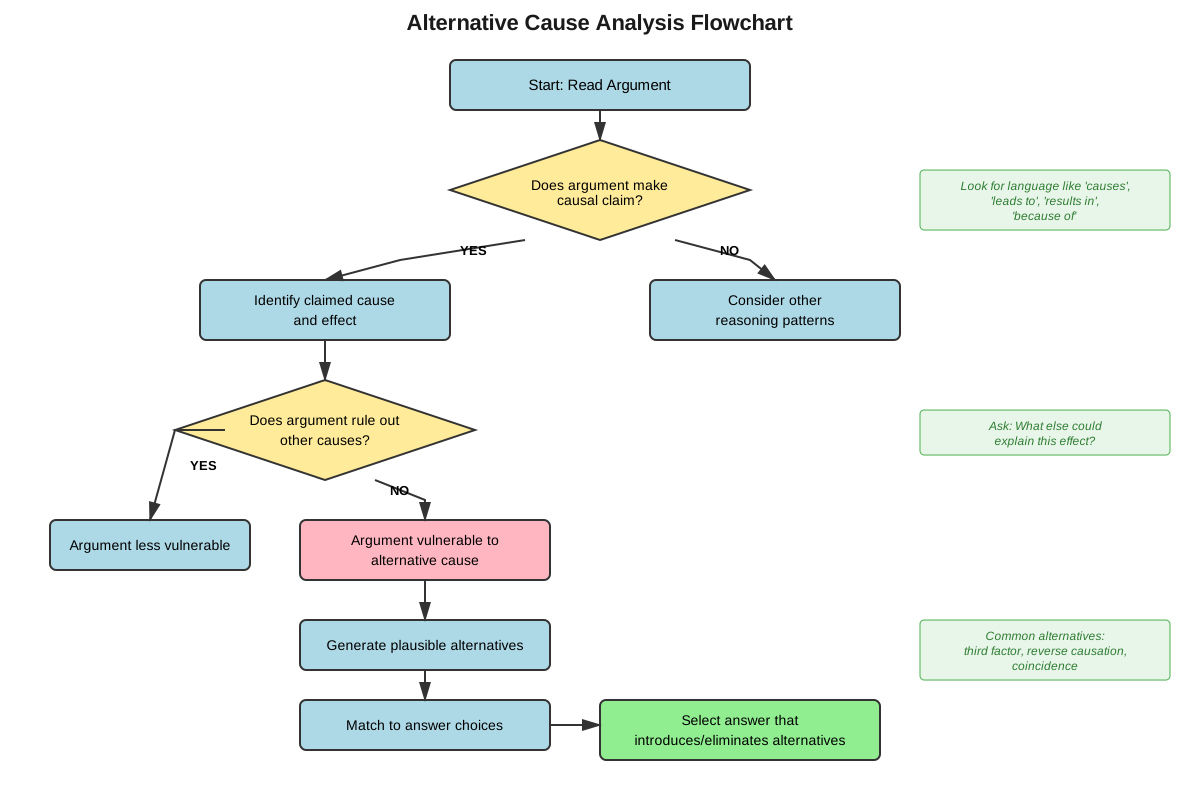
When reading LSAT stimuli, immediately flag arguments containing these trigger phrases as potentially vulnerable to alternative cause objections:
- Temporal markers: "after," "following," "since," "when," "during the period that"
- Correlation language: "associated with," "correlated with," "linked to," "accompanied by," "related to"
- Causal conclusions: "therefore," "thus," "consequently," "as a result," "caused by," "due to," "because of"
- Single-factor attributions: "the reason for," "explains why," "accounts for," "responsible for"
When these triggers appear together—especially temporal/correlation language in premises followed by causal language in the conclusion—alternative cause vulnerability is highly likely.
Question Type-Specific Approaches
For Weaken questions: After identifying alternative cause vulnerability, predict that the correct answer will introduce a different factor that could plausibly cause the observed effect. Eliminate answers that:
- Merely challenge the evidence without proposing an alternative
- Introduce irrelevant factors that couldn't cause the effect
- Strengthen rather than weaken the causal claim
- Address different logical flaws (like sampling issues) without introducing alternatives
For Strengthen questions: Predict that the correct answer will rule out alternative causes by showing they were absent, controlled, or insufficient. Eliminate answers that:
- Introduce new information without addressing alternatives
- Explain the mechanism without eliminating other causes
- Actually introduce alternative causes (these weaken, not strengthen)
- Are consistent with the argument but don't address its vulnerability
For Assumption questions: Predict that the correct answer will state that no alternative cause exists or that other factors remained constant. Test answers using the negation technique—if negating the answer choice introduces an alternative cause that would weaken the argument, it's likely correct.
For Flaw questions: Look for answer choices describing the failure to eliminate alternative causes. Common correct answer phrasings include:
- "Fails to rule out other possible causes"
- "Treats a correlation as evidence of causation"
- "Overlooks the possibility that another factor might explain"
- "Takes for granted that no other explanation exists"
Process of Elimination Strategy
When evaluating answer choices in alternative cause questions:
- First pass: Eliminate answers that don't address causation at all—those discussing scope, sampling, definitions, or other logical issues unrelated to alternative causes
- Second pass: For remaining answers, ask: "Does this introduce a plausible alternative cause (Weaken), rule out alternatives (Strengthen), assume no alternatives exist (Assumption), or describe the failure to eliminate alternatives (Flaw)?"
- Final evaluation: Between two contenders, choose the answer that more directly addresses the specific causal claim in the conclusion. The correct answer should target the exact cause-effect relationship stated, not a tangential causal claim.
Time Management
Alternative cause questions typically require 60-90 seconds once you've identified the pattern. Allocate time as follows:
- 15-20 seconds: Read stimulus and identify the causal claim and vulnerability
- 10-15 seconds: Predict the answer type (what would introduce/rule out alternatives)
- 30-45 seconds: Evaluate answer choices using process of elimination
- 5-10 seconds: Confirm the selected answer addresses the alternative cause vulnerability
If you're spending more than 90 seconds, you may be overthinking. Alternative cause questions reward pattern recognition more than deep analysis—once you've identified the vulnerability, the correct answer typically becomes apparent quickly.
Memory Techniques
The "ABC" Mnemonic
Remember the basic alternative cause structure with ABC:
- A and B are correlated (the observation)
- Argument concludes A causes B (the causal claim)
- C might actually cause B (the alternative cause)
This simple framework helps you quickly identify the three elements in any alternative cause question: the proposed cause (A), the effect (B), and the potential alternative (C).
The "RICE" Framework for Identifying Vulnerabilities
Use RICE to remember when arguments are vulnerable to alternative cause objections:
- Relationship observed (correlation or temporal sequence)
- Inference to causation (conclusion claims one caused the other)
- Concurrent factors ignored (other things might have changed)
- Elimination absent (argument doesn't rule out alternatives)
If all four elements are present, the argument is highly vulnerable to alternative cause objections.
Visualization: The Causal Fork
Picture a fork in the road to remember alternative cause structure:
        [Alternative Cause C]
              /        \
             /          \
            ↓            ↓
    [Proposed Cause A]  [Effect B]
The argument claims A causes B (horizontal arrow), but C might actually cause both A and B (the fork), or C might cause B directly while A is merely correlated. This visual helps distinguish alternative cause from reverse causation (which would just flip the arrow between A and B).
The "Rule Out" Reminder
For Strengthen questions, remember: "Strengthen by Ruling Out". When an argument has alternative cause vulnerability, strengthening requires ruling out alternatives. This simple phrase helps you predict correct answers in strengthen questions involving causation.
Question Type Acronym: WSAF
Remember how alternative causes appear across question types with WSAF:
- Weaken: introduce alternatives
- Strengthen: rule out alternatives
- Assumption: assume no alternatives
- Flaw: failing to eliminate alternatives
Summary
Alternative cause reasoning represents one of the most critical patterns in LSAT Logical Reasoning, testing the ability to recognize when arguments incorrectly infer causation from correlation without eliminating other possible explanations. The fundamental vulnerability occurs when an argument observes that two events are correlated or temporally related and concludes that one caused the other, while failing to consider that a different factor might be the true cause. This pattern appears across multiple question types—Weaken questions ask test-takers to introduce plausible alternatives, Strengthen questions require ruling out alternatives, Assumption questions test whether the argument assumes no alternatives exist, and Flaw questions identify the failure to eliminate alternatives. Success with alternative cause questions requires recognizing structural indicators (temporal correlation language, single-factor explanations, observational studies), understanding the logical gap between correlation and causation, and predicting how answer choices will exploit or address this vulnerability. Mastering this topic yields significant score improvements because alternative cause reasoning appears in approximately 8-12 questions per test and connects to broader causation concepts that pervade the Logical Reasoning section.
Key Takeaways
- Alternative cause objections propose that a different factor—not the one identified in the argument—actually caused the observed effect, exploiting the gap between correlation and causation
- Arguments vulnerable to alternative cause objections typically observe correlation or temporal sequence and conclude causation without eliminating other possible explanations
- Trigger phrases including "after," "following," "associated with," and "correlated with" signal potential alternative cause vulnerability when followed by causal conclusions
- In Weaken questions, introducing a plausible alternative cause undermines the argument; in Strengthen questions, ruling out alternatives supports it; in Assumption questions, the argument assumes no alternatives exist; in Flaw questions, the error is failing to eliminate alternatives
- Alternative cause differs from reverse causation—alternative cause introduces a third factor as the true cause, while reverse causation flips the direction between two existing factors
- The strength of an alternative cause objection depends on plausibility and relevance—the proposed alternative must be capable of producing the observed effect and must be applicable to the situation described
- Mastering alternative cause reasoning requires pattern recognition more than deep analysis—once the vulnerability is identified, correct answers typically become apparent through systematic elimination
Related Topics
Reverse Causation: While alternative cause introduces a third factor, reverse causation challenges arguments by suggesting the supposed effect actually caused the supposed cause. Understanding both patterns enables comprehensive analysis of causal reasoning flaws.
Correlation versus Causation: This foundational concept underlies alternative cause reasoning. Mastering the distinction between events that merely occur together and events where one produces the other is essential for recognizing when arguments are vulnerable to alternative cause objections.
Confounding Variables: A specific type of alternative cause common in scientific and statistical arguments, confounding variables are factors correlated with both the proposed cause and effect. This concept deepens understanding of how alternative causes operate in research contexts.
Necessary and Sufficient Conditions: Causal claims implicitly treat causes as sufficient for their effects. Understanding necessary and sufficient conditions helps distinguish alternative cause reasoning from other logical patterns and clarifies why alternative causes undermine causal arguments.
Controlled Experiments versus Observational Studies: Arguments based on observational studies are more vulnerable to alternative cause objections than those based on controlled experiments. This distinction helps evaluate the strength of causal claims and predict how arguments can be strengthened or weakened.
Practice CTA
Now that you've mastered the conceptual foundation of alternative cause reasoning, it's time to cement your understanding through active practice. The patterns and strategies covered in this guide will become automatic only through repeated application to actual LSAT questions. Challenge yourself with the practice questions and flashcards designed specifically for this topic—each question you work through strengthens your pattern recognition and builds the confidence needed to quickly identify and exploit alternative cause vulnerabilities under timed conditions. Remember: understanding the concept is just the beginning; mastery comes from practice. Your investment in working through practice materials now will translate directly into points on test day.
Sign up free to keep reading
Create a free AnvayaPrep account to finish this LSAT guide on Alternative cause — plus flashcards and practice questions.