Overview
Before and after comparisons are a fundamental reasoning pattern in LSAT Logical Reasoning that appears with remarkable frequency across multiple question types. This pattern involves examining a situation at two different time points—before and after an intervention, change, or event—and drawing conclusions about what caused the observed differences. The LSAT tests whether students can identify when such comparisons are valid, recognize their logical vulnerabilities, and evaluate whether the evidence truly supports causal claims.
Understanding before and after comparisons is essential for success on the LSAT because these arguments appear in approximately 15-20% of Logical Reasoning questions, particularly in Strengthen, Weaken, Flaw, and Assumption question types. The test makers favor this pattern because it mirrors real-world reasoning that professionals—especially lawyers—must evaluate constantly: Did the new policy cause the observed improvement? Can we attribute the change in outcomes to the intervention, or might other factors explain the difference? The ability to scrutinize temporal comparisons critically is fundamental to legal analysis, where establishing causation often determines case outcomes.
Within the broader framework of causation and explanation, before and after comparisons represent one of the most common methods people use to infer causal relationships. This topic connects directly to other causal reasoning patterns, including correlation versus causation, alternative explanations, and the evaluation of statistical evidence. Mastering before and after comparisons provides the foundation for understanding how the LSAT tests causal reasoning more broadly, making it a high-yield investment of study time that will improve performance across numerous question types.
Learning Objectives
- [ ] Identify how Before and after comparisons appears in LSAT questions
- [ ] Explain the reasoning pattern behind Before and after comparisons
- [ ] Apply Before and after comparisons to solve LSAT-style problems accurately
- [ ] Recognize the key vulnerabilities and assumptions in before-and-after arguments
- [ ] Distinguish between valid and invalid temporal comparisons
- [ ] Generate alternative explanations that could account for observed changes
- [ ] Evaluate whether sufficient controls exist to support causal conclusions
Prerequisites
- Basic understanding of causal reasoning: Necessary to distinguish between correlation and causation, which forms the foundation for evaluating temporal comparisons.
- Familiarity with argument structure: Required to identify conclusions, premises, and the logical connections between them in before-and-after arguments.
- Recognition of necessary and sufficient conditions: Helps evaluate whether the observed change was truly necessary or sufficient to produce the outcome.
- Understanding of alternative explanations: Essential for recognizing that factors other than the stated cause might explain observed differences.
Why This Topic Matters
Before and after comparisons appear throughout professional and academic contexts because they represent one of the most intuitive ways humans reason about cause and effect. Medical researchers compare patient outcomes before and after treatment, policymakers evaluate programs by measuring conditions before and after implementation, and businesses assess interventions by comparing performance metrics across time periods. The ability to evaluate such comparisons critically is essential for lawyers who must assess whether evidence truly supports causal claims in litigation, regulatory compliance, and policy analysis.
On the LSAT, before and after comparisons appear in approximately 15-20% of Logical Reasoning questions, making them one of the highest-yield patterns to master. These arguments most commonly appear in:
- Weaken questions (30-35% of before-and-after questions): Testing whether students can identify alternative explanations or confounding factors
- Strengthen questions (25-30%): Requiring students to recognize what evidence would make the causal inference more reliable
- Flaw questions (20-25%): Asking students to identify the logical error in assuming causation from temporal sequence
- Assumption questions (15-20%): Testing recognition of what must be true for the argument to work
The LSAT presents before and after comparisons in diverse contexts: crime rates before and after policy changes, business performance before and after management decisions, health outcomes before and after interventions, and educational results before and after program implementations. Recognizing the common structure across these varied contexts enables efficient question analysis and accurate answer selection.
Core Concepts
The Basic Structure of Before and After Comparisons
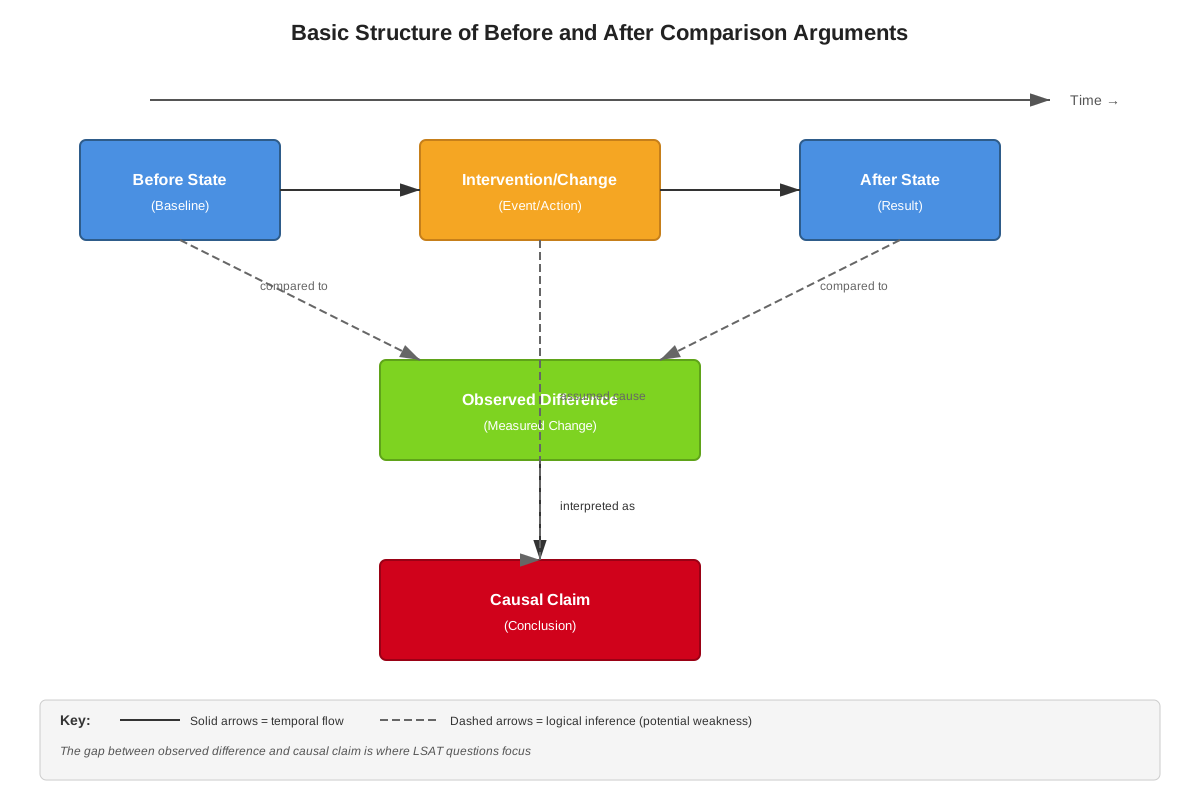
A before and after comparison argument follows a predictable logical structure. The argument presents evidence about a situation at Time 1 (before), describes an intervention or change that occurred, then presents evidence about the situation at Time 2 (after). The argument concludes that the intervention caused the observed difference between the two time points.
The standard form looks like this:
- Baseline measurement: At Time 1, condition X existed (e.g., "Last year, 100 traffic accidents occurred at the intersection")
- Intervention: An action or change was implemented (e.g., "The city installed a traffic light")
- Follow-up measurement: At Time 2, condition Y exists (e.g., "This year, only 60 traffic accidents occurred")
- Causal conclusion: The intervention caused the change (e.g., "Therefore, the traffic light reduced accidents by 40%")
The logical reasoning challenge lies in evaluating whether the conclusion legitimately follows from the premises. The LSAT tests whether students recognize that temporal sequence alone does not establish causation—just because B followed A does not mean A caused B.
Key Assumptions in Before and After Arguments
Every before and after comparison rests on several critical assumptions that the LSAT frequently tests. Understanding these assumptions is essential for answering Assumption questions and for identifying how to strengthen or weaken such arguments.
The "All Else Equal" Assumption: The argument assumes that nothing else relevant changed between Time 1 and Time 2 except the stated intervention. This is the most commonly tested assumption. If other factors also changed, they might explain the observed difference instead of (or in addition to) the intervention.
The "Proper Measurement" Assumption: The argument assumes that the measurements at both time points were conducted using comparable methods, definitions, and standards. If measurement methods changed, apparent differences might reflect measurement artifacts rather than real changes.
The "Sufficient Time" Assumption: The argument assumes that enough time elapsed for the intervention to produce effects, but not so much time that other factors became more likely to influence outcomes. The LSAT sometimes presents arguments where the time frame is either too short or too long to support the causal inference.
The "Representative Period" Assumption: The argument assumes that both time periods were typical or comparable in relevant ways. If Time 1 was unusual (an anomalous peak or trough), regression to the mean might explain observed changes rather than the intervention.
Common Vulnerabilities in Before and After Reasoning
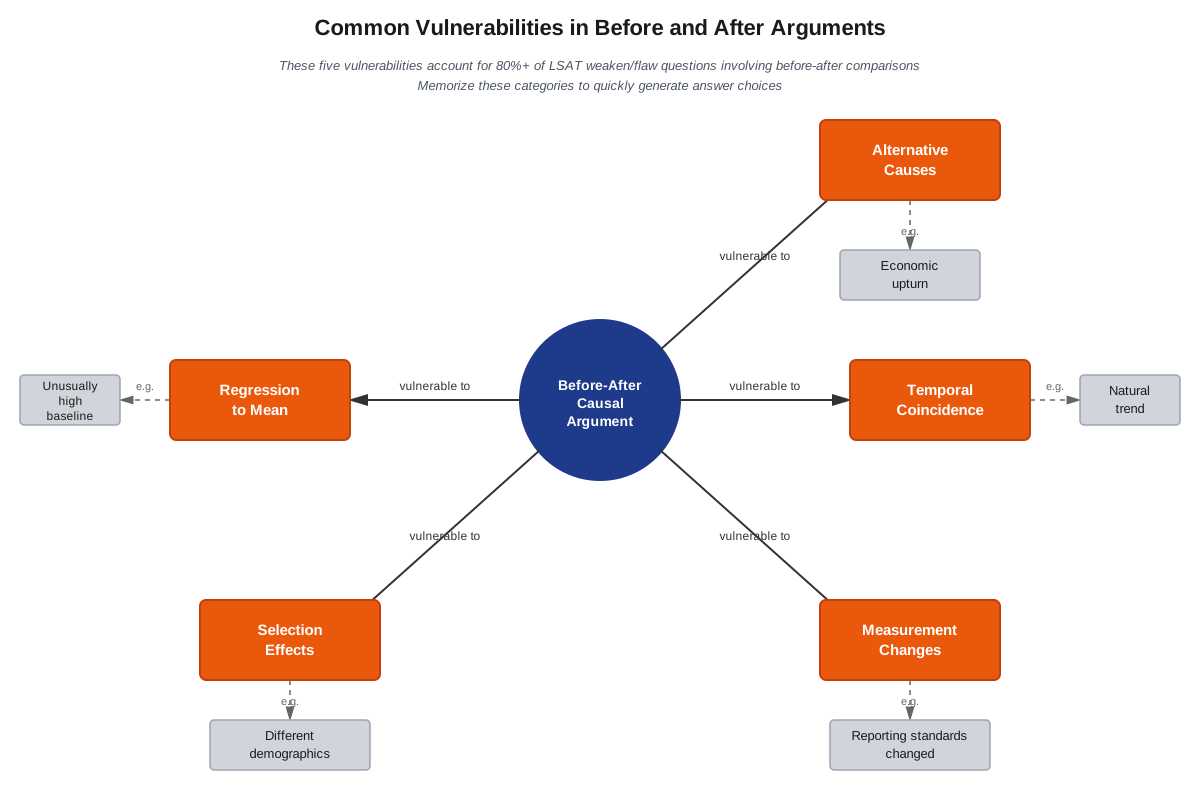
The LSAT exploits several recurring vulnerabilities in before and after comparisons. Recognizing these patterns enables rapid question analysis.
| Vulnerability | Description | Example |
|---|---|---|
| Alternative causes | Other factors changed simultaneously with the intervention | A city attributes crime reduction to increased police patrols, but economic conditions also improved |
| Natural trends | The measured phenomenon was already changing before the intervention | Sales were already increasing before the marketing campaign began |
| Reverse causation | The supposed effect actually preceded and caused the intervention | People started exercising more before joining the gym, not because of it |
| Measurement changes | How the outcome was measured changed between time points | Crime statistics decreased because reporting methods changed, not because crime declined |
| Regression to mean | An extreme initial measurement naturally moved toward average | An unusually bad year was followed by a more typical year, regardless of intervention |
| Sample differences | The groups measured at each time point differed in relevant ways | Different populations were surveyed before and after the policy change |
Strengthening Before and After Arguments
When the LSAT asks how to strengthen a before and after comparison, the correct answer typically addresses one of the key assumptions or vulnerabilities. Strong answers often:
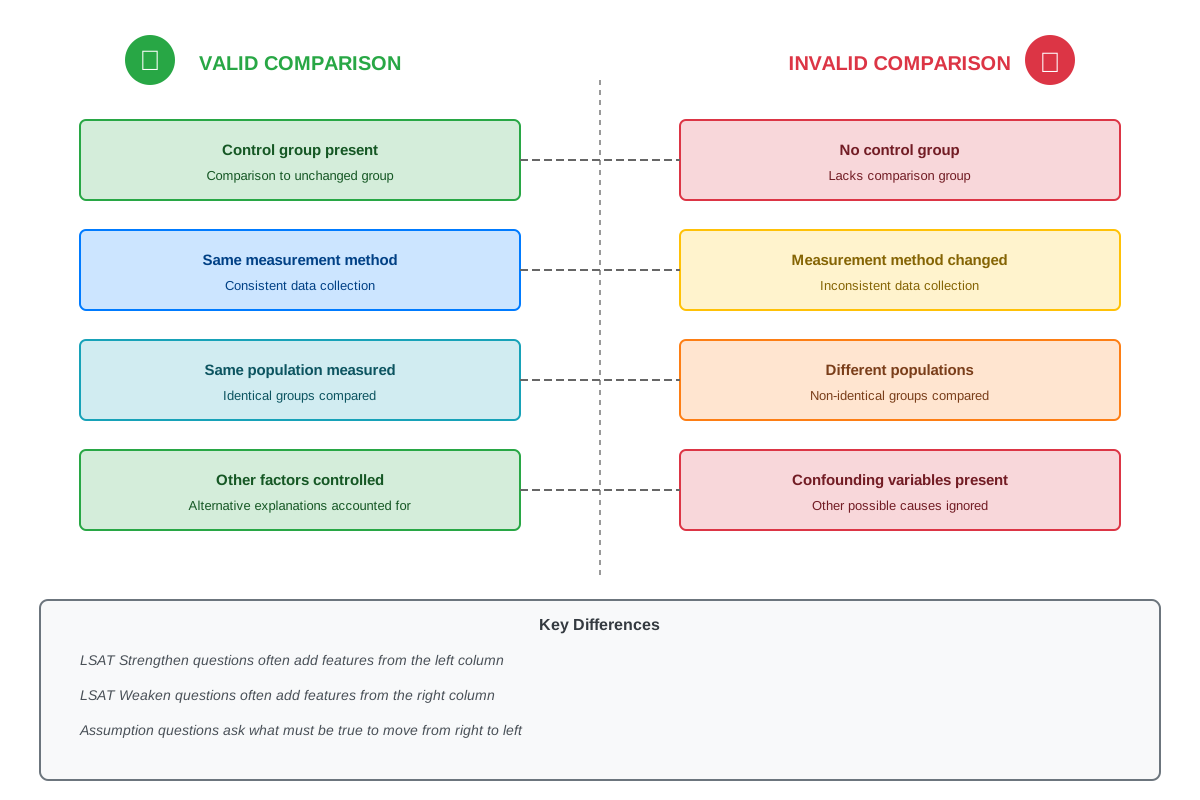
- Rule out alternative explanations: Show that other potentially relevant factors remained constant or did not change in ways that would explain the outcome
- Establish proper controls: Demonstrate that measurement methods, definitions, and standards remained consistent
- Show the change was specific: Indicate that the change occurred only where the intervention was applied, not in comparable situations without the intervention
- Demonstrate appropriate timing: Confirm that the effect appeared at the right time relative to the intervention
- Eliminate pre-existing trends: Show that the outcome was stable before the intervention, making the subsequent change more attributable to it
Weakening Before and After Arguments
Conversely, when asked to weaken such arguments, correct answers typically:
- Introduce alternative causes: Present other factors that changed and could explain the observed difference
- Reveal measurement problems: Show that how outcomes were measured or defined changed between time points
- Expose pre-existing trends: Demonstrate that the change was already occurring before the intervention
- Question the time frame: Indicate that insufficient time passed for the intervention to work, or that too much time passed
- Show the change was general: Reveal that similar changes occurred even where the intervention was not applied
The Role of Control Groups and Comparisons
The LSAT sometimes presents arguments that include or should include control groups—comparable situations where the intervention did not occur. The presence or absence of control group comparisons significantly affects argument strength. An argument that compares outcomes before and after an intervention in one group is weaker than an argument that also compares those outcomes to a similar group that did not receive the intervention.
For example, an argument claiming that a new teaching method improved test scores is stronger if it shows that: (1) scores increased after implementing the method, AND (2) scores in comparable classrooms using the old method did not increase. The control comparison helps rule out alternative explanations like easier tests or generally improving student preparation.
Concept Relationships
Before and after comparisons function as a specific application of broader causal reasoning principles. The relationship map flows as follows:
General Causal Reasoning → Temporal Sequence as Evidence → Before and After Comparisons → Specific Vulnerabilities (alternative causes, measurement issues, pre-existing trends)
Within the topic itself, understanding the basic structure enables recognition of the key assumptions, which in turn allows identification of common vulnerabilities. This knowledge directly supports the ability to strengthen or weaken such arguments:
Basic Structure → Key Assumptions → Common Vulnerabilities → Strengthening/Weakening Strategies
Before and after comparisons connect to several related Logical Reasoning topics:
- Correlation versus Causation: Before and after comparisons represent a temporal form of correlation; the same principles about not inferring causation from correlation apply
- Alternative Explanations: The primary weakness in before and after arguments involves alternative explanations for observed changes
- Statistical Reasoning: Many before and after comparisons involve numerical data, requiring evaluation of whether statistics support causal claims
- Necessary and Sufficient Conditions: Evaluating whether the intervention was necessary or sufficient for the observed outcome
High-Yield Facts
⭐ Temporal sequence alone never establishes causation—just because B followed A does not prove A caused B; the LSAT consistently tests this principle.
⭐ The most common weakness in before and after arguments is the presence of alternative explanations—other factors that changed simultaneously could account for observed differences.
⭐ Before and after comparisons assume "all else equal"—that nothing else relevant changed between the two time points except the stated intervention.
⭐ Measurement consistency is critical—if how outcomes were measured changed between time points, apparent differences might be artifacts rather than real changes.
⭐ Pre-existing trends can invalidate causal conclusions—if the change was already occurring before the intervention, the intervention may not have caused it.
- Arguments are stronger when they include control groups or comparisons to situations without the intervention.
- Regression to the mean can explain changes when the initial measurement was extreme or unusual.
- The time frame matters—effects should appear at appropriate times relative to the intervention.
- Sample composition must remain comparable—if different populations were measured at each time point, differences might reflect sample characteristics rather than real changes.
- Reverse causation is possible—sometimes the supposed effect actually preceded and motivated the intervention.
- Correlation in time does not equal causation, even when one event immediately precedes another.
- The absence of change in control situations strengthens causal claims about situations where change occurred.
Quick check — test yourself on Before and after comparisons so far.
Try Flashcards →Common Misconceptions
Misconception: If one event follows another in time, the first event caused the second.
Correction: Temporal sequence is necessary but not sufficient for causation. Many events follow each other without causal relationships. The LSAT specifically tests whether students recognize that post hoc reasoning (after this, therefore because of this) is fallacious without additional evidence ruling out alternative explanations.
Misconception: A before and after comparison is automatically strong evidence for causation if the change is large or dramatic.
Correction: The magnitude of change does not address whether the stated cause actually produced it. Large changes can result from factors other than the proposed cause. The strength of the argument depends on ruling out alternatives, not on the size of the effect.
Misconception: If no obvious alternative explanation comes to mind, the before and after comparison must be valid.
Correction: The absence of immediately apparent alternatives does not mean alternatives do not exist. The LSAT often presents answer choices introducing plausible alternative explanations that test-takers might not have considered independently. The argument's validity depends on whether alternatives have been ruled out, not on whether they are obvious.
Misconception: Before and after comparisons in controlled scientific studies are immune to the logical problems tested on the LSAT.
Correction: While well-designed studies address many vulnerabilities, the LSAT can still test whether specific controls were adequate, whether measurement remained consistent, or whether the time frame was appropriate. The presence of scientific methodology does not automatically validate all causal inferences.
Misconception: Strengthening a before and after argument requires proving the causal claim is definitely true.
Correction: Strengthening means making the argument more likely to be valid, not proving it conclusively. An answer that rules out one alternative explanation or confirms one key assumption strengthens the argument even if other vulnerabilities remain. The LSAT tests relative strength, not absolute proof.
Worked Examples
Example 1: Identifying and Analyzing a Before and After Comparison
Stimulus: "Five years ago, Millville had 200 reported burglaries. The city then implemented a neighborhood watch program. Last year, Millville had only 120 reported burglaries. Clearly, the neighborhood watch program reduced burglaries by 40%."
Analysis:
Step 1 - Identify the structure: This is a classic before and after comparison. Time 1 (five years ago): 200 burglaries. Intervention: neighborhood watch program. Time 2 (last year): 120 burglaries. Conclusion: The program caused the reduction.
Step 2 - Identify the key assumptions: The argument assumes (1) nothing else relevant changed during those five years, (2) burglaries were measured and reported consistently at both time points, (3) the initial year was not anomalous, and (4) the time frame is appropriate for the program to have effects.
Step 3 - Identify vulnerabilities: Multiple factors could weaken this argument:
- Alternative causes: Economic conditions, demographics, police resources, or other crime prevention measures might have changed
- Measurement issues: Reporting practices or definitions of burglary might have changed
- Pre-existing trends: Burglaries might have been declining before the program started
- Time frame: Five years is long enough for many other factors to change
If this were a Weaken question, correct answers might state:
- "During the five-year period, Millville's unemployment rate dropped significantly" (alternative cause)
- "Four years ago, Millville changed how it classified certain property crimes, excluding some incidents previously counted as burglaries" (measurement change)
- "Burglaries in Millville had been declining steadily for three years before the neighborhood watch program began" (pre-existing trend)
If this were a Strengthen question, correct answers might state:
- "Burglary rates remained constant in neighboring cities that did not implement neighborhood watch programs" (control comparison)
- "Millville's demographic composition, economic conditions, and police staffing remained essentially unchanged during the five-year period" (rules out alternatives)
- "Burglary rates in Millville had been stable for the decade preceding the neighborhood watch program" (eliminates pre-existing trend)
Example 2: Complex Before and After Comparison with Multiple Elements
Stimulus: "A study found that employees at TechCorp reported higher job satisfaction after the company implemented flexible work schedules. Before the policy change, 45% of employees rated their satisfaction as 'high.' Six months after implementation, 62% rated their satisfaction as 'high.' The flexible schedule policy clearly improved employee satisfaction."
Question: Which of the following, if true, most weakens the argument?
Answer Choices:
(A) Some employees preferred the original fixed schedule
(B) TechCorp also gave all employees a significant raise three months after implementing flexible schedules
(C) Other companies with flexible schedules also report high employee satisfaction
(D) The increase in satisfaction was consistent across all departments
(E) Flexible schedules allow employees to better balance work and personal responsibilities
Analysis:
Step 1 - Understand the argument structure: Before: 45% high satisfaction. Intervention: flexible schedules. After (6 months): 62% high satisfaction. Conclusion: Flexible schedules caused the improvement.
Step 2 - Identify what would weaken: We need an alternative explanation for the increased satisfaction or a reason to doubt the causal connection.
Step 3 - Evaluate each choice:
(A) Some employees preferred the original fixed schedule: This shows the policy was not universally popular, but does not explain why overall satisfaction increased. This does not weaken the causal claim. Eliminate.
(B) TechCorp also gave all employees a significant raise three months after implementing flexible schedules: This introduces a powerful alternative explanation. The raise could explain the increased satisfaction instead of (or in addition to) the flexible schedules. The timing (three months after the schedule change, three months before the satisfaction measurement) makes this particularly relevant. This weakens the argument significantly. Keep.
(C) Other companies with flexible schedules also report high employee satisfaction: This might slightly strengthen the argument by showing a pattern, but it does not weaken the causal claim about TechCorp. Eliminate.
(D) The increase in satisfaction was consistent across all departments: This strengthens the argument by showing the effect was widespread, making it more likely the policy caused it. Eliminate.
(E) Flexible schedules allow employees to better balance work and personal responsibilities: This explains a mechanism by which flexible schedules could improve satisfaction, which strengthens rather than weakens the argument. Eliminate.
Answer: (B) - This introduces an alternative cause (the raise) that occurred during the relevant time period and could explain the observed increase in satisfaction, thereby weakening the conclusion that flexible schedules caused the improvement.
Exam Strategy
Recognizing Before and After Comparisons
Watch for these trigger phrases that signal before and after reasoning:
- "Before X, the rate was... After X, the rate became..."
- "Since implementing [policy], [outcome] has changed"
- "Prior to [intervention], [condition] existed. Now, [different condition] exists"
- "Following [event], [result] occurred"
- "After [change], [measurement] increased/decreased"
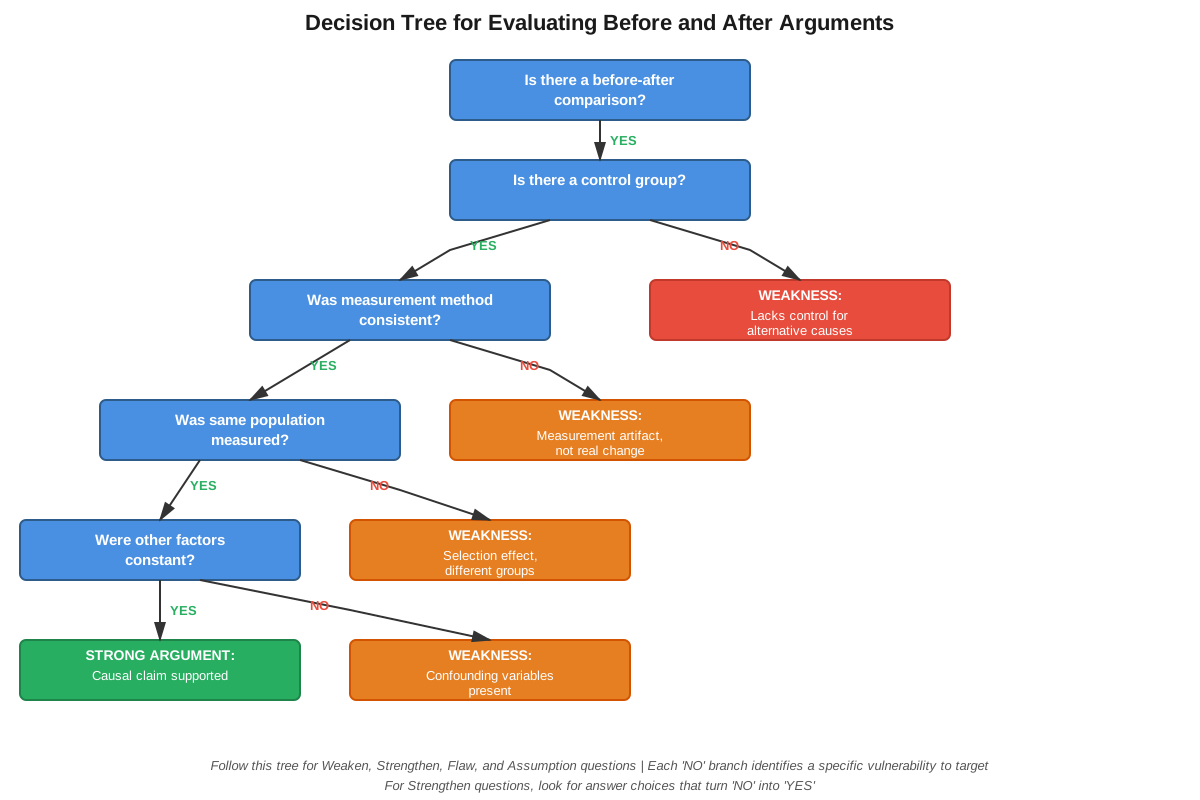
Systematic Approach to Before and After Questions
Step 1 - Identify the three components: Quickly note the before state, the intervention, and the after state. Understanding this structure focuses your analysis.
Step 2 - Articulate the causal claim: State to yourself what the argument claims caused what. This clarifies what you need to strengthen, weaken, or identify as an assumption.
Step 3 - Generate the "all else equal" question: Ask yourself, "What else might have changed?" This primes you to recognize alternative explanations in answer choices.
Step 4 - Consider measurement consistency: Ask whether how things were measured might have changed. This is especially important when the argument involves statistics or rates.
Step 5 - Evaluate the time frame: Consider whether enough time passed for the intervention to work, but not so much that other factors became likely.
Question-Type Specific Strategies
For Weaken questions: The correct answer will usually introduce an alternative explanation, reveal a measurement problem, or show a pre-existing trend. Eliminate answers that are irrelevant to causation or that actually strengthen the argument.
For Strengthen questions: Look for answers that rule out alternatives, confirm measurement consistency, eliminate pre-existing trends, or provide control comparisons. Eliminate answers that are consistent with the argument but do not make the causal inference more likely.
For Assumption questions: The correct answer will state something that must be true for the argument to work, typically that alternatives do not exist, measurements were consistent, or no pre-existing trend explains the change. Use the negation test: if negating the answer choice destroys the argument, it is a necessary assumption.
For Flaw questions: The correct answer will describe the logical error, often stating that the argument assumes causation from temporal sequence, fails to consider alternatives, or overlooks measurement issues.
Time Management
Before and after comparison questions typically require 1:15 to 1:30 minutes. The structure is usually straightforward to identify (15-20 seconds), but evaluating answer choices requires careful consideration of whether each choice affects the causal inference (45-60 seconds). Do not rush the answer choice evaluation—many incorrect answers will seem relevant but will not actually strengthen or weaken the causal claim.
Exam Tip: When stuck between two answer choices, ask yourself which one more directly addresses whether the stated intervention caused the observed change. The correct answer will have a clear logical connection to the causal claim, not just a topical connection to the subject matter.
Memory Techniques
The "TAME" Acronym for Vulnerabilities
Remember the four most common vulnerabilities with TAME:
- Trends (pre-existing trends that explain the change)
- Alternatives (other factors that changed simultaneously)
- Measurement (how outcomes were measured changed)
- Extreme baseline (regression to mean from unusual starting point)
The "Before-During-After" Visualization
Visualize a timeline with three sections:
- Before: What was the baseline? Was it stable or changing?
- During: What intervention occurred? What else might have changed?
- After: What was measured? How was it measured?
This mental timeline helps systematically identify vulnerabilities.
The "Control Question" Mnemonic
For strengthening questions, remember: "What happened WHERE it WASN'T?"
This reminds you that arguments are stronger when they show what happened in comparable situations without the intervention (control comparisons).
The Causation Checklist
Remember RACE for what must be true for valid causal inference:
- Ruled out alternatives
- Appropriate time frame
- Consistent measurement
- Eliminated pre-existing trends
Summary
Before and after comparisons represent one of the most frequently tested reasoning patterns on the LSAT Logical Reasoning section, appearing in approximately 15-20% of questions across multiple question types. These arguments present evidence about a situation at two time points—before and after an intervention—and conclude that the intervention caused the observed difference. The fundamental logical principle is that temporal sequence alone does not establish causation; just because one event followed another does not prove the first caused the second. Every before and after comparison rests on critical assumptions: that nothing else relevant changed between time points, that measurements remained consistent, that the time frame was appropriate, and that the baseline was representative. The LSAT tests these assumptions by asking students to strengthen arguments (by ruling out alternatives or confirming assumptions), weaken arguments (by introducing alternative explanations or revealing measurement problems), identify flaws (recognizing the logical gap between temporal sequence and causation), or recognize necessary assumptions (what must be true for the argument to work). Mastering this topic requires understanding the standard structure, recognizing common vulnerabilities (alternative causes, measurement changes, pre-existing trends, and regression to mean), and systematically evaluating whether evidence supports causal claims.
Key Takeaways
- Temporal sequence never establishes causation by itself—before and after comparisons always require additional evidence ruling out alternative explanations
- The "all else equal" assumption is the most commonly tested vulnerability—arguments fail when other relevant factors changed simultaneously with the stated intervention
- Measurement consistency is critical—changes in how outcomes were measured or defined can create apparent differences that do not reflect real changes
- Pre-existing trends can invalidate causal conclusions—if change was already occurring before the intervention, the intervention may not have caused it
- Control comparisons strengthen arguments—showing that change occurred where the intervention was applied but not in comparable situations without it supports causal claims
- Strengthening requires ruling out alternatives or confirming assumptions—not proving the conclusion is definitely true, but making it more likely to be valid
- The TAME acronym captures the four most common vulnerabilities: Trends, Alternatives, Measurement, and Extreme baseline
Related Topics
Correlation versus Causation: Explores the broader principle that correlation does not imply causation, of which before and after comparisons represent a temporal application. Mastering before and after comparisons provides concrete practice with this fundamental logical principle.
Alternative Explanations: Examines how to generate and evaluate competing explanations for observed phenomena. This skill directly supports the ability to weaken before and after arguments by identifying what else might have caused the observed change.
Statistical Reasoning: Covers how to evaluate numerical evidence and statistical claims, which frequently appear in before and after comparisons involving rates, percentages, or measurements.
Necessary and Sufficient Conditions: Analyzes the logical relationships between conditions and outcomes, helping evaluate whether an intervention was necessary or sufficient for an observed result.
Experimental Design and Control Groups: Extends before and after reasoning to more complex experimental contexts, examining how proper controls strengthen causal inferences.
Practice CTA
Now that you understand the logical structure and common vulnerabilities of before and after comparisons, you are ready to apply this knowledge to LSAT-style practice questions. The concepts covered in this guide appear frequently on the exam, making practice with this question type a high-yield investment of your study time. Work through the practice questions systematically, using the strategies outlined in the Exam Strategy section. For each question, identify the before state, intervention, and after state, then articulate what the argument assumes and what would strengthen or weaken the causal claim. Review the flashcards to reinforce the key vulnerabilities and strengthening strategies until you can recognize them instantly. With focused practice, you will develop the pattern recognition and analytical skills needed to answer before and after comparison questions quickly and accurately on test day. Your ability to master this topic will significantly improve your overall Logical Reasoning score.
Sign up free to keep reading
Create a free AnvayaPrep account to finish this LSAT guide on Before and after comparisons — plus flashcards and practice questions.