Overview
Causal assumption questions represent one of the most frequently tested and strategically important question types on the LSAT Logical Reasoning section. These questions assess a test-taker's ability to identify unstated premises that connect evidence about correlation or sequence to a conclusion about cause and effect. When an LSAT argument claims that one event or factor causes another, it invariably relies on hidden assumptions about the relationship between these variables. Mastering causal assumptions requires understanding not just what the argument explicitly states, but what it must take for granted to reach its causal conclusion.
The LSAT tests causal reasoning because legal thinking constantly involves evaluating cause-and-effect relationships: Did the defendant's actions cause the plaintiff's injury? Will a proposed policy cause the intended outcome? What factors caused a particular legal precedent to develop? Attorneys must identify gaps in causal reasoning, recognize alternative explanations, and understand what evidence would strengthen or weaken causal claims. Causation and explanation questions appear in various forms throughout the Logical Reasoning section, including assumption questions, strengthen/weaken questions, and flaw questions.
Understanding causal assumptions connects directly to broader logical reasoning skills tested on the LSAT. These questions build upon fundamental concepts of argument structure (premise-conclusion relationships), necessary versus sufficient conditions, and the distinction between correlation and causation. Causal assumption questions also relate closely to other question types: what strengthens a causal argument often addresses its underlying assumptions, while what weakens it often exploits those same assumptions. This topic serves as a cornerstone for mastering approximately 15-20% of all Logical Reasoning questions on any given LSAT administration.
Learning Objectives
- [ ] Identify how Causal assumption appears in LSAT questions
- [ ] Explain the reasoning pattern behind Causal assumption
- [ ] Apply Causal assumption to solve LSAT-style problems accurately
- [ ] Distinguish between correlation and causation in argument structures
- [ ] Recognize the five major types of causal assumptions tested on the LSAT
- [ ] Evaluate answer choices by testing whether they represent necessary assumptions for causal conclusions
- [ ] Predict common causal assumptions before reviewing answer choices
Prerequisites
- Basic argument structure: Understanding premises and conclusions is essential because causal assumptions bridge the gap between evidence and causal claims
- Correlation versus causation: Recognizing that two things occurring together does not prove one causes the other forms the foundation for identifying causal reasoning gaps
- Necessary versus sufficient conditions: Causal assumptions are necessary conditions for the argument's validity, meaning the conclusion cannot follow without them
- Conditional reasoning fundamentals: Understanding "if-then" relationships helps recognize when arguments assume certain conditions must be present or absent for causation to occur
Why This Topic Matters
Lsat causal assumption questions appear with remarkable consistency across all modern LSAT administrations. Approximately 3-5 questions per Logical Reasoning section directly test causal reasoning, with additional questions incorporating causal elements within strengthen/weaken or flaw question types. This translates to roughly 8-12 questions per complete LSAT exam, making causal reasoning one of the highest-yield topics for focused study. Students who master causal assumptions typically see immediate score improvements because these questions follow predictable patterns once the underlying logic becomes clear.
Beyond the LSAT, causal reasoning pervades legal practice and everyday decision-making. Tort law centers on establishing causation between defendant conduct and plaintiff harm. Policy debates hinge on whether proposed interventions will cause desired outcomes. Scientific research, business strategy, and medical diagnosis all require rigorous causal analysis. The LSAT tests this skill because attorneys must constantly evaluate whether evidence truly supports causal claims or whether alternative explanations remain viable.
Causal assumption questions most commonly appear as Assumption questions (both necessary and sufficient), Strengthen questions, Weaken questions, and Flaw questions. The stimulus typically presents evidence showing correlation, temporal sequence, or statistical association, then concludes that one factor causes another. The question stem asks test-takers to identify what the argument assumes, what would strengthen or weaken it, or what logical flaw it commits. Recognizing the causal reasoning pattern immediately narrows the range of correct answers and enables strategic elimination of incorrect choices.
Core Concepts
The Basic Structure of Causal Arguments
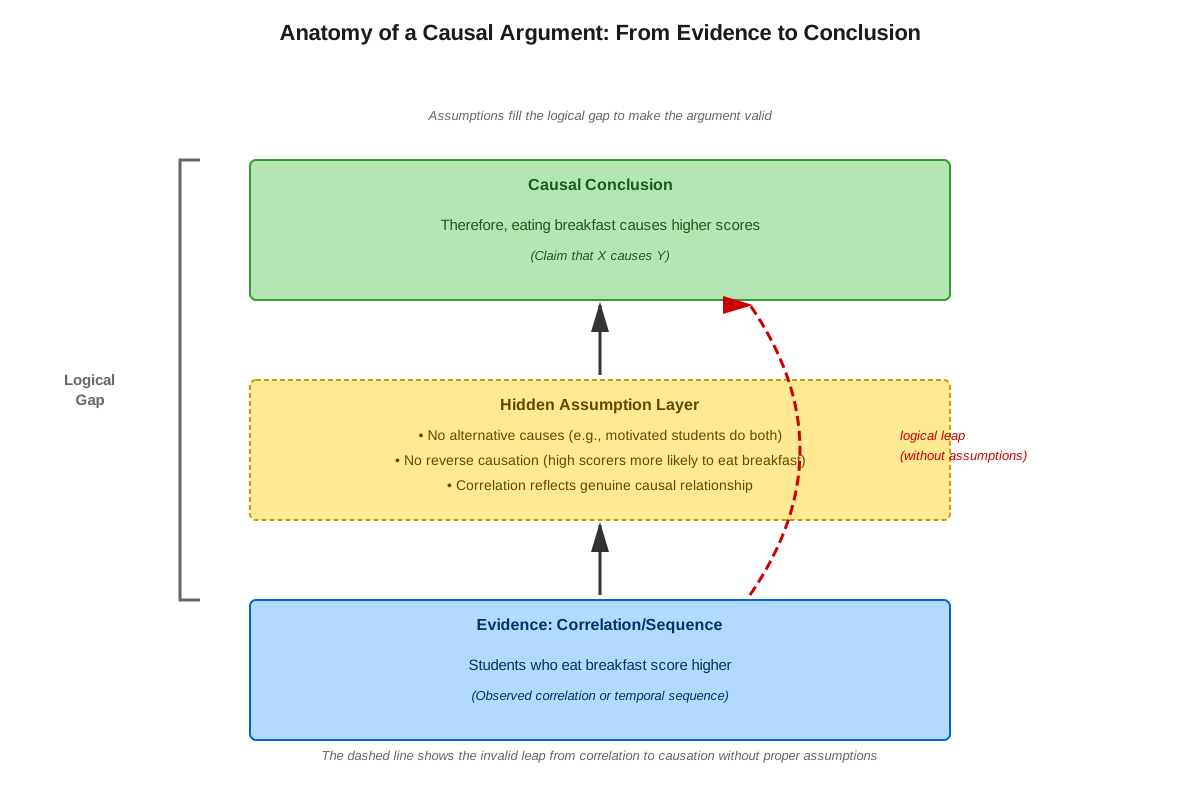
A causal assumption is an unstated premise that must be true for an argument to validly conclude that one thing causes another. LSAT causal arguments follow a predictable structure: the premises present evidence (often correlation, temporal sequence, or statistical data), and the conclusion asserts a cause-and-effect relationship. The gap between evidence and conclusion creates space for assumptions.
Consider this basic pattern:
- Evidence: A and B occur together (correlation)
- Conclusion: Therefore, A causes B (causation)
- Assumption: Something must bridge the logical gap between correlation and causation
The argument assumes multiple things simultaneously: that the correlation isn't coincidental, that B doesn't cause A instead (reverse causation), that no third factor C causes both A and B, and that other necessary conditions for causation exist.
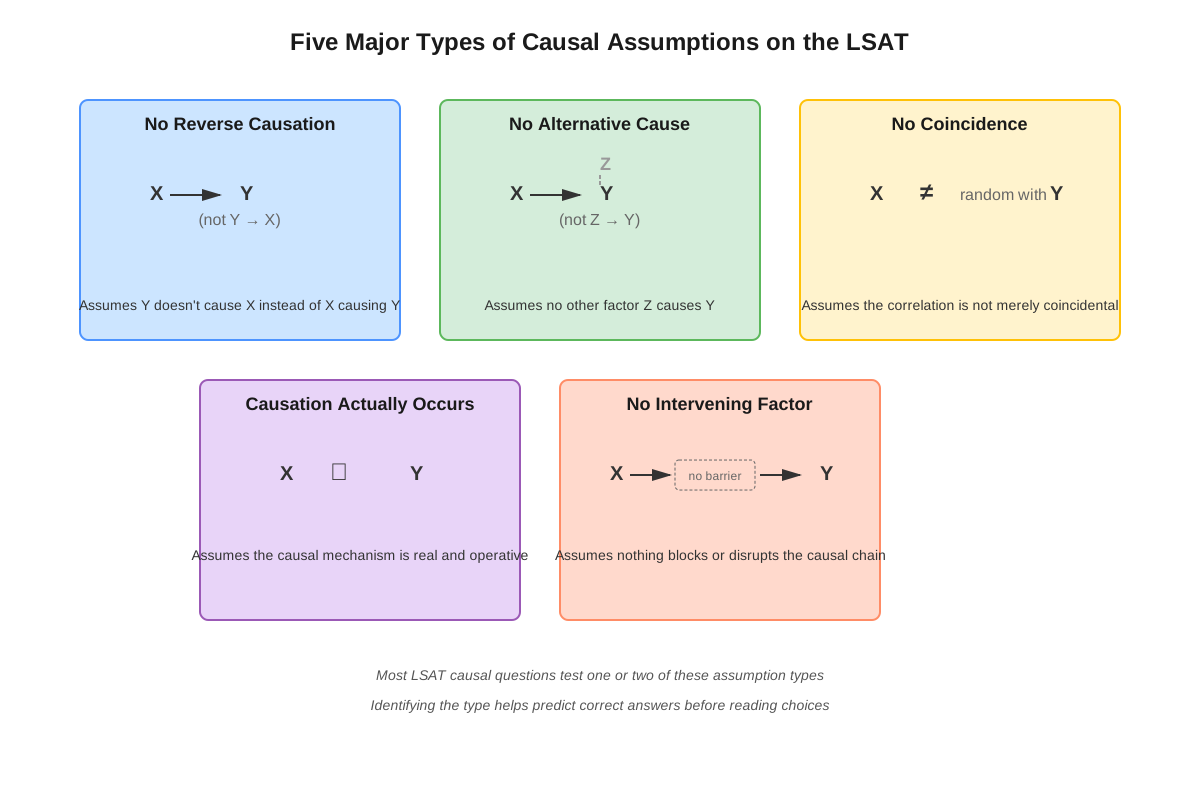
The Five Major Types of Causal Assumptions
1. No Reverse Causation
When an argument concludes that A causes B, it assumes that B does not actually cause A instead. This assumption is necessary because correlation alone cannot determine the direction of causation.
Example: "Students who eat breakfast score higher on tests. Therefore, eating breakfast improves test performance." This assumes that performing well on tests doesn't cause students to eat breakfast (perhaps successful students have better overall habits, including breakfast consumption).
2. No Alternative Cause
The argument assumes no third factor causes both the alleged cause and the alleged effect. This is perhaps the most commonly tested causal assumption on the LSAT.
Example: "Crime rates dropped after the city installed more streetlights. Therefore, streetlights reduce crime." This assumes no other factor (like increased police presence, demographic changes, or economic improvement) caused both the streetlight installation and the crime reduction.
3. No Coincidence
The argument assumes the correlation or temporal sequence is not merely coincidental. Two events can occur together or in sequence without any causal relationship.
Example: "Every time the CEO wears a red tie, stock prices rise. Therefore, the CEO's red tie causes stock increases." This assumes the correlation isn't pure coincidence.
4. Cause is Sufficient
The argument assumes the alleged cause is actually capable of producing the effect—that it has sufficient causal power.
Example: "Drinking one glass of water daily prevents all diseases. Therefore, water consumption causes health." This assumes water has sufficient causal power to produce such a dramatic effect, which is questionable.
5. No Interfering Factors
The argument assumes nothing prevents the cause from producing its effect. Even if A generally causes B, intervening factors might block this causal relationship in specific instances.
Example: "Studying causes higher grades, so students who study will get higher grades." This assumes no interfering factors (like test anxiety, illness, or unfair grading) prevent studying from producing its typical effect.
Recognizing Causal Language
LSAT arguments signal causal reasoning through specific language patterns. Recognizing these triggers immediately alerts test-takers to anticipate causal assumptions:
| Causal Indicators | Example Phrases |
|---|---|
| Direct causation | "causes," "produces," "brings about," "leads to," "results in" |
| Causal explanation | "because of," "due to," "as a result of," "is responsible for" |
| Effect language | "effect," "consequence," "outcome," "impact" |
| Conditional causation | "if...then" (when implying causation, not just correlation) |
| Purpose/function | "in order to," "for the purpose of," "so that" |
The Correlation-Causation Gap
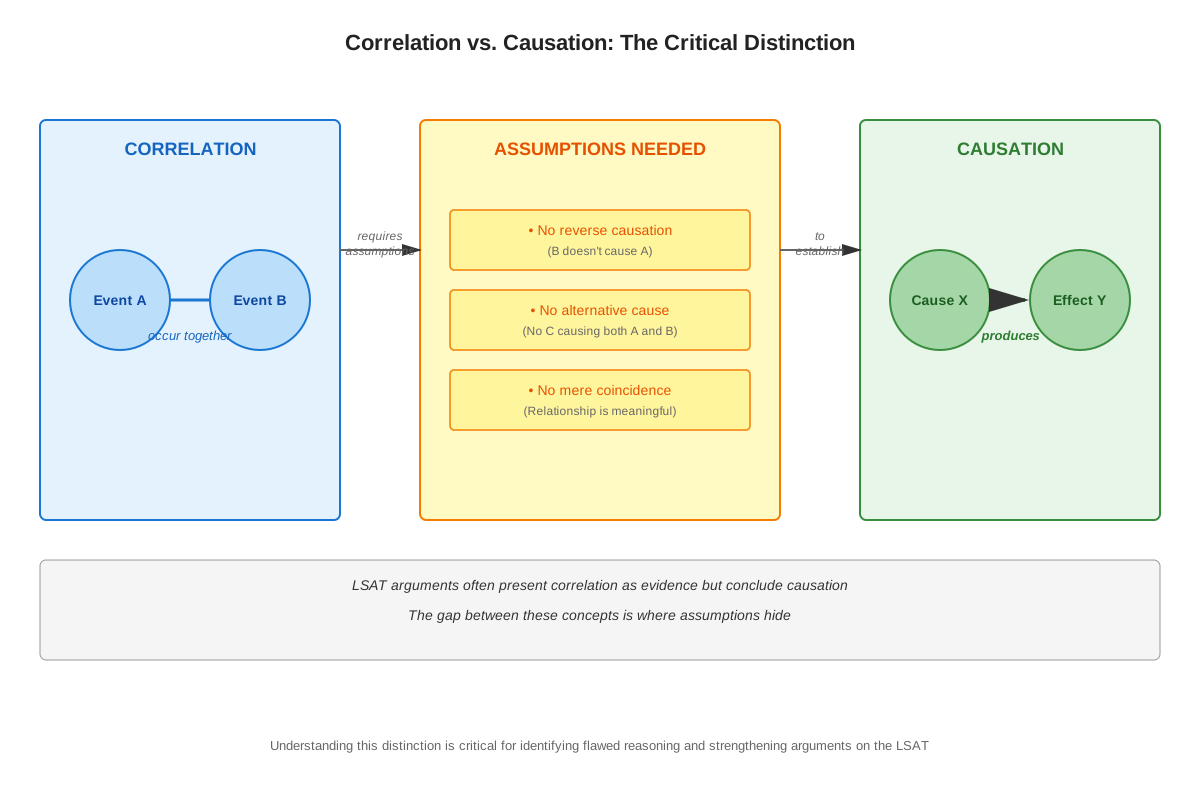
The fundamental logical gap in causal reasoning is the leap from correlation (two things occurring together) to causation (one thing producing the other). The LSAT exploits this gap relentlessly. Understanding why correlation doesn't prove causation illuminates all causal assumptions:
- Temporal correlation: A and B happen at the same time
- Sequential correlation: A happens before B
- Statistical correlation: A and B occur together more often than chance predicts
None of these patterns alone proves causation. Each requires additional assumptions to support a causal conclusion. The LSAT tests whether students recognize what must be assumed to bridge this gap.
The Negation Test for Causal Assumptions
For Assumption questions specifically, the negation test helps verify correct answers. A necessary assumption, when negated, must destroy the argument. For causal assumptions:
- Original assumption: "No third factor causes both A and B"
- Negation: "A third factor does cause both A and B"
- Result: If true, this negation eliminates the causal relationship between A and B, destroying the argument
This test works because necessary assumptions are conditions without which the conclusion cannot stand. Practicing the negation test builds intuition for recognizing causal assumptions quickly.
Causal Chains and Complex Causation
Some LSAT arguments involve causal chains (A causes B, which causes C) or multiple causes (both A and B cause C). These complex structures create additional assumption opportunities:
- Chain assumptions: Each link in the chain requires its own causal assumptions
- Multiple cause assumptions: The argument may assume causes work independently or synergistically
- Necessary versus sufficient causes: The argument may confuse causes that are necessary (required) with those that are sufficient (enough by themselves)
Complex causal arguments often contain multiple gaps, and correct answers may address any of these gaps.
Concept Relationships
The concepts within causal assumption reasoning form an interconnected logical framework. The correlation-causation gap serves as the foundational concept from which all five types of causal assumptions emerge. When an argument leaps from correlation to causation, it must assume no reverse causation, no alternative cause, and no coincidence simultaneously. These three assumptions address different ways the correlation might exist without the claimed causal relationship being true.
The assumptions about sufficient causal power and no interfering factors operate at a different level—they address whether the causal mechanism can actually function as claimed. These connect to the broader logical reasoning concept of necessary versus sufficient conditions: a cause must be sufficient to produce its effect, and necessary conditions for that effect must be present.
This topic builds directly on prerequisite knowledge of argument structure (identifying the conclusion helps locate the causal claim) and correlation versus causation (recognizing when arguments confuse the two). It connects forward to strengthen/weaken questions (strengthening a causal argument often means providing evidence for its assumptions, while weakening it means undermining those assumptions) and flaw questions (many causal arguments commit the "correlation doesn't prove causation" flaw).
The relationship map flows as follows:
Correlation/Evidence → (requires assumptions to bridge gap) → Causal Conclusion
The assumptions fill this gap:
Evidence → [No reverse causation + No alternative cause + No coincidence + Sufficient power + No interference] → Valid causal conclusion
High-Yield Facts
⭐ Causal assumption questions appear 8-12 times per complete LSAT exam, making them one of the highest-yield topics for focused study.
⭐ The most commonly tested causal assumption is "no alternative cause"—arguments frequently assume no third factor explains the correlation.
⭐ Temporal sequence (A before B) does not prove causation; arguments assuming it does commit a logical flaw.
⭐ Reverse causation is especially common when the argument involves behavior and outcomes—the outcome may actually influence the behavior rather than vice versa.
⭐ Correct answers to causal assumption questions often use conditional language like "only if," "unless," or "no...other than" to express necessary conditions.
- Causal arguments can appear in any Logical Reasoning question type, not just Assumption questions.
- The phrase "correlation does not imply causation" captures the fundamental gap in causal reasoning.
- Strengthening a causal argument typically involves ruling out alternative explanations or reverse causation.
- Weakening a causal argument typically involves introducing alternative causes or showing reverse causation.
- Statistical correlation, no matter how strong, never proves causation without additional assumptions.
- Causal assumptions are always necessary assumptions (required for the conclusion) but may not be sufficient assumptions (enough by themselves).
- The negation test works reliably for identifying necessary causal assumptions in Assumption questions.
- Multiple causal assumptions may exist in a single argument, but the correct answer addresses only one.
Quick check — test yourself on Causal assumption so far.
Try Flashcards →Common Misconceptions
Misconception: If A happens before B, then A must cause B.
Correction: Temporal sequence is necessary but not sufficient for causation. Many things happen in sequence without causal relationships. The argument must assume the sequence isn't coincidental and that no other factor caused both events.
Misconception: Strong correlation proves causation.
Correction: Even perfect correlation (100% of the time A occurs, B occurs) doesn't prove causation. B might cause A, a third factor might cause both, or it might be coincidence. Statistical strength doesn't eliminate the need for causal assumptions.
Misconception: The correct answer to a causal assumption question must mention both the cause and effect explicitly.
Correction: Correct answers often address assumptions indirectly. An answer ruling out alternative causes might not mention the original cause at all, focusing instead on eliminating other potential explanations.
Misconception: If the argument says "A causes B," it's claiming A is the only cause of B.
Correction: Causal claims typically assert that A is a cause of B, not necessarily the only cause. The argument assumes A contributes to B, not that B never occurs without A (unless explicitly stated).
Misconception: Causal assumption questions only appear as Assumption question types.
Correction: Causal reasoning appears across multiple question types including Strengthen, Weaken, Flaw, Evaluate, and even some Inference questions. Recognizing the causal reasoning pattern matters regardless of question type.
Misconception: The assumption must make the argument's conclusion certain.
Correction: Necessary assumptions are required for the argument to work, but they don't guarantee the conclusion is true. They simply make the reasoning valid given the premises. Sufficient assumptions would make the conclusion certain, but most LSAT assumption questions ask for necessary assumptions.
Misconception: Personal experience or intuition about causation helps answer these questions.
Correction: The LSAT tests logical relationships, not real-world knowledge. An argument might claim something implausible causes something else, but the correct answer addresses the logical gap, not the real-world plausibility.
Worked Examples
Example 1: Classic Alternative Cause
Stimulus: "A recent study found that people who drink coffee daily have lower rates of depression than those who don't drink coffee. Therefore, drinking coffee prevents depression."
Question: Which of the following is an assumption required by the argument?
Analysis:
- Identify the conclusion: "Drinking coffee prevents depression" (causal claim)
- Identify the evidence: Correlation between coffee drinking and lower depression rates
- Identify the gap: The argument leaps from correlation to causation
- Predict assumptions: The argument assumes:
- No reverse causation (depression doesn't cause people to avoid coffee)
- No alternative cause (no third factor causes both coffee drinking and lower depression)
- Not coincidental
- Coffee has sufficient power to affect depression
- No interfering factors
Predicted correct answer: Something ruling out alternative explanations or reverse causation.
Sample answer choices:
- (A) Coffee contains caffeine, which is a stimulant.
- (B) People who are not depressed are more likely to engage in social activities like meeting friends for coffee.
- (C) Depression rates have increased over the past decade.
- (D) There is no other factor that both causes people to drink coffee and independently reduces depression.
- (E) Most people who drink coffee do so in the morning.
Evaluation:
- (A) provides background information but doesn't address the causal gap
- (B) suggests reverse causation (not being depressed leads to coffee drinking), which would weaken the argument, not state an assumption
- (C) is irrelevant to the causal relationship
- (D) directly addresses the "no alternative cause" assumption—this is correct
- (E) provides irrelevant detail about when coffee is consumed
Negation test: If we negate (D): "There IS another factor that both causes people to drink coffee and independently reduces depression." This destroys the argument because it means coffee might not cause the depression reduction at all—the third factor does. This confirms (D) is a necessary assumption.
Example 2: Reverse Causation
Stimulus: "Companies that invest heavily in employee training programs report higher productivity levels than companies that don't. This demonstrates that employee training causes increased productivity."
Question: The argument's reasoning is most vulnerable to criticism on the grounds that it fails to consider whether:
Analysis:
- Identify the conclusion: "Employee training causes increased productivity"
- Identify the evidence: Correlation between training investment and productivity
- Identify the question type: This is a Flaw question asking what the argument "fails to consider"
- Predict the flaw: The argument assumes the causal direction without ruling out reverse causation
Predicted correct answer: Something suggesting that high productivity might cause companies to invest in training (reverse causation).
Sample answer choices:
- (A) employee training programs vary in quality and effectiveness
- (B) companies with higher productivity have more resources available to invest in employee training
- (C) some highly productive companies have minimal training programs
- (D) productivity can be measured in different ways
- (E) employee satisfaction also correlates with productivity
Evaluation:
- (A) addresses whether training is sufficient but doesn't challenge the causal direction
- (B) suggests reverse causation—productivity enables training investment rather than training causing productivity—this is correct
- (C) provides a counterexample but doesn't identify the logical flaw
- (D) is about measurement issues, not causation
- (E) introduces another correlation but doesn't address the causal reasoning flaw
This example demonstrates how causal reasoning appears in Flaw questions. The argument "fails to consider" that the causal arrow might point the opposite direction.
Exam Strategy
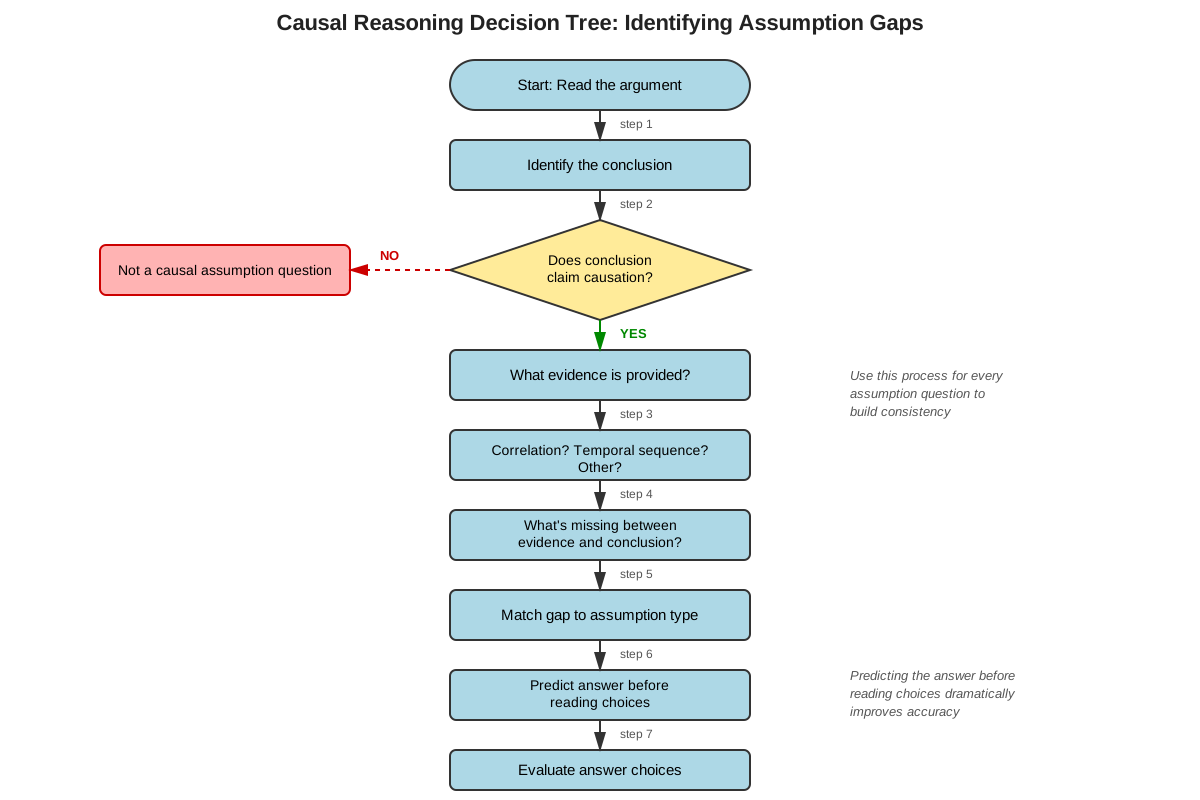
When approaching lsat causal assumption questions, follow this systematic process:
Step 1: Identify the causal claim (usually in the conclusion)
Look for causal language: "causes," "leads to," "results in," "because of," "due to," "responsible for." Circle or mentally note both the alleged cause and the alleged effect.
Step 2: Identify the evidence type
Determine whether the evidence shows correlation, temporal sequence, statistical association, or something else. This reveals the gap between evidence and conclusion.
Step 3: Predict the assumption category
Before looking at answer choices, predict which type of causal assumption the argument requires:
- Does it need to rule out reverse causation?
- Does it need to eliminate alternative causes?
- Does it need to establish sufficient causal power?
- Does it need to rule out coincidence?
- Does it need to eliminate interfering factors?
Step 4: Evaluate answer choices strategically
Exam Tip: Eliminate answers that are irrelevant to the causal relationship, even if they're true. The correct answer must address the gap between the evidence and the causal conclusion.
Use these elimination strategies:
- Eliminate background information: Answers that provide context but don't bridge the causal gap are wrong
- Eliminate opposite answers: For Assumption questions, answers that would weaken the argument are wrong
- Eliminate scope mismatches: Answers discussing different variables than those in the causal claim are wrong
- Apply the negation test: For necessary assumption questions, negate remaining answers and see which negation destroys the argument
Trigger words to watch for in answer choices:
- "No other factor..." (signals alternative cause assumption)
- "Only if..." or "unless..." (signals necessary condition)
- "Not the case that..." (often used in negating alternatives)
- "Independent of..." (signals ruling out confounding variables)
Time allocation advice:
Spend 15-20 seconds identifying the causal structure before reading answer choices. This upfront investment saves time by enabling rapid elimination. Causal assumption questions should take 60-90 seconds total once the pattern becomes familiar.
Common trap answers:
- Sufficient but not necessary: Answers that would help the argument but aren't required
- Reverse direction: Answers that state the opposite of what the argument needs
- Irrelevant strengtheners: Answers that support the conclusion through different reasoning
- Scope shifts: Answers that discuss related but distinct causal relationships
Memory Techniques
Mnemonic for the five major causal assumptions: "RANCIS"
- Reverse causation (ruled out)
- Alternative causes (ruled out)
- Not coincidence
- Cause is sufficient
- Interfering factors (absent)
- Sequence (if temporal, not just correlation)
Visualization strategy: Picture a bridge with gaps. The evidence is one side, the causal conclusion is the other side. Each assumption is a plank in the bridge. If any plank is missing (assumption is false), the bridge collapses (argument fails).
The "Third Factor Test": Whenever you see correlation leading to causation, immediately ask: "Could a third factor cause both?" This single question catches the most common causal assumption on the LSAT.
Acronym for causal language: "CAPER"
- Causes
- As a result of
- Produces
- Effect
- Responsible for
The Direction Arrow: When reading causal arguments, draw a mental arrow from cause to effect. Then ask: "Could this arrow point the other way?" This catches reverse causation assumptions instantly.
The "But What If?" technique: After identifying the causal claim, ask "But what if...":
- "...it's actually the reverse?" (reverse causation)
- "...something else caused both?" (alternative cause)
- "...it's just coincidence?" (no coincidence)
- "...the cause isn't strong enough?" (sufficient power)
- "...something blocks the effect?" (interfering factors)
Summary
Causal assumption questions test the ability to identify unstated premises that bridge the gap between evidence (typically correlation or temporal sequence) and conclusions about cause and effect. These questions appear frequently across multiple question types in LSAT Logical Reasoning sections, making them essential for score improvement. The five major types of causal assumptions—no reverse causation, no alternative cause, no coincidence, sufficient causal power, and no interfering factors—account for virtually all causal reasoning gaps tested on the LSAT. Success requires recognizing causal language in conclusions, identifying the type of evidence provided, predicting which assumptions the argument requires, and systematically eliminating wrong answers. The negation test provides a reliable verification method for necessary assumption questions. Mastering causal assumptions not only improves performance on these specific questions but also enhances performance on strengthen, weaken, and flaw questions that incorporate causal reasoning. The key insight is that correlation never proves causation without additional assumptions, and the LSAT systematically tests whether students recognize what those assumptions must be.
Key Takeaways
- Causal assumptions bridge the gap between correlation and causation, addressing why the evidence supports the causal conclusion
- The five major assumption types (RANCIS) cover nearly all causal reasoning questions on the LSAT
- "No alternative cause" is the most frequently tested causal assumption, appearing in approximately 40% of causal reasoning questions
- Temporal sequence and statistical correlation, no matter how strong, never prove causation without additional assumptions
- The negation test reliably identifies necessary causal assumptions: when negated, the correct answer must destroy the argument
- Causal reasoning appears across multiple question types, not just Assumption questions, making pattern recognition essential
- Predicting the assumption type before reading answer choices dramatically improves accuracy and speed
Related Topics
Strengthen and Weaken Questions: These question types frequently test causal reasoning by asking what evidence would support or undermine causal claims. Mastering causal assumptions enables immediate recognition of what would strengthen (evidence for assumptions) or weaken (evidence against assumptions) causal arguments.
Flaw Questions: Many logical flaws involve causal reasoning errors, particularly "confusing correlation with causation" and "failing to consider alternative explanations." Understanding causal assumptions makes these flaws immediately recognizable.
Necessary vs. Sufficient Assumptions: Causal assumptions are always necessary (required for the argument) but understanding the distinction helps avoid trap answers that provide sufficient but unnecessary support.
Method of Agreement and Difference: These advanced causal reasoning patterns, based on John Stuart Mill's methods, appear in complex LSAT arguments and build directly on basic causal assumption concepts.
Conditional Logic and Causation: Understanding how conditional statements relate to causal claims deepens mastery, particularly for arguments that confuse "if A then B" (conditional) with "A causes B" (causal).
Practice CTA
Now that you understand the core concepts and strategies for causal assumption questions, it's time to apply this knowledge. Work through the practice questions systematically, identifying the causal claim, predicting the assumption type, and using the elimination strategies outlined above. Review the flashcards to reinforce the five major assumption types and common causal language patterns. Remember: causal reasoning is one of the most predictable and high-yield areas of the LSAT. Focused practice on these questions typically yields rapid score improvement. Each practice question you complete strengthens your pattern recognition and builds the intuition needed to handle these questions quickly and confidently on test day. You've built the foundation—now cement it through deliberate practice.
Sign up free to keep reading
Create a free AnvayaPrep account to finish this LSAT guide on Causal assumption — plus flashcards and practice questions.