Overview
A causal chain is a sequence of cause-and-effect relationships where one event causes another, which in turn causes a third event, and so on. In logical reasoning on the LSAT, causal chains represent a fundamental pattern of argumentation that appears frequently across multiple question types. Understanding causal chains is essential because they form the backbone of many arguments you'll encounter, particularly in causation and explanation questions where you must identify, strengthen, weaken, or evaluate reasoning that depends on linked causal relationships.
The LSAT tests your ability to recognize when an argument relies on a causal chain, identify potential vulnerabilities in that chain, and understand how breaking any single link affects the entire argument. Unlike simple cause-and-effect relationships (A causes B), causal chains involve multiple steps (A causes B, which causes C, which causes D), creating more complex reasoning patterns with more potential points of failure. This complexity makes causal chains particularly valuable for LSAT question writers, who use them to test sophisticated analytical thinking.
Mastering lsat causal chain reasoning connects directly to broader Logical Reasoning skills including assumption identification, argument structure analysis, and critical evaluation of evidence. Causal chains often appear alongside correlation-versus-causation issues, necessary and sufficient conditions, and conditional reasoning patterns. The ability to map out causal sequences, identify missing links, and recognize alternative explanations represents a high-yield skill that will improve performance across Strengthen, Weaken, Assumption, Flaw, and Evaluate questions.
Learning Objectives
- [ ] Identify how Causal chain appears in LSAT questions
- [ ] Explain the reasoning pattern behind Causal chain
- [ ] Apply Causal chain to solve LSAT-style problems accurately
- [ ] Diagram causal chain arguments to visualize the sequence of relationships
- [ ] Recognize vulnerable links within a causal chain and predict how answer choices might exploit them
- [ ] Distinguish between complete and incomplete causal chains in argument structures
- [ ] Evaluate the strength of evidence supporting each link in a causal chain
Prerequisites
- Basic cause-and-effect reasoning: Understanding simple causal relationships (A causes B) is necessary because causal chains build upon this foundation by linking multiple causal relationships in sequence.
- Argument structure identification: Recognizing premises, conclusions, and supporting evidence enables students to map where causal chains function within larger arguments.
- Conditional reasoning fundamentals: Familiarity with "if-then" relationships helps distinguish between causal claims (X causes Y) and conditional claims (if X, then Y), which often appear together in LSAT arguments.
- Correlation versus causation: Understanding that correlation doesn't prove causation is essential for evaluating whether each link in a causal chain is properly supported.
Why This Topic Matters
Causal chain reasoning appears in real-world contexts constantly: medical diagnoses (infection → inflammation → tissue damage → organ failure), economic policy (tax cuts → increased spending → business growth → job creation), and scientific explanations (greenhouse gases → atmospheric warming → ice melt → sea level rise). The ability to analyze multi-step causal sequences is fundamental to critical thinking in law, medicine, business, and public policy—precisely the fields LSAT-takers typically pursue.
On the LSAT, causal chain arguments appear in approximately 15-20% of Logical Reasoning questions, making them a high-frequency pattern worth mastering. They most commonly appear in:
- Weaken questions: Answer choices often break a link in the chain or provide alternative explanations
- Strengthen questions: Correct answers typically support a vulnerable link or eliminate alternative pathways
- Assumption questions: The correct answer often supplies a missing link necessary for the chain to hold
- Flaw questions: Arguments may incorrectly assume all links are established or ignore alternative causal pathways
- Evaluate questions: The correct answer tests whether a specific link in the chain is valid
The LSAT frequently uses causal chains in arguments about scientific phenomena, business decisions, historical events, and social policies. Recognizing the pattern quickly allows efficient question analysis and accurate prediction of answer choices.
Core Concepts
The Structure of Causal Chains
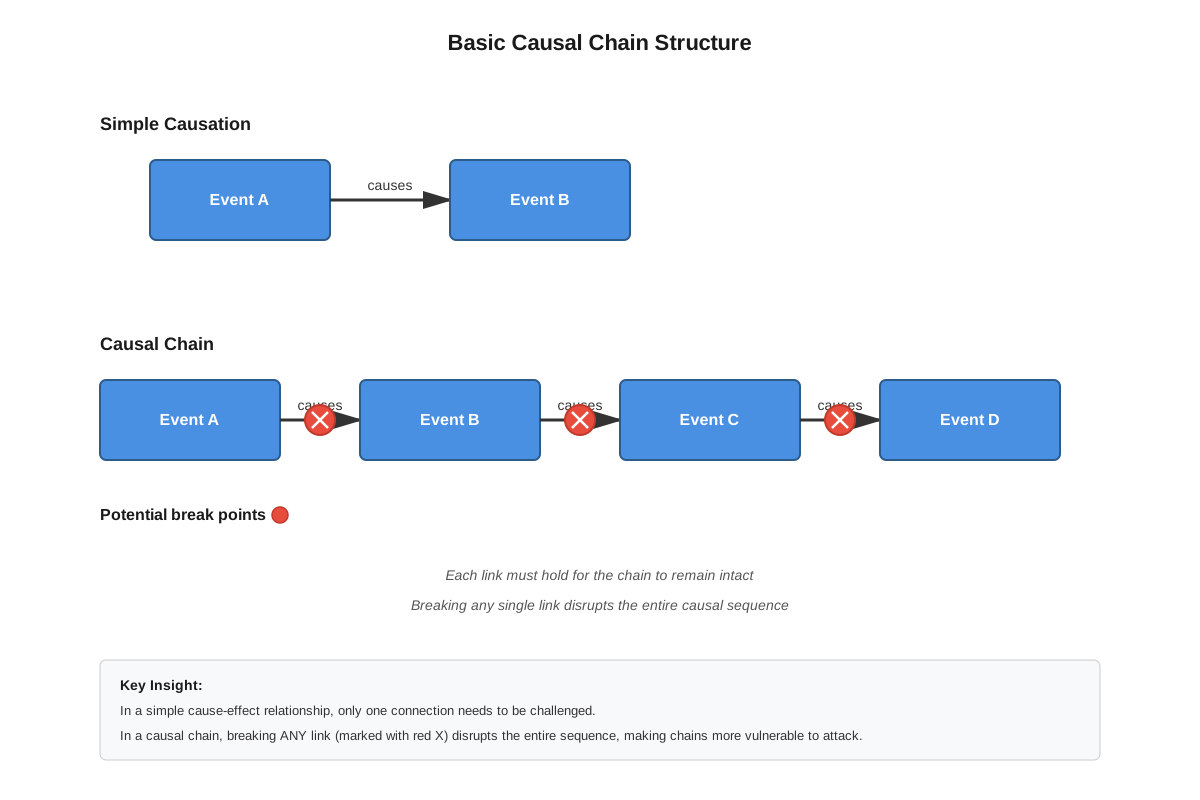
A causal chain consists of three or more events connected by causal relationships, where each event (except the first) is caused by the preceding event and (except the last) causes the subsequent event. The basic structure follows this pattern:
Event A → causes → Event B → causes → Event C → causes → Event D
Each arrow represents a distinct causal claim that must be supported for the entire chain to hold. The strength of a causal chain argument depends on the strength of its weakest link—if any single causal connection fails, the entire chain breaks down.
Consider this example: "The new highway reduced traffic congestion, which decreased commute times, which increased worker productivity, which boosted company profits." This chain contains four events and three causal links, each of which could be challenged.
Complete versus Incomplete Causal Chains
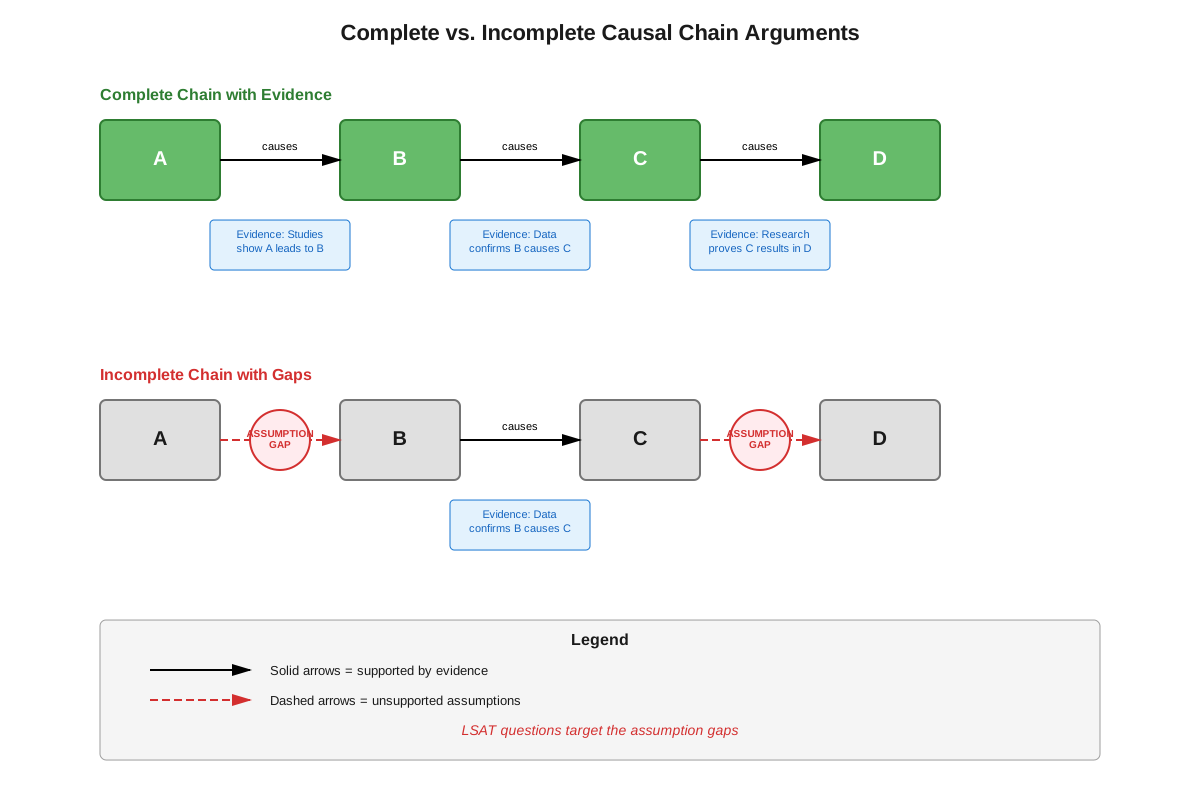
LSAT arguments often present incomplete causal chains where one or more links are assumed but not explicitly stated. Recognizing these gaps is crucial for Assumption questions.
Complete chain: "Pesticide use killed beneficial insects, which allowed pest populations to increase, which damaged crops, resulting in lower yields."
Incomplete chain: "Pesticide use resulted in lower crop yields because it killed beneficial insects." (The middle links—pest population increase and crop damage—are implied but not stated.)
| Complete Chain | Incomplete Chain |
|---|---|
| All causal links explicitly stated | One or more links assumed |
| Easier to evaluate each connection | Requires identifying missing links |
| Less vulnerable to assumption questions | Common in Assumption questions |
| May still have weak links | Gaps represent necessary assumptions |
Vulnerable Links in Causal Chains
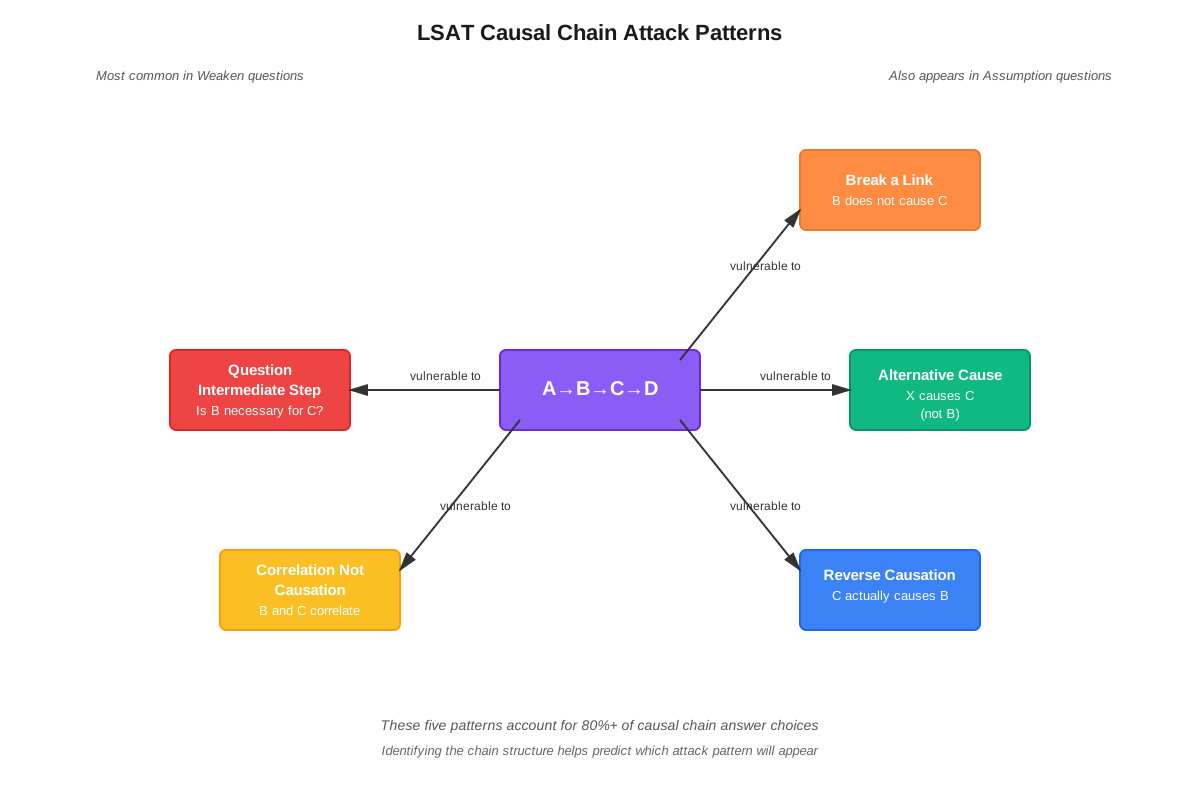
Each link in a causal chain represents a potential vulnerability. The LSAT exploits these vulnerabilities by:
- Questioning whether the first event actually occurred: If Event A didn't happen, the chain cannot begin
- Breaking a middle link: Showing that Event B doesn't actually cause Event C
- Providing alternative causes: Demonstrating that Event C was caused by something other than Event B
- Introducing intervening factors: Showing that additional events between B and C prevent the causal connection
- Reversing causation: Suggesting that Event C actually caused Event B rather than vice versa
Necessary Links and Sufficient Links
Understanding the difference between necessary and sufficient conditions helps evaluate causal chains:
- A necessary link must be present for the chain to work, but its presence alone doesn't guarantee the outcome
- A sufficient link is enough to produce the next event in the chain
Most causal chain arguments on the LSAT treat each link as sufficient (B is enough to cause C) while the entire chain is necessary to reach the final conclusion. Recognizing when an argument incorrectly assumes sufficiency or necessity is key to identifying flaws.
Alternative Causal Pathways
A sophisticated challenge to causal chain reasoning involves alternative causal pathways—different routes from the initial event to the final outcome. For example:
Primary chain: A → B → C → D
Alternative pathway: A → X → Y → D
If an alternative pathway exists, the argument's conclusion about the specific mechanism (the B-C pathway) may be weakened even if the overall causal connection between A and D remains valid. The LSAT frequently tests whether students recognize that multiple causal pathways can lead to the same outcome.
Temporal Sequence and Causation
Causal chains inherently involve temporal sequences—earlier events cause later events. However, the LSAT tests whether students incorrectly assume that temporal sequence proves causation. Just because Event B follows Event A doesn't mean A caused B. Strong causal chain arguments provide evidence beyond mere temporal ordering, such as:
- Mechanism explanations (how A causes B)
- Correlation strength
- Elimination of alternative explanations
- Experimental or comparative evidence
Cumulative versus Sequential Effects
Some causal chains involve cumulative effects where multiple causes contribute to a single outcome, while others involve sequential effects where each event fully causes the next. Distinguishing between these patterns matters for evaluating argument strength:
Sequential: Each event is both necessary and sufficient for the next (A alone causes B, B alone causes C)
Cumulative: Multiple factors combine to produce effects (A contributes to B, but other factors also matter)
LSAT arguments often blur this distinction, treating cumulative effects as if they were purely sequential, creating a logical flaw.
Concept Relationships
The concepts within causal chain reasoning connect hierarchically and functionally. At the foundation lies the basic structure of causal chains (Event A → Event B → Event C), which determines how all other concepts apply. This structure directly leads to the distinction between complete and incomplete chains—some arguments explicitly state all links while others leave gaps that become necessary assumptions.
The structural understanding enables identification of vulnerable links, since each connection point in the chain represents a potential weakness. These vulnerabilities manifest in specific ways: alternative causal pathways challenge whether the stated chain is the actual mechanism, temporal sequence issues question whether succession proves causation, and the necessary versus sufficient distinction tests whether each link truly produces the next event.
The relationship map flows as follows:
Basic Causal Chain Structure → Complete/Incomplete Chain Analysis → Vulnerable Link Identification → Specific Challenge Types (Alternative Pathways, Temporal Fallacies, Necessity/Sufficiency Errors) → Answer Choice Prediction
This topic connects to prerequisite knowledge by building on simple cause-and-effect reasoning (extending single causal relationships into chains) and correlation versus causation (applying that distinction to each link). It relates to broader Logical Reasoning concepts including conditional reasoning (causal chains often combine with conditional statements), assumption identification (missing links become necessary assumptions), and argument evaluation (assessing chain strength).
High-Yield Facts
- ⭐ A causal chain breaks down completely if any single link is severed or shown to be invalid
- ⭐ LSAT Weaken questions often attack the middle links of causal chains rather than the first or last events
- ⭐ Missing links in causal chains represent necessary assumptions that must be true for the argument to succeed
- ⭐ Alternative causal pathways weaken arguments about specific mechanisms even if the overall causal connection remains plausible
- ⭐ Temporal sequence alone never proves causation in a causal chain—additional evidence is required
- Each link in a causal chain requires independent support; evidence for one link doesn't automatically support other links
- Strengthen questions often eliminate alternative explanations or provide evidence for the weakest link
- Causal chains can be reversed (C causes B causes A) as an alternative explanation
- Intervening factors that prevent causal transmission break the chain even if earlier links are valid
- Correlation at each step is necessary but not sufficient to establish a causal chain
- The longer the causal chain, the more vulnerable the argument becomes to challenges
- Flaw questions often identify arguments that assume all links without providing evidence for each connection
Quick check — test yourself on Causal chain so far.
Try Flashcards →Common Misconceptions
Misconception: If the first and last events in a chain are causally connected, the specific intermediate steps must be correct.
Correction: Multiple causal pathways can connect the same initial and final events. Evidence that A causes D doesn't prove that the specific mechanism (A→B→C→D) is correct rather than an alternative pathway (A→X→Y→D).
Misconception: Temporal sequence (B happens after A, C happens after B) is sufficient to establish a causal chain.
Correction: Temporal ordering is necessary but not sufficient for causation. Events can occur in sequence without causal connection, and the LSAT frequently includes answer choices that exploit post hoc ergo propter hoc reasoning (after this, therefore because of this).
Misconception: Strengthening one link in a causal chain strengthens the entire argument proportionally.
Correction: A chain is only as strong as its weakest link. Strengthening an already-strong link provides minimal benefit, while the weakest link remains the primary vulnerability. Effective strengthening targets the most questionable connection.
Misconception: Breaking a link in a causal chain proves the final event didn't occur.
Correction: Breaking a link in a proposed causal chain only shows that the specific mechanism is incorrect. The final event may still have occurred through an alternative causal pathway or different mechanism.
Misconception: All events in a causal chain must be explicitly stated in the argument.
Correction: LSAT arguments frequently present incomplete causal chains with implied intermediate steps. Identifying these unstated links is essential for Assumption questions, where the correct answer often supplies the missing connection.
Misconception: If each individual link in a chain is possible, the entire chain is therefore probable.
Correction: Probability compounds through a chain. Even if each link has a 70% probability, a four-link chain has only about 24% probability of all links holding (0.7^4 ≈ 0.24). Arguments that treat possible chains as probable commit a logical error.
Worked Examples
Example 1: Assumption Question
Argument: "The city's decision to increase parking fees led to reduced downtown traffic congestion. This reduction in congestion will attract more shoppers to downtown stores, ultimately revitalizing the struggling retail district."
Question: Which of the following is an assumption required by the argument?
Analysis:
Let's map the causal chain:
- Increased parking fees → reduced traffic congestion (stated)
- Reduced traffic congestion → more shoppers downtown (claimed)
- More shoppers downtown → retail district revitalization (claimed)
The argument explicitly establishes the first link (parking fees reduced congestion). However, the second link (reduced congestion → more shoppers) contains a gap. The argument assumes that reduced traffic congestion will actually attract shoppers, but this requires that shoppers were previously avoiding downtown because of traffic congestion, not for other reasons.
The third link (more shoppers → revitalization) assumes that increased foot traffic will translate to increased purchases and business success.
Predicted answer: The correct answer will likely address the second link, stating something like: "Traffic congestion was a significant factor deterring shoppers from visiting downtown stores" or "Shoppers who avoided downtown previously did so primarily because of traffic issues rather than other factors such as limited store selection or safety concerns."
Why this matters: This example demonstrates how incomplete causal chains create necessary assumptions. The argument jumps from reduced congestion to more shoppers without establishing that congestion was the barrier preventing shoppers from coming downtown.
Example 2: Weaken Question
Argument: "Studies show that countries with higher coffee consumption have lower rates of Parkinson's disease. Increased coffee consumption reduces inflammation in neural tissue, which prevents the cellular damage that leads to Parkinson's. Therefore, public health campaigns should encourage coffee drinking to reduce Parkinson's incidence."
Question: Which of the following, if true, most weakens the argument?
Analysis:
The causal chain presented:
- Coffee consumption → reduced neural inflammation
- Reduced neural inflammation → prevents cellular damage
- Prevented cellular damage → lower Parkinson's rates
Let's identify vulnerable links:
- Link 1: Does coffee actually reduce neural inflammation, or is this correlation without causation?
- Link 2: Is inflammation the primary cause of the cellular damage leading to Parkinson's?
- Link 3: Would preventing this specific type of cellular damage actually reduce Parkinson's incidence?
Additionally, we should consider:
- Alternative explanation: Perhaps genetic factors that protect against Parkinson's also increase coffee tolerance or preference
- Reverse causation: Early Parkinson's symptoms might reduce coffee consumption before diagnosis
Strong weakening answers might:
- Break Link 1: "Coffee consumption correlates with other dietary and lifestyle factors that reduce inflammation, but coffee itself has no direct anti-inflammatory effect on neural tissue"
- Provide alternative explanation: "Genetic variations that protect against Parkinson's disease also increase the body's ability to metabolize caffeine, making coffee consumption more pleasant for these individuals"
- Challenge the intervention: "The anti-inflammatory effects of coffee observed in studies require consumption levels that would be unsafe for most people"
Predicted answer: The alternative explanation (genetic factors) is strongest because it breaks the causal chain while explaining the observed correlation. This answer shows that the correlation exists not because coffee prevents Parkinson's, but because a third factor (genetics) influences both coffee consumption and Parkinson's risk.
Why this matters: This example illustrates how LSAT Weaken questions target causal chains by providing alternative explanations, reversing causation, or breaking specific links. Recognizing the chain structure allows you to predict which types of answers will be most effective.
Exam Strategy
Trigger Words and Phrases
Watch for language that signals causal chain reasoning:
- "Led to," "resulted in," "caused," "produced," "brought about"
- "Which in turn," "thereby," "consequently," "thus"
- Sequential connectors: "first...then...finally," "initially...subsequently"
- Mechanism language: "by means of," "through the process of," "via"
When you see multiple causal connectors in a single argument, immediately recognize you're dealing with a causal chain and begin mapping the links.
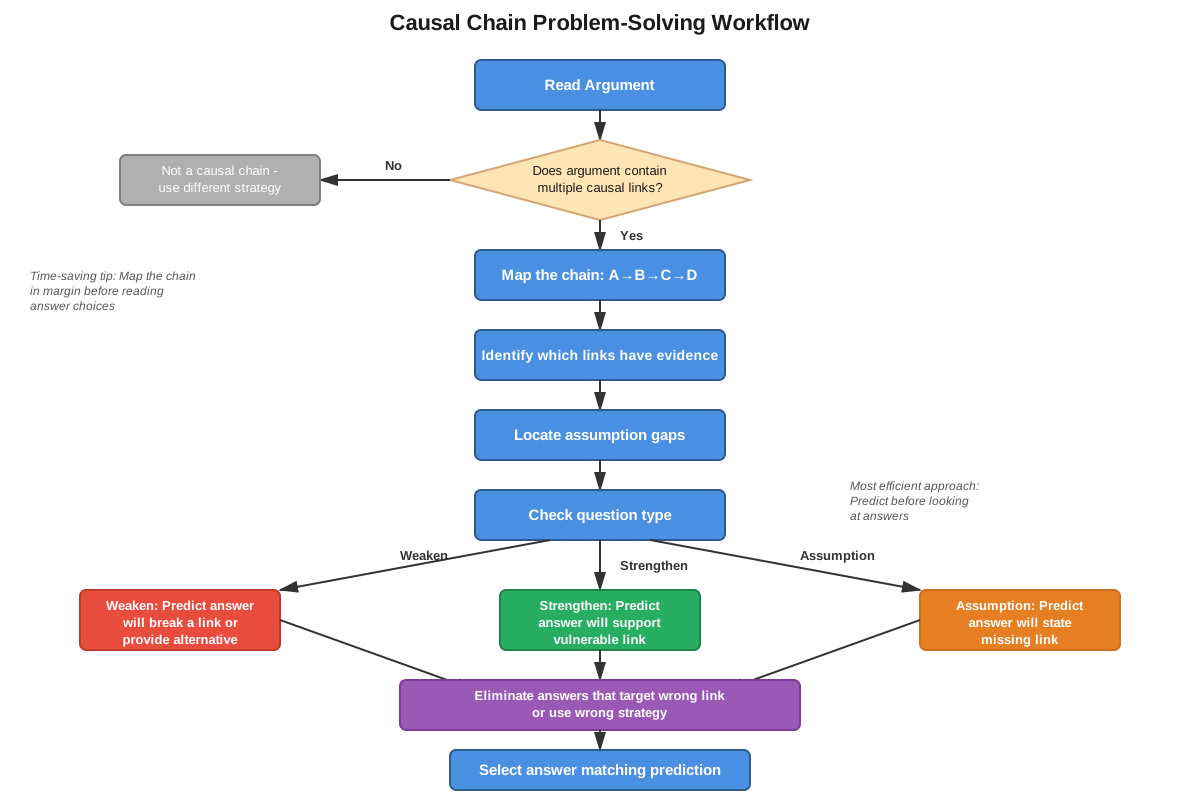
Approach Process
- Map the chain: Write out or mentally diagram each event and causal connection (A→B→C→D)
- Identify gaps: Note any implied but unstated links
- Assess vulnerability: Determine which link has the weakest support
- Predict challenges: For Weaken questions, anticipate alternative pathways or broken links; for Strengthen questions, expect support for weak links; for Assumption questions, look for missing connections
Question-Type Specific Strategies
Weaken Questions:
- Eliminate answers that attack only the conclusion without addressing the causal mechanism
- Favor answers that break middle links over those that question the initial event
- Look for alternative causal pathways that explain the correlation differently
- Consider answers that introduce intervening factors preventing causal transmission
Strengthen Questions:
- Identify the weakest link and predict answers that support it
- Eliminate alternative explanations
- Look for answers that provide mechanism evidence (how the cause produces the effect)
- Favor answers that address the most vulnerable connection
Assumption Questions:
- Focus on unstated links between explicitly mentioned events
- Use the negation test: if negating an answer choice breaks the chain, it's likely correct
- Look for answers that rule out alternative causes or intervening factors
Time Management
Causal chain questions typically require 1:15-1:30 minutes because mapping the chain takes additional time. However, this upfront investment pays off by making answer choice evaluation faster and more accurate. Don't rush the initial analysis—a clear chain diagram prevents costly errors in answer selection.
Exam Tip: If an argument presents more than three causal links, the LSAT is almost certainly testing your ability to identify the weakest link or recognize a missing connection. Immediately assess which link has the least support.
Memory Techniques
CHAIN Acronym for analyzing causal chain arguments:
- Connections: Map each causal link explicitly
- Holes: Identify missing or assumed links
- Alternatives: Consider other causal pathways
- Intervening factors: Look for events that might block causal transmission
- Necessity: Determine whether each link is truly necessary for the conclusion
Visualization Strategy: Picture a physical chain with each link representing a causal connection. When evaluating answers, visualize which link is being attacked (for Weaken) or reinforced (for Strengthen). If any link breaks, the entire chain falls apart—this mental image reinforces the logical principle.
The "Domino Effect" Memory Aid: Think of causal chains like dominoes—each must fall in sequence for the final domino to fall. This helps remember that:
- All links must hold for the conclusion to follow
- Breaking any single link stops the entire sequence
- The chain is only as strong as its weakest domino
Link Vulnerability Checklist (memorize this sequence):
- Does the first event actually occur?
- Does each event actually cause the next?
- Are there alternative causes for later events?
- Do intervening factors prevent transmission?
- Is the temporal sequence sufficient to prove causation?
Summary
Causal chain reasoning involves sequences of cause-and-effect relationships where multiple events connect through causal links (A causes B, which causes C, which causes D). On the LSAT, these arguments appear frequently in Logical Reasoning questions, particularly in Weaken, Strengthen, and Assumption question types. The fundamental principle is that a causal chain is only as strong as its weakest link—breaking any single connection invalidates the entire argument. LSAT questions exploit this vulnerability by providing alternative causal pathways, breaking middle links, introducing intervening factors, or revealing missing connections that represent necessary assumptions. Success requires mapping the complete chain, identifying gaps or weak links, and predicting how answer choices will target specific vulnerabilities. Understanding that temporal sequence doesn't prove causation, that multiple pathways can produce the same outcome, and that each link requires independent support are essential skills for mastering this high-yield topic.
Key Takeaways
- Causal chains consist of multiple linked cause-and-effect relationships where each event causes the next in sequence
- Breaking any single link in a causal chain destroys the entire argument—the chain is only as strong as its weakest connection
- LSAT questions frequently target middle links rather than initial or final events, making careful chain mapping essential
- Missing links in causal chains represent necessary assumptions that must be supplied for the argument to succeed
- Alternative causal pathways can explain correlations without validating the specific mechanism proposed in the argument
- Temporal sequence (B follows A) is necessary but never sufficient to establish causation in LSAT arguments
- Effective analysis requires mapping all links, identifying gaps, assessing vulnerability, and predicting answer choice strategies based on question type
Related Topics
Simple Cause and Effect: Understanding basic two-event causal relationships (A causes B) provides the foundation for analyzing more complex causal chains. Mastering causal chains enables progression to arguments involving multiple simultaneous causes and complex causal networks.
Correlation versus Causation: This fundamental distinction applies to each link in a causal chain. Students who master causal chains are better equipped to analyze arguments that confuse correlation with causation at multiple points in a sequence.
Necessary and Sufficient Conditions: Causal chains often involve claims about what's necessary or sufficient for events to occur. Understanding these logical relationships enhances the ability to evaluate whether each link in a chain truly holds.
Alternative Explanations: Causal chain arguments are vulnerable to alternative explanations at each link. Mastering this topic prepares students for more complex arguments involving competing explanatory frameworks.
Conditional Reasoning: Many causal chain arguments combine causal claims with conditional statements. Understanding both patterns and how they interact represents advanced Logical Reasoning skill.
Practice CTA
Now that you understand the structure and vulnerabilities of causal chain arguments, you're ready to apply these concepts to actual LSAT questions. The practice questions and flashcards will reinforce your ability to quickly map causal chains, identify weak links, and predict correct answers. Remember that causal chain questions are high-yield—mastering this pattern will improve your performance across multiple question types. Approach each practice question by first mapping the chain, then predicting the answer before looking at the choices. This active approach builds the analytical skills that lead to top LSAT scores. You've got this!
Sign up free to keep reading
Create a free AnvayaPrep account to finish this LSAT guide on Causal chain — plus flashcards and practice questions.