Overview
Causal predictions represent one of the most frequently tested reasoning patterns on the LSAT Logical Reasoning section. This concept involves arguments that use established causal relationships to forecast future outcomes or predict what will happen under certain conditions. When an argument claims that because X causes Y in one context, X will cause Y in another context, it is making a causal prediction. Understanding this reasoning pattern is essential because the LSAT regularly tests whether students can identify the assumptions underlying such predictions, recognize their vulnerabilities, and evaluate their logical strength.
The importance of mastering causal predictions extends beyond isolated question types. This topic sits at the intersection of causation and explanation, conditional reasoning, and argument evaluation—three pillars of LSAT logical reasoning. Questions involving causal predictions appear in multiple question types, including Strengthen, Weaken, Assumption, Flaw, and Parallel Reasoning questions. The ability to recognize when an argument extrapolates from past causal relationships to future scenarios is a high-yield skill that directly impacts performance across 15-20% of Logical Reasoning questions on any given LSAT.
What makes causal predictions particularly challenging is that they require students to think dynamically about how causal relationships might change across different contexts, time periods, or populations. Unlike simple causal claims that assert "X causes Y," lsat causal predictions involve an additional inferential leap: "Because X caused Y before (or in one situation), X will cause Y again (or in a different situation)." This extra step introduces multiple potential vulnerabilities that the LSAT exploits to test critical thinking skills. Mastering this topic means developing the ability to spot these vulnerabilities instantly and understanding exactly what assumptions must hold for the prediction to be valid.
Learning Objectives
- [ ] Identify how Causal predictions appears in LSAT questions
- [ ] Explain the reasoning pattern behind Causal predictions
- [ ] Apply Causal predictions to solve LSAT-style problems accurately
- [ ] Distinguish between simple causal claims and causal predictions involving temporal or contextual extrapolation
- [ ] Recognize the standard vulnerabilities and assumptions inherent in causal prediction arguments
- [ ] Evaluate answer choices that strengthen or weaken causal predictions by addressing relevant assumptions
- [ ] Construct parallel reasoning structures that mirror causal prediction patterns
Prerequisites
- Basic causal reasoning: Understanding the difference between correlation and causation, and recognizing causal language indicators (causes, leads to, results in, produces, brings about) is fundamental to identifying when arguments make predictive leaps.
- Conditional logic fundamentals: Familiarity with sufficient and necessary conditions helps distinguish between causal relationships (which are not reversible) and conditional statements, preventing confusion when predictions are made.
- Argument structure analysis: The ability to identify premises, conclusions, and gaps in reasoning is essential for spotting where causal predictions introduce assumptions.
- Strengthen and Weaken question mechanics: Since causal predictions frequently appear in these question types, understanding how to support or undermine arguments is necessary for applying this concept effectively.
Why This Topic Matters
In real-world contexts, causal predictions form the backbone of policy decisions, scientific research, business strategy, and medical treatment. When a pharmaceutical company predicts that a drug effective in clinical trials will work in the general population, or when an economist forecasts that a policy successful in one country will succeed in another, they are making causal predictions. The LSAT tests this reasoning pattern because lawyers must constantly evaluate whether past outcomes reliably predict future results—whether precedents apply to new cases, whether evidence from one context transfers to another, and whether proposed solutions will achieve intended effects.
On the LSAT, causal predictions appear with remarkable frequency. Approximately 15-20% of Logical Reasoning questions involve some form of causal reasoning, and roughly half of these include predictive elements. This translates to 3-5 questions per test that directly test understanding of causal predictions. The topic appears most commonly in:
- Weaken questions: Where the correct answer introduces a reason why the predicted causal relationship might not hold
- Strengthen questions: Where the correct answer provides evidence that the causal relationship will likely persist or transfer
- Assumption questions: Where the correct answer identifies what must be true for the prediction to be valid
- Flaw questions: Where the argument's error involves unjustified extrapolation from past to future or from one context to another
The LSAT particularly favors scenarios where causal predictions involve changes in context, population, time period, scale, or implementation method. Recognizing these variations is key to identifying the specific vulnerability being tested.
Core Concepts
The Basic Structure of Causal Predictions
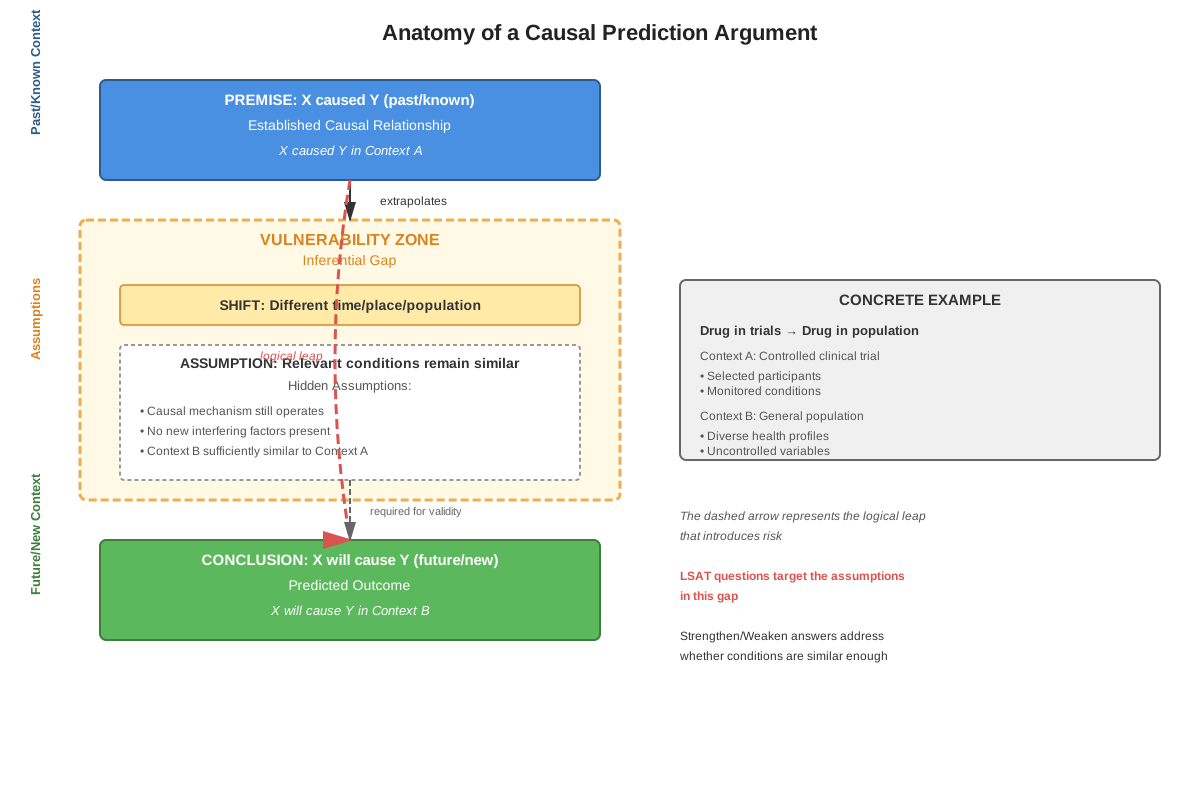
A causal prediction argument follows a two-part structure. First, it establishes a causal relationship in one context: "In situation A, X caused Y." Second, it predicts that this relationship will hold in a different context: "Therefore, in situation B, X will cause Y." The logical gap between these two parts—the assumption that the causal relationship transfers—is where the LSAT focuses its attention.
Consider this structure:
- Premise: Past or established causal relationship (X caused Y in context A)
- Conclusion: Predicted causal relationship (X will cause Y in context B)
- Hidden assumption: Contexts A and B are relevantly similar; no relevant differences exist that would prevent the causal relationship from holding
The strength of a causal prediction depends entirely on the similarity between the original context and the predicted context. The more differences exist, the weaker the prediction becomes.
Types of Contextual Shifts in Causal Predictions
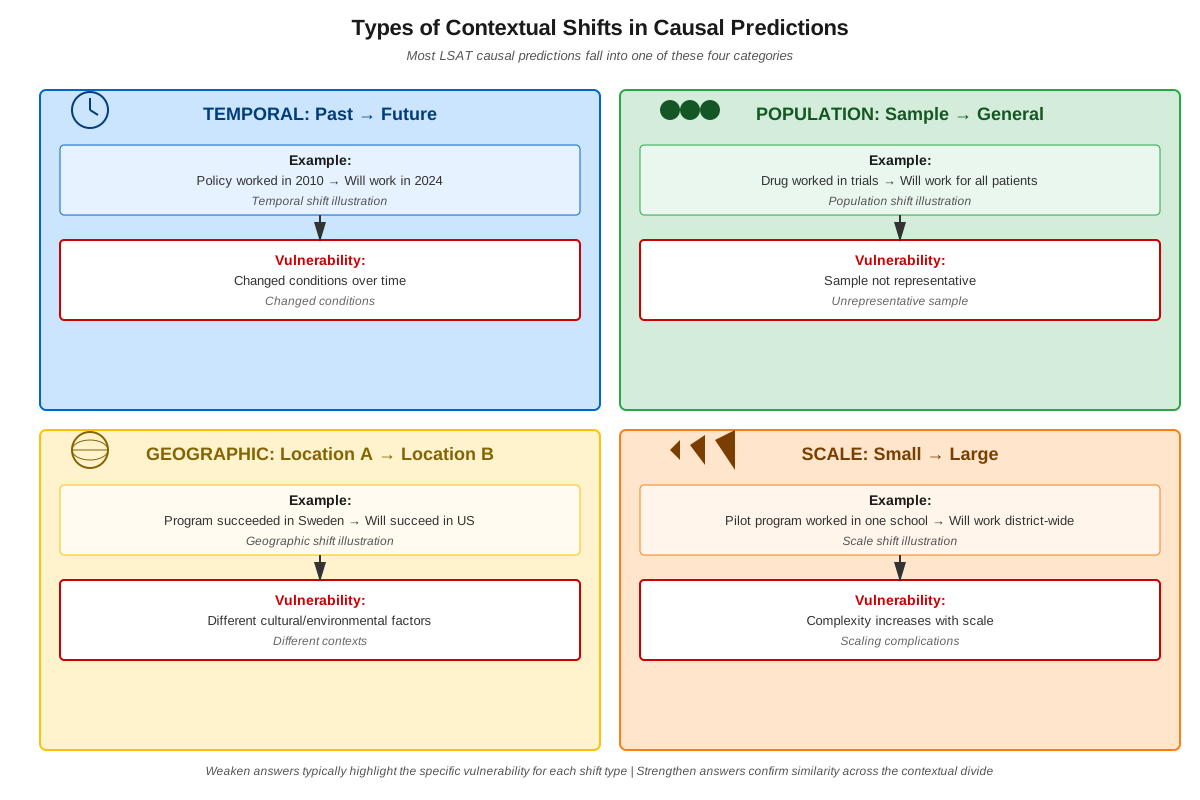
Temporal predictions involve extrapolating from past to future. An argument might claim that because a marketing strategy increased sales last year, it will increase sales next year. The vulnerability lies in changed circumstances: market conditions, consumer preferences, competitive landscape, or economic factors may have shifted.
Population or group transfers occur when an argument applies a causal relationship observed in one group to a different group. For example, if a teaching method improved test scores for elementary students, will it work for high school students? The assumption is that relevant characteristics of the groups are similar enough for the causal mechanism to operate identically.
Scale or magnitude shifts involve predictions that a causal relationship will hold when the scale changes. A policy effective in a small pilot program might be predicted to work city-wide or nation-wide. The assumption is that scaling up won't introduce new factors that disrupt the causal mechanism.
Methodological or implementation changes occur when the specific way a cause is applied differs between contexts. If a drug administered intravenously showed certain effects, will it have the same effects when taken orally? The delivery mechanism might affect the causal relationship.
Key Assumptions in Causal Predictions
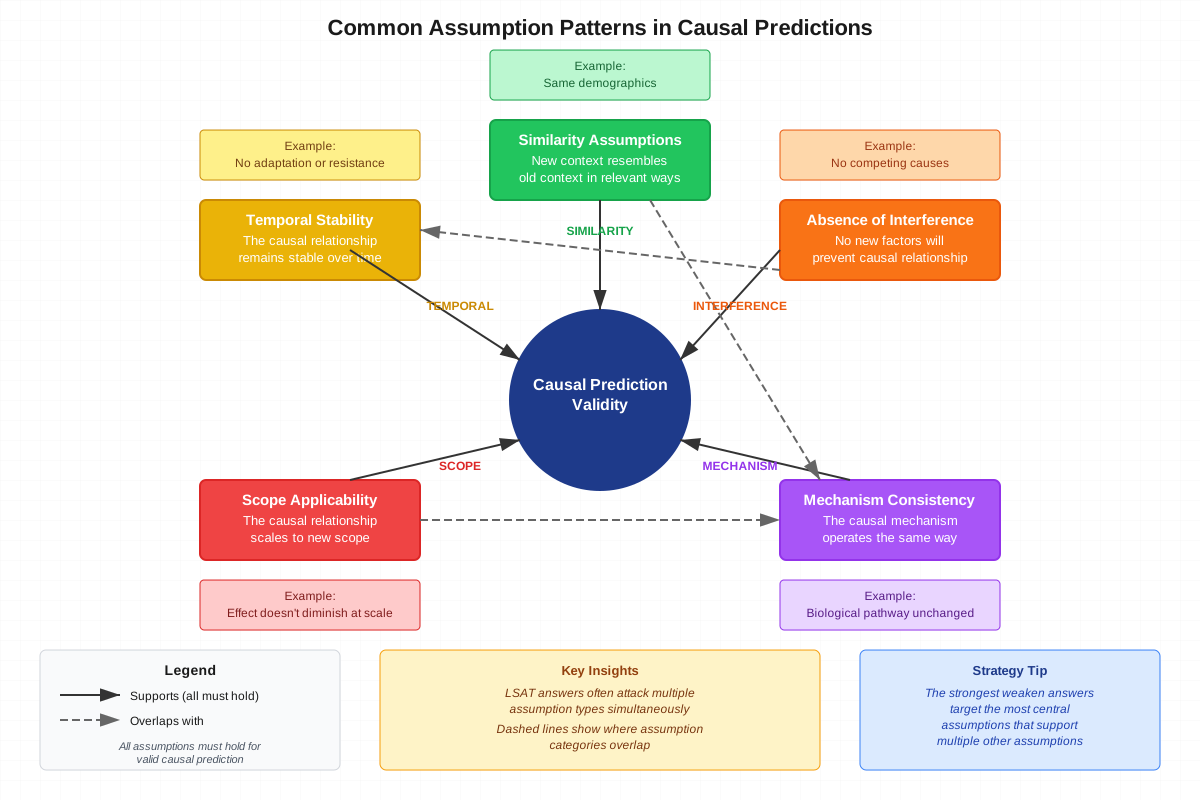
Every causal prediction rests on several critical assumptions:
| Assumption Type | Description | Example Vulnerability |
|---|---|---|
| Consistency assumption | The causal mechanism itself hasn't changed | The biological process that made the treatment effective has evolved or adapted |
| Similarity assumption | Relevant conditions between contexts are sufficiently alike | Different demographic characteristics affect how the cause operates |
| Absence of interference | No new factors will prevent or alter the causal relationship | New regulations, competitors, or environmental factors emerge |
| Mechanism persistence | The underlying reason X causes Y still applies | The psychological principle that explained past behavior no longer holds |
| Scope assumption | The causal relationship applies at the predicted scale or intensity | Effects that work at small scale don't translate to large scale |
Identifying Causal Predictions in LSAT Questions
Several linguistic markers signal causal prediction arguments:
- Temporal indicators: "will," "is likely to," "should," "can be expected to," "will probably"
- Comparative language: "similarly," "likewise," "in the same way," "just as"
- Extrapolation phrases: "this suggests that," "we can conclude that," "therefore it follows that"
- Causal language combined with future or conditional tense: "will cause," "would result in," "is going to lead to"
When these markers appear alongside evidence of a past or established causal relationship, a causal prediction argument is likely present.
Strengthening Causal Predictions
To strengthen a causal prediction, evidence must address the gap between the original context and the predicted context. Effective strengtheners:
- Demonstrate relevant similarity: Show that key factors are the same across contexts
- Rule out interfering factors: Eliminate potential disruptions to the causal mechanism
- Provide additional confirming instances: Show the causal relationship held in other similar transitions
- Explain the causal mechanism: Clarify why the cause produces the effect in a way that applies to both contexts
- Address known differences: Show that apparent differences don't affect the causal relationship
Weakening Causal Predictions
To weaken a causal prediction, evidence must highlight reasons the causal relationship might not transfer:
- Identify relevant differences: Point out how contexts differ in ways that matter to the causal mechanism
- Introduce interfering factors: Present new elements that could prevent or alter the predicted effect
- Show mechanism breakdown: Demonstrate that the reason the cause produced the effect no longer applies
- Provide counterexamples: Present cases where similar predictions failed
- Question scope applicability: Show that scale or intensity changes affect the causal relationship
Concept Relationships
The concept of causal predictions builds directly on foundational causal reasoning. Understanding simple causal claims ("X causes Y") is prerequisite to understanding causal predictions ("X caused Y, so X will cause Y again"). The relationship flows: Basic causation → Causal predictions → Complex causal reasoning with multiple variables.
Within the topic itself, the concepts connect as follows:
Basic structure of causal predictions → Types of contextual shifts → Key assumptions → Identification strategies → Strengthening/Weakening techniques
Each type of contextual shift (temporal, population, scale, methodological) introduces specific assumptions that must hold for the prediction to be valid. These assumptions, in turn, determine what kinds of evidence will strengthen or weaken the argument. Understanding this chain allows students to work backward from answer choices to identify what assumption is being tested.
Causal predictions also connect to broader LSAT concepts:
- Conditional reasoning: While distinct, both involve "if-then" thinking; causal predictions often get confused with conditional statements
- Analogical reasoning: Both involve applying relationships from one context to another, but analogies compare structural relationships while causal predictions extrapolate specific cause-effect relationships
- Necessary assumptions: Every causal prediction contains necessary assumptions about contextual similarity
- Sufficient assumptions: Some answer choices provide sufficient conditions for the prediction to hold by guaranteeing relevant similarity
High-Yield Facts
⭐ Causal predictions always involve extrapolating from one context to another—past to future, one group to another, or one situation to a different situation.
⭐ The primary vulnerability in causal prediction arguments is the assumption that contexts are relevantly similar.
⭐ Temporal causal predictions assume that conditions haven't changed between the time periods in question.
⭐ To weaken a causal prediction, identify relevant differences between the original context and the predicted context.
⭐ To strengthen a causal prediction, demonstrate relevant similarities or rule out potential interfering factors.
- Causal predictions appear most frequently in Weaken, Strengthen, and Assumption questions on the LSAT.
- Scale shifts (from small to large implementation) are a common vulnerability tested in causal prediction arguments.
- Population transfers assume that the groups share characteristics relevant to the causal mechanism.
- The phrase "will likely" or "should" combined with causal language signals a causal prediction.
- Explaining the underlying mechanism of causation typically strengthens a causal prediction by showing why it should transfer.
- Counterexamples showing failed predictions in similar circumstances effectively weaken causal prediction arguments.
- Causal predictions differ from simple causal claims by adding a predictive or extrapolative element.
- The LSAT often tests whether students recognize that past success doesn't guarantee future success without additional assumptions.
Quick check — test yourself on Causal predictions so far.
Try Flashcards →Common Misconceptions
Misconception: All arguments with causal language involve causal predictions. → Correction: Only arguments that extrapolate from one context to another involve causal predictions. Simple causal claims that don't make predictions about new contexts are not causal predictions, even though they involve causation.
Misconception: If a causal relationship existed in the past, it's reasonable to assume it will continue without additional evidence. → Correction: This is precisely the assumption that causal prediction arguments make and that the LSAT tests. Without evidence of relevant similarity or absence of interfering factors, such predictions are logically vulnerable.
Misconception: Strengthening a causal prediction requires proving the prediction will definitely come true. → Correction: Strengthening only requires making the conclusion more likely, not certain. Evidence of relevant similarity or absence of known interfering factors strengthens without guaranteeing the outcome.
Misconception: Any difference between contexts weakens a causal prediction. → Correction: Only relevant differences weaken causal predictions. Differences that don't affect the causal mechanism are irrelevant. For example, if a teaching method worked in schools with blue walls and is predicted to work in schools with white walls, the wall color difference is irrelevant unless it somehow affects the causal mechanism.
Misconception: Causal predictions and conditional statements are the same thing. → Correction: Conditional statements express logical relationships ("If A, then B") that are definitional or rule-based, while causal predictions involve empirical claims about cause-and-effect relationships that may or may not hold across contexts. Conditional logic is reversible in specific ways (contrapositive); causal relationships are not.
Misconception: Providing more examples of the original causal relationship strengthens the prediction. → Correction: Additional examples of X causing Y in the original context don't address whether the relationship will hold in the new context. What strengthens the prediction is evidence that the new context is relevantly similar or that the relationship has held across similar transitions.
Misconception: Temporal predictions are weaker than other types of causal predictions. → Correction: No type of causal prediction is inherently weaker than others. The strength depends on the degree of relevant similarity between contexts and the likelihood of interfering factors, regardless of whether the shift is temporal, population-based, or methodological.
Worked Examples
Example 1: Temporal Causal Prediction
Argument: "Last year, the city implemented a new traffic light timing system at major intersections, and traffic congestion decreased by 15%. Therefore, if the city implements the same system at additional intersections this year, traffic congestion will decrease further."
Analysis:
Step 1: Identify the argument structure
- Premise: New traffic light timing system caused 15% decrease in congestion last year
- Conclusion: Same system will cause further decrease this year
- This is a temporal causal prediction (past to future)
Step 2: Identify the assumption
The argument assumes that conditions this year are relevantly similar to last year—that no factors have changed that would prevent the causal relationship from holding.
Step 3: Consider vulnerabilities
- Traffic patterns may have changed (new construction, population shifts)
- The initial intersections may have been the ones where the system was most effective
- Driver behavior may have adapted to the new system
- The remaining intersections may have different characteristics
Step 4: Evaluate answer choices (Weaken question)
Weak answer: "The traffic light timing system was expensive to implement."
- This addresses cost, not whether the causal relationship will hold
Strong answer: "The intersections where the system was implemented last year had significantly higher traffic volumes than the intersections where it would be implemented this year."
- This identifies a relevant difference (traffic volume) that could affect whether the causal mechanism operates similarly
Why this works: The answer provides a reason to doubt that the causal relationship will transfer by showing the contexts differ in a way that matters to the effectiveness of the intervention.
Example 2: Population Transfer Causal Prediction
Argument: "A study found that when elderly patients with mild cognitive impairment engaged in daily crossword puzzles for six months, their memory test scores improved by an average of 20%. Therefore, implementing a daily crossword puzzle program for middle-aged adults will likely improve their cognitive function."
Analysis:
Step 1: Identify the argument structure
- Premise: Crossword puzzles caused cognitive improvement in elderly patients with mild impairment
- Conclusion: Crossword puzzles will cause cognitive improvement in middle-aged adults
- This is a population transfer causal prediction
Step 2: Identify the assumption
The argument assumes that middle-aged adults are relevantly similar to elderly patients with mild cognitive impairment in ways that matter to how crossword puzzles affect cognitive function.
Step 3: Consider vulnerabilities
- Middle-aged adults may not have cognitive impairment to improve from
- The cognitive mechanisms may differ between age groups
- Baseline cognitive function levels differ
- The type of cognitive benefit may differ
Step 4: Evaluate answer choices (Assumption question)
Weak answer: "Middle-aged adults enjoy crossword puzzles as much as elderly patients do."
- Enjoyment doesn't necessarily affect whether the causal mechanism operates
Strong answer: "The cognitive processes that crossword puzzles engage are similar in middle-aged adults and elderly patients with mild cognitive impairment."
- This is necessary for the prediction to hold; if the cognitive processes differ fundamentally, the causal relationship might not transfer
Why this works: The answer identifies what must be true for the causal mechanism to operate similarly across the two populations. If the cognitive processes engaged are different, the cause might not produce the same effect.
Exam Strategy
When approaching LSAT questions involving causal predictions, follow this systematic process:
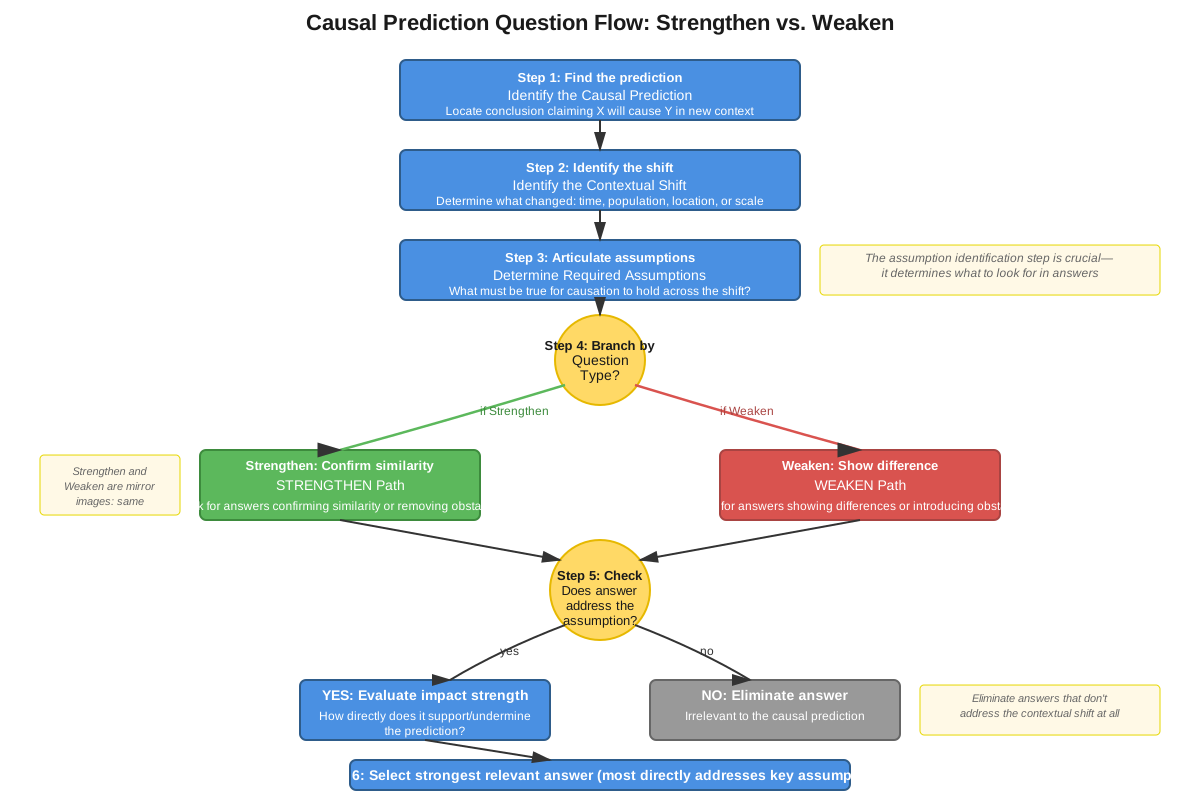
Step 1: Identify the causal prediction structure
Look for evidence of a causal relationship in one context followed by a prediction about a different context. Watch for temporal markers ("will," "should," "is likely to") combined with causal language.
Step 2: Pinpoint the contextual shift
Determine exactly how the predicted context differs from the original: Is it temporal? A different population? A different scale? A different implementation method? This tells you where the vulnerability lies.
Step 3: Articulate the assumption
Before looking at answer choices, mentally state what must be true for the prediction to hold: "The argument assumes that [the contexts are similar in X way]" or "The argument assumes that [no Y factor will interfere]."
Step 4: Predict answer characteristics
For Weaken questions, expect answers that highlight relevant differences or introduce interfering factors. For Strengthen questions, expect answers that demonstrate relevant similarity or rule out interference. For Assumption questions, expect answers that bridge the gap between contexts.
Step 5: Eliminate systematically
Exam Tip: Eliminate answers that address the original causal relationship without addressing the prediction. Many wrong answers strengthen or weaken the premise (that X caused Y in the original context) rather than the conclusion (that X will cause Y in the new context).
Trigger words and phrases to watch for:
- "Similarly," "likewise," "in the same way" → signals analogical reasoning that may involve causal prediction
- "Will," "should," "can be expected to" → signals prediction
- "Previously," "in the past," "historically" → sets up temporal comparison
- "Just as," "if...then" → may signal causal prediction or analogical reasoning
Time allocation advice:
Causal prediction questions typically require 1:15-1:30 minutes. Spend 30-40 seconds understanding the argument structure and identifying the contextual shift, then 35-50 seconds evaluating answer choices. Don't rush the initial analysis—correctly identifying the type of contextual shift makes answer evaluation much faster.
Process-of-elimination tips:
- Eliminate answers that address irrelevant differences between contexts
- Eliminate answers that only discuss the original causal relationship without addressing the prediction
- For Strengthen/Weaken, eliminate answers that go in the wrong direction (even slightly)
- For Assumption questions, use the negation test: if negating the answer doesn't hurt the argument, eliminate it
Memory Techniques
SHIFT Mnemonic for types of contextual shifts in causal predictions:
- Scale (small to large, pilot to full implementation)
- Historical/temporal (past to future)
- Implementation method (different way of applying the cause)
- Folk/population (one group to another)
- Territory/location (one place to another)
RAINS Mnemonic for assumptions in causal predictions:
- Relevant similarity exists between contexts
- Absence of interfering factors
- Intensity/scale doesn't affect the relationship
- No mechanism breakdown
- Same underlying conditions apply
Visualization strategy: Picture a bridge between two islands. The first island represents the original context where the causal relationship was established. The second island represents the predicted context. The bridge represents the assumptions connecting them. Weakening answers blow up parts of the bridge; strengthening answers reinforce it. This mental image helps remember that causal predictions require a connection between contexts.
The "Time Travel Test": When you see a causal prediction, ask yourself: "Is this argument time traveling (past to future), teleporting (one place/group to another), or zooming (changing scale)?" This quick categorization helps identify the type of contextual shift and its vulnerabilities.
Summary
Causal predictions represent a critical reasoning pattern on the LSAT where arguments extrapolate from established causal relationships in one context to predict outcomes in different contexts. These arguments follow a two-part structure: establishing that X caused Y in context A, then concluding that X will cause Y in context B. The logical vulnerability lies in the assumption that contexts are relevantly similar and that no interfering factors will prevent the causal relationship from holding. The LSAT tests this pattern across multiple question types, most commonly in Weaken, Strengthen, and Assumption questions. Success requires identifying the type of contextual shift (temporal, population, scale, or methodological), recognizing the specific assumptions the shift introduces, and evaluating whether answer choices address the gap between contexts. Strong answers for Weaken questions highlight relevant differences or introduce interfering factors; strong answers for Strengthen questions demonstrate relevant similarity or rule out interference. Mastering causal predictions means developing the automatic ability to spot when arguments make predictive leaps and understanding exactly what must be true for those predictions to be valid.
Key Takeaways
- Causal predictions involve extrapolating from one context to another, introducing assumptions about relevant similarity that the LSAT systematically tests
- The primary vulnerability is always the gap between the original context and the predicted context—focus your analysis there
- Identify the type of contextual shift (temporal, population, scale, methodological) to predict what assumptions and vulnerabilities will be tested
- To weaken causal predictions, look for relevant differences between contexts or interfering factors; to strengthen, look for relevant similarities or absence of interference
- Not all differences between contexts matter—only those that affect the causal mechanism are relevant
- Causal predictions appear in 15-20% of Logical Reasoning questions and are high-yield for score improvement
- Always articulate the assumption before evaluating answer choices to avoid being distracted by answers that address the wrong gap
Related Topics
Simple Causal Claims: Understanding basic causation without predictive elements provides the foundation for recognizing when arguments add the extra inferential step of prediction. Mastering causal predictions enables progression to more complex causal reasoning involving multiple causes or effects.
Analogical Reasoning: While distinct from causal predictions, analogical reasoning also involves applying relationships from one context to another. Understanding the difference helps avoid confusion and strengthens overall reasoning skills.
Necessary vs. Sufficient Assumptions: Causal predictions always rest on necessary assumptions about contextual similarity. Deepening understanding of assumption types enhances ability to evaluate causal prediction arguments.
Conditional Logic and Causation: Distinguishing between conditional relationships and causal relationships prevents common errors in identifying and analyzing causal predictions.
Statistical Reasoning and Sampling: Many causal predictions involve generalizing from samples to populations, connecting this topic to statistical reasoning principles tested elsewhere on the LSAT.
Practice CTA
Now that you understand the structure, vulnerabilities, and strategic approach to causal prediction arguments, it's time to cement this knowledge through practice. Attempt the practice questions focusing specifically on identifying the contextual shift and articulating the assumption before evaluating answer choices. Use the flashcards to drill recognition of causal prediction patterns and common vulnerabilities until identifying them becomes automatic. Remember: causal predictions appear frequently on the LSAT, making this one of the highest-yield topics for improving your Logical Reasoning score. Every question you master in this area directly translates to points on test day. You've built the framework—now apply it with confidence!
Sign up free to keep reading
Create a free AnvayaPrep account to finish this LSAT guide on Causal predictions — plus flashcards and practice questions.