Overview
Experimental controls represent one of the most frequently tested concepts in LSAT Logical Reasoning sections, particularly within questions involving causation and explanation. When the LSAT presents arguments about scientific studies, medical research, or any investigation claiming a causal relationship, understanding experimental controls becomes essential for evaluating the strength and validity of those arguments. An experimental control is a baseline condition in a study that allows researchers to isolate the effect of a single variable by comparing outcomes between groups that differ only in the factor being tested. Without proper controls, it becomes impossible to determine whether an observed effect results from the variable under investigation or from some other confounding factor.
The LSAT frequently tests whether test-takers can identify flaws in experimental design, recognize when controls are absent or inadequate, and evaluate whether alternative explanations undermine causal claims. Questions may ask students to strengthen or weaken arguments based on experimental evidence, identify assumptions underlying causal reasoning, or select answer choices that properly describe methodological flaws. Understanding lsat experimental controls requires recognizing that correlation does not equal causation and that rigorous experimental design demands systematic comparison between controlled conditions.
This topic connects intimately with broader Logical Reasoning skills including identifying assumptions, evaluating evidence, recognizing alternative explanations, and assessing argument structure. Mastery of experimental controls enhances performance across multiple question types including Strengthen, Weaken, Flaw, Assumption, and Evaluate questions. The principles learned here apply whenever an LSAT argument makes claims about cause-and-effect relationships, whether in scientific contexts or everyday reasoning scenarios.
Learning Objectives
- [ ] Identify how Experimental controls appears in LSAT questions
- [ ] Explain the reasoning pattern behind Experimental controls
- [ ] Apply Experimental controls to solve LSAT-style problems accurately
- [ ] Distinguish between adequate and inadequate control groups in experimental designs
- [ ] Recognize confounding variables that undermine causal conclusions
- [ ] Evaluate whether experimental methodology supports or weakens causal claims
- [ ] Identify the specific assumptions that experimental controls are designed to address
Prerequisites
- Basic understanding of causal reasoning: Necessary because experimental controls specifically address how to establish causation rather than mere correlation
- Familiarity with argument structure: Required to identify premises, conclusions, and the logical gaps that experimental controls help address
- Recognition of sufficient and necessary conditions: Relevant because experimental design tests whether a variable is sufficient or necessary to produce an effect
- Understanding of alternative explanations: Essential since the purpose of controls is to rule out competing explanations for observed phenomena
Why This Topic Matters
Experimental controls appear with remarkable frequency on the LSAT, showing up in approximately 15-20% of Logical Reasoning questions across typical exams. This high-yield topic crosses multiple question types, making it one of the most valuable concepts to master for score improvement. Questions involving experimental methodology appear as Strengthen/Weaken questions (most common), Flaw questions, Assumption questions, Method of Reasoning questions, and occasionally as Parallel Reasoning questions involving scientific scenarios.
In real-world applications, understanding experimental controls proves essential for evaluating medical research, policy decisions based on studies, product effectiveness claims, and scientific reporting in media. The ability to critically assess whether a study's design supports its conclusions represents a fundamental critical thinking skill that extends far beyond the LSAT. Legal professionals regularly encounter expert testimony based on experimental evidence, making this reasoning pattern directly relevant to legal practice.
On the LSAT, experimental controls typically appear in passages describing studies comparing two or more groups, research investigating the effectiveness of treatments or interventions, or arguments claiming that one factor causes another based on observational data. The test-makers frequently present flawed experimental designs where inadequate controls allow alternative explanations to undermine the conclusion. Recognizing these flaws and understanding what would constitute proper experimental methodology becomes crucial for selecting correct answers and eliminating attractive wrong answer choices.
Core Concepts
What Are Experimental Controls?
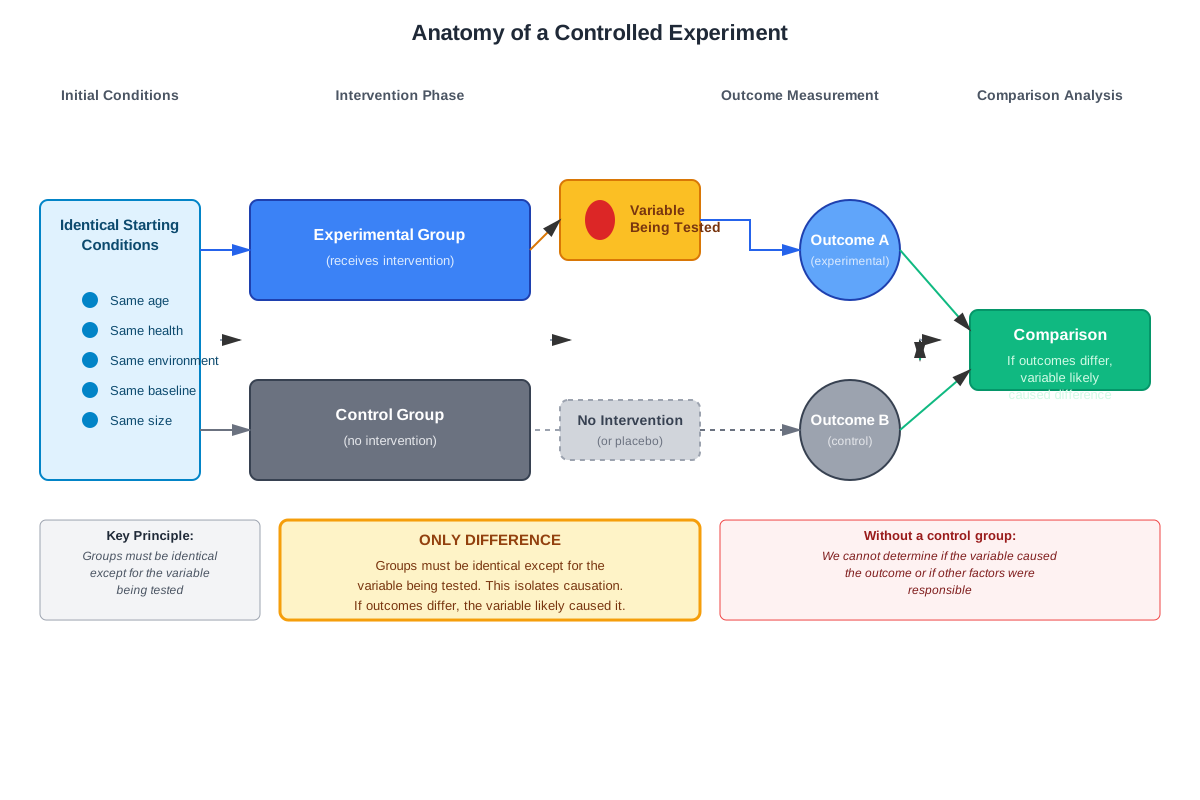
Experimental controls are baseline conditions or comparison groups in a study designed to isolate the effect of a single variable by holding all other factors constant. The fundamental principle underlying experimental controls is that to establish causation, researchers must demonstrate that the variable under investigation—and not some other factor—produces the observed effect. A control group receives no treatment or receives a standard treatment, while an experimental group receives the intervention being tested. By comparing outcomes between these groups, researchers can attribute differences to the variable being manipulated.
The logic of experimental controls rests on a simple but powerful principle: if two groups are identical in every respect except for one variable, and those groups show different outcomes, then that variable likely caused the difference. Without this comparison, observed effects might result from countless alternative factors including natural variation, placebo effects, selection bias, or environmental conditions unrelated to the variable of interest.
Types of Control Groups
Different experimental designs employ various types of control groups depending on the research question and practical constraints:
| Control Type | Description | Purpose | LSAT Relevance |
|---|---|---|---|
| Negative Control | Group receiving no treatment | Establishes baseline; shows what happens without intervention | Most common in LSAT questions |
| Positive Control | Group receiving known effective treatment | Confirms experimental system works; provides comparison standard | Less common but appears in comparative effectiveness questions |
| Placebo Control | Group receiving inactive treatment that appears identical | Controls for psychological effects of receiving treatment | Frequently tested; addresses belief/expectation confounds |
| Historical Control | Comparison to past data rather than concurrent group | Used when concurrent controls are impractical | Often presented as flawed methodology |
Confounding Variables
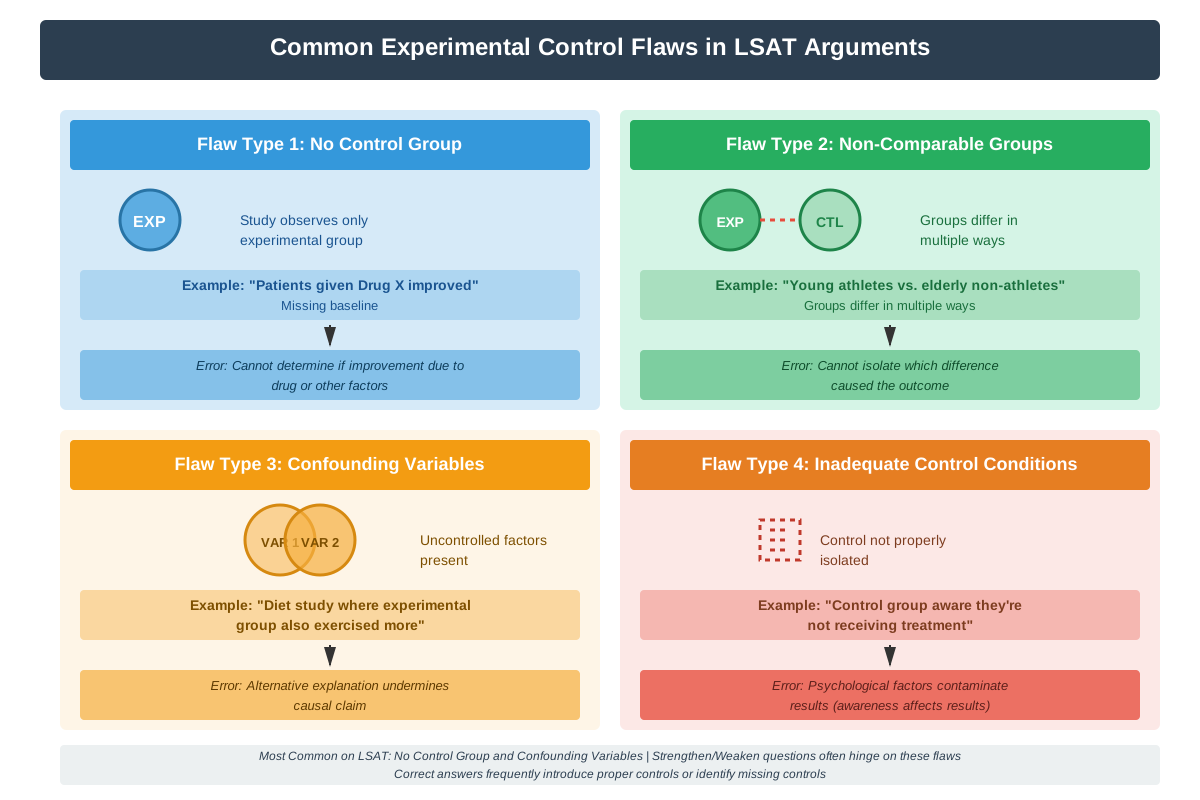
A confounding variable (or confound) is any factor other than the independent variable that might explain observed differences between groups. Proper experimental controls aim to eliminate or account for confounding variables. The LSAT frequently tests whether students can identify potential confounds that undermine causal conclusions.
Common categories of confounding variables include:
- Selection bias: Groups differ in pre-existing characteristics before treatment begins
- Environmental factors: Groups experience different conditions unrelated to the treatment
- Time-related changes: Natural progression, maturation, or historical events affect outcomes
- Measurement differences: Groups are assessed using different methods or at different times
- Placebo/expectation effects: Beliefs about treatment affect outcomes independent of treatment mechanism
The Logic of Causal Inference
Establishing causation through experimental controls follows this logical structure:
- Hypothesis: Variable X causes outcome Y
- Experimental design: Create two groups identical except for presence/absence of X
- Observation: Measure outcome Y in both groups
- Comparison: If group with X shows different Y than group without X, and no other differences exist between groups, then X likely causes Y
- Conclusion: The causal claim is supported (though not definitively proven)
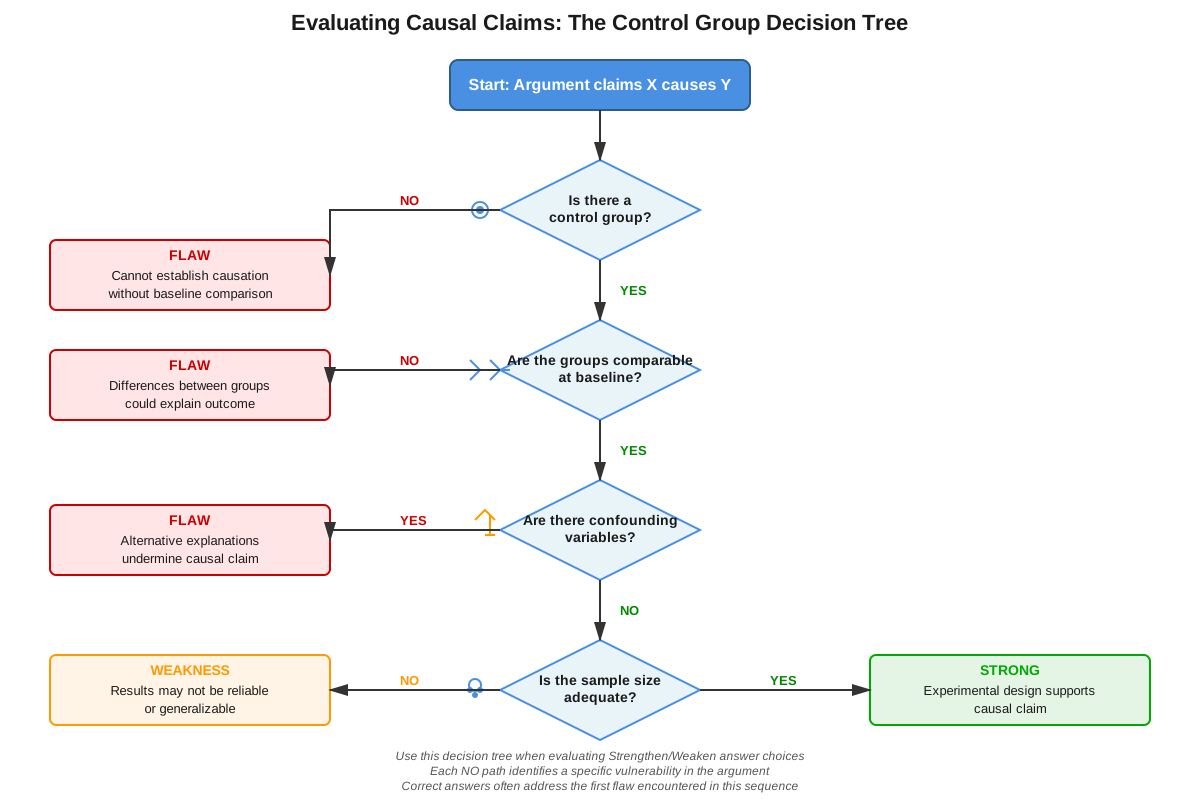
This reasoning pattern appears repeatedly in LSAT questions. Arguments claiming causation become vulnerable when:
- No control group exists for comparison
- Control and experimental groups differ in ways beyond the variable of interest
- Alternative explanations for observed differences remain unaddressed
- Sample sizes are too small to rule out chance variation
- Measurement methods differ between groups
Randomization and Control
Randomization—randomly assigning subjects to experimental or control groups—serves as a powerful method for ensuring groups are comparable. Random assignment distributes both known and unknown confounding variables evenly across groups, making it unlikely that pre-existing differences explain observed outcomes. The LSAT often presents studies lacking randomization, creating vulnerability to the criticism that groups differed in important ways before treatment began.
Blinding and Experimental Validity
Blinding (keeping participants and/or researchers unaware of group assignments) prevents expectations from influencing outcomes or measurements. Single-blind studies keep participants unaware; double-blind studies keep both participants and researchers unaware. The LST occasionally tests whether students recognize that lack of blinding introduces potential bias, particularly in studies where outcomes involve subjective assessment or where participant behavior might change based on knowledge of treatment status.
Concept Relationships
The concepts within experimental controls form an interconnected logical framework. Experimental controls serve as the overarching methodology designed to address confounding variables. The presence of confounds threatens causal inference, which represents the ultimate goal of experimental research. Randomization functions as a technique for creating comparable groups, thereby minimizing confounds. Blinding addresses a specific category of confounds related to expectations and bias.
This topic connects to prerequisite knowledge of causal reasoning by providing the methodological framework for establishing causation rather than mere correlation. Understanding alternative explanations becomes operationalized through identifying specific confounding variables that experimental controls should address. The concept of sufficient and necessary conditions relates to experimental controls because well-designed experiments test whether a variable is sufficient to produce an effect (does introducing X cause Y?) and sometimes whether it's necessary (does removing X prevent Y?).
Relationship map:
- Causal claim → requires → Experimental evidence → demands → Proper controls → achieved through → Randomization + Comparison groups + Blinding → which eliminate → Confounding variables → thereby supporting → Valid causal inference
Experimental controls also connect forward to more advanced topics in argument evaluation, including statistical reasoning, sampling methodology, and the distinction between internal validity (does the study design support its conclusions?) and external validity (do findings generalize beyond the study context?).
High-Yield Facts
⭐ An experimental control group provides a baseline for comparison by experiencing identical conditions except for the variable being tested
⭐ Without a control group, it's impossible to determine whether an observed effect results from the treatment or from other factors
⭐ Confounding variables are alternative explanations that undermine causal conclusions when experimental and control groups differ in ways beyond the variable of interest
⭐ Randomization helps ensure that experimental and control groups are comparable by distributing potential confounds evenly
⭐ Placebo controls are necessary when psychological expectations might influence outcomes independent of the treatment's physical mechanism
- Historical controls (comparing current results to past data) are weaker than concurrent controls because time-related factors might explain differences
- Selection bias occurs when groups differ in pre-existing characteristics, making it unclear whether treatment or pre-existing differences caused observed outcomes
- Blinding prevents expectations from influencing either participant responses or researcher measurements
- The larger the sample size, the less likely that chance variation explains observed differences between groups
- A study can have a control group but still be flawed if the control group is not truly comparable to the experimental group
- Correlation does not establish causation; experimental controls provide the methodology for moving from correlation to causal inference
- Multiple control groups may be necessary to rule out different alternative explanations
Quick check — test yourself on Experimental controls so far.
Try Flashcards →Common Misconceptions
Misconception: Any comparison group constitutes an adequate control group.
Correction: A proper control group must be comparable to the experimental group in all relevant respects except for the variable being tested. Simply having two groups to compare is insufficient if those groups differ in ways that might explain observed outcomes.
Misconception: If a study has a control group, its causal conclusions are automatically valid.
Correction: The presence of a control group is necessary but not sufficient for valid causal inference. The control group must be properly designed, groups must be comparable, sample sizes must be adequate, and measurements must be reliable. Many LSAT questions present studies with inadequate or flawed control groups.
Misconception: Experimental controls are only relevant in medical or scientific contexts.
Correction: The logic of experimental controls applies to any causal claim, including business decisions, policy interventions, educational programs, and everyday reasoning. The LSAT tests this concept across diverse contexts, not just traditional scientific studies.
Misconception: A control group that receives no treatment is always the best design.
Correction: The appropriate control depends on the research question. Sometimes a placebo control is necessary to account for expectation effects. Other times, comparing a new treatment to standard treatment (positive control) is more informative than comparing to no treatment.
Misconception: If the experimental group shows improvement, the treatment must have caused that improvement.
Correction: Without a control group, improvement might result from natural recovery, placebo effects, regression to the mean, or other time-related factors. The control group shows what would have happened without treatment, making it possible to isolate the treatment's effect.
Misconception: Randomization eliminates all confounding variables.
Correction: Randomization makes it unlikely that confounds systematically differ between groups, but with small sample sizes, random assignment might still produce groups that differ in important ways by chance. Additionally, randomization doesn't address confounds that arise after group assignment, such as differential dropout rates.
Worked Examples
Example 1: Identifying a Flawed Control Group
Question: A researcher concludes that a new medication reduces headache frequency. The study compared headache frequency in 50 patients taking the medication for one month with headache frequency in 50 patients who did not take the medication. The medication group reported fewer headaches. Which of the following most weakens the researcher's conclusion?
(A) Some patients in the medication group experienced side effects
(B) The medication group consisted of volunteers who sought treatment, while the control group consisted of people who did not seek treatment
(C) Headache frequency varies naturally over time
(D) The medication is expensive to produce
(E) Some headaches have no identifiable cause
Analysis:
The researcher claims the medication causes reduced headache frequency based on comparing two groups. To evaluate this argument, we must assess whether the experimental design adequately controls for alternative explanations.
Step 1: Identify the causal claim and evidence structure
- Conclusion: The medication reduces headache frequency
- Evidence: Medication group had fewer headaches than non-medication group
- Implicit assumption: The groups were comparable except for medication use
Step 2: Consider what confounding variables might undermine the conclusion
The control group must be comparable to the experimental group in all relevant respects. If the groups differ in ways that might affect headache frequency, we cannot attribute differences to the medication alone.
Step 3: Evaluate each answer choice
(A) Side effects don't explain why the medication group had fewer headaches; this is irrelevant to whether the medication caused the reduction.
(B) CORRECT: This identifies a critical confounding variable—selection bias. People who seek treatment might differ systematically from those who don't (perhaps in headache severity, health consciousness, or other factors). The groups weren't comparable before treatment began, so observed differences might reflect pre-existing differences rather than medication effects. This represents a fundamental flaw in experimental control.
(C) While natural variation is a general concern, it doesn't specifically explain why these two groups differed. Both groups would experience natural variation, so this doesn't identify a confound that differentiates the groups.
(D) Cost is irrelevant to whether the medication is effective.
(E) The cause of headaches doesn't affect whether the comparison between groups is valid.
Connection to learning objectives: This example demonstrates how to identify inadequate experimental controls (selection bias creating non-comparable groups) and apply this reasoning to weaken a causal argument.
Example 2: Recognizing What Would Strengthen an Experimental Design
Question: A study found that students who attended a test preparation course scored higher on standardized tests than students who did not attend the course. The researcher concluded that the course improves test scores. Which of the following, if true, would most strengthen the researcher's conclusion?
(A) The course covered all topics that appear on the standardized test
(B) Students were randomly assigned to either attend the course or not attend, and both groups had similar test scores before the course began
(C) The course was taught by experienced instructors
(D) Students who attended the course reported feeling more confident
(E) The standardized test is widely used for college admissions
Analysis:
Step 1: Identify the argument's vulnerability
The researcher claims the course causes improved scores based on comparing attendees to non-attendees. The main vulnerability is that these groups might differ in ways beyond course attendance—perhaps students who chose to attend were already more motivated, had more resources, or had higher baseline abilities.
Step 2: Determine what would address this vulnerability
The strongest support would eliminate alternative explanations by ensuring the groups were comparable except for course attendance.
Step 3: Evaluate answer choices
(A) Course content relevance doesn't address whether the comparison groups were comparable; even a comprehensive course might attract students who would have scored higher anyway.
(B) CORRECT: Random assignment eliminates selection bias by ensuring groups are comparable before the intervention. Confirming similar baseline scores further strengthens the comparison by showing groups started at the same level. This addresses the primary threat to causal inference—that pre-existing differences rather than the course explain score differences.
(C) Instructor quality doesn't address whether the control group was comparable to the experimental group.
(D) Confidence might be a mediating factor in how the course works, but doesn't address whether the comparison groups were equivalent.
(E) The test's purpose is irrelevant to whether the study design supports the causal conclusion.
Connection to learning objectives: This example illustrates how proper experimental controls (randomization and baseline comparability) strengthen causal arguments by eliminating confounding variables.
Exam Strategy
When approaching LSAT questions involving experimental controls, follow this systematic process:
Step 1: Identify the causal claim
Look for conclusions stating that X causes Y, X leads to Y, X is responsible for Y, or X explains Y. The argument will typically support this claim with evidence from a study or comparison.
Step 2: Map the experimental design
Identify:
- What groups are being compared?
- What variable differs between groups?
- What outcome is being measured?
- Is there a control group?
Step 3: Ask the critical control questions
- Are the groups comparable in all respects except the variable of interest?
- Could pre-existing differences explain the observed outcomes?
- Are there alternative explanations for the results?
- Was randomization used?
- Could placebo effects or expectations influence results?
Step 4: Match your analysis to the question task
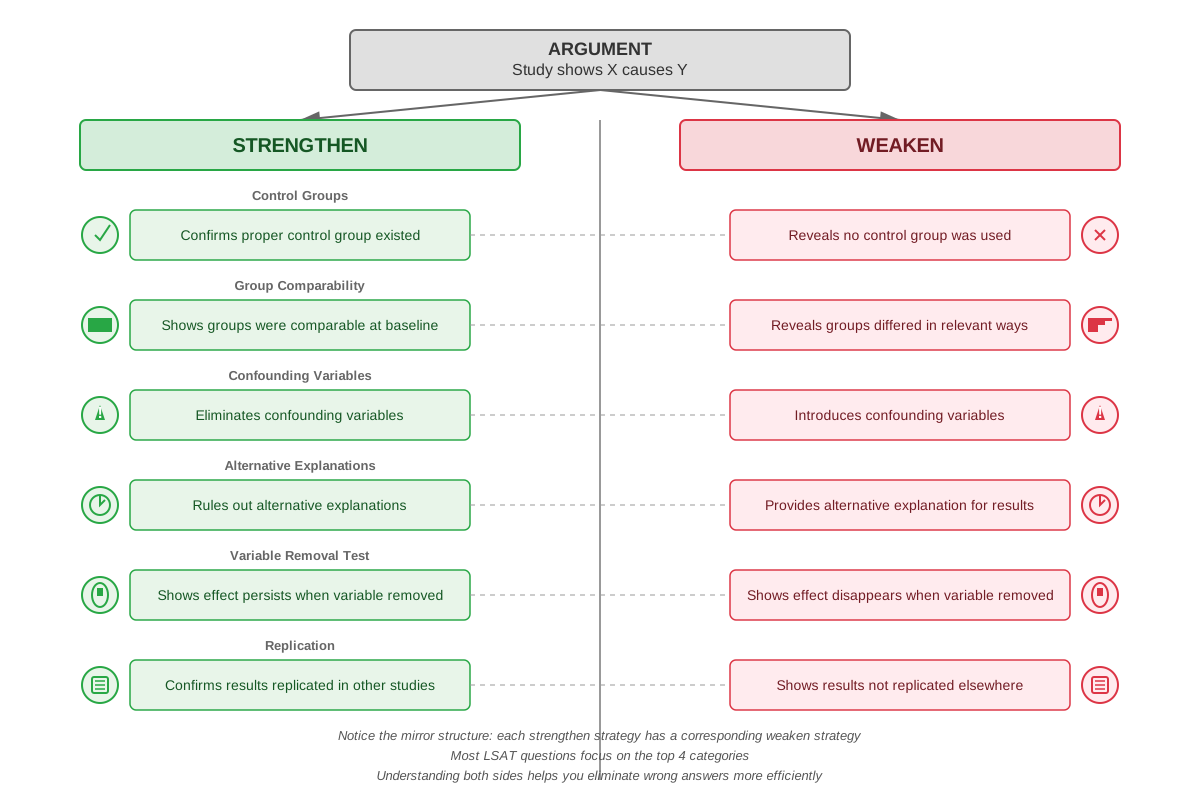
- Weaken questions: Look for answer choices identifying confounding variables or ways the groups aren't comparable
- Strengthen questions: Look for answer choices eliminating confounds or confirming group comparability
- Flaw questions: Identify the specific methodological flaw in the experimental design
- Assumption questions: Identify what must be true for the comparison to be valid (usually that groups are comparable)
Exam Tip: The LSAT frequently presents studies where the control group differs from the experimental group in subtle but important ways. Train yourself to ask: "What else might be different between these groups besides the variable being tested?"
Trigger words and phrases to watch for:
- "A study compared..." (signals experimental design)
- "Researchers found that..." (often introduces causal claim based on comparison)
- "Those who [did X] showed [outcome Y]" (implicit comparison to those who didn't do X)
- "The control group..." (explicitly mentions experimental design)
- "Random assignment" or "randomly selected" (signals proper methodology)
- "Volunteers" or "self-selected" (red flag for selection bias)
Process of elimination tips:
- Eliminate answer choices that are irrelevant to group comparability
- Eliminate answer choices that address the mechanism of how something works rather than whether the comparison is valid
- Eliminate answer choices that would affect both groups equally (these don't explain differences between groups)
- In strengthen questions, eliminate answer choices that merely show the treatment is plausible without addressing whether the study design supports the conclusion
Time allocation:
Experimental control questions typically require 60-90 seconds. Spend 20-30 seconds understanding the study design and identifying potential confounds, then 30-60 seconds evaluating answer choices. Don't rush this analysis—these questions reward careful attention to the comparison between groups.
Memory Techniques
Acronym for evaluating experimental controls: COMPARE
- Comparable groups (are they similar in relevant respects?)
- Other explanations (what alternative factors might explain results?)
- Measurement (are outcomes assessed consistently?)
- Placebo effects (could expectations influence results?)
- Assignment method (was randomization used?)
- Relevant differences (do groups differ in ways that matter?)
- Experimental vs. control (is there a proper baseline for comparison?)
Visualization strategy:
Picture two identical twins representing the experimental and control groups. They should be identical in every way except for one feature (the variable being tested). If you can imagine other differences between the twins, those represent potential confounding variables that threaten the study's validity.
Mnemonic for common confounds: "STEP"
- Selection bias (groups differ before treatment)
- Time-related factors (natural changes over time)
- Expectations (placebo effects)
- Pre-existing differences (baseline characteristics)
Memory aid for the fundamental principle:
"One difference, one conclusion"—If groups differ in only one way, you can conclude that difference caused different outcomes. If groups differ in multiple ways, you cannot isolate which difference caused the outcome.
Summary
Experimental controls represent a cornerstone of causal reasoning on the LSAT, appearing frequently across multiple Logical Reasoning question types. The fundamental principle is that establishing causation requires comparing groups that are identical in all relevant respects except for the variable being tested. A proper control group provides the baseline showing what happens without the intervention, making it possible to isolate the effect of the variable of interest. Without adequate controls, alternative explanations—confounding variables—undermine causal conclusions. The LSAT tests whether students can identify flawed experimental designs, recognize confounding variables, evaluate whether study methodology supports causal claims, and understand what would strengthen or weaken arguments based on experimental evidence. Mastery requires recognizing that correlation does not establish causation, that comparison groups must be truly comparable, and that proper experimental design demands attention to randomization, selection bias, placebo effects, and baseline differences. Success on these questions comes from systematically evaluating whether the experimental design eliminates alternative explanations for observed outcomes.
Key Takeaways
- Experimental controls establish causation by providing a baseline comparison group that differs from the experimental group only in the variable being tested
- Confounding variables—alternative explanations for observed differences—represent the primary threat to causal conclusions in experimental studies
- Proper experimental design requires comparable groups, ideally achieved through random assignment
- The LSAT frequently presents flawed studies where selection bias, lack of placebo controls, or other methodological weaknesses undermine causal claims
- When evaluating experimental arguments, always ask: "What else might differ between these groups besides the variable of interest?"
- Strengthen questions often reward answer choices that eliminate confounds or confirm group comparability
- Weaken questions often reward answer choices that identify confounding variables or ways groups aren't comparable
Related Topics
Statistical Reasoning and Sample Representativeness: Building on experimental controls, this topic addresses whether study samples adequately represent the populations to which conclusions are generalized, and whether sample sizes are sufficient to support conclusions.
Correlation vs. Causation: This foundational topic explores why observational correlations don't establish causal relationships and how experimental controls provide the methodology for moving from correlation to causation.
Necessary and Sufficient Conditions in Causal Reasoning: This advanced topic examines how experimental designs test whether variables are necessary, sufficient, or both for producing outcomes, connecting formal logic to experimental methodology.
Alternative Explanations and Assumption Questions: This related topic focuses on identifying unstated assumptions in causal arguments and recognizing alternative explanations that undermine conclusions—skills directly enhanced by understanding experimental controls.
Mastering experimental controls provides the foundation for these advanced topics and significantly improves performance on the substantial portion of LSAT Logical Reasoning questions involving causal claims and scientific evidence.
Practice CTA
Now that you understand the principles of experimental controls and how they appear on the LSAT, it's time to apply this knowledge. Work through the practice questions to test your ability to identify flawed experimental designs, recognize confounding variables, and evaluate causal arguments. Use the flashcards to reinforce key concepts and ensure you can quickly recognize experimental control issues under timed conditions. Remember: understanding the theory is just the first step—consistent practice applying these principles to LSAT-style questions is what transforms knowledge into score improvement. You've built a strong foundation; now strengthen it through deliberate practice.
Sign up free to keep reading
Create a free AnvayaPrep account to finish this LSAT guide on Experimental controls — plus flashcards and practice questions.