Overview
Explanation answer traps represent one of the most challenging aspects of LSAT Logical Reasoning questions, particularly within the domain of causation and explanation. When the LSAT asks test-takers to identify which answer choice best explains a surprising phenomenon or resolves an apparent paradox, the test writers deliberately craft wrong answer choices that appear compelling but fail to address the core issue. These traps exploit common reasoning errors and cognitive biases that even sophisticated test-takers fall prey to under time pressure.
Understanding explanation answer traps is essential for LSAT success because explanation questions appear frequently throughout the Logical Reasoning sections, and they often separate high scorers from average performers. These questions test not just reading comprehension but the ability to distinguish between answers that sound relevant versus those that genuinely resolve the logical puzzle presented. The difference between a 160 and a 170+ score often hinges on consistently avoiding these carefully constructed traps.
Within the broader landscape of Logical Reasoning, explanation questions connect directly to causal reasoning, assumption identification, and strengthening/weakening arguments. Mastering explanation answer traps builds critical skills for recognizing what information is actually relevant to a logical structure versus what merely seems related. This topic serves as a bridge between understanding basic argument structure and executing advanced critical reasoning under exam conditions.
Learning Objectives
- [ ] Identify how Explanation answer traps appears in LSAT questions
- [ ] Explain the reasoning pattern behind Explanation answer traps
- [ ] Apply Explanation answer traps to solve LSAT-style problems accurately
- [ ] Distinguish between answers that address symptoms versus underlying causes
- [ ] Recognize when an answer choice introduces irrelevant information disguised as explanation
- [ ] Evaluate whether a proposed explanation actually resolves both sides of the paradox presented
- [ ] Predict common trap patterns before reading answer choices
Prerequisites
- Basic argument structure: Understanding premises, conclusions, and how claims support one another is essential because explanation questions require identifying what needs to be explained and what would constitute a satisfactory explanation.
- Causal reasoning fundamentals: Recognizing cause-and-effect relationships matters because explanations typically establish causal connections between phenomena.
- Paradox/discrepancy identification: The ability to spot apparent contradictions or surprising facts is necessary since explanation questions present puzzling situations requiring resolution.
- Answer choice elimination strategies: General test-taking skills for the LSAT provide the foundation for applying trap-specific elimination techniques.
Why This Topic Matters
Explanation questions constitute approximately 10-15% of all Logical Reasoning questions on the LSAT, making them a high-frequency question type that directly impacts scores. These questions appear in both Logical Reasoning sections and occasionally connect to Reading Comprehension passages that present scientific or social phenomena requiring interpretation. Missing explanation questions consistently can cost test-takers 4-6 points on their scaled score—the difference between admission to a top-tier law school and a mid-tier program.
In legal practice, attorneys constantly construct explanations for client behavior, case outcomes, and factual patterns. The reasoning skills tested by explanation questions—distinguishing genuine explanatory factors from coincidental associations—mirror the analytical work required in legal research, case theory development, and oral argument. Law schools value this skill because it demonstrates the capacity for sophisticated causal analysis.
On the LSAT, explanation questions typically appear with stems like "Which one of the following, if true, most helps to explain the surprising finding?" or "Which one of the following, if true, most helps to resolve the apparent paradox?" The test writers invest significant effort in crafting wrong answers that exploit predictable reasoning errors, making these questions particularly effective at discriminating between test-takers who have developed systematic approaches versus those relying on intuition.
Core Concepts
Understanding Explanation Questions
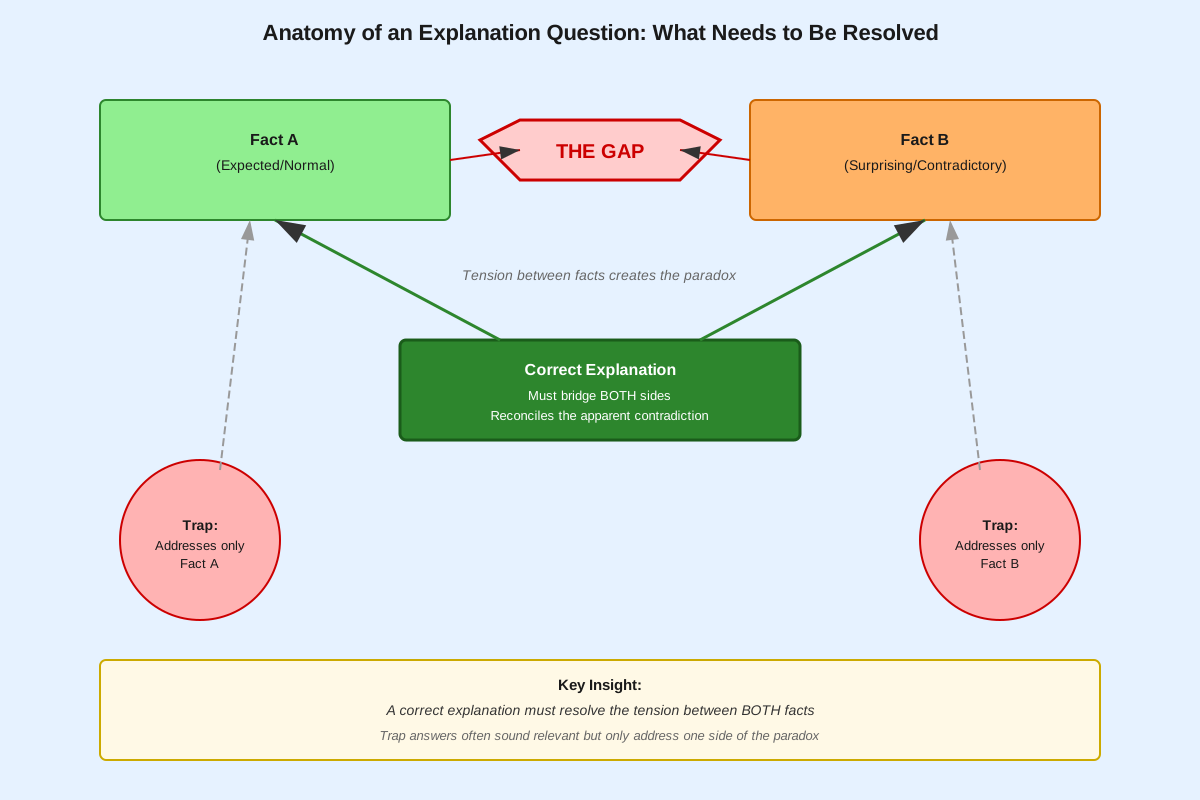
LSAT explanation answer traps are incorrect answer choices specifically designed to appear correct by exploiting common reasoning vulnerabilities. These traps work because they activate familiar patterns of thinking that feel satisfying but don't actually resolve the logical puzzle. The stimulus in an explanation question presents two facts or observations that seem inconsistent, surprising, or paradoxical. The correct answer provides information that, when added to the stimulus, makes both facts compatible or the surprising fact less surprising.
The fundamental structure involves: (1) Fact A that seems normal or expected, (2) Fact B that contradicts expectations or seems incompatible with Fact A, and (3) an answer choice that bridges the gap by providing a causal mechanism, distinguishing factor, or additional context that reconciles the apparent tension.
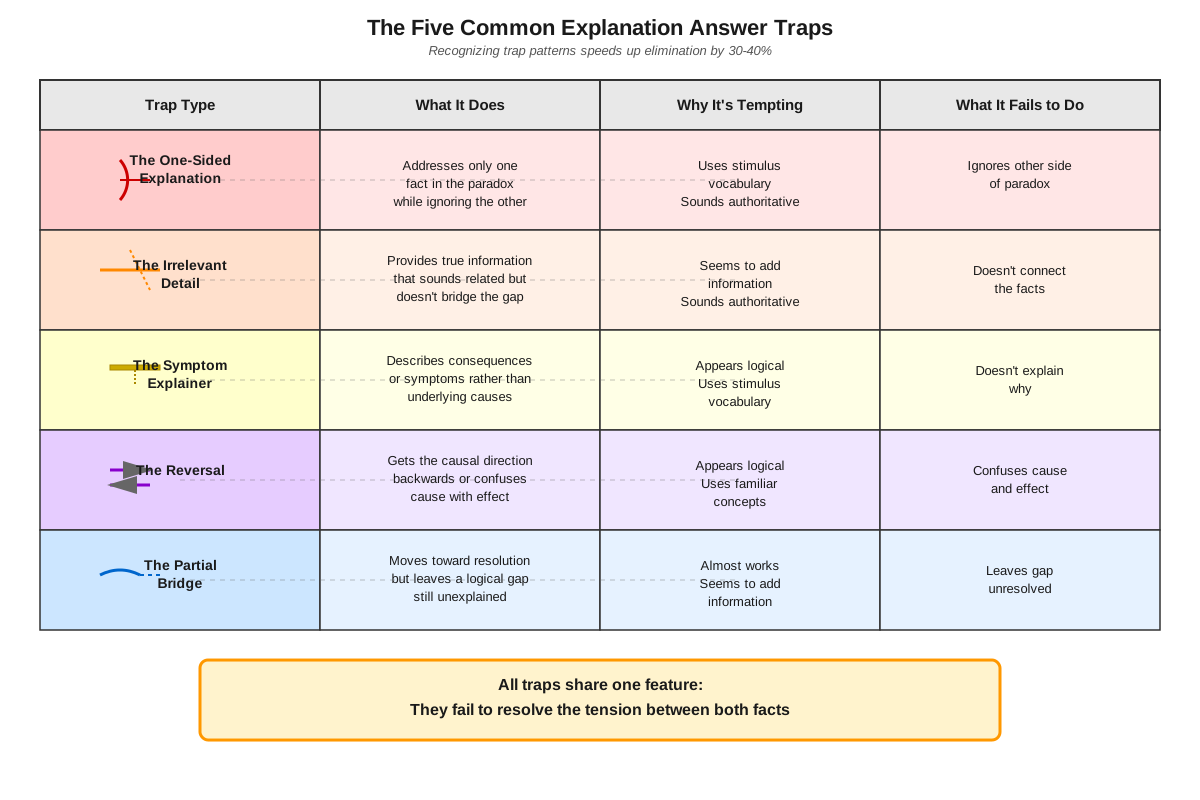
The Relevance Trap
The most common explanation answer trap involves relevance confusion—answer choices that relate to the general topic but don't address the specific discrepancy requiring explanation. These answers feel right because they connect to keywords or concepts in the stimulus, creating an illusion of explanatory power.
For example, if the stimulus states "Restaurant X increased prices by 20% yet saw customer traffic increase by 15%," a relevance trap might say "Restaurant X is located in a high-income neighborhood." While this relates to the restaurant's customer base, it doesn't explain why the price increase coincided with increased traffic—it would be true regardless of whether traffic increased or decreased.
The correct answer must explain the relationship between the two facts, not just elaborate on one fact in isolation. Test-takers fall for relevance traps because under time pressure, topical connection feels like logical connection.
The Partial Explanation Trap
Partial explanation traps address one element of the paradox while ignoring the other. These answers explain why Fact A might be true but fail to account for Fact B, or vice versa. They're particularly deceptive because they demonstrate genuine explanatory reasoning—just incomplete reasoning.
Consider: "Company Z's profits increased despite declining sales." A partial explanation trap might state: "Company Z reduced operating costs by 30%." This explains how profits could increase in general, but it doesn't specifically address why profits increased despite declining sales—it would work equally well if sales had increased, decreased, or stayed flat. The correct answer must address the surprising conjunction of both facts.
The Reverse Causation Trap
Some explanation traps present the causal relationship backwards. If the stimulus presents "A occurred, then surprisingly B occurred," these traps suggest B caused A rather than explaining how A led to B or how both could coexist. This trap exploits the difficulty of tracking causal direction under time pressure.
For instance, if the stimulus states "After the city installed speed cameras, traffic accidents increased," a reverse causation trap might say "Areas with high accident rates are more likely to have speed cameras installed." This reverses the temporal sequence—it explains why cameras were installed rather than why accidents increased after installation.
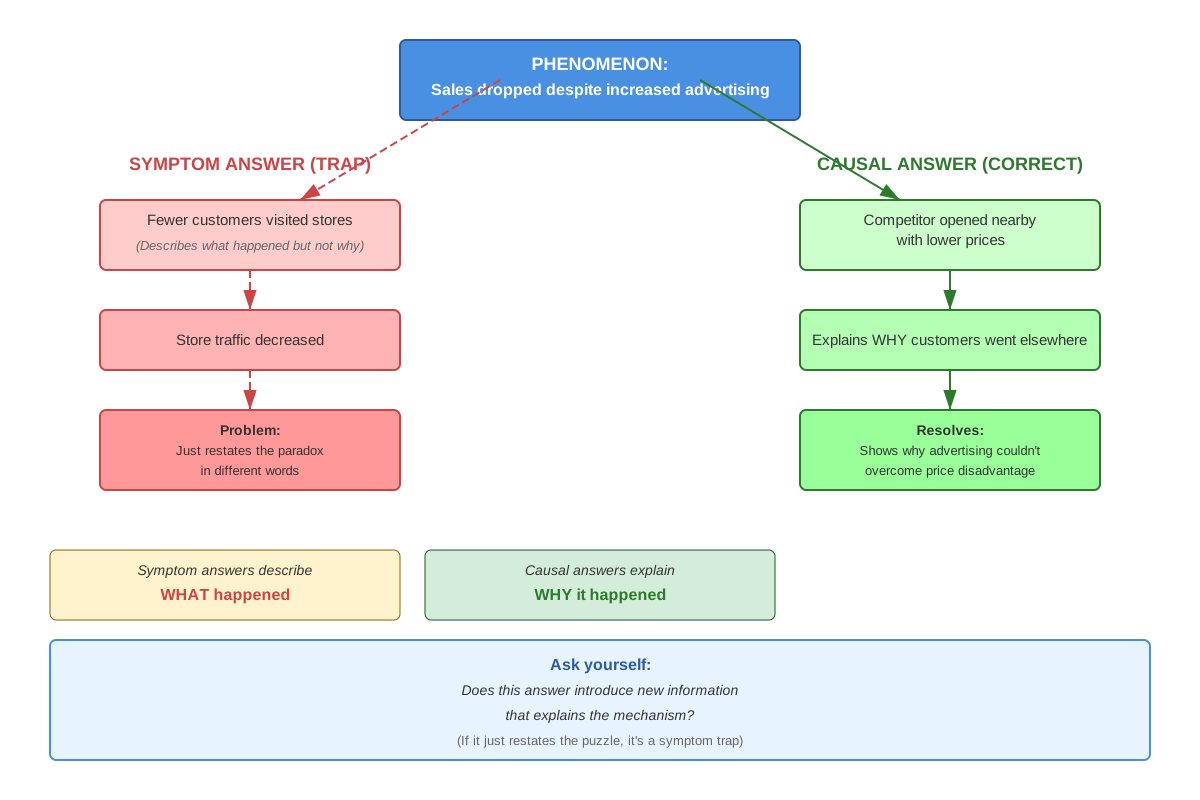
The Symptom vs. Cause Trap
Symptom traps describe effects or correlates of the phenomenon rather than explaining the underlying mechanism. These answers identify something that occurs alongside the facts in question but don't establish why the relationship exists.
If the stimulus presents "Students who study with music perform worse on tests than those who study in silence," a symptom trap might state "Students who study with music report feeling more relaxed during study sessions." This describes an associated experience but doesn't explain the performance difference—relaxation could theoretically improve or worsen performance, so this doesn't resolve the paradox.
The Scope Mismatch Trap
Scope mismatch traps provide explanations that are too broad, too narrow, or address a different population than the one in the stimulus. These answers might explain a general phenomenon when the stimulus asks about a specific instance, or explain one subgroup when the stimulus concerns a different subgroup.
For example, if the stimulus discusses "why teenagers in Urban Area X show declining interest in driving," a scope trap might explain "why Americans generally are driving less." The explanation might be factually accurate but doesn't address what's specific to teenagers in that particular urban area.
The Temporal Mismatch Trap
Some traps present information that occurred at the wrong time to explain the phenomenon. These answers might describe conditions that existed before the surprising fact emerged, after it emerged, or during a different time period entirely.
If the stimulus states "In 2020, City Y experienced a sudden drop in public transit ridership," a temporal trap might say "In 2015, City Y began a program to improve transit reliability." This occurred too early to explain a sudden 2020 change—if the program were the cause, the effect should have appeared around 2015.
Comparison Table: Trap Types
| Trap Type | What It Does | Why It's Wrong | How to Spot It |
|---|---|---|---|
| Relevance Trap | Relates to topic but not the specific discrepancy | Doesn't address the relationship between facts | Ask: "Does this explain why both facts are true together?" |
| Partial Explanation | Explains one fact but ignores the other | Only resolves half the paradox | Check: "Does this account for both surprising elements?" |
| Reverse Causation | Flips the causal direction | Explains the wrong temporal sequence | Verify: "Does the timeline match the stimulus?" |
| Symptom vs. Cause | Describes correlation without mechanism | Identifies effect rather than underlying reason | Question: "Does this show why or just what else is true?" |
| Scope Mismatch | Wrong population or context | Too broad, narrow, or different group | Compare: "Does this match the specific group/situation?" |
| Temporal Mismatch | Wrong time period | Timing doesn't align with phenomenon | Check: "When did this occur relative to the surprising fact?" |
Concept Relationships
The various explanation answer traps interconnect through a common mechanism: they all exploit the difference between apparent relevance and genuine explanatory power. Relevance traps form the foundation—they establish topical connection without logical connection. Partial explanation traps build on this by adding genuine explanatory reasoning but applying it incompletely. Reverse causation and temporal mismatch traps both involve sequence errors, where the timing or direction of causation doesn't align with what needs explaining.
Symptom versus cause traps connect to the broader LSAT skill of distinguishing correlation from causation, which appears throughout strengthen/weaken questions and flaw questions. Scope mismatch traps relate to the critical skill of matching answer choices to stimulus specificity, which applies across all Logical Reasoning question types.
The relationship map flows: Topical relevance (necessary but insufficient) → Temporal alignment (must occur at right time) → Causal direction (must point the right way) → Complete coverage (must address all elements) → Mechanistic explanation (must show why, not just what) → Correct answer.
Understanding these relationships helps test-takers develop a systematic checking process: First verify relevance, then check timing, then verify causal direction, then ensure completeness, and finally confirm the answer provides a mechanism rather than just describing symptoms.
High-Yield Facts
⭐ Explanation questions require answers that make both facts in the paradox compatible, not just elaborate on one fact
⭐ The correct explanation must address the specific relationship between the facts, not just relate to the general topic
⭐ Temporal sequence matters: the explanation must occur at the right time to cause or enable the surprising phenomenon
⭐ Partial explanations that resolve only one side of the paradox are always wrong, even if they demonstrate valid reasoning
⭐ Answers that describe symptoms or correlates without establishing causal mechanisms are traps
- Reverse causation traps are especially common when the stimulus presents a temporal sequence of events
- Scope mismatches often involve answers that explain a general trend when the stimulus asks about a specific instance
- The most tempting wrong answers typically contain 2-3 keywords from the stimulus, creating false familiarity
- Correct explanations often introduce new information not mentioned in the stimulus—this is expected and necessary
- If an answer choice would be equally true whether the surprising fact occurred or not, it cannot be the correct explanation
- Explanation questions never require outside knowledge; all necessary information appears in the stimulus and correct answer combined
- Wrong answers frequently explain why one might expect the opposite of what actually occurred, rather than explaining what did occur
- The phrase "most helps to explain" means the answer must do explanatory work, not just be consistent with the facts
- Answers using extreme language ("always," "never," "only") are rarely correct in explanation questions because explanations typically involve contributing factors rather than absolute determinants
- When two answers both seem to explain the phenomenon, the correct one will address both elements of the paradox more completely
Quick check — test yourself on Explanation answer traps so far.
Try Flashcards →Common Misconceptions
Misconception: Any answer that relates to the topic and could be true must be correct.
Correction: Relevance to the general topic is necessary but insufficient. The answer must specifically explain the relationship between the two facts presented, not just add true information about the subject matter. Many trap answers are factually plausible but logically irrelevant to the specific discrepancy.
Misconception: The correct answer will always use vocabulary or concepts explicitly mentioned in the stimulus.
Correction: Correct explanations frequently introduce entirely new information, factors, or mechanisms not mentioned in the stimulus. The test requires synthesizing the stimulus with new information from the answer choice. Trap answers often recycle stimulus language to create false familiarity.
Misconception: If an answer explains why one of the facts is true, it's correct.
Correction: Explanation questions present two facts that seem incompatible or surprising together. The correct answer must explain their coexistence or the surprising nature of their relationship. Explaining only one fact in isolation, even perfectly, leaves the paradox unresolved.
Misconception: The correct explanation must be the most common or likely reason for the phenomenon.
Correction: The LSAT doesn't test real-world probability or common sense about what usually causes things. The correct answer is whichever choice, if true, would best resolve the logical tension in the stimulus, regardless of whether it represents a typical or atypical scenario.
Misconception: Longer, more detailed answers are more likely to be correct because they provide more explanation.
Correction: Answer length has no correlation with correctness. Trap answers are often longer because they include irrelevant details that create an illusion of thoroughness. The correct answer might be concise, providing just the key information needed to resolve the paradox.
Misconception: If an answer addresses a cause mentioned in the stimulus, it must be explaining that cause's effects.
Correction: Some trap answers describe what caused the cause—they go one step further back in the causal chain than necessary. If the stimulus says "X caused Y, but surprisingly Z also occurred," an answer explaining what caused X doesn't explain why Z occurred alongside Y.
Misconception: Explanation questions are really just asking for strengthening answers.
Correction: While there's overlap, explanation questions specifically require resolving an apparent paradox or surprising fact, not just making an argument more convincing. Strengthening answers support a conclusion; explanation answers reconcile seemingly incompatible facts. The logical task differs.
Worked Examples
Example 1: Restaurant Paradox
Stimulus: "A restaurant implemented a policy requiring reservations for all dinner service, expecting this would increase revenue by ensuring full capacity. However, in the first month after implementing the policy, revenue decreased by 15% compared to the previous month."
Question: Which one of the following, if true, most helps to explain the unexpected decrease in revenue?
Answer Choices:
(A) The restaurant is located in a neighborhood with many competing restaurants
(B) Many customers who previously dined at the restaurant preferred spontaneous dining without advance planning
(C) The restaurant's food quality remained consistent before and after the policy change
(D) Reservation systems are commonly used by successful restaurants in major cities
(E) The restaurant's operating costs decreased slightly after implementing the reservation system
Analysis:
First, identify what needs explaining: The restaurant expected increased revenue from the reservation policy, but revenue actually decreased. The correct answer must explain why requiring reservations led to decreased (not increased) revenue.
(A) Relevance Trap: This relates to the restaurant's competitive environment but doesn't explain the change. The neighborhood had competing restaurants before and after the policy change, so this doesn't explain why revenue specifically decreased after the policy was implemented. This would be equally true if revenue had increased, decreased, or stayed the same. Eliminate.
(B) Potential Correct Answer: This directly addresses the mechanism by which requiring reservations could decrease revenue. If many previous customers preferred spontaneous dining, the reservation requirement would prevent them from dining at the restaurant, reducing customer volume and thus revenue. This explains the relationship between the policy change and the revenue decrease. Keep.
(C) Irrelevant Information: Food quality consistency doesn't explain why revenue changed. If anything, consistent quality should mean consistent revenue, not a decrease. This is a relevance trap that addresses the restaurant generally but not the specific paradox. Eliminate.
(D) Scope Mismatch: This describes what other restaurants do but doesn't explain why this particular restaurant experienced decreased revenue. Even if reservation systems are common, that doesn't explain why implementing one here led to revenue loss. This is a classic trap that provides general information when specific explanation is needed. Eliminate.
(E) Partial Explanation Trap: This addresses costs but not revenue. The paradox concerns revenue decrease, not profit. Even if costs decreased, that doesn't explain why revenue (total money coming in) decreased. This trap tries to shift focus from the actual phenomenon requiring explanation. Eliminate.
Correct Answer: (B)
This answer provides a causal mechanism: reservation requirement → excludes spontaneous diners → fewer customers → decreased revenue. It explains both why the policy didn't increase revenue as expected AND why it actually decreased revenue.
Example 2: Exercise Study Paradox
Stimulus: "A study found that people who exercised regularly reported higher stress levels than people who exercised infrequently or not at all. This finding surprised researchers, who expected exercise to be associated with lower stress."
Question: Which one of the following, if true, most helps to resolve the apparent paradox?
Answer Choices:
(A) People experiencing high stress are more likely to begin exercise programs as a stress management strategy
(B) Exercise has been scientifically proven to reduce stress hormones in the body
(C) The study participants who exercised regularly also worked longer hours than those who exercised infrequently
(D) Regular exercise requires significant time commitment and scheduling
(E) Stress levels vary considerably among individuals regardless of exercise habits
Analysis:
The paradox: Regular exercisers report higher stress than non-exercisers, but exercise is expected to reduce stress. The correct answer must explain how both facts can be true—how regular exercisers can have higher stress despite exercise's stress-reducing effects.
(A) Potential Correct Answer: This provides a causal mechanism that resolves the paradox. If people start exercising because they're already stressed, then regular exercisers would be people who began with high stress. Even if exercise reduces their stress somewhat, they might still report higher stress than people who weren't stressed enough to start exercising in the first place. This explains the surprising correlation by revealing that stress preceded and caused exercise, not vice versa. Keep.
(B) Partial Explanation Trap: This explains why we'd expect exercise to reduce stress but doesn't explain why the study found the opposite. This actually reinforces the paradox rather than resolving it. The question acknowledges that exercise should reduce stress—we need to know why regular exercisers still report higher stress. Eliminate.
(C) Confounding Variable: This could explain the finding by suggesting that longer work hours (not exercise) cause the higher stress. However, this doesn't explain the relationship between exercise and stress—it just identifies a different cause of stress. While this could be correct, it's less direct than (A). Hold for comparison.
(D) Symptom Description: This describes a potential stressor associated with exercise but doesn't explain why regular exercisers report higher stress overall. The time commitment stress would need to outweigh exercise's stress-reducing benefits significantly, and this answer doesn't establish that. This is too weak and speculative. Eliminate.
(E) Irrelevant Information: This states that stress varies among individuals but doesn't explain the systematic difference between regular exercisers and non-exercisers found in the study. This is a relevance trap that acknowledges stress variation without explaining the specific pattern observed. Eliminate.
Comparing (A) and (C): Both could potentially explain the finding, but (A) directly addresses the relationship between exercise and stress by revealing the causal direction, while (C) introduces a third variable. (A) is more complete because it explains why people who exercise regularly would be a self-selected group with higher baseline stress. (C) would need additional assumptions about why regular exercisers work longer hours.
Correct Answer: (A)
This demonstrates reverse causation resolution—the apparent paradox exists because we assumed exercise caused stress levels, but actually stress levels caused exercise behavior. High-stress individuals sought out exercise, so regular exercisers represent a pre-selected high-stress population.
Exam Strategy
When approaching explanation questions on the LSAT, begin by carefully identifying both elements of the paradox or surprising phenomenon. Write brief notes distinguishing "Expected: X" from "Actual: Y" to clarify what needs explaining. This prevents falling for partial explanation traps that address only one element.
Trigger phrases that signal explanation questions include: "most helps to explain," "resolves the apparent paradox," "accounts for the surprising finding," "reconciles the discrepancy," and "explains the unexpected result." When these appear, immediately shift into paradox-resolution mode rather than argument-evaluation mode.
Before reading answer choices, predict what type of information would resolve the paradox. Ask: "What additional fact would make both observations make sense together?" This prediction doesn't need to be specific, but having a general sense of what's missing helps recognize the correct answer and avoid traps.
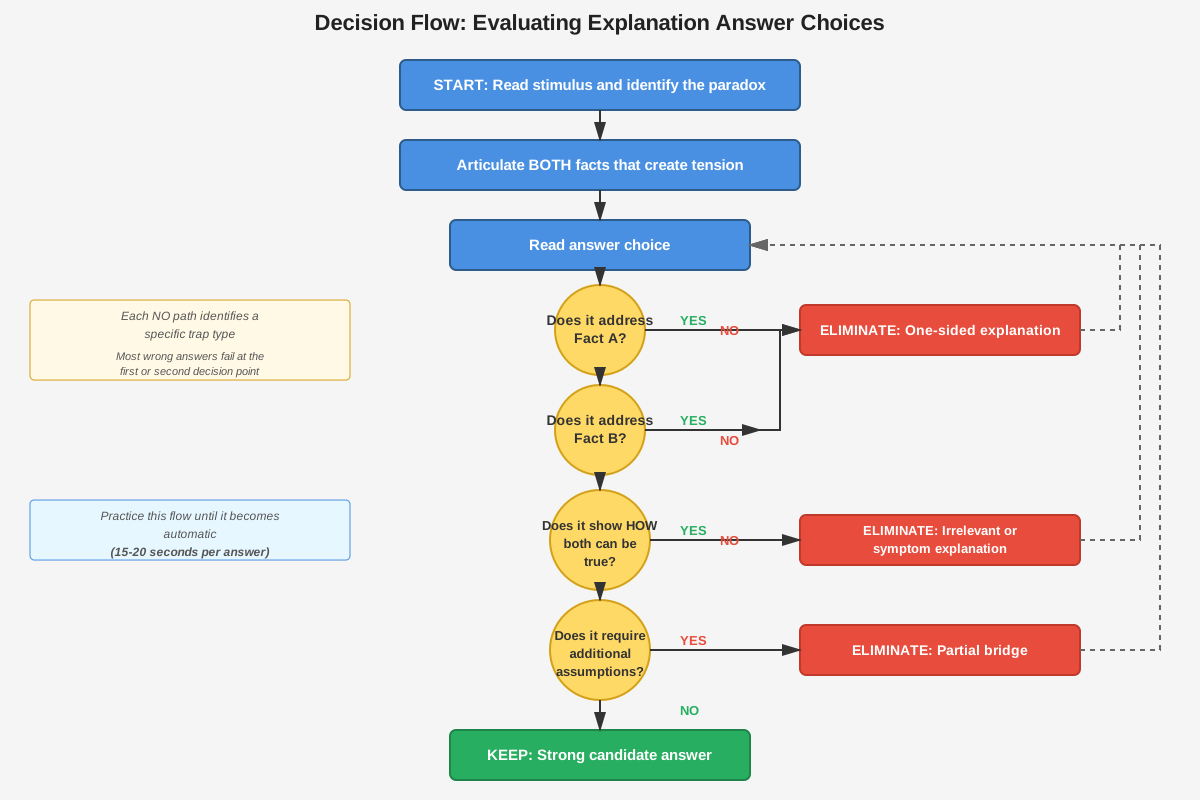
Process of elimination strategy: First pass, eliminate obvious relevance traps—answers that relate to the topic but don't address the specific relationship between facts. Second pass, eliminate partial explanations that address only one fact. Third pass, check remaining answers for temporal alignment and causal direction. Finally, verify the remaining answer(s) provide a mechanism, not just a symptom.
Watch for trap indicators: Answer choices that simply restate information from the stimulus in different words are usually wrong. Answers using extreme language ("only," "always," "never") are rarely correct. Answers that would be equally true whether the surprising fact occurred or not cannot explain that fact.
Time allocation: Spend 15-20 seconds fully understanding the paradox before reading answers. This upfront investment prevents re-reading and confusion. Spend 30-40 seconds on the first elimination pass, then 20-30 seconds comparing remaining choices. If stuck between two answers, check which one addresses both elements of the paradox more completely—that's almost always correct.
For difficult questions, use the "would this still be true if the opposite occurred?" test. If an answer choice would be equally valid whether the surprising fact happened or didn't happen, it can't explain that fact. This quickly eliminates relevance and scope traps.
Memory Techniques
TRAPS Acronym for checking answer choices:
- Timing: Does the temporal sequence align?
- Relevance: Does it address the specific relationship, not just the topic?
- All elements: Does it cover both facts in the paradox?
- Point: Does the causal arrow point the right direction?
- Symptom check: Does it explain why (mechanism) or just what (description)?
Visualization Strategy: Picture the paradox as two puzzle pieces that don't fit together. The correct explanation is the missing piece that makes them connect. Wrong answers are pieces from different puzzles—they might look similar but don't actually bridge the gap.
The "Both-And" Rule: Mentally insert "both...and" when reading the stimulus: "Both [Fact A] AND [Fact B] are true—how?" This reinforces that the correct answer must account for both facts simultaneously, preventing partial explanation errors.
Reverse Causation Check: Draw a simple arrow showing the assumed causal direction in the stimulus, then check if answer choices flip that arrow. If they do, they're likely traps unless the question specifically asks about reverse causation.
Scope Matching Mantra: "Same people, same place, same time." The correct explanation should match the population, location, and time period specified in the stimulus. Mismatches in any dimension signal potential traps.
Summary
Explanation answer traps represent sophisticated wrong answer choices designed to exploit common reasoning errors when test-takers attempt to resolve paradoxes or explain surprising phenomena. These traps succeed by creating the appearance of relevance through topical connection, partial reasoning, or familiar concepts while failing to address the specific logical relationship requiring explanation. The six primary trap types—relevance traps, partial explanations, reverse causation, symptom versus cause confusion, scope mismatches, and temporal misalignments—each exploit different aspects of the reasoning process. Mastering explanation questions requires systematic verification that answer choices address both elements of the paradox, provide causal mechanisms rather than mere descriptions, match the scope and timing of the stimulus, and point causal arrows in the correct direction. Success depends on distinguishing between answers that feel satisfying because they relate to the topic versus answers that actually resolve the logical tension by explaining how seemingly incompatible facts can coexist.
Key Takeaways
- Explanation questions require answers that reconcile both facts in a paradox, not just elaborate on one fact in isolation
- The most common trap involves topical relevance without logical relevance—answers that relate to the subject matter but don't explain the specific relationship between facts
- Correct explanations often introduce entirely new information not mentioned in the stimulus; this is expected and necessary
- Partial explanations that address only one element of the paradox are always wrong, even if they demonstrate valid causal reasoning
- Temporal sequence and causal direction must align with the stimulus; reverse causation and timing mismatches are frequent traps
- Distinguishing symptoms (what else is true) from causes (why it's true) is essential for avoiding descriptive traps
- Systematic checking using the TRAPS framework prevents falling for sophisticated wrong answers under time pressure
Related Topics
Paradox/Resolve Questions: These questions explicitly ask test-takers to resolve apparent contradictions and directly build on explanation trap recognition. Mastering explanation traps provides the foundation for consistently succeeding on resolve questions.
Strengthen and Weaken Questions: Understanding what genuinely explains a phenomenon versus what merely relates to it transfers directly to evaluating which answer choices actually strengthen or weaken arguments versus which just seem relevant.
Causal Reasoning and Correlation vs. Causation: Explanation questions frequently test the ability to distinguish genuine causal relationships from mere correlations, making this a natural progression for deeper study.
Necessary Assumption Questions: The skill of identifying what information is truly required (versus merely helpful) for an argument parallels the skill of identifying what information actually explains (versus merely relates to) a phenomenon.
Flaw Questions Involving Causal Reasoning: Many flaw questions present arguments that confuse correlation with causation or reverse causal direction—the same errors exploited by explanation answer traps.
Practice CTA
Now that you understand the sophisticated traps embedded in LSAT explanation questions, you're ready to apply this knowledge systematically. Attempt the practice questions for this topic, actively identifying which trap type each wrong answer represents. Use the TRAPS framework to check your reasoning on every question. Create flashcards for the six main trap types with examples from your practice to reinforce pattern recognition. Remember: recognizing these traps isn't just about avoiding wrong answers—it's about developing the precise analytical thinking that law school and legal practice demand. Each practice question you work through builds the neural pathways for rapid, accurate trap detection under exam pressure. You've got this!
Sign up free to keep reading
Create a free AnvayaPrep account to finish this LSAT guide on Explanation answer traps — plus flashcards and practice questions.