Overview
Reconciliation answer choices represent a critical question type within LSAT Logical Reasoning sections that tests a student's ability to resolve apparent contradictions or explain seemingly inconsistent facts. These questions present two statements or observations that appear to conflict with one another, and the correct answer provides information that explains how both statements can be true simultaneously. Unlike strengthen or weaken questions that ask test-takers to support or undermine an argument, reconciliation questions require identifying the missing piece of information that makes sense of an apparent paradox.
Mastering reconciliation answer choices is essential for LSAT success because these questions appear regularly throughout the Logical Reasoning sections and demand a sophisticated understanding of causation and explanation. Students must recognize that what appears contradictory on the surface often becomes coherent when additional context, distinctions, or mechanisms are introduced. The skill of reconciling apparent inconsistencies mirrors the analytical thinking required in legal reasoning, where attorneys must frequently explain how seemingly conflicting precedents, facts, or testimonies can coexist within a coherent framework.
Within the broader landscape of LSAT reconciliation answer choices and logical reasoning, this question type connects directly to causal reasoning, assumption identification, and inference questions. While assumption questions ask what must be true for an argument to work, reconciliation questions ask what would explain how two apparently conflicting observations can both be accurate. This distinction is subtle but crucial: reconciliation questions don't require proving an argument valid but rather demonstrating that no actual contradiction exists when properly understood.
Learning Objectives
- [ ] Identify how Reconciliation answer choices appears in LSAT questions
- [ ] Explain the reasoning pattern behind Reconciliation answer choices
- [ ] Apply Reconciliation answer choices to solve LSAT-style problems accurately
- [ ] Distinguish reconciliation questions from strengthen, weaken, and assumption questions
- [ ] Evaluate answer choices by determining whether they address both sides of the apparent contradiction
- [ ] Recognize common reconciliation mechanisms including scope distinctions, temporal differences, and causal pathways
Prerequisites
- Basic argument structure: Understanding premises and conclusions is necessary because reconciliation questions present factual claims that must be analyzed for their logical relationships
- Causal reasoning fundamentals: Recognizing cause-and-effect relationships helps identify how explanatory mechanisms resolve apparent contradictions
- Conditional logic basics: Understanding sufficient and necessary conditions aids in recognizing when two statements apply to different circumstances or populations
- Reading comprehension skills: Accurately parsing complex stimulus language ensures correct identification of what appears contradictory
Why This Topic Matters
Reconciliation questions test the fundamental legal skill of harmonizing apparently conflicting information—a daily requirement for attorneys who must reconcile competing testimonies, seemingly inconsistent statutes, or contradictory precedents. In legal practice, the ability to explain how two apparently conflicting facts can coexist often determines case outcomes. This makes reconciliation reasoning one of the most practically applicable skills tested on the LSAT.
From an exam perspective, reconciliation questions typically appear 2-4 times per LSAT administration across the two scored Logical Reasoning sections, making them a high-yield topic that can significantly impact overall scores. These questions often appear at medium to medium-high difficulty levels, serving as score differentiators between good and excellent performances. The LSAT frequently embeds reconciliation questions within passages about scientific studies, business scenarios, or social phenomena where statistical or observational data appears contradictory.
Common manifestations include: studies showing unexpected correlations (e.g., a medication that reduces symptoms but increases hospitalizations), business scenarios with paradoxical outcomes (e.g., increased advertising spending correlating with decreased sales), or social observations that defy intuition (e.g., a safety regulation that increases accident rates). Recognizing these patterns allows test-takers to quickly identify reconciliation questions and activate the appropriate analytical framework.
Core Concepts
The Structure of Reconciliation Questions
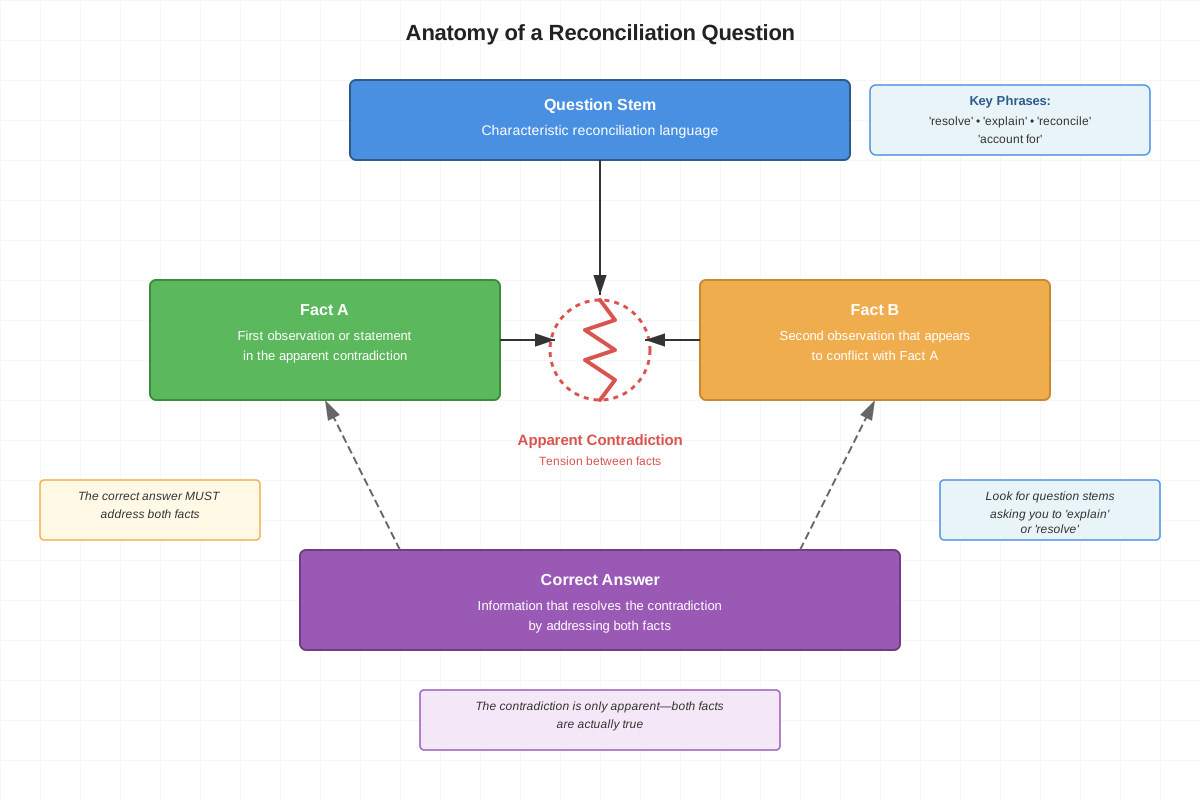
Reconciliation answer choices address questions that present an apparent paradox, discrepancy, or surprising result that requires explanation. The stimulus typically contains two factual statements that seem inconsistent or contradictory when considered together. The question stem explicitly asks which answer choice "resolves," "explains," or "reconciles" the apparent discrepancy. Common phrasings include: "Which one of the following, if true, most helps to resolve the apparent discrepancy?" or "Which one of the following, if true, most helps to explain the surprising result?"
The key structural element distinguishing reconciliation questions is that both statements in the stimulus are presented as facts—neither is an argument requiring support or attack. The test-taker must accept both statements as true and find the answer that explains how they can coexist without actual contradiction. This differs fundamentally from strengthen/weaken questions where the goal is to make an argument more or less persuasive.
The Reconciliation Mechanism
A successful reconciliation answer provides information that eliminates the apparent contradiction by revealing that the two statements actually address different situations, populations, time periods, or aspects of a phenomenon. The correct answer introduces a distinction or additional factor that shows why both observations can be simultaneously true.
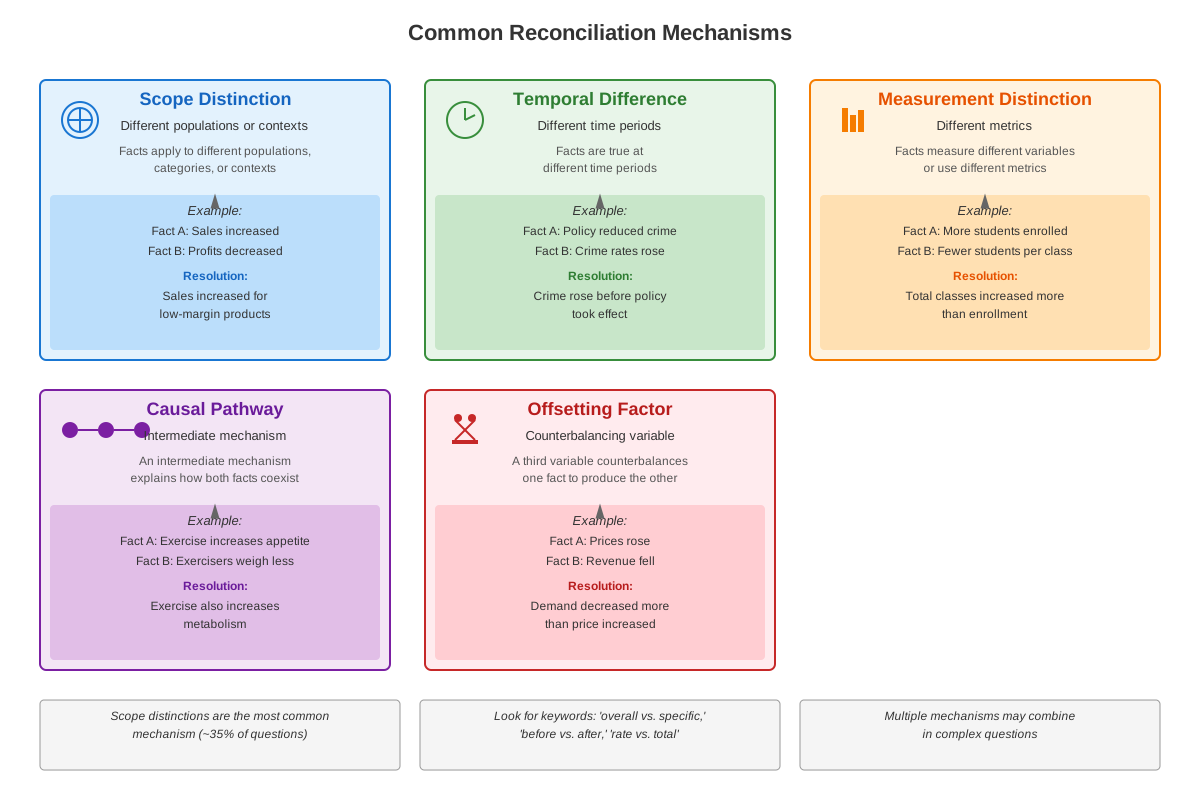
Common reconciliation mechanisms include:
- Scope distinctions: The two statements apply to different groups, categories, or contexts
- Temporal differences: The statements describe different time periods or stages
- Measurement differences: The statements use different metrics or standards
- Causal pathway clarification: Introducing an intermediate cause or confounding variable
- Definition refinement: Clarifying that key terms have different meanings in each statement
The Reconciliation Process
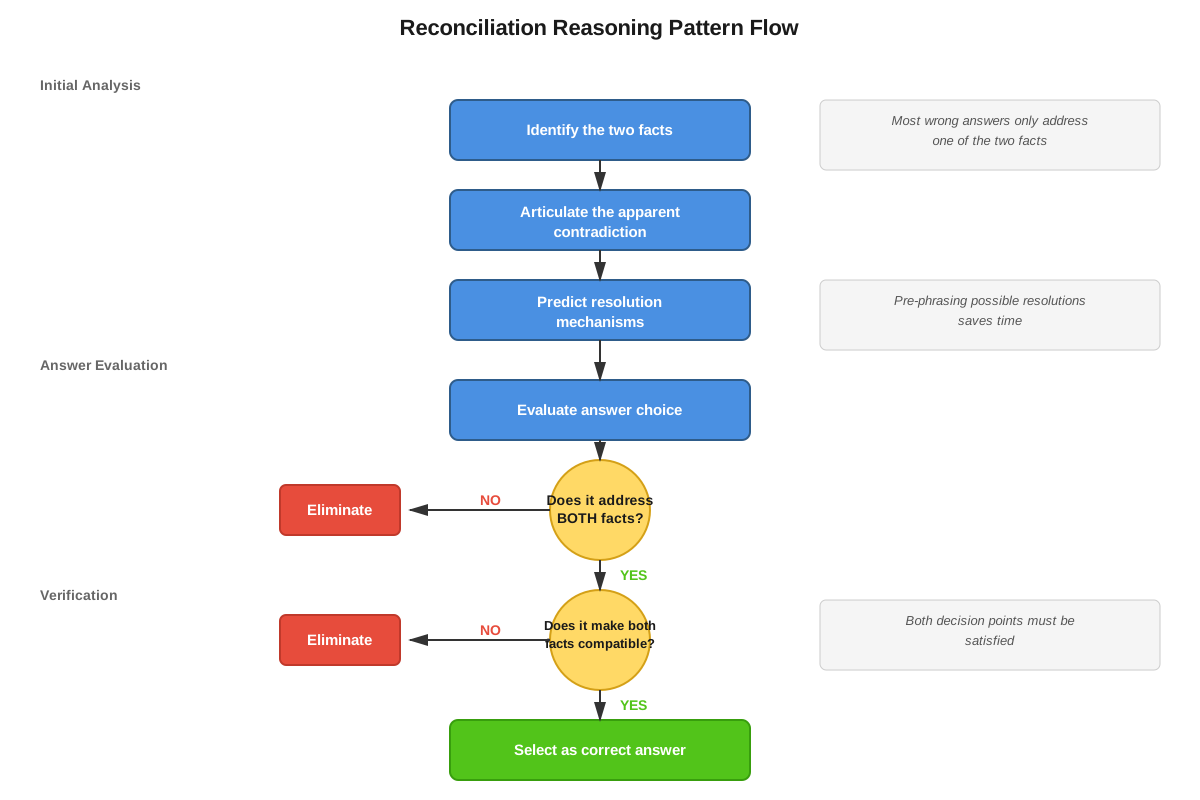
When approaching reconciliation questions, follow this systematic process:
- Identify the apparent contradiction: Clearly articulate what seems inconsistent between the two statements
- Determine what would need to be true: Consider what additional information would make both statements sensible
- Evaluate each answer choice: Test whether it addresses both sides of the discrepancy
- Eliminate non-reconcilers: Remove answers that address only one statement, introduce irrelevant information, or create new contradictions
The correct answer must be relevant to both statements. A common trap is selecting an answer that explains one observation but ignores the other, leaving the paradox unresolved.
Types of Apparent Contradictions
| Contradiction Type | Description | Example Pattern |
|---|---|---|
| Statistical Paradox | Data trends that seem to conflict | Increased safety measures correlate with more accidents |
| Causal Reversal | Expected cause-effect relationship appears inverted | Treatment associated with worse outcomes |
| Comparative Anomaly | Comparison yields unexpected result | Less expensive product has higher profit margin |
| Behavioral Inconsistency | Actions contradict stated preferences or logic | People choose option they claim to dislike |
| Temporal Inconsistency | Past and present observations conflict | Condition improved then worsened despite continued treatment |
Distinguishing Reconciliation from Related Question Types
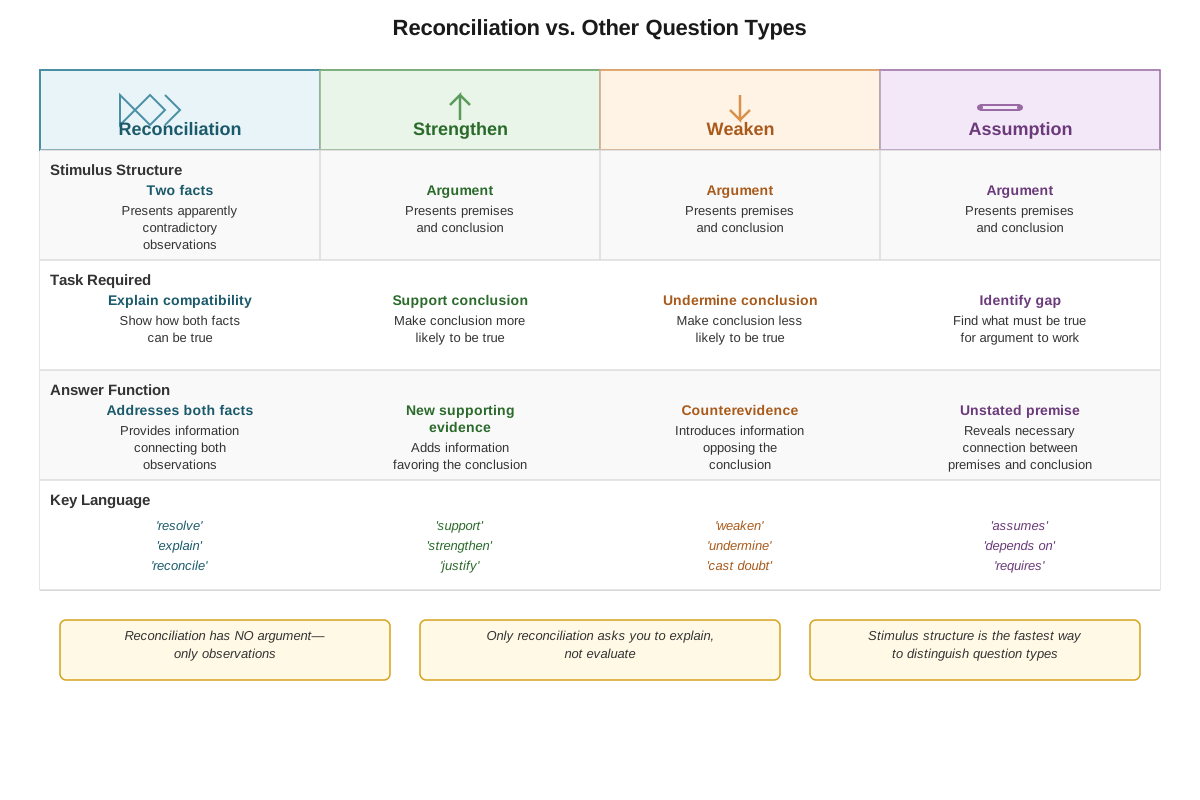
Reconciliation vs. Strengthen: Strengthen questions ask for evidence supporting an argument's conclusion, while reconciliation questions ask for information explaining how two facts can coexist. Strengthen questions have an argument structure (premises → conclusion); reconciliation questions present factual observations without argumentative claims.
Reconciliation vs. Assumption: Assumption questions identify unstated premises necessary for an argument's validity. Reconciliation questions don't involve arguments requiring assumptions but rather observations requiring explanation. The correct reconciliation answer provides sufficient information to resolve the paradox, not a necessary condition for an argument.
Reconciliation vs. Inference: Inference questions ask what must be true based on the stimulus. Reconciliation questions ask what would explain the stimulus. Inference answers are logically required by the given information; reconciliation answers introduce new information that makes sense of existing facts.
Concept Relationships
The core concepts within reconciliation questions form an interconnected analytical framework. The structure of reconciliation questions (presenting two apparently contradictory facts) necessitates understanding the reconciliation mechanism (how additional information resolves contradictions). This mechanism operates through the reconciliation process (systematic evaluation of answer choices), which requires recognizing different types of apparent contradictions to select appropriate resolution strategies.
These concepts connect to prerequisite knowledge of causation and explanation because reconciliation often involves clarifying causal relationships or introducing explanatory factors. Understanding argument structure helps distinguish reconciliation questions from other Logical Reasoning types, while conditional logic skills enable recognition of scope distinctions that frequently resolve apparent contradictions.
Relationship Map:
Apparent Contradiction (stimulus) → Reconciliation Mechanism (conceptual tool) → Reconciliation Process (application method) → Correct Answer (resolution) → Both Facts Explained (outcome)
This topic also connects forward to more advanced Logical Reasoning skills including parallel reasoning (recognizing analogous explanatory structures) and complex argumentation (managing multiple interacting claims).
High-Yield Facts
⭐ Reconciliation questions present two factual statements that appear contradictory but are both true; the correct answer explains how both can coexist
⭐ The correct answer must address BOTH sides of the apparent contradiction, not just explain one observation
⭐ Common reconciliation mechanisms include scope distinctions, temporal differences, and clarification of causal pathways
⭐ Question stems use specific language: "resolve," "explain," "reconcile," or "account for" the discrepancy or paradox
⭐ Unlike strengthen/weaken questions, reconciliation questions do not present arguments with conclusions to support or attack
- Reconciliation questions typically appear 2-4 times per LSAT administration
- The stimulus in reconciliation questions contains only factual observations, not argumentative reasoning
- Incorrect answers often explain only one statement while ignoring the other
- Temporal scope distinctions (before vs. after, short-term vs. long-term) frequently provide reconciliation
- Statistical reconciliations often involve clarifying what population or metric is being measured
- The correct answer introduces NEW information not stated in the stimulus
- Reconciliation answers need not prove the statements are true, only explain how they could both be true
Quick check — test yourself on Reconciliation answer choices so far.
Try Flashcards →Common Misconceptions
Misconception: Reconciliation questions ask which answer choice proves both statements are true → Correction: Reconciliation questions assume both statements ARE true and ask what explains how they can coexist; the answer doesn't prove truth but provides explanatory coherence
Misconception: An answer that explains one of the two observations is sufficient → Correction: The correct answer must address both sides of the apparent contradiction; explaining only one statement leaves the paradox unresolved
Misconception: Reconciliation questions are the same as strengthen questions → Correction: Strengthen questions support an argument's conclusion with additional evidence, while reconciliation questions explain how two factual observations can both be accurate without any argument being present
Misconception: The correct answer must eliminate all possible doubt about the situation → Correction: The correct answer need only provide a plausible explanation that makes both statements coherent; it doesn't require proving this is the only possible explanation
Misconception: Reconciliation answers should restate information from the stimulus → Correction: Effective reconciliation answers introduce NEW information that wasn't in the stimulus; merely restating given facts cannot resolve an apparent contradiction
Misconception: Complex or technical-sounding answers are more likely correct → Correction: The correct answer is the one that most directly addresses both observations, regardless of complexity; LSAT often uses technical language in wrong answers to distract from their logical inadequacy
Worked Examples
Example 1: Medical Study Paradox
Stimulus: A recent study found that patients who received a new blood pressure medication had significantly lower blood pressure readings than those who received a placebo. However, the same study found that patients receiving the medication were hospitalized for cardiovascular events at a higher rate than those receiving the placebo.
Question: Which one of the following, if true, most helps to resolve the apparent discrepancy?
Answer Choices:
(A) The medication was more expensive than standard blood pressure treatments
(B) Patients with the most severe hypertension were more likely to be prescribed the medication
(C) The medication lowered blood pressure by dilating blood vessels
(D) Some patients in the placebo group also experienced reduced blood pressure
(E) The medication had been tested in previous studies with similar results
Analysis:
First, identify the apparent contradiction: The medication successfully lowers blood pressure (positive outcome) but is associated with more hospitalizations (negative outcome). This seems paradoxical because lower blood pressure should reduce cardiovascular events.
What would reconcile this? We need information explaining why the medication could lower blood pressure yet still correlate with more hospitalizations.
Evaluating each choice:
(A) Cost information is irrelevant to the medical outcomes described. This doesn't address why the medication both helps and harms. Eliminate.
(B) This introduces a crucial distinction: if patients with more severe hypertension received the medication, they might have been at higher baseline risk for cardiovascular events. The medication lowered their blood pressure, but their underlying condition still made them more likely to be hospitalized than the healthier placebo group. This addresses both observations: the medication works (lowers BP) AND hospitalizations are higher (because the treatment group was sicker to begin with). Strong candidate.
(C) This explains the mechanism by which the medication lowers blood pressure but doesn't address why hospitalizations increased. It only explains one side. Eliminate.
(D) This weakens the finding about the medication's effectiveness but doesn't explain the hospitalization discrepancy. Eliminate.
(E) This confirms the pattern but doesn't explain it. Repetition isn't reconciliation. Eliminate.
Correct Answer: (B)
This example demonstrates the scope distinction reconciliation mechanism: the two groups being compared differed in a relevant way (disease severity) that explains the apparent paradox.
Example 2: Business Paradox
Stimulus: Company X increased its advertising budget by 40% last year. Despite this substantial increase in advertising spending, the company's sales declined by 15% during the same period.
Question: Which one of the following, if true, most helps to explain the surprising result?
Answer Choices:
(A) Company X's main competitor decreased its advertising spending during the same period
(B) The overall market for Company X's products contracted by 30% last year
(C) Company X's advertising campaign won several industry awards
(D) Advertising costs increased across all media platforms last year
(E) Company X had increased its advertising budget in previous years as well
Analysis:
The apparent contradiction: More advertising (which should increase sales) coincided with decreased sales. This defies the expected positive relationship between advertising and sales.
What would reconcile this? Information showing why increased advertising could occur alongside decreased sales without contradiction.
Evaluating each choice:
(A) If the competitor decreased advertising, Company X should have gained market share, making the sales decline even more puzzling. This deepens rather than resolves the paradox. Eliminate.
(B) If the overall market contracted by 30%, Company X's 15% decline actually represents relative success—they lost less market share than the overall market decline would predict. The increased advertising may have prevented an even steeper decline. This reconciles both facts: advertising increased AND sales declined, but the decline would have been worse without the advertising given the market contraction. Strong candidate.
(C) Awards indicate advertising quality but don't explain why sales declined despite increased spending. Eliminate.
(D) This explains why Company X might have spent more (costs rose) but doesn't address the sales decline. Eliminate.
(E) Past patterns don't explain the current paradox. Eliminate.
Correct Answer: (B)
This example illustrates contextual information as a reconciliation mechanism: introducing broader market conditions that reframe the relationship between the two observations.
Exam Strategy
When approaching reconciliation questions on the LSAT, implement this strategic framework:
Recognition Phase: Identify reconciliation questions through trigger language in the question stem. Watch for: "resolve the apparent discrepancy," "explain the surprising result," "reconcile the apparent paradox," "account for the discrepancy," or "explain the unexpected finding." These phrases signal that you're dealing with reconciliation rather than strengthen, weaken, or assumption questions.
Analysis Phase: Before examining answer choices, invest 15-20 seconds clearly articulating the apparent contradiction. Ask yourself: "What seems inconsistent here?" and "What would need to be true for both statements to make sense together?" This pre-thinking prevents falling for attractive wrong answers that only address one side.
Elimination Strategy:
- Eliminate one-sided answers first: Any choice that explains only one observation without addressing the other cannot reconcile the paradox
- Remove irrelevant information: Answers introducing facts unrelated to either observation are distractors
- Reject contradiction-deepeners: Some wrong answers actually make the paradox worse rather than resolving it
- Watch for scope mismatches: Answers that discuss different populations, time periods, or contexts than those in the stimulus typically fail to reconcile
Time Management: Allocate approximately 1:15-1:30 for reconciliation questions. They require careful analysis but shouldn't consume excessive time. If stuck between two answers, ask: "Which one addresses BOTH observations more directly?"
Exam Tip: The correct reconciliation answer often introduces a distinction (different groups, time periods, or measurements) that wasn't explicit in the stimulus. Train yourself to recognize when answer choices create meaningful distinctions versus irrelevant ones.
Process of Elimination Power Move: After reading the stimulus, predict the type of reconciliation mechanism needed (scope distinction, temporal difference, causal clarification, etc.). This prediction helps quickly eliminate answers using wrong mechanisms.
Memory Techniques
BOTH Mnemonic: When evaluating reconciliation answers, remember BOTH:
- Both observations must be addressed
- Observations are facts, not arguments
- Two-sided explanation required
- How can both be true simultaneously?
The Bridge Visualization: Picture the two apparently contradictory statements as opposite riverbanks. The correct answer is the bridge connecting them. Wrong answers are either boats that only reach one bank, bridges to nowhere (irrelevant), or bridges that collapse (create new contradictions).
RED FLAG Acronym for wrong answers:
- Repetition of stimulus facts without new information
- Explains only one side
- Deepens the contradiction
- Foreign to both observations
- Lacks logical connection
- Assumes what needs explanation
- Generalizes beyond the scope
The "Different Buckets" Mental Model: Many reconciliations work by showing the two observations apply to different "buckets" (populations, times, contexts). When stuck, ask: "What different buckets would make both true?"
Summary
Reconciliation answer choices represent a distinctive LSAT Logical Reasoning question type that tests the ability to explain apparent contradictions between factual observations. Unlike strengthen or weaken questions that evaluate arguments, reconciliation questions present two seemingly inconsistent facts and ask which answer choice explains how both can be true simultaneously. The correct answer introduces new information—typically a scope distinction, temporal difference, measurement clarification, or causal pathway—that eliminates the apparent paradox. Success requires recognizing that both statements must be addressed, identifying the type of contradiction present, and systematically eliminating answers that explain only one observation, introduce irrelevant information, or deepen rather than resolve the discrepancy. Mastering reconciliation questions demands understanding that what appears contradictory often becomes coherent when proper context, distinctions, or mechanisms are introduced—a fundamental skill in legal reasoning and a high-yield topic for LSAT performance.
Key Takeaways
- Reconciliation questions present two factual observations that appear contradictory; the correct answer explains how both can be true
- The correct answer MUST address both sides of the apparent contradiction, not just one observation
- Common reconciliation mechanisms include scope distinctions, temporal differences, and causal clarifications
- Reconciliation differs from strengthen/weaken questions because it involves factual observations, not arguments with conclusions
- Question stems use specific trigger language: "resolve," "explain," "reconcile," or "account for" the discrepancy
- Wrong answers typically explain only one side, introduce irrelevant information, or deepen the contradiction
- Effective strategy involves pre-thinking what type of information would reconcile the paradox before evaluating answer choices
Related Topics
Strengthen and Weaken Questions: Understanding how to support or undermine arguments builds the analytical foundation for recognizing what reconciliation questions require differently—explanation rather than evidential support.
Causal Reasoning: Many reconciliation questions involve clarifying causal relationships or introducing confounding variables, making advanced causal reasoning skills essential for handling complex reconciliation scenarios.
Assumption Questions: While distinct from reconciliation, assumption questions develop the skill of identifying missing logical connections, which translates to recognizing what information would bridge apparent contradictions.
Inference Questions: Mastering reconciliation enhances inference skills by training recognition of what additional information makes given facts coherent, supporting the ability to draw valid conclusions.
Practice CTA
Now that you've mastered the conceptual framework for reconciliation answer choices, it's time to cement your understanding through active practice. Attempt the practice questions designed specifically for this topic, paying careful attention to identifying both sides of each apparent contradiction before evaluating answer choices. Use the flashcards to reinforce recognition of reconciliation mechanisms and trigger language. Remember: reconciliation questions are high-yield score improvers because they reward systematic analysis over intuition. Each practice question you complete strengthens the analytical patterns that will serve you throughout the Logical Reasoning sections. You've built the foundation—now apply it with confidence!
Sign up free to keep reading
Create a free AnvayaPrep account to finish this LSAT guide on Reconciliation answer choices — plus flashcards and practice questions.