Overview
The unexpected result is a fundamental reasoning pattern that appears frequently in LSAT Logical Reasoning questions, particularly within the domain of causation and explanation. This pattern presents a scenario where an action, intervention, or condition produces an outcome that contradicts what was anticipated based on prior knowledge, established theories, or common assumptions. Understanding how to identify, analyze, and resolve these apparent contradoxes is essential for success on the LSAT.
On the LSAT, unexpected result questions typically present a puzzle: something happened that shouldn't have happened, or something didn't happen that should have. The test-taker must then identify which answer choice best explains, resolves, or accounts for this discrepancy. These questions test the ability to think critically about causal relationships, recognize hidden variables, and understand that initial assumptions may be incomplete or flawed. The pattern appears most commonly in Resolve/Explain questions, but also surfaces in Strengthen, Weaken, and Assumption questions where understanding the gap between expectation and reality is crucial.
Mastering the lsat unexpected result pattern strengthens overall performance in Logical Reasoning by developing skills in causal analysis, hypothesis testing, and recognizing alternative explanations. This topic connects directly to broader concepts in causation and explanation, including correlation versus causation, necessary and sufficient conditions, and the identification of confounding variables. Students who excel at unexpected result questions demonstrate sophisticated reasoning abilities that extend beyond pattern recognition to genuine analytical thinking.
Learning Objectives
- [ ] Identify how Unexpected result appears in LSAT questions
- [ ] Explain the reasoning pattern behind Unexpected result
- [ ] Apply Unexpected result to solve LSAT-style problems accurately
- [ ] Distinguish between genuine unexpected results and merely surprising outcomes
- [ ] Generate multiple plausible explanations for a given unexpected result
- [ ] Evaluate the strength of competing explanations for discrepancies between expectation and reality
- [ ] Recognize the role of hidden assumptions in creating apparent paradoxes
Prerequisites
- Basic understanding of causal reasoning: Necessary to distinguish between correlation and causation, which forms the foundation for understanding why results may appear unexpected when causal assumptions are incorrect.
- Familiarity with argument structure: Required to identify premises, conclusions, and the logical relationships between them in passages presenting unexpected outcomes.
- Knowledge of necessary and sufficient conditions: Essential for understanding when an expected cause fails to produce its typical effect or when an effect occurs without its presumed cause.
- Ability to identify assumptions: Critical for recognizing what unstated beliefs create the expectation that a particular result contradicts.
Why This Topic Matters
In real-world contexts, unexpected results drive scientific discovery, policy revision, and problem-solving across all domains. When medical treatments produce counterintuitive outcomes, when economic policies fail to achieve predicted results, or when social interventions have unintended consequences, the ability to analyze and explain these discrepancies becomes invaluable. This reasoning pattern reflects how experts in any field must reconcile theory with observation and revise understanding when reality contradicts prediction.
On the LSAT, unexpected result questions appear with high frequency, comprising approximately 10-15% of all Logical Reasoning questions across both sections. They most commonly appear as Resolve/Explain questions (also called "Paradox" questions), but the underlying pattern also appears in Strengthen questions where the correct answer must account for an apparent anomaly, and in Weaken questions where introducing an unexpected result undermines an argument. According to LSAC data, these questions have a moderate-to-high difficulty rating, with many test-takers struggling because they fail to identify the precise nature of the discrepancy or select answers that address only part of the puzzle.
The pattern typically appears in passages discussing scientific studies, business outcomes, policy implementations, or historical events where observed results contradict theoretical predictions or common sense expectations. The LSAT favors scenarios involving human behavior, economic trends, environmental phenomena, and technological implementations—contexts where multiple variables interact in complex ways, creating opportunities for unexpected outcomes.
Core Concepts
The Structure of Unexpected Result Arguments
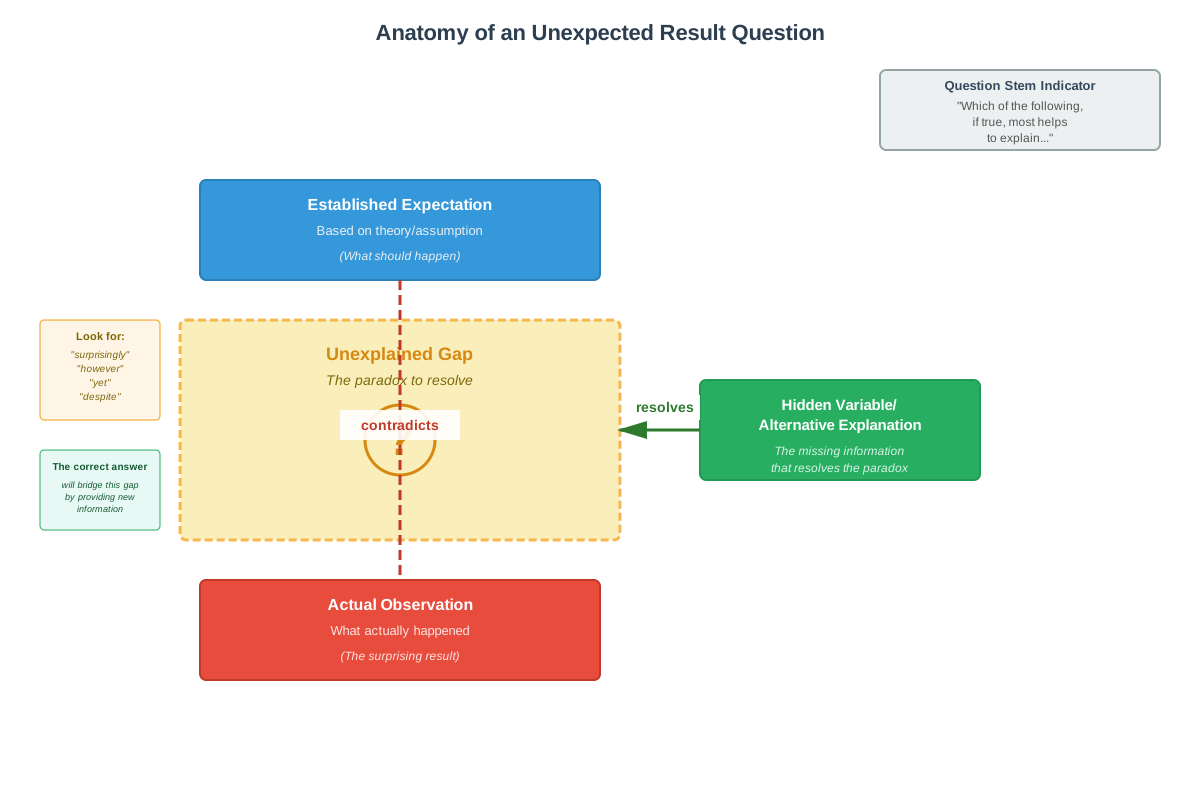
An unexpected result argument follows a consistent three-part structure that test-takers must recognize instantly. First, the passage establishes an expectation based on a theory, prior observation, or common assumption. This expectation represents what should happen under normal circumstances or according to conventional understanding. Second, the passage presents an observation that contradicts this expectation—the actual result that occurred. Third, either explicitly or implicitly, the passage identifies a discrepancy or gap between what was expected and what actually happened.
For example, a passage might establish that increasing the price of a product typically reduces demand (expectation), then note that a particular store raised prices and saw demand increase (observation), creating a discrepancy that requires explanation. The key to mastering these questions lies in precisely identifying what was expected, what actually occurred, and why these two facts appear contradictory.
Types of Unexpected Results
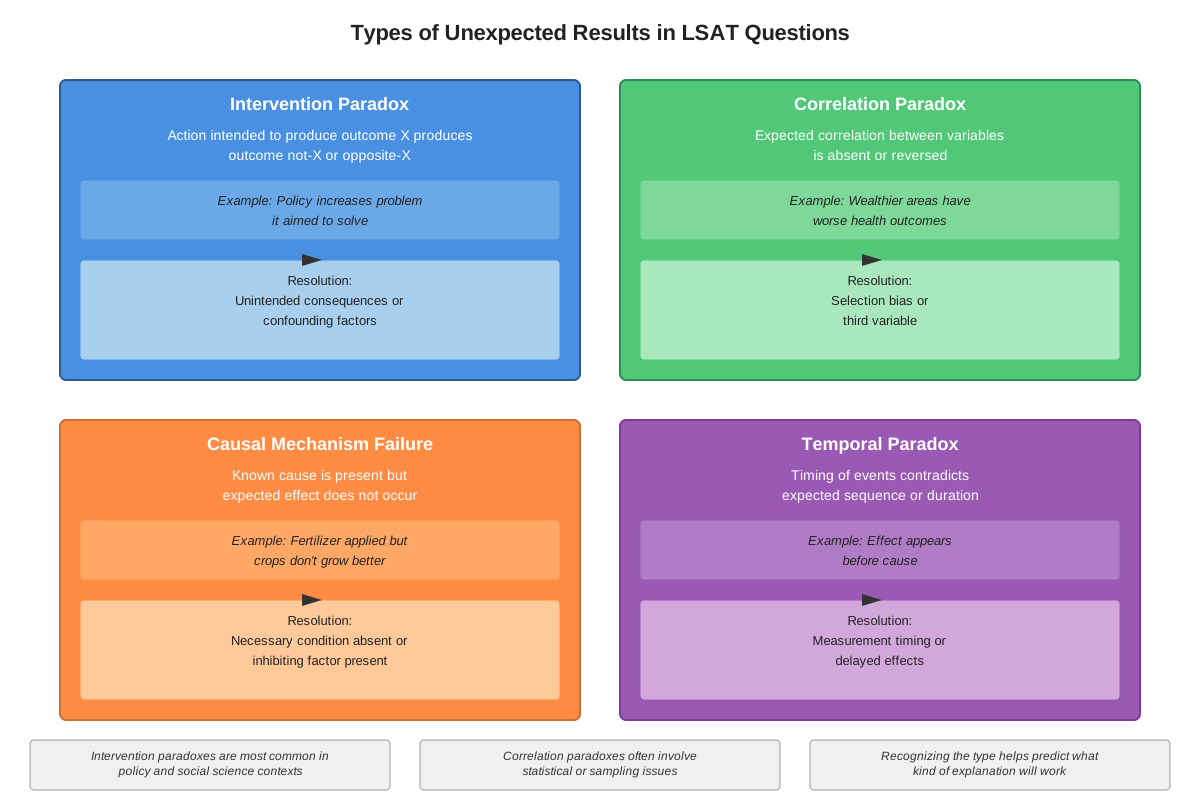
The LSAT presents several distinct categories of unexpected results, each requiring slightly different analytical approaches:
Intervention Paradoxes: An action taken to achieve a specific goal produces the opposite effect or no effect at all. Example: A city implements traffic calming measures to reduce accidents, but accident rates increase. The resolution typically involves identifying an unintended consequence of the intervention or a confounding variable that the intervention inadvertently affected.
Correlation Reversals: Two variables that typically correlate in one direction show the opposite relationship in a specific case. Example: Education level usually correlates with higher income, but in a particular region, more educated workers earn less. The explanation often involves a third variable that affects both factors or a special circumstance that disrupts the normal relationship.
Temporal Anomalies: A pattern that holds over time suddenly reverses or disappears. Example: A species population that has been declining for decades suddenly increases despite continued habitat loss. The resolution frequently involves identifying a recent change in conditions or the crossing of a critical threshold.
Comparative Discrepancies: Two similar cases produce different outcomes despite apparently identical conditions. Example: Two cities implement the same public health program, but only one sees improvement. The explanation typically reveals a hidden difference between the cases that wasn't initially apparent.
The Role of Hidden Assumptions
Every unexpected result rests on at least one hidden assumption that, when revealed, explains why the result appeared unexpected. These assumptions fall into several categories:
| Assumption Type | Description | Example |
|---|---|---|
| Ceteris Paribus | Assumes all other factors remain constant | Assuming price is the only factor affecting demand |
| Completeness | Assumes all relevant factors have been considered | Overlooking a competing cause |
| Uniformity | Assumes conditions are uniform across cases | Assuming all members of a group are identical |
| Temporal Stability | Assumes conditions haven't changed over time | Assuming past patterns will continue |
| Measurement Accuracy | Assumes observations are accurate and complete | Overlooking measurement errors or selection bias |
Identifying which assumption created the expectation is crucial for evaluating potential explanations. The correct answer on the LSAT will typically reveal or correct the flawed assumption that made the result seem unexpected.
Criteria for Strong Explanations
Not all explanations for unexpected results are equally valid. The LSAT tests the ability to distinguish strong explanations from weak ones using specific criteria:
- Completeness: A strong explanation accounts for both sides of the discrepancy—why the expected result didn't occur AND why the actual result did occur
- Specificity: The explanation must address the particular circumstances of the case, not just provide a general possibility
- Sufficiency: The explanation must be adequate to fully resolve the discrepancy without requiring additional unstated assumptions
- Consistency: The explanation cannot contradict any facts stated in the passage
- Parsimony: When multiple explanations are possible, simpler explanations that require fewer additional assumptions are preferred
Common Resolution Mechanisms
The LSAT employs recurring mechanisms to resolve unexpected results. Recognizing these patterns accelerates question analysis:
Confounding Variables: A third factor affects both the presumed cause and the effect, creating a spurious relationship. The unexpected result occurs because the confounding variable was overlooked.
Threshold Effects: A relationship holds only above or below a certain level. The unexpected result occurs because a critical threshold was crossed.
Compensating Factors: Multiple causes operate simultaneously, with some producing opposite effects. The unexpected result reflects the net effect of competing forces.
Selection Bias: The sample or population observed differs systematically from the general case. The unexpected result occurs because the observed group is atypical.
Temporal Lag: Causes and effects operate on different timescales. The unexpected result occurs because insufficient time has passed for the expected effect to manifest.
Measurement Issues: The observation method itself affects the outcome or fails to capture the true effect. The unexpected result reflects measurement problems rather than genuine anomalies.
Concept Relationships
The unexpected result pattern connects intimately with other causation and explanation concepts. Causal reasoning forms the foundation: unexpected results arise when causal assumptions prove incorrect or incomplete. Understanding necessary and sufficient conditions helps identify when an expected cause fails to produce its effect (questioning sufficiency) or when an effect occurs without its presumed cause (questioning necessity).
The pattern also relates to correlation versus causation: many unexpected results occur because an assumed causal relationship was actually mere correlation, with both variables driven by a hidden third factor. Alternative explanations become crucial when multiple potential resolutions exist for the same discrepancy—the LSAT tests the ability to identify which explanation best accounts for all the facts.
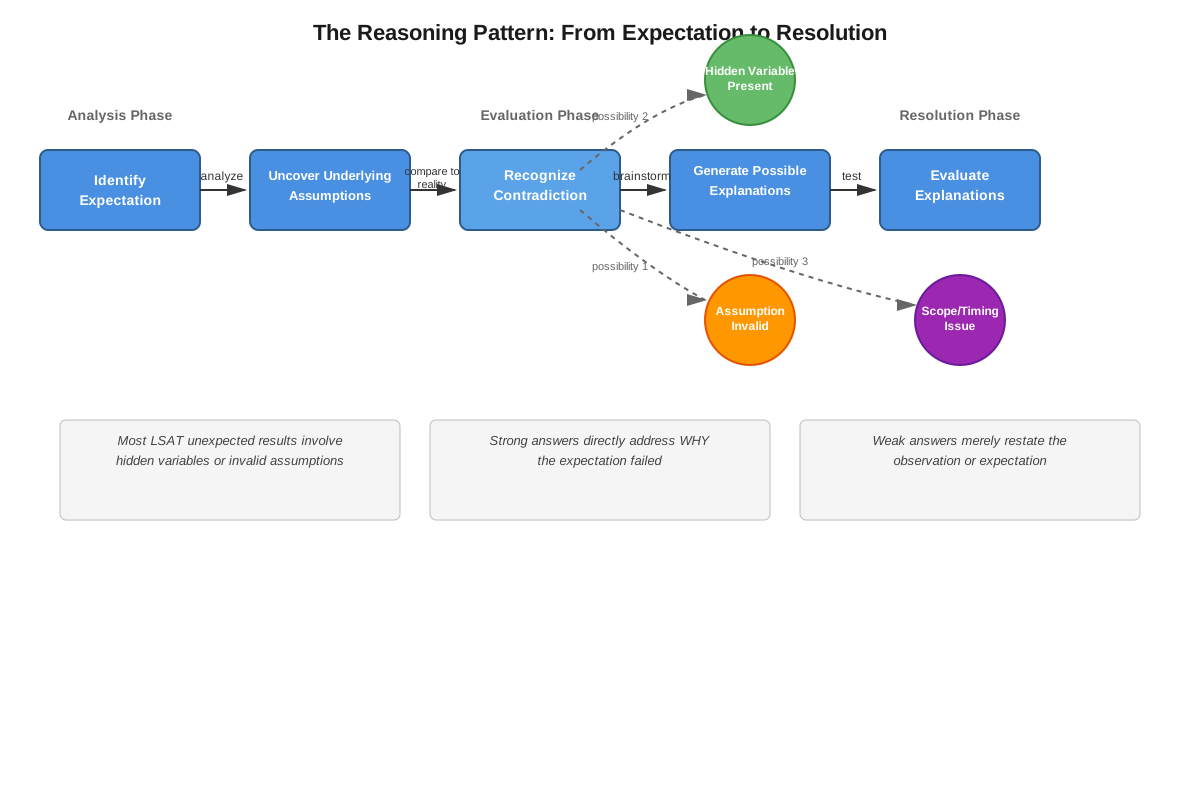
Within the topic itself, concepts flow logically: Identifying the structure of unexpected result arguments → Recognizing the type of unexpected result → Identifying hidden assumptions → Evaluating potential explanations → Selecting the strongest resolution. Each step builds on the previous one, creating a systematic approach to these questions.
The relationship map flows as follows: Hidden Assumptions → Create Expectations → Which conflict with Observations → Producing Unexpected Results → Requiring Explanations → That reveal Confounding Variables or Measurement Issues → Which resolve the Discrepancy.
High-Yield Facts
⭐ Unexpected result questions always involve a discrepancy between what was expected and what actually occurred—identify both elements explicitly before evaluating answer choices.
⭐ The correct explanation must account for BOTH why the expected result didn't happen AND why the actual result did happen—partial explanations are always wrong.
⭐ Most unexpected results stem from hidden assumptions about ceteris paribus conditions—look for overlooked variables that affect the outcome.
⭐ Confounding variables are the most common resolution mechanism on the LSAT—a third factor that affects both the presumed cause and the observed effect.
⭐ Selection bias frequently explains comparative discrepancies—the observed group differs systematically from the general population.
- Temporal lag effects can make interventions appear ineffective when insufficient time has passed for results to manifest.
- Threshold effects explain why relationships that hold generally fail in specific cases—the case falls above or below a critical level.
- Measurement issues can create apparent unexpected results when the observation method itself affects outcomes or captures incomplete data.
- Compensating factors explain why an intervention produces no net effect—opposing forces cancel each other out.
- The strength of an explanation depends on how few additional assumptions it requires—parsimony matters on the LSAT.
Quick check — test yourself on Unexpected result so far.
Try Flashcards →Common Misconceptions
Misconception: Any surprising or unusual outcome qualifies as an unexpected result. → Correction: An unexpected result specifically requires a contradiction between a theoretically grounded expectation and an observed outcome. Mere surprise or rarity doesn't create the logical structure these questions test. The expectation must be based on a stated or implied principle, not just personal intuition.
Misconception: The correct answer only needs to explain why the unexpected result occurred. → Correction: Strong explanations must account for both sides of the discrepancy—why the expected result failed to occur AND why the actual result happened instead. Answers that address only one side leave the paradox partially unresolved.
Misconception: If an answer choice is factually possible, it's a good explanation. → Correction: Possibility is insufficient; the explanation must be specifically relevant to the circumstances described and sufficient to fully resolve the discrepancy without requiring additional unstated assumptions. The LSAT tests the ability to distinguish adequate explanations from merely possible ones.
Misconception: More complex explanations are more sophisticated and therefore better. → Correction: The LSAT favors parsimonious explanations that require fewer additional assumptions. Overly complex explanations that introduce multiple new factors are typically incorrect. The principle of Occam's Razor applies—simpler explanations that adequately resolve the discrepancy are preferred.
Misconception: Unexpected results indicate that the original theory or expectation was completely wrong. → Correction: Most unexpected results reveal incomplete understanding rather than fundamental error. The original expectation may be correct under most circumstances but fail in specific cases due to additional factors. The resolution typically refines rather than replaces the original understanding.
Misconception: Statistical outliers and unexpected results are the same thing. → Correction: Statistical outliers are extreme values within an expected distribution, while unexpected results contradict the predicted pattern entirely. An outlier might be rare but still consistent with theory; an unexpected result violates theoretical predictions regardless of frequency.
Worked Examples
Example 1: The Exercise Paradox
Passage: Studies consistently show that regular exercise reduces stress levels. However, a recent survey of corporate executives found that those who exercised more frequently reported higher stress levels than those who exercised less frequently. Which of the following, if true, best explains this unexpected result?
Analysis:
Step 1 - Identify the expectation: Regular exercise reduces stress levels (based on consistent study findings).
Step 2 - Identify the observation: Among corporate executives, more frequent exercisers reported higher stress.
Step 3 - Identify the discrepancy: The expected negative correlation between exercise and stress is reversed in this population.
Step 4 - Evaluate answer choices (hypothetical):
(A) "Corporate executives who experience higher stress are more likely to take up exercise as a coping mechanism."
- This explains why high-stress executives exercise more (addressing the observation) AND why the expected stress-reducing effect isn't visible (the stress preceded the exercise). This accounts for both sides of the discrepancy through a confounding variable (pre-existing stress levels that drive both exercise behavior and reported stress). This is likely correct.
(B) "Exercise reduces stress only when performed for at least 30 minutes per session."
- This addresses why exercise might not reduce stress but doesn't explain why exercisers report HIGHER stress. Partial explanation—incorrect.
(C) "Corporate executives generally have higher stress levels than the general population."
- This is irrelevant to the comparison between executives who exercise more versus less. Doesn't address the discrepancy—incorrect.
(D) "Some forms of exercise are more effective at reducing stress than others."
- This might explain variation in effectiveness but doesn't explain the reversed correlation. Doesn't resolve the paradox—incorrect.
Correct Answer: (A) demonstrates the classic selection bias resolution—the group that exercises more differs systematically from the group that exercises less in a way that affects the outcome. The pre-existing stress level is the hidden variable that explains the unexpected result.
Example 2: The Advertising Anomaly
Passage: Economic theory predicts that increased advertising expenditure leads to increased sales. However, when Company X doubled its advertising budget last quarter, sales actually declined by 15%. Which of the following, if true, most helps to resolve this apparent discrepancy?
Analysis:
Step 1 - Identify the expectation: Increased advertising should increase sales (based on economic theory).
Step 2 - Identify the observation: Company X doubled advertising but sales declined.
Step 3 - Identify the discrepancy: The expected positive effect of advertising not only failed to occur but the opposite happened.
Step 4 - Evaluate answer choices (hypothetical):
(A) "Company X's main competitor launched a superior product during the same quarter."
- This explains why sales declined (competing factor) but also implicitly explains why advertising didn't help (the competitor's advantage overwhelmed advertising effects). This introduces a compensating factor that more than offset the positive effect of advertising. Strong candidate.
(B) "Company X's advertising campaign was poorly designed and ineffective."
- This might explain why advertising didn't increase sales, but doesn't explain why sales actively DECLINED. The company would have been no worse off than before. Partial explanation—incorrect.
(C) "Advertising effects typically take several quarters to fully manifest."
- This is a temporal lag explanation that might explain why sales haven't increased YET, but doesn't explain why they declined. Doesn't resolve the paradox—incorrect.
(D) "Company X operates in a highly competitive market."
- This provides general context but doesn't specifically explain the timing or magnitude of the sales decline. Too vague—incorrect.
Correct Answer: (A) provides a complete resolution by identifying a confounding variable (competitor's product launch) that both explains the sales decline and accounts for why increased advertising couldn't prevent it. The unexpected result occurs because multiple causal forces operated simultaneously, with the negative force overwhelming the positive one.
Exam Strategy
When approaching unexpected result questions on the LSAT, follow this systematic process:
Step 1 - Identify the Question Type: Look for trigger phrases such as "resolve the discrepancy," "explain the unexpected result," "account for the apparent paradox," or "reconcile the findings." These signal that the passage will present conflicting information requiring explanation.
Step 2 - Map the Discrepancy: Before reading answer choices, explicitly identify: (a) What was expected and why, (b) What actually occurred, and (c) Why these conflict. Write brief notes if time permits. This prevents confusion when evaluating answers.
Step 3 - Predict the Resolution Type: Based on the context, anticipate whether the resolution likely involves a confounding variable, selection bias, temporal lag, threshold effect, or measurement issue. This prediction accelerates answer evaluation.
Step 4 - Apply the Completeness Test: Eliminate any answer choice that addresses only one side of the discrepancy. The correct answer must explain both why the expected result didn't occur AND why the actual result did occur.
Step 5 - Check for Additional Assumptions: Eliminate answers that require unstated assumptions to work. The explanation should be self-sufficient given the facts in the passage.
Exam Tip: Watch for answer choices that are factually true but logically irrelevant. The LSAT frequently includes answers that relate to the topic but don't actually resolve the specific discrepancy presented.
Time Allocation: Allocate 1:15-1:30 for unexpected result questions. They require careful analysis but shouldn't consume excessive time. If stuck between two answers, choose the one that requires fewer additional assumptions.
Process of Elimination Strategy:
- First pass: Eliminate answers that address only one side of the discrepancy
- Second pass: Eliminate answers that are too vague or general
- Third pass: Between remaining answers, choose the more parsimonious explanation
Red Flag Phrases: Be cautious of answer choices containing "might," "could," or "possibly" without specific mechanisms. These signal weak explanations that rely on mere possibility rather than adequate resolution.
Memory Techniques
CURE Acronym for evaluating explanations:
- Complete: Addresses both sides of the discrepancy
- Unique: Specific to the circumstances described
- Relevant: Directly addresses the logical gap
- Economical: Requires minimal additional assumptions
The Two-Sided Coin Visualization: Picture the unexpected result as a coin with two faces—one showing what was expected, one showing what occurred. The correct explanation must account for both faces simultaneously. If an answer only explains one face, flip the coin and ask whether it explains the other side.
CAST Mnemonic for common resolution types:
- Confounding variables
- Assumption errors
- Selection bias
- Temporal/Threshold effects
The Hidden Variable Hunt: Visualize the argument as an iceberg—the stated facts are above water, but hidden variables lurk below. The unexpected result signals that something important remains submerged. The correct answer brings that hidden factor to the surface.
Summary
The unexpected result pattern represents a critical reasoning skill tested extensively on the LSAT Logical Reasoning sections. These questions present scenarios where observed outcomes contradict theoretical expectations, requiring test-takers to identify explanations that resolve the apparent paradox. Success depends on precisely mapping the discrepancy between expectation and observation, recognizing that strong explanations must account for both sides of the contradiction, and identifying hidden assumptions or variables that created the false expectation. The most common resolution mechanisms include confounding variables, selection bias, temporal lags, threshold effects, and measurement issues. Mastering this pattern requires systematic analysis: identify what was expected and why, determine what actually occurred, evaluate explanations for completeness and parsimony, and select answers that fully resolve the discrepancy without requiring additional unstated assumptions. This reasoning pattern appears in 10-15% of Logical Reasoning questions and connects fundamentally to broader concepts in causation, correlation, and argument analysis.
Key Takeaways
- Unexpected result questions always involve a specific discrepancy between a theoretically grounded expectation and an observed outcome—identify both elements explicitly before evaluating answers
- The correct explanation must be complete, addressing both why the expected result didn't occur AND why the actual result did occur
- Most unexpected results stem from hidden assumptions, confounding variables, or selection bias that weren't initially apparent in the scenario
- Strong explanations are parsimonious, requiring minimal additional assumptions while fully resolving the discrepancy
- Common resolution mechanisms include confounding variables, selection bias, temporal lag, threshold effects, compensating factors, and measurement issues
- Apply the CURE criteria (Complete, Unique, Relevant, Economical) to evaluate competing explanations systematically
- These questions appear frequently on the LSAT (10-15% of Logical Reasoning) and mastering them significantly improves overall performance
Related Topics
Causal Reasoning Fundamentals: Understanding how causes produce effects and how to distinguish genuine causal relationships from mere correlations provides the foundation for analyzing unexpected results. Mastering unexpected results deepens causal reasoning skills by revealing how causal assumptions can be incomplete or context-dependent.
Necessary and Sufficient Conditions: This topic explores the logical relationships between conditions and outcomes, helping identify when expected causes fail to produce effects (questioning sufficiency) or when effects occur without presumed causes (questioning necessity). Unexpected results often reveal that conditions thought to be sufficient or necessary are actually neither.
Strengthen and Weaken Questions: These question types frequently incorporate unexpected result patterns, where the correct answer must account for anomalies or introduce discrepancies. Skills developed in analyzing unexpected results transfer directly to evaluating how new information affects argument strength.
Assumption Questions: Identifying unstated assumptions is crucial for understanding unexpected results, as these results typically arise from flawed or incomplete assumptions. Mastering unexpected results enhances the ability to recognize what arguments take for granted.
Formal Logic and Conditional Reasoning: Understanding logical relationships helps analyze when expected patterns fail and why, particularly in cases involving necessary and sufficient conditions. This provides a more rigorous framework for evaluating unexpected results.
Practice CTA
Now that you've mastered the core concepts of unexpected result reasoning, it's time to apply these skills to authentic LSAT questions. The practice questions and flashcards have been specifically designed to reinforce the patterns, resolution mechanisms, and analytical strategies covered in this guide. Focus on systematically mapping discrepancies, applying the CURE criteria, and identifying hidden assumptions. Each practice question represents an opportunity to strengthen your reasoning abilities and build the confidence needed for test day success. Remember: unexpected result questions reward careful analysis and systematic thinking—skills that improve dramatically with deliberate practice. Begin your practice session now to transform these concepts into automatic, reliable test-taking skills.
Sign up free to keep reading
Create a free AnvayaPrep account to finish this LSAT guide on Unexpected result — plus flashcards and practice questions.