Overview
Conditional indicators are linguistic markers that signal the presence of conditional relationships in LSAT arguments. These words and phrases act as signposts, alerting test-takers to the logical structure underlying a statement. Mastering conditional indicators is fundamental to success on the LSAT because they appear in virtually every section of the exam—from Logical Reasoning to Reading Comprehension to Logic Games. When an argument states "If you study diligently, then you will improve your score," the word "if" serves as a conditional indicator that establishes a specific logical relationship between studying and score improvement.
Understanding lsat conditional indicators transforms how students approach logical reasoning questions. Rather than reading arguments as simple prose, students who recognize these indicators can immediately diagram the logical structure, identify necessary and sufficient conditions, and predict valid inferences. This skill becomes particularly crucial when dealing with complex arguments that contain multiple conditional statements, negations, or contrapositive reasoning. The ability to spot and correctly interpret conditional indicators often means the difference between selecting the correct answer and falling for an attractive distractor.
Within the broader framework of conditional logic, indicators serve as the foundation upon which all other conditional reasoning skills are built. Before students can master contrapositives, conditional chains, or formal logic notation, they must first develop the ability to recognize when an argument contains conditional relationships. This topic connects directly to argument structure analysis, assumption identification, and inference questions—three of the most common question types on the LSAT. The patterns established by conditional indicators appear in approximately 40-50% of Logical Reasoning questions and are essential for success in Logic Games scenarios involving rules and constraints.
Learning Objectives
- [ ] Identify how Conditional indicators appears in LSAT questions
- [ ] Explain the reasoning pattern behind Conditional indicators
- [ ] Apply Conditional indicators to solve LSAT-style problems accurately
- [ ] Distinguish between sufficient condition indicators and necessary condition indicators in complex sentences
- [ ] Translate conditional statements with multiple indicators into proper logical notation
- [ ] Recognize conditional relationships even when indicators are implied rather than explicit
- [ ] Evaluate answer choices by testing them against conditional relationships identified through indicators
Prerequisites
- Basic sentence structure and grammar: Understanding subjects, predicates, and clauses is essential for parsing complex conditional statements that may contain multiple indicators.
- Fundamental logic concepts: Familiarity with the concepts of "if-then" relationships helps students grasp why certain words signal specific logical structures.
- LSAT question format awareness: Knowing the basic structure of Logical Reasoning questions allows students to focus on content rather than format when applying conditional indicator knowledge.
Why This Topic Matters
Conditional indicators represent one of the highest-yield topics for LSAT preparation because they provide a systematic method for decoding argument structure. In real-world contexts, conditional reasoning governs legal precedents, contractual obligations, policy implementation, and scientific hypotheses—all domains that law students and attorneys must navigate with precision. The ability to recognize and interpret conditional language prevents costly misunderstandings in legal documents where the difference between "if" and "only if" can determine case outcomes.
On the LSAT itself, conditional indicators appear with remarkable frequency. Research on released LSAT exams shows that approximately 45% of Logical Reasoning questions contain at least one conditional statement, and Logic Games sections regularly feature 3-5 conditional rules per game. The question types most likely to test conditional indicator knowledge include:
- Sufficient Assumption questions: Requiring students to identify what conditional statement would make an argument valid
- Must Be True/Inference questions: Testing the ability to derive valid conclusions from conditional premises
- Flaw questions: Exposing errors in conditional reasoning, such as affirming the consequent or denying the antecedent
- Parallel Reasoning questions: Demanding recognition of identical conditional structures across different content
- Logic Games: Where conditional rules determine valid arrangements and trigger chain reactions of inferences
Common manifestations in exam passages include policy recommendations ("If we implement this regulation, then compliance costs will increase"), causal claims disguised as conditionals, and complex sentences with multiple indicators that must be parsed carefully. The LSAT frequently tests whether students can maintain accuracy when conditional indicators appear in non-standard positions or when multiple indicators create layered conditional relationships.
Core Concepts
What Are Conditional Indicators?
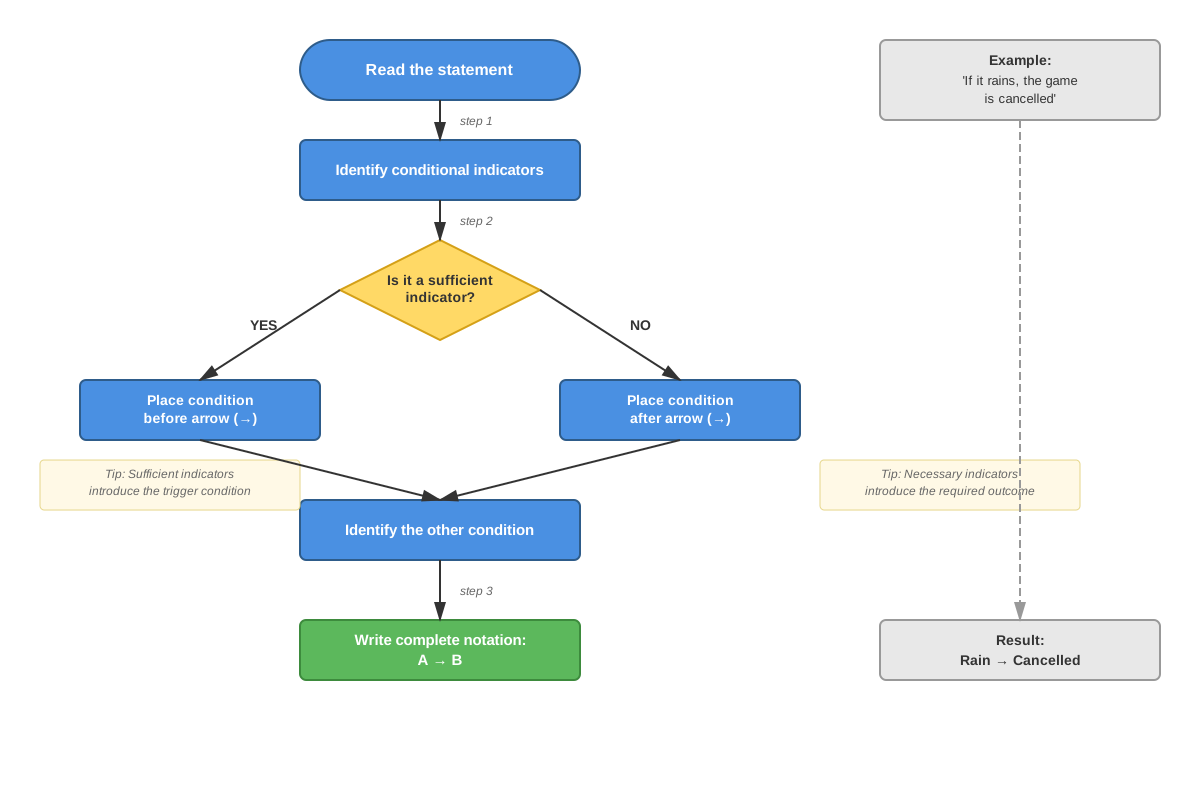
Conditional indicators are specific words or phrases that signal the presence of a conditional relationship between two statements. A conditional relationship establishes that one condition (the sufficient condition) is enough to guarantee another condition (the necessary condition). The formula for this relationship is: If [sufficient condition], then [necessary condition]. Conditional indicators tell us which part of the statement is sufficient and which is necessary.
These indicators function as linguistic cues that allow test-takers to quickly identify logical structure without getting distracted by content. Whether an argument discusses economics, biology, or philosophy, the same indicators signal the same logical relationships. This consistency makes conditional indicators one of the most reliable tools in a test-taker's arsenal.
Sufficient Condition Indicators
Sufficient condition indicators mark the part of a statement that is enough to guarantee the other part. When these indicators appear, the condition they introduce or precede is the sufficient condition. The most common sufficient condition indicators include:
| Indicator | Example | Logical Structure |
|---|---|---|
| If | If it rains, the game is cancelled | Rain → Cancelled |
| When | When temperatures drop, pipes freeze | Drop → Freeze |
| Whenever | Whenever she studies, she improves | Study → Improve |
| All | All doctors are professionals | Doctor → Professional |
| Any | Any violation results in a penalty | Violation → Penalty |
| Each | Each participant must register | Participant → Register |
| Every | Every winner receives a prize | Winner → Prize |
| The only | The only way to succeed is practice | Succeed → Practice |
The word "if" is the most frequently tested sufficient condition indicator on the LSAT. It appears in standard conditional statements and must be carefully distinguished from "only if," which functions differently. When "if" appears, the clause immediately following it becomes the sufficient condition, regardless of whether "if" appears at the beginning or middle of a sentence.
"All," "any," "each," and "every" are categorical sufficient condition indicators that appear frequently in Logic Games and Logical Reasoning. These words establish that membership in one category is sufficient for membership in another. For example, "All lawyers passed the bar exam" translates to: Lawyer → Passed Bar Exam.
Necessary Condition Indicators
Necessary condition indicators mark the part of a statement that must occur if the other part occurs. These indicators introduce or precede the necessary condition—the outcome that is required. Key necessary condition indicators include:
| Indicator | Example | Logical Structure |
|---|---|---|
| Only if | You pass only if you study | Pass → Study |
| Only | Only members can vote | Vote → Member |
| Then | If it's Tuesday, then it's a weekday | Tuesday → Weekday |
| Requires | Admission requires a ticket | Admission → Ticket |
| Needs | Success needs preparation | Success → Preparation |
| Must | To qualify, you must apply | Qualify → Apply |
| Necessary | Registration is necessary for entry | Entry → Registration |
| Unless | We leave unless it stops raining | Leave → NOT Raining |
| Until | Stay here until I return | NOT Stay → Return |
| Without | Without water, plants die | NOT Die → Water |
The phrase "only if" causes more confusion than perhaps any other conditional indicator. Students often mistake it for "if," but "only if" introduces the necessary condition, not the sufficient condition. "You will succeed only if you work hard" means: Succeed → Work Hard. The success requires hard work; hard work is necessary for success.
"Unless," "until," and "without" are negative necessary condition indicators that require special attention. "Unless" means "if not" and introduces a necessary condition while negating it. "The concert will be cancelled unless we sell 100 tickets" translates to: NOT Cancelled → Sell 100 Tickets (or equivalently: NOT Sell 100 → Cancelled).
Compound and Complex Indicators
Many LSAT statements contain multiple conditional indicators within a single sentence, creating layered logical relationships. Consider: "Only if you register will you be eligible, and if you're eligible, then you can participate." This sentence contains three conditional indicators ("only if," "will," and "if...then") that must be parsed separately and then connected.
The process for handling compound indicators involves:
- Identify each indicator in the sentence
- Determine what condition each indicator introduces (sufficient or necessary)
- Diagram each conditional relationship separately
- Connect the relationships through shared terms
Some indicators work in pairs, such as "if...then" constructions. While "if" alone is sufficient to establish a conditional relationship, the addition of "then" makes the structure more explicit and helps students identify the necessary condition more easily.
Implicit Conditional Relationships
Not all conditional relationships on the LSAT are marked by explicit indicators. The exam frequently tests whether students can recognize conditional logic even when indicators are absent or subtle. Statements like "Doctors are professionals" contain an implicit "all" and should be read as "All doctors are professionals" (Doctor → Professional).
Causal language often implies conditional relationships. "Smoking causes cancer" suggests that smoking is sufficient for cancer risk, though the relationship may be probabilistic rather than absolute. The LSAT exploits the ambiguity between causal and conditional language, testing whether students can identify when an argument treats a correlation as if it were a conditional guarantee.
Definitional statements also create conditional relationships. "A democracy is a government by the people" establishes that being a democracy is sufficient for being a government by the people (Democracy → Government by People), and being a government by the people is necessary for being a democracy.
Conditional Indicator Position
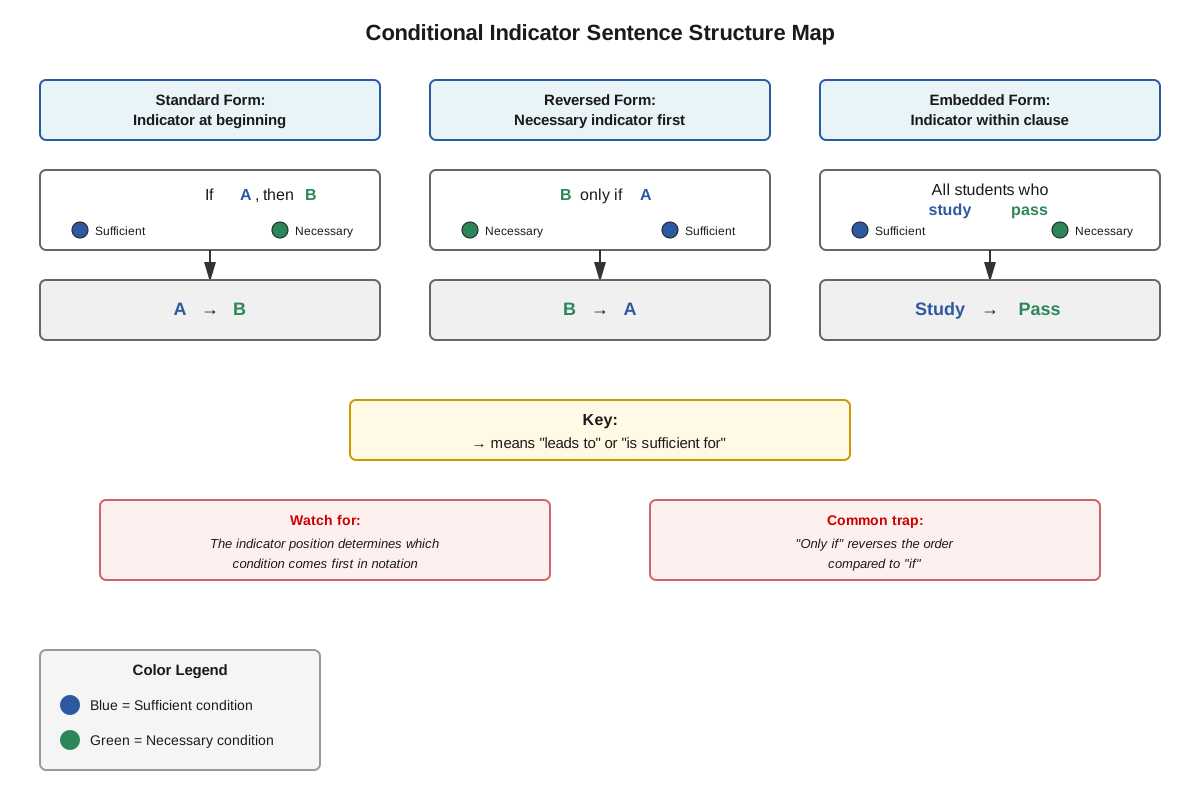
The position of a conditional indicator within a sentence does not change its logical function, but it does affect how students must parse the sentence. "If A, then B" and "B if A" express identical logical relationships (A → B), but the second formulation places the necessary condition first, which can confuse students who expect sufficient conditions to appear first.
Standard form places the sufficient condition first: "If [sufficient], then [necessary]." However, LSAT questions frequently use non-standard forms to test comprehension:
- Reversed form: "B if A" (still means A → B)
- Necessary-first form: "Only if B, A" (still means A → B)
- Embedded form: "A, which requires B, is essential" (A → B and Something → A)
Developing fluency with all positional variations ensures that students can accurately diagram conditional relationships regardless of how they're presented.
Concept Relationships
The concepts within conditional indicators form a hierarchical structure. At the foundation lies the basic distinction between sufficient and necessary conditions—understanding this distinction is prerequisite to everything else. From this foundation, students build upward to recognize specific indicators that mark each type of condition.
Sufficient condition indicators → enable identification of → the sufficient condition → which combines with → necessary condition indicators → to form → complete conditional statements → which can be → diagrammed and analyzed → leading to → valid inferences and contrapositives.
The relationship between explicit and implicit indicators represents a progression in difficulty. Students first master obvious indicators like "if" and "only if," then advance to recognizing conditional relationships in categorical statements ("all," "every"), and finally develop the ability to spot implicit conditionals in causal language and definitions.
Compound indicators connect to the concept of conditional chains, where multiple conditional statements link together through shared terms. This connection bridges the current topic to more advanced conditional logic topics like transitive reasoning and complex inference patterns.
The position of indicators relates directly to sentence parsing skills and the ability to maintain accuracy under time pressure. Students who understand that indicator position doesn't change logical function can process sentences more quickly and avoid common traps.
Quick check — test yourself on Conditional indicators so far.
Try Flashcards →High-Yield Facts
⭐ "If" introduces the sufficient condition; "only if" introduces the necessary condition—these are not interchangeable.
⭐ "Unless" means "if not" and introduces a necessary condition that must be negated when diagramming.
⭐ "All," "any," "each," and "every" are sufficient condition indicators that establish categorical relationships.
⭐ The word "only" (without "if") introduces a necessary condition: "Only members can vote" means Vote → Member.
⭐ Conditional indicators can appear anywhere in a sentence; their position doesn't change their logical function.
- "Then" explicitly marks the necessary condition in "if...then" constructions but is often implied rather than stated.
- "The only" is a sufficient condition indicator despite containing the word "only": "The only way to win is to practice" means Win → Practice.
- Negative necessary condition indicators ("unless," "without," "until") require negating the condition they introduce.
- Multiple indicators in one sentence must be parsed separately before connecting the resulting conditional relationships.
- Implicit conditionals appear in definitional statements, categorical claims, and causal language without explicit indicators.
- "When" and "whenever" function identically to "if" as sufficient condition indicators.
- "Requires," "needs," and "must" are necessary condition indicators commonly used in formal or technical language.
- The contrapositive of any conditional statement is formed by reversing and negating both conditions, regardless of which indicators were used in the original statement.
Common Misconceptions
Misconception: "Only if" means the same thing as "if" because they both contain the word "if."
Correction: "Only if" introduces the necessary condition, while "if" introduces the sufficient condition. "You pass only if you study" (Pass → Study) means something entirely different from "If you study, you pass" (Study → Pass). The first guarantees nothing about passing when you study; the second guarantees passing when you study.
Misconception: The sufficient condition must always appear first in a sentence.
Correction: Conditional indicators determine which condition is sufficient regardless of word order. "B if A" places the necessary condition first but still means A → B. Students must identify the indicator and apply its function rather than relying on position.
Misconception: "Unless" means "if" and can be treated the same way.
Correction: "Unless" means "if not" and introduces a necessary condition that must be negated. "We cancel unless it's sunny" means NOT Cancel → Sunny, or equivalently, NOT Sunny → Cancel. Treating "unless" like "if" produces incorrect diagrams.
Misconception: Every conditional statement contains an explicit conditional indicator.
Correction: Many LSAT conditional relationships are implicit, appearing in categorical statements ("Doctors are professionals"), causal claims, or definitions. Students must recognize conditional logic even when traditional indicators are absent.
Misconception: "The only" introduces a necessary condition because it contains the word "only."
Correction: "The only" is a sufficient condition indicator. "The only way to succeed is practice" means Succeed → Practice. The phrase establishes that success is sufficient to guarantee that practice occurred (because practice is the only way to achieve success).
Misconception: When multiple indicators appear in one sentence, they create a single conditional relationship.
Correction: Multiple indicators typically create multiple conditional relationships that must be diagrammed separately and then connected. Each indicator performs its own logical function and must be analyzed individually.
Worked Examples
Example 1: Parsing Multiple Indicators
Question: Diagram the logical structure of the following statement: "Only if the committee approves the proposal will funding be allocated, and if funding is allocated, then the project can begin."
Solution:
Step 1: Identify all conditional indicators in the statement.
- "Only if" (necessary condition indicator)
- "will" (consequence marker, part of the necessary condition)
- "if" (sufficient condition indicator)
- "then" (necessary condition marker)
Step 2: Parse the first conditional relationship.
"Only if the committee approves the proposal will funding be allocated"
- "Only if" introduces the necessary condition: committee approves
- The sufficient condition is: funding allocated
- Diagram: Funding Allocated → Committee Approves
Step 3: Parse the second conditional relationship.
"if funding is allocated, then the project can begin"
- "If" introduces the sufficient condition: funding allocated
- "Then" marks the necessary condition: project begins
- Diagram: Funding Allocated → Project Begins
Step 4: Connect the relationships through the shared term "funding allocated."
Committee Approves ← Funding Allocated → Project Begins
Or, reading the chain from left to right:
Project Begins → Funding Allocated → Committee Approves
Step 5: Identify valid inferences.
- If the project begins, then funding was allocated (from the second conditional)
- If funding was allocated, then the committee approved (from the first conditional)
- Therefore, by transitivity: If the project begins, then the committee approved
- Contrapositive: If the committee didn't approve, then the project didn't begin
Connection to Learning Objectives: This example demonstrates how to identify multiple conditional indicators in a single statement (Objective 1), explains the reasoning pattern of connecting conditional chains (Objective 2), and applies this knowledge to derive valid inferences (Objective 3).
Example 2: Handling Negative Indicators
Question: A Logical Reasoning question states: "The museum will remain open unless attendance drops below 100 visitors per day." Which of the following must be true?
(A) If attendance drops below 100, the museum will close.
(B) If the museum remains open, attendance is at least 100.
(C) If attendance is at least 100, the museum will remain open.
(D) The museum will close only if attendance drops below 100.
(E) Both A and B.
Solution:
Step 1: Identify the conditional indicator.
"Unless" is a negative necessary condition indicator meaning "if not."
Step 2: Diagram the original statement.
"The museum will remain open unless attendance drops below 100"
- Rewrite "unless" as "if not": The museum will remain open if attendance does NOT drop below 100
- Or, more directly: NOT (Museum Closes) → NOT (Attendance < 100)
- Simplified: Museum Open → Attendance ≥ 100
Step 3: Determine the contrapositive.
Original: Museum Open → Attendance ≥ 100
Contrapositive: Attendance < 100 → Museum Closes
Step 4: Evaluate each answer choice.
(A) "If attendance drops below 100, the museum will close."
This matches our contrapositive exactly: Attendance < 100 → Museum Closes. ✓
(B) "If the museum remains open, attendance is at least 100."
This matches our original diagram: Museum Open → Attendance ≥ 100. ✓
(C) "If attendance is at least 100, the museum will remain open."
This reverses the original conditional without negating: Attendance ≥ 100 → Museum Open. This is an invalid inference (affirming the consequent). ✗
(D) "The museum will close only if attendance drops below 100."
"Only if" introduces a necessary condition: Museum Closes → Attendance < 100. This is the reverse of our contrapositive and is invalid. ✗
(E) "Both A and B."
Since both A and B are valid inferences, this is correct. ✓
Answer: (E)
Connection to Learning Objectives: This example shows how to identify the negative conditional indicator "unless" (Objective 1), explains the reasoning pattern of converting "unless" statements and forming contrapositives (Objective 2), and applies this knowledge to eliminate incorrect answer choices (Objective 3).
Exam Strategy
When approaching LSAT questions involving conditional indicators, implement a systematic process that minimizes errors and maximizes efficiency:
Step 1: Scan for indicators first. Before reading an argument for content, quickly scan for conditional indicators. This primes your brain to recognize logical structure and prevents you from getting lost in complex content. Look for high-frequency indicators like "if," "only if," "all," "unless," and "requires."
Step 2: Diagram immediately. As soon as you identify a conditional relationship, diagram it using consistent notation (arrows, letters, or whatever system you've practiced). Don't try to hold conditional relationships in your head—the LSAT deliberately overloads working memory to induce errors.
Step 3: Watch for indicator position. When an indicator appears mid-sentence or in non-standard position, slow down and carefully identify which condition is sufficient and which is necessary. The LSAT frequently places indicators in unusual positions to test whether students truly understand their function.
Step 4: Handle "unless" with extra care. Because "unless" requires both negation and identification of the necessary condition, it's a common source of errors. When you see "unless," immediately rewrite it as "if not" and proceed from there.
Step 5: Check for multiple indicators. If a sentence contains more than one conditional indicator, parse each relationship separately before attempting to connect them. Trying to process multiple conditionals simultaneously leads to confusion and mistakes.
Exam Tip: The LSAT loves to test the difference between "if" and "only if" by placing them in answer choices that are otherwise identical. Always verify which indicator appears before selecting an answer.
Trigger words to watch for:
- "If" vs. "only if" distinctions in answer choices
- "Unless" in stimulus or answer choices (requires negation)
- "All," "any," "each," "every" in categorical statements
- "The only" (sufficient condition despite containing "only")
- Implicit conditionals in causal language ("causes," "leads to," "results in")
Process-of-elimination tips:
- Eliminate any answer choice that reverses a conditional relationship without negating both conditions
- Eliminate answers that treat "if" and "only if" as interchangeable
- Eliminate answers that ignore the negation required by "unless"
- Eliminate answers that confuse sufficient and necessary conditions
Time allocation:
Spend 10-15 seconds identifying and diagramming conditional relationships in the stimulus. This upfront investment saves 30-45 seconds during answer choice evaluation because you can quickly test each choice against your diagram rather than re-reading the stimulus repeatedly.
Memory Techniques
Mnemonic for "Only If": Only Introduces Necessary (OIN). When you see "only if," remember that it introduces the necessary condition, not the sufficient condition.
Mnemonic for Sufficient Condition Indicators: I'll Wager All Eggs (IWAE)
- If
- When/Whenever
- All/Any
- Each/Every
Visualization for "Unless": Picture a gate that stays closed UNLESS a condition is met. The gate staying open (the thing that doesn't happen) requires the condition. This helps remember that "unless" introduces a necessary condition and involves negation.
Acronym for Necessary Condition Indicators: ONLY TURN (Only, oNly if, Lacks/without, You must/requires, Then, Until, Requires, Needs)
Memory palace technique: Imagine walking through a house where:
- The front door has "IF" written on it (sufficient to enter)
- The back door requires a key labeled "ONLY IF" (necessary to exit)
- The basement is dark "UNLESS" you flip a switch (negation required)
- ALL rooms have furniture (categorical sufficient condition)
Sentence position reminder: Create a mental image of conditional indicators as magnets that "attract" their respective conditions regardless of where they appear in a sentence. The magnet's pull (logical function) doesn't change based on position.
Summary
Conditional indicators are linguistic markers that signal logical relationships between statements, serving as the foundation for conditional reasoning on the LSAT. These indicators fall into two primary categories: sufficient condition indicators (like "if," "when," "all," "any") that mark conditions sufficient to guarantee an outcome, and necessary condition indicators (like "only if," "requires," "must," "unless") that mark conditions required for an outcome. Mastering conditional indicators requires recognizing that their logical function remains constant regardless of position within a sentence, understanding that "unless" means "if not" and requires negation, and distinguishing between the similar-looking but functionally opposite indicators "if" and "only if." The LSAT tests conditional indicators across multiple question types, particularly in Sufficient Assumption, Must Be True, and Flaw questions, making this topic one of the highest-yield areas for focused study. Success requires systematic identification of indicators, immediate diagramming of relationships, careful attention to compound indicators that create multiple conditional relationships, and recognition of implicit conditionals in categorical and causal language.
Key Takeaways
- Conditional indicators are words or phrases that signal sufficient or necessary conditions; recognizing them is essential for diagramming logical relationships accurately.
- "If" introduces the sufficient condition, while "only if" introduces the necessary condition—confusing these two indicators is one of the most common errors on the LSAT.
- "Unless" means "if not" and introduces a necessary condition that must be negated when diagramming: "A unless B" becomes NOT A → B.
- Categorical indicators like "all," "any," "each," and "every" establish sufficient conditions for membership in a category.
- Conditional indicators maintain their logical function regardless of where they appear in a sentence; position affects parsing but not meaning.
- Multiple indicators in a single sentence create multiple conditional relationships that must be diagrammed separately and then connected through shared terms.
- Implicit conditional relationships appear in definitional statements, categorical claims, and causal language even without explicit indicators.
Related Topics
Contrapositives: Once students master conditional indicators and can accurately diagram conditional statements, the next step is learning to form contrapositives by reversing and negating both conditions. This skill is essential for making valid inferences and eliminating incorrect answer choices.
Conditional Chains: After understanding individual conditional relationships, students progress to connecting multiple conditionals through shared terms, enabling transitive reasoning and complex inference patterns that appear frequently in Logic Games.
Formal Logic Notation: Mastering conditional indicators provides the foundation for learning symbolic logic notation, which allows for more efficient diagramming of complex arguments and game scenarios.
Necessary vs. Sufficient Assumptions: Understanding conditional indicators directly enables success on Assumption questions, where students must identify what conditional relationship would make an argument valid (sufficient) or what must be true for the argument to work (necessary).
Conditional Reasoning Flaws: Recognizing conditional indicators allows students to spot common logical errors like affirming the consequent, denying the antecedent, and confusing sufficient with necessary conditions—all frequent wrong answer traps on Flaw questions.
Practice CTA
Now that you've mastered the fundamentals of conditional indicators, it's time to cement your understanding through active practice. Attempt the practice questions associated with this topic, focusing on identifying indicators quickly and diagramming accurately. Use the flashcards to drill the distinction between sufficient and necessary condition indicators until recognition becomes automatic. Remember: conditional indicators appear in nearly half of all Logical Reasoning questions, making this one of the highest-return investments of your study time. Every minute spent mastering this topic pays dividends across multiple question types and sections. You've built the foundation—now strengthen it through deliberate practice!
Sign up free to keep reading
Create a free AnvayaPrep account to finish this LSAT guide on Conditional indicators — plus flashcards and practice questions.