Overview
Conditional statements in principle questions represent one of the most sophisticated and high-yield question types on the LSAT Logical Reasoning section. These questions require test-takers to identify, apply, or evaluate broad principles that are expressed in conditional form—statements that establish "if-then" relationships between conditions and consequences. Unlike straightforward conditional reasoning questions that focus on formal logic manipulation, principle questions demand that students recognize how abstract rules govern specific situations and how particular scenarios exemplify general principles.
The LSAT frequently tests conditional statements in principle questions because they mirror the type of reasoning essential to legal practice: applying general legal rules to specific factual situations, identifying which principle justifies a particular decision, or determining whether a given principle supports or undermines an argument. These questions assess both logical reasoning skills and the ability to move fluidly between abstract principles and concrete applications. Mastering this topic is essential because principle questions appear in approximately 15-20% of Logical Reasoning questions, and conditional logic underlies many of them.
Within the broader landscape of conditional logic, principle questions represent an applied form of reasoning that builds upon foundational skills in identifying sufficient and necessary conditions, recognizing contrapositive relationships, and understanding logical chains. While basic conditional reasoning focuses on formal validity, lsat conditional statements in principle questions require additional interpretive skills: extracting the conditional structure from complex language, recognizing when a principle applies to a situation, and distinguishing between principles that differ in subtle but crucial ways. This topic serves as a bridge between pure formal logic and the nuanced reasoning required for more complex LSAT question types, including parallel reasoning and method of reasoning questions.
Learning Objectives
- [ ] Identify how conditional statements in principle questions appears in LSAT questions
- [ ] Explain the reasoning pattern behind conditional statements in principle questions
- [ ] Apply conditional statements in principle questions to solve LSAT-style problems accurately
- [ ] Distinguish between sufficient condition principles and necessary condition principles in answer choices
- [ ] Recognize when a specific scenario satisfies or violates a conditional principle
- [ ] Evaluate whether a given principle, when applied, justifies a particular conclusion or action
- [ ] Translate complex natural language into conditional statement form to facilitate principle matching
Prerequisites
- Basic conditional logic structure: Understanding sufficient and necessary conditions is fundamental because principle questions express relationships in "if-then" format
- Contrapositive formation: Recognizing logically equivalent statements is essential for identifying when principles apply in their contrapositive form
- Argument structure identification: Distinguishing premises from conclusions enables proper application of principles to argumentative contexts
- Formal logic notation: Familiarity with symbolic representation (A → B) facilitates quick analysis of complex conditional relationships
- Sufficient vs. necessary conditions: Distinguishing these concepts prevents misapplication of principles that specify different types of requirements
Why This Topic Matters
In legal reasoning—the domain the LSAT is designed to assess—applying general principles to specific cases constitutes the core of legal analysis. Attorneys must constantly determine which legal rules govern particular situations, whether precedents apply to new cases, and what principles justify specific outcomes. Conditional statements in principle questions directly test this fundamental legal skill by requiring test-takers to match abstract rules with concrete scenarios or to identify which principle, if accepted, would support a given argument.
On the LSAT, principle questions appear with remarkable frequency across both Logical Reasoning sections. Approximately 3-5 questions per test involve principle reasoning, and a substantial majority of these incorporate conditional logic. These questions appear in several formats: "Which principle, if valid, most helps to justify the reasoning?" (principle-support questions), "Which principle is illustrated by the situation described?" (principle-conform questions), and "The argument's reasoning conforms to which principle?" (principle-application questions). Each format requires recognizing and manipulating conditional relationships.
The practical importance extends beyond test performance. Students who master conditional statements in principle questions develop transferable skills in legal reasoning, policy analysis, and ethical decision-making. These questions train the mind to recognize when general rules apply, to identify exceptions based on conditional requirements, and to reason precisely about the relationship between abstract standards and particular instances—skills that prove invaluable in law school case analysis, statutory interpretation, and legal writing.
Core Concepts
The Structure of Conditional Principles
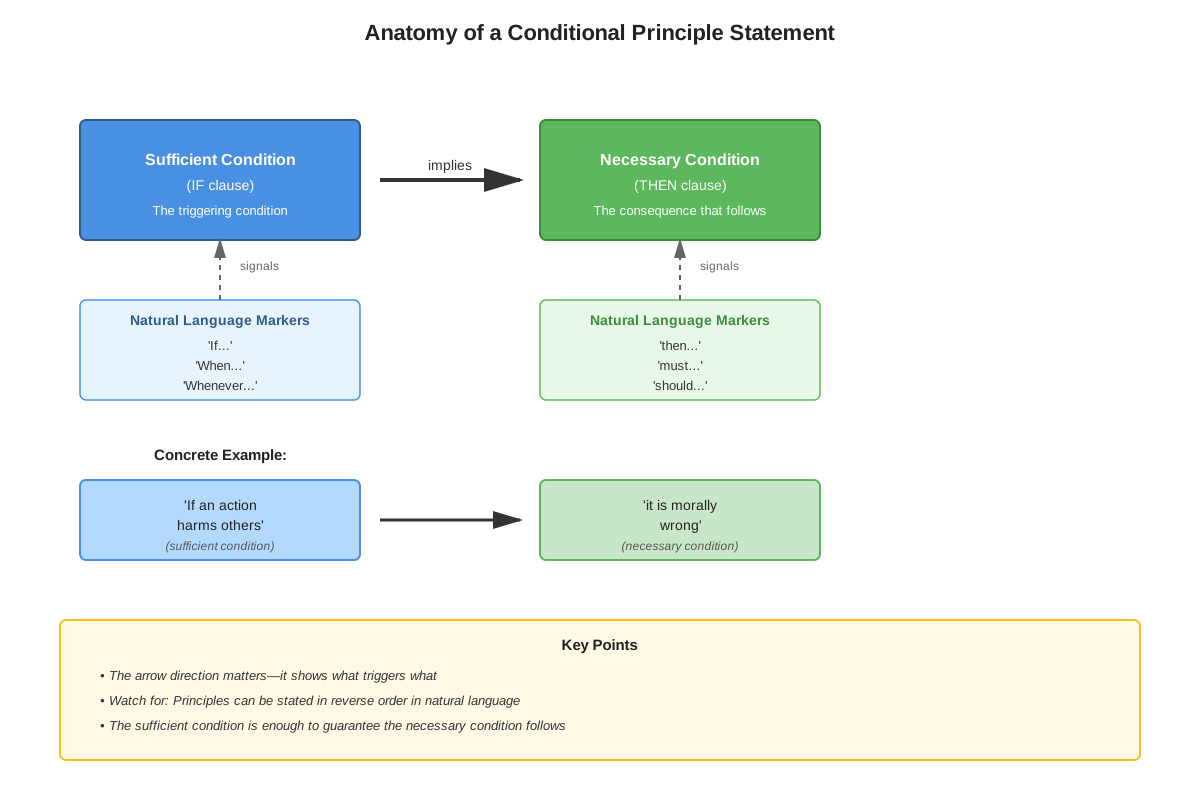
A conditional principle expresses a general rule in the form of a conditional statement: if certain conditions are met (the sufficient condition), then a particular consequence follows (the necessary condition). On the LSAT, these principles typically govern actions, judgments, obligations, or permissions. For example: "If an action harms no one, then it is morally permissible" establishes that causing no harm is sufficient for moral permissibility.
The key structural elements include:
- The sufficient condition: The triggering circumstance or set of circumstances
- The necessary condition: The guaranteed result, obligation, or classification
- The scope: The domain to which the principle applies (moral judgments, legal obligations, rational decisions, etc.)
- The strength: Whether the principle is absolute or qualified by exceptions
Understanding these elements allows test-takers to parse complex principle statements and determine whether they match specific scenarios. The LSAT often disguises conditional structure through varied linguistic formulations, requiring students to recognize equivalent expressions like "only if," "unless," "whenever," and "any time that."
Types of Principle Questions with Conditional Logic
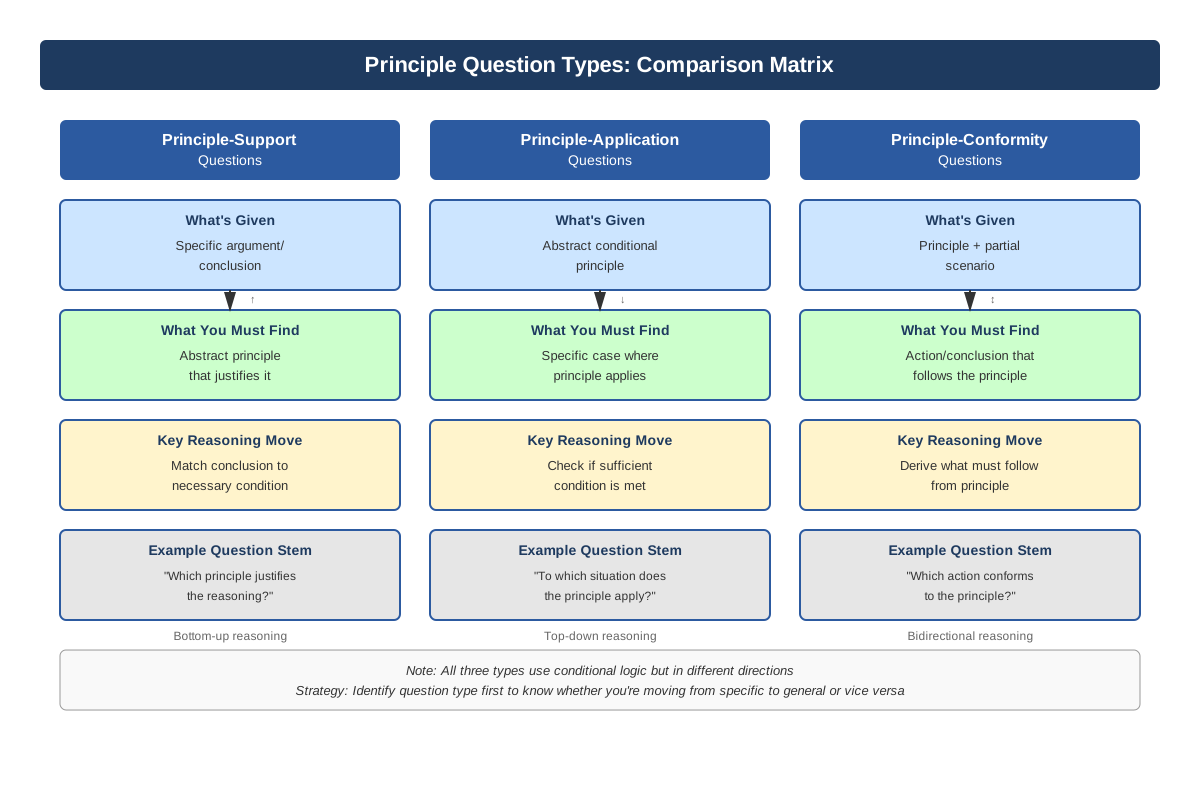
Principle-Support Questions present an argument and ask which principle, if valid, would justify the reasoning. These questions require identifying the gap between premises and conclusion, then selecting a conditional principle that bridges that gap. The correct answer typically has the argument's premises as its sufficient condition and the conclusion as its necessary condition.
Principle-Conform Questions describe a specific situation or action and ask which principle it exemplifies or conforms to. Success requires matching the details of the scenario to the conditions specified in the principle. The scenario must satisfy the sufficient condition of the correct principle, thereby triggering its necessary condition.
Principle-Application Questions provide a general principle and ask how it applies to a specific case, or which scenario it would support. These questions test whether students can recognize when a principle's conditions are met and correctly derive the required consequence.
| Question Type | Task | Key Skill |
|---|---|---|
| Principle-Support | Find principle that justifies argument | Identify reasoning gap and bridge it |
| Principle-Conform | Match scenario to principle | Recognize when conditions are satisfied |
| Principle-Application | Apply principle to new case | Derive consequences from satisfied conditions |
Matching Principles to Scenarios
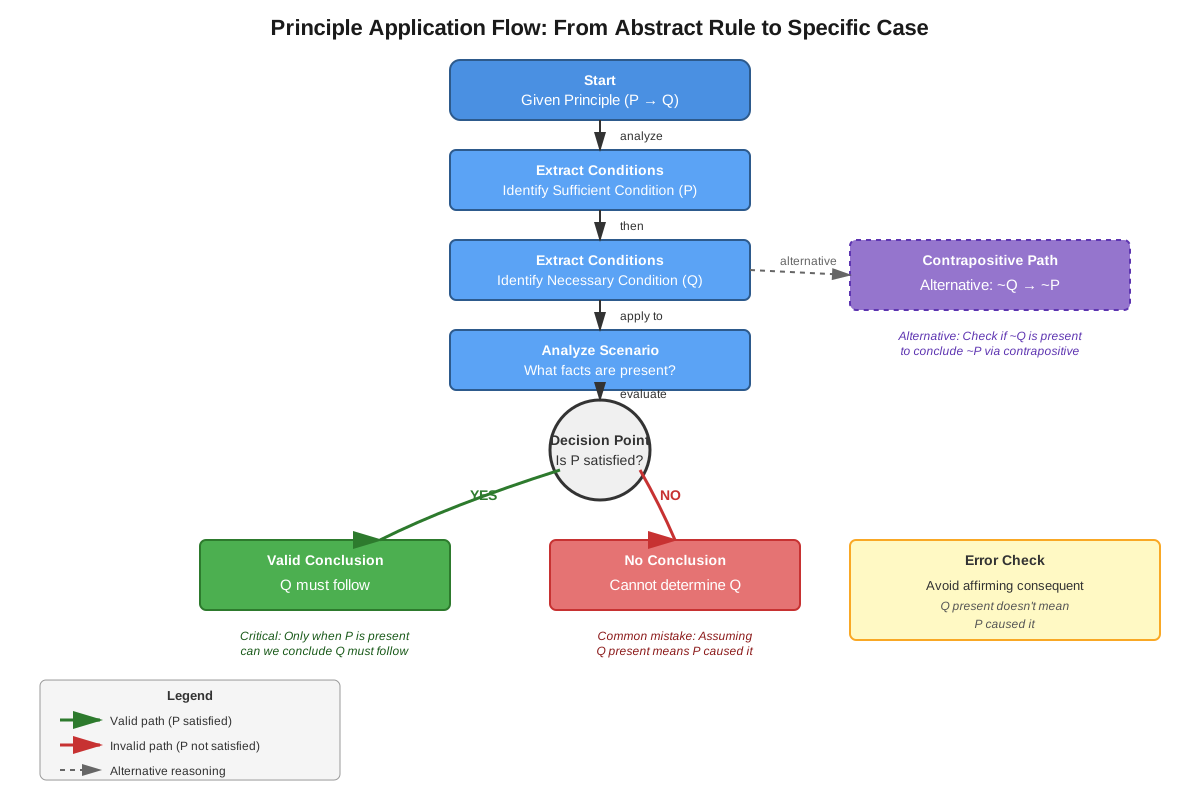
The core challenge in lsat conditional statements in principle questions involves determining whether a specific situation satisfies a general principle's conditions. This matching process requires several steps:
- Extract the conditional structure from the principle, identifying what triggers the rule (sufficient condition) and what follows (necessary condition)
- Identify the relevant features of the specific scenario
- Determine whether the scenario's features satisfy the principle's sufficient condition
- Verify that the principle's necessary condition matches the scenario's outcome or the argument's conclusion
Consider this principle: "If a policy benefits the majority while harming a minority, then it is unjust." The sufficient condition is "benefits majority AND harms minority." A scenario describing a policy that benefits 60% of citizens while harming 30% would satisfy this sufficient condition, triggering the necessary condition that the policy is unjust.
Conditional Principles vs. Biconditional Principles
Most LSAT principles are unidirectional conditionals (if A, then B), but some are biconditionals (if and only if A, then B). Biconditional principles establish both that A is sufficient for B AND that A is necessary for B. Recognizing this distinction is crucial because biconditional principles are more restrictive—they specify the only way to achieve the necessary condition.
For example:
- Conditional: "If a contract was signed under duress, it is invalid" (duress is sufficient for invalidity, but other things might also invalidate contracts)
- Biconditional: "A contract is invalid if and only if it was signed under duress" (duress is both necessary and sufficient for invalidity—the only way contracts become invalid)
The LSAT tests whether students recognize these differences by including wrong answers that treat conditional principles as biconditional or vice versa.
Necessary vs. Sufficient Condition Principles
Some principles specify sufficient conditions for an outcome: "If X, then Y" means X is enough to guarantee Y. Other principles specify necessary conditions: "Only if X, then Y" or "Y only if X" means X is required for Y (but might not be enough by itself). This distinction proves critical in principle questions.
A sufficient condition principle tells you what guarantees a result. A necessary condition principle tells you what's required for a result. Wrong answers often confuse these, presenting a sufficient condition principle when a necessary condition principle is needed, or vice versa.
Qualified vs. Absolute Principles
LSAT principles vary in strength. Absolute principles contain no exceptions: "If A, then always B." Qualified principles include limiting conditions: "If A, then usually B" or "If A and not C, then B." The LSAT frequently includes wrong answers that are too strong (absolute when the argument requires qualification) or too weak (qualified when the argument requires an absolute principle).
Recognizing qualification language is essential: "typically," "generally," "in most cases," "unless," "except when," and "provided that" all signal qualified principles. The correct answer must match the argument's strength—neither overstating nor understating the principle's scope.
Concept Relationships
The concepts within conditional statements in principle questions form an interconnected system. The structure of conditional principles serves as the foundation, providing the basic framework that all other concepts build upon. This structure directly enables matching principles to scenarios, which requires applying the conditional framework to specific cases. The matching process depends critically on understanding necessary vs. sufficient condition principles, since misidentifying which type of condition a principle specifies leads to incorrect matching.
Types of principle questions represent different ways the LSAT tests the same underlying skill set—each question type requires extracting conditional structure and matching it appropriately, but they approach this task from different angles. Principle-support questions work backward from conclusion to principle, while principle-conform questions work forward from principle to scenario.
The distinction between conditional and biconditional principles affects all other concepts, since biconditional principles impose stricter matching requirements. Similarly, qualified vs. absolute principles influences matching—a scenario might satisfy an absolute principle's conditions but fail to satisfy a qualified principle's additional restrictions.
These concepts connect to prerequisite knowledge of basic conditional logic through direct application: the sufficient/necessary distinction learned in foundational conditional reasoning becomes the basis for distinguishing principle types. The contrapositive formation skill enables recognition that principles can apply in their contrapositive form—if a scenario satisfies "not B," then "not A" must follow.
Relationship map: Basic conditional structure → Principle structure → Principle types (support/conform/application) → Matching process → Consideration of qualifications and biconditionals → Correct answer selection
High-Yield Facts
⭐ Principle-support questions require finding a conditional principle where the argument's premises satisfy the sufficient condition and the conclusion matches the necessary condition
⭐ The correct principle must match both the scope and strength of the argument—neither broader nor narrower, neither stronger nor weaker
⭐ When a principle uses "only if," the phrase following "only if" is the necessary condition, not the sufficient condition
⭐ Biconditional principles ("if and only if") are rare in correct answers because they're more restrictive than most arguments require
⭐ The contrapositive of a principle applies just as validly as the original statement—scenarios can satisfy principles in contrapositive form
- Qualified principles containing "unless" or "except when" require checking that the exception conditions are not met in the scenario
- Principle-conform questions often include wrong answers that match only some features of the scenario while missing crucial details
- Sufficient condition principles tell you what guarantees an outcome; necessary condition principles tell you what's required for an outcome
- Wrong answers frequently confuse sufficient and necessary conditions, presenting one when the other is needed
- Multiple principles might seem to apply to a scenario, but only one will match all relevant features and the appropriate strength
- Principles expressed in abstract language must be translated into the specific domain of the argument (moral, legal, prudential, etc.)
- The LSAT often disguises conditional structure using varied linguistic formulations that must be recognized as equivalent
Quick check — test yourself on Conditional statements in principle questions so far.
Try Flashcards →Common Misconceptions
Misconception: Any principle that seems related to the argument's topic is correct → Correction: The principle must establish a conditional relationship that specifically connects the argument's premises (as sufficient condition) to its conclusion (as necessary condition), not merely discuss related concepts
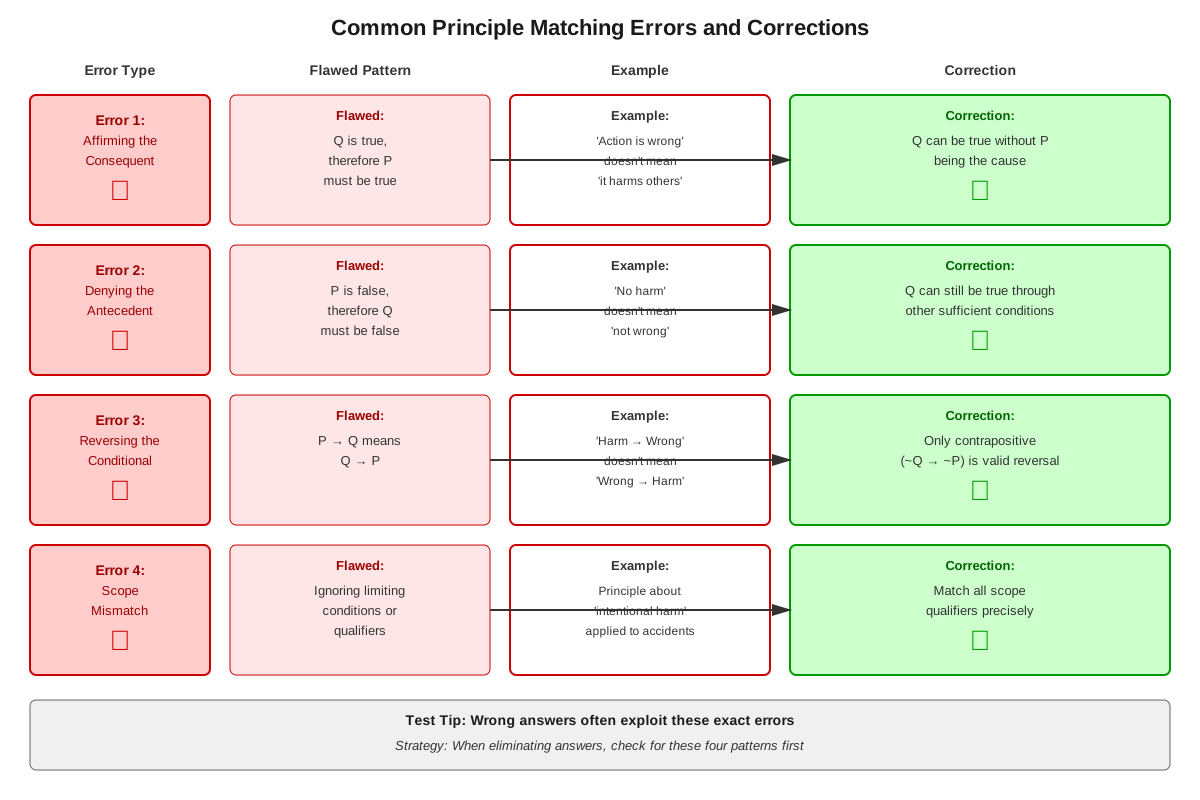
Misconception: If a scenario satisfies a principle's necessary condition, the principle applies → Correction: Satisfying the necessary condition doesn't trigger the principle; only satisfying the sufficient condition triggers the conditional relationship. This confuses the direction of conditional logic.
Misconception: The correct principle must use the same words as the argument → Correction: Principles are typically expressed in more abstract or general language than the specific argument, requiring recognition of when specific instances exemplify general categories
Misconception: Stronger principles are better because they're more definitive → Correction: The correct principle must match the argument's strength; an overly strong (absolute) principle fails when the argument requires qualification, and an overly weak (qualified) principle fails when the argument requires certainty
Misconception: Biconditional principles are just stronger versions of conditional principles → Correction: Biconditionals establish a different logical relationship (both sufficient AND necessary), not merely a stronger version of the same relationship. They specify the only way to achieve the necessary condition.
Misconception: Principle questions test memorization of philosophical or legal principles → Correction: The LSAT provides all necessary principles in the question or answer choices; success depends on logical analysis of conditional relationships, not outside knowledge
Misconception: If multiple principles seem to work, any of them is acceptable → Correction: Only one answer choice will correctly match all relevant features of the argument or scenario with appropriate scope and strength; others will have subtle but crucial mismatches
Worked Examples
Example 1: Principle-Support Question
Argument: "The new traffic law should not be enforced. While it would reduce accidents, it would require surveillance cameras at every intersection, which would constitute an unacceptable invasion of privacy."
Question: Which principle, if valid, most helps to justify the reasoning?
Answer Choices:
(A) Laws that reduce accidents should be enforced unless they violate privacy
(B) If a law requires unacceptable invasions of privacy, it should not be enforced
(C) Traffic laws should prioritize safety over privacy concerns
(D) Laws should not be enforced if they require expensive surveillance equipment
(E) Any law that reduces accidents should be enforced
Solution Process:
Step 1: Identify the argument's structure
- Premise: The law requires unacceptable privacy invasion
- Conclusion: The law should not be enforced
- Gap: Why does privacy invasion mean the law shouldn't be enforced?
Step 2: Express the needed principle in conditional form
- Sufficient condition: Law requires unacceptable privacy invasion
- Necessary condition: Law should not be enforced
- Needed principle: If [unacceptable privacy invasion], then [should not be enforced]
Step 3: Evaluate each answer choice
(A) This is close but backward—it makes enforcement the default unless privacy is violated, which doesn't directly support the conclusion. It's also qualified ("unless"), suggesting exceptions.
(B) CORRECT: This matches perfectly. Sufficient condition: "requires unacceptable invasions of privacy" (matches the premise). Necessary condition: "should not be enforced" (matches the conclusion). The conditional structure bridges the gap.
(C) This contradicts the argument by prioritizing safety over privacy.
(D) This focuses on expense rather than privacy invasion—wrong sufficient condition.
(E) This contradicts the argument by supporting enforcement of accident-reducing laws.
Key Takeaway: The correct principle must have the argument's premise as its sufficient condition and the conclusion as its necessary condition, creating a logical bridge.
Example 2: Principle-Conform Question
Scenario: "Martinez refused to testify against her business partner despite being offered immunity from prosecution. She explained that their twenty-year friendship meant more to her than avoiding legal consequences."
Question: The scenario conforms to which principle?
Answer Choices:
(A) One should refuse to testify whenever doing so protects a friend
(B) If testifying would betray a long-standing friendship, one is justified in refusing even at personal cost
(C) Legal immunity should be rejected when accepting it would harm a friend
(D) Friendship obligations override legal obligations in all circumstances
(E) One should never testify against a business partner
Solution Process:
Step 1: Identify the scenario's key features
- Martinez refused to testify
- She had a long-standing friendship (20 years) with the person
- Refusing came at personal cost (no immunity)
- She valued friendship over avoiding consequences
Step 2: Express these features in conditional form
- Sufficient condition: Testifying would betray long-standing friendship
- Necessary condition: Justified in refusing even at personal cost
- The scenario exemplifies: When friendship is at stake, refusing is justified despite costs
Step 3: Evaluate each answer choice
(A) Too broad—"whenever" suggests any friendship, not specifically long-standing ones. Also doesn't mention personal cost.
(B) CORRECT: Sufficient condition: "testifying would betray a long-standing friendship" (matches the 20-year friendship). Necessary condition: "justified in refusing even at personal cost" (matches refusing despite losing immunity). All scenario features are captured.
(C) Focuses on "harm" to friend rather than betrayal of friendship—subtly different. Also uses "should be rejected" (obligation) rather than "justified" (permission).
(D) Too strong—"all circumstances" makes this absolute, but the scenario only demonstrates one case, not a universal rule.
(E) Too narrow—focuses on business partners specifically rather than the friendship aspect, which is what Martinez emphasized.
Key Takeaway: The correct principle must match all relevant features of the scenario without being too broad (covering cases not exemplified) or too narrow (missing key features).
Exam Strategy
Recognition Triggers
Watch for these phrases that signal conditional principles in answer choices:
- "If... then..."
- "Only if..."
- "Whenever..."
- "Any time that..."
- "Should/must/ought to... if..."
- "Justified in... when..."
- "...unless..."
- "...provided that..."
These linguistic markers indicate conditional structure that must be analyzed for sufficient and necessary conditions.
Systematic Approach for Principle-Support Questions
- Identify the conclusion first: What is the argument trying to establish?
- Identify the premises: What evidence or reasons are provided?
- Spot the gap: What unstated assumption connects premises to conclusion?
- Formulate the needed principle: "If [premises], then [conclusion]"
- Eliminate answers with wrong sufficient conditions: The sufficient condition must match the premises
- Eliminate answers with wrong necessary conditions: The necessary condition must match the conclusion
- Check scope and strength: Ensure the principle isn't too broad, narrow, strong, or weak
Systematic Approach for Principle-Conform Questions
- Catalog all relevant features of the scenario: actions, motivations, consequences, relationships
- Identify the outcome or judgment in the scenario
- For each answer choice, extract the conditional structure
- Check if the scenario satisfies the sufficient condition: Do the scenario's features match what triggers the principle?
- Verify the necessary condition matches: Does the principle's consequence match the scenario's outcome?
- Eliminate mismatches: Any feature mismatch or wrong strength eliminates an answer
Time-Saving Tip: In principle-support questions, immediately eliminate any answer choice whose necessary condition (the "then" part) doesn't match the argument's conclusion. This often eliminates 2-3 answers quickly.
Process of Elimination Strategies
Eliminate answers that are too strong: If the argument includes qualifying language like "generally" or "in most cases," eliminate principles that are absolute. Conversely, if the argument makes an unqualified claim, eliminate principles with exceptions.
Eliminate answers that reverse sufficient and necessary conditions: If the argument establishes that A leads to B, eliminate principles that state B leads to A (unless they're biconditional).
Eliminate answers that introduce new concepts: If a principle mentions factors not present in the argument or scenario, it's likely incorrect. The principle should connect elements already present, not introduce new requirements.
Eliminate answers that are too narrow or too broad: The principle should match the scope of the argument—neither covering only a subset of the relevant cases nor extending to unrelated cases.
Time Allocation
Principle questions typically require 90-120 seconds. Allocate time as follows:
- 20-30 seconds: Read and analyze the stimulus
- 10-15 seconds: Formulate the needed principle or identify scenario features
- 50-70 seconds: Evaluate answer choices systematically
- 10-15 seconds: Verify the selected answer
If a question exceeds two minutes, mark it for review and move on. Principle questions can be time-consuming, but spending excessive time on one question jeopardizes performance on others.
Memory Techniques
SCAN Mnemonic for Principle Analysis:
- Sufficient condition: What triggers the principle?
- Consequence (necessary condition): What follows when triggered?
- Application: Does the scenario satisfy the sufficient condition?
- Necessity check: Does the necessary condition match the outcome?
The Bridge Visualization: Picture the argument as two islands (premises and conclusion) separated by water. The correct principle is the bridge that connects them. The bridge must touch both islands at the right points—wrong answers are bridges that miss one or both islands, or connect the wrong locations.
"Only If" Reversal Reminder: Remember "ONLY = NECESSARY" by visualizing a door with "ONLY" written on it—you can ONLY enter (reach the necessary condition) through that specific door. The phrase after "only if" is what's necessary, not what's sufficient.
Strength Spectrum: Visualize principles on a strength spectrum from "always/must" (absolute) to "sometimes/may" (weak). The correct answer must match where the argument falls on this spectrum.
Feature Checklist Method: For principle-conform questions, create a mental checklist of scenario features and tick them off as you verify each answer choice captures them. The correct answer checks all boxes.
Summary
Conditional statements in principle questions represent a sophisticated integration of formal logic and applied reasoning on the LSAT. These questions require test-takers to recognize conditional relationships expressed in natural language, match abstract principles to specific scenarios, and identify which general rules justify particular conclusions. Success depends on systematically extracting conditional structure (identifying sufficient and necessary conditions), understanding the distinction between different principle types (sufficient vs. necessary condition principles, conditional vs. biconditional, absolute vs. qualified), and carefully matching principles to arguments or scenarios. The key skills involve translating complex language into conditional form, recognizing when a scenario satisfies a principle's triggering conditions, and ensuring that selected principles match both the scope and strength of the argument. Mastery requires moving fluidly between abstract principles and concrete applications while maintaining precision about logical relationships—exactly the type of reasoning essential to legal analysis and tested extensively on the LSAT.
Key Takeaways
- Conditional principles establish "if-then" relationships where satisfying the sufficient condition guarantees the necessary condition follows
- Principle-support questions require finding a conditional bridge where the argument's premises are the sufficient condition and the conclusion is the necessary condition
- Principle-conform questions require matching scenario features to a principle's sufficient condition and verifying the necessary condition matches the outcome
- The correct principle must match the argument's strength—neither too absolute nor too qualified, neither too broad nor too narrow
- "Only if" introduces the necessary condition, not the sufficient condition—a frequent source of confusion that the LSAT exploits
- Systematic analysis of conditional structure (identifying sufficient and necessary conditions) is more reliable than intuitive matching
- Wrong answers often confuse sufficient and necessary conditions or introduce concepts not present in the argument or scenario
Related Topics
Formal Logic and Conditional Reasoning: Deepening understanding of conditional logic fundamentals, including complex conditional chains, multiple sufficient conditions, and multiple necessary conditions, provides the foundation for more sophisticated principle analysis.
Parallel Reasoning Questions: These questions require matching argument structures, often involving conditional relationships, building on the pattern-recognition skills developed through principle questions.
Necessary Assumption Questions: Identifying unstated assumptions that arguments depend on involves similar gap-analysis skills used in principle-support questions, where the principle fills the argumentative gap.
Sufficient Assumption Questions: These questions explicitly ask for a principle or statement that, if assumed, makes the argument valid—a direct application of conditional principle reasoning.
Flaw Questions with Conditional Logic: Recognizing errors in conditional reasoning (affirming the consequent, denying the antecedent) helps identify when principles are misapplied in arguments.
Practice CTA
Now that you've mastered the core concepts of conditional statements in principle questions, it's time to cement your understanding through active practice. Work through the practice questions to apply these strategies to realistic LSAT scenarios, and use the flashcards to reinforce key distinctions and recognition patterns. Remember: principle questions reward systematic analysis over intuition. Each practice question is an opportunity to refine your approach and build the confidence needed to tackle these high-yield questions efficiently on test day. Your investment in mastering this topic will pay dividends across multiple question types in the Logical Reasoning section!
Sign up free to keep reading
Create a free AnvayaPrep account to finish this LSAT guide on Conditional statements in principle questions — plus flashcards and practice questions.