Overview
Conditional statements with no represent one of the most frequently tested patterns in LSAT Logical Reasoning sections. These statements appear when the word "no" introduces a relationship between two categories or conditions, creating a specific type of universal negative claim. Understanding how to properly translate and manipulate these statements is fundamental to success on the LSAT, as they appear in approximately 15-20% of all Logical Reasoning questions and form the backbone of many formal logic problems.
The challenge with conditional statements containing "no" lies in their translation into standard conditional form. Unlike straightforward "if-then" statements, "no" statements require careful analysis to identify both the sufficient and necessary conditions correctly. Misinterpreting these statements leads to invalid inferences and incorrect answer choices—a trap the LSAT deliberately sets for unprepared test-takers. Mastering this pattern enables students to quickly recognize valid and invalid argument structures, identify flawed reasoning, and evaluate logical relationships with precision.
Within the broader framework of conditional logic, statements with "no" connect directly to contrapositive reasoning, necessary and sufficient conditions, and categorical logic. They serve as a bridge between simple conditional statements and more complex logical structures involving multiple conditions, making them essential for tackling the most challenging Logical Reasoning questions. Students who develop fluency with "no" statements gain a significant advantage in both speed and accuracy across multiple question types, including Must Be True, Sufficient Assumption, Necessary Assumption, and Flaw questions.
Learning Objectives
- [ ] Identify how conditional statements with no appears in LSAT questions
- [ ] Explain the reasoning pattern behind conditional statements with no
- [ ] Apply conditional statements with no to solve LSAT-style problems accurately
- [ ] Translate "no" statements into proper conditional notation with 100% accuracy
- [ ] Generate valid contrapositives from conditional statements containing "no"
- [ ] Distinguish between "no," "not," and "none" in conditional contexts
- [ ] Recognize and avoid common logical fallacies involving negation in conditional reasoning
Prerequisites
- Basic conditional logic structure: Understanding "if-then" statements is essential because "no" statements are a specialized form of conditional relationship
- Sufficient and necessary conditions: Recognizing which condition triggers the other is required to properly translate "no" statements into conditional form
- Contrapositive formation: The ability to form valid contrapositives is necessary because "no" statements often require contrapositive reasoning to reach correct inferences
- Logical negation: Understanding how to properly negate terms and concepts is fundamental to working with "no" statements, which inherently involve negation
- Categorical relationships: Basic familiarity with how categories relate (all, some, none) provides context for understanding universal negative claims
Why This Topic Matters
Conditional statements with no appear with remarkable frequency on the LSAT, making them one of the highest-yield topics for test preparation. Research on LSAT question patterns reveals that approximately 15-20% of Logical Reasoning questions involve conditional logic with negation, and "no" statements specifically appear in 8-12% of all Logical Reasoning questions. These statements are particularly common in Must Be True questions, Sufficient Assumption questions, and Parallel Reasoning questions, where formal logic skills provide the most direct path to correct answers.
Beyond exam performance, understanding "no" statements develops critical thinking skills applicable to legal reasoning, contract interpretation, and statutory analysis—core competencies for law school and legal practice. Legal documents frequently contain universal negative claims ("no person shall," "no contract is valid unless"), and the ability to parse these statements precisely is essential for legal professionals.
On the LSAT, "no" statements appear in several distinct contexts: as premises in arguments that students must evaluate, as answer choices in Must Be True questions where students must identify valid inferences, and as components of complex conditional chains in Sufficient Assumption questions. The test writers deliberately craft incorrect answer choices that exploit common misunderstandings of "no" statements, making this topic a key differentiator between average and exceptional scores. Students who master this pattern can often eliminate 3-4 answer choices immediately, saving valuable time and increasing accuracy on some of the most challenging questions in the Logical Reasoning section.
Core Concepts
The Basic Structure of "No" Statements
Conditional statements with no create a universal negative relationship between two categories or conditions. When a statement uses "no" to connect two terms, it asserts that the two categories have zero overlap—no member of the first category is also a member of the second category. This universal negative claim translates into conditional form with specific rules that differ from affirmative conditional statements.
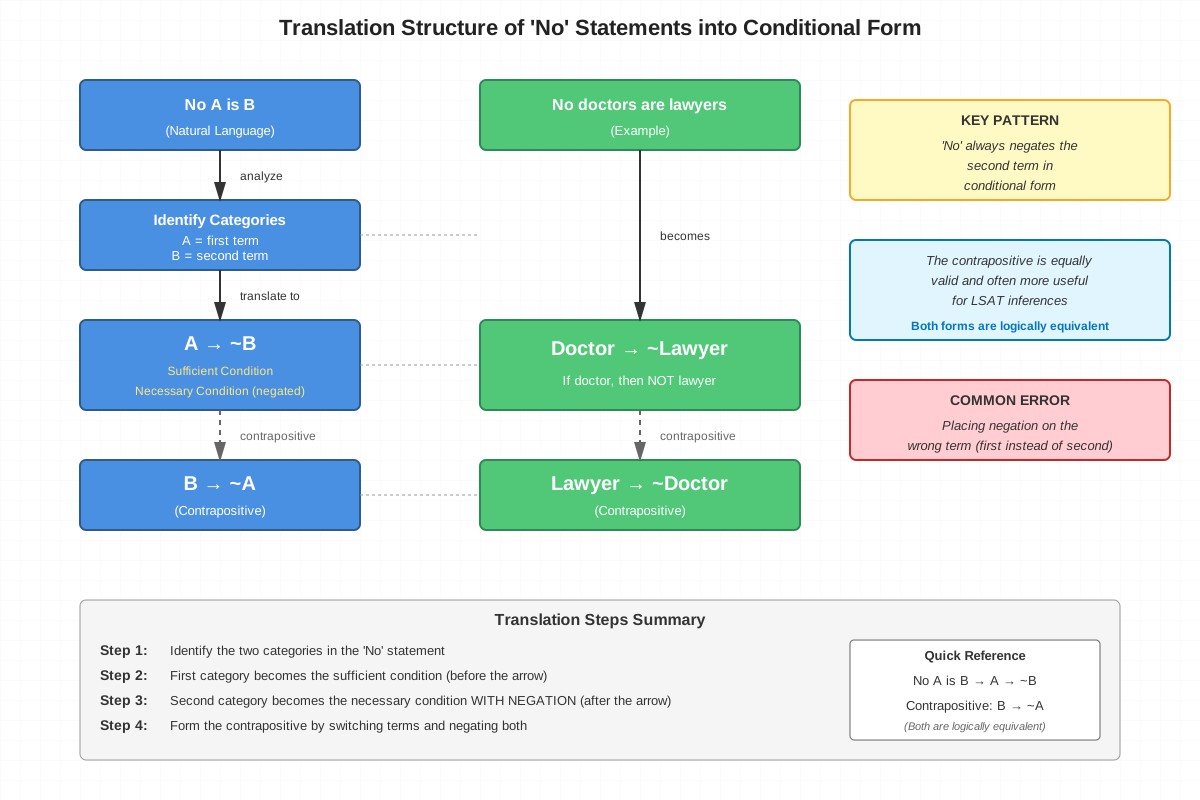
The fundamental translation rule states: "No A is B" translates to "If A, then NOT B" (symbolically: A → ~B). This translation captures the logical meaning that whenever something belongs to category A, it automatically excludes membership in category B. Understanding this translation is the foundation for all work with "no" statements in LSAT conditional statements with no contexts.
Translation Mechanics and Notation
The process of translating "no" statements into conditional notation follows a systematic approach:
- Identify the two terms connected by "no"
- Determine which term follows "no" (this becomes the sufficient condition)
- Make the first term the sufficient condition (the "if" part)
- Make the second term negated as the necessary condition (the "then not" part)
For example, "No lawyers are accountants" translates to: If lawyer → NOT accountant (L → ~A). The term immediately following "no" (lawyers) becomes the sufficient condition, and the second term (accountants) becomes the negated necessary condition.
Contrapositive Formation with "No" Statements
The contrapositive of a "no" statement follows standard contrapositive rules: reverse the terms and negate both. However, because "no" statements already contain negation, the contrapositive introduces a double negative that resolves to an affirmative.
Starting with: A → ~B
The contrapositive is: B → ~A
Using our example: If lawyer → NOT accountant (L → ~A)
Contrapositive: If accountant → NOT lawyer (A → ~L)
This contrapositive is logically equivalent to the original statement and equally valid for drawing inferences. Notably, both the original statement and its contrapositive express the same universal negative relationship—complete separation between the two categories.
Common Variations and Phrasings
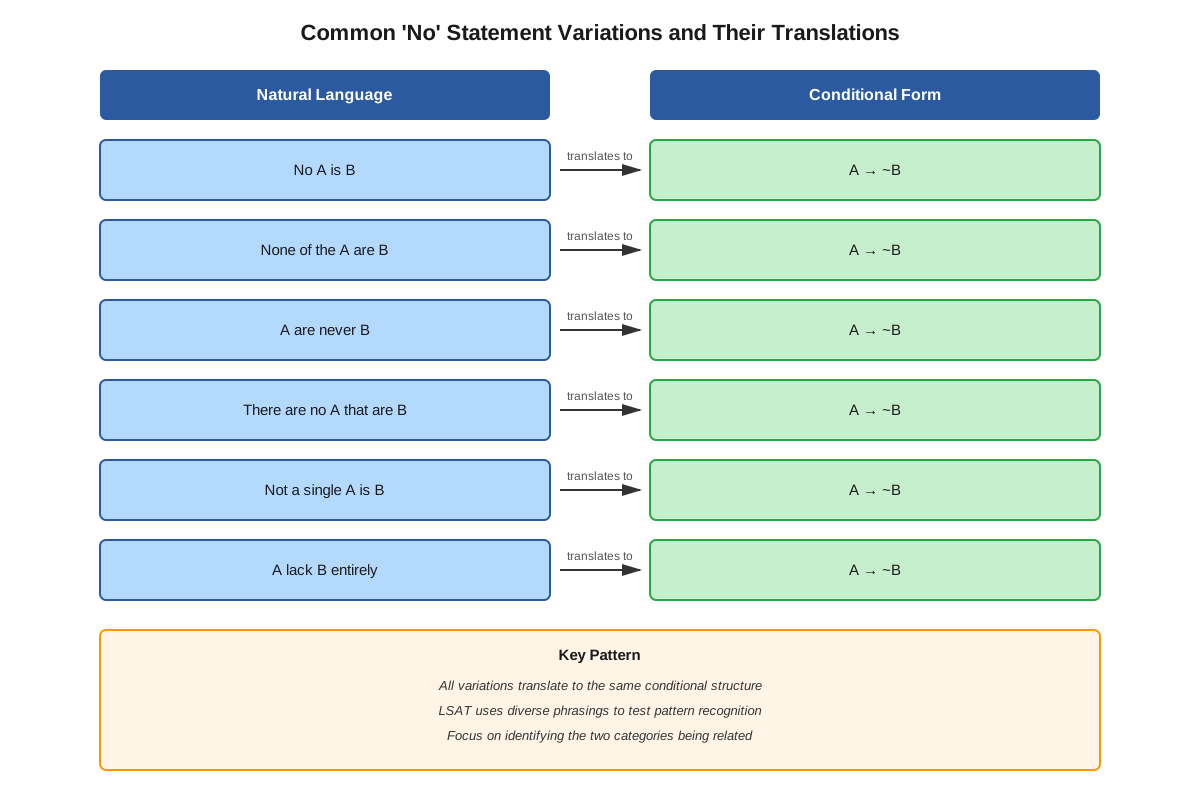
The LSAT presents "no" statements in multiple linguistic forms, all translating to the same logical structure:
| Phrasing | Example | Translation |
|---|---|---|
| No A is B | No doctors are lawyers | D → ~L |
| No A are B | No students are teachers | S → ~T |
| None of the A are B | None of the winners are professionals | W → ~P |
| There are no A that are B | There are no mammals that are fish | M → ~F |
| A is never B | A valid contract is never unenforceable | VC → ~U |
Each variation expresses the same logical relationship: complete exclusion between two categories. Recognizing these variations enables quick translation regardless of how the test presents the statement.
Distinguishing "No" from "Not" and "None"
A critical skill involves distinguishing "no" statements from superficially similar constructions:
- "No A is B" creates a conditional: A → ~B
- "A is not B" (about a specific individual) is a simple negation, not a conditional statement
- "Not all A are B" means "some A are not B," which is NOT equivalent to "no A is B"
- "None of the A are B" is equivalent to "no A is B" and translates identically
The distinction matters because the LSAT frequently includes answer choices that confuse these patterns. "Not all lawyers are wealthy" is vastly different from "No lawyers are wealthy"—the former allows that some lawyers might be wealthy, while the latter excludes all lawyers from wealth.
Chaining "No" Statements with Other Conditionals
Conditional logic often requires combining "no" statements with other conditional statements to reach valid conclusions. When chaining conditionals, the negation in "no" statements must be carefully tracked:
Given:
- No A is B (A → ~B)
- If C, then A (C → A)
Valid conclusion: If C, then NOT B (C → ~B)
The reasoning: If C triggers A, and A excludes B, then C must also exclude B. This chaining follows the transitive property of conditional logic while respecting the negation.
Invalid Inferences and Common Errors
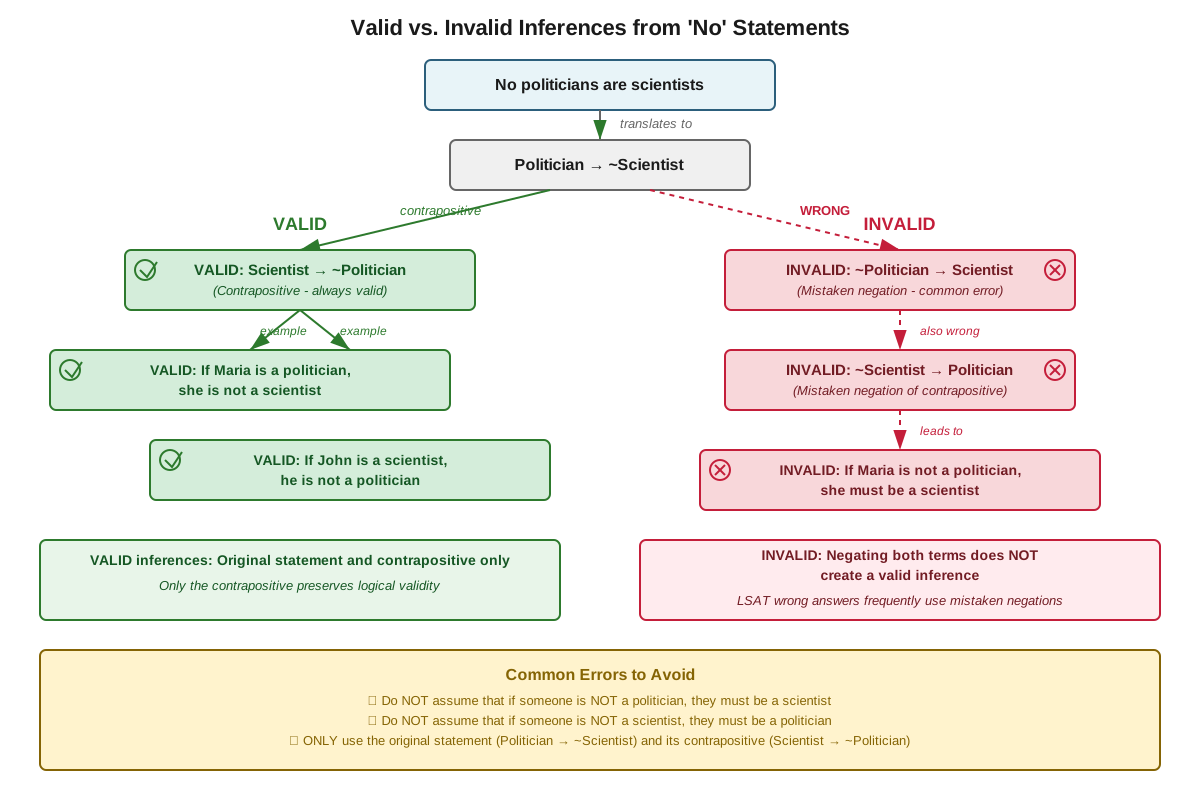
Several invalid inference patterns frequently appear in incorrect answer choices:
Invalid Pattern 1: Affirming the Necessary (Negated)
From "No A is B" (A → ~B), you CANNOT conclude "If NOT B, then A" (~B → A)
The contrapositive is "If B, then NOT A" (B → ~A), not the reverse.
Invalid Pattern 2: Assuming the Converse
From "No A is B" (A → ~B), you CANNOT conclude "No B is A" without additional reasoning
While this happens to be true for "no" statements due to their symmetric nature, it's not a valid inference from conditional form alone—it's a property of categorical exclusion.
Invalid Pattern 3: Mistranslation of Scope
"No successful lawyers are unprepared" (SL → ~U) does NOT mean "All lawyers are prepared"
It only tells us about successful lawyers, not all lawyers.
Concept Relationships
The concepts within conditional statements with no form an interconnected logical system. The basic translation rule (No A is B → A → ~B) serves as the foundation, from which contrapositive formation naturally follows. The contrapositive (B → ~A) represents the same logical relationship from a different perspective, and both forms are equally valid for drawing inferences.
Translation mechanics connect directly to variation recognition—understanding that multiple phrasings express identical logical structures. This recognition enables rapid processing of LSAT questions regardless of surface-level wording differences. Both translation and variation recognition feed into chaining operations, where "no" statements combine with other conditionals to generate valid conclusions.
The relationship to prerequisite knowledge flows as follows: Basic conditional logic → Sufficient/necessary conditions → Negation → "No" statements → Complex conditional chains. Each level builds on the previous, with "no" statements representing an intermediate complexity level that bridges simple conditionals and multi-conditional arguments.
Common error patterns relate inversely to valid inference rules—each invalid pattern represents a violation of proper conditional reasoning. Understanding why certain inferences fail reinforces understanding of why valid inferences succeed, creating a comprehensive mental model of conditional logic with negation.
Externally, this topic connects to: Sufficient Assumption questions (where "no" statements often provide the missing logical link), Necessary Assumption questions (where the argument depends on an unstated "no" relationship), Flaw questions (where arguments illegitimately infer "no" relationships), and Must Be True questions (where "no" statements in the stimulus support specific inferences).
High-Yield Facts
⭐ "No A is B" always translates to "If A, then NOT B" (A → ~B), with the term following "no" becoming the sufficient condition
⭐ The contrapositive of a "no" statement reverses and negates both terms, producing another valid "no" relationship (from A → ~B to B → ~A)
⭐ "No" statements express complete categorical exclusion—zero overlap between the two categories mentioned
⭐ "None of the A are B" is logically equivalent to "No A is B" and translates identically into conditional form
⭐ You cannot validly conclude "If NOT B, then A" from "No A is B"—this is the fallacy of affirming the necessary condition
- "Not all A are B" is fundamentally different from "No A is B"—the former allows some overlap, the latter allows none
- When chaining "no" statements with other conditionals, the negation must be tracked through each step of the chain
- "A is never B" translates identically to "No A is B" despite different surface structure
- The contrapositive of a "no" statement is also a "no" statement expressing the same mutual exclusion
- "No" statements can appear in disguised forms such as "completely excludes," "entirely incompatible with," or "mutually exclusive"
- Double negatives in contrapositives of "no" statements resolve to affirmatives (NOT NOT B = B)
- Scope limitations in "no" statements are critical—"No successful lawyers are unprepared" says nothing about unsuccessful lawyers
Quick check — test yourself on Conditional statements with no so far.
Try Flashcards →Common Misconceptions
Misconception: "No A is B" means the same as "All A are not B"
Correction: While these are logically equivalent, "All A are not B" is ambiguous in English (it could mean "not all A are B"). The conditional translation A → ~B captures the precise meaning without ambiguity.
Misconception: From "No A is B," you can conclude "If NOT B, then A"
Correction: This is the fallacy of affirming the necessary condition. The valid contrapositive is "If B, then NOT A" (B → ~A). NOT B tells you nothing definitive about A—there could be many things that are not B but also not A.
Misconception: "No" statements and "not" statements are interchangeable
Correction: "No A is B" creates a universal conditional relationship (A → ~B), while "A is not B" (about a specific instance) is simply a negation without conditional structure. The former applies to all members of category A; the latter applies to one specific thing.
Misconception: "No A is B" and "No B is A" require separate justification
Correction: While these are technically different conditional statements (A → ~B vs. B → ~A), they express the same categorical relationship of mutual exclusion. However, in formal conditional logic, one is the contrapositive of the other, so if one is true, the other must be true.
Misconception: You can chain "no" statements by matching the negated term
Correction: Chaining requires matching an affirmative necessary condition with an affirmative sufficient condition. From "A → ~B" and "~B → C," you cannot validly chain because ~B is a necessary condition in the first statement and a sufficient condition in the second. You would need "B → ~C" to chain with "A → ~B" (producing A → ~B → ~C, which is invalid). Valid chaining requires: A → ~B and C → A, yielding C → ~B.
Misconception: "Not all A are B" is just a weaker version of "No A is B"
Correction: These statements are categorically different. "Not all A are B" means "at least one A is not B" (some A are not B), which is compatible with most A being B. "No A is B" means "zero A are B," which is far stronger and completely excludes any overlap.
Misconception: The word order in "no" statements doesn't matter for translation
Correction: Word order is critical. "No lawyers are doctors" (L → ~D) is different from "No doctors are lawyers" (D → ~L). While these happen to be contrapositives expressing the same mutual exclusion, the translation process requires identifying which term follows "no" to determine the sufficient condition correctly.
Worked Examples
Example 1: Basic Translation and Inference
Problem: Consider the following statements:
- No professional athletes are full-time students.
- Maria is a professional athlete.
What can be validly concluded?
Solution:
Step 1: Translate the "no" statement into conditional form
"No professional athletes are full-time students" translates to:
If professional athlete → NOT full-time student
Symbolically: PA → ~FTS
Step 2: Identify what we know about Maria
We know: Maria is a professional athlete (PA)
Step 3: Apply the conditional rule
Since Maria satisfies the sufficient condition (she is a professional athlete), we can trigger the conditional and conclude the necessary condition must hold:
Maria is NOT a full-time student (~FTS)
Step 4: Consider the contrapositive
The contrapositive of our original statement is:
If full-time student → NOT professional athlete (FTS → ~PA)
This is equally valid but doesn't help us with Maria since we don't know whether she's a full-time student (we actually know she's not).
Valid Conclusion: Maria is not a full-time student.
Invalid Conclusions to Avoid:
- "All full-time students are not professional athletes" (this is the contrapositive, which is valid, but it's not what we concluded about Maria specifically)
- "Maria is a part-time student" (we only know she's NOT a full-time student; she might not be a student at all)
- "No full-time students are professional athletes" (this is the contrapositive expressed as a "no" statement, which is valid, but again not about Maria specifically)
Connection to Learning Objectives: This example demonstrates identification of "no" statements in LSAT-style problems, proper translation into conditional form, and application to reach valid conclusions while avoiding common invalid inferences.
Example 2: Complex Chaining with "No" Statements
Problem: Consider the following argument:
"No effective medications are without side effects. All medications approved by the FDA are effective medications. Therefore, no medications approved by the FDA are without side effects."
Evaluate whether this argument is valid.
Solution:
Step 1: Translate each statement into conditional form
Statement 1: "No effective medications are without side effects"
Translation: If effective medication → NOT without side effects
Or more clearly: If effective medication → HAS side effects
Symbolically: EM → SE
Statement 2: "All medications approved by the FDA are effective medications"
Translation: If FDA-approved → effective medication
Symbolically: FDA → EM
Conclusion: "No medications approved by the FDA are without side effects"
Translation: If FDA-approved → HAS side effects
Symbolically: FDA → SE
Step 2: Test whether the conclusion follows from the premises
We have:
- Premise 1: FDA → EM
- Premise 2: EM → SE
- Conclusion: FDA → SE
Step 3: Apply conditional chaining rules
When we have two conditionals where the necessary condition of one matches the sufficient condition of another, we can chain them:
FDA → EM (from premise 2)
EM → SE (from premise 1)
Therefore: FDA → SE (valid chain)
Step 4: Verify the conclusion
The conclusion (FDA → SE) is exactly what we derived from chaining the premises. The argument is VALID.
Step 5: Express in "no" statement form
FDA → SE can be expressed as: "No FDA-approved medications are without side effects" or equivalently "All FDA-approved medications have side effects."
Analysis: This argument demonstrates valid conditional chaining involving a "no" statement. The "no" statement in premise 1 creates a conditional (EM → SE) that chains with the "all" statement in premise 2 (FDA → EM) to produce a valid conclusion. This pattern appears frequently in Sufficient Assumption and Must Be True questions.
Connection to Learning Objectives: This example demonstrates the reasoning pattern behind conditional statements with no, shows how to apply these statements in complex logical chains, and illustrates the type of formal logic reasoning required for high-difficulty LSAT questions.
Exam Strategy
Recognition Triggers
When approaching LSAT Logical Reasoning questions, watch for these trigger words and phrases that signal "no" statements:
- "No [category] is/are [category]"
- "None of the [category] is/are [category]"
- "[Category] is never [category]"
- "There are no [category] that are [category]"
- "Completely excludes," "entirely incompatible," "mutually exclusive"
- "Cannot be both [X] and [Y]"
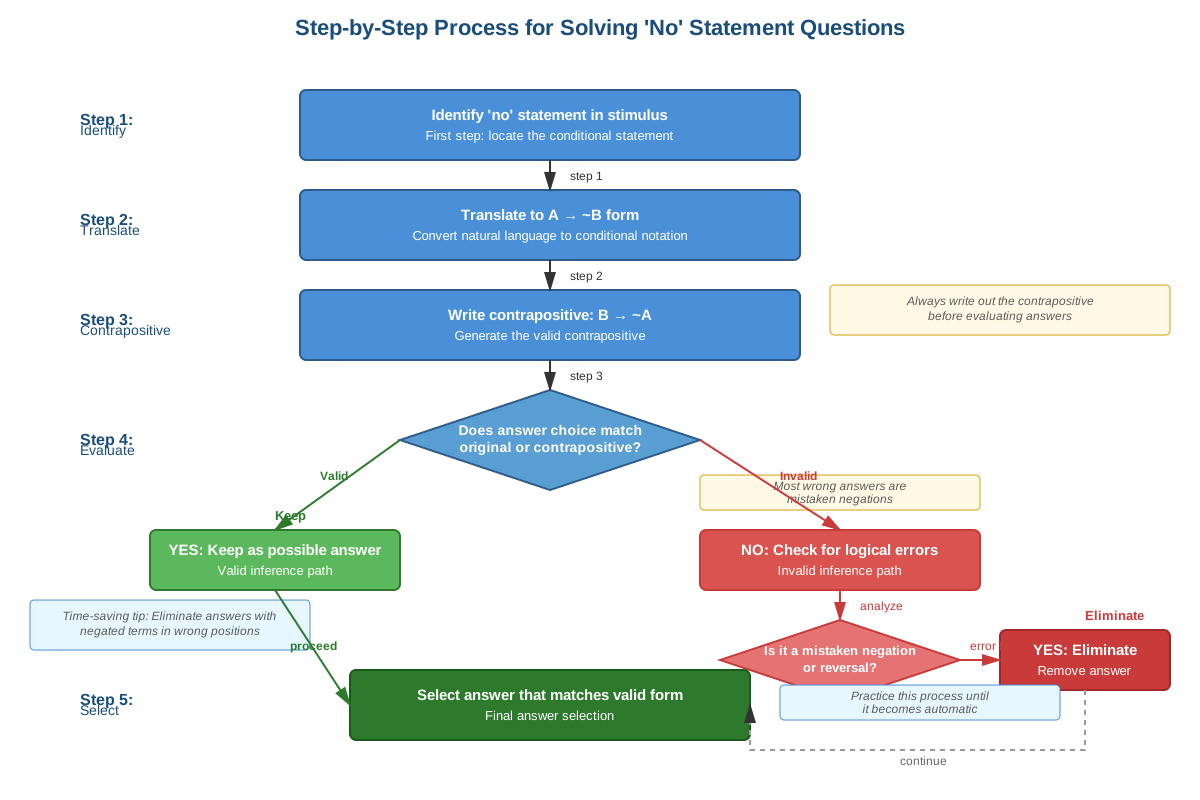
When you spot these triggers, immediately translate into conditional form (A → ~B) before attempting to answer the question. This translation should become automatic with practice.
Question Type Strategies
For Must Be True Questions:
- Translate all "no" statements in the stimulus into conditional notation
- Form the contrapositive of each "no" statement
- Look for chaining opportunities with other conditionals
- The correct answer will be a valid inference from your translations—often a contrapositive or chained conclusion
- Eliminate answers that commit the "affirming the necessary" fallacy
For Sufficient Assumption Questions:
- Identify the gap between premise and conclusion
- Determine if a "no" statement could bridge that gap
- The correct answer often provides a "no" statement that excludes a problematic category
- Test each answer by translating it and checking if it enables valid chaining to the conclusion
For Flaw Questions:
- Look for arguments that illegitimately conclude a "no" relationship
- Check whether the argument confuses "not all" with "no"
- Identify whether the argument commits the "affirming the necessary" fallacy with a "no" statement
- Watch for scope shifts where a "no" statement about a subset is applied to a larger category
Process of Elimination Tips
Eliminate answer choices that:
- Confuse "no" with "not all" or "some are not"
- Present the inverse rather than the contrapositive (If ~B → A instead of If B → ~A)
- Extend a "no" statement beyond its proper scope
- Affirm the necessary condition (conclude A from ~B when given A → ~B)
- Introduce new terms not connected to the "no" statement through valid chaining
Time Management
Allocate approximately:
- 15-20 seconds for translating "no" statements into conditional notation
- 10-15 seconds for forming the contrapositive
- 20-30 seconds for identifying valid chains or inferences
- 30-40 seconds for evaluating answer choices
Questions involving "no" statements often reward careful, systematic analysis over speed. If you encounter a complex conditional logic question with multiple "no" statements, it's worth investing the full 90 seconds to work through it methodically rather than rushing and missing the question.
Exam Tip: Write out your conditional translations in the test booklet margin. The physical act of writing "A → ~B" helps prevent mental errors and provides a reference for checking answer choices. This small time investment (5-10 seconds) significantly increases accuracy.
Memory Techniques
The "NO-GO" Mnemonic
Negation On the necessary side
Goes with the second term
Original term triggers it
This reminds you that in "No A is B," the negation appears on the necessary side (NOT B), goes with the second term mentioned (B), and the original first term (A) triggers the conditional.
The Contrapositive Flip Visualization
Visualize "no" statements as a wall between two categories. When you form the contrapositive, imagine flipping the wall around—it still separates the same two categories, just viewed from the opposite direction. This reinforces that A → ~B and B → ~A express the same mutual exclusion.
The "NONE = NO + ONE" Memory Aid
Remember that "NONE of the A are B" equals "NO A is B" by thinking: NONE = NO + ONE (meaning not even one A is B). This helps you recognize that "none" statements translate identically to "no" statements.
The Scope Spotlight Technique
When translating "no" statements, imagine a spotlight illuminating only the specific category mentioned. "No successful lawyers are unprepared" puts the spotlight on successful lawyers only—the statement says nothing about unsuccessful lawyers. This visualization prevents scope errors.
The Chain-Link Acronym: MATCH
Match the necessary to sufficient
Affirmative terms must align
Track negations through each step
Contrapositive if needed
Hold scope constant
This acronym guides you through chaining "no" statements with other conditionals, reminding you to match affirmative terms and track negations carefully.
Summary
Conditional statements with no represent a high-yield pattern in LSAT Logical Reasoning, appearing in 8-12% of questions across multiple question types. The fundamental translation rule—"No A is B" becomes "If A, then NOT B" (A → ~B)—serves as the foundation for all work with these statements. Mastery requires recognizing various phrasings ("none," "never," "completely excludes"), forming valid contrapositives (B → ~A), and chaining "no" statements with other conditionals while tracking negations precisely. Common errors include confusing "no" with "not all," affirming the necessary condition, and extending statements beyond their proper scope. Success on LSAT questions involving "no" statements demands systematic translation into conditional notation, careful attention to scope limitations, and recognition of valid versus invalid inference patterns. Students who develop fluency with these patterns gain significant advantages in speed and accuracy, particularly on Must Be True, Sufficient Assumption, and Flaw questions where conditional logic provides the most direct path to correct answers.
Key Takeaways
- "No A is B" translates to "If A, then NOT B" (A → ~B), with the first term as sufficient condition and the second term negated as necessary condition
- The contrapositive of a "no" statement (B → ~A) is equally valid and expresses the same mutual exclusion from the opposite perspective
- "None," "never," and "no" are logically equivalent in conditional contexts and translate identically into conditional form
- Valid chaining requires matching affirmative necessary conditions with affirmative sufficient conditions while carefully tracking negations through each step
- Scope limitations are critical—"no" statements apply only to the specific categories mentioned, not to broader or related categories
- Common invalid inferences include affirming the necessary condition (concluding A from ~B when given A → ~B) and confusing "no" with "not all"
- Systematic translation into conditional notation before attempting to answer questions dramatically increases accuracy and reduces time spent on difficult problems
Related Topics
Sufficient and Necessary Conditions: Understanding the distinction between conditions that trigger outcomes (sufficient) and conditions required for outcomes (necessary) provides the foundation for all conditional logic, including "no" statements. Mastering "no" statements reinforces this fundamental distinction.
Contrapositive Formation: The ability to form valid contrapositives extends beyond "no" statements to all conditional reasoning. Advanced work with contrapositives enables rapid evaluation of complex arguments and identification of logical equivalences.
Conditional Chains and Transitive Reasoning: Building on "no" statements, conditional chains involve linking multiple conditionals to reach distant conclusions. This skill is essential for the most challenging Logical Reasoning questions and appears frequently in Logic Games.
Formal Logic in Logic Games: The conditional reasoning skills developed through "no" statements apply directly to Logic Games, where rules often express conditional relationships. Students who master "no" statements find Logic Games rules easier to translate and manipulate.
Quantifiers and Categorical Logic: "No" statements connect to broader categorical logic involving "all," "some," and "none." Understanding how these quantifiers interact enables sophisticated reasoning about category relationships and set theory applications in LSAT questions.
Practice CTA
Now that you've mastered the core concepts of conditional statements with no, it's time to cement your understanding through active practice. Attempt the practice questions associated with this topic, focusing on translating each "no" statement into proper conditional notation before evaluating answer choices. Use the flashcards to drill the translation patterns until they become automatic—speed and accuracy on these foundational patterns will pay dividends across all Logical Reasoning question types.
Remember: conditional logic skills improve dramatically with deliberate practice. Each question you work through strengthens your pattern recognition and reduces the time needed to process these statements on test day. Approach practice systematically, reviewing both correct and incorrect answers to understand why certain inferences are valid while others fail. Your investment in mastering this high-yield topic will translate directly into points on test day. You've got this!
Sign up free to keep reading
Create a free AnvayaPrep account to finish this LSAT guide on Conditional statements with no — plus flashcards and practice questions.