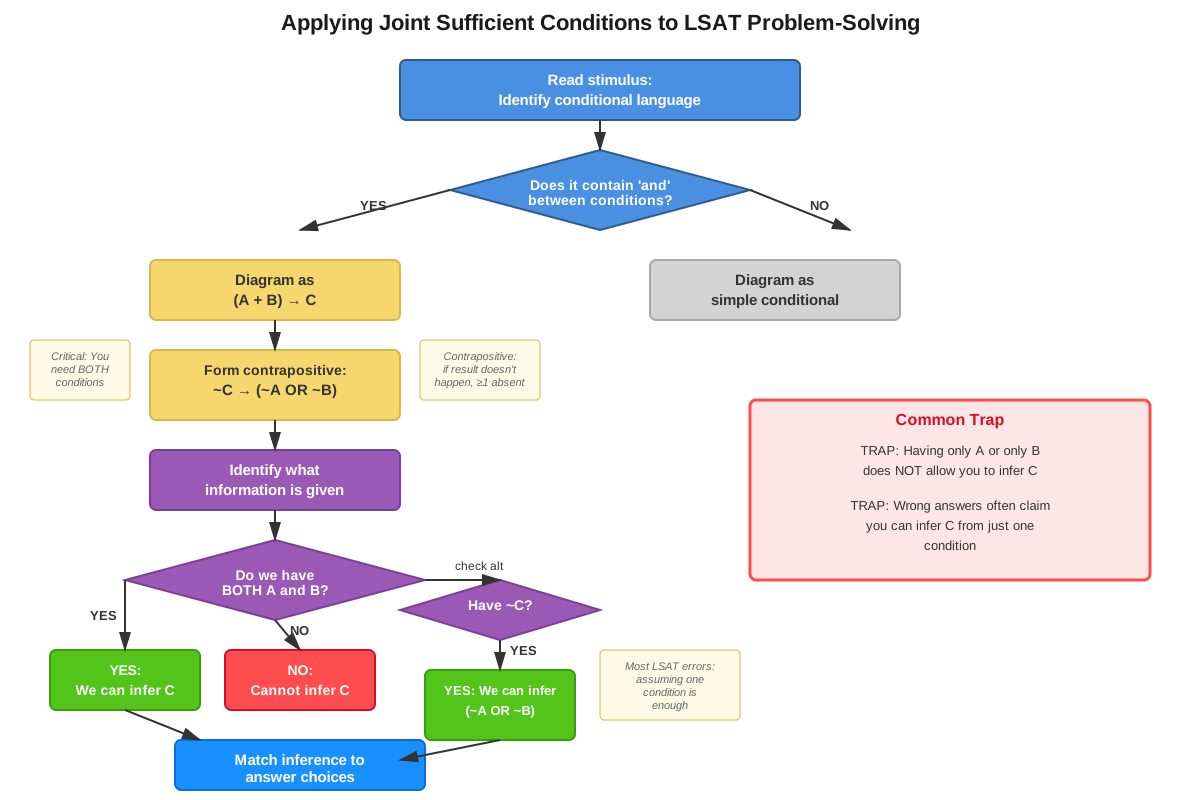
Overview
Joint sufficient conditions represent a critical pattern in conditional logic that appears frequently throughout the LSAT's Logical Reasoning sections. Unlike simple conditional statements where a single condition guarantees an outcome, joint sufficient conditions require two or more conditions to work together simultaneously to produce a necessary result. Understanding this pattern is essential because the LSAT regularly tests whether students can recognize when multiple factors must combine to trigger a consequence, and whether they can properly diagram and manipulate these more complex logical relationships.
This topic builds directly upon foundational conditional logic principles but adds a layer of complexity that distinguishes medium-difficulty questions from basic ones. The LSAT exploits students' tendency to oversimplify compound conditions, creating wrong answer choices that treat joint conditions as if they operate independently. Mastering joint sufficient conditions enables students to navigate Must Be True questions, Sufficient Assumption questions, and Parallel Reasoning questions with greater accuracy, particularly when stimulus arguments contain multiple moving parts that must align for a conclusion to follow.
Within the broader landscape of Logical Reasoning, joint sufficient conditions serve as a bridge between basic conditional statements and the most complex logical structures tested on the exam. This pattern appears not only in explicitly conditional language but also in causal reasoning, rule application scenarios, and argument evaluation contexts. Students who develop fluency with joint sufficient conditions gain a significant advantage in recognizing logical gaps, identifying necessary assumptions, and predicting valid inferences across multiple question types.
Learning Objectives
- [ ] Identify how joint sufficient conditions appears in LSAT questions
- [ ] Explain the reasoning pattern behind joint sufficient conditions
- [ ] Apply joint sufficient conditions to solve LSAT-style problems accurately
- [ ] Diagram joint sufficient conditions using proper logical notation
- [ ] Distinguish between joint sufficient conditions and alternative sufficient conditions
- [ ] Recognize the contrapositive of statements containing joint sufficient conditions
- [ ] Evaluate arguments that depend on joint sufficient conditions for their validity
Prerequisites
- Basic conditional logic notation: Understanding "if-then" statements and the arrow notation (A → B) is essential because joint sufficient conditions build upon this foundation by adding multiple elements to the sufficient condition side.
- Contrapositive formation: The ability to form contrapositives of simple conditionals is necessary because joint sufficient conditions have specific contrapositive rules that differ from simple statements.
- Logical operators (AND/OR): Familiarity with how "and" and "or" function logically is required because joint sufficient conditions fundamentally involve the conjunction of multiple conditions.
- Sufficient vs. necessary conditions: Clear understanding of the distinction between what guarantees an outcome (sufficient) versus what is required for an outcome (necessary) provides the conceptual framework for joint conditions.
Why This Topic Matters
Joint sufficient conditions appear in approximately 15-20% of Logical Reasoning questions across both LR sections, making them one of the most frequently tested advanced conditional logic patterns on the LSAT. This topic directly impacts performance on Must Be True questions, Sufficient Assumption questions, Necessary Assumption questions, Strengthen/Weaken questions involving conditional reasoning, and Parallel Reasoning questions that feature compound conditional structures.
In real-world contexts, joint sufficient conditions model how complex systems actually operate. Legal reasoning—the domain the LSAT is designed to assess—frequently involves situations where multiple criteria must be satisfied simultaneously for a legal consequence to follow. For example, establishing liability often requires proving multiple elements together: duty, breach, causation, and damages. Contract formation requires offer, acceptance, and consideration working in concert. Understanding joint sufficient conditions prepares students not just for the LSAT but for the type of multi-factor analysis central to legal practice.
On the exam, joint sufficient conditions most commonly appear in three contexts: (1) stimulus arguments that establish rules requiring multiple conditions, (2) answer choices in Sufficient Assumption questions where the correct answer must bridge multiple gaps simultaneously, and (3) Must Be True questions where students must recognize what can be validly inferred when all joint conditions are satisfied or when one joint condition fails. The LSAT particularly favors testing whether students understand that failing to meet even one joint condition means the sufficient condition is not satisfied, preventing the necessary condition from being guaranteed.
Core Concepts
Definition and Structure
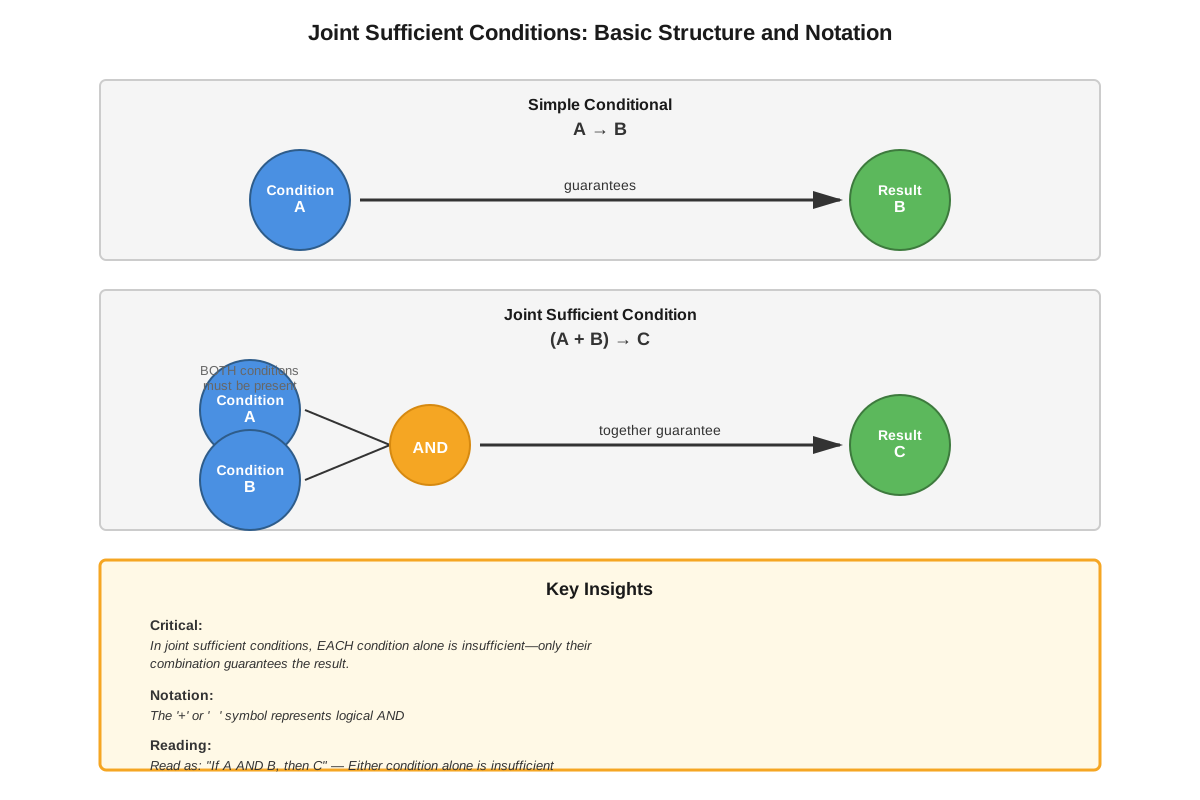
Joint sufficient conditions occur when two or more conditions must all be present simultaneously to guarantee a necessary outcome. The logical structure can be represented as: (A AND B) → C, where both A and B must occur together for C to be guaranteed. This differs fundamentally from simple conditionals where a single sufficient condition triggers the necessary condition.
The "joint" aspect is critical: these conditions operate as a team, not as alternatives. If either condition is absent, the sufficient condition as a whole is not satisfied, and the necessary condition is not guaranteed to occur. This creates a higher threshold for triggering the consequence than simple conditionals provide.
Logical Notation and Diagramming
The standard notation for joint sufficient conditions uses the plus sign (+) or the word "AND" between conditions on the sufficient side:
A + B → C
or
(A AND B) → C
This notation explicitly shows that A and B must both be present to guarantee C. Some students prefer using parentheses to emphasize that the joint conditions function as a single unit. The key is maintaining consistency and clarity in notation to avoid confusion during timed exam conditions.
The Contrapositive of Joint Sufficient Conditions
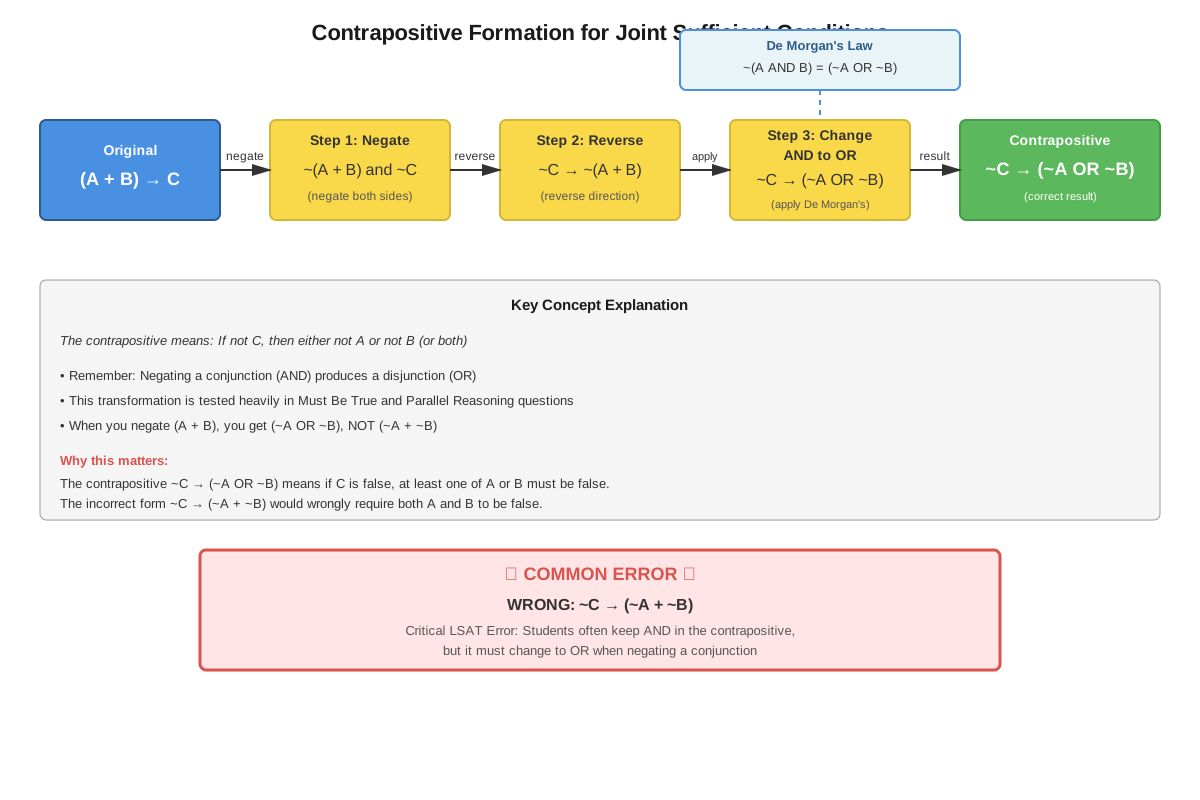
Understanding the contrapositive of joint sufficient conditions is essential for LSAT success. When forming the contrapositive, the joint sufficient conditions transform according to De Morgan's Law:
Original: A + B → C
Contrapositive: ~C → ~A OR ~B
This transformation is counterintuitive for many students. When the necessary condition fails to occur (~C), at least one of the joint sufficient conditions must be absent. However, we cannot determine which specific condition is absent—it could be A, could be B, or could be both. The contrapositive uses "OR" because negating a conjunction (AND) produces a disjunction (OR).
This principle has significant practical implications for LSAT questions. If you know the necessary condition did not occur, you can infer that the joint sufficient conditions were not all present together, but you cannot conclude that any specific condition was definitely absent.
Distinguishing Joint from Alternative Sufficient Conditions
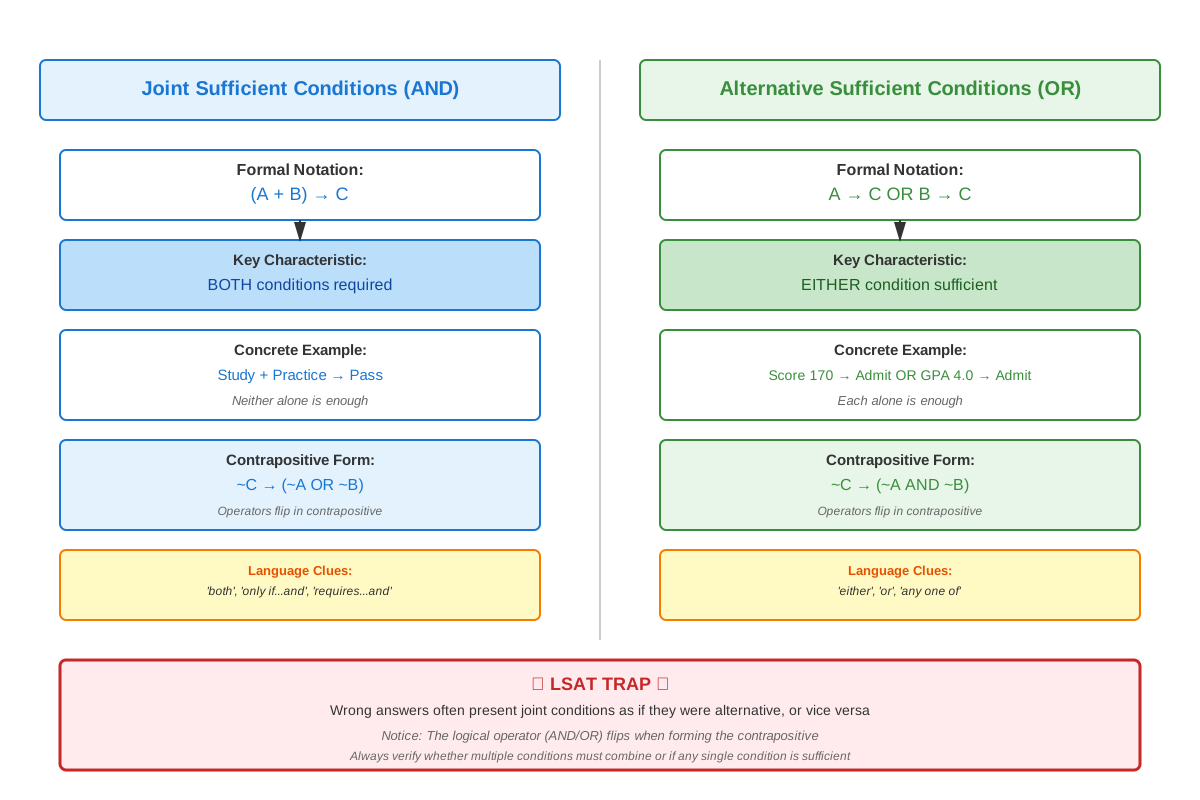
A critical distinction exists between joint sufficient conditions and alternative sufficient conditions:
| Joint Sufficient Conditions | Alternative Sufficient Conditions |
|---|---|
| A + B → C | A → C OR B → C |
| Both conditions required | Either condition alone suffices |
| Higher threshold to trigger | Lower threshold to trigger |
| Contrapositive: ~C → ~A OR ~B | Contrapositive: ~C → ~A AND ~B |
| Language: "both," "all," "requires" | Language: "either," "or," "any" |
The LSAT frequently tests whether students can distinguish these patterns. Wrong answer choices often confuse joint and alternative conditions, treating situations that require multiple factors as if any single factor would suffice, or vice versa.
Trigger Language for Joint Sufficient Conditions
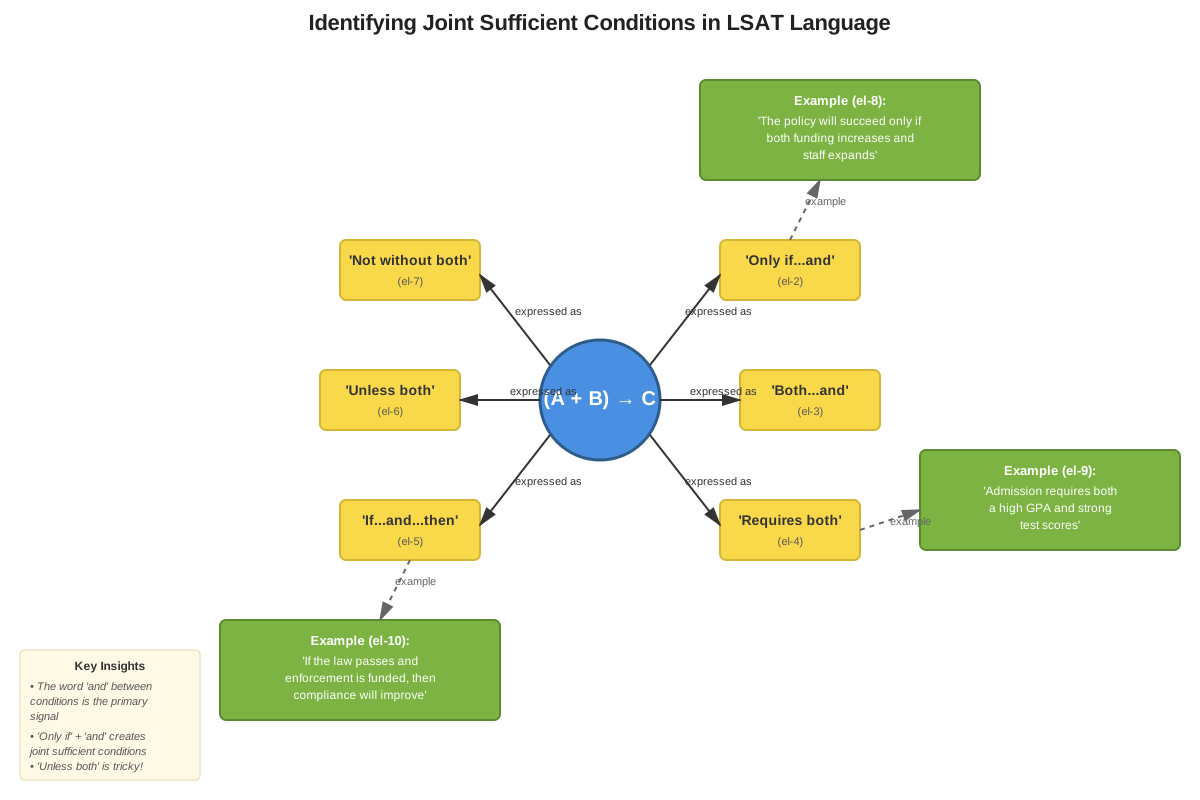
Recognizing joint sufficient conditions requires attention to specific linguistic markers:
- "Both...and": "Both a valid license and insurance are required to operate legally"
- "All": "All applicants must have a degree and experience"
- "Requires" (with multiple objects): "Admission requires a high GPA and strong recommendations"
- "Only if...and": "You succeed only if you study and practice"
- "Unless...and": "The project fails unless we have funding and approval"
- Multiple conditions in the antecedent: "If you have talent and work hard, you will succeed"
Satisfying vs. Failing Joint Sufficient Conditions
Understanding what happens when joint sufficient conditions are or are not met is crucial for inference questions:
When ALL joint conditions are satisfied: The necessary condition is guaranteed. If A + B → C, and both A and B occur, then C must occur.
When ANY joint condition fails: The sufficient condition as a whole is not satisfied, and the necessary condition is not guaranteed. If A + B → C, and A occurs but B does not, we cannot conclude anything definite about C—it might occur or might not occur.
This asymmetry creates common trap answers on the LSAT. Students often incorrectly assume that if one joint condition is present, the necessary condition is somewhat likely or partially guaranteed. In formal logic, partial satisfaction of joint sufficient conditions provides no guarantee whatsoever.
Multiple Sets of Joint Sufficient Conditions
Some LSAT stimuli present multiple different sets of joint sufficient conditions that can each independently guarantee the same necessary condition:
(A + B) → E
(C + D) → E
In this structure, either the combination of A and B together, or the combination of C and D together, would guarantee E. This represents alternative pathways, each of which has its own joint requirements. The contrapositive becomes: ~E → (~A OR ~B) AND (~C OR ~D), meaning if E doesn't occur, at least one condition from the first pair is absent AND at least one condition from the second pair is absent.
Concept Relationships
Joint sufficient conditions build directly upon simple conditional logic by adding complexity to the sufficient condition side. The progression moves from "A → B" (simple conditional) to "A + B → C" (joint sufficient conditions) to potentially "A + B → C + D" (joint sufficient conditions with joint necessary conditions, though this is less common on the LSAT).
The relationship to contrapositive formation is bidirectional: understanding basic contrapositives enables students to form contrapositives of joint conditions, while mastering joint condition contrapositives deepens understanding of logical negation and De Morgan's Laws. This creates a reinforcing cycle where each concept strengthens the other.
Joint sufficient conditions connect to necessary assumptions in argument structure. When an argument's conclusion depends on multiple factors working together, any assumption that one of those factors is present becomes necessary for the argument's validity. Recognizing joint sufficient conditions helps identify these multiple necessary assumptions.
The relationship map flows as follows:
Simple Conditionals → adds complexity → Joint Sufficient Conditions → requires understanding → De Morgan's Laws → enables → Complex Contrapositive Formation → applies to → Argument Analysis → improves performance on → Multiple Question Types
Additionally, joint sufficient conditions relate to causal reasoning when multiple causes must combine to produce an effect, and to formal logic rules in Logic Games when multiple conditions must be satisfied simultaneously for a valid arrangement.
High-Yield Facts
⭐ Joint sufficient conditions require ALL listed conditions to be present simultaneously to guarantee the necessary condition.
⭐ The contrapositive of "A + B → C" is "~C → ~A OR ~B" (the AND becomes OR when negated).
⭐ If even one joint sufficient condition is absent, the necessary condition is NOT guaranteed to occur.
⭐ Language markers like "both...and," "requires," and "all" frequently signal joint sufficient conditions.
⭐ Satisfying only some joint sufficient conditions provides zero logical guarantee about the necessary condition.
- Joint sufficient conditions create a higher threshold for triggering consequences than simple sufficient conditions.
- Multiple different sets of joint sufficient conditions can each independently guarantee the same necessary condition.
- The LSAT frequently creates wrong answers by treating joint conditions as if they operate independently.
- When the necessary condition occurs, you cannot conclude that the joint sufficient conditions occurred (affirming the consequent fallacy).
- Joint sufficient conditions appear most frequently in Must Be True, Sufficient Assumption, and Parallel Reasoning questions.
Quick check — test yourself on Joint sufficient conditions so far.
Try Flashcards →Common Misconceptions
Misconception: If one of the joint sufficient conditions is present, the necessary condition is somewhat likely or partially guaranteed.
Correction: In formal logic, partial satisfaction of joint sufficient conditions provides no guarantee whatsoever about the necessary condition. All joint conditions must be present for the guarantee to apply; otherwise, the necessary condition might occur or might not occur based on factors outside the conditional relationship.
Misconception: The contrapositive of "A + B → C" is "~C → ~A + ~B" (keeping the AND).
Correction: The contrapositive must apply De Morgan's Law, transforming the AND into OR: "~C → ~A OR ~B." This means if C doesn't occur, at least one of the joint conditions must be absent, but we cannot determine which specific one.
Misconception: Joint sufficient conditions and necessary conditions are the same thing because both involve multiple requirements.
Correction: Joint sufficient conditions involve multiple factors on the sufficient (triggering) side that together guarantee an outcome. Multiple necessary conditions would involve multiple requirements on the necessary (guaranteed) side. These are distinct logical structures with different implications.
Misconception: If the necessary condition occurs, the joint sufficient conditions must have all been present.
Correction: This commits the fallacy of affirming the consequent. The necessary condition might occur for reasons entirely unrelated to the joint sufficient conditions. Conditionals only guarantee one direction: from sufficient to necessary, not the reverse.
Misconception: "A or B → C" represents joint sufficient conditions.
Correction: This represents alternative sufficient conditions, where either A alone or B alone would be sufficient to guarantee C. Joint sufficient conditions require "A and B → C," where both must be present together.
Misconception: In joint sufficient conditions, the order in which the conditions occur matters.
Correction: Joint sufficient conditions require simultaneous presence (or presence within the relevant timeframe), but the order is irrelevant. "A + B → C" has the same logical meaning as "B + A → C."
Worked Examples
Example 1: Must Be True Question
Stimulus: "A student receives honors only if that student both maintains a GPA above 3.5 and completes an independent research project. Chen maintained a GPA above 3.5 this semester."
Question: Which of the following must be true?
Analysis:
Step 1: Identify and diagram the conditional relationship. The phrase "only if" indicates the necessary condition, so we need to reverse the order:
Honors → (GPA > 3.5) + Research ProjectStep 2: Form the contrapositive using De Morgan's Law:
~(GPA > 3.5) OR ~Research Project → ~HonorsThis means: If either the GPA requirement is not met OR the research project is not completed, then the student does not receive honors.
Step 3: Analyze what we know. Chen maintained a GPA above 3.5, which satisfies one of the two joint sufficient conditions for the contrapositive's necessary condition (not receiving honors) to be avoided. However, we know nothing about whether Chen completed a research project.
Step 4: Evaluate what must be true:
- Can we conclude Chen receives honors? No—we don't know if Chen completed the research project, and both conditions are required.
- Can we conclude Chen doesn't receive honors? No—Chen might have completed the research project, satisfying both joint conditions.
- Can we conclude that if Chen doesn't receive honors, Chen didn't complete the research project? No—Chen might not have received honors for other reasons not covered by this conditional.
Correct inference: We cannot make any definite conclusion about whether Chen receives honors based solely on the GPA information. The only thing we can conclude is that if Chen did not complete a research project, Chen definitely did not receive honors (from the original conditional).
Example 2: Sufficient Assumption Question
Stimulus: "The new policy will reduce traffic congestion. After all, the policy will increase public transportation usage."
Question: Which of the following, if assumed, would allow the conclusion to be properly drawn?
Analysis:
Step 1: Identify the argument structure:
- Premise: Policy increases public transportation usage
- Conclusion: Policy reduces traffic congestion
- Gap: No explicit connection between increased public transportation and reduced congestion
Step 2: Recognize that this requires a sufficient assumption—something that, if true, guarantees the conclusion follows from the premise.
Step 3: Consider what joint sufficient conditions might be needed. The premise gives us one condition (increased public transportation usage). What else might be needed to guarantee reduced congestion?
Step 4: Evaluate answer choices (hypothetical):
(A) "Increased public transportation usage always reduces traffic congestion."
- This creates: Increased PT → Reduced congestion
- This would be sufficient alone, but might be stronger than necessary
(B) "If public transportation usage increases and fewer people drive personal vehicles, traffic congestion will be reduced."
- This creates: Increased PT + Fewer personal vehicles → Reduced congestion
- This requires an additional condition beyond what the premise provides
- This would NOT be sufficient because we don't know if fewer people will drive personal vehicles
(C) "Whenever public transportation usage increases, fewer people drive personal vehicles."
- This creates: Increased PT → Fewer personal vehicles
- Combined with answer choice B's logic, this could work, but it's not presented as a joint condition
Correct approach: The sufficient assumption must bridge the gap using only what's given in the premise. Answer choice (A) provides a simple sufficient condition that guarantees the conclusion. Answer choice (B) introduces joint sufficient conditions but fails to establish that both conditions are met. Understanding joint sufficient conditions helps eliminate (B) because recognizing that it requires an additional unestablished condition reveals it as insufficient.
Exam Strategy
When approaching LSAT questions involving joint sufficient conditions, follow this systematic process:
Step 1: Identify trigger language. Scan for words like "both," "all," "requires" (with multiple objects), "only if...and," or multiple conditions connected by "and" in conditional contexts. These signal potential joint sufficient conditions requiring careful diagramming.
Step 2: Diagram immediately and accurately. Use consistent notation (A + B → C) and write out the contrapositive (~C → ~A OR ~B) before evaluating answer choices. This prevents errors under time pressure and creates a visual reference for eliminating wrong answers.
Step 3: Check for partial satisfaction traps. The LSAT loves creating wrong answer choices that assume partial satisfaction of joint conditions provides some guarantee. Actively look for answers that conclude something definite when only one of multiple joint conditions is established.
Step 4: Apply the contrapositive strategically. Many correct answers depend on recognizing what must be true when the necessary condition fails. If you see that the necessary condition didn't occur, immediately reference your contrapositive to determine what can be inferred about the joint sufficient conditions.
Exam Tip: In Sufficient Assumption questions, wrong answers frequently introduce joint sufficient conditions when a simple sufficient condition would work, or fail to establish that all joint conditions are met. Always verify that the assumption actually guarantees the conclusion given only what's in the premise.
Time allocation: Spend an extra 10-15 seconds carefully diagramming joint sufficient conditions and their contrapositives. This upfront investment typically saves 30-45 seconds by making answer choice elimination faster and more accurate.
Process of elimination: Eliminate any answer choice that:
- Treats joint conditions as if they operate independently
- Concludes something definite from partial satisfaction of joint conditions
- Confuses joint sufficient conditions with alternative sufficient conditions
- Reverses the conditional without negating (affirming the consequent)
- Negates both joint conditions when only one needs to be negated in the contrapositive
Memory Techniques
Mnemonic for contrapositive transformation: "AND to OR when you negate the door" (the "door" being the necessary condition that serves as the gateway). When you negate the necessary condition and form the contrapositive, the AND connecting joint sufficient conditions becomes OR.
Visualization strategy: Picture joint sufficient conditions as two keys required to open a lock. Both keys must be inserted simultaneously for the lock to open (necessary condition). If you have only one key, the lock remains closed. This physical metaphor reinforces that partial satisfaction provides no guarantee.
Acronym for evaluation: BATS
- Both conditions present? (Check if all joint conditions are satisfied)
- All or nothing (Partial satisfaction = no guarantee)
- Transform to OR (Contrapositive changes AND to OR)
- Sufficient side (Joint conditions appear on the sufficient/triggering side)
Memory aid for trigger language: "BEAR hugs require both arms" - Both, Every, All, Requires (with multiple objects) signal joint sufficient conditions.
Summary
Joint sufficient conditions represent a critical pattern in LSAT conditional logic where two or more conditions must all be present simultaneously to guarantee a necessary outcome. Diagrammed as "A + B → C," these structures require careful attention to ensure all conditions are satisfied before concluding the necessary condition occurs. The contrapositive of joint sufficient conditions follows De Morgan's Law, transforming "A + B → C" into "~C → ~A OR ~B," meaning if the necessary condition fails, at least one joint condition must be absent. The LSAT frequently tests whether students recognize that partial satisfaction of joint sufficient conditions provides no logical guarantee about the necessary condition—all joint conditions must be present for the guarantee to apply. Mastering this topic requires fluency in identifying trigger language, accurately diagramming both the original conditional and its contrapositive, and avoiding common traps that treat joint conditions as if they operate independently. This pattern appears across multiple question types, particularly Must Be True, Sufficient Assumption, and Parallel Reasoning questions, making it essential for achieving high scores in Logical Reasoning sections.
Key Takeaways
- Joint sufficient conditions require ALL listed conditions to be present simultaneously to guarantee the necessary condition; partial satisfaction provides zero guarantee
- The contrapositive of joint sufficient conditions transforms AND into OR: "A + B → C" becomes "~C → ~A OR ~B"
- Trigger language including "both...and," "all," "requires" (with multiple objects), and "only if...and" signals joint sufficient conditions
- The LSAT creates trap answers by treating joint conditions as if they operate independently or by assuming partial satisfaction provides some guarantee
- Distinguishing joint sufficient conditions from alternative sufficient conditions is critical—joint requires all conditions together, alternative requires any one condition alone
- Accurate diagramming and contrapositive formation are essential skills that prevent errors under time pressure
- Joint sufficient conditions appear frequently in Must Be True, Sufficient Assumption, and Parallel Reasoning questions, making them high-yield for score improvement
Related Topics
Alternative Sufficient Conditions: Understanding how "A → C OR B → C" differs from joint sufficient conditions enables students to distinguish between situations where any single condition suffices versus situations requiring multiple conditions together. This distinction appears frequently in Parallel Reasoning questions.
Formal Logic in Logic Games: Joint sufficient conditions form the foundation for complex rules in Logic Games, where multiple conditions must be satisfied simultaneously for valid game board configurations. Mastering this topic in Logical Reasoning transfers directly to improved Logic Games performance.
Necessary Assumptions with Multiple Gaps: Arguments that depend on joint sufficient conditions often have multiple necessary assumptions, one for each joint condition. Understanding joint sufficient conditions enables more sophisticated analysis of argument structure.
Causal Reasoning with Multiple Causes: When arguments claim that multiple factors must combine to produce an effect, they implicitly invoke joint sufficient conditions. This connection helps students analyze and evaluate causal arguments more effectively.
Practice CTA
Now that you've mastered the core concepts of joint sufficient conditions, it's time to cement your understanding through active practice. Attempt the practice questions designed specifically for this topic, focusing on accurately identifying joint conditions, forming contrapositives, and avoiding partial satisfaction traps. Use the flashcards to drill trigger language recognition and contrapositive formation until these skills become automatic. Remember: understanding joint sufficient conditions gives you a significant competitive advantage on the LSAT, as many test-takers struggle with this pattern. Your investment in mastering this medium-difficulty topic will pay dividends across multiple question types and both Logical Reasoning sections. Approach each practice question methodically, diagram carefully, and review both correct and incorrect answers to refine your reasoning process. You're building the logical precision that distinguishes top LSAT performers!
Sign up free to keep reading
Create a free AnvayaPrep account to finish this LSAT guide on Joint sufficient conditions — plus flashcards and practice questions.