Overview
Necessary conditions form one of the two fundamental pillars of conditional logic on the LSAT, alongside sufficient conditions. Understanding necessary conditions is absolutely critical for success in Logical Reasoning sections, as they appear in approximately 20-25% of all LR questions either directly or as part of more complex logical structures. A necessary condition represents something that must be true whenever a given statement is true—it's a requirement that cannot be absent. For example, having oxygen is a necessary condition for human survival; without oxygen, survival is impossible. On the LSAT, recognizing necessary conditions allows test-takers to properly diagram conditional statements, identify logical flaws, evaluate arguments, and predict valid inferences.
The LSAT tests necessary conditions across multiple question types, including Must Be True, Sufficient Assumption, Necessary Assumption, Strengthen/Weaken, and Flaw questions. Mastering this concept enables students to quickly translate complex verbal statements into clear logical relationships, avoid common reasoning errors, and eliminate wrong answer choices with confidence. The ability to distinguish necessary conditions from sufficient conditions—and to understand their asymmetric relationship—separates high scorers from average performers.
Within the broader landscape of Logical Reasoning, necessary conditions connect intimately with formal logic, argument structure, and inference patterns. They serve as building blocks for understanding contrapositive relationships, conditional chains, and the logical force of various argument structures. Students who master necessary conditions gain a powerful analytical tool that applies not only to explicitly conditional statements but also to implicit logical relationships embedded throughout LSAT passages.
Learning Objectives
- [ ] Identify how Necessary condition appears in LSAT questions
- [ ] Explain the reasoning pattern behind Necessary condition
- [ ] Apply Necessary condition to solve LSAT-style problems accurately
- [ ] Distinguish necessary conditions from sufficient conditions in complex statements
- [ ] Construct valid contrapositives using necessary condition relationships
- [ ] Recognize the full range of linguistic indicators that signal necessary conditions
- [ ] Evaluate argument validity by testing whether necessary conditions are satisfied
Prerequisites
- Basic propositional logic: Understanding of "if-then" statements provides the foundation for conditional relationships
- Logical operators: Familiarity with AND, OR, and NOT operations enables manipulation of complex conditional statements
- Argument structure: Recognizing premises and conclusions helps identify where conditional logic functions within arguments
- Formal notation basics: Comfort with symbolic representation (arrows, letters) facilitates efficient diagramming of conditional relationships
Why This Topic Matters
Necessary conditions appear throughout everyday reasoning, legal arguments, scientific hypotheses, and policy debates. In law—the field the LSAT prepares students for—necessary conditions define legal requirements, contractual obligations, and constitutional protections. Understanding what must be present for a legal standard to be met is fundamental to legal analysis. For instance, "probable cause" is a necessary condition for obtaining a search warrant; without it, the warrant is invalid.
On the LSAT specifically, necessary conditions appear in approximately 8-12 questions per test across both Logical Reasoning sections. They feature prominently in:
- Necessary Assumption questions (15-20% of LR): Identifying what must be true for an argument to work
- Sufficient Assumption questions (8-10% of LR): Understanding what's needed versus what's enough
- Must Be True/Inference questions (12-15% of LR): Deriving valid conclusions from conditional premises
- Flaw questions (15-18% of LR): Recognizing when arguments confuse necessary and sufficient conditions
- Strengthen/Weaken questions (20-25% of LR): Evaluating whether necessary conditions are met or undermined
The LSAT frequently tests whether students can recognize that satisfying a necessary condition does not guarantee the sufficient condition occurs—a logical error called "affirming the consequent." Questions also test whether students understand that failing to meet a necessary condition guarantees the sufficient condition cannot occur. These patterns recur across hundreds of official LSAT questions, making necessary condition mastery a high-yield investment of study time.
Core Concepts
Definition and Logical Structure
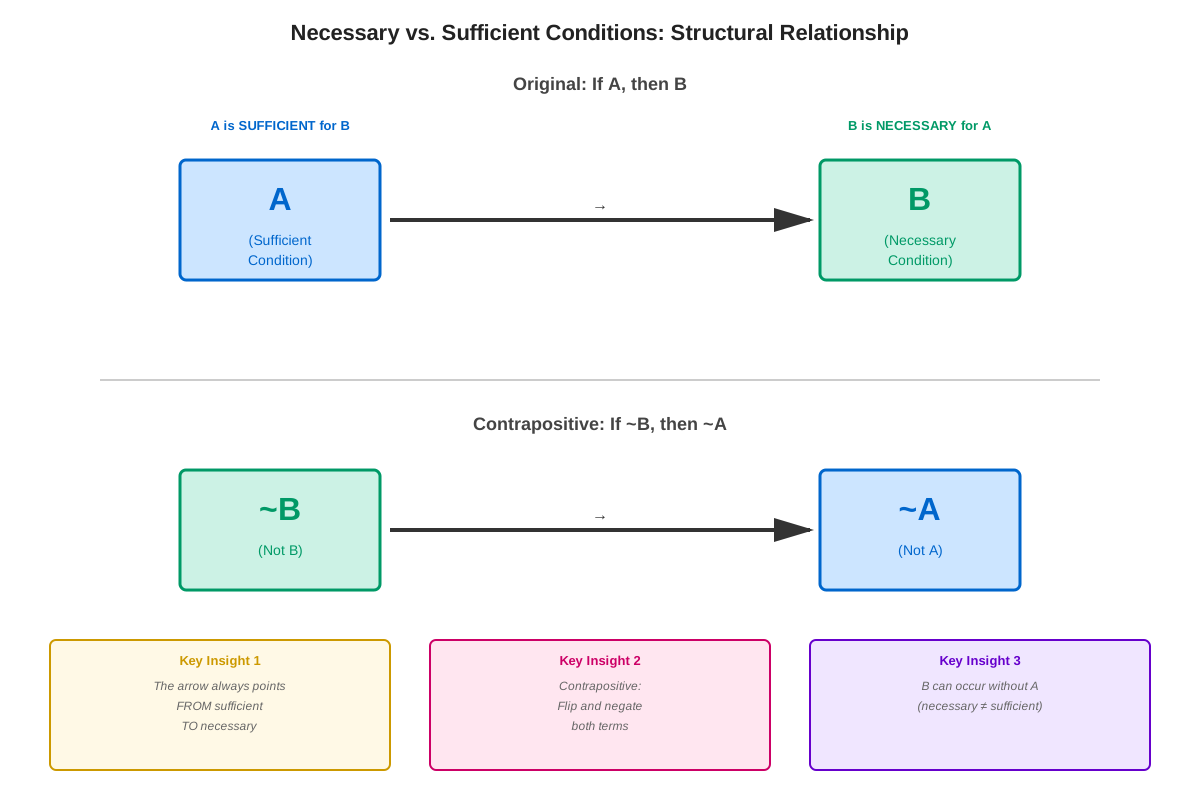
A necessary condition is a condition that must be present whenever a particular statement or event is true. In the conditional statement "If A, then B," B represents the necessary condition. The statement asserts that A cannot be true without B also being true. However—and this is crucial—B can be true without A being true. The relationship is one-directional: A requires B, but B does not require A.
The formal structure can be represented as:
- Conditional statement: A → B
- Reading: "If A, then B" or "A only if B"
- Meaning: A is sufficient for B; B is necessary for A
- Logical force: Whenever A is true, B must be true; if B is false, A must be false
The necessary condition (B) represents the minimum requirement. Without it, the sufficient condition (A) cannot occur. Think of necessary conditions as gatekeepers: they don't guarantee entry, but without them, entry is impossible.
Linguistic Indicators of Necessary Conditions
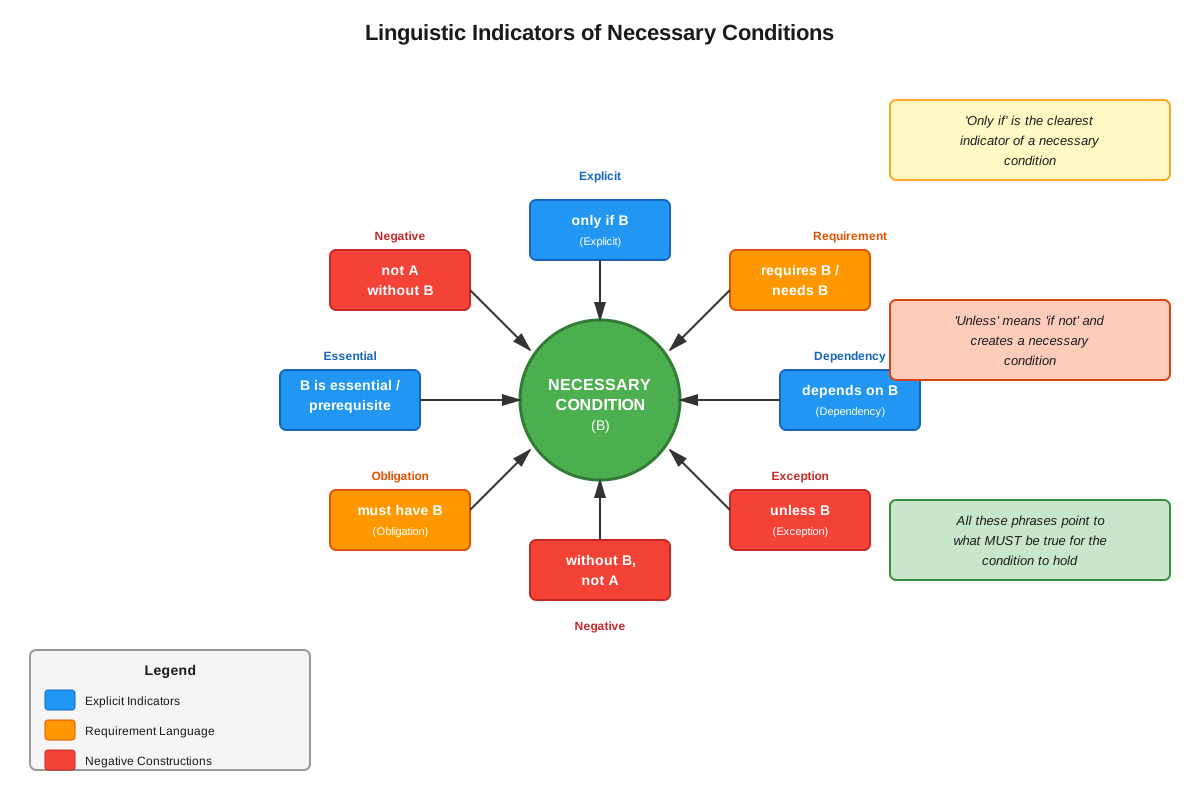
The LSAT uses diverse language to express necessary conditions, and recognizing these indicators is essential for accurate diagramming. Unlike sufficient condition indicators (which typically use "if"), necessary condition indicators are more varied:
| Indicator Phrase | Example | Diagram |
|---|---|---|
| only if | "You pass only if you study" | Pass → Study |
| requires | "Admission requires a degree" | Admission → Degree |
| depends on | "Success depends on effort" | Success → Effort |
| necessary for | "Oxygen is necessary for fire" | Fire → Oxygen |
| unless | "You fail unless you study" | ~Study → Fail (or Pass → Study) |
| without | "Without water, plants die" | Plants alive → Water |
| must | "To vote, you must register" | Vote → Register |
| need | "You need a ticket to enter" | Enter → Ticket |
The word "only" is particularly important. "Only if" introduces a necessary condition, while "if and only if" indicates both necessary and sufficient conditions (a biconditional relationship). The LSAT frequently tests whether students recognize this distinction.
The Contrapositive Relationship
Every conditional statement has a logically equivalent contrapositive formed by negating both conditions and reversing their order. Understanding contrapositives is essential because they represent the same logical relationship from a different angle:
- Original: A → B (If A, then B)
- Contrapositive: ~B → ~A (If not B, then not A)
These statements are logically equivalent—they always have the same truth value. If the original is true, the contrapositive must be true, and vice versa. This relationship is powerful on the LSAT because:
- It allows inference of new information from conditional premises
- It helps identify valid versus invalid reasoning patterns
- It reveals when necessary conditions are violated
For example:
- Original: "If you're a lawyer, then you passed the bar exam" (Lawyer → Passed Bar)
- Contrapositive: "If you didn't pass the bar exam, then you're not a lawyer" (~Passed Bar → ~Lawyer)
The contrapositive makes explicit what was implicit: passing the bar is necessary for being a lawyer, so failing the bar guarantees you're not a lawyer.
Necessary vs. Sufficient Conditions
The distinction between necessary and sufficient conditions is among the most tested concepts on the LSAT. Many wrong answer choices exploit confusion between these two types:
Sufficient Condition (the "if" part):
- Guarantees the necessary condition
- Is enough to produce the result
- Can occur in multiple ways
- Example: Being a dog is sufficient for being a mammal
Necessary Condition (the "then" part):
- Is required for the sufficient condition
- Does not guarantee the sufficient condition
- Must be present but may not be enough alone
- Example: Being a mammal is necessary for being a dog
A helpful analogy: Having a key (sufficient) is enough to open a lock, but the lock being unlocked (necessary result) doesn't tell you which key was used or even if a key was used at all (maybe it was picked).
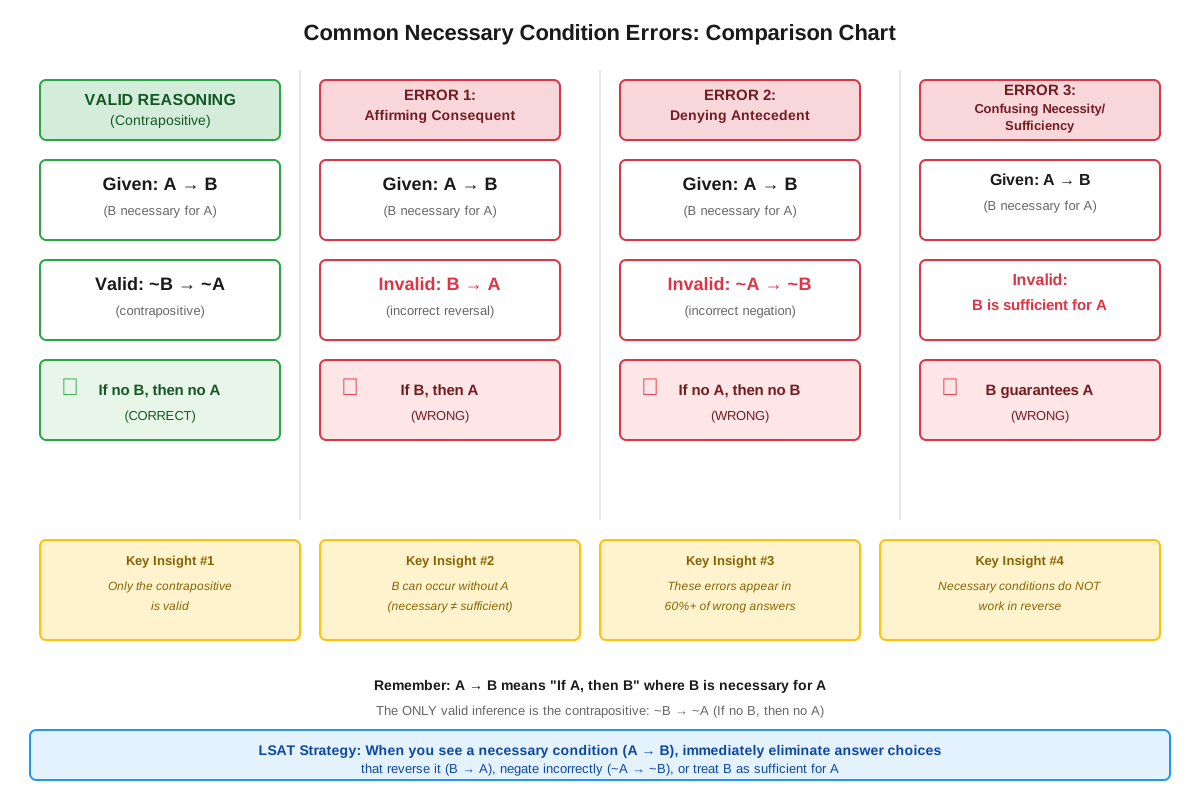
Common Logical Errors Involving Necessary Conditions
The LSAT frequently features arguments that commit logical errors related to necessary conditions:
1. Affirming the Consequent (Affirming the Necessary Condition)
- Pattern: A → B; B is true; therefore A is true
- Error: Assumes that because a necessary condition is met, the sufficient condition must have occurred
- Example: "If it rained, the ground is wet. The ground is wet. Therefore, it rained." (The ground could be wet from a sprinkler)
2. Denying the Antecedent (Denying the Sufficient Condition)
- Pattern: A → B; A is false; therefore B is false
- Error: Assumes that because the sufficient condition didn't occur, the necessary condition cannot be true
- Example: "If it rained, the ground is wet. It didn't rain. Therefore, the ground isn't wet." (Again, sprinklers exist)
3. Confusing Necessity with Sufficiency
- Error: Treating a necessary condition as if it were sufficient
- Example: "A college degree is necessary for this job, so getting a degree guarantees you'll get the job." (The degree is required but not enough alone)
Multiple Necessary Conditions
Some statements require multiple necessary conditions, all of which must be satisfied:
- Statement: "To graduate, you must complete coursework AND pass exams AND pay fees"
- Diagram: Graduate → (Coursework AND Exams AND Fees)
- Contrapositive: ~Coursework OR ~Exams OR ~Fees → ~Graduate
If any single necessary condition fails, the sufficient condition cannot occur. This creates multiple ways to prevent the sufficient condition but only one way to achieve it (satisfying all necessary conditions).
Conversely, when multiple sufficient conditions exist for a single necessary condition:
- Statement: "If you're a doctor OR a lawyer OR an engineer, then you have professional training"
- Diagram: Doctor OR Lawyer OR Engineer → Professional Training
- Meaning: Any one of these is sufficient; professional training is necessary for all
Concept Relationships
Necessary conditions form the foundation of conditional logic, which itself is central to formal reasoning on the LSAT. The relationship map flows as follows:
Basic Conditional Logic → Necessary Conditions → Contrapositive Reasoning → Conditional Chains → Complex Argument Analysis
Within necessary condition reasoning itself:
- Identification of indicators → enables → Accurate diagramming
- Accurate diagramming → enables → Contrapositive formation
- Contrapositive formation → enables → Valid inference generation
- Understanding necessity vs. sufficiency → prevents → Logical fallacies
Necessary conditions connect to prerequisite topics:
- Propositional logic provides the formal framework for expressing necessary conditions symbolically
- Argument structure shows where necessary conditions function (often as unstated assumptions)
- Logical operators combine with necessary conditions to create complex conditional statements
Necessary conditions also enable progression to advanced topics:
- Conditional chains: Linking multiple conditionals where one statement's necessary condition becomes another's sufficient condition
- Formal logic games: Many Logic Games rules are conditional statements requiring necessary condition analysis
- Assumption questions: Necessary assumptions are literally necessary conditions for argument validity
High-Yield Facts
⭐ A necessary condition must be true whenever the sufficient condition is true, but can be true even when the sufficient condition is false
⭐ The contrapositive of any conditional statement is logically equivalent to the original statement
⭐ "Only if" introduces a necessary condition, not a sufficient condition (common trap)
⭐ Satisfying a necessary condition does NOT guarantee the sufficient condition occurs (affirming the consequent fallacy)
⭐ Failing to meet a necessary condition DOES guarantee the sufficient condition cannot occur
- The word "unless" typically introduces a necessary condition and means "if not"
- Multiple necessary conditions connected by AND must all be satisfied; if any fails, the sufficient condition cannot occur
- Multiple sufficient conditions connected by OR mean any one is enough to guarantee the necessary condition
- "If and only if" creates a biconditional where each condition is both necessary and sufficient for the other
- Necessary conditions often appear as unstated assumptions in LSAT arguments
- The phrase "required for" or "requirement for" signals a necessary condition
- Temporal language like "before" can indicate necessary conditions (X must happen before Y means X is necessary for Y)
- Necessary conditions can be negated: "A only if not B" means A → ~B
Quick check — test yourself on Necessary condition so far.
Try Flashcards →Common Misconceptions
Misconception: "Only if" means the same as "if" and introduces a sufficient condition.
Correction: "Only if" introduces a necessary condition. "You pass only if you study" means Pass → Study, not Study → Pass. The sufficient condition comes before "only if."
Misconception: If a necessary condition is satisfied, the sufficient condition must have occurred.
Correction: Necessary conditions can be true without the sufficient condition being true. If "rain → wet ground," wet ground doesn't prove it rained (sprinklers, flooding, etc. could cause wet ground). This is the affirming the consequent fallacy.
Misconception: If the sufficient condition doesn't occur, the necessary condition cannot be true.
Correction: The sufficient condition is just one way (not the only way) for the necessary condition to be true. If it doesn't rain, the ground can still be wet from other causes. This is the denying the antecedent fallacy.
Misconception: Necessary and sufficient conditions are interchangeable or symmetric.
Correction: The relationship is asymmetric and directional. A → B does not mean B → A. Being a dog is sufficient for being a mammal, but being a mammal is not sufficient for being a dog.
Misconception: "Unless" means "if" and introduces a sufficient condition.
Correction: "Unless" typically means "if not" and introduces a necessary condition. "You fail unless you study" means ~Study → Fail, which contraposes to Pass → Study (studying is necessary for passing).
Misconception: Meeting all necessary conditions guarantees the sufficient condition will occur.
Correction: Necessary conditions are required but may not be sufficient. A job might require a degree, experience, and references (all necessary), but having all three doesn't guarantee getting the job—they might also need to be the best candidate.
Misconception: The contrapositive changes the meaning of a conditional statement.
Correction: The contrapositive is logically equivalent to the original statement—it expresses the exact same relationship from a different perspective. Both are always true together or false together.
Worked Examples
Example 1: Identifying and Diagramming Necessary Conditions
Passage: "The company will expand internationally only if it secures additional funding. Without additional funding, the expansion cannot proceed. However, securing funding does not guarantee expansion, as market conditions must also be favorable."
Step 1: Identify conditional statements and their indicators
- "only if" signals a necessary condition
- "without" signals a necessary condition (via contrapositive)
- "does not guarantee" explicitly states that funding is not sufficient
Step 2: Diagram the relationships
- "Expand only if secure funding" → Expand → Funding
- "Without funding, cannot expand" → ~Funding → ~Expand (contrapositive: Expand → Funding)
- Both statements express the same relationship: funding is necessary for expansion
Step 3: Identify what is NOT stated
- Funding → Expand is explicitly denied
- The passage states funding is necessary but not sufficient
- Favorable market conditions are mentioned as an additional requirement
Step 4: Valid inferences
- If the company expands, it must have secured funding (original statement)
- If the company doesn't secure funding, it won't expand (contrapositive)
- If the company secures funding, we cannot conclude it will expand (funding is necessary, not sufficient)
Step 5: Invalid inferences (common wrong answers)
- "The company secured funding, so it will expand" (affirming the consequent)
- "The company didn't expand, so it didn't secure funding" (denying the antecedent—maybe it got funding but market conditions weren't favorable)
Connection to Learning Objectives: This example demonstrates how to identify necessary condition indicators in LSAT passages, diagram the relationships accurately, and distinguish valid from invalid inferences—directly addressing all three primary learning objectives.
Example 2: Necessary Assumption Question
Argument: "The new medication will be approved by the FDA because it has been proven safe in clinical trials. All medications proven safe in clinical trials receive FDA approval."
Question: Which of the following is a necessary assumption of the argument?
Step 1: Identify the argument structure
- Premise: The medication has been proven safe in clinical trials
- Conclusion: The medication will be approved by the FDA
- Stated principle: Safe in trials → FDA approval
Step 2: Diagram the logical structure
- Safe in trials → FDA approval
- This medication is safe in trials
- Therefore, this medication will get FDA approval
Step 3: Identify the logical gap
- The argument assumes the stated principle is accurate and complete
- The argument assumes nothing else is required for FDA approval beyond safety in trials
- The argument assumes the medication actually completed proper clinical trials
Step 4: Test potential necessary assumptions
- Assumption A: "Efficacy in clinical trials is not required for FDA approval"
- Test by negation: If efficacy IS required, and we only know about safety, the conclusion fails
- This IS a necessary assumption
- Assumption B: "The medication is more effective than existing treatments"
- Test by negation: If it's not more effective, does the conclusion fail?
- No—the argument only claims approval, not superiority
- This is NOT necessary
- Assumption C: "The clinical trials followed proper FDA protocols"
- Test by negation: If trials didn't follow protocols, "proven safe" might not count
- The conclusion would fail
- This IS a necessary assumption
Step 5: Apply the Negation Test
The negation test is crucial for necessary assumptions: negate the assumption and see if the argument falls apart. If it does, the assumption is necessary.
Connection to Learning Objectives: This example shows how necessary condition reasoning underlies necessary assumption questions—the correct answer provides a condition that must be true for the argument to work, demonstrating application of necessary condition logic to LSAT problem-solving.
Exam Strategy
Recognition Triggers
When approaching LSAT questions, watch for these triggers that signal necessary condition reasoning:
Explicit indicators in the stimulus:
- "only if," "only when," "only where"
- "requires," "depends on," "relies on"
- "necessary," "prerequisite," "requirement"
- "unless," "without," "except"
- "must," "need," "cannot...without"
Question stem language:
- "Which of the following is a necessary assumption?"
- "The argument requires which of the following?"
- "Which of the following must be true?"
- "The conclusion depends on which assumption?"
Systematic Approach
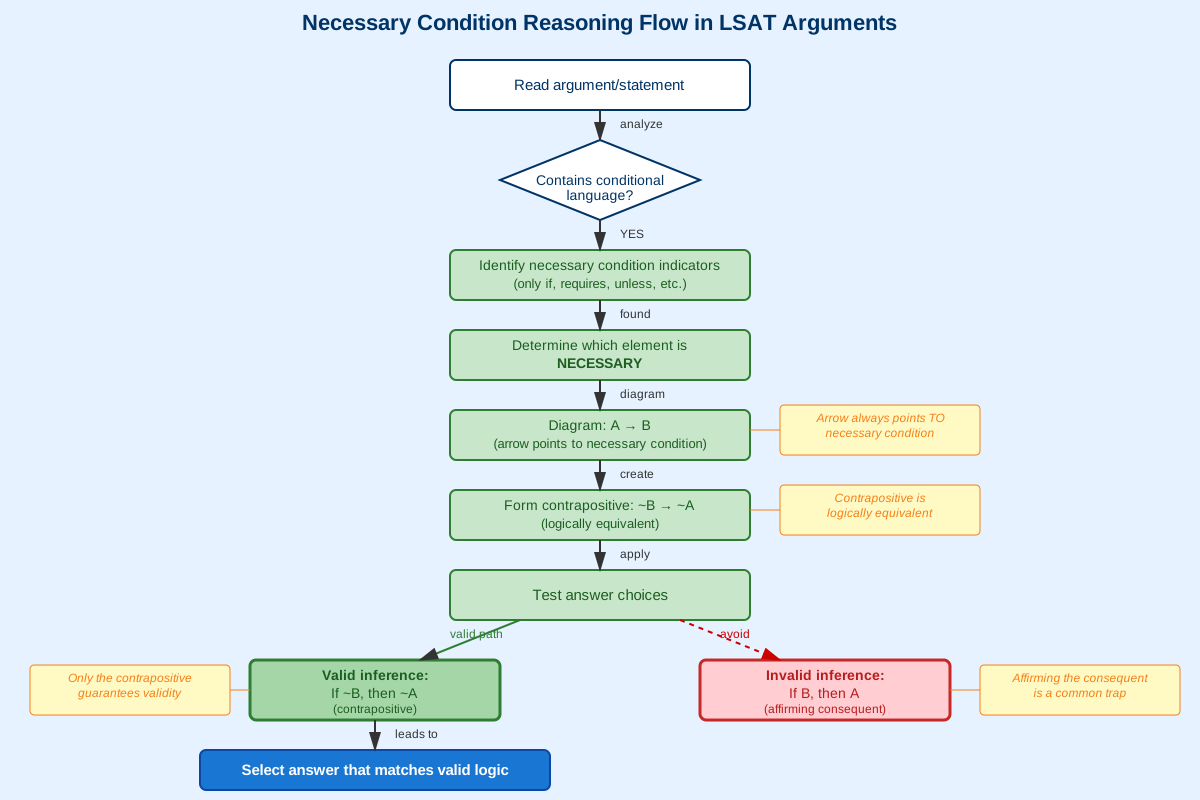
For Must Be True/Inference Questions:
- Diagram all conditional statements in the stimulus
- Form contrapositives of each conditional
- Look for conditional chains (where one statement's necessary condition matches another's sufficient condition)
- Eliminate answers that affirm the consequent or deny the antecedent
- Select the answer that follows validly from the conditionals
For Necessary Assumption Questions:
- Identify the conclusion and main premise
- Diagram any conditional logic present
- Spot the logical gap between premise and conclusion
- Apply the Negation Test: negate each answer choice and see if the argument falls apart
- The correct answer, when negated, destroys the argument
For Flaw Questions:
- Check if the argument confuses necessary and sufficient conditions
- Look for affirming the consequent (assuming that because a necessary condition is met, the sufficient condition occurred)
- Look for denying the antecedent (assuming that because the sufficient condition didn't occur, the necessary condition is false)
- Check if the argument treats a necessary condition as if it were sufficient
Process of Elimination Tips
Eliminate answers that:
- Reverse the conditional relationship (treat necessary as sufficient or vice versa)
- State something that could be false while the argument still works (for necessary assumptions)
- Go beyond what can be validly inferred from the conditionals
- Introduce new sufficient conditions when the question asks about necessary conditions
- Confuse "some" with "all" in conditional relationships
Time Management
- Diagramming decision: Diagram when you see 2+ conditional statements or complex nested conditions; otherwise, track mentally
- Time allocation: Spend 15-20 seconds identifying and diagramming conditionals, then 30-40 seconds evaluating answers
- Skip signals: If you can't identify the conditional structure within 30 seconds, mark and return later
- Confidence check: Before selecting an answer, verify it doesn't commit the affirming/denying fallacies
Exam Tip: The LSAT rarely tests necessary conditions in isolation. Most questions combine necessary condition reasoning with other logical elements. Always check for conditional chains, embedded conditionals, and quantifier interactions.
Memory Techniques
The "ONLY" Mnemonic
Opposite of what you think
Necessary, not sufficient
Look for what comes after
You need it, but it's not enough
When you see "only if," remember it introduces the necessary condition (opposite of "if"), and what comes after "only if" is what's needed.
The Arrow Direction Rule
"If" points forward → "Only if" points backward
- "If A, then B" = A → B
- "A only if B" = A → B (same direction!)
- The sufficient condition always goes on the left of the arrow
The Contrapositive Flip-and-Negate
Flip the order
Negate both terms
Original: A → B
Contrapositive: ~B → ~A
Visualize physically flipping the statement and adding "not" to both sides.
The "Unless" Translation
Unless = If Not
"A unless B" = "If not B, then A" = ~B → A
Contrapositive: ~A → B (which often makes more intuitive sense)
Example: "You fail unless you study" = "If you don't study, you fail" = ~Study → Fail
The Necessity Test Visualization
Imagine necessary conditions as foundations of a building:
- The building (sufficient condition) cannot exist without the foundation (necessary condition)
- But having a foundation doesn't mean a building will be built
- If there's no foundation, there's definitely no building
- Multiple foundations might be needed (multiple necessary conditions)
Summary
Necessary conditions represent requirements that must be satisfied for a given statement to be true, forming one half of the fundamental conditional relationship tested extensively on the LSAT. In the conditional statement "If A, then B," B is the necessary condition—it must be true whenever A is true, though B can be true without A. Recognizing necessary conditions requires familiarity with diverse linguistic indicators including "only if," "requires," "depends on," "unless," and "without." The contrapositive relationship (~B → ~A) is logically equivalent to the original conditional and enables valid inferences. The LSAT frequently tests whether students can distinguish necessary from sufficient conditions, avoid the fallacies of affirming the consequent and denying the antecedent, and identify necessary assumptions that arguments depend upon. Mastering necessary conditions requires accurate diagramming, systematic application of the contrapositive, and careful attention to the asymmetric nature of conditional relationships. This skill appears across multiple question types and represents a high-yield investment for test preparation.
Key Takeaways
- Necessary conditions must be present for the sufficient condition to occur, but their presence alone doesn't guarantee the sufficient condition
- "Only if" introduces a necessary condition; what comes after "only if" is required but not sufficient
- The contrapositive (~B → ~A) is always logically equivalent to the original conditional (A → B)
- Affirming the consequent (assuming necessary condition satisfaction proves sufficient condition occurrence) is a logical fallacy
- Necessary assumptions are conditions that must be true for an argument to be valid; use the Negation Test to identify them
- Multiple necessary conditions connected by AND must all be satisfied; failure of any one prevents the sufficient condition
- Necessary condition reasoning appears in 20-25% of Logical Reasoning questions across multiple question types
Related Topics
Sufficient Conditions: The complementary concept to necessary conditions; understanding both and their relationship is essential for complete mastery of conditional logic. Sufficient conditions guarantee outcomes while necessary conditions are required for them.
Contrapositive Reasoning: Building directly on necessary condition understanding, contrapositive reasoning enables inference of new information and identification of logically equivalent statements—a powerful tool for Must Be True questions.
Conditional Chains: Linking multiple conditional statements where one statement's necessary condition becomes another's sufficient condition, creating extended logical sequences that appear frequently in both Logical Reasoning and Logic Games.
Formal Logic in Logic Games: Many Logic Games rules are conditional statements requiring the same necessary condition analysis skills, making this topic essential for both major scored sections.
Necessary Assumptions: A specific question type that directly applies necessary condition reasoning to argument analysis, typically appearing 4-5 times per test.
Practice CTA
Now that you've mastered the core concepts of necessary conditions, it's time to cement your understanding through active practice. Attempt the practice questions associated with this topic, focusing on accurately identifying necessary condition indicators, diagramming conditional relationships, and forming valid contrapositives. Use the flashcards to drill the linguistic indicators until recognition becomes automatic—speed and accuracy in identifying "only if," "unless," and "requires" will save you valuable time on test day. Remember that necessary condition reasoning is a skill that improves dramatically with deliberate practice. Each question you work through strengthens your pattern recognition and logical intuition. You're building one of the most valuable skills for LSAT success—keep practicing, and watch your confidence and accuracy soar!
Sign up free to keep reading
Create a free AnvayaPrep account to finish this LSAT guide on Necessary condition — plus flashcards and practice questions.