Overview
Argument direction is a fundamental concept in LSAT logical reasoning that refers to the trajectory or flow of reasoning within an argument—specifically, whether the argument is building toward a conclusion that supports, opposes, or qualifies a particular position. Understanding argument direction is crucial for success on evaluate and complete the argument questions, where test-takers must identify what information would strengthen, weaken, or complete an incomplete line of reasoning. This concept appears across multiple question types on the LSAT, including strengthen/weaken questions, assumption questions, and inference questions, making it one of the highest-yield topics for test preparation.
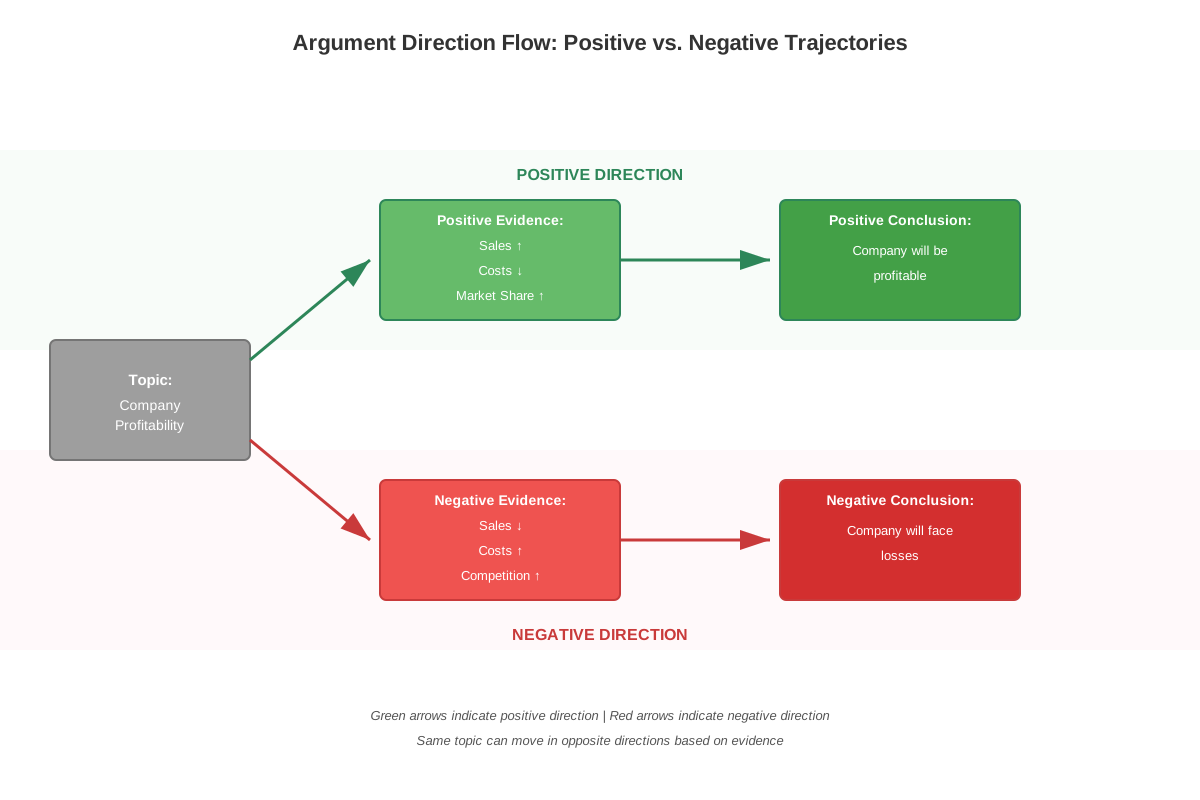
Mastering lsat argument direction enables students to quickly identify the author's purpose and predict what kind of information the argument needs or what conclusion it's building toward. When an argument begins with evidence about declining sales figures and rising production costs, for example, a skilled test-taker immediately recognizes the direction points toward a negative conclusion about profitability. This predictive ability dramatically improves both accuracy and speed on test day, as students can eliminate answer choices that move in the wrong direction before even fully analyzing their content.
The relationship between argument direction and other Logical Reasoning concepts is foundational. Argument direction underlies the structure of premises and conclusions, determines what assumptions are necessary, and dictates what evidence would be relevant. Without understanding the direction an argument is heading, students cannot effectively identify gaps in reasoning, evaluate the strength of evidence, or select appropriate conclusions. This topic serves as a bridge between basic argument structure analysis and advanced critical reasoning skills required for top LSAT scores.
Learning Objectives
- [ ] Identify how Argument direction appears in LSAT questions
- [ ] Explain the reasoning pattern behind Argument direction
- [ ] Apply Argument direction to solve LSAT-style problems accurately
- [ ] Predict the likely conclusion of an incomplete argument based on its directional trajectory
- [ ] Distinguish between arguments moving in opposite directions on the same topic
- [ ] Evaluate whether new information aligns with or contradicts an argument's established direction
- [ ] Recognize directional shift indicators and pivot words that signal changes in argument flow
Prerequisites
- Basic argument structure: Understanding premises and conclusions is essential because argument direction describes the relationship between these components and the trajectory from evidence to claim.
- Indicator words: Familiarity with conclusion indicators (therefore, thus, hence) and premise indicators (because, since, given that) helps identify the flow of reasoning within arguments.
- Logical connectives: Knowledge of how "and," "but," "however," and similar words function enables recognition of when arguments shift direction or introduce contrasting information.
- Reading comprehension fundamentals: The ability to identify main ideas and supporting details provides the foundation for tracking how arguments develop and move toward their conclusions.
Why This Topic Matters
Argument direction appears in approximately 40-50% of all Logical Reasoning questions on the LSAT, making it one of the most frequently tested concepts. This topic is particularly critical for question types that ask students to complete arguments, identify assumptions, strengthen or weaken reasoning, or evaluate the relevance of new information. Understanding argument direction transforms these questions from challenging puzzles into predictable patterns that can be solved systematically.
In real-world applications, recognizing argument direction is essential for legal reasoning, policy analysis, and persuasive communication. Attorneys must track the direction of opposing counsel's arguments to prepare effective counterarguments. Policy analysts need to identify whether research findings support or undermine proposed initiatives. Business leaders must evaluate whether market data points toward expansion or consolidation strategies. The LSAT tests this skill because it's fundamental to legal practice and critical thinking in professional contexts.
On the exam, argument direction most commonly appears in "complete the argument" questions where the final sentence is incomplete, strengthen/weaken questions where students must identify information that pushes the argument in a particular direction, and assumption questions where the correct answer must align with the argument's established trajectory. Questions may present arguments about scientific studies, business decisions, policy recommendations, or everyday reasoning scenarios. The ability to quickly identify whether an argument is moving toward a positive, negative, or qualified conclusion allows test-takers to eliminate wrong answers efficiently and select correct responses with confidence.
Core Concepts
Understanding Argument Direction
Argument direction refers to the overall trajectory of reasoning within an argument—the path from premises to conclusion and the stance the argument takes on its subject matter. Every argument moves in a particular direction: it either supports a position (positive direction), opposes a position (negative direction), or qualifies a position (nuanced direction). Recognizing this direction early in reading an argument passage enables test-takers to predict what kind of conclusion will follow and what type of evidence would be relevant.
The direction of an argument is established through the cumulative effect of its premises. If an argument presents multiple pieces of evidence suggesting a product is dangerous, the direction clearly points toward a conclusion recommending against its use. Conversely, if premises highlight benefits and address potential concerns, the direction points toward endorsement. The key skill is identifying this trajectory before reaching the conclusion, which allows for prediction and evaluation of logical completeness.
Directional Indicators and Signal Words
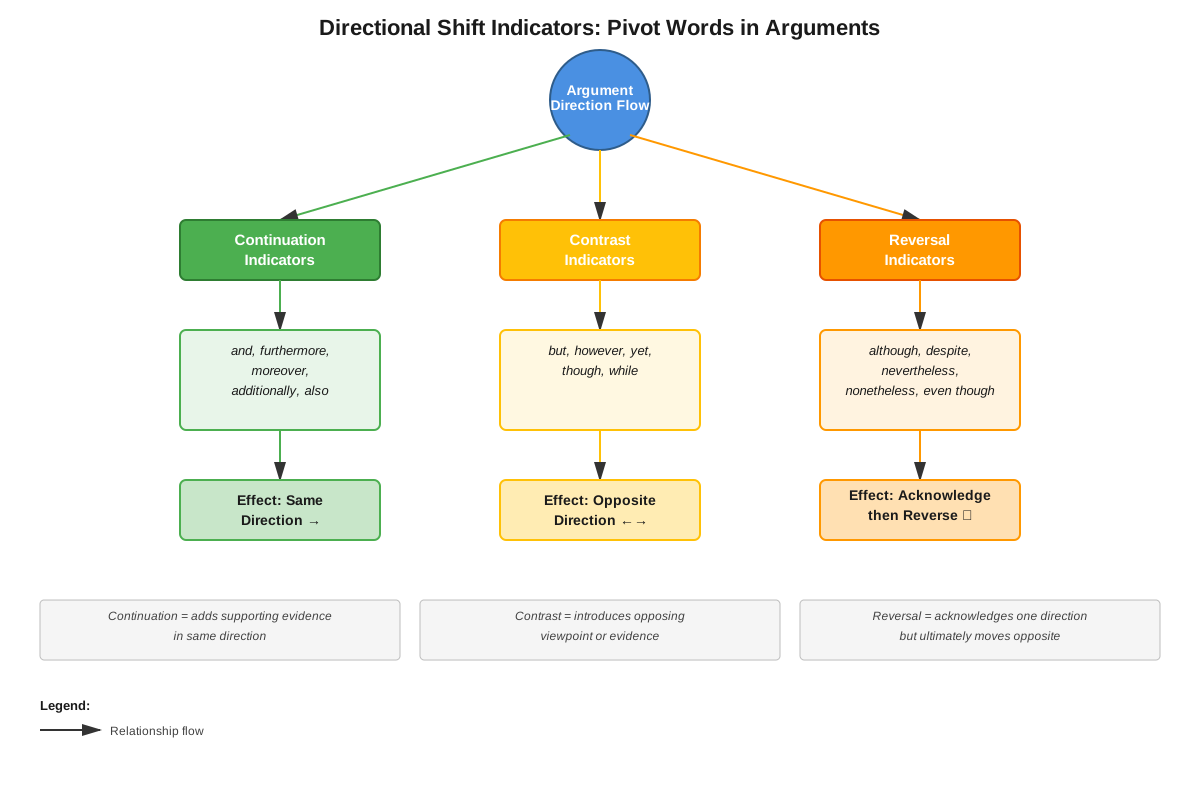
Certain words and phrases serve as directional indicators that signal the trajectory of reasoning. Positive directional indicators include "benefits," "advantages," "improvements," "success," and "effective." Negative directional indicators include "problems," "failures," "risks," "decline," and "ineffective." Neutral or qualifying indicators include "however," "although," "while," "despite," and "on the other hand."
Pivot words are particularly important because they signal a change in argument direction. When an argument begins with "Many people believe X is beneficial," but then continues with "however, recent studies suggest," the "however" signals a directional shift from positive to negative. Recognizing these pivots prevents misidentifying the argument's ultimate direction based solely on its opening statements.
Types of Argument Direction
| Direction Type | Characteristics | Example Premise Pattern | Likely Conclusion |
|---|---|---|---|
| Positive/Supportive | Evidence favors a position, action, or claim | Benefits outweigh costs; data shows improvement | Should adopt, is effective, will succeed |
| Negative/Opposing | Evidence undermines a position or recommends against action | Risks exceed benefits; data shows decline | Should reject, is ineffective, will fail |
| Qualified/Nuanced | Evidence supports position with limitations or conditions | Benefits exist but only under certain circumstances | Should adopt with modifications, is effective when... |
| Comparative | Evidence establishes relative superiority or inferiority | Option A performs better than Option B across metrics | Should choose A over B, A is preferable |
Tracking Direction Through Multiple Premises
Complex LSAT arguments often present multiple premises that must be synthesized to determine overall direction. The skill of tracking direction requires weighing the cumulative effect of evidence rather than focusing on individual statements in isolation. An argument might present three positive premises and one negative premise; the overall direction depends on how these are weighted and integrated.
Consider this premise sequence: "The new policy reduced costs by 15%. Employee satisfaction increased. However, customer complaints doubled. The company's market share declined." To determine direction, test-takers must evaluate whether the positive outcomes (cost reduction, employee satisfaction) outweigh the negative outcomes (complaints, market share loss). The argument's direction will be established by which set of premises receives greater emphasis or is presented as more significant.
Direction in Incomplete Arguments
Evaluate and complete the argument questions specifically test the ability to identify argument direction in incomplete passages. These questions present premises and ask test-takers to select the conclusion that best completes the argument. The correct answer must align with the established direction—it cannot introduce a new direction or contradict the trajectory set by the premises.
For example, if premises establish that a medication has severe side effects, is expensive, and shows minimal effectiveness compared to alternatives, the argument direction clearly points toward a negative conclusion. Answer choices suggesting the medication should be widely prescribed would contradict this direction, while choices recommending against its use would align with it.
Directional Consistency and Logical Flow
Arguments maintain directional consistency when their conclusions follow logically from the trajectory established by their premises. Inconsistency occurs when a conclusion contradicts or fails to align with the direction indicated by the evidence. The LSAT frequently tests this concept by including answer choices that are factually related to the argument's topic but directionally inconsistent with its reasoning.
A common trap involves answer choices that are true statements about the topic but move in the wrong direction. If an argument establishes that urban sprawl causes environmental damage and presents evidence of increasing sprawl, a conclusion stating "urban planning has improved" would be directionally inconsistent, even if urban planning has improved in some unrelated way. The conclusion must follow the specific direction established by the given premises.
Concept Relationships
Argument direction serves as the foundational concept connecting multiple elements of logical reasoning. The relationship flows as follows:
Premises → Argument Direction → Conclusion → Assumptions → Strengthening/Weakening Evidence
Premises establish the initial direction through the type and quality of evidence presented. This direction determines what conclusion can logically follow. The conclusion, in turn, reveals what assumptions must be true for the argument to work (assumptions must align with the argument's direction). Finally, strengthening evidence pushes the argument further in its established direction, while weakening evidence pushes against it.
Argument direction connects to argument structure by determining how premises relate to conclusions. It connects to assumption identification because assumptions must bridge gaps in the direction of reasoning. It relates to strengthen/weaken questions because these explicitly ask for information that affects the argument's directional trajectory. Understanding direction also enables better performance on inference questions because valid inferences must be consistent with the argument's established direction.
The concept also relates to conditional reasoning when arguments move from conditional premises toward conclusions about specific cases. If an argument establishes "If X, then Y" and provides evidence that X is occurring, the direction points toward concluding that Y will occur. Recognizing this directional flow helps identify valid versus invalid inferences from conditional statements.
Quick check — test yourself on Argument direction so far.
Try Flashcards →High-Yield Facts
⭐ Argument direction is established by the cumulative effect of premises, not by individual statements in isolation.
⭐ The correct answer in "complete the argument" questions must align with the direction established by the premises.
⭐ Pivot words like "however," "but," and "although" signal directional shifts and often indicate the argument's true direction.
⭐ Strengthening evidence pushes an argument further in its established direction; weakening evidence pushes against it.
⭐ Answer choices that are factually true but directionally inconsistent with the premises are incorrect.
- Arguments can shift direction mid-passage, with the final direction being what matters for conclusion selection.
- Qualified conclusions (those with limitations or conditions) often represent the correct direction when premises present mixed evidence.
- Comparative arguments establish direction by showing relative superiority or inferiority between options.
- Directional consistency requires that conclusions follow the specific trajectory of the given premises, not general knowledge about the topic.
- Recognizing argument direction early in reading enables prediction of correct answers before reviewing all choices.
- Negative directional indicators (problems, risks, failures) are often more heavily weighted in LSAT arguments than positive indicators.
- Arguments with multiple premises pointing in the same direction create stronger directional momentum than those with mixed evidence.
Common Misconceptions
Misconception: The argument's direction is determined by the first premise presented.
Correction: Argument direction is established by the cumulative effect of all premises, and arguments often begin with background information or opposing viewpoints before establishing their true direction through pivot words and subsequent evidence.
Misconception: A single positive premise in an otherwise negative argument changes the overall direction to neutral or mixed.
Correction: Overall direction depends on the weight and emphasis given to premises, not merely their count. An argument can acknowledge minor benefits while still moving in a clearly negative direction if the negative evidence is more substantial or significant.
Misconception: The correct conclusion must introduce new information beyond what the premises establish.
Correction: Correct conclusions align with and follow from the established direction without introducing new directional elements. They synthesize the given premises rather than adding new trajectories.
Misconception: Directionally consistent answers are always the most extreme option in the established direction.
Correction: The correct answer matches the degree and specificity of the premises' direction. If premises establish moderate concerns, an extremely negative conclusion would overshoot the established direction and be incorrect.
Misconception: Arguments about the same topic always move in the same direction.
Correction: Different arguments about the same topic can move in opposite directions depending on their premises. An argument about electric vehicles could support adoption (positive direction) or recommend caution (negative direction) based on different evidence sets.
Misconception: Qualified or nuanced conclusions are always correct when premises present mixed evidence.
Correction: While qualified conclusions are often appropriate for mixed evidence, the correct answer depends on which direction receives greater emphasis in the premises. Sometimes mixed evidence still points clearly in one direction if one set of premises is more substantial.
Worked Examples
Example 1: Complete the Argument
Passage: "City officials claim that the new traffic management system has improved commute times. However, the system cost $50 million to implement, significantly exceeding the original budget. Additionally, a recent survey found that 65% of commuters report no change in their travel times, while 20% report longer commutes. Only 15% of commuters experienced reduced travel times. Therefore, _____________."
Analysis:
- Identify the premises: The argument presents one claim supporting the system (officials' claim) but then uses "however" to pivot direction.
- Track directional indicators: "However" signals a shift. "Significantly exceeding budget" is negative. Survey data shows 85% experienced no improvement or worsening, only 15% improved—strongly negative evidence.
- Determine overall direction: The cumulative evidence points in a negative direction regarding the system's success.
- Predict conclusion type: The conclusion should express skepticism about or opposition to the claim that the system improved commute times.
Correct conclusion: "the city officials' claim that the new system has improved commute times is not well supported by the evidence."
Why this works: This conclusion aligns with the negative direction established by the cost overrun and survey data showing minimal improvement. It directly addresses the officials' claim mentioned at the beginning and uses the subsequent evidence to oppose it.
Wrong answer example: "the city should expand the traffic management system to additional neighborhoods."
Why it's wrong: This moves in a positive direction (expansion/endorsement) when the premises establish a negative direction (cost overruns, lack of improvement). It's directionally inconsistent.
Example 2: Evaluate the Argument
Passage: "Researchers found that students who participated in music education programs scored an average of 12% higher on standardized math tests than students who did not participate in such programs. The researchers concluded that music education causes improved mathematical reasoning abilities."
Question: Which of the following, if true, would most weaken the argument?
Analysis:
- Identify argument direction: The argument moves from correlation (music students score higher) to causation (music causes better math skills)—a positive direction claiming music education is beneficial for math.
- Understand what "weaken" means directionally: Weakening evidence pushes against the established direction, suggesting the causal claim is not well-supported.
- Predict answer type: Look for information suggesting an alternative explanation for the correlation or evidence that music doesn't cause math improvement.
Strong weakening answer: "Students with strong mathematical reasoning abilities are more likely to choose to participate in music education programs."
Why this works: This provides an alternative explanation (reverse causation) that pushes against the argument's direction. Instead of music causing math improvement, math ability causes music participation. This directly undermines the causal direction established by the conclusion.
Analysis of direction: The original argument direction: Music → Better Math (positive causal claim). The weakening information reverses this: Math Ability → Music Participation. This directional reversal weakens the argument by suggesting the causation runs opposite to the claimed direction.
Exam Strategy
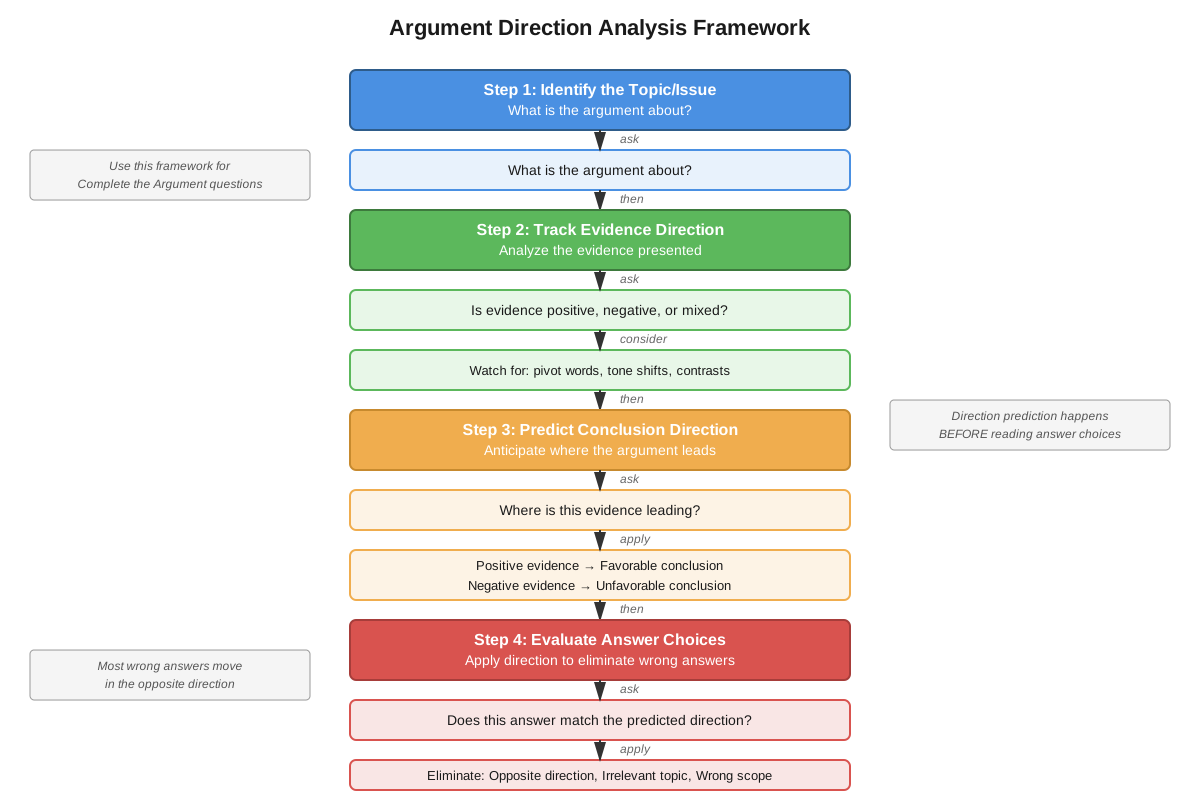
When approaching LSAT questions involving argument direction, follow this systematic process:
Step 1: Identify pivot words immediately. As you read, mark or mentally note words like "however," "but," "although," "despite," and "yet." These often signal the argument's true direction, especially when the passage begins with an opposing viewpoint.
Step 2: Track cumulative evidence. Don't let the first premise overly influence your perception of direction. Read through all premises and evaluate their combined effect. Ask yourself: "Is the weight of evidence positive, negative, or qualified?"
Step 3: Predict before reading answer choices. After reading the premises in a "complete the argument" question, pause and predict what direction the conclusion should take. This prediction serves as a filter for evaluating answer choices.
Step 4: Eliminate directionally inconsistent answers first. In complete-the-argument questions, immediately eliminate any answer choice that moves in the wrong direction, regardless of whether it's factually related to the topic. This typically eliminates 2-3 answer choices quickly.
Step 5: Watch for degree mismatches. Even among directionally consistent answers, eliminate those that overshoot or undershoot the degree of direction established by the premises. If premises establish moderate concerns, extremely negative conclusions are incorrect.
Exam Tip: In strengthen/weaken questions, the correct answer will always push in the specified direction. If you're asked to weaken and an answer choice seems neutral or slightly strengthening, it's wrong—even if it's relevant to the topic.
Trigger phrases for direction identification:
- "This suggests that..." (introduces the direction)
- "Therefore, we should..." (action conclusion following established direction)
- "However, evidence indicates..." (directional pivot)
- "While X is true, Y is more significant..." (establishes which direction dominates)
Time allocation: Spend 15-20 seconds identifying argument direction before attempting to answer. This upfront investment saves time by enabling rapid elimination of wrong answers and increases accuracy significantly.
Memory Techniques
Mnemonic for Direction Types: "PNCQ"
- Positive (supporting, endorsing)
- Negative (opposing, recommending against)
- Comparative (establishing relative superiority)
- Qualified (supporting with conditions/limitations)
Visualization Strategy: Picture argument direction as a physical arrow. As you read premises, visualize the arrow pointing up (positive), down (negative), or horizontal with conditions (qualified). When you encounter pivot words, visualize the arrow changing direction. The final arrow direction when you finish reading premises shows where the conclusion must point.
The "However Rule": Remember that in LSAT arguments, what comes after "however" or "but" is almost always more important than what comes before. The post-pivot content typically establishes the argument's true direction.
Acronym for Pivot Words: "HABD"
- However
- Although
- But
- Despite
When you see HABD words, the argument's true direction follows them, not what preceded them.
The Weight Scale Technique: Visualize a balance scale. Place positive premises on one side and negative premises on the other. The side that's heavier (more numerous, more significant, more emphasized) shows the argument's direction. This prevents the error of treating all premises as equal when determining overall direction.
Summary
Argument direction is the trajectory of reasoning within an argument—the path from premises to conclusion and the stance taken on the subject matter. Mastering this concept requires identifying whether arguments move in positive (supporting), negative (opposing), qualified (conditional), or comparative directions based on the cumulative effect of their premises. Directional indicators and pivot words signal the trajectory, with words like "however" and "but" often marking shifts to the argument's true direction. On the LSAT, argument direction appears most frequently in complete-the-argument questions, where correct answers must align with the established trajectory, and in strengthen/weaken questions, where correct answers push with or against the argument's direction. Success requires tracking direction through multiple premises, recognizing that conclusions must maintain directional consistency with their supporting evidence, and eliminating answer choices that are topically relevant but directionally inconsistent. The ability to quickly identify argument direction enables prediction of correct answers, efficient elimination of wrong choices, and significant improvements in both accuracy and speed on test day.
Key Takeaways
- Argument direction is established by the cumulative weight of all premises, not individual statements in isolation
- Pivot words like "however," "but," and "although" typically signal the argument's true direction and often mark shifts from setup to main reasoning
- Correct answers in complete-the-argument questions must align with the direction established by premises in both trajectory and degree
- Strengthening evidence pushes an argument further in its established direction; weakening evidence pushes against it
- Directionally inconsistent answer choices should be eliminated immediately, even if they're factually related to the argument's topic
- Recognizing argument direction early enables prediction of correct answers and dramatically improves elimination efficiency
- The LSAT frequently tests whether students can distinguish between topical relevance and directional consistency
Related Topics
Assumption Questions: Understanding argument direction is essential for identifying assumptions because assumptions must bridge gaps in the established direction of reasoning. Mastering direction enables prediction of what unstated premises are necessary for the argument to reach its conclusion.
Strengthen and Weaken Questions: These question types explicitly test the ability to identify information that affects argument direction. Strengthening evidence pushes the argument further in its established direction, while weakening evidence pushes against it or suggests an alternative direction.
Parallel Reasoning: Identifying argument direction helps match arguments with similar logical structures. Arguments that move in the same direction (positive to positive, negative to negative) with similar premise-to-conclusion relationships are parallel.
Flaw Questions: Many logical flaws involve directional inconsistencies, such as conclusions that don't follow from the direction established by premises or arguments that shift direction without justification.
Inference Questions: Valid inferences must be consistent with the argument's established direction. Understanding direction helps eliminate inference answer choices that contradict or diverge from the passage's trajectory.
Practice CTA
Now that you understand argument direction and its critical role in LSAT Logical Reasoning, it's time to apply these concepts to practice questions. Work through the practice problems focusing specifically on identifying argument direction before attempting to answer. Use the flashcards to reinforce recognition of directional indicators and pivot words. Remember: every minute spent mastering argument direction translates directly to faster, more accurate performance on test day. The patterns you've learned here appear in nearly half of all Logical Reasoning questions—making this one of the highest-yield topics for your LSAT preparation. Approach each practice question systematically, track the direction through the premises, and watch your accuracy improve dramatically.
Sign up free to keep reading
Create a free AnvayaPrep account to finish this LSAT guide on Argument direction — plus flashcards and practice questions.