Overview
Complete the argument questions represent a distinctive and frequently tested question type within the LSAT's Logical Reasoning sections. Unlike questions that ask test-takers to evaluate, strengthen, or weaken existing arguments, these questions present incomplete reasoning structures and require students to identify the conclusion that logically follows from the given premises. This question type directly assesses a student's ability to recognize logical patterns, understand inferential relationships, and predict where an argument naturally leads based on its foundational statements.
Mastering lsat complete the argument questions is essential for achieving a competitive LSAT score because these questions appear regularly across both Logical Reasoning sections, typically comprising 2-4 questions per test. They test fundamental skills in logical reasoning that underpin success across all question types: the ability to track an argument's logical flow, identify the relationship between premises and conclusions, and recognize when a particular conclusion necessarily or most reasonably follows from given information. Students who excel at these questions demonstrate sophisticated understanding of argument structure and inferential reasoning.
Within the broader context of evaluate and complete the argument question types, complete the argument questions occupy a unique position. While evaluation questions ask students to assess the quality or validity of complete arguments, completion questions require constructive reasoning—building toward a logical endpoint rather than critiquing an existing one. This skill connects directly to assumption questions, inference questions, and main point questions, as all require understanding how premises support conclusions. However, complete the argument questions are distinctive in presenting an explicit gap that must be filled with the most logical continuation, making them an excellent diagnostic tool for assessing overall logical reasoning proficiency.
Learning Objectives
- [ ] Identify how Complete the argument questions appears in LSAT questions
- [ ] Explain the reasoning pattern behind Complete the argument questions
- [ ] Apply Complete the argument questions to solve LSAT-style problems accurately
- [ ] Distinguish between conclusions that must be true versus conclusions that are most strongly supported by the premises
- [ ] Recognize common argument patterns and structural templates that signal specific types of conclusions
- [ ] Evaluate answer choices by testing their logical fit with the established premises and argument direction
Prerequisites
- Basic argument structure: Understanding the distinction between premises (evidence) and conclusions (claims supported by evidence) is fundamental, as complete the argument questions require identifying where premises naturally lead.
- Conditional reasoning: Familiarity with "if-then" statements and their logical implications helps predict conclusions in arguments built on conditional relationships.
- Inference skills: The ability to determine what must be true or is strongly supported based on given information directly applies to selecting appropriate conclusions.
- Argument indicators: Recognizing conclusion indicators (therefore, thus, consequently) and premise indicators (because, since, given that) helps identify the argument's logical structure and the gap to be filled.
Why This Topic Matters
Complete the argument questions test one of the most practical reasoning skills applicable beyond the LSAT: the ability to follow logical threads to their natural conclusions. In legal practice, attorneys must regularly construct arguments from evidence, anticipating where their reasoning leads and what conclusions judges or juries will draw. This same skill applies to business analysis, scientific reasoning, and everyday decision-making where individuals must project logical outcomes from available information.
On the LSAT specifically, complete the argument questions appear with high frequency and predictability. Each Logical Reasoning section typically contains 1-2 of these questions, meaning test-takers can expect 2-4 questions per exam. These questions carry the same weight as all other Logical Reasoning questions, and because they follow recognizable patterns, they represent high-yield opportunities for score improvement. Students who master the systematic approach to these questions can often answer them more quickly than other question types, creating valuable time for more challenging questions.
These questions commonly appear in several formats: arguments about causal relationships requiring causal conclusions, comparative arguments requiring comparative conclusions, arguments presenting problems requiring solution-oriented conclusions, and conditional arguments requiring conclusions that follow logical rules. The LSAT frequently embeds these questions in contexts involving scientific studies, policy debates, business decisions, and philosophical reasoning, requiring students to navigate complex content while maintaining focus on logical structure.
Core Concepts
Question Stem Recognition
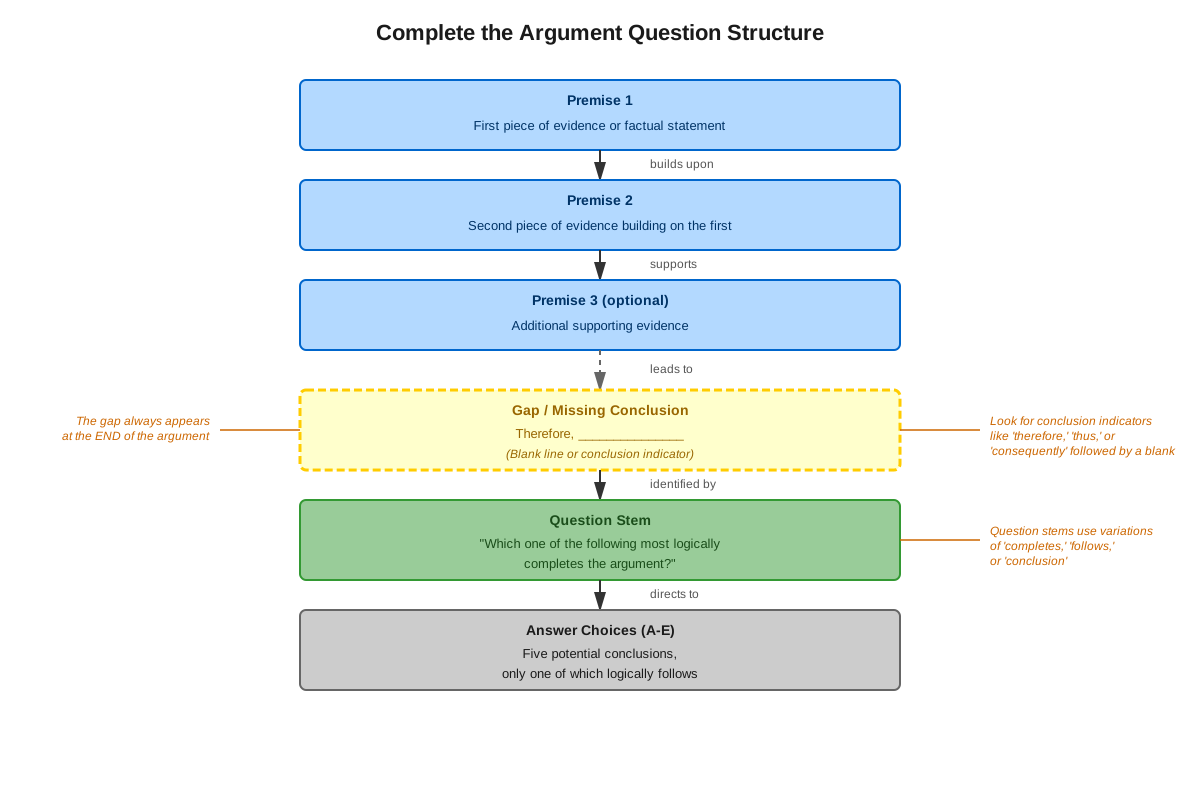
Complete the argument questions can be identified by distinctive question stems that explicitly indicate the task: completing an incomplete argument. Common phrasings include "Which one of the following most logically completes the argument?", "The conclusion of the argument is most strongly supported if which one of the following completes the passage?", and "Which one of the following, if true, would provide the most logical completion to the argument?" Recognizing these stems immediately signals the specific approach required: reading the stimulus to understand the premises and argument direction, then selecting the answer choice that provides the most logical conclusion.
The question stem sometimes includes qualifiers that affect answer selection. "Most logically completes" indicates that the correct answer should follow naturally from the premises without requiring additional assumptions. "Most strongly supported" suggests that while multiple answers might be possible, one has the strongest logical connection to the given premises. Understanding these nuances helps distinguish between answers that are merely consistent with the premises versus those that represent the argument's natural endpoint.
Argument Structure Analysis
When approaching complete the argument questions, the first critical step involves identifying the argument's structural components. The stimulus will present one or more premises—statements presented as facts or accepted claims—that establish a foundation for reasoning. These premises may include evidence, data, observations, principles, or stipulated conditions. The argument will then indicate a logical direction through transitional language or structural cues before presenting a blank or incomplete final statement.
The logical gap appears at the point where the argument's conclusion should be stated. This gap is not random; it follows a specific logical pattern established by the premises. Students must read actively to identify: (1) what information the premises provide, (2) what logical relationship exists among the premises, (3) what direction the argument is heading, and (4) what type of conclusion would naturally complete this logical progression. The argument's structure often mirrors common reasoning patterns: cause-and-effect, comparison, problem-solution, conditional reasoning, or categorical relationships.
Common Argument Patterns
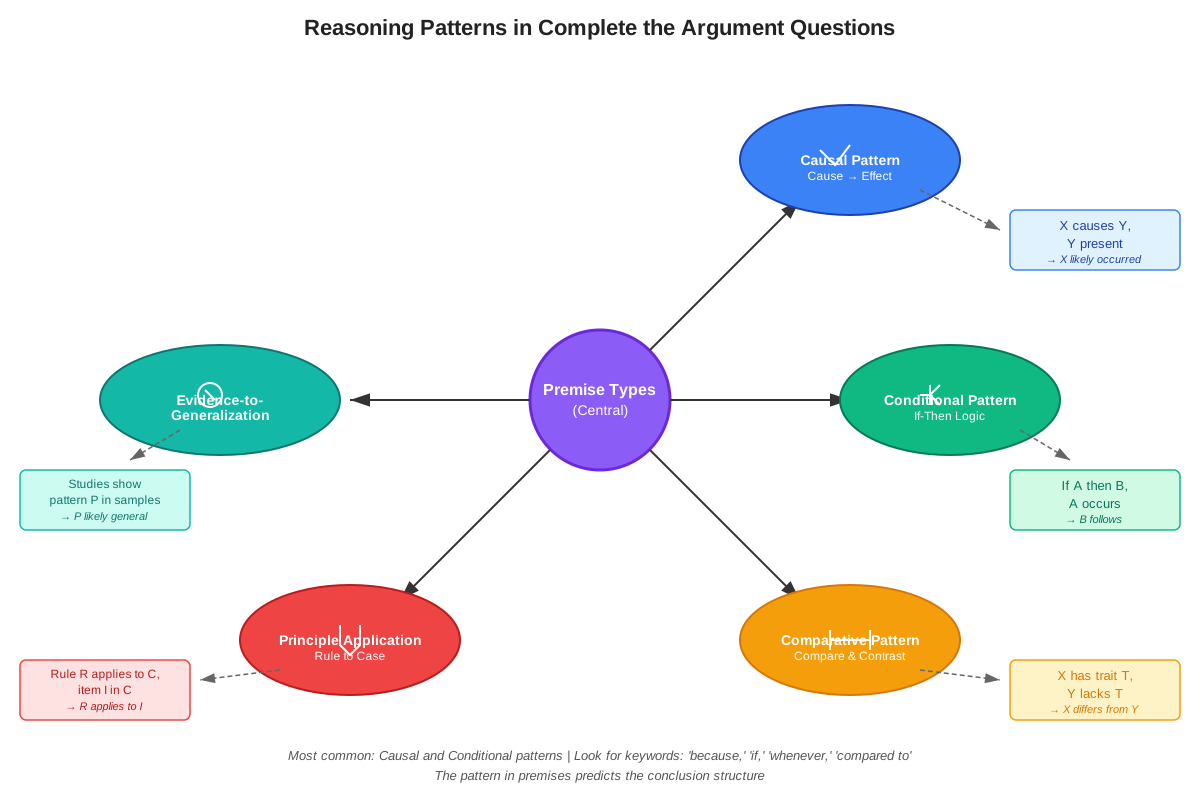
Several reasoning patterns appear repeatedly in complete the argument questions, and recognizing these patterns accelerates answer selection:
Causal Arguments: When premises establish that X causes Y or that certain conditions lead to specific outcomes, the conclusion typically states a causal claim, prediction, or recommendation based on that causal relationship. For example, if premises establish that increased exercise improves cardiovascular health and that cardiovascular health extends lifespan, the conclusion might state that increased exercise extends lifespan.
Comparative Arguments: When premises compare two or more items, groups, or situations, the conclusion typically makes a comparative claim. If premises establish that Method A is more efficient than Method B and that Method B is more efficient than Method C, the conclusion logically states that Method A is more efficient than Method C.
Problem-Solution Arguments: When premises identify a problem and describe characteristics of potential solutions, the conclusion typically recommends a specific solution or explains why a particular approach would address the problem. The logical connection depends on matching solution characteristics to problem requirements.
Conditional Arguments: When premises establish conditional relationships (if-then statements), the conclusion typically applies these conditions to a specific case or chains multiple conditionals together. Understanding conditional logic—including contrapositives and the distinction between sufficient and necessary conditions—is crucial for these arguments.
Answer Choice Evaluation
Evaluating answer choices for complete the argument questions requires systematic testing of logical fit. The correct answer must satisfy several criteria:
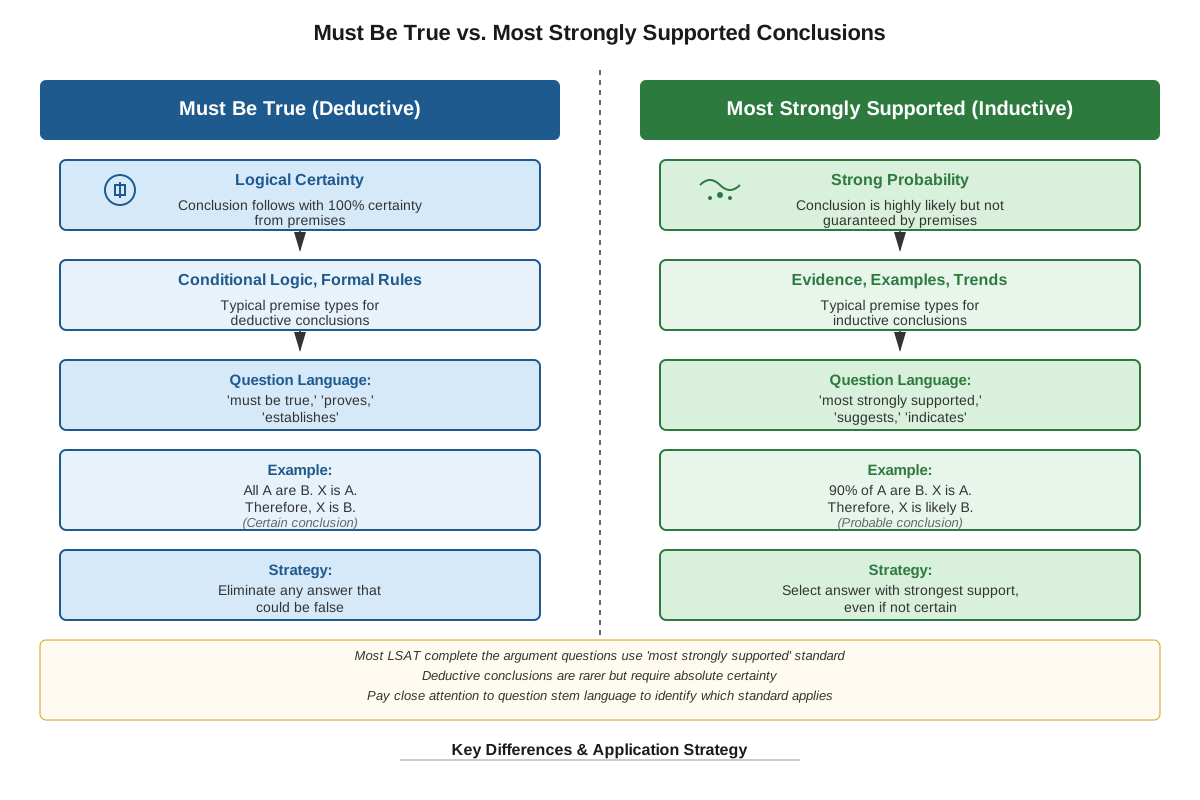
Logical Necessity or Strong Support: The conclusion must follow from the premises without requiring additional unstated assumptions. While some complete the argument questions ask for conclusions that "must be true," others ask for conclusions that are "most strongly supported," allowing for reasonable inferences beyond strict logical necessity.
Scope Consistency: The conclusion must match the scope of the premises. If premises discuss "some members" of a group, the conclusion cannot make claims about "all members." If premises address a specific time period, the conclusion should not extend beyond that timeframe without justification.
Direction Alignment: The conclusion must continue the argument's established direction. If premises build toward a positive recommendation, the conclusion should not suddenly shift to a negative claim. Transitional language in the stimulus often signals this direction.
Terminology Consistency: The conclusion should use terms and concepts introduced in the premises. Answer choices that introduce entirely new concepts or shift to different terminology typically represent incorrect answers unless the premises establish clear connections to these new terms.
Wrong Answer Patterns
Understanding common wrong answer patterns helps eliminate incorrect choices efficiently:
| Wrong Answer Type | Characteristics | Why It's Wrong |
|---|---|---|
| Scope Shift | Makes broader or narrower claims than premises support | Extends beyond or fails to reach the logical scope established by premises |
| Reverse Logic | States the opposite of what premises support | Contradicts the argument's established direction |
| Irrelevant Conclusion | Addresses topics not discussed in premises | Fails to connect logically to the given information |
| Unsupported Leap | Requires major additional assumptions | Goes beyond what premises can reasonably support |
| Premise Restatement | Simply repeats information already stated | Fails to advance the argument to a conclusion |
Concept Relationships
The skills required for complete the argument questions build directly on foundational logical reasoning abilities. Understanding basic argument structure (premises supporting conclusions) provides the framework for identifying what type of conclusion fits a given set of premises. This connects to assumption questions, as both require understanding what's needed to bridge premises to conclusions—though assumption questions identify missing links while complete the argument questions construct the endpoint.
Complete the argument questions also relate closely to inference questions (must be true questions). Both require determining what logically follows from given information. However, inference questions typically present complete arguments or sets of facts and ask what can be concluded, while complete the argument questions present incomplete arguments with a specific structural gap to fill. The distinction lies in whether the logical endpoint is explicitly marked as missing.
Within the evaluate and complete the argument unit, these questions represent the constructive counterpart to evaluation questions. Evaluation questions ask students to identify what additional information would help assess an argument's strength, while complete the argument questions ask students to construct the argument's natural conclusion. Both require understanding argument structure and logical relationships, but they apply this understanding differently.
The relationship flow can be mapped as: Basic Argument Structure → Premise-Conclusion Relationships → Inference Skills → Complete the Argument Questions → Assumption Identification → Argument Evaluation. Each skill builds on previous ones, with complete the argument questions occupying a central position that both requires foundational skills and enables more advanced analytical tasks.
Quick check — test yourself on Complete the argument questions so far.
Try Flashcards →High-Yield Facts
⭐ Complete the argument questions appear 2-4 times per LSAT, making them a high-frequency question type worth systematic preparation.
⭐ The correct answer must follow logically from the premises without requiring additional unstated assumptions beyond those reasonable in context.
⭐ Scope consistency is the most common differentiator between correct and incorrect answers—the conclusion must match the breadth and limitations of the premises.
⭐ Transitional language in the stimulus signals the argument's direction and often indicates what type of conclusion is expected (causal, comparative, prescriptive, etc.).
⭐ Wrong answers frequently introduce new concepts not mentioned or implied in the premises, making them logically disconnected from the argument.
- The conclusion must be the argument's endpoint, not a restatement of premises or an intermediate step in reasoning.
- Conditional arguments require conclusions that properly apply or chain the conditional relationships established in premises.
- Comparative arguments require conclusions that maintain the comparative relationship without reversing or distorting it.
- Causal arguments typically conclude with causal claims, predictions, or recommendations based on the established causal relationship.
- Answer choices that are merely consistent with premises but don't represent the argument's natural conclusion are incorrect—the conclusion must be where the argument is specifically heading.
Common Misconceptions
Misconception: Any answer choice that could be true based on the premises is correct. → Correction: The correct answer must be where the argument is specifically heading based on its structure and direction, not merely something that could be true. The argument's logical flow and transitional language indicate a specific endpoint.
Misconception: The longest or most complex answer choice is typically correct because it seems more sophisticated. → Correction: Correct answers are often straightforward and directly connected to the premises. Complexity frequently signals wrong answers that introduce unnecessary complications or scope shifts.
Misconception: If an answer choice introduces a new term, it must be wrong. → Correction: While many wrong answers introduce irrelevant new concepts, correct answers may introduce new terms if the premises establish clear logical connections to those terms. The key is whether the new term follows logically from what's stated.
Misconception: Complete the argument questions ask for conclusions that must be 100% logically certain. → Correction: While some questions ask for conclusions that "must be true," others ask for conclusions that are "most strongly supported" or "most logical," allowing for reasonable inferences that are highly probable but not absolutely certain.
Misconception: The correct answer will always use the same terminology as the premises. → Correction: Correct answers may paraphrase or synthesize concepts from the premises using different language, as long as the meaning remains consistent and the logical connection is clear.
Misconception: If premises present a problem, the conclusion must present a solution. → Correction: While problem-solution is one common pattern, premises presenting a problem might conclude with an explanation of why the problem exists, a prediction about consequences, or an analysis of the problem's nature—not necessarily a solution.
Worked Examples
Example 1: Causal Argument
Stimulus: "Recent studies have shown that regular meditation reduces cortisol levels in the bloodstream. Elevated cortisol levels are strongly associated with increased stress and anxiety. Additionally, individuals who practice meditation regularly report significantly lower levels of perceived stress compared to non-meditators. Therefore, _____________."
Analysis Process:
- Identify premises: (a) Meditation reduces cortisol; (b) Elevated cortisol associates with stress/anxiety; (c) Meditators report lower perceived stress.
- Recognize pattern: This is a causal argument establishing that meditation → reduced cortisol → reduced stress, supported by both physiological and self-reported evidence.
- Determine direction: The "therefore" signals a conclusion drawing together these causal relationships.
- Predict conclusion type: Should state a causal claim about meditation's effect on stress or a recommendation based on this relationship.
Answer Choices:
(A) meditation is the most effective stress-reduction technique available
(B) regular meditation practice can effectively reduce stress and anxiety
(C) everyone should meditate daily to eliminate all stress
(D) cortisol is the only biochemical factor affecting stress levels
(E) perceived stress levels always correlate with actual cortisol measurements
Evaluation:
- (A) introduces a comparison ("most effective") not supported by premises—scope shift to "all techniques"
- (B) directly follows from the causal chain established: meditation → reduced cortisol → reduced stress/anxiety; matches scope (can reduce, not eliminate)
- (C) too extreme ("eliminate all stress") and prescriptive beyond what premises support
- (D) contradicts premises by claiming cortisol is "only" factor—unsupported scope
- (E) makes a claim about correlation between perceived and actual stress not addressed in premises
Correct Answer: (B) follows logically from the causal relationships established, maintains appropriate scope, and represents the natural endpoint of the argument.
Example 2: Comparative Argument
Stimulus: "Digital textbooks offer several advantages over traditional printed textbooks. They can be updated instantly to reflect new information, whereas printed textbooks require costly reprinting. Digital textbooks also allow students to search for specific terms quickly, while printed textbooks require manual page-by-page searching. However, studies show that students retain information better when reading from printed pages compared to screens. Given these considerations, _____________."
Analysis Process:
- Identify premises: (a) Digital books: instant updates, searchable; (b) Printed books: costly updates, manual searching; (c) Printed books: better retention.
- Recognize pattern: Comparative argument presenting advantages of both formats, with a crucial retention advantage for printed books.
- Determine direction: "Given these considerations" signals a conclusion that weighs these competing factors.
- Predict conclusion type: Should acknowledge trade-offs or suggest a balanced approach, not simply declare one format superior.
Answer Choices:
(A) digital textbooks are clearly superior to printed textbooks in all respects
(B) printed textbooks should be completely eliminated from educational settings
(C) the choice between digital and printed textbooks involves trade-offs between convenience and learning effectiveness
(D) students should never use digital textbooks for any purpose
(E) the cost of updating textbooks is the most important factor in format selection
Evaluation:
- (A) contradicts the retention advantage of printed books—ignores key premise
- (B) extreme and contradicts the advantages of digital books mentioned
- (C) acknowledges both sets of advantages (convenience for digital, retention for printed) and recognizes the trade-off structure of the argument
- (D) too extreme and ignores legitimate advantages of digital format
- (E) elevates one factor (cost) above the retention issue without justification from premises
Correct Answer: (C) appropriately synthesizes the comparative information, acknowledges the trade-offs presented, and represents the balanced conclusion the argument's structure supports.
Exam Strategy
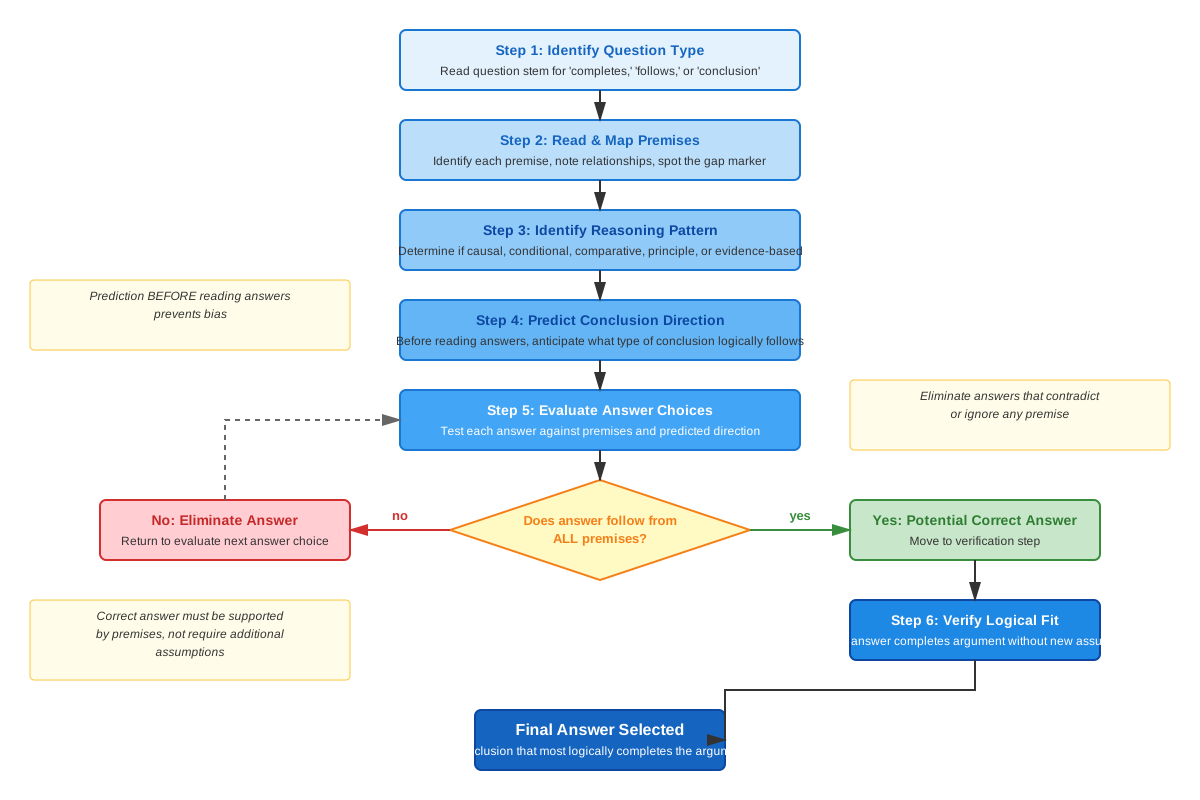
When approaching complete the argument questions on the LSAT, implement this systematic process:
Step 1: Identify the Question Type (5-10 seconds). Read the question stem first to confirm this is a complete the argument question. Look for phrases like "most logically completes," "which one of the following completes the passage," or similar language indicating you need to select a conclusion.
Step 2: Read Actively for Structure (30-45 seconds). As you read the stimulus, identify premises and note the argument's logical direction. Pay special attention to transitional language (however, therefore, thus, given that) which signals shifts in reasoning or the approach to the conclusion. Mentally categorize the argument pattern (causal, comparative, conditional, problem-solution).
Step 3: Predict the Conclusion (10-15 seconds). Before looking at answer choices, formulate a rough prediction of what the conclusion should say. This prediction doesn't need to be word-perfect but should capture the logical endpoint: "This should conclude with a causal claim about X affecting Y" or "This needs a comparative conclusion showing A is better than B for this specific purpose."
Step 4: Evaluate Answer Choices Systematically (45-60 seconds). Test each answer against these criteria:
- Does it follow logically from the premises?
- Does it match the scope of the premises?
- Does it continue the argument's established direction?
- Does it represent an endpoint rather than a premise restatement?
Exam Tip: Eliminate answers that introduce major new concepts first—these are usually wrong and can be eliminated quickly, leaving more time to distinguish between closer choices.
Trigger words and phrases to watch for in stimuli:
- "Therefore," "thus," "consequently": Signal that the conclusion is about to be stated—the blank typically follows these words
- "However," "but," "although": Indicate a shift or qualification that affects what conclusion is appropriate
- "Given that," "since," "because": Mark premises that will support the conclusion
- "This suggests," "this indicates": Signal that an inference or conclusion is being drawn
Process of elimination strategies:
- Eliminate scope shifts first (too broad or too narrow)
- Eliminate answers that contradict the argument's direction
- Eliminate premise restatements that don't advance to a conclusion
- Between remaining choices, select the one that requires fewer additional assumptions
Time allocation: Aim to complete these questions in 1:15-1:30. They often allow for faster completion than strengthen/weaken questions because the task is more straightforward once you understand the argument's structure. If you find yourself spending over 2 minutes, select your best answer and move on—these questions rarely justify extended time investment.
Memory Techniques
SCOPE Mnemonic for evaluating answer choices:
- Supported by premises (not requiring major leaps)
- Consistent with direction (continues argument's path)
- On-topic (addresses concepts from premises)
- Proportional (matches breadth of premises)
- Endpoint (conclusion, not premise restatement)
The "Bridge" Visualization: Picture the premises as one side of a bridge and the conclusion as the other side. The correct answer completes the bridge by connecting directly to where the premises lead. Wrong answers either build bridges to different destinations (scope shifts), build bridges that don't connect (logical gaps), or simply add more support to the starting side (premise restatements).
Pattern Recognition Acronym - CCCP:
- Causal (X causes Y, therefore...)
- Comparative (A vs. B, therefore...)
- Conditional (If X then Y, therefore...)
- Problem-solution (Problem exists, therefore solution/explanation...)
The "Therefore Test": When evaluating an answer choice, mentally insert "therefore" before it and read it as the conclusion following the premises. If it sounds awkward or disconnected, it's likely wrong. The correct answer should sound like a natural continuation when preceded by "therefore."
Summary
Complete the argument questions test the fundamental logical reasoning skill of recognizing where an argument naturally leads based on its premises. These questions present incomplete arguments and require test-takers to select the conclusion that most logically completes the reasoning structure. Success requires identifying the argument's structural components, recognizing common reasoning patterns (causal, comparative, conditional, problem-solution), and evaluating answer choices for logical fit, scope consistency, and directional alignment. The correct answer must follow from the premises without requiring major additional assumptions, match the scope established by the premises, and represent the argument's natural endpoint rather than a premise restatement or tangential claim. Wrong answers typically involve scope shifts, introduce irrelevant concepts, contradict the argument's direction, or require unsupported logical leaps. By systematically analyzing argument structure, predicting conclusion types, and applying consistent evaluation criteria, students can efficiently and accurately answer these high-frequency LSAT questions.
Key Takeaways
- Complete the argument questions appear 2-4 times per LSAT and test the ability to recognize logical endpoints from given premises
- The correct answer must follow logically from premises, match their scope, and continue the argument's established direction
- Common argument patterns include causal, comparative, conditional, and problem-solution structures—recognizing these accelerates answer selection
- Scope consistency is the most frequent differentiator between correct and incorrect answers
- Systematic evaluation using the SCOPE criteria (Supported, Consistent, On-topic, Proportional, Endpoint) improves accuracy and efficiency
- Wrong answers typically introduce irrelevant concepts, shift scope, contradict direction, or restate premises without advancing to a conclusion
- Predicting the conclusion type before reviewing answer choices improves accuracy and reduces susceptibility to attractive wrong answers
Related Topics
Assumption Questions: After mastering complete the argument questions, students should study assumption questions, which identify the unstated premises that bridge explicit premises to conclusions. Understanding how to complete arguments provides foundation for recognizing what's missing from arguments.
Inference Questions (Must Be True): These questions share the core skill of determining what logically follows from given information but apply it to complete arguments rather than incomplete ones. The logical reasoning skills transfer directly between question types.
Main Point Questions: Identifying an argument's main conclusion in complete arguments builds on the same structural analysis skills used in complete the argument questions, extending them to arguments where the conclusion is present but must be distinguished from premises.
Strengthen and Weaken Questions: Once students can identify what conclusion follows from premises, they can more effectively evaluate what additional information would support or undermine that conclusion, making complete the argument questions excellent preparation for these more complex question types.
Practice CTA
Now that you understand the systematic approach to complete the argument questions, it's time to apply these strategies to actual LSAT-style problems. The practice questions and flashcards will reinforce your ability to recognize argument patterns, predict logical conclusions, and efficiently evaluate answer choices. Each practice question you complete strengthens your pattern recognition and builds the confidence needed to approach these questions quickly and accurately on test day. Remember: these questions represent high-yield opportunities for score improvement because they follow predictable patterns—consistent practice transforms these patterns into automatic recognition, giving you a significant advantage on test day.
Sign up free to keep reading
Create a free AnvayaPrep account to finish this LSAT guide on Complete the argument questions — plus flashcards and practice questions.