Overview
Completion answer traps represent one of the most challenging aspects of LSAT Logical Reasoning questions, particularly within the "Evaluate and Complete the Argument" question family. These traps are deliberately constructed incorrect answer choices that appear compelling because they contain elements that seem logically connected to the argument's premises, yet fail to properly complete the argument's logical structure. Understanding these traps is essential because they exploit common reasoning errors and cognitive biases that test-takers naturally fall into under time pressure.
The LSAT tests not just your ability to identify correct reasoning patterns, but also your capacity to avoid seductive but flawed alternatives. LSAT completion answer traps are specifically designed to test whether you truly understand the logical relationship between premises and conclusions, or whether you're simply pattern-matching based on topic similarity or emotional appeal. These questions typically present an incomplete argument and ask you to select the answer choice that most logically completes it—but the wrong answers are crafted to seem plausible by incorporating relevant vocabulary, addressing related issues, or appearing to strengthen the argument when the question actually requires a different logical function.
Within the broader context of Logical Reasoning, completion questions test your ability to recognize argument structure, identify missing logical links, and distinguish between statements that genuinely complete an argument versus those that merely relate to its subject matter. Mastering completion answer traps builds directly on your understanding of argument structure, assumption identification, and the distinction between necessary and sufficient conditions. This skill set is foundational for success across multiple Logical Reasoning question types, including Assumption, Strengthen, and Inference questions.
Learning Objectives
- [ ] Identify how Completion answer traps appears in LSAT questions
- [ ] Explain the reasoning pattern behind Completion answer traps
- [ ] Apply Completion answer traps to solve LSAT-style problems accurately
- [ ] Distinguish between answer choices that complete an argument's logical structure versus those that merely relate to its topic
- [ ] Recognize the five most common types of completion traps and their distinguishing features
- [ ] Develop a systematic elimination strategy for completion questions that minimizes susceptibility to trap answers
Prerequisites
- Argument Structure Recognition: Understanding premises, conclusions, and the logical relationships between them is essential because completion questions require identifying what logical element is missing from an incomplete argument.
- Assumption Identification: Recognizing unstated assumptions helps distinguish between answer choices that bridge logical gaps versus those that introduce irrelevant information.
- Conditional Reasoning: Understanding necessary and sufficient conditions is relevant because many completion traps involve confusing these relationships or introducing conditional statements that don't logically follow.
- Scope Recognition: The ability to identify an argument's precise scope prevents falling for trap answers that are too broad, too narrow, or address tangential issues.
Why This Topic Matters
Completion questions appear with significant frequency on the LSAT, typically comprising 2-4 questions per Logical Reasoning section. This translates to approximately 8-16% of your Logical Reasoning score, making mastery of this question type essential for achieving a competitive score. More importantly, the skills required to avoid completion answer traps—precise logical analysis, scope management, and structural reasoning—transfer directly to other high-frequency question types.
In real-world applications, the ability to recognize incomplete arguments and distinguish genuine logical completions from superficially related statements is crucial for legal reasoning, contract analysis, and judicial opinion writing. Lawyers must constantly evaluate whether conclusions follow from premises, identify missing logical links in opposing arguments, and construct complete chains of reasoning that withstand scrutiny.
On the LSAT, completion questions most commonly appear in two formats: (1) arguments that end with "therefore" or "thus" followed by a blank, requiring you to select the logical conclusion, and (2) arguments with a blank in the middle, requiring you to identify the missing premise or intermediate step. The answer traps in these questions exploit predictable cognitive shortcuts, including topic familiarity bias, extreme statement attraction, and the tendency to confuse correlation with causation. Understanding these traps transforms completion questions from challenging puzzles into systematic, manageable tasks.
Core Concepts
Understanding Completion Question Structure
Logical reasoning completion questions present arguments with a deliberate gap—either a missing conclusion or a missing premise. The correct answer must satisfy the specific logical function required by the argument's structure. The argument provides a logical framework, and only one answer choice will fit precisely into that framework while maintaining logical validity.
The key distinction is between logical completion and topical relevance. A statement can be highly relevant to an argument's subject matter while failing to complete its logical structure. For example, if an argument establishes that "all mammals are warm-blooded" and "whales are mammals," the logical completion is "whales are warm-blooded"—not "whales are intelligent" or "mammals evolved from reptiles," even though these statements relate to the topic.
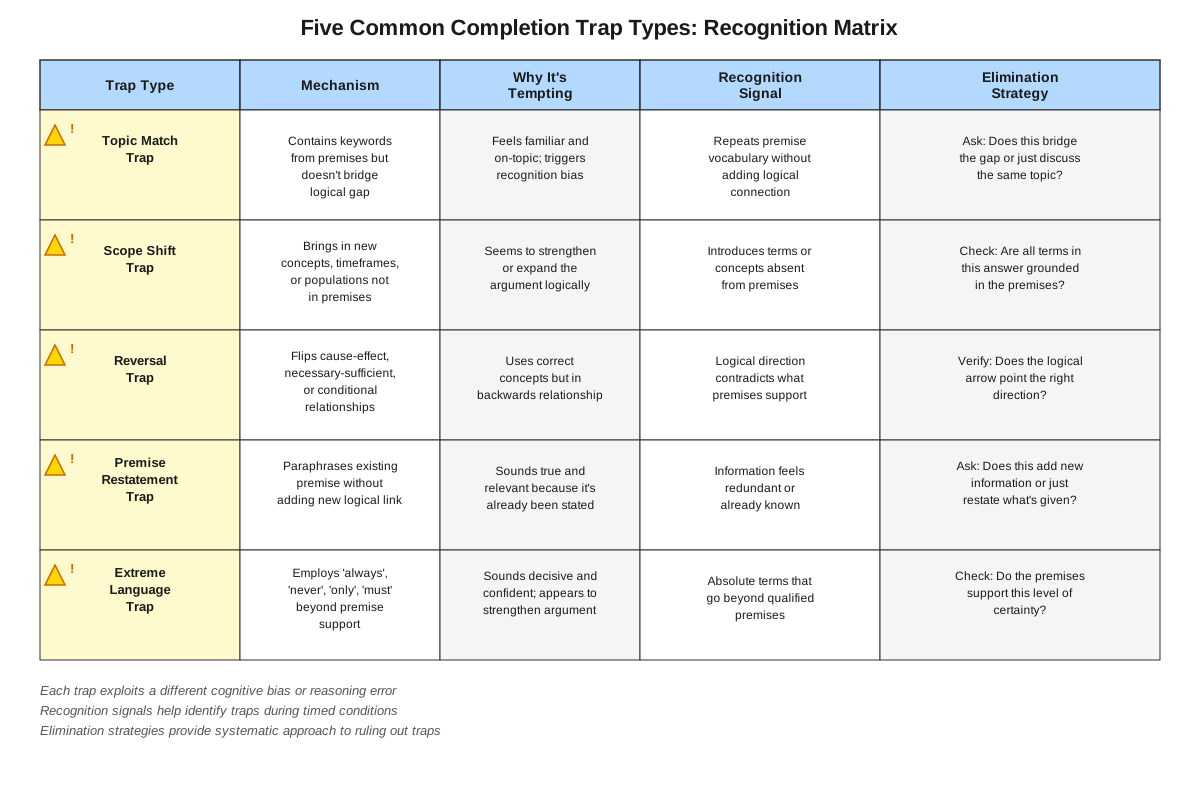
The Five Primary Completion Answer Traps
1. The Topic Match Trap
This trap presents an answer choice that discusses the same subject matter as the argument but fails to complete the logical relationship between premises and conclusion. These answers feel comfortable because they use familiar vocabulary and address related concepts, but they don't bridge the specific logical gap in the argument.
Example pattern: If an argument discusses corporate tax rates and their effect on employment, a topic match trap might discuss corporate tax rates and government revenue—related but not completing the specific logical chain about employment.
2. The Overreach Trap
The overreach trap extends beyond what the premises can support, making a claim that is broader, stronger, or more absolute than the argument's logic justifies. These answers are tempting because they seem impressive and definitive, but they introduce new scope or make unwarranted generalizations.
Example pattern: If premises establish that "some studies show X," an overreach trap might conclude "X is always true" or "X is the primary cause of Y," when the premises only support a more modest conclusion.
3. The Reversal Trap
This trap inverts the logical relationship established in the premises, often confusing necessary and sufficient conditions or reversing cause and effect. These answers are particularly dangerous because they use the same logical elements as the correct answer but arrange them incorrectly.
Example pattern: If premises establish "If A, then B," a reversal trap might conclude "If B, then A" or "Only if B, then A."
4. The Premise Restatement Trap
These answers simply repeat information already stated in the premises without advancing the argument toward a conclusion. They feel safe because they're definitely true based on the passage, but they fail to complete the argument because they add no new logical step.
Example pattern: If the argument states "Sales increased 20% after the marketing campaign," a premise restatement trap might conclude "The marketing campaign was followed by a sales increase."
5. The Scope Shift Trap
This trap subtly changes the argument's scope by introducing new terms, shifting from specific to general (or vice versa), or addressing a related but distinct issue. These answers often seem logical in isolation but don't maintain the precise scope established by the premises.
Example pattern: If premises discuss "customer satisfaction in retail stores," a scope shift trap might conclude something about "consumer behavior in all commercial settings" or "employee satisfaction in retail stores."
Identifying the Logical Gap
To avoid completion answer traps, you must first identify what specific logical function the missing statement must perform. Ask three diagnostic questions:
- What logical relationship exists between the stated premises? (e.g., conditional, causal, comparative)
- What new term or concept appears in the conclusion that wasn't in the premises? (This identifies the gap that must be bridged)
- What is the minimum claim needed to make the argument valid? (Avoid answers that do more than necessary)
The Structural Completion Test
A correct completion must satisfy three criteria simultaneously:
| Criterion | Description | Test Question |
|---|---|---|
| Logical Necessity | The answer must be required by the argument's structure | Does this statement necessarily follow from the premises, or do the premises necessarily lead to this conclusion? |
| Scope Precision | The answer must match the exact scope of the argument | Does this answer address precisely the same subjects/terms as the argument, without broadening or narrowing? |
| Functional Fit | The answer must perform the specific logical function required | Does this statement serve as the conclusion (if the blank is at the end) or bridge the gap between premises (if the blank is in the middle)? |
Concept Relationships
The concept of completion answer traps connects directly to several foundational logical reasoning skills. Argument structure recognition serves as the foundation → enabling gap identification → which allows for trap recognition → leading to systematic elimination → resulting in correct answer selection.
Completion questions build upon assumption questions because both require identifying what's missing from an argument. However, assumption questions ask what must be true for the argument to work, while completion questions ask you to explicitly state the missing element. Understanding this distinction prevents confusing the two question types.
The relationship to scope analysis is bidirectional: recognizing scope helps avoid completion traps, while practicing completion questions sharpens scope recognition skills. Similarly, conditional reasoning both informs and is reinforced by completion question practice, particularly in avoiding reversal traps.
Mastery of completion answer traps enhances performance on strengthen/weaken questions because both require understanding how new information relates to an argument's logical structure. The skills are transferable: if you can identify what completes an argument, you can identify what strengthens it; if you can spot a scope shift trap, you can recognize when a strengthening answer is out of scope.
High-Yield Facts
⭐ Completion answer traps most commonly exploit topic familiarity—answers that discuss the same subject but don't complete the logical structure
⭐ The correct answer to a completion question must maintain the exact scope established by the premises without broadening or narrowing
⭐ Reversal traps are especially common in completion questions involving conditional reasoning (if-then statements)
⭐ An answer that simply restates a premise cannot be the correct completion, even if it's definitely true
⭐ The correct completion is often more modest than trap answers—it does exactly what's needed and no more
- Completion questions with the blank at the end require you to identify the conclusion that logically follows from the premises
- Completion questions with the blank in the middle require you to identify the missing premise that bridges the logical gap
- Extreme language (always, never, only, must) in answer choices often signals overreach traps, though not always
- The correct answer will use terms that connect logically to both the premises and the conclusion (if stated)
- Time pressure increases susceptibility to topic match traps because they feel familiar and comfortable
- Completion traps often introduce causation when premises only establish correlation
- Answer choices that introduce entirely new concepts not mentioned in the argument are almost always incorrect
- The principle of charity (interpreting arguments in their strongest form) doesn't apply to trap answer elimination—be ruthlessly precise about logical requirements
Quick check — test yourself on Completion answer traps so far.
Try Flashcards →Common Misconceptions
Misconception: If an answer choice is true and relevant to the topic, it must be a good completion.
Correction: Truth and topical relevance are necessary but not sufficient. The answer must specifically complete the logical structure of the argument, not merely relate to its subject matter. Many trap answers are both true and relevant but fail to bridge the specific logical gap in the argument.
Misconception: The correct answer should introduce new, interesting information to make the argument stronger.
Correction: The correct completion does exactly what the argument's logic requires—no more, no less. Introducing impressive-sounding new information often signals an overreach trap. The best completion is the most precise and minimal statement that satisfies the logical requirement.
Misconception: Longer, more detailed answer choices are more likely to be correct because they're more complete.
Correction: Length and detail often characterize trap answers, particularly overreach traps. The LSAT rewards precision, not verbosity. Shorter answers that precisely complete the logical structure are often correct.
Misconception: If an answer choice uses the same key terms as the argument, it's probably correct.
Correction: This describes the topic match trap. Using the same vocabulary doesn't guarantee logical completion. The correct answer must use terms in the right logical relationship, not just mention them.
Misconception: Completion questions are just asking for your opinion about what would make sense.
Correction: Completion questions have objectively correct answers based on logical structure, not subjective judgment. The correct answer is determined by the logical relationships established in the premises, not by what seems reasonable or persuasive in general.
Misconception: Eliminating wrong answers is less important than finding the right answer quickly.
Correction: Given the sophistication of LSAT completion answer traps, systematic elimination is often more reliable than trying to identify the correct answer immediately. Recognizing trap patterns allows for confident elimination, making the correct answer more apparent.
Worked Examples
Example 1: Missing Conclusion
Argument: "Every member of the city council voted in favor of the new zoning ordinance. The ordinance requires a unanimous vote to pass. Therefore, ___________."
Answer Choices:
(A) the zoning ordinance will benefit the city
(B) the city council members agreed with each other
(C) the new zoning ordinance passed
(D) future zoning ordinances will also pass
(E) the city council should reconsider its decision
Analysis:
First, identify the logical structure. We have two premises:
- Every council member voted in favor
- Unanimous vote required to pass
The conclusion must follow logically from these premises.
(A) Topic Match Trap: This discusses the zoning ordinance but introduces the new concept of "benefit," which isn't supported by the premises. The premises tell us about votes, not outcomes or benefits.
(B) Premise Restatement Trap: This essentially restates that everyone voted the same way, which is already established by "every member voted in favor." It doesn't advance the argument.
(C) CORRECT: This is the logical completion. If every member voted in favor (unanimous support) and unanimous vote is required, then the ordinance must have passed. This precisely completes the logical chain.
(D) Overreach Trap: This extends far beyond what the premises support, making a prediction about future ordinances when the premises only discuss one specific ordinance.
(E) Scope Shift Trap: This introduces a normative judgment ("should reconsider") when the premises establish only factual information about votes and requirements.
Key Lesson: The correct answer (C) does exactly what's needed—it applies the rule stated in premise 2 to the fact stated in premise 1, yielding the logical conclusion. It doesn't introduce new concepts, make predictions, or offer judgments.
Example 2: Missing Premise
Argument: "The new medication has been shown to reduce symptoms in 85% of patients in clinical trials. ___________. Therefore, doctors should consider prescribing this medication to their patients with similar conditions."
Answer Choices:
(A) The medication is more effective than existing treatments
(B) Clinical trial results generally predict real-world effectiveness
(C) Most patients prefer newer medications to older ones
(D) The medication has minimal side effects
(E) Pharmaceutical companies conducted the trials properly
Analysis:
The argument moves from "clinical trial results show 85% effectiveness" to "doctors should prescribe it." What logical link is missing?
(A) Scope Shift Trap: This introduces a comparison to other treatments, which isn't necessary for the argument. The conclusion is about whether doctors should "consider" prescribing it, not whether it's the best option.
(B) CORRECT: This bridges the gap between clinical trial results and real-world prescription decisions. For trial results to justify prescribing recommendations, we must assume those results translate to actual practice. This is the missing premise that makes the argument valid.
(C) Topic Match Trap: This discusses medication preferences but doesn't connect trial effectiveness to prescription decisions. Patient preference about new versus old is irrelevant to whether trial results justify prescribing.
(D) Overreach Trap: While side effects matter for prescription decisions, the argument's logic specifically moves from effectiveness data to prescription consideration. This introduces a new criterion not required by the argument's structure.
(E) Topic Match Trap: This addresses trial validity but doesn't bridge the gap between trial results and prescription practice. Even if we assume proper methodology, we still need the link that trial results predict real-world outcomes.
Key Lesson: The correct answer (B) provides the necessary assumption that connects the evidence type (clinical trials) to the recommendation type (real-world prescribing). It doesn't add extra information or shift to related but distinct issues.
Exam Strategy
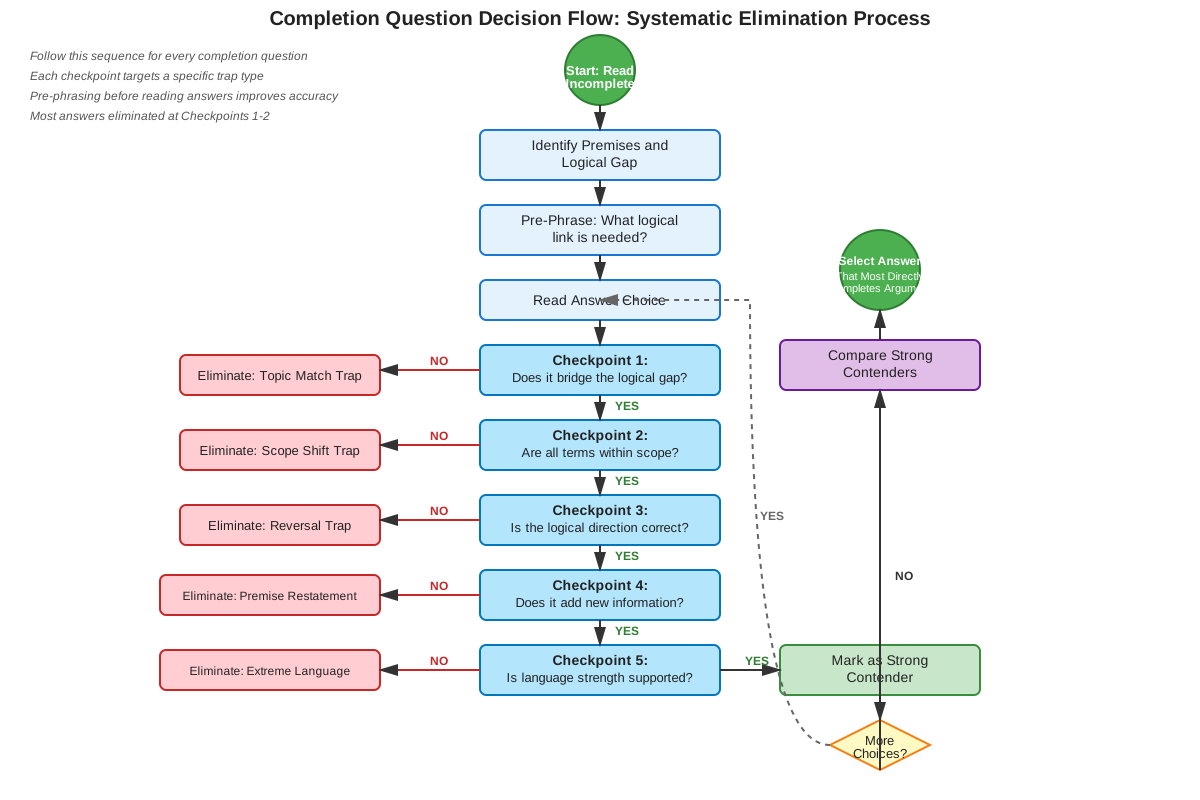
Systematic Approach to Completion Questions
Step 1: Read the argument and identify the blank's location (2-3 seconds)
- Blank at the end = missing conclusion
- Blank in the middle = missing premise/link
Step 2: Analyze the logical structure before looking at answers (10-15 seconds)
- Identify all stated premises
- Note any conditional relationships, causal claims, or comparisons
- Identify what terms/concepts need to be connected
Step 3: Predict the logical function needed (5-10 seconds)
- What must the missing statement accomplish?
- What scope must it maintain?
- What's the minimum claim needed?
Step 4: Eliminate trap answers systematically (20-30 seconds)
- Cross out topic match traps (relevant but don't complete logic)
- Eliminate overreach traps (too strong/broad)
- Remove scope shift traps (introduce new terms)
- Reject premise restatements (add nothing new)
- Watch for reversal traps (invert logical relationships)
Step 5: Verify the remaining answer (5-10 seconds)
- Does it maintain exact scope?
- Does it complete the specific logical function?
- Does it use terms that connect premises to conclusion?
Exam Tip: If you're torn between two answers, one is likely the correct completion and the other is probably a topic match trap. Re-read the argument focusing solely on logical structure, not content, to distinguish them.
Trigger Words and Phrases
Watch for these question stems that signal completion questions:
- "Which one of the following most logically completes the argument?"
- "The conclusion of the argument is most strongly supported if which one of the following is true?"
- "Which one of the following, if true, allows the conclusion to be properly drawn?"
Red flag words in trap answers:
- Extreme absolutes: always, never, only, must, cannot (often signal overreach)
- New comparatives: better, worse, more, less (when comparison wasn't in premises)
- Causal language: causes, leads to, results in (when premises show only correlation)
- Scope expanders: all, every, in general, typically (when premises are more limited)
Time Allocation
Completion questions should take 1:00-1:20 on average:
- 15-20 seconds: Read and analyze argument structure
- 30-45 seconds: Eliminate trap answers
- 10-15 seconds: Verify correct answer
If you exceed 1:30, you're likely overthinking. Trust your structural analysis and move on.
Memory Techniques
The SCOPE Acronym for Trap Identification
Shift - Does the answer shift scope (broader, narrower, or different terms)?
Copy - Does it merely copy/restate a premise?
Overreach - Does it claim more than premises support?
Premise-free - Does it ignore the premises and just sound good?
Extreme - Does it use extreme language unsupported by premises?
Visualization Strategy: The Bridge Metaphor
Visualize the argument as two islands (premises and conclusion) with a gap between them. The correct answer is the bridge that:
- Starts exactly where the premises end (no scope shift)
- Reaches exactly where the conclusion begins (no overreach)
- Is strong enough to support the logical weight (no gaps)
- Uses materials from both islands (connects existing terms)
Trap answers are:
- Bridges to different islands (scope shift)
- Bridges that extend past the destination (overreach)
- Decorative structures on one island (premise restatement)
- Bridges made of unrelated materials (topic match)
The "Minimum Viable Completion" Principle
Remember: MVC = Minimum Viable Completion
The correct answer does the minimum necessary to complete the argument's logic. If an answer does more than necessary, it's probably a trap. This principle helps you avoid overreach traps and impressive-sounding but incorrect answers.
Summary
Completion answer traps represent sophisticated wrong answers designed to exploit predictable reasoning errors in LSAT Logical Reasoning questions. These traps succeed by appearing relevant, using familiar vocabulary, or seeming to strengthen arguments while failing to complete the specific logical structure required. The five primary trap types—topic match, overreach, reversal, premise restatement, and scope shift—account for the vast majority of incorrect answers in completion questions. Success requires a systematic approach: analyze the argument's logical structure before examining answers, identify the specific function the missing statement must perform, and eliminate answers that fail to maintain precise scope or logical necessity. The correct completion is typically the most modest answer that precisely bridges the logical gap, neither adding unnecessary information nor shifting to related but distinct issues. Mastering completion answer traps requires understanding that logical completion differs fundamentally from topical relevance, and that the LSAT rewards precision over persuasiveness.
Key Takeaways
- Completion answer traps exploit the difference between topical relevance and logical completion—many trap answers discuss the right subject but don't complete the argument's structure
- The five primary trap types (topic match, overreach, reversal, premise restatement, scope shift) account for most incorrect answers and can be systematically identified
- Correct completions maintain exact scope, perform the specific logical function required, and typically represent the minimum claim needed to complete the argument
- Analyze argument structure before reading answer choices to avoid being influenced by attractive but incorrect options
- Systematic elimination using trap pattern recognition is more reliable than trying to identify the correct answer immediately
- The correct answer connects terms and concepts already present in the argument without introducing new scope or making unwarranted generalizations
- Time pressure increases susceptibility to topic match traps because they feel comfortable and familiar—conscious awareness of this bias improves performance
Related Topics
Assumption Questions: Closely related to completion questions, assumption questions ask what must be true for an argument to work. Mastering completion traps provides direct preparation for identifying necessary assumptions versus attractive but unnecessary statements.
Strengthen/Weaken Questions: The skills developed in avoiding completion traps—particularly scope analysis and logical structure recognition—transfer directly to evaluating whether new information genuinely affects an argument's strength.
Inference Questions: Understanding what logically follows from premises (the core skill in completion questions) is essential for inference questions, which ask what must be true based on given information.
Parallel Reasoning Questions: Recognizing logical structure independent of content, a key skill for avoiding topic match traps, is fundamental to identifying parallel argument structures.
Flaw Questions: Many completion traps represent common logical flaws (scope shifts, reversals, overreach). Understanding these traps enhances ability to identify flaws in complete arguments.
Practice CTA
Now that you understand the patterns behind completion answer traps and have learned systematic strategies for avoiding them, it's time to apply these concepts to actual LSAT-style questions. The practice questions and flashcards will reinforce your ability to recognize trap patterns quickly and accurately, building the automaticity needed for test-day success. Remember: completion questions are highly learnable—consistent practice with conscious attention to trap patterns transforms them from challenging puzzles into reliable scoring opportunities. Approach each practice question as an opportunity to refine your trap recognition skills, and you'll see measurable improvement in both accuracy and speed.
Sign up free to keep reading
Create a free AnvayaPrep account to finish this LSAT guide on Completion answer traps — plus flashcards and practice questions.