Overview
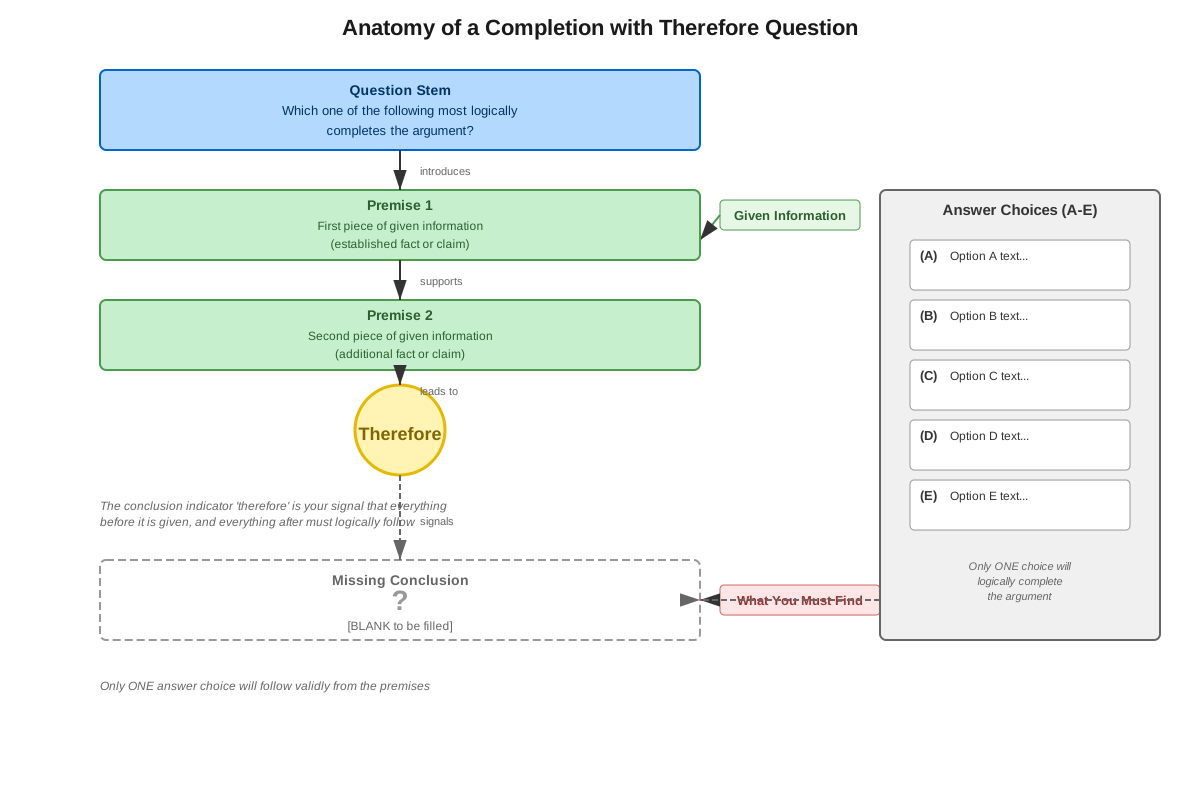
Completion with therefore questions represent a distinctive and frequently tested question type within LSAT Logical Reasoning sections. These questions present an argument with a missing conclusion—the final statement that should logically follow from the premises provided. The test-taker must identify which answer choice best completes the argument when preceded by the inference indicator "therefore" or similar conclusion markers.
This question type tests a fundamental skill that underlies all logical reasoning: the ability to recognize what legitimately follows from given information. Unlike assumption questions that ask what's missing from the middle of an argument, or strengthen/weaken questions that ask how to affect an argument's validity, completion questions require identifying the proper endpoint of a chain of reasoning. Success on these questions demands understanding both deductive validity (what must be true) and inductive strength (what is most supported), depending on the argument structure presented.
Within the broader landscape of LSAT completion with therefore questions and the evaluate and complete the argument question family, this topic connects directly to skills tested in inference questions, must-be-true questions, and main point questions. Mastering completion questions builds the foundational reasoning skills necessary for virtually every other Logical Reasoning question type, making it an essential component of comprehensive LSAT preparation. These questions typically appear 2-4 times per Logical Reasoning section and are considered medium difficulty, though they can range from straightforward to highly challenging depending on argument complexity.
Learning Objectives
- [ ] Identify how Completion with therefore appears in LSAT questions
- [ ] Explain the reasoning pattern behind Completion with therefore
- [ ] Apply Completion with therefore to solve LSAT-style problems accurately
- [ ] Distinguish between conclusions that must be true versus those that are merely supported by premises
- [ ] Evaluate answer choices by testing their logical connection to provided premises
- [ ] Recognize common argument structures that appear in completion questions
- [ ] Identify and avoid answer choices that introduce new information unsupported by premises
Prerequisites
- Basic argument structure: Understanding premises, conclusions, and inference indicators is essential because completion questions require identifying where conclusions belong in argument chains
- Conditional reasoning fundamentals: Knowledge of if-then statements and their logical relationships helps evaluate whether proposed conclusions follow validly from conditional premises
- Inference types: Familiarity with deductive versus inductive reasoning enables proper assessment of whether a conclusion must be true or is merely supported
- Common logical patterns: Recognition of basic argument forms (modus ponens, modus tollens, categorical syllogisms) accelerates identification of valid completions
Why This Topic Matters
Completion with therefore questions test the most fundamental skill in logical reasoning: determining what follows from given information. This skill extends far beyond standardized testing into legal practice, where attorneys must draw appropriate conclusions from evidence, statutes, and precedents. The ability to recognize what legitimately follows from premises while avoiding overreach or unsupported leaps is central to legal analysis, judicial reasoning, and persuasive advocacy.
On the LSAT, completion questions appear with notable frequency—typically 2-4 questions per Logical Reasoning section, accounting for approximately 8-15% of all Logical Reasoning questions. These questions are considered high-yield because they test pure reasoning ability without requiring identification of argument flaws or evaluation of external factors. Performance on completion questions strongly correlates with overall Logical Reasoning scores.
Completion questions appear in several recognizable formats. The most common presents an argument with premises followed by a conclusion indicator ("therefore," "thus," "so," "consequently," "it follows that") and a blank or incomplete final statement. Some variations present the argument structure without explicit conclusion indicators but ask which statement "most logically completes the argument." Others may embed the completion within a longer passage where the test-taker must identify which statement best serves as the argument's conclusion. Regardless of format, all completion questions share the core task: identifying what the premises actually support or establish.
Core Concepts
The Structure of Completion Questions
Completion with therefore questions follow a predictable structure that, once recognized, enables systematic approach and solution. The question stem typically contains language such as "Which one of the following most logically completes the argument?" or presents an argument ending with "therefore" followed by a blank or incomplete statement. The argument itself consists of premises—factual claims, observations, or stipulated information—that lead toward a conclusion that the test-taker must identify.
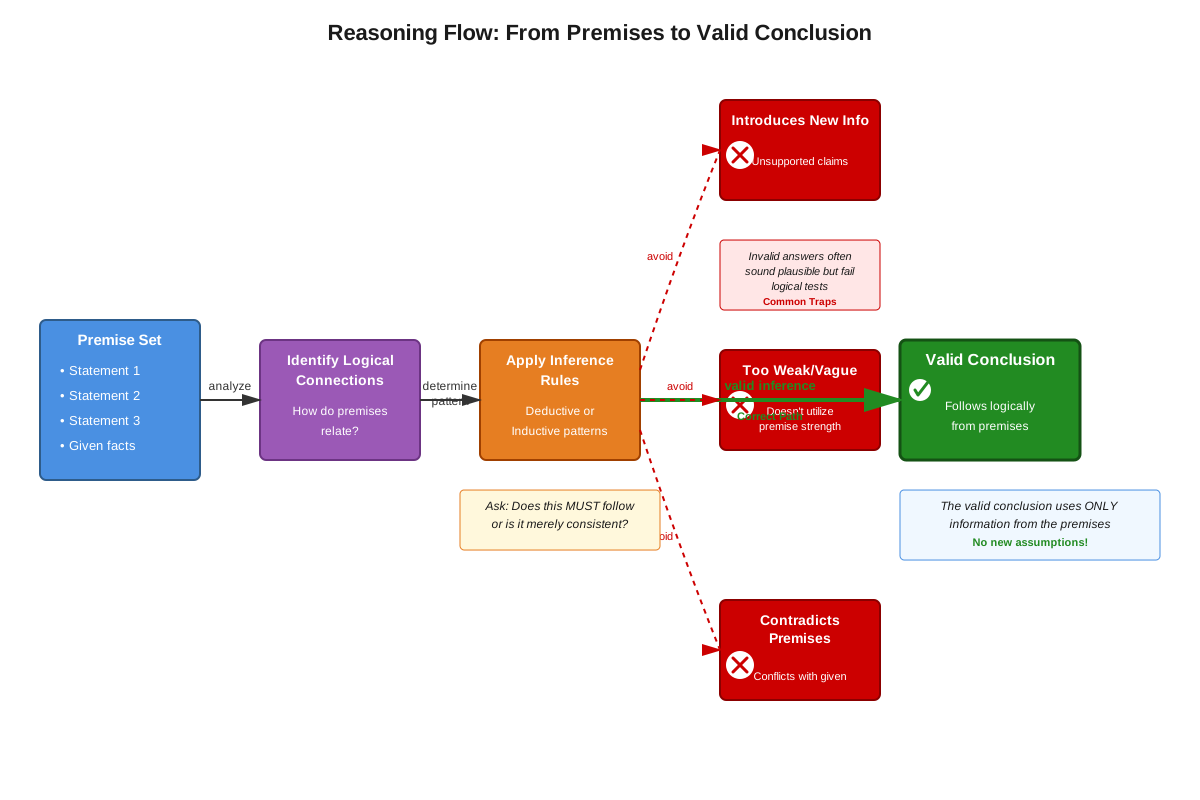
The critical distinction in these questions lies in understanding what "logically completes" means. The correct answer must be the statement that follows most directly and necessarily from the premises provided, without introducing unsupported assumptions or making leaps beyond what the evidence establishes. This requires careful attention to the scope, strength, and subject matter of the premises.
Deductive Versus Inductive Completions
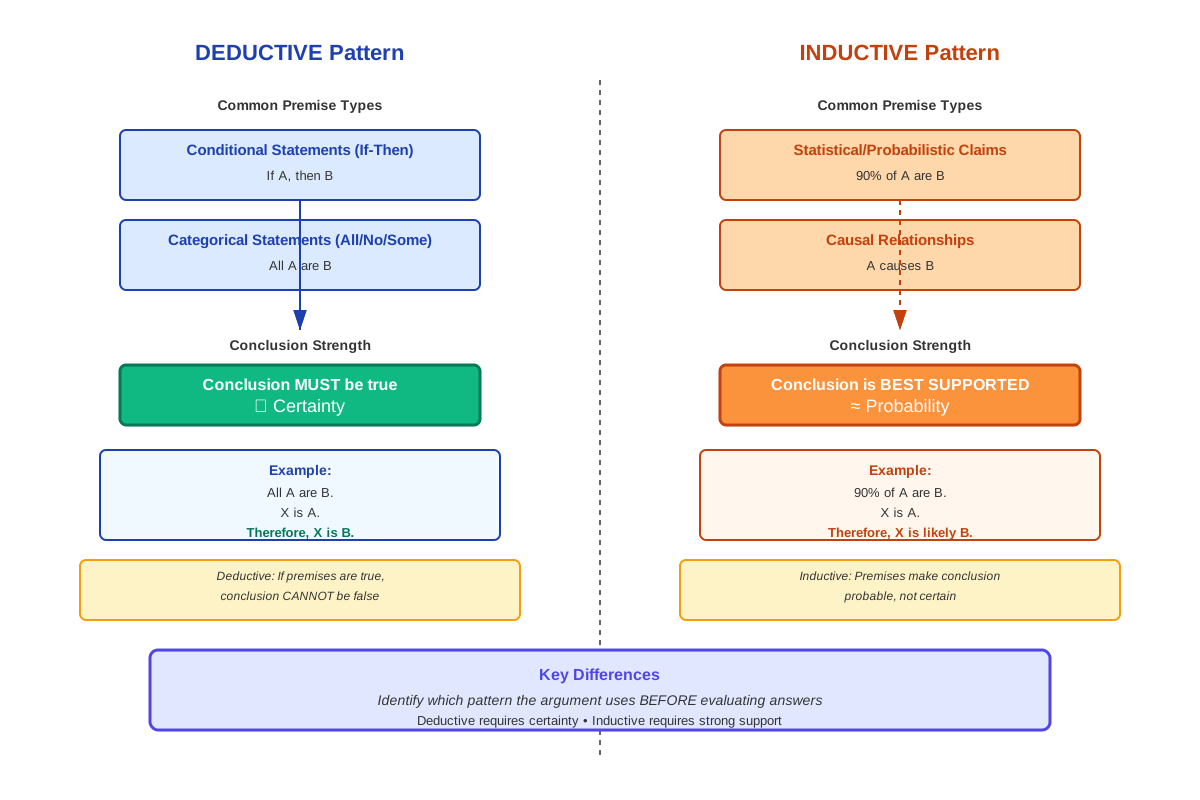
Understanding whether an argument requires a deductive or inductive completion is fundamental to selecting correct answers. Deductive completions follow necessarily from premises—if the premises are true, the conclusion must be true. These typically involve:
- Categorical syllogisms (All A are B; All B are C; therefore, all A are C)
- Conditional reasoning chains (If A then B; If B then C; therefore, if A then C)
- Formal logical relationships where the conclusion is logically entailed
Inductive completions, by contrast, are strongly supported by premises but don't follow with absolute necessity. These involve:
- Generalizations from specific instances
- Causal inferences from correlational data
- Predictions based on established patterns
- Explanatory hypotheses that account for observed phenomena
Most LSAT completion questions involve inductive reasoning, requiring identification of the conclusion most strongly supported rather than logically necessitated. However, recognizing when deductive validity is required prevents selecting answers that are merely plausible when certainty is demanded.
Scope Matching in Completions
Perhaps the most critical skill in completion questions is scope matching—ensuring the conclusion's scope precisely aligns with what the premises establish. Scope encompasses several dimensions:
| Scope Dimension | Premises Must Support | Common Errors |
|---|---|---|
| Quantifier scope | If premises discuss "some," conclusion cannot claim "all" | Overgeneralizing from limited evidence |
| Subject scope | Conclusion must address same entities as premises | Shifting to related but distinct subjects |
| Temporal scope | Time frame of conclusion must match premises | Extending past patterns indefinitely into future |
| Modal scope | Strength of claim (must, likely, might) must match evidence strength | Claiming certainty from probabilistic evidence |
Incorrect answer choices frequently violate scope by being too broad (claiming more than premises support), too narrow (failing to capture what premises establish), or off-topic (addressing subjects not discussed in premises).
The Role of Intermediate Conclusions
Complex completion questions may contain intermediate conclusions—statements that follow from some premises and serve as premises for further reasoning. Recognizing these structures prevents selecting an intermediate conclusion as the final completion. The pattern typically appears as:
- Initial premises (evidence, observations, facts)
- Intermediate conclusion (follows from initial premises)
- Additional premises (building on intermediate conclusion)
- Final conclusion (what the question asks for)
The correct completion must represent the endpoint of the reasoning chain, not a midpoint. Test-takers must trace the full argument structure to identify where reasoning terminates.
Common Argument Patterns in Completion Questions
Certain argument structures appear repeatedly in completion questions. Recognizing these patterns accelerates solution:
Causal Arguments: Premises establish correlation or temporal sequence; completion infers causal relationship (or appropriately limits causal claim)
Comparative Arguments: Premises compare two or more entities on specific dimensions; completion draws inference about relative standing or implications of differences
Conditional Chains: Premises establish series of if-then relationships; completion identifies what follows from triggering initial condition or what's required for final outcome
Problem-Solution Arguments: Premises identify problem and describe proposed solution; completion evaluates solution's likely effectiveness or identifies necessary conditions
Definitional Arguments: Premises establish criteria or definitions; completion applies these to specific case or draws implications
Eliminating Wrong Answer Types
Incorrect answers in completion questions fall into predictable categories:
- Out of scope: Introduces topics, entities, or concepts not mentioned in premises
- Too strong: Makes absolute claims when premises support only qualified conclusions
- Too weak: Fails to capture full strength of what premises establish
- Reverses logic: Confuses sufficient and necessary conditions or reverses causal direction
- Intermediate conclusion: Represents midpoint rather than endpoint of reasoning
- Requires additional assumption: Needs unstated premise to connect to given premises
Concept Relationships
The concepts within completion with therefore questions form an interconnected system. Argument structure recognition serves as the foundation, enabling identification of premises versus conclusions. This connects directly to scope matching, which requires understanding what each premise establishes and ensuring the conclusion doesn't exceed that scope. Deductive versus inductive reasoning determines the standard for evaluation—whether the conclusion must follow necessarily or must be strongly supported—which in turn affects answer choice elimination strategies.
Intermediate conclusions relate to argument structure by adding complexity to the reasoning chain, requiring test-takers to distinguish between steps in reasoning and final endpoints. Common argument patterns represent recurring structures that combine the other concepts—each pattern involves specific scope considerations, may be deductive or inductive, and requires recognizing where intermediate conclusions end and final conclusions begin.
These concepts connect to prerequisite knowledge of conditional reasoning (which appears frequently in deductive completions), basic inference skills (the foundation for all completion questions), and argument structure (necessary for parsing complex reasoning chains). They also connect forward to assumption questions (which ask what's missing from the middle rather than the end), inference questions (which may ask what follows without providing argument structure), and main point questions (which require identifying conclusions in complete arguments).
Relationship map: Argument Structure Recognition → Premise Identification → Scope Analysis → Reasoning Type Determination (Deductive/Inductive) → Answer Choice Evaluation → Elimination of Scope Violations, Logical Errors, and Unsupported Claims → Selection of Best Completion
High-Yield Facts
⭐ The correct completion must be supported by the premises without requiring additional unstated assumptions
⭐ Scope violations—particularly overgeneralization—are the most common wrong answer trap in completion questions
⭐ When premises contain conditional statements, the completion often involves applying or combining those conditionals
⭐ Completion questions test what follows from premises, not what would strengthen or complete the reasoning process
⭐ The correct answer will match the premises in subject matter, scope, and strength of claim
- Intermediate conclusions are wrong answers when they represent steps in reasoning rather than final endpoints
- Comparative premises typically lead to comparative conclusions, not absolute claims about individual entities
- Temporal or causal language in premises often signals that the completion will involve prediction or causal inference
- Answer choices introducing new entities or concepts not mentioned in premises are nearly always incorrect
- When premises establish necessary or sufficient conditions, the completion must respect those logical relationships
- Quantifier shifts (some → all, many → most, etc.) between premises and completion signal incorrect answers
- The conclusion indicator "therefore" signals that what follows must be justified by what precedes it
- Completion questions reward conservative reasoning—selecting what's clearly supported over what's merely possible
Quick check — test yourself on Completion with therefore so far.
Try Flashcards →Common Misconceptions
Misconception: The correct completion is whichever answer choice seems most reasonable or true in the real world → Correction: The correct completion must follow from the specific premises provided, regardless of real-world plausibility. LSAT completion questions test logical reasoning, not factual knowledge or general reasonableness.
Misconception: If an answer choice is supported by the premises, it's correct even if it doesn't fully capture what the premises establish → Correction: The correct answer must be the statement most strongly and completely supported by the premises. An answer that's merely consistent with premises but doesn't represent what they actually establish is incorrect.
Misconception: Completion questions ask for assumptions needed to make the argument work → Correction: Completion questions ask for conclusions that follow from premises, not missing premises or assumptions. The completion is what the argument establishes, not what it requires to be valid.
Misconception: The longest or most detailed answer choice is usually correct because it's most complete → Correction: Correct completions are often concise and precisely scoped. Length doesn't indicate correctness; logical connection to premises does. Longer answers frequently introduce unsupported details.
Misconception: If the premises discuss a problem, the completion should propose a solution → Correction: The completion must follow from what the premises actually establish. If premises only describe a problem without discussing solutions, the completion cannot introduce solutions without additional support. The completion reflects the argument's logical endpoint, not what would be practically useful.
Misconception: Strong language (must, always, never) in answer choices indicates incorrect answers → Correction: While overly strong claims often exceed premise support, strong language is correct when premises provide deductive support. The issue isn't strength per se but whether the premises justify that level of certainty.
Worked Examples
Example 1: Conditional Reasoning Completion
Argument: "All effective managers possess strong communication skills. Maria has been promoted to a management position. However, Maria's previous performance reviews consistently noted her poor communication abilities. Therefore, _____"
Step 1 - Identify Premises:
- Premise 1: All effective managers possess strong communication skills (If effective manager → strong communication)
- Premise 2: Maria is now a manager
- Premise 3: Maria has poor communication abilities
Step 2 - Analyze Logical Structure:
This involves a conditional statement about effective managers and specific information about Maria. The premises establish that effective management requires strong communication, and Maria lacks this requirement.
Step 3 - Determine Scope:
The premises discuss what's required for effective management, not management generally. Maria is a manager but the question is whether she'll be effective.
Step 4 - Evaluate Answer Choices:
(A) "Maria will not be an effective manager"
- This follows logically: Effective management requires strong communication (contrapositive: no strong communication → not effective manager). Maria lacks strong communication, so she won't be effective. CORRECT
(B) "Maria should not have been promoted"
- This introduces evaluation of the promotion decision, which premises don't address. Out of scope.
(C) "Maria will improve her communication skills"
- This predicts future development unsupported by premises. Introduces new information.
(D) "Most managers have strong communication skills"
- This shifts from "effective managers" to "managers" generally. Scope violation.
(E) "Communication skills can be learned"
- This general claim about skill development isn't supported by premises. Out of scope.
Answer: (A) - This completion properly applies the conditional logic from the premises to Maria's specific situation without exceeding scope or introducing unsupported claims.
Example 2: Causal Inference Completion
Argument: "Studies show that cities with extensive public transportation systems have lower rates of traffic congestion than cities without such systems. Additionally, cities with lower traffic congestion report higher average life satisfaction among residents. Metropolis recently completed a comprehensive public transportation network. Therefore, _____"
Step 1 - Identify Premises:
- Premise 1: Extensive public transit correlates with lower traffic congestion
- Premise 2: Lower traffic congestion correlates with higher life satisfaction
- Premise 3: Metropolis now has extensive public transit
Step 2 - Analyze Logical Structure:
This presents correlational evidence forming a chain: public transit → lower congestion → higher satisfaction. Metropolis has implemented the first element.
Step 3 - Determine Reasoning Type:
This is inductive reasoning based on correlational patterns. The completion should reflect what's likely or expected, not what must occur with certainty.
Step 4 - Evaluate Answer Choices:
(A) "Metropolis will experience higher life satisfaction than any other city"
- Too strong; premises support relative improvement, not absolute superiority. Overgeneralization.
(B) "Metropolis residents will likely experience increased life satisfaction"
- This follows the correlational chain appropriately with qualified language ("likely"). CORRECT
(C) "Public transportation causes increased life satisfaction"
- This claims direct causation when premises only establish correlation through intermediate factor (congestion). Logical leap.
(D) "Metropolis will have no traffic congestion"
- Too absolute; premises indicate "lower" congestion, not elimination. Scope violation.
(E) "Other cities should build public transportation systems"
- This prescriptive claim isn't supported by descriptive correlational data. Introduces normative judgment.
Answer: (B) - This completion appropriately follows the correlational chain established in premises while maintaining appropriate scope (qualified prediction rather than certainty) and subject matter (Metropolis's life satisfaction).
Exam Strategy
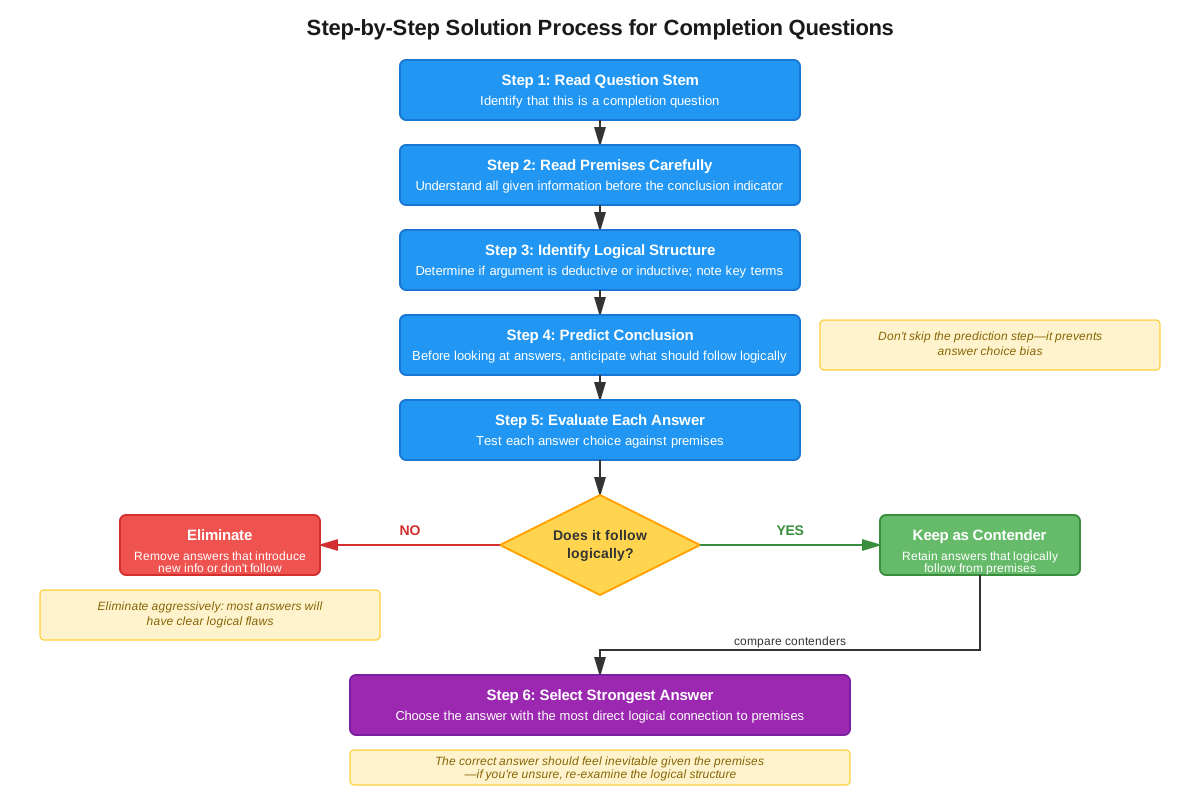
When approaching completion with therefore questions on the LSAT, employ this systematic process:
Step 1 - Read the question stem first to confirm it's a completion question. Look for phrases like "most logically completes," "conclusion follows," or explicit "therefore" with blank.
Step 2 - Read the argument carefully, identifying each premise and noting any intermediate conclusions. Pay special attention to quantifiers (all, some, most), conditional indicators (if, when, requires), and scope limitations (specific subjects, time frames, contexts).
Step 3 - Before looking at answer choices, formulate your own completion based on what the premises establish. This prediction serves as an anchor, preventing distraction by attractive but incorrect options.
Step 4 - Evaluate each answer choice by asking:
- Does this follow from the premises without additional assumptions?
- Does the scope match (subject, quantifier, strength)?
- Does this represent the endpoint of reasoning or an intermediate step?
- Does this introduce new information unsupported by premises?
Trigger words to watch for:
- Conclusion indicators: therefore, thus, so, consequently, it follows that, hence
- Scope limiters: some, many, most, typically, often, likely (versus all, always, must)
- Conditional markers: if, when, requires, necessary, sufficient, only if
- Causal language: causes, leads to, results in, because of
Process of elimination tips:
- Immediately eliminate answers introducing topics not mentioned in premises
- Eliminate answers that shift quantifiers upward (some → most → all)
- Eliminate answers requiring you to assume additional facts
- Between two seemingly correct answers, choose the more conservative claim that stays closer to premise scope
Time allocation: Spend 1:00-1:15 on completion questions. They're typically faster than assumption or flaw questions because you're selecting what follows rather than identifying what's missing or wrong. If you find yourself spending over 1:30, you're likely overthinking—return to the premises and match scope directly.
Exam Tip: The correct answer to a completion question will often feel "boring" or "obvious" because it simply states what the premises establish without dramatic leaps or interesting additions. Resist the temptation to select more exciting answers that go beyond premise support.
Memory Techniques
SCOPE Acronym for evaluating completions:
- Subject matter must match premises
- Conservative claims preferred over dramatic leaps
- Out-of-scope information signals wrong answers
- Premises must support without additional assumptions
- Endpoint of reasoning, not intermediate step
The "Therefore Test": When evaluating an answer choice, insert it after "therefore" and ask: "Would someone reading just the premises accept this conclusion as following logically?" If you need to explain or justify the connection, it's likely wrong.
Visualization Strategy: Picture the argument as a bridge. The premises are the starting point, the conclusion is the destination. The correct completion reaches exactly where the bridge extends—no further, no shorter. Wrong answers either fall short (too weak), overshoot (too strong), or head in different directions (out of scope).
The Quantifier Ladder: Visualize quantifiers as rungs on a ladder from bottom to top: some → many → most → all. Premises establish a specific rung; conclusions cannot climb higher without additional support.
Conditional Chain Links: For arguments with conditional statements, visualize each if-then as a chain link. The completion must represent where the chain leads when you follow all connected links, not a leap to an unconnected link.
Summary
Completion with therefore questions test the fundamental logical reasoning skill of identifying what follows from given premises. These questions present arguments with missing conclusions, requiring test-takers to select the statement that most logically completes the reasoning. Success demands careful attention to scope—ensuring the conclusion matches premises in subject matter, quantifier strength, and claim certainty. The correct completion must be supported by premises without requiring additional assumptions, representing the endpoint rather than an intermediate step in the reasoning chain. Most completion questions involve inductive reasoning where the conclusion is strongly supported rather than logically necessitated, though some require recognizing deductive validity. Common wrong answer traps include scope violations (especially overgeneralization), introduction of unsupported new information, confusion of intermediate and final conclusions, and claims requiring additional assumptions. Systematic approach involves identifying all premises, determining argument structure and reasoning type, predicting the completion before viewing answers, and eliminating choices that exceed premise support or shift scope. Mastery of completion questions builds foundational skills applicable across all Logical Reasoning question types.
Key Takeaways
- Completion questions require identifying conclusions that follow from premises without additional assumptions—test what the argument establishes, not what would make it stronger
- Scope matching is critical: the correct completion must align with premises in subject matter, quantifier strength (some/most/all), and claim certainty (might/likely/must)
- Wrong answers typically violate scope by being too broad, introduce unsupported new information, or represent intermediate rather than final conclusions
- Most completions involve inductive reasoning where the answer is strongly supported rather than logically necessary; match the strength of your conclusion to the strength of premise support
- Systematic approach—identify premises, analyze structure, predict completion, then evaluate answers—prevents distraction by attractive but incorrect options
- Conservative reasoning wins: when uncertain between answers, select the claim that stays closest to what premises explicitly establish
- Trigger words (therefore, thus, consequently) and conditional/causal language in premises guide identification of logical relationships that determine correct completions
Related Topics
Inference Questions: These questions ask what must be true or is most supported by a passage, similar to completion questions but without providing argument structure. Mastering completion questions develops the core inference skills needed for these questions.
Main Point Questions: These require identifying the conclusion in a complete argument. Completion questions build the ability to recognize what serves as a proper conclusion versus supporting premises.
Assumption Questions: While completion questions ask for conclusions, assumption questions ask for missing premises. Understanding what makes a valid completion helps identify what assumptions would be necessary to reach given conclusions.
Parallel Reasoning Questions: These require matching argument structures. Recognizing the reasoning patterns in completion questions (conditional chains, causal arguments, comparative reasoning) builds pattern recognition skills essential for parallel reasoning.
Sufficient Assumption Questions: These ask what, if added, would make an argument valid. Understanding what makes a completion follow logically from premises helps identify what would guarantee a given conclusion.
Practice CTA
Now that you've mastered the core concepts of completion with therefore questions, it's time to apply this knowledge to actual LSAT-style problems. The practice questions and flashcards will reinforce your understanding of scope matching, logical completion, and systematic answer evaluation. Each practice question you complete strengthens your pattern recognition and builds the confidence needed to approach these questions efficiently on test day. Remember: completion questions reward careful, conservative reasoning—trust the systematic approach you've learned, and you'll consistently identify correct answers. Begin practicing now to transform this knowledge into test-day performance!
Sign up free to keep reading
Create a free AnvayaPrep account to finish this LSAT guide on Completion with therefore — plus flashcards and practice questions.