Overview
Completion with unless represents a critical skill within LSAT Logical Reasoning sections, specifically appearing in questions that ask test-takers to evaluate and complete the argument. These questions present an incomplete argument and require students to identify the missing piece—typically a necessary assumption, conclusion, or premise—that involves the conditional logic trigger word "unless." Understanding how "unless" functions in logical statements is fundamental to success on the LSAT, as this word creates conditional relationships that must be properly translated and analyzed.
The LSAT frequently tests conditional reasoning through various question types, and "unless" serves as one of the most challenging conditional indicators because it operates differently from straightforward "if-then" constructions. When completing arguments that contain "unless," test-takers must recognize that this word introduces a necessary condition while simultaneously negating the sufficient condition. This dual function makes lsat completion with unless questions particularly demanding, as students must both translate the logical structure correctly and identify what information would make the argument valid or complete.
Mastery of completion with unless questions connects directly to broader LSAT competencies including assumption identification, conditional reasoning, formal logic translation, and argument structure analysis. These questions test whether students can recognize logical gaps in reasoning and select the precise statement that bridges those gaps when conditional language is involved. Success with this topic requires both mechanical translation skills and deeper comprehension of how arguments depend on unstated conditional relationships to reach their conclusions.
Learning Objectives
- [ ] Identify how Completion with unless appears in LSAT questions
- [ ] Explain the reasoning pattern behind Completion with unless
- [ ] Apply Completion with unless to solve LSAT-style problems accurately
- [ ] Translate "unless" statements into standard conditional form (if-then notation)
- [ ] Recognize the relationship between "unless" and necessary conditions in argument completion
- [ ] Distinguish between completion questions requiring "unless" in the answer versus those requiring completion of arguments containing "unless"
- [ ] Evaluate answer choices by testing whether they create valid conditional relationships within incomplete arguments
Prerequisites
- Basic conditional logic (if-then statements): Understanding standard conditional relationships is essential because "unless" creates conditional statements that must be translated into if-then form for proper analysis.
- Necessary and sufficient conditions: Distinguishing between these condition types is crucial since "unless" specifically introduces necessary conditions while negating sufficient conditions.
- Argument structure identification: Recognizing premises, conclusions, and assumptions allows students to identify where "unless" statements fit within an argument's logical framework.
- Contrapositive formation: The ability to form contrapositives is required because "unless" statements often need to be analyzed through their contrapositive forms to complete arguments correctly.
Why This Topic Matters
Completion with unless questions appear regularly throughout LSAT Logical Reasoning sections, representing approximately 3-5% of all Logical Reasoning questions across both scored sections. While this percentage may seem modest, these questions are strategically important because they combine multiple high-difficulty elements: conditional reasoning, assumption identification, and formal logic translation. Students who master this topic gain a significant competitive advantage, as these questions often separate high scorers from average performers.
In real-world applications, the logical reasoning skills tested by completion with unless questions translate directly to legal analysis, contract interpretation, and statutory construction. Attorneys regularly encounter conditional language in legal documents, where "unless" clauses create exceptions, establish necessary conditions for obligations, and define the boundaries of legal rules. The ability to recognize what information is needed to complete a conditional argument mirrors the analytical work lawyers perform when identifying gaps in legal reasoning or determining what additional facts would strengthen or complete a legal position.
On the LSAT, completion with unless appears in several question formats: "Which one of the following, if assumed, allows the conclusion to be properly drawn?", "The argument's conclusion follows logically if which one of the following is assumed?", and "The argument requires the assumption that..." When "unless" appears in either the stimulus or answer choices, the question difficulty typically increases by one level, transforming medium questions into challenging ones. These questions commonly appear in positions 15-25 within a Logical Reasoning section, the range where the LSAT places its most discriminating items.
Core Concepts
Understanding "Unless" as a Conditional Indicator
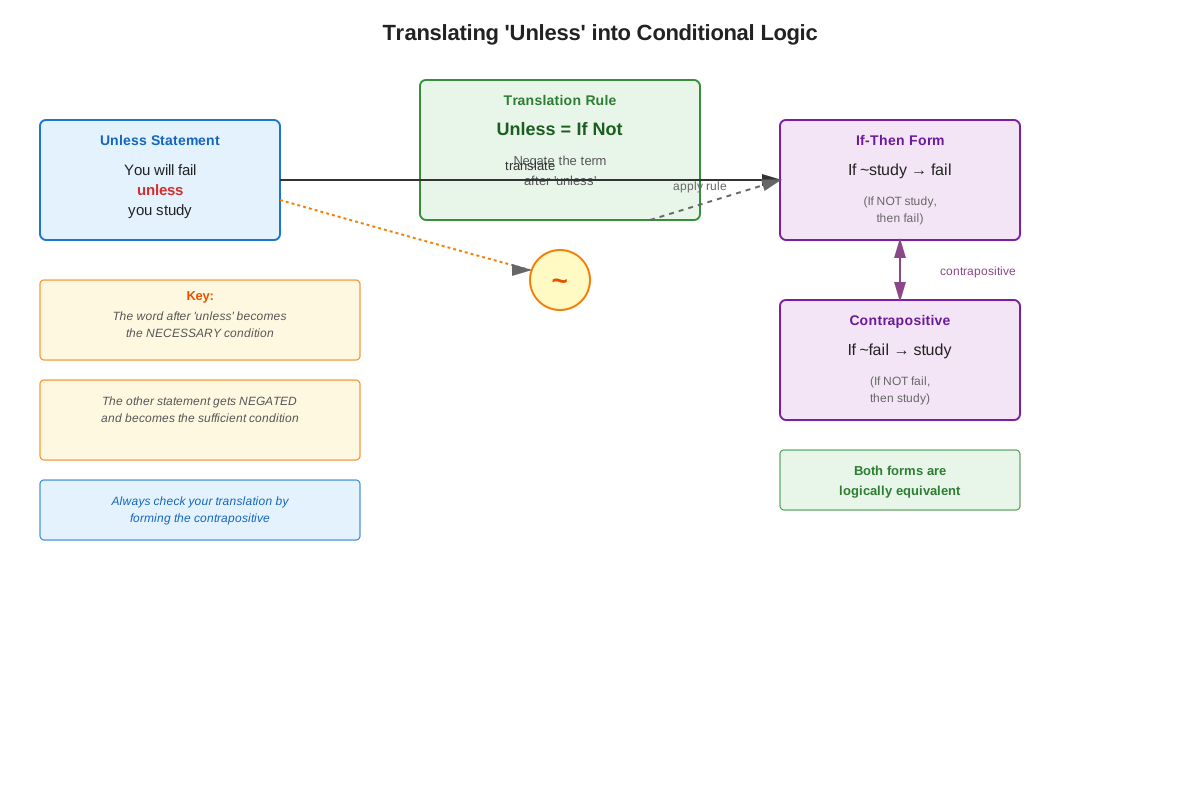
The word "unless" functions as a conditional indicator that creates a specific logical relationship between two statements. Unlike straightforward "if-then" constructions, "unless" simultaneously performs two operations: it introduces a necessary condition and negates the sufficient condition. The standard translation rule states: "A unless B" translates to "If not B, then A" or equivalently "If not A, then B." This dual function makes "unless" one of the most frequently misunderstood conditional indicators on the LSAT.
Consider the statement: "The company will fail unless it secures funding." This translates to: "If the company does not secure funding, then it will fail." The contrapositive, which is logically equivalent, states: "If the company does not fail, then it secured funding." Understanding both the standard form and contrapositive is essential for completion questions because the missing piece might be expressed in either form.
The Logical Structure of Unless Statements
| Original Form | Standard Translation | Contrapositive |
|---|---|---|
| A unless B | If ~B → A | If ~A → B |
| The plant dies unless watered | If ~watered → dies | If ~dies → watered |
| No admission unless ticket | If ~ticket → ~admission | If admission → ticket |
The table above demonstrates the consistent pattern that governs all "unless" translations. The statement following "unless" becomes the necessary condition (appearing in the consequent of the contrapositive), while the other statement becomes the sufficient condition only when negated. This pattern holds regardless of which clause appears first in the sentence—"unless" always introduces the necessary condition.
Completion Questions Involving Unless
Completion with unless questions on the LSAT typically fall into three categories:
- Missing premise containing "unless": The argument's reasoning depends on a conditional relationship that must be expressed using "unless" in the correct answer choice.
- Completing arguments that already contain "unless": The stimulus includes an "unless" statement, and the correct answer provides the additional information needed to reach the conclusion.
- Assumption questions with "unless" logic: The argument implicitly relies on an "unless" relationship that must be made explicit to validate the reasoning.
For each category, the solution strategy involves identifying the logical gap, determining what conditional relationship would bridge that gap, and translating between "unless" form and standard conditional form as needed.
The Role of Negation in Unless Completion
A critical aspect of lsat completion with unless questions involves proper handling of negation. Because "unless" inherently negates one component of the conditional relationship, students must carefully track which elements are negated and which remain positive. Common errors occur when test-takers fail to negate the sufficient condition or incorrectly negate both components.
Consider this incomplete argument: "The proposal will pass. The committee supports it." To complete this argument with an "unless" statement, we need to identify what condition, if absent, would prevent the proposal from passing. The completion might be: "The proposal will pass unless the board vetoes it." This translates to: "If the board does not veto it, then the proposal will pass." The argument now has a complete logical structure: the committee supports it (premise), the board won't veto it (implied by the unless clause when we know the conclusion is true), therefore the proposal will pass (conclusion).
Identifying What's Missing in Unless Arguments
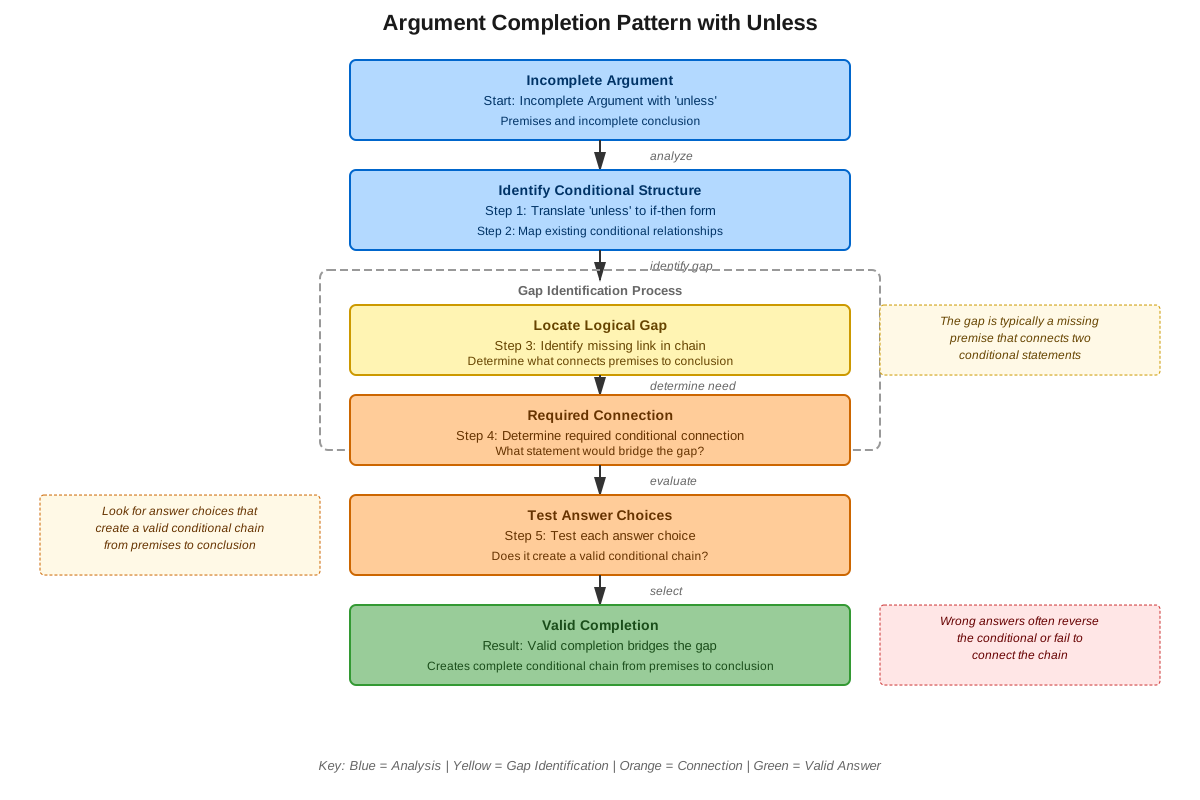
When approaching completion questions, the systematic process involves:
- Identify the conclusion: Determine what the argument is trying to prove.
- Map existing premises: Note what evidence is already provided.
- Recognize the logical gap: Identify what connection is missing between premises and conclusion.
- Determine the conditional relationship needed: Establish whether the missing piece should be a sufficient condition, necessary condition, or both.
- Translate to/from unless form: Convert between "unless" statements and standard conditionals to match the required answer format.
This five-step process ensures systematic analysis rather than intuitive guessing, which is particularly important for unless questions where intuition often misleads test-takers.
Unless in Sufficient Assumption Questions
When "unless" appears in sufficient assumption questions—those asking what, if assumed, would allow the conclusion to follow logically—the correct answer typically provides a conditional statement that, combined with the premises, guarantees the conclusion. The "unless" formulation often appears because it efficiently expresses both what must be true and what must not be true for the conclusion to hold.
For example, if an argument concludes "The project will succeed" based on the premise "The team is experienced," a sufficient assumption might be "The project will succeed unless funding is cut." This assumption, combined with an implicit premise that funding won't be cut, allows the conclusion to follow. The "unless" clause identifies the one condition that could prevent the conclusion, and by ruling it out (or assuming it doesn't occur), the argument becomes valid.
Unless in Necessary Assumption Questions
In necessary assumption questions, "unless" statements often appear because they express conditions that must hold for the argument to work. A necessary assumption is something the argument requires to be true; without it, the argument falls apart. When expressed with "unless," these assumptions typically identify potential obstacles that must not occur.
If an argument concludes "The medication is safe" based on "Clinical trials showed no adverse effects in healthy adults," a necessary assumption might be "The medication is safe unless it affects children differently than adults." This assumption is necessary because if children could be affected differently and the medication is intended for children, the conclusion wouldn't follow from the premise. The "unless" clause identifies a potential gap in the reasoning that the argument must assume doesn't undermine the conclusion.
Concept Relationships
The concepts within completion with unless form an interconnected logical framework. Understanding "unless" as a conditional indicator serves as the foundation, leading directly to the ability to translate unless statements into standard conditional form. This translation skill enables proper identification of necessary and sufficient conditions, which in turn allows recognition of logical gaps in arguments. Once gaps are identified, students can determine whether the missing piece should be expressed as an unless statement or whether an existing unless statement requires additional premises to complete the argument.
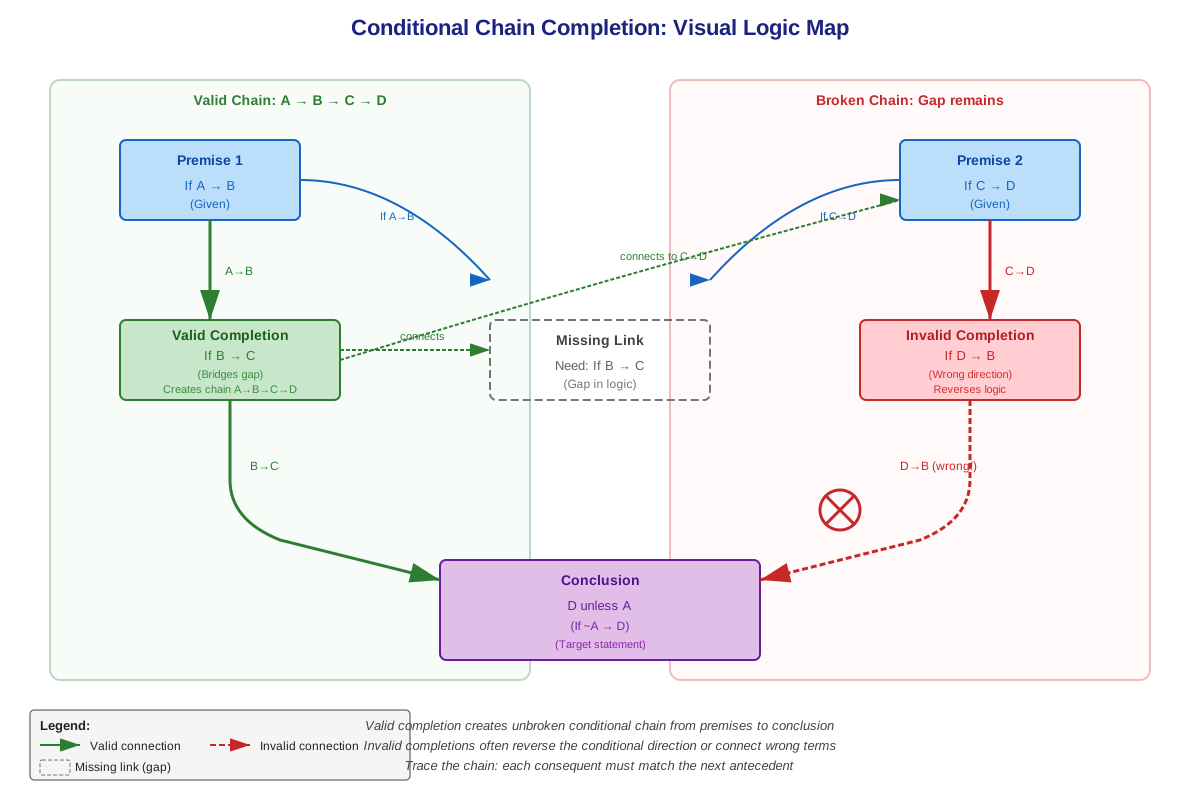
The relationship flows: Conditional Logic Fundamentals → Unless Translation Rules → Negation Handling → Gap Identification → Completion Strategy Selection → Answer Choice Evaluation.
Completion with unless connects to prerequisite topics through its dependence on basic conditional reasoning. Every unless statement is fundamentally a conditional statement, so mastery of if-then logic is essential. The topic also connects forward to more advanced logical reasoning skills including formal logic games, complex conditional chains, and multi-conditional argument analysis. Students who master completion with unless develop the logical flexibility needed for the most challenging LSAT questions across all sections.
The relationship between unless completion and assumption questions is particularly important. Many completion questions are essentially assumption questions in disguise—they ask what must be added to make an argument work, which is precisely what assumption questions test. The difference lies primarily in format: completion questions explicitly state that something is missing, while assumption questions require recognizing the gap independently.
High-Yield Facts
⭐ "A unless B" always translates to "If not B, then A" or its equivalent "If not A, then B"—this is the fundamental translation rule that governs all unless logic on the LSAT.
⭐ The word following "unless" introduces the necessary condition—this remains true regardless of sentence structure or clause order.
⭐ Unless statements require negating the sufficient condition—the condition that is NOT preceded by "unless" must be negated when forming the standard conditional.
⭐ Completion questions with unless typically appear in the medium-to-hard difficulty range—expect these questions in positions 15-25 of Logical Reasoning sections.
⭐ The contrapositive of an unless statement is always logically equivalent to the original—both forms may be needed to identify the correct completion.
- Unless statements can appear in either the stimulus or answer choices, requiring different analytical approaches for each scenario.
- Necessary assumptions involving unless often identify potential obstacles or exceptions that must not occur for the argument to succeed.
- Sufficient assumptions with unless typically provide conditional guarantees that, when combined with premises, make the conclusion certain.
- Multiple unless statements in a single argument create complex conditional chains that must be mapped systematically.
- The logical force of "unless" is identical to "if not," "only if," and "except when"—these phrases are interchangeable in formal logic.
- Completion questions may require recognizing that an unless statement is missing even when the word "unless" doesn't appear in the stimulus.
- Arguments containing unless statements often have implicit premises about whether the condition following "unless" actually occurs.
Quick check — test yourself on Completion with unless so far.
Try Flashcards →Common Misconceptions
Misconception: "Unless" means the same as "if" and can be translated directly without negation.
Correction: "Unless" requires negating the sufficient condition. "A unless B" translates to "If not B, then A," not "If B, then A." The negation is essential to the correct logical structure.
Misconception: The word order in unless statements determines which component gets negated.
Correction: The word following "unless" is always the necessary condition and never gets negated in the standard translation. The other component becomes the sufficient condition only when negated, regardless of whether it appears before or after "unless" in the sentence.
Misconception: Completion questions always require adding an unless statement to the argument.
Correction: Completion questions may require adding information to an argument that already contains an unless statement, or they may require recognizing that the missing piece should be expressed conditionally without using "unless" at all. The question stem and answer choices determine the required format.
Misconception: If an argument contains an unless statement, that statement must be the key to completing the argument.
Correction: An unless statement in the stimulus may be a premise that's already complete, with the logical gap existing elsewhere in the argument. The presence of "unless" doesn't automatically indicate where the completion is needed.
Misconception: Unless statements always express negative conditions or bad outcomes.
Correction: "Unless" is a neutral logical operator that can connect any two propositions, positive or negative. "The party will be fun unless it rains" and "The party will be boring unless we have music" both use "unless" correctly despite expressing different valences.
Misconception: The contrapositive of an unless statement is more important than the original form.
Correction: Both the original form and contrapositive are equally valid and equally important. Depending on the argument structure, either form might be the one needed to identify the correct completion. Skilled test-takers consider both forms when analyzing unless statements.
Worked Examples
Example 1: Completing an Argument with Unless Logic
Stimulus: "The archaeological site must be preserved. The artifacts found there are historically significant, and the site provides valuable information about ancient civilizations."
Question: Which one of the following, if assumed, allows the conclusion to be properly drawn?
Answer Choices:
(A) Archaeological sites should be preserved if they contain historically significant artifacts.
(B) Any site that provides valuable information should be preserved.
(C) The site will deteriorate unless it is preserved.
(D) Archaeological sites must be preserved unless they lack historical significance.
(E) Sites providing valuable information about ancient civilizations must be preserved unless preservation is prohibitively expensive.
Analysis:
Step 1: Identify the conclusion: "The archaeological site must be preserved."
Step 2: Map the premises: (1) The artifacts are historically significant, (2) The site provides valuable information about ancient civilizations.
Step 3: Recognize the gap: The premises establish characteristics of the site, but don't connect these characteristics to the necessity of preservation. We need a principle that links these features to the obligation to preserve.
Step 4: Evaluate answer choices:
(A) This provides a sufficient condition (if artifacts are significant → should preserve) but uses "should" rather than "must," making it too weak.
(B) This creates the connection we need: valuable information → must preserve. Since the premise states the site provides valuable information, this assumption would allow the conclusion to follow. However, let's check the unless options.
(C) This describes what will happen without preservation but doesn't establish that preservation is obligatory.
(D) This translates to: "If archaeological sites lack historical significance, then they need not be preserved" (contrapositive: "If they must be preserved, then they have historical significance"). This is backwards—it would work if our conclusion were about the site having significance, not about preservation being necessary.
(E) This translates to: "If sites provide valuable information and preservation is not prohibitively expensive, then they must be preserved." This works! The premise establishes the site provides valuable information. If we assume preservation isn't prohibitively expensive (which the unless clause allows when the conclusion is true), then the site must be preserved.
Correct Answer: (E)
The unless clause in (E) identifies the one exception that would prevent the obligation to preserve. By assuming this exception doesn't apply (preservation isn't prohibitively expensive), the argument becomes valid. This demonstrates how unless statements in sufficient assumptions work: they provide a conditional guarantee while identifying potential obstacles that must not occur.
Example 2: Identifying Missing Unless Logic
Stimulus: "The company's new product will be profitable. Market research indicates strong consumer demand, and the production costs are lower than anticipated."
Question: The argument's conclusion follows logically if which one of the following is assumed?
Answer Choices:
(A) Products with strong consumer demand are always profitable.
(B) Lower production costs guarantee profitability.
(C) The product will be profitable unless a competitor releases a similar product first.
(D) Strong consumer demand and low production costs are sufficient for profitability.
(E) The company will not face unexpected regulatory obstacles.
Analysis:
Step 1: Conclusion: "The new product will be profitable."
Step 2: Premises: (1) Strong consumer demand, (2) Lower production costs than anticipated.
Step 3: Gap identification: The premises provide positive factors, but profitability could still fail if certain obstacles arise. The argument assumes no deal-breaking obstacles exist.
Step 4: Evaluate choices:
(A) Too strong—"always" is extreme and not necessary for this specific argument.
(B) Too strong—"guarantee" is extreme, and this ignores the demand premise.
(C) This unless statement translates to: "If a competitor doesn't release a similar product first, then the product will be profitable." This would be sufficient if we knew no competitor would release a similar product, but the argument doesn't establish this. The unless clause identifies a potential obstacle, but we'd need additional information to know this obstacle won't occur.
(D) This directly connects the premises to the conclusion: if strong demand AND low costs, then profitable. Since both conditions are met, the conclusion follows. This is a sufficient assumption.
(E) This addresses one potential obstacle but doesn't comprehensively connect the premises to the conclusion.
Correct Answer: (D)
While (C) contains "unless" and identifies a relevant obstacle, it doesn't make the argument valid without additional premises. Choice (D) provides the complete logical bridge needed. This example demonstrates that completion questions don't always require unless statements in the answer—sometimes a straightforward conditional or principle is more appropriate. The presence of "unless" in an answer choice doesn't automatically make it correct; the logical structure must properly complete the argument.
Exam Strategy
When approaching completion with unless questions on the LSAT, begin by reading the stimulus carefully to identify whether "unless" appears in the argument itself or whether you're looking for an answer choice containing "unless." This distinction determines your analytical approach.
Trigger phrases that signal completion questions include: "which one of the following, if assumed," "the conclusion follows logically if," "the argument requires the assumption that," and "which one of the following most logically completes the argument." When these phrases appear alongside arguments containing conditional language, expect unless logic to be relevant.
Process-of-elimination strategy: First, eliminate answer choices that are irrelevant to the logical gap—choices that address different concepts than those in the premises and conclusion. Second, eliminate choices that are too extreme (using words like "always," "never," "only," or "must" when the argument doesn't require such strong claims). Third, for remaining choices containing "unless," translate them into standard conditional form and test whether they bridge the logical gap. Fourth, verify that your selected answer, when combined with the premises, actually allows the conclusion to follow—don't assume an answer is correct just because it sounds related to the topic.
Time allocation: Completion with unless questions typically require 90-120 seconds. Spend 30 seconds reading and analyzing the stimulus, 15 seconds identifying the logical gap, 30 seconds evaluating answer choices, and 15-30 seconds verifying your selection. If you find yourself spending more than two minutes, mark the question and return to it after completing easier questions in the section.
Testing answer choices: For sufficient assumption questions, the correct answer must guarantee the conclusion when combined with premises. Test this by assuming the answer choice is true and checking whether the conclusion must follow. For necessary assumption questions, the correct answer must be required for the argument to work. Test this by negating the answer choice and checking whether the argument falls apart.
Exam Tip: When you see "unless" in an answer choice, immediately write down its translation in standard conditional form. This prevents errors caused by trying to evaluate the logic in your head while managing test anxiety.
Memory Techniques
The UNLESS Mnemonic:
- Understand the conclusion first
- Negate the sufficient condition
- Locate the necessary condition (after "unless")
- Evaluate both standard form and contrapositive
- Select the answer that bridges the gap
- Systematically test your choice
Visualization Strategy: Picture "unless" as a gate that only opens when a specific condition is met. The condition following "unless" is the key that opens the gate. If you don't have the key (the condition is false), the gate stays closed (the other statement must be true). This mental image helps remember that "unless" introduces the necessary condition—the key you need.
Translation Acronym - NOS:
- Negate the first part
- Or keep the second part as-is
- Switch to if-then format
"The plant dies unless watered" becomes "If NOT watered, then dies" using NOS: Negate "watered," keep "dies," switch to if-then.
The Contrapositive Flip: Remember that every unless statement has a twin—its contrapositive. When stuck, flip it: "If not A, then B" becomes "If not B, then A." One form will usually make the logical relationship clearer.
Summary
Completion with unless represents a sophisticated logical reasoning skill that combines conditional logic translation, argument structure analysis, and gap identification. The fundamental principle governing all unless statements is that "A unless B" translates to "If not B, then A," with the word following "unless" always introducing the necessary condition. On the LSAT, these questions appear in multiple formats: arguments requiring completion with an unless statement, arguments already containing unless that need additional premises, and assumption questions where unless logic provides the missing link. Success requires systematic translation of unless statements into standard conditional form, careful tracking of negations, identification of logical gaps between premises and conclusions, and evaluation of whether proposed completions actually make arguments valid. The key distinction between sufficient and necessary assumptions involving unless is that sufficient assumptions guarantee the conclusion when added, while necessary assumptions identify conditions that must hold for the argument to work at all. Mastery of completion with unless questions provides a significant competitive advantage on the LSAT because these questions combine multiple high-difficulty elements and frequently appear in the discriminating middle-to-end portions of Logical Reasoning sections.
Key Takeaways
- "Unless" always introduces the necessary condition and requires negating the sufficient condition when translating to standard conditional form—this is the non-negotiable foundation of all unless logic.
- Completion questions require identifying the logical gap first, then determining whether the missing piece should be expressed with unless or another logical structure—don't assume unless is always the answer.
- Both the standard form and contrapositive of unless statements are equally valid and may be needed to solve different questions—practice working with both forms fluently.
- Systematic translation prevents errors: write down the conditional form of unless statements rather than trying to evaluate them mentally, especially under test pressure.
- The presence of "unless" in an answer choice doesn't make it correct—the logical structure must properly bridge the gap between premises and conclusion.
- Unless statements in sufficient assumptions typically identify exceptions or obstacles that must not occur for the conclusion to follow, while in necessary assumptions they express conditions required for the argument's validity.
- Time management is crucial: allocate 90-120 seconds per completion question, and don't hesitate to skip and return if translation becomes confusing.
Related Topics
Conditional Logic Chains: Building on unless completion, conditional chains involve multiple linked conditional statements where the consequent of one becomes the antecedent of another. Mastering unless logic provides the foundation for analyzing these complex chains.
Formal Logic in Logic Games: The conditional reasoning skills developed through unless completion transfer directly to Logic Games, where unless statements frequently appear in rules and must be diagrammed correctly.
Sufficient and Necessary Assumptions: These question types extensively use unless logic, and mastering completion with unless enables more sophisticated analysis of what arguments require versus what would guarantee their conclusions.
Contrapositive Application: Advanced work with contrapositives builds on unless translation skills, particularly in questions requiring multiple logical steps or chain reasoning.
Conditional Indicators Mastery: Unless is one of many conditional indicators (if, only if, when, whenever, provided that, etc.), and mastering unless facilitates learning the complete set of conditional translations.
Practice CTA
Now that you've mastered the core concepts of completion with unless, it's time to solidify your understanding through active practice. The practice questions and flashcards designed for this topic will challenge you to apply translation rules, identify logical gaps, and select correct completions under timed conditions. Remember that proficiency with unless logic develops through repeated exposure and deliberate practice—each question you work through strengthens your pattern recognition and speeds your translation process. Approach the practice materials systematically, reviewing any questions you miss to understand exactly where your reasoning diverged from the correct analysis. Your investment in mastering this high-yield topic will pay dividends throughout the Logical Reasoning sections and contribute significantly to your overall LSAT score. You've built the foundation—now apply it!
Sign up free to keep reading
Create a free AnvayaPrep account to finish this LSAT guide on Completion with unless — plus flashcards and practice questions.