Overview
Evaluate answer traps represent one of the most challenging aspects of LSAT Logical Reasoning questions, particularly within the "Evaluate and Complete the Argument" question family. These traps are deliberately constructed incorrect answer choices that appear attractive to test-takers who haven't fully mastered the specific reasoning patterns required for evaluation questions. Understanding these traps is not merely about avoiding wrong answers—it's about developing the analytical precision that distinguishes top LSAT performers from average scorers.
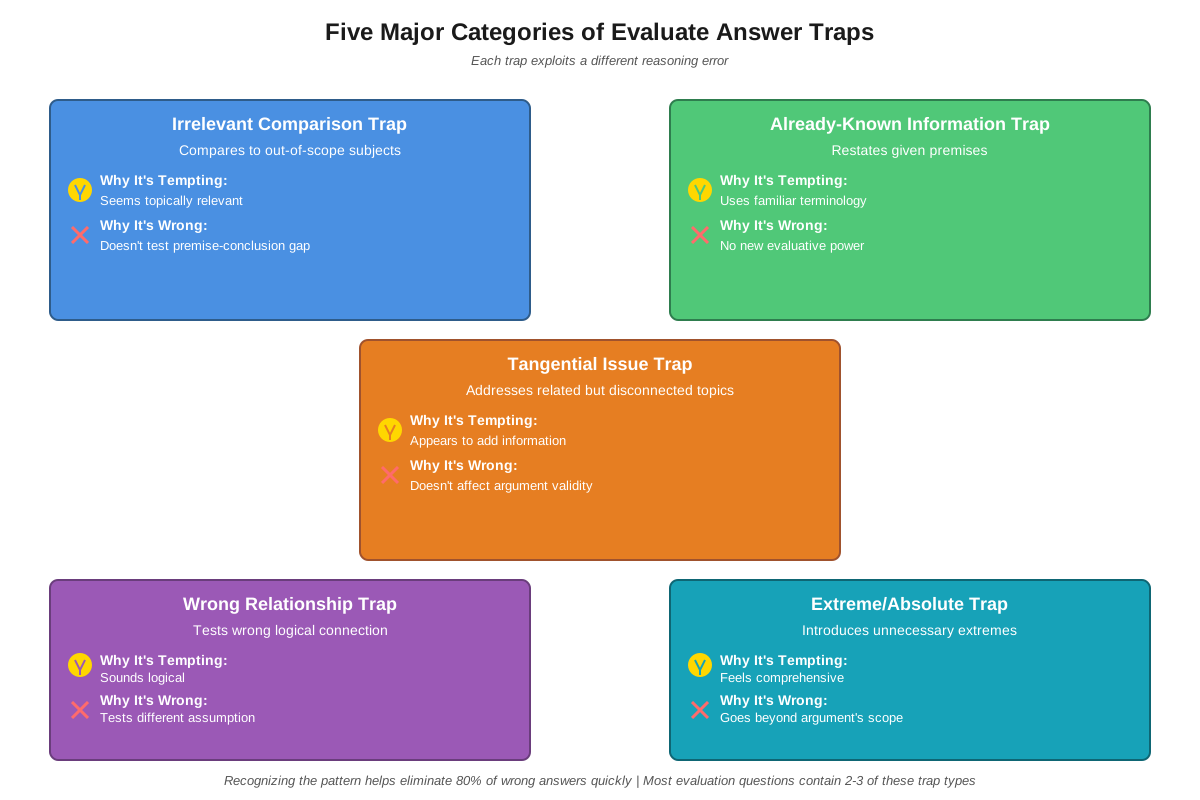
The LSAT test-makers invest considerable effort in crafting answer traps that exploit common reasoning errors, hasty reading, and incomplete analysis. In evaluation questions, where students must identify what additional information would help determine an argument's validity, the wrong answers often seem relevant to the argument's topic while failing to actually test the logical connection between premises and conclusion. These LSAT evaluate answer traps typically fall into predictable categories: answers that address irrelevant comparisons, restate information already known, introduce tangential issues, or test the wrong logical relationship.
Mastering evaluate answer traps connects directly to broader LSAT skills including assumption identification, argument structure analysis, and critical reasoning. When students learn to recognize these traps systematically, they simultaneously strengthen their ability to identify logical gaps, distinguish between sufficient and necessary conditions, and evaluate causal reasoning—all high-value skills across multiple Logical Reasoning question types. This topic serves as a bridge between understanding what arguments require (assumptions, evidence) and recognizing what they don't need (irrelevant information, already-established facts).
Learning Objectives
- [ ] Identify how Evaluate answer traps appears in LSAT questions
- [ ] Explain the reasoning pattern behind Evaluate answer traps
- [ ] Apply Evaluate answer traps to solve LSAT-style problems accurately
- [ ] Distinguish between answer choices that test relevant versus irrelevant information
- [ ] Recognize the five major categories of evaluate answer traps
- [ ] Develop a systematic elimination process for evaluation questions
- [ ] Predict common trap patterns before reading answer choices
Prerequisites
- Argument structure identification: Understanding premises, conclusions, and logical gaps is essential because evaluate questions require identifying what information would strengthen or weaken the connection between these elements.
- Assumption recognition: Recognizing unstated assumptions enables students to identify what additional information would be relevant to test, as evaluate questions essentially ask "what would help us assess this assumption?"
- Strengthen and Weaken question types: Familiarity with these question types provides the foundation for evaluation questions, which ask what information would help determine whether an argument should be strengthened or weakened.
- Conditional reasoning basics: Understanding sufficient and necessary conditions helps distinguish between information that would actually test an argument versus information that merely relates to the topic.
Why This Topic Matters
In real-world contexts, the ability to identify what information would help evaluate an argument is fundamental to critical decision-making. Lawyers must determine what evidence would be relevant to a case, business leaders must identify what data would help assess a strategic decision, and researchers must recognize what experiments would test their hypotheses. The LSAT's evaluation questions directly assess this practical reasoning skill.
On the LSAT itself, evaluation questions appear with moderate frequency—typically 2-4 questions per test across both Logical Reasoning sections. While less common than assumption or strengthen/weaken questions, evaluation questions are considered medium-to-high difficulty, with average test-takers answering them correctly only 40-55% of the time. This difficulty stems largely from the sophisticated answer traps employed, making trap recognition a high-yield study focus that can significantly improve scores.
These questions commonly appear in several formats: explicit "evaluate" questions asking what would be "most useful to know," questions asking what information would "help determine whether the conclusion is justified," and questions seeking what would "most help in assessing the argument." The arguments themselves frequently involve causal reasoning, analogies, statistical evidence, or proposals for action—contexts where multiple pieces of information might seem relevant, but only one truly tests the logical connection at issue.
Core Concepts
Understanding Evaluation Questions
Evaluation questions ask test-takers to identify what additional information would help determine whether an argument's conclusion follows logically from its premises. Unlike strengthen or weaken questions that provide new information and ask about its effect, evaluation questions require identifying what information you would need to know. The correct answer, when answered either "yes" or "no," should significantly impact the argument's strength—one answer making it stronger, the other making it weaker.
The fundamental principle underlying evaluation questions is the relevance test: the correct answer must directly address a logical gap or assumption in the argument. This means the information must connect the specific premises to the specific conclusion in a way that genuinely tests whether the reasoning holds. Many trap answers fail this test by addressing related but ultimately irrelevant issues.
The Five Major Categories of Evaluate Answer Traps
1. The Irrelevant Comparison Trap
This trap presents information comparing elements that aren't actually at issue in the argument. The argument might discuss whether Policy A would achieve Goal X, but the trap answer asks about comparing Policy A to Policy B. Unless the argument's reasoning depends on Policy A being better than alternatives, this comparison is irrelevant.
Example pattern: Argument concludes "We should implement solar panels because they'll reduce costs." Trap answer: "Whether solar panels are more efficient than wind turbines." This comparison isn't relevant unless the argument claimed solar was the best option among alternatives.
2. The Already-Known Information Trap
These traps ask about information that's already established in the argument or that wouldn't change regardless of the answer. If the argument states "Sales increased 20% after the advertising campaign," a trap might ask "Whether sales increased after the campaign." This is already known and thus cannot help evaluate anything.
Key indicator: If you can answer the question definitively based on information already in the stimulus, it's likely a trap. Evaluation questions must ask about unknown information.
3. The Tangential Issue Trap
This sophisticated trap introduces information related to the argument's topic but not to its logical structure. The argument might conclude that a restaurant's new menu will increase profits based on customer survey responses. A trap might ask about "the nutritional value of the new menu items." While related to the menu, this doesn't test whether survey responses predict profit increases.
Recognition strategy: Ask "Does this test the connection between these specific premises and this specific conclusion?" If it only relates to the general topic, it's tangential.
4. The Reversed Causation Trap
When arguments involve causal reasoning, traps often present the causal relationship in reverse or test a different causal relationship than the one at issue. If an argument concludes "X causes Y," a trap might ask about whether "Y causes X" or whether "Z causes Y" when Z isn't mentioned in the argument's reasoning.
Example: Argument: "The new training program caused productivity increases." Trap: "Whether increased productivity leads to better training outcomes." This reverses the causal direction without testing the original claim.
5. The Scope Mismatch Trap
These traps ask about information that's either too broad or too narrow relative to the argument's scope. An argument about "most employees" might have a trap asking about "all employees" or "employees in one specific department." The scope shift means the information wouldn't properly test the argument's actual claim.
| Trap Category | Key Characteristic | Recognition Question |
|---|---|---|
| Irrelevant Comparison | Compares elements not at issue | Does the argument depend on this comparison? |
| Already-Known | Information stated or implied in stimulus | Can I answer this from the passage? |
| Tangential Issue | Topic-related but logically disconnected | Does this test the premise-conclusion link? |
| Reversed Causation | Wrong causal direction | Does this test the actual causal claim made? |
| Scope Mismatch | Wrong breadth of claim | Does this match the argument's scope exactly? |
The Correct Answer Pattern
Correct answers to evaluation questions share consistent characteristics. They identify information that, depending on the answer, would either strengthen or weaken the argument significantly. This creates what test-prep experts call the "two-way street" property: answering the question one way supports the argument, answering it the opposite way undermines it.
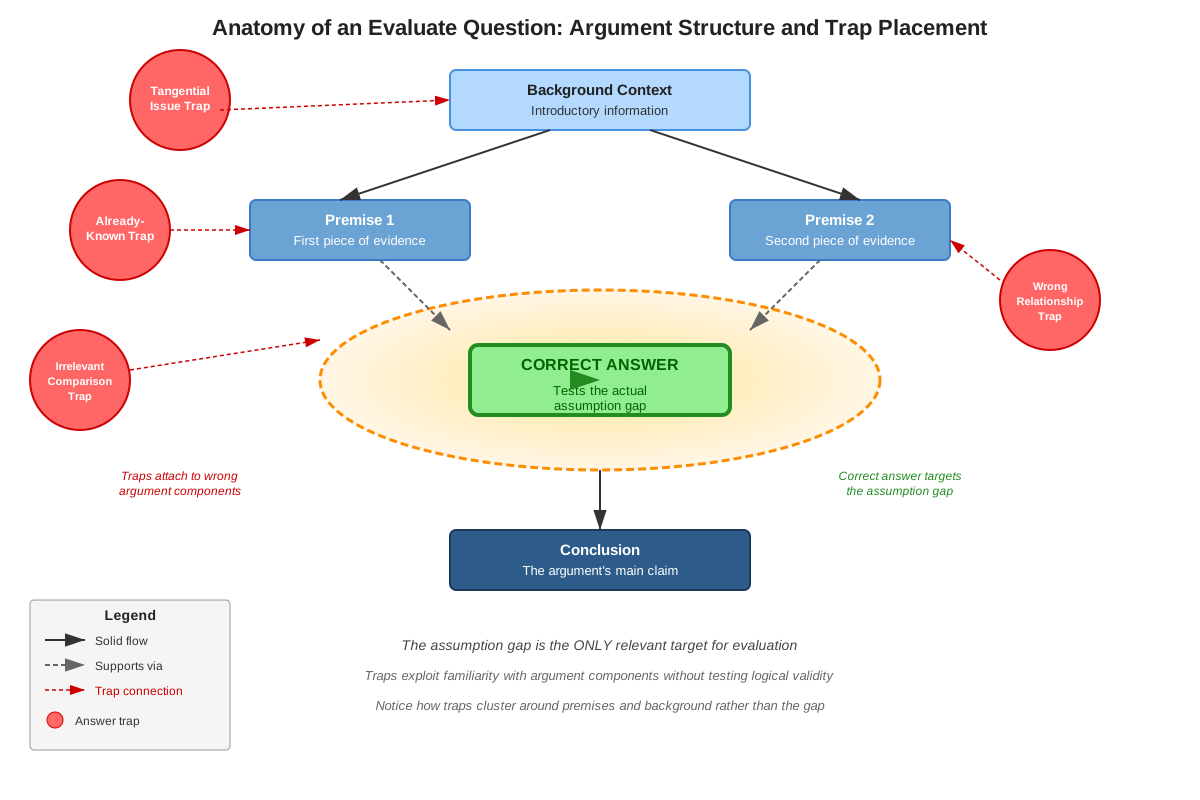
The correct answer typically tests the argument's central assumption—the unstated logical connection between premises and conclusion. If an argument assumes that correlation implies causation, the correct answer asks whether alternative explanations exist. If an argument assumes a sample is representative, the correct answer asks whether the sample matches the broader population in relevant ways.
The Negation Technique for Evaluation Questions
A powerful strategy for identifying correct answers involves the assumption negation technique adapted for evaluation questions. For each answer choice, consider: "If the answer to this question were 'no' (or the opposite), would that significantly weaken the argument? If the answer were 'yes,' would that strengthen it?" If both directions have significant impact, you've likely found the correct answer.
This technique helps distinguish between trap answers (which have little impact either way or impact in only one direction) and correct answers (which have substantial impact in both directions). For instance, if learning that "the sample was representative" would strengthen an argument but learning "the sample was not representative" would weaken it, this information is genuinely evaluative.
Concept Relationships
The concept of evaluate answer traps connects hierarchically to broader LSAT logical reasoning skills. At the foundation lies argument structure analysis—the ability to identify premises, conclusions, and logical gaps. This foundational skill enables assumption identification, which directly feeds into evaluation question success because the correct answer typically tests the argument's key assumption.
Assumption identification → leads to → Recognizing what information would test that assumption → leads to → Correct evaluation answer selection
Simultaneously, understanding strengthen and weaken questions provides parallel insight into evaluation questions. An evaluation question essentially asks: "What would we need to know to determine whether this argument should be strengthened or weakened?" The trap patterns in evaluation questions mirror common wrong answers in strengthen/weaken questions: irrelevant information, scope mismatches, and reversed logic.
The five trap categories relate to each other through the common principle of logical relevance. The Irrelevant Comparison and Tangential Issue traps both fail the relevance test but in different ways—comparisons fail by introducing unnecessary contrasts, while tangential issues fail by addressing related but disconnected topics. The Already-Known trap fails a different test: the new information requirement. The Reversed Causation and Scope Mismatch traps fail the precision test—they address something close to but not exactly matching what the argument requires.
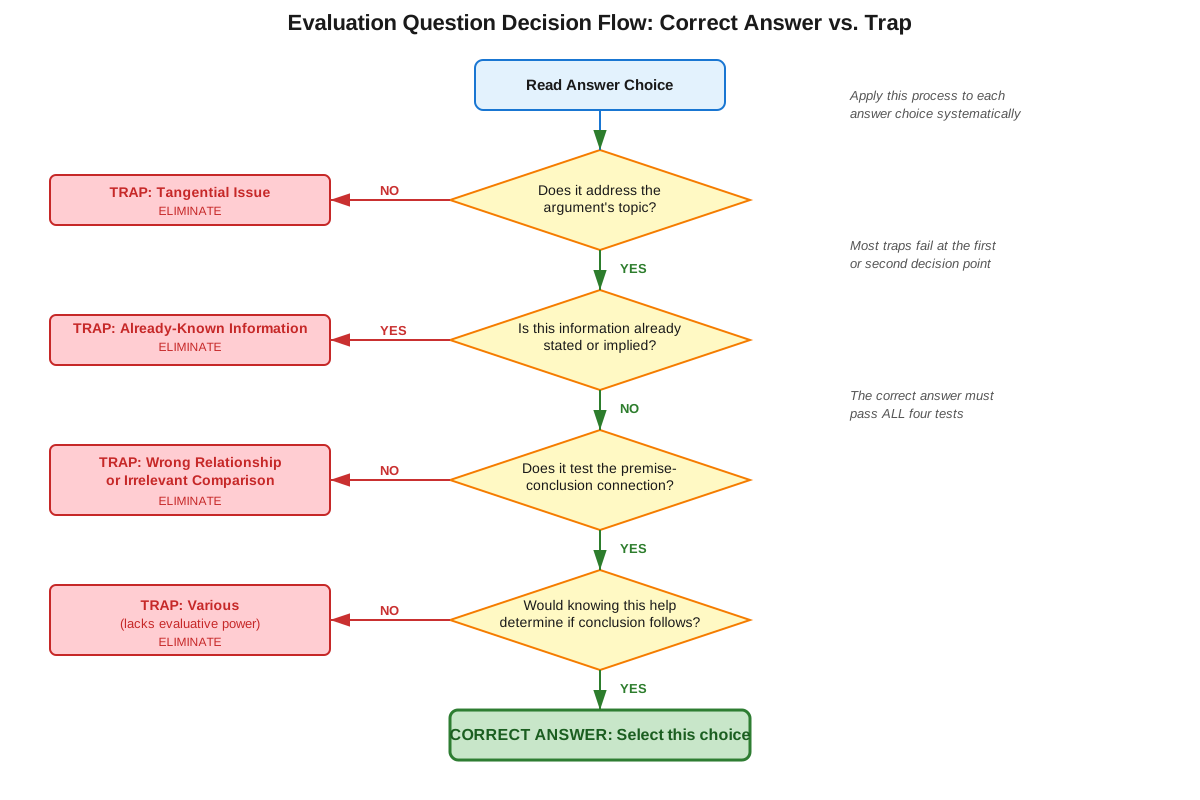
Understanding these relationships enables students to develop a systematic elimination process: First, eliminate answers that fail the relevance test (Irrelevant Comparison, Tangential Issue). Second, eliminate answers that fail the new information requirement (Already-Known). Third, eliminate answers that fail the precision test (Reversed Causation, Scope Mismatch). What remains should be the correct answer that tests the argument's central assumption.
High-Yield Facts
⭐ The correct answer to an evaluation question must have significant impact on the argument's strength regardless of how the question is answered—creating a "two-way street" effect.
⭐ If you can definitively answer a question based solely on information in the stimulus, that answer choice is a trap—evaluation questions must ask about unknown information.
⭐ Approximately 60-70% of evaluation question wrong answers fall into the Irrelevant Comparison or Tangential Issue categories.
⭐ The correct answer typically tests the argument's central unstated assumption, not peripheral issues mentioned in the premises.
⭐ Scope mismatches are particularly common traps in evaluation questions involving statistical or survey-based arguments.
- Evaluation questions appear 2-4 times per LSAT, typically with 40-55% accuracy rates among test-takers.
- The phrase "most useful to know in evaluating" or "most helpful in assessing" signals an evaluation question type.
- Wrong answers often use extreme language ("all," "never," "only") that shifts the scope beyond what the argument requires.
- Causal arguments are especially prone to Reversed Causation traps that test the wrong causal direction.
- The Already-Known trap often appears as the first or second answer choice to catch hasty readers.
- Correct answers frequently use conditional language ("whether," "if") that allows for testing both possibilities.
- Arguments involving analogies typically have traps asking about irrelevant differences between the compared situations.
- Time pressure causes test-takers to select trap answers that "sound relevant" without testing the actual logical connection.
- The Tangential Issue trap exploits topic familiarity—students select answers about subjects they recognize from the passage.
- Evaluation questions with proposal-based arguments often include traps about implementation details rather than whether the proposal would achieve its stated goal.
Quick check — test yourself on Evaluate answer traps so far.
Try Flashcards →Common Misconceptions
Misconception: Any information related to the argument's topic would help evaluate it. → Correction: Only information that tests the specific logical connection between the given premises and the stated conclusion is relevant. Topic relatedness is necessary but not sufficient for a correct evaluation answer.
Misconception: The correct answer should introduce entirely new concepts not mentioned in the argument. → Correction: The correct answer typically addresses concepts or relationships implied by the argument's reasoning, even if not explicitly stated. It tests assumptions rather than introducing completely foreign elements.
Misconception: If answering a question would strengthen the argument, that question must be the correct evaluation answer. → Correction: The correct answer must have significant impact in BOTH directions—one answer strengthening the argument and the opposite answer weakening it. One-directional impact suggests a strengthen question, not an evaluation question.
Misconception: Longer, more detailed answer choices are more likely to be correct because they seem more thorough. → Correction: Answer length has no correlation with correctness in evaluation questions. Trap answers are often lengthy to appear comprehensive while actually addressing irrelevant issues. Correct answers can be concise.
Misconception: Evaluation questions ask what additional evidence would prove the conclusion true. → Correction: Evaluation questions ask what information would help assess the argument's strength, not prove it conclusively. The LSAT tests logical reasoning, not absolute proof. The correct answer identifies what would make the argument more or less persuasive, not definitively true or false.
Misconception: If an answer choice addresses a potential weakness in the argument, it must be correct. → Correction: While correct answers often relate to potential weaknesses, many trap answers also point to weaknesses that aren't actually central to the argument's logic. The correct answer must address the PRIMARY logical gap, not just any weakness.
Misconception: Comparative answer choices are always traps. → Correction: While Irrelevant Comparison is a common trap category, some arguments genuinely depend on comparisons. If the argument's reasoning explicitly or implicitly relies on something being better, worse, more, or less than something else, a comparative answer might be correct.
Worked Examples
Example 1: Restaurant Expansion Argument
Stimulus: "The Downtown Diner should expand to a second location in the suburbs. A survey of 200 suburban residents showed that 75% would eat at a Downtown Diner location if one opened nearby. The restaurant has been profitable downtown for five years, demonstrating its successful business model."
Question: Which of the following would be most useful to know in evaluating the argument?
Answer Choices:
(A) Whether the Downtown Diner is more profitable than other downtown restaurants
(B) Whether the 200 surveyed residents are representative of the broader suburban population
(C) Whether the Downtown Diner has considered other expansion locations
(D) Whether suburban residents prefer the same menu items as downtown customers
(E) Whether the restaurant has been profitable every single year or only on average
Analysis:
First, identify the argument structure:
- Premises: Survey shows 75% of 200 suburban residents would eat there; restaurant has been profitable downtown for 5 years
- Conclusion: Should expand to suburbs
- Assumption: The survey accurately predicts actual suburban demand; downtown success translates to suburban success
Now evaluate each answer:
(A) Irrelevant Comparison Trap: The argument doesn't claim the Diner is the best restaurant or needs to be more profitable than competitors. It only needs to be profitable enough to justify expansion. Whether it's MORE profitable than others doesn't test whether suburban expansion would succeed. Eliminate.
(B) Potential Correct Answer: This directly tests a key assumption—that the 200 surveyed people represent the broader suburban market. If YES (they are representative), the survey evidence is strong. If NO (they're not representative), the survey evidence is weak. This creates the two-way street effect. Keep.
(C) Tangential Issue Trap: Whether they considered other locations doesn't test whether THIS location (suburbs) would succeed. The argument is about whether to expand to suburbs specifically, not about the decision-making process. Eliminate.
(D) Scope Mismatch Trap: This might seem relevant, but the argument doesn't assume identical preferences—only that suburban residents would eat there. Even if preferences differ, the restaurant could adjust the menu. This doesn't test the core assumption about demand. Eliminate.
(E) Already-Known Information Trap: The stimulus states the restaurant "has been profitable downtown for five years." Whether this means every year or on average doesn't change the fact that it's been successful, which is all the argument claims. This is either already known or irrelevant to the suburban expansion question. Eliminate.
Correct Answer: (B)
This example demonstrates how the correct answer tests the argument's central assumption (survey representativeness) while traps fail various tests: irrelevant comparison (A), tangential issue (C), scope mismatch (D), and already-known information (E).
Example 2: Causal Reasoning Argument
Stimulus: "City officials concluded that the new traffic light system caused the 15% reduction in accidents at the Main Street intersection. The reduction occurred in the three months immediately following the system's installation, and no other changes were made to the intersection during that period."
Question: The answer to which of the following questions would most help in evaluating the city officials' conclusion?
Answer Choices:
(A) Whether accident rates at other intersections without the new system also decreased during the same period
(B) Whether the new traffic light system was more expensive than the previous system
(C) Whether drivers approve of the new traffic light system
(D) Whether the reduction in accidents has continued beyond the initial three-month period
(E) Whether the intersection had a higher accident rate than other intersections before the new system
Analysis:
Argument structure:
- Premises: 15% accident reduction in three months after new system; no other changes
- Conclusion: New system CAUSED the reduction
- Assumption: No alternative explanation exists; the correlation indicates causation
Evaluate each answer:
(A) Potential Correct Answer: This tests whether an alternative explanation exists. If YES (other intersections also saw reductions), this suggests a common cause (perhaps seasonal factors, citywide awareness campaigns, or weather patterns) rather than the traffic light system specifically. If NO (only this intersection saw reductions), this strengthens the causal claim. Perfect two-way street. Keep.
(B) Irrelevant Comparison Trap: Cost doesn't affect whether the system caused the accident reduction. This might be relevant to whether the system was a good investment, but that's not the conclusion. The argument is about causation, not cost-effectiveness. Eliminate.
(C) Tangential Issue Trap: Driver approval relates to the topic (traffic lights) but doesn't test whether the system caused accident reduction. Drivers could disapprove of an effective system or approve of an ineffective one. Eliminate.
(D) Scope Mismatch Trap: The conclusion is about whether the system caused the reduction that occurred in the three-month period mentioned. Whether the effect continued afterward doesn't test the causal claim about the initial reduction. This shifts the temporal scope. Eliminate.
(E) Irrelevant Comparison Trap: Whether this intersection was worse than others before doesn't test whether the new system caused the improvement. An intersection could be the worst in the city and still have reductions caused by factors other than the traffic light. Eliminate.
Correct Answer: (A)
This example illustrates how causal arguments require testing for alternative explanations. The correct answer (A) directly addresses whether the correlation might be explained by factors other than the claimed cause, while traps introduce irrelevant comparisons (B, E), tangential issues (C), and scope mismatches (D).
Exam Strategy
Systematic Approach to Evaluation Questions
Step 1: Identify the Question Type (5-10 seconds)
Look for trigger phrases: "most useful to know," "most helpful in evaluating," "most important to determine," or "answer to which question would most help assess." These signal evaluation questions requiring a different approach than strengthen/weaken questions.
Step 2: Analyze the Argument Structure (15-20 seconds)
Before reading answer choices, identify:
- The specific conclusion (what is being argued?)
- The premises supporting it (what evidence is given?)
- The logical gap or assumption (what's unstated but necessary?)
Exam Tip: Write down a one-sentence summary of the assumption. This becomes your prediction for what the correct answer should test.
Step 3: Predict the Correct Answer Type (5-10 seconds)
Based on the assumption, predict what kind of information would test it:
- For causal arguments: alternative explanations or necessary conditions
- For statistical arguments: sample representativeness or data interpretation
- For analogies: relevant similarities or differences
- For proposals: whether the plan would achieve its stated goal
Step 4: Apply the Two-Way Street Test (30-40 seconds)
For each answer choice, ask: "If the answer were YES, would that strengthen the argument? If the answer were NO, would that weaken it?" Only the correct answer should have significant impact in both directions.
Step 5: Eliminate Trap Categories (integrated with Step 4)
Actively look for the five trap patterns:
- Can I answer this from the stimulus? → Already-Known trap
- Does this compare things not at issue? → Irrelevant Comparison trap
- Does this test the actual premise-conclusion link? → Tangential Issue trap
- Does this match the argument's scope? → Scope Mismatch trap
- Does this test the right causal direction? → Reversed Causation trap
Time Allocation
Evaluation questions typically require 60-90 seconds—slightly longer than average because they demand careful analysis of what information would be relevant. Don't rush the argument analysis phase; investing 20 seconds to identify the assumption saves time by making trap elimination faster and more accurate.
Trigger Words and Phrases
In Question Stems:
- "most useful to know"
- "most helpful in evaluating/assessing"
- "most important to determine"
- "answer to which question would most help"
- "which of the following would it be most relevant to investigate"
In Correct Answers:
- "Whether..." (introduces testable information)
- "If..." (suggests conditional testing)
- Language matching the argument's scope exactly
In Trap Answers:
- Extreme language: "all," "every," "never," "only," "must"
- Comparative language when comparison isn't at issue: "more than," "better than," "worse than"
- Past tense when argument is about future: "has been" vs. "will be"
- Detailed implementation language when argument is about goals
Process of Elimination Strategy
Use a three-pass system:
First Pass: Eliminate obvious traps (Already-Known, clearly Irrelevant Comparisons) - should eliminate 1-2 answers
Second Pass: Apply the two-way street test to remaining answers - should eliminate 1-2 more
Third Pass: For final two answers, return to the argument's specific conclusion and ask which answer tests the exact logical connection at issue
Exam Tip: If stuck between two answers, one is likely testing a peripheral assumption while the other tests the central assumption. Choose the one that addresses the main logical gap between premises and conclusion.
Memory Techniques
The TRAIN Acronym for Trap Recognition
Tangential - Does it only relate to the topic, not the logic?
Reversed - Does it test the wrong causal direction?
Already-known - Can I answer it from the stimulus?
Irrelevant comparison - Does it compare things not at issue?
Narrow/broad scope - Does the scope mismatch the argument?
The Two-Way Street Visualization
Picture a street with "STRENGTHEN" written on one side and "WEAKEN" on the other. The correct answer is a question that, depending on how you answer it, takes you down one side or the other. Trap answers are dead-ends that don't lead anywhere meaningful or only go one direction.
The Assumption Bridge Technique
Visualize the argument as two islands (premises and conclusion) with a bridge (assumption) connecting them. The correct evaluation answer asks: "Is this bridge stable?" Trap answers ask about the islands themselves (already-known), other bridges (irrelevant comparisons), or the water around the islands (tangential issues).
The SCOPE Checklist
Before selecting an answer, verify:
Specific enough - Not too broad
Connects premises to conclusion - Not tangential
Opposite answers matter - Two-way street
Precise causal direction - Not reversed
Externally unknown - Not already stated
Summary
Evaluate answer traps represent sophisticated wrong answers designed to exploit common reasoning errors in LSAT Logical Reasoning evaluation questions. These traps fall into five primary categories: Irrelevant Comparisons (comparing elements not at issue), Already-Known Information (asking about established facts), Tangential Issues (topic-related but logically disconnected), Reversed Causation (wrong causal direction), and Scope Mismatches (wrong breadth of claim). The correct answer to an evaluation question must create a "two-way street" effect—answering it one way strengthens the argument while answering it the opposite way weakens it. This correct answer typically tests the argument's central unstated assumption, the logical bridge connecting premises to conclusion. Success requires systematic analysis: identify the argument's structure and assumption, predict what information would test that assumption, apply the two-way street test to each answer choice, and eliminate traps by recognizing their characteristic patterns. Mastering these trap patterns not only improves performance on evaluation questions but strengthens overall logical reasoning skills applicable across multiple LSAT question types.
Key Takeaways
- The two-way street test is the most reliable method for identifying correct evaluation answers: the information must significantly impact the argument's strength regardless of how the question is answered.
- Five trap categories account for nearly all wrong answers: Irrelevant Comparison, Already-Known Information, Tangential Issue, Reversed Causation, and Scope Mismatch—learn to recognize each pattern instantly.
- The correct answer tests the argument's central assumption, not peripheral issues or already-established facts; invest time identifying this assumption before reading answer choices.
- If you can answer a question definitively from the stimulus alone, it's a trap; evaluation questions must ask about unknown information that would help assess the argument.
- Topic relatedness is necessary but insufficient; many traps exploit this by presenting information related to the argument's subject matter without testing its logical structure.
- Systematic elimination using trap recognition is faster and more accurate than trying to identify the correct answer directly; eliminate wrong answers first, then verify the remaining choice.
- Time invested in argument analysis (20 seconds) saves time in answer evaluation; understanding the assumption enables rapid trap elimination and confident answer selection.
Related Topics
Assumption Questions: Mastering evaluate answer traps directly enhances assumption question performance, as evaluation questions essentially ask what information would test an argument's assumptions. Understanding what makes information relevant for evaluation clarifies what assumptions are necessary versus sufficient.
Strengthen and Weaken Questions: These question types are closely related to evaluation questions—strengthen/weaken questions provide information and ask about its effect, while evaluation questions ask what information would be useful. The same logical reasoning skills apply, and trap patterns often mirror each other across these question types.
Flaw Questions: Recognizing evaluate answer traps improves flaw identification because many traps exploit the same logical errors that flaw questions test: scope shifts, causal reasoning errors, and unwarranted assumptions. Understanding what information would fix a flaw helps identify the flaw itself.
Parallel Reasoning Questions: The precision required to distinguish between trap answers and correct answers in evaluation questions—particularly regarding scope and logical structure—transfers directly to parallel reasoning questions, which require matching argument structures exactly.
Practice CTA
Now that you understand the patterns behind evaluate answer traps and have learned systematic strategies for avoiding them, it's time to put this knowledge into practice. Attempt the practice questions for this topic, actively applying the TRAIN acronym and two-way street test to each answer choice. As you work through problems, focus not just on selecting correct answers but on articulating why each wrong answer fits a specific trap category—this metacognitive practice will cement your pattern recognition skills. Remember that mastering evaluate answer traps is a high-yield investment: these questions appear consistently on the LSAT, and the reasoning skills you develop transfer across multiple question types. Review the flashcards to reinforce trap categories and recognition strategies, ensuring these patterns become automatic under test conditions. Your ability to navigate these sophisticated traps will distinguish you as a top-tier logical reasoner.
Sign up free to keep reading
Create a free AnvayaPrep account to finish this LSAT guide on Evaluate answer traps — plus flashcards and practice questions.