Overview
Evaluate questions represent a distinctive and frequently tested question type within the LSAT's Logical Reasoning section. These questions require test-takers to identify what additional information would be most useful in assessing the strength or validity of an argument. Unlike questions that ask you to strengthen, weaken, or identify assumptions, evaluate questions specifically test your ability to recognize what piece of information—if known—would help determine whether an argument succeeds or fails. This question type demands a sophisticated understanding of argument structure because you must identify the precise gap or uncertainty in the reasoning that, once resolved, would clarify the argument's merit.
The importance of mastering LSAT evaluate questions cannot be overstated. These questions typically appear 2-4 times per LSAT administration, making them a reliable component of your score. More significantly, the analytical skills required to excel at evaluate questions—identifying argumentative gaps, recognizing unstated connections between premises and conclusions, and understanding what information would be decisive—transfer directly to other Logical Reasoning question types. When you can identify what would help evaluate an argument, you've essentially identified the argument's vulnerability or dependency, which is closely related to identifying assumptions, strengthening factors, and weakening factors.
Within the broader framework of Logical Reasoning, evaluate questions belong to the "Evaluate and Complete the Argument" family. They test your ability to analyze argument structure critically and recognize what's missing or uncertain in the logical chain connecting premises to conclusion. This skill set is foundational for legal reasoning, where attorneys must constantly assess what additional evidence or information would be decisive in determining the strength of a case. Mastering evaluate questions enhances your overall logical reasoning abilities and provides a framework for approaching virtually every argument-based question on the LSAT.
Learning Objectives
- [ ] Identify how Evaluate questions appears in LSAT questions
- [ ] Explain the reasoning pattern behind Evaluate questions
- [ ] Apply Evaluate questions to solve LSAT-style problems accurately
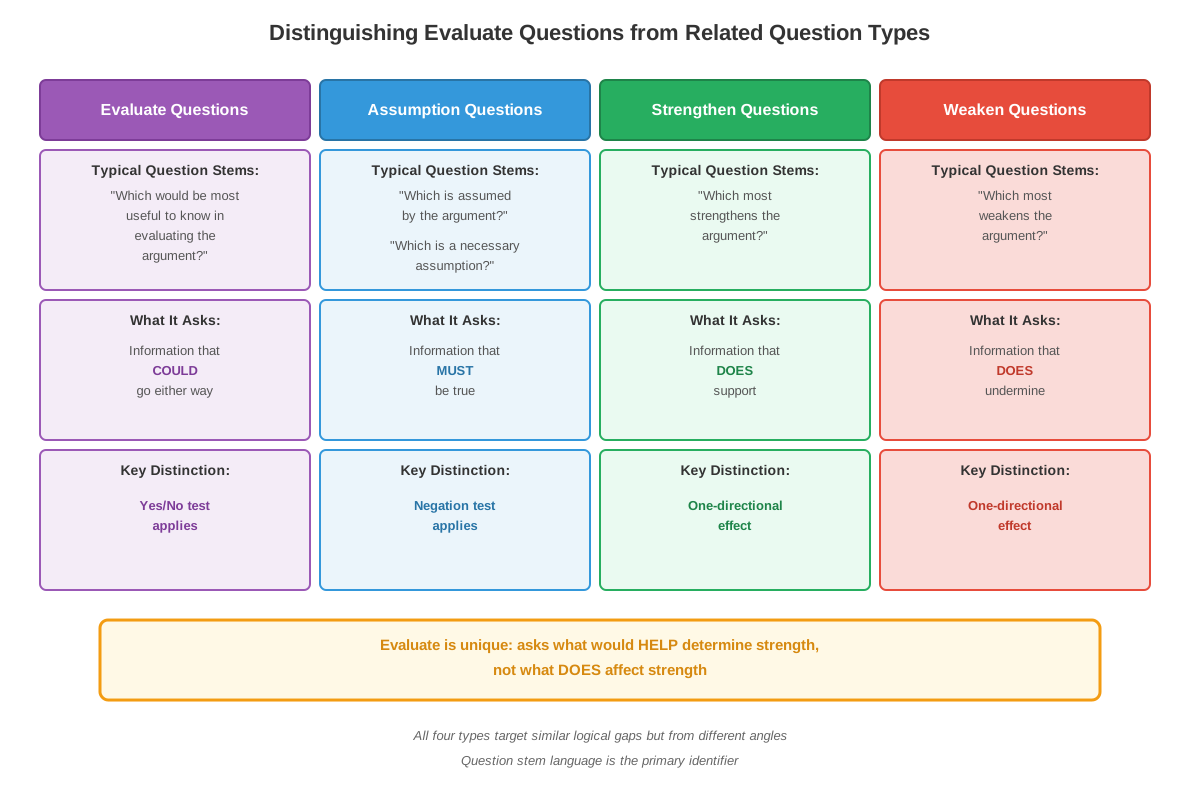
- [ ] Distinguish evaluate questions from assumption, strengthen, and weaken questions based on question stem language
- [ ] Formulate the "yes/no" test to determine whether an answer choice provides evaluative information
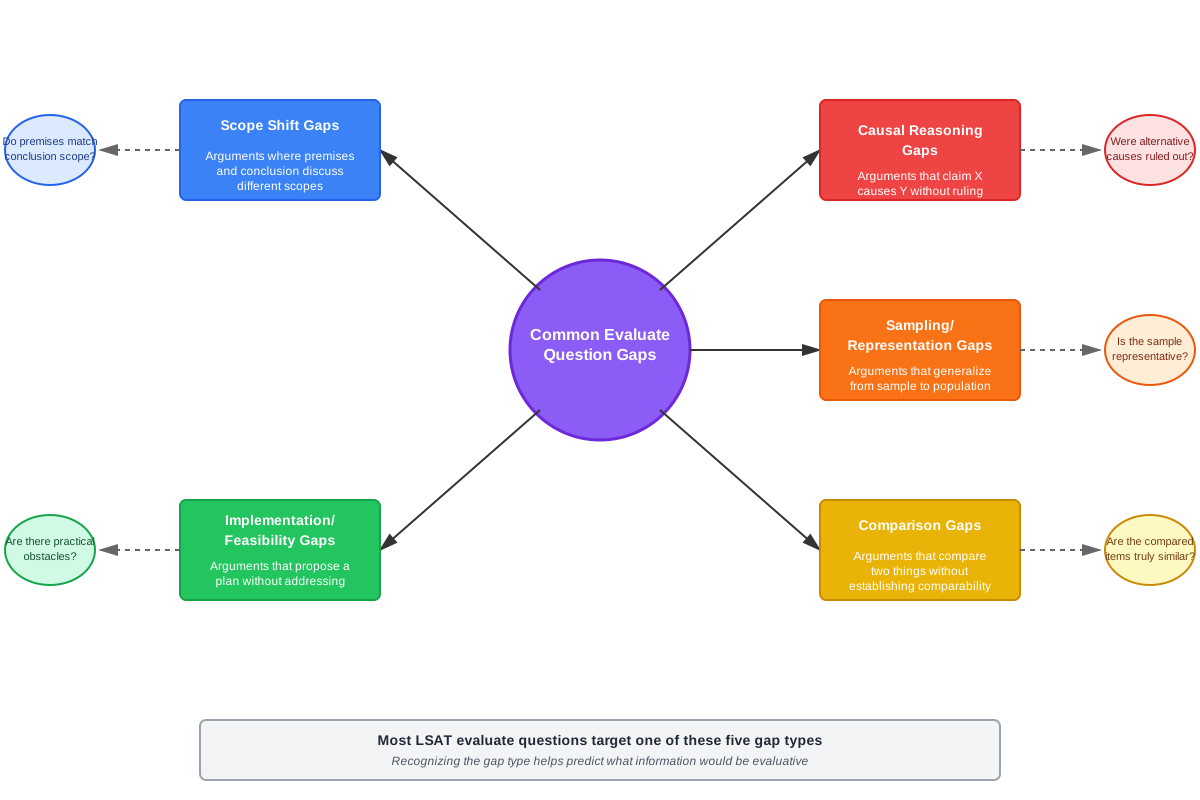
- [ ] Recognize the most common types of gaps that evaluate questions target in LSAT arguments
Prerequisites
- Basic argument structure: Understanding premises, conclusions, and how they connect is essential because evaluate questions require identifying what's uncertain in this connection
- Assumption identification: Recognizing unstated premises helps identify what information would be useful to know, as evaluate questions often target the same logical gaps that assumptions fill
- Conditional reasoning fundamentals: Many evaluate questions involve conditional relationships, requiring understanding of sufficient and necessary conditions
- Causal reasoning patterns: Since many LSAT arguments involve causal claims, recognizing causal structure helps identify what would help evaluate such arguments
Why This Topic Matters
Evaluate questions test a critical thinking skill that extends far beyond standardized testing. In legal practice, attorneys must constantly determine what additional discovery, testimony, or evidence would be most useful in assessing the strength of their case or their opponent's position. In business, executives must identify what information would help evaluate whether a proposed strategy will succeed. In academic research, scholars must determine what data would help assess competing hypotheses. The ability to identify decisive information—information that would significantly impact the assessment of an argument—represents sophisticated analytical thinking.
On the LSAT specifically, evaluate questions appear with reliable frequency, typically comprising 2-4 questions per test (approximately 8-15% of Logical Reasoning questions). This consistency makes them high-yield material for focused study. The LSAT tests evaluate questions across diverse content areas—scientific reasoning, business decisions, policy arguments, and everyday scenarios—meaning you cannot rely on subject-matter knowledge but must instead master the underlying logical structure.
Evaluate questions commonly appear in several recognizable patterns. The test frequently presents arguments involving causal claims where alternative explanations exist, comparative arguments where the comparison's validity depends on unstated similarities, arguments from analogy where the relevance of the analogy is uncertain, and arguments involving representative samples where the sample's representativeness is questionable. Recognizing these patterns helps you anticipate what information would be most useful to know.
Core Concepts
Defining Evaluate Questions
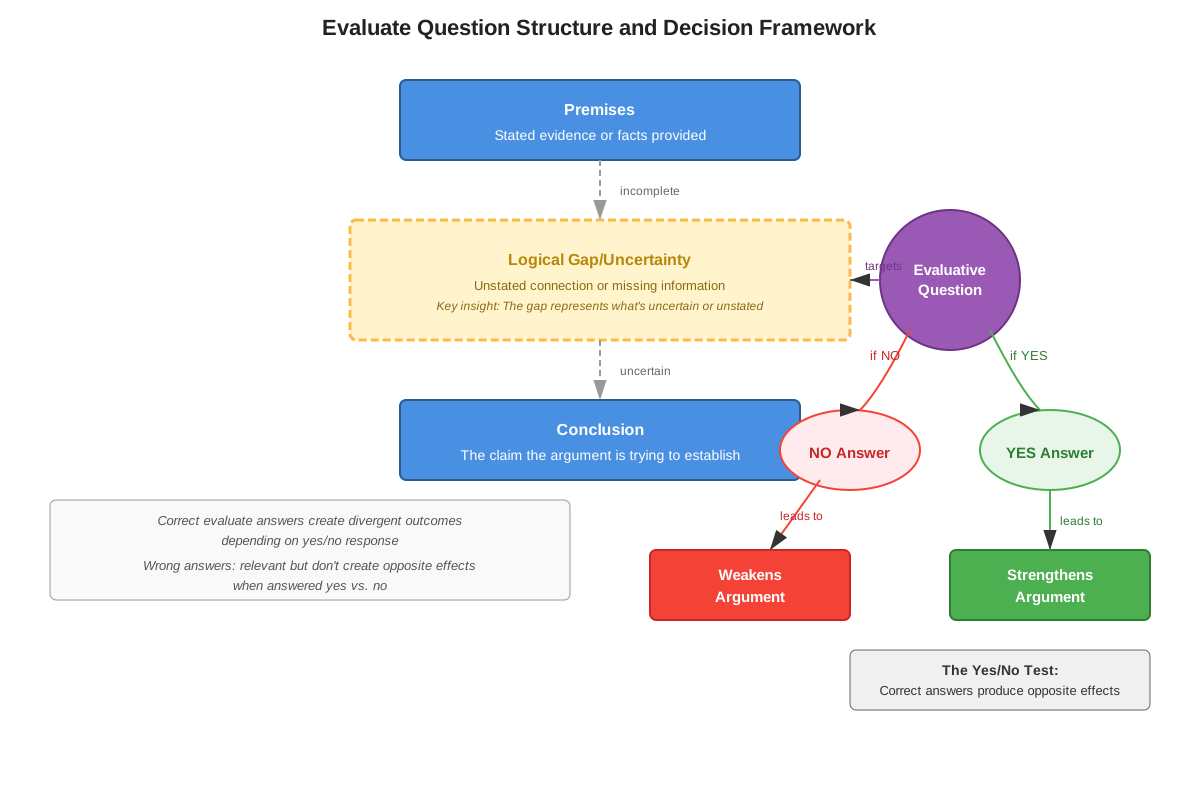
Evaluate questions ask you to identify information that would be most useful in assessing, judging, or determining the strength or validity of an argument. The question stem typically includes phrases like "would be most useful to know in evaluating," "would help to evaluate," or "the answer to which of the following questions would be most useful in determining." The key characteristic distinguishing evaluate questions from other question types is that the correct answer presents information that could cut either way—depending on the answer to the question or the truth of the statement, the argument could be either strengthened or weakened.
This bidirectional quality is crucial. An evaluate answer doesn't simply strengthen or weaken the argument; instead, it identifies a factor where different possible answers would have opposite effects on the argument's strength. For instance, if an argument assumes that two groups are similar in relevant ways, knowing whether they actually are similar would strengthen the argument (if they are similar) or weaken it (if they differ in relevant ways). This information is therefore useful for evaluation.
The "Yes/No" Test
The most reliable technique for identifying correct evaluate answers is the "yes/no" test (also called the "variance test"). This test involves taking each answer choice and considering: if the answer to this question were "yes," how would that affect the argument? Then consider: if the answer were "no," how would that affect the argument? The correct answer will show significant variance—one answer (yes or no) will strengthen the argument while the opposite answer will weaken it, or at minimum, one direction will have a substantial impact on the argument's validity.
For example, consider an argument concluding that a new medication is safe based on clinical trials. An answer choice asking "Were the clinical trial participants similar to the general population in relevant health characteristics?" passes the yes/no test. If yes, the argument is strengthened (the trials are more relevant to the general population). If no, the argument is weakened (the trials may not predict general population outcomes). This variance indicates the information would be useful in evaluating the argument.
Conversely, irrelevant answer choices will show no variance or variance in only one direction. If an answer choice would strengthen the argument whether answered yes or no, or would have no impact either way, it's not useful for evaluation—it doesn't help you assess the argument's merit.
Common Argument Gaps Targeted by Evaluate Questions
Evaluate questions systematically target predictable types of logical gaps. Understanding these patterns helps you anticipate what information would be evaluatively useful:
Causal Arguments with Alternative Explanations: When an argument concludes that X caused Y based on correlation or temporal sequence, evaluate questions often ask about alternative causes. Knowing whether alternative explanations exist or whether confounding factors were present would help evaluate whether X actually caused Y.
Comparative Arguments: When an argument draws conclusions by comparing two things (groups, time periods, locations), evaluate questions target whether the comparison is valid. Information about relevant similarities or differences between the compared entities would help evaluate the argument.
Arguments from Analogy: When an argument reasons that because A and B are similar in some respects, they're likely similar in another respect, evaluate questions ask about the relevance of the similarities or the existence of relevant differences.
Representative Sample Arguments: When an argument generalizes from a sample to a population, evaluate questions target whether the sample is representative. Information about potential sampling bias or relevant differences between sample and population would be evaluative.
Necessary Condition Arguments: When an argument assumes that a certain condition is necessary for an outcome, evaluate questions may ask whether that condition is actually necessary or whether alternative means exist.
Relationship to Other Question Types
Understanding how evaluate questions relate to other Logical Reasoning question types clarifies their unique characteristics:
| Question Type | What It Asks | Relationship to Evaluate |
|---|---|---|
| Assumption | What must be true for the argument to work? | Evaluate questions often target the same gaps that assumptions fill, but ask what information would help assess the gap rather than what fills it |
| Strengthen | What makes the argument more likely to be valid? | Evaluate answers, when answered one way, strengthen the argument |
| Weaken | What makes the argument less likely to be valid? | Evaluate answers, when answered the opposite way, weaken the argument |
| Flaw | What's wrong with the argument's reasoning? | Evaluate questions identify what information would help determine whether a potential flaw actually undermines the argument |
The key distinction is that evaluate questions don't take a position on the argument's strength—they identify what would help you take such a position.
Question Stem Variations
Recognizing evaluate question stems is essential for proper identification. Common formulations include:
- "The answer to which of the following questions would be most useful in evaluating the argument?"
- "Which of the following would it be most useful to know in evaluating the argument?"
- "Which of the following would be most important to determine in evaluating the hypothesis?"
- "In evaluating the argument, it would be most useful to determine which of the following?"
- "The answer to which of the following questions would most help in determining whether the conclusion is justified?"
All these variations share the core characteristic: they ask what information would help assess the argument rather than asking you to assess it directly.
Concept Relationships
The concepts within evaluate questions form an interconnected logical framework. The definition of evaluate questions establishes the foundation—identifying information useful for assessment. This leads directly to the yes/no test, which provides the operational method for determining whether information is truly evaluative. The yes/no test works because it operationalizes the bidirectional requirement: truly evaluative information must have different implications depending on how the question is answered.
The common argument gaps represent the content-level application of these structural principles. Each gap type (causal, comparative, analogical, representative sample) represents a specific way that premises can fail to fully support conclusions. Recognizing these patterns allows you to predict what information would be evaluative before examining answer choices, making you more efficient and accurate.
The relationship to other question types provides context and prevents confusion. Evaluate questions occupy a middle ground: they identify the same logical gaps that assumption questions target, but instead of asking what must be true (assumption) or what would make the argument better/worse (strengthen/weaken), they ask what would help you determine the argument's merit. This relationship means that skills developed for assumption questions transfer directly to evaluate questions—if you can identify what an argument assumes, you can identify what information would help evaluate whether that assumption is warranted.
The progression flows: Question stem recognition → Argument analysis (identifying the gap) → Answer choice evaluation (applying the yes/no test) → Selection of the choice showing maximum variance.
High-Yield Facts
⭐ Evaluate questions ask for information that could either strengthen OR weaken the argument depending on the answer—this bidirectional quality is the defining characteristic
⭐ The yes/no test is the most reliable method: the correct answer will have opposite effects on the argument depending on whether answered yes or no
⭐ Evaluate questions typically appear 2-4 times per LSAT, making them a consistent score component
⭐ The correct answer targets the argument's central assumption or gap—the same vulnerability that assumption questions would identify
⭐ Common question stem language includes "most useful to know in evaluating," "would help to evaluate," and "answer to which question would be most useful"
- Evaluate questions differ from strengthen/weaken questions because they don't take a position on the argument's validity—they identify what would help you take such a position
- Causal arguments are frequently targeted by evaluate questions asking about alternative explanations or confounding factors
- Comparative arguments are evaluated by asking about relevant similarities or differences between the compared entities
- The correct answer will show significant variance when tested—one direction substantially impacts the argument while the opposite direction has the opposite impact
- Irrelevant answer choices either have no impact regardless of how they're answered or only impact the argument in one direction
- Arguments involving representative samples are evaluated by asking whether the sample is actually representative of the population
- Evaluate questions often present answer choices as questions themselves, asking "whether X is true" or "the answer to which question"
- The scope of the correct answer must match the scope of the conclusion—information about a broader or narrower claim won't effectively evaluate the specific conclusion
- Temporal reasoning arguments (X happened before Y, therefore X caused Y) are evaluated by asking about alternative causes or whether the correlation is spurious
- Background information that's interesting but doesn't impact the logical connection between premises and conclusion won't be the correct answer
Quick check — test yourself on Evaluate questions so far.
Try Flashcards →Common Misconceptions
Misconception: Evaluate questions are asking you to strengthen or weaken the argument directly.
Correction: Evaluate questions ask what information would be useful in assessing the argument, not asking you to assess it yourself. The correct answer identifies information that could go either way—strengthening if answered one way, weakening if answered the opposite way.
Misconception: The correct answer to an evaluate question must be something that strengthens the argument.
Correction: The correct answer must be information that would have significant impact on the argument's assessment, but that impact could be positive or negative depending on the answer. Information that only strengthens (regardless of the answer) is not evaluative—it's just a strengthener.
Misconception: Any information related to the argument's topic is useful for evaluation.
Correction: Only information that directly impacts the logical connection between premises and conclusion is evaluative. Background information, tangential details, or facts about related but distinct issues don't help evaluate the specific argument presented.
Misconception: Evaluate questions are asking about the argument's assumptions.
Correction: While evaluate questions often target the same logical gaps that assumptions fill, they're asking what information would help assess the gap, not what the argument assumes. An assumption is something the argument takes for granted; evaluative information is something that, if known, would help determine whether the argument succeeds.
Misconception: The correct answer must be phrased as a question.
Correction: While many evaluate answer choices are phrased as questions ("whether X is true"), some are phrased as statements ("information about X"). The format doesn't matter—what matters is whether the information would help evaluate the argument using the yes/no test.
Misconception: If information would weaken the argument, it's not useful for evaluation.
Correction: Information that would weaken the argument if answered one way but strengthen it if answered the opposite way is precisely what evaluate questions seek. The usefulness comes from the variance, not from the direction of impact.
Misconception: Evaluate questions are rare and not worth focused study.
Correction: Evaluate questions appear consistently on every LSAT (2-4 per test), and the skills they develop—identifying logical gaps and understanding what information is decisive—transfer to multiple other question types, making them high-yield study material.
Worked Examples
Example 1: Causal Argument
Argument: "City officials note that traffic accidents at the intersection of Main and Oak Streets decreased by 40% after a new traffic light was installed. They conclude that the new traffic light caused the reduction in accidents."
Question: "The answer to which of the following questions would be most useful in evaluating the officials' conclusion?"
Answer Choices:
A) Were traffic accidents at other intersections in the city also reduced during the same period?
B) How much did the new traffic light cost to install?
C) Do drivers generally prefer traffic lights to stop signs?
D) Were there any accidents at the intersection before the traffic light was installed?
E) How long does the average driver wait at the new traffic light?
Analysis:
First, identify the argument structure. The premise is that accidents decreased after the traffic light installation. The conclusion is that the traffic light caused this decrease. The gap is the classic post hoc reasoning gap—just because Y followed X doesn't mean X caused Y. Alternative explanations might exist.
Now apply the yes/no test to each answer:
Choice A: If accidents decreased at other intersections too, this suggests a city-wide trend (perhaps better weather, a safety campaign, or demographic changes) rather than the traffic light specifically causing the reduction at Main and Oak. If accidents didn't decrease elsewhere, this strengthens the claim that the traffic light specifically caused the reduction. This shows strong variance—yes weakens, no strengthens. This is promising.
Choice B: Whether the light was expensive or cheap doesn't affect whether it caused the accident reduction. No variance. Eliminate.
Choice C: Driver preferences don't affect whether the light actually reduced accidents. No variance. Eliminate.
Choice D: The argument already states accidents decreased by 40%, implying there were previous accidents to compare against. This doesn't help evaluate whether the light caused the decrease. No variance. Eliminate.
Choice E: Wait times might affect driver satisfaction but don't help determine whether the light caused fewer accidents. No variance. Eliminate.
Correct Answer: A
This answer targets the central gap in causal reasoning: alternative explanations. Knowing whether a broader trend existed helps evaluate whether the specific intervention (traffic light) caused the specific outcome (fewer accidents at that intersection).
Example 2: Comparative Argument
Argument: "A study found that employees at Company X who work from home are 15% more productive than those who work in the office. The CEO of Company Y concludes that allowing Company Y's employees to work from home would increase their productivity by a similar amount."
Question: "Which of the following would be most useful to know in evaluating the CEO's conclusion?"
Answer Choices:
A) Whether Company Y's employees want to work from home
B) Whether the types of work performed at Company X and Company Y are similar
C) How many employees at Company X work from home
D) Whether Company X's overall profits increased after allowing remote work
E) What percentage of Company Y's employees currently work from home
Analysis:
The argument structure involves reasoning by analogy: what happened at Company X will happen at Company Y. The gap is whether the two companies are relevantly similar—whether factors that made remote work successful at X also exist at Y.
Apply the yes/no test:
Choice B: If the work types are similar (both involve similar tasks, collaboration needs, technology requirements), then the comparison is more valid and the conclusion is strengthened. If the work types differ significantly (perhaps X involves independent work while Y requires constant collaboration), the comparison is less valid and the conclusion is weakened. Strong variance—this is evaluative.
Choice A: Employee preferences might affect implementation but don't determine whether productivity would actually increase. Wanting to work from home doesn't mean productivity will increase. Minimal variance. Eliminate.
Choice C: The number of remote workers at X doesn't affect whether the productivity increase would transfer to Y. No variance. Eliminate.
Choice D: Overall profits involve many factors beyond productivity. This doesn't help evaluate whether Y's productivity specifically would increase. Minimal variance. Eliminate.
Choice E: The current percentage at Y doesn't help evaluate whether allowing remote work would increase productivity. No variance. Eliminate.
Correct Answer: B
This answer targets the central gap in comparative reasoning: relevant similarity. The argument assumes that what worked at Company X will work at Company Y, but this depends on whether the companies are similar in ways that matter for the conclusion. Knowing about work type similarity directly helps evaluate this assumption.
Exam Strategy
When approaching evaluate questions on the LSAT, follow this systematic process:
Step 1: Identify the question type by recognizing trigger language: "useful to know in evaluating," "would help to evaluate," "answer to which question would be most useful." This identification is crucial because it determines your approach—you're looking for bidirectional information, not simply strengtheners or weakeners.
Step 2: Analyze the argument structure with particular attention to the gap between premises and conclusion. Ask yourself: What is this argument assuming? What could go wrong with this reasoning? What's uncertain in the connection between evidence and conclusion? The correct answer will almost always target this central gap.
Step 3: Predict before looking at answers when possible. Based on the argument type (causal, comparative, analogical, representative sample), anticipate what information would be useful. For causal arguments, think about alternative explanations. For comparative arguments, think about relevant similarities or differences. This prediction makes you less susceptible to attractive wrong answers.
Step 4: Apply the yes/no test rigorously to each answer choice. Literally ask: "If the answer to this question were yes, how would that affect the argument? If the answer were no, how would that affect the argument?" The correct answer will show clear variance—opposite answers will have opposite effects (or at least one direction will have substantial impact while the other has opposite or neutral impact).
Step 5: Eliminate answers showing no variance or variance in only one direction. If an answer would strengthen the argument regardless of how it's answered, it's not evaluative—it's just additional support. If an answer has no impact either way, it's irrelevant.
Trigger words and phrases to watch for in question stems:
- "most useful to know"
- "would help to evaluate"
- "most important to determine"
- "answer to which question"
- "in evaluating the argument"
- "in assessing whether"
Time allocation: Evaluate questions typically require 1:15-1:30 minutes. They're not usually the fastest questions because the yes/no test requires checking multiple answer choices, but they're also not the slowest because the test provides a clear, mechanical method for evaluation. Don't rush the yes/no test—taking an extra 10 seconds to properly test an answer is better than selecting an answer that only impacts the argument in one direction.
Process of elimination tips specific to evaluate questions:
- Eliminate any answer about implementation, cost, or feasibility unless the conclusion is specifically about implementation, cost, or feasibility
- Eliminate background information that doesn't affect the logical connection between premises and conclusion
- Eliminate answers that are too broad or too narrow relative to the conclusion's scope
- Eliminate answers that would only strengthen or only weaken regardless of how they're answered
- Be suspicious of answers involving people's beliefs, preferences, or intentions unless the conclusion is specifically about beliefs, preferences, or intentions
Memory Techniques
EVALUATE Acronym for the systematic approach:
- Examine the question stem for trigger language
- Verify the argument's conclusion and premises
- Analyze the gap between premises and conclusion
- Look for the assumption or uncertainty
- Use the yes/no test on each answer
- Assess variance—opposite answers should have opposite effects
- Target the central gap, not peripheral issues
- Eliminate answers with no variance
The Seesaw Visualization: Picture a seesaw or balance scale. The correct answer to an evaluate question is like asking which way the seesaw tilts. If the answer to the question is "yes," the seesaw tilts one way (strengthening or weakening the argument). If the answer is "no," the seesaw tilts the opposite way. Wrong answers are like asking about something that doesn't affect the seesaw at all—it stays balanced regardless of the answer.
The "Both Directions" Mnemonic: For evaluate questions, remember "BD"—Both Directions. The correct answer must matter in Both Directions. If it only matters in one direction (only strengthens or only weakens), it's not evaluative.
Common Gap Types—CARS:
- Causal (alternative explanations)
- Analogical (relevant similarities)
- Representative (sample validity)
- Sufficiency (necessary conditions)
When you see an argument, quickly categorize it using CARS to predict what information would be evaluative.
Question Stem Recognition—"USEFUL": If you see the word "useful" in a question stem, it's almost certainly an evaluate question. This single word is the most reliable indicator.
Summary
Evaluate questions represent a sophisticated LSAT question type that tests your ability to identify what information would be most useful in assessing an argument's validity. These questions require understanding that truly evaluative information must be bidirectional—capable of either strengthening or weakening the argument depending on the answer. The yes/no test provides a reliable mechanical method for identifying correct answers: the right choice will show significant variance when you consider how the argument would be affected if the answer were yes versus if it were no. Evaluate questions systematically target predictable logical gaps, including alternative explanations in causal arguments, relevant similarities in comparative arguments, representativeness in sampling arguments, and necessary conditions in sufficiency arguments. Mastering evaluate questions requires recognizing their distinctive question stems, analyzing argument structure to identify the central gap or assumption, and rigorously applying the yes/no test to distinguish truly evaluative information from mere background details or one-directional strengtheners. The skills developed through evaluate questions—identifying logical gaps, recognizing what information is decisive, and understanding bidirectional reasoning—transfer directly to other Logical Reasoning question types and represent core critical thinking abilities tested throughout the LSAT.
Key Takeaways
- Evaluate questions ask what information would be most useful in assessing an argument, not asking you to assess it directly—the correct answer must be bidirectional
- The yes/no test is your most reliable tool: if the answer to a question were yes, how would that affect the argument? If no, how would that affect it? Correct answers show opposite effects
- Evaluate questions target the same logical gaps that assumption questions identify, but ask what would help assess the gap rather than what the argument assumes
- Common argument patterns include causal claims (evaluate by asking about alternative explanations), comparative arguments (evaluate by asking about relevant similarities), and representative samples (evaluate by asking about representativeness)
- Eliminate answer choices that show no variance or variance in only one direction—if information only strengthens or only weakens regardless of the answer, it's not evaluative
- Question stem trigger language includes "most useful to know in evaluating," "would help to evaluate," and "answer to which question would be most useful"
- Evaluate questions appear 2-4 times per LSAT consistently, making them high-yield material that rewards focused study and systematic application of the yes/no test
Related Topics
Assumption Questions: These questions ask what the argument takes for granted, targeting the same logical gaps that evaluate questions identify. Mastering evaluate questions strengthens assumption question skills because both require identifying what's uncertain or unstated in the argument's reasoning.
Strengthen and Weaken Questions: These question types are closely related to evaluate questions—the correct evaluate answer, when answered one way, strengthens the argument and when answered the opposite way, weakens it. Understanding evaluate questions provides insight into what makes arguments stronger or weaker.
Flaw Questions: Identifying logical flaws requires recognizing gaps in reasoning, the same skill needed for evaluate questions. Many evaluate questions essentially ask what information would help determine whether a potential flaw actually undermines the argument.
Sufficient Assumption Questions: These questions ask what, if added to the argument, would make the conclusion follow logically. This relates to evaluate questions because both identify what's missing from the argument, though sufficient assumption questions ask what would complete the argument while evaluate questions ask what would help assess it.
Causal Reasoning: Since many evaluate questions target causal arguments, deepening your understanding of causal reasoning patterns—including correlation versus causation, alternative explanations, and confounding variables—directly improves evaluate question performance.
Practice CTA
Now that you've mastered the core concepts of evaluate questions, it's time to put your knowledge into practice. Attempt the practice questions to apply the yes/no test, identify argument gaps, and distinguish evaluative information from irrelevant details. Use the flashcards to reinforce question stem recognition and common gap patterns. Remember: evaluate questions reward systematic thinking and mechanical application of the yes/no test. Each practice question you complete strengthens your ability to identify what information truly matters for assessing arguments—a skill that will serve you throughout the Logical Reasoning section and beyond. You've built the foundation; now build the fluency through deliberate practice.
Sign up free to keep reading
Create a free AnvayaPrep account to finish this LSAT guide on Evaluate questions — plus flashcards and practice questions.