Overview
Evaluating analogies is a critical skill in LSAT logical reasoning that tests the ability to assess whether two situations are sufficiently similar to support a conclusion drawn from their comparison. When arguments rely on analogical reasoning, they claim that because two things share certain characteristics, they likely share other characteristics as well. The LSAT frequently tests whether test-takers can identify the strengths and weaknesses of such comparisons, making this a high-yield topic for exam preparation.
On the LSAT, analogy-based arguments appear across multiple question types, including Strengthen, Weaken, Flaw, and Evaluate and Complete the Argument questions. Understanding how to assess analogies requires recognizing both the explicit similarities cited in an argument and the implicit assumptions about what makes those similarities relevant. Strong analogies rest on relevant similarities between the compared situations, while weak analogies fail because the differences between the situations outweigh their similarities or because the cited similarities don't actually support the conclusion being drawn.
Mastering this topic connects directly to broader logical reasoning skills, including identifying assumptions, recognizing argument structure, and understanding conditional reasoning. The ability to evaluate analogies also supports performance on parallel reasoning questions and helps with understanding how evidence relates to conclusions throughout the Logical Reasoning section. This foundational skill appears in approximately 10-15% of Logical Reasoning questions, making it essential for achieving a competitive LSAT score.
Learning Objectives
- [ ] Identify how Evaluating analogies appears in LSAT questions
- [ ] Explain the reasoning pattern behind Evaluating analogies
- [ ] Apply Evaluating analogies to solve LSAT-style problems accurately
- [ ] Distinguish between relevant and irrelevant similarities in analogical arguments
- [ ] Recognize the implicit assumptions underlying analogical reasoning
- [ ] Determine what additional information would strengthen or weaken an analogy
- [ ] Evaluate whether cited similarities are sufficient to support the argument's conclusion
Prerequisites
- Basic argument structure: Understanding premises, conclusions, and how evidence supports claims is essential because analogical arguments follow standard argument patterns while adding a comparative element.
- Assumption identification: Recognizing unstated assumptions helps identify the gaps in analogical reasoning where the argument assumes similarities are relevant without proving they are.
- Strengthen and Weaken question types: Familiarity with these question types provides the foundation for understanding how additional information affects analogical arguments.
- Conditional reasoning basics: Understanding sufficient and necessary conditions helps evaluate when similarities in one area actually support conclusions about similarities in another area.
Why This Topic Matters
Analogical reasoning pervades legal thinking, making it a natural focus for the LSAT. Lawyers regularly argue that previous cases should guide current decisions because the situations share relevant similarities. Courts use precedent through analogical reasoning, comparing facts of past cases to present circumstances. The LSAT tests this skill because it directly reflects the type of reasoning law students and attorneys must perform daily.
On the exam, lsat evaluating analogies questions appear in several forms. Approximately 3-5 questions per test directly involve analogical reasoning, with additional questions incorporating analogies as secondary elements. These questions most commonly appear as Strengthen/Weaken questions (40%), Flaw questions (30%), Assumption questions (20%), and Evaluate questions (10%). The difficulty level ranges from medium to hard, with harder questions featuring more complex analogies or multiple layers of comparison.
Common manifestations include: arguments comparing business practices across industries, policy arguments citing other jurisdictions' experiences, scientific arguments comparing experimental subjects or conditions, and historical arguments drawing lessons from past events. The LSAT also tests analogies in reverse—questions may ask test-takers to identify which situation is most analogous to a given scenario, requiring the same evaluative skills applied in a different direction.
Core Concepts
The Structure of Analogical Arguments
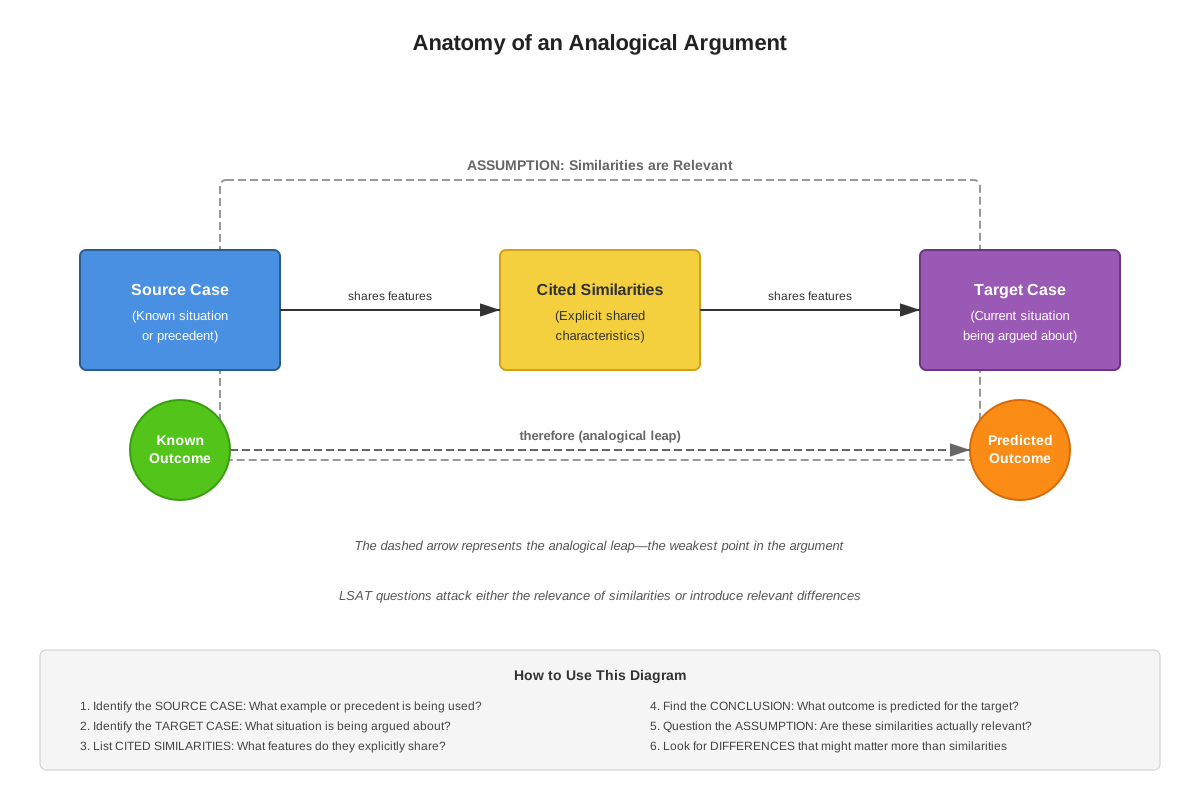
An analogical argument claims that because two or more things share certain characteristics, they likely share additional characteristics. The basic structure includes: (1) a source analog—the situation about which we have information, (2) a target analog—the situation about which we're drawing a conclusion, (3) cited similarities—the characteristics explicitly stated as shared between source and target, and (4) the inferred similarity—the characteristic the argument concludes the target shares with the source.
For example: "City A implemented a congestion tax and reduced traffic by 30%. City B has similar population density and road infrastructure, so City B should also implement a congestion tax to reduce traffic." Here, City A is the source analog, City B is the target analog, population density and road infrastructure are cited similarities, and the effectiveness of the congestion tax is the inferred similarity.
Relevant vs. Irrelevant Similarities
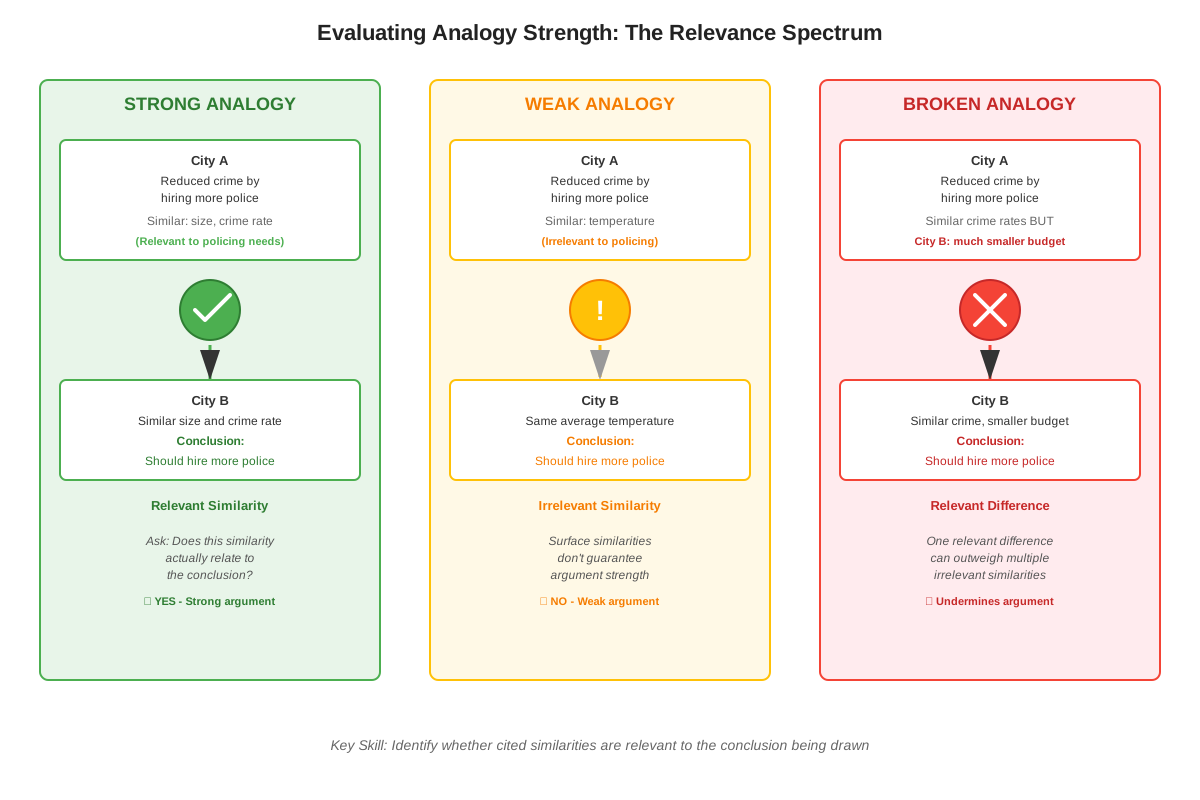
Not all similarities strengthen an analogy equally. Relevant similarities are characteristics that actually affect the outcome or characteristic being inferred. Irrelevant similarities are shared features that don't impact the conclusion. The LSAT frequently tests whether test-takers can distinguish between these categories.
Consider the congestion tax example: if both cities also have mayors with the same first name, this similarity is irrelevant to whether the policy would succeed. However, if both cities have similar public transportation infrastructure, this similarity is highly relevant because it affects whether drivers have alternatives to driving, which directly impacts congestion tax effectiveness.
| Similarity Type | Definition | Impact on Argument |
|---|---|---|
| Relevant Similarity | Shared characteristic that affects the inferred outcome | Strengthens the analogy |
| Irrelevant Similarity | Shared characteristic unrelated to the inferred outcome | No impact on argument strength |
| Relevant Difference | Distinct characteristic that affects the inferred outcome | Weakens the analogy |
| Irrelevant Difference | Distinct characteristic unrelated to the inferred outcome | No impact on argument strength |
The Assumption in Analogical Reasoning
Every analogical argument contains a critical assumption: that the cited similarities are sufficient to support the conclusion and that there are no relevant differences that would undermine the comparison. This assumption bridges the gap between "these things are similar in ways X, Y, and Z" and "therefore, they're similar in way W."
The strength of this assumption depends on: (1) how many relevant similarities exist, (2) how relevant those similarities are to the inferred characteristic, (3) whether relevant differences exist that outweigh the similarities, and (4) whether the cited similarities actually cause or correlate with the inferred characteristic in the source analog.
Evaluating Analogy Strength
Strong analogies possess several characteristics:
- Multiple relevant similarities: The more ways the situations resemble each other in relevant respects, the stronger the analogy
- High relevance: The similarities directly relate to the characteristic being inferred
- Few relevant differences: The situations don't differ in ways that would affect the outcome
- Causal connection: In the source analog, the cited similarities actually produce or correlate with the inferred characteristic
Weak analogies fail on one or more of these dimensions. The LSAT often presents arguments with superficial similarities that don't actually support the conclusion, or arguments that ignore crucial differences between the compared situations.
Common Patterns in LSAT Analogy Questions
The LSAT tests analogical reasoning through several recurring patterns:
Pattern 1: Identifying the Flaw: Questions present an argument by analogy and ask test-takers to identify why the reasoning is flawed. The correct answer typically points out relevant differences or explains why the cited similarities don't support the conclusion.
Pattern 2: Strengthening the Analogy: Questions ask what would make the analogy stronger. Correct answers typically establish additional relevant similarities or rule out potential relevant differences.
Pattern 3: Weakening the Analogy: Questions ask what would undermine the analogy. Correct answers typically reveal relevant differences or show that the cited similarities don't actually relate to the inferred characteristic.
Pattern 4: Evaluating the Analogy: Questions ask what information would be most useful in assessing the argument. Correct answers identify the key assumption—usually whether a particular similarity or difference exists that would significantly impact the analogy's strength.
The Role of Scope and Context
Analogies can fail due to scope mismatches even when surface similarities exist. If the source analog involves a small-scale implementation and the target analog involves large-scale implementation, this scope difference may be relevant. Similarly, contextual factors—the broader circumstances surrounding each situation—can make seemingly similar situations actually quite different in relevant ways.
For instance, an argument might claim that because a teaching method worked in private schools, it will work in public schools. Even if the schools share some characteristics, differences in funding, class size, student demographics, or administrative structure might be relevant differences that undermine the analogy.
Concept Relationships
The concepts within analogical reasoning form an interconnected system. Analogical argument structure provides the framework for identifying the source analog, target analog, cited similarities, and inferred similarity. This structure then enables evaluation of relevant versus irrelevant similarities, which determines whether the cited similarities actually support the conclusion. The distinction between relevant and irrelevant similarities directly connects to the assumption in analogical reasoning—the argument assumes the similarities are relevant and sufficient.
Analogy strength evaluation synthesizes all previous concepts, applying criteria about relevance, number of similarities, and presence of differences to assess overall argument quality. Common LSAT patterns represent the practical application of these evaluative skills to specific question types, while scope and context considerations add nuance to the evaluation process.
This topic connects to prerequisite knowledge as follows: Basic argument structure → Analogical argument structure → Assumption identification → Assumptions in analogies → Strengthen/Weaken skills → Strengthening/Weakening analogies. The progression moves from general logical reasoning skills to specific application in analogical contexts.
Related topics build on this foundation: Parallel reasoning questions require identifying structural analogies between arguments. Causal reasoning often involves analogies between situations to infer causal relationships. Principle questions sometimes require applying general rules through analogical reasoning to specific cases.
High-Yield Facts
⭐ Analogical arguments assume that cited similarities are relevant to the inferred characteristic without proving this relevance.
⭐ The strength of an analogy depends more on the relevance of similarities than on the number of similarities.
⭐ Relevant differences weaken analogies more than irrelevant similarities strengthen them.
⭐ To weaken an analogy, identify relevant differences between the source and target analogs or show that cited similarities don't actually relate to the conclusion.
⭐ To strengthen an analogy, establish additional relevant similarities or eliminate potential relevant differences.
- Analogies can fail even when many similarities exist if those similarities don't relate to what's being inferred.
- The LSAT often includes irrelevant similarities as distractors in answer choices.
- Scope differences (scale, magnitude, duration) frequently represent relevant differences that weaken analogies.
- Temporal context matters—what worked in one time period may not work in another due to changed circumstances.
- Analogies in LSAT arguments typically have at least one unstated but relevant difference that weakens the reasoning.
- The best way to evaluate an analogy is to ask: "What would need to be true for these similarities to support this conclusion?"
- Multiple weak analogies don't combine to create one strong analogy—each comparison must independently support the conclusion.
Quick check — test yourself on Evaluating analogies so far.
Try Flashcards →Common Misconceptions
Misconception: More similarities always make an analogy stronger. → Correction: Only relevant similarities strengthen analogies. Ten irrelevant similarities provide no support, while one highly relevant similarity can create a strong analogy. The LSAT frequently tests this by presenting arguments with numerous superficial similarities that don't relate to the conclusion.
Misconception: Any difference between compared situations weakens the analogy. → Correction: Only relevant differences weaken analogies. The source and target analogs can differ in countless ways without affecting the argument's strength, as long as those differences don't impact the inferred characteristic. For example, two cities can differ in climate without affecting whether a traffic policy would work in both.
Misconception: Analogies are inherently weak forms of reasoning. → Correction: Analogies can be strong or weak depending on the relevance and number of similarities and the presence or absence of relevant differences. Well-constructed analogies with multiple relevant similarities and few relevant differences provide substantial support for their conclusions.
Misconception: To strengthen an analogy, you must prove the conclusion is true. → Correction: Strengthening an analogy means making the comparison more apt, not proving the conclusion. You strengthen by showing the situations are more similar in relevant ways or less different than initially apparent, which makes the inference more reasonable without guaranteeing it's correct.
Misconception: The source analog must be identical to the target analog for the analogy to work. → Correction: Analogies require relevant similarity, not identity. If situations were identical, no inference would be needed—we'd already know the answer. Analogies work precisely because they allow us to reason from similar but non-identical situations.
Misconception: Historical or temporal differences are always relevant. → Correction: Whether time differences matter depends on whether relevant circumstances have changed. If the factors affecting the outcome remain constant over time, temporal differences may be irrelevant. The LSAT tests whether test-takers can identify when historical context actually matters versus when it's a distractor.
Worked Examples
Example 1: Evaluating a Business Analogy
Argument: "TechCorp increased employee productivity by 25% after implementing a four-day workweek. DataSystems should also implement a four-day workweek because, like TechCorp, it's a technology company with primarily office-based employees."
Question: Which of the following, if true, would most weaken the argument?
Analysis Process:
- Identify the analogical structure:
- Source analog: TechCorp
- Target analog: DataSystems
- Cited similarities: Both are technology companies with office-based employees
- Inferred similarity: Four-day workweek will increase productivity
- Identify the assumption: The argument assumes that being a technology company with office-based employees is sufficient to predict that the four-day workweek will have similar effects, and that no relevant differences exist between the companies.
- Consider what would weaken this: We need a relevant difference—something that affects whether the four-day workweek would increase productivity at DataSystems.
- Evaluate potential weakeners:
- "DataSystems is located in a different city than TechCorp" → Irrelevant unless location affects the policy's effectiveness
- "TechCorp's productivity increase resulted from simultaneous implementation of new project management software" → Highly relevant! This suggests the four-day workweek wasn't actually responsible for the productivity gain
- "DataSystems has more employees than TechCorp" → Potentially relevant if scale affects implementation, but not as direct as other options
- "TechCorp employees work primarily on long-term projects, while DataSystems employees handle time-sensitive client requests requiring daily availability" → Very relevant! This difference in work structure directly affects whether reducing workdays would maintain productivity
Best Answer: The option revealing that TechCorp's productivity gains came from other factors, or the option showing that DataSystems' work requires daily availability. Both identify relevant differences that undermine the analogy.
Connection to Learning Objectives: This example demonstrates how to identify analogical structure, recognize the underlying assumption, and determine what information would weaken the comparison by revealing relevant differences.
Example 2: Strengthening a Policy Analogy
Argument: "Country X reduced youth unemployment by 40% after implementing a vocational training program. Country Y should implement a similar program to reduce its youth unemployment."
Question: Which of the following, if true, would most strengthen the argument?
Analysis Process:
- Identify the structure:
- Source: Country X
- Target: Country Y
- Cited similarity: Both face youth unemployment (implied)
- Inferred similarity: The program will reduce unemployment in Country Y
- Identify what's missing: The argument provides minimal information about similarities between the countries. To strengthen, we need to establish relevant similarities or rule out relevant differences.
- Consider what makes vocational training programs successful: Factors might include: employer demand for trained workers, youth willingness to participate, funding availability, existing educational infrastructure, types of industries in the economy.
- Evaluate potential strengtheners:
- "Both countries have similar population sizes" → Likely irrelevant to program effectiveness
- "Country Y's youth unemployment rate is similar to Country X's rate before implementing the program" → Somewhat relevant, establishes comparable starting points
- "Both countries have economies dominated by manufacturing and technical industries that require vocational skills" → Highly relevant! This establishes that the program addresses actual labor market needs in both countries
- "Country Y's government has expressed interest in reducing unemployment" → Irrelevant to whether the program would work
- "Both countries have similar educational systems and youth populations with comparable skill levels" → Very relevant, establishes that the target population is similar
Best Answer: Options establishing that both countries have similar economic structures requiring vocational skills, or that the youth populations and educational systems are comparable. These establish relevant similarities that make the analogy stronger.
Connection to Learning Objectives: This example shows how to identify what information would strengthen an analogy by establishing additional relevant similarities between the compared situations, and how to distinguish relevant from irrelevant similarities.
Exam Strategy
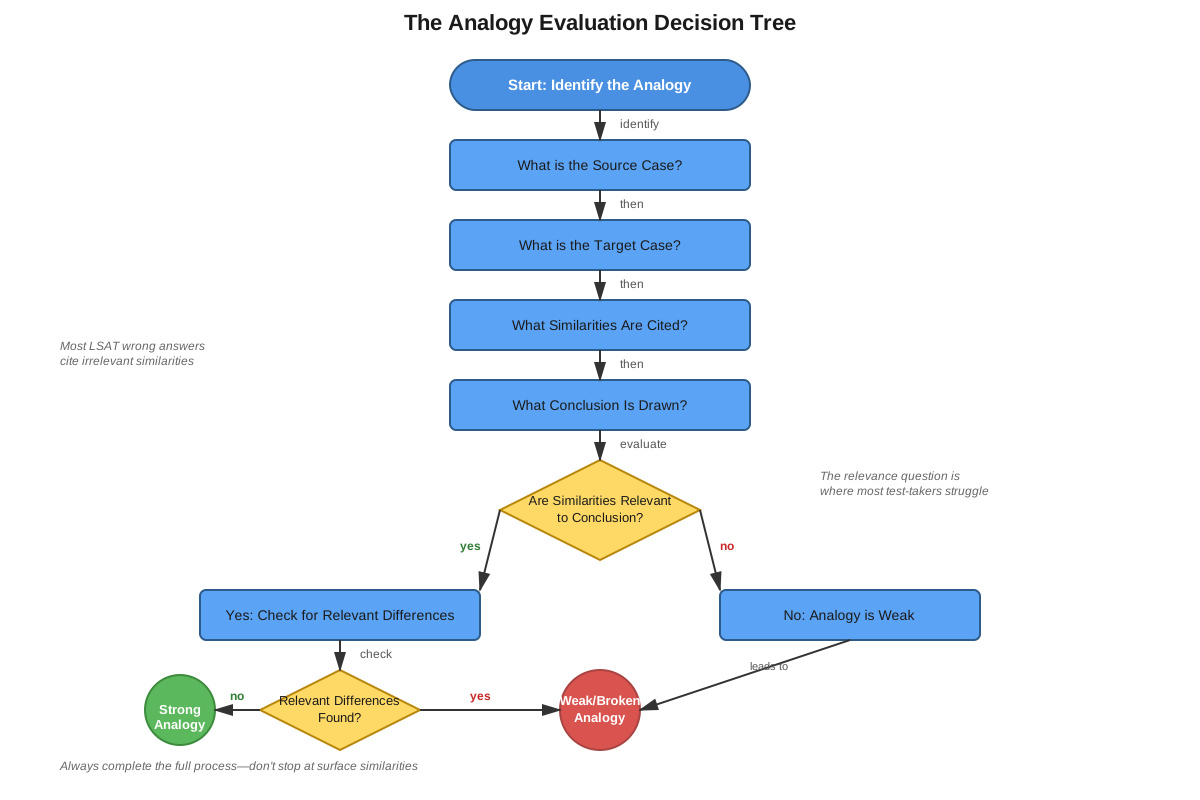
When approaching lsat evaluating analogies questions, follow this systematic process:
Step 1: Identify the Analogy (10-15 seconds)
Quickly identify what's being compared to what. Look for comparison language: "similarly," "likewise," "just as," "like," or explicit comparisons between two situations, policies, or entities.
Step 2: Map the Structure (15-20 seconds)
Identify: (1) source analog, (2) target analog, (3) cited similarities, (4) inferred similarity. This structure reveals what the argument explicitly states versus what it assumes.
Step 3: Assess Relevance (10-15 seconds)
Ask: "Do the cited similarities actually relate to what's being inferred?" This critical step separates strong from weak analogies and helps predict correct answers.
Step 4: Predict the Answer (10-15 seconds)
Before reading answer choices, predict what would strengthen or weaken the analogy:
- To strengthen: additional relevant similarities or elimination of potential differences
- To weaken: relevant differences or showing cited similarities don't relate to the conclusion
- To identify the flaw: the assumption that similarities are sufficient
- To evaluate: information about whether a particular similarity or difference exists
Step 5: Eliminate and Select (20-30 seconds)
Eliminate answers that: (1) address irrelevant similarities or differences, (2) go beyond the scope of the argument, (3) strengthen when you need to weaken or vice versa, (4) address the conclusion directly rather than the analogy's strength.
Exam Tip: The LSAT loves to include answer choices that mention real differences between the compared situations but differences that don't actually affect the conclusion. Always ask: "Does this difference matter for what's being inferred?"
Trigger Words and Phrases:
- "Similarly," "likewise," "in the same way," "just as"
- "By analogy," "comparable situation," "parallel case"
- "If X worked for A, it should work for B"
- "The same reasoning suggests"
Time Allocation:
Spend 1:15-1:30 on these questions. They require careful analysis but shouldn't consume excessive time. If you find yourself re-reading multiple times, move on and return if time permits.
Process of Elimination Tips:
- Eliminate answers about irrelevant similarities first—these are common distractors
- Be suspicious of answers that seem to weaken/strengthen but address the conclusion rather than the comparison
- Watch for scope shifts—answers that discuss different scales, timeframes, or populations than the argument
- Correct answers often introduce new information that reveals a relevant similarity or difference not mentioned in the stimulus
Memory Techniques
RAINS Mnemonic for evaluating analogy strength:
- Relevance: Are the similarities relevant to what's being inferred?
- Assumption: What must be true for this comparison to work?
- Inferred characteristic: What's being concluded about the target?
- Number: Are there multiple relevant similarities?
- Scope: Are the situations comparable in scale and context?
Visualization Strategy: Picture the two situations being compared as two circles. The overlapping area represents cited similarities. Ask yourself: "Is the inferred characteristic in the overlapping area or outside it?" If outside, the analogy is weak.
The "Would This Matter?" Test: For any similarity or difference, ask "Would this matter for the conclusion?" If yes, it's relevant; if no, it's a distractor. This simple question prevents falling for irrelevant information.
Source-Target-Cite-Infer (STCI): When reading an analogical argument, mentally label each component as you encounter it. This active reading technique ensures you understand the structure before attempting the question.
Summary
Evaluating analogies is a high-yield LSAT skill that requires understanding how arguments use comparisons to support conclusions. Strong analogical arguments establish multiple relevant similarities between a source analog (the known situation) and a target analog (the situation about which a conclusion is drawn), while weak analogies rely on irrelevant similarities or ignore relevant differences. The critical assumption in any analogy is that the cited similarities are sufficient to support inferring additional similarities. LSAT questions test whether test-takers can identify this assumption, recognize what would strengthen or weaken the comparison, and distinguish relevant from irrelevant similarities. Success requires systematic analysis: identify the analogical structure, assess the relevance of cited similarities, consider potential relevant differences, and predict what information would affect the analogy's strength. The most common trap is focusing on irrelevant similarities or differences that don't actually impact the conclusion being drawn.
Key Takeaways
- Analogical arguments claim that because two things share certain characteristics, they likely share additional characteristics; the strength depends on whether cited similarities are relevant to what's being inferred.
- Relevant similarities strengthen analogies; irrelevant similarities provide no support regardless of how many exist.
- Every analogy assumes that cited similarities are sufficient and that no relevant differences undermine the comparison—this assumption is the key vulnerability.
- To weaken an analogy, identify relevant differences or show that cited similarities don't relate to the conclusion; to strengthen, establish additional relevant similarities or eliminate potential differences.
- The LSAT frequently uses irrelevant similarities and differences as distractors—always ask whether the information actually affects the inferred characteristic.
- Systematic analysis (identify structure → assess relevance → predict answer → eliminate irrelevant options) is more effective than intuitive reading for these questions.
- Scope and context matter—situations can share surface similarities while differing in scale, timeframe, or circumstances that affect whether the comparison holds.
Related Topics
Parallel Reasoning: This topic extends analogical reasoning to argument structure, requiring identification of arguments with analogous logical patterns rather than analogous content situations. Mastering analogy evaluation provides the foundation for recognizing structural similarities.
Causal Reasoning: Many causal arguments rely on analogies between situations to infer that similar causes will produce similar effects. Understanding how to evaluate analogies strengthens the ability to assess causal claims.
Necessary and Sufficient Assumptions: Analogical arguments contain assumptions about what's necessary or sufficient for the comparison to hold. This topic deepens understanding of the logical gaps in analogical reasoning.
Principle Questions: Some principle questions require applying general rules to specific situations through analogical reasoning, determining whether a situation is sufficiently similar to fall under a stated principle.
Flaw Questions: Many flaw questions involve identifying problems with analogical reasoning, making this topic essential preparation for recognizing common argument weaknesses.
Practice CTA
Now that you understand how to evaluate analogies systematically, it's time to apply these skills to actual LSAT questions. Work through the practice questions, focusing on identifying the analogical structure before reading answer choices. Use the flashcards to reinforce the distinction between relevant and irrelevant similarities—this distinction is the key to success on these questions. Remember: every hour spent mastering analogical reasoning translates directly to points on test day, as these questions appear consistently across every LSAT administration. You've built the framework; now build the fluency through deliberate practice.
Sign up free to keep reading
Create a free AnvayaPrep account to finish this LSAT guide on Evaluating analogies — plus flashcards and practice questions.