Overview
Evaluating explanations is a critical skill tested on the LSAT Logical Reasoning section that requires test-takers to assess the strength, validity, and completeness of causal or explanatory arguments. Unlike questions that ask you to strengthen or weaken an argument, evaluating explanation questions demand that you identify what additional information would be most useful in determining whether a proposed explanation is correct. These questions test your ability to recognize the gaps in reasoning, identify alternative explanations, and understand what evidence would help distinguish between competing hypotheses.
This topic represents a sophisticated form of logical reasoning that appears regularly on the LSAT, typically accounting for 2-4 questions per test. The skill of evaluating explanations bridges multiple reasoning competencies: you must understand causal reasoning, recognize assumptions, identify relevant evidence, and think critically about what makes one explanation superior to another. Questions in this category often present a phenomenon or observation followed by a proposed explanation, then ask which question or piece of information would be most helpful in evaluating that explanation's merit.
Within the broader framework of evaluate and complete the argument question types, evaluating explanations stands as one of the most intellectually demanding tasks. It requires not just passive comprehension but active analytical thinking about the logical structure of explanatory reasoning. Mastering this skill enhances performance across all Logical Reasoning question types because it develops the fundamental ability to identify what matters most in an argument—a transferable skill that applies to assumption, strengthen/weaken, flaw, and inference questions alike.
Learning Objectives
- [ ] Identify how Evaluating explanations appears in LSAT questions
- [ ] Explain the reasoning pattern behind Evaluating explanations
- [ ] Apply Evaluating explanations to solve LSAT-style problems accurately
- [ ] Distinguish between relevant and irrelevant information when assessing explanatory arguments
- [ ] Generate alternative explanations for observed phenomena to test the strength of proposed explanations
- [ ] Recognize the specific question stems that signal evaluation of explanation tasks
- [ ] Determine which piece of information would most effectively discriminate between competing explanations
Prerequisites
- Basic argument structure: Understanding premises, conclusions, and how they relate is essential because evaluating explanations requires identifying what the argument claims and what it assumes.
- Causal reasoning fundamentals: Recognizing cause-and-effect relationships is necessary since most explanations propose causal mechanisms for observed phenomena.
- Assumption identification: The ability to spot unstated assumptions helps identify gaps in explanatory reasoning that need evaluation.
- Strengthen and weaken question types: Familiarity with these question types provides context for understanding how additional information affects argument strength.
Why This Topic Matters
In real-world contexts, evaluating explanations is fundamental to scientific reasoning, medical diagnosis, legal argumentation, and business decision-making. When a doctor considers multiple diagnoses for a patient's symptoms, when a detective weighs different theories about a crime, or when a business analyst tries to explain declining sales, they engage in the same type of reasoning tested by these LSAT questions. The ability to determine what information would help distinguish between competing explanations is essential for any profession requiring critical thinking and evidence-based decision-making.
On the LSAT, evaluating explanation questions typically appear 2-4 times per test, making them a high-yield topic for focused study. These questions most commonly appear with stems like "Which of the following would be most useful to know in evaluating the argument?" or "The answer to which of the following questions would be most helpful in assessing the researcher's hypothesis?" They test a sophisticated form of reasoning that law schools value highly because legal practice constantly requires attorneys to evaluate competing explanations for events, behaviors, and evidence.
These questions appear across various content domains—scientific studies, business scenarios, historical explanations, and everyday observations. The LSAT tests your ability to think structurally about explanations regardless of subject matter, making this a pure reasoning skill rather than a content knowledge test. Understanding this question type also improves performance on related question types because the analytical skills transfer directly to assumption, flaw, and strengthen/weaken questions.
Core Concepts
The Nature of Explanatory Arguments
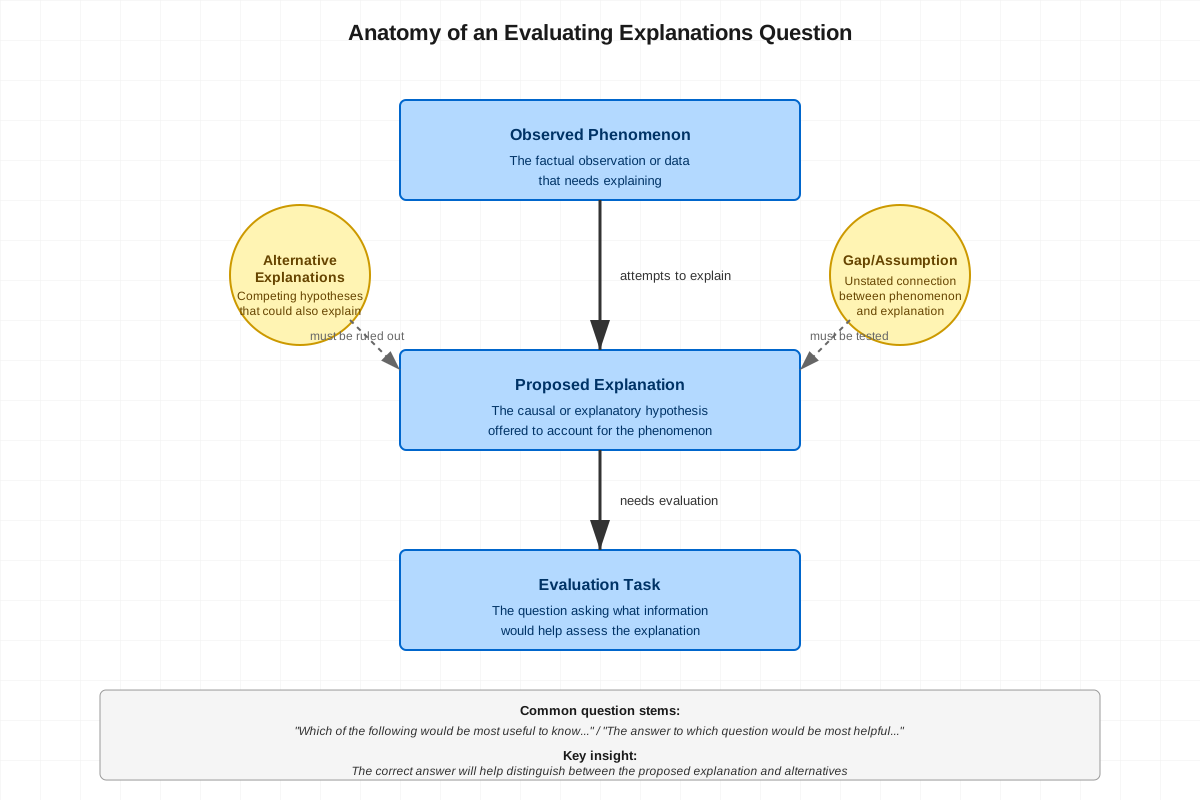
An explanatory argument presents a phenomenon, observation, or set of facts that requires explanation, then proposes a hypothesis or theory to account for those facts. Unlike arguments that try to prove something will happen or should happen, explanatory arguments work backward from an observed effect to a proposed cause. For example: "Sales increased 30% last quarter. This increase is explained by our new advertising campaign." The structure consists of an explanandum (what needs explaining—the sales increase) and an explanans (the proposed explanation—the advertising campaign).
The key vulnerability in explanatory arguments lies in the possibility of alternative explanations. Just because one explanation could account for the observed facts doesn't mean it's the correct or best explanation. Perhaps sales increased due to a competitor going out of business, seasonal factors, economic conditions, or multiple factors working together. Evaluating an explanation requires determining whether the proposed cause is actually responsible for the observed effect or whether other factors might better account for the phenomenon.
The Logic of Evaluation Questions
LSAT evaluating explanations questions don't ask you to prove or disprove the explanation. Instead, they ask what information would be most useful in determining whether the explanation is correct. This represents a meta-level of reasoning: you're not evaluating the explanation directly but rather identifying what would allow you to evaluate it. The correct answer typically points to information that would either strengthen or weaken the explanation depending on how the question is answered.
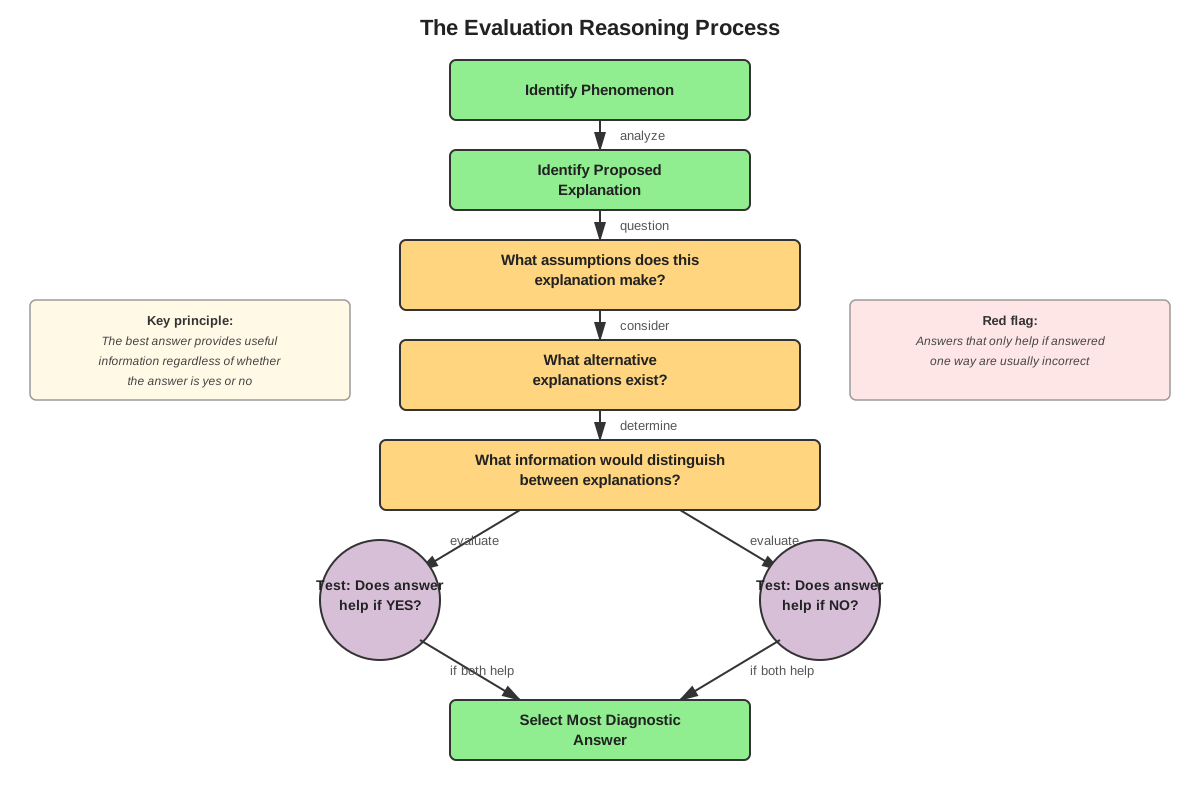
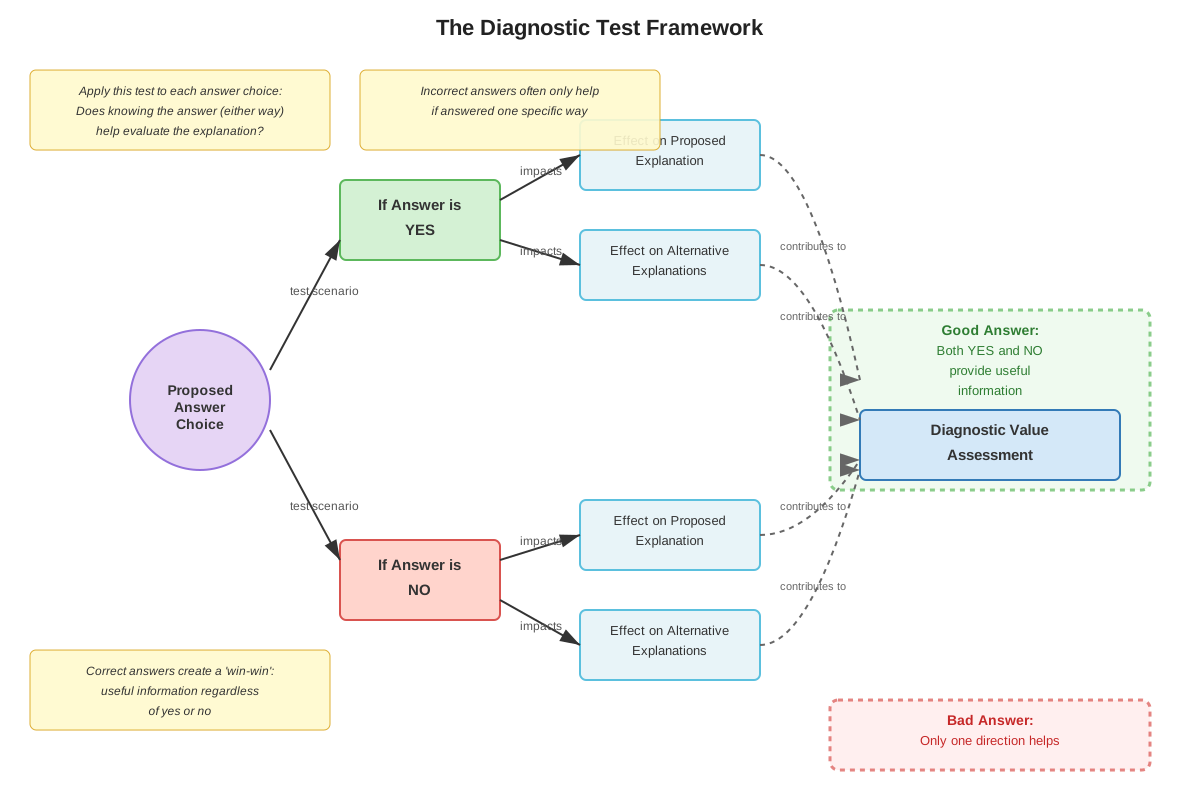
The most effective evaluation questions create a fork in the reasoning: if answered one way, the explanation looks strong; if answered another way, the explanation looks weak. For instance, in the advertising example above, asking "Did any major competitors close stores in the same period?" creates such a fork. If yes, the advertising explanation weakens; if no, it strengthens. This binary quality—where different answers to the evaluation question lead to different conclusions about the explanation's merit—is the hallmark of correct answers.
Components of Strong Evaluation Questions
Effective evaluation questions address the core assumptions or gaps in the explanatory reasoning. They typically fall into several categories:
Alternative cause questions probe whether other factors might explain the phenomenon. These are among the most common because explanatory arguments often assume their proposed cause is the only or primary factor at work. An evaluation question might ask whether other potential causes were present or absent during the relevant time period.
Necessary condition questions examine whether conditions required for the proposed explanation were actually present. If an explanation requires certain circumstances to work, knowing whether those circumstances existed is crucial for evaluation. For example, if someone explains plant growth by citing fertilizer use, knowing whether the plants actually received adequate water (a necessary condition for fertilizer effectiveness) would be valuable.
Temporal relationship questions investigate the timing of cause and effect. For a causal explanation to work, the proposed cause must precede or coincide with the effect. Questions about when events occurred relative to each other help evaluate whether the temporal relationship supports the causal claim.
Mechanism questions explore whether the proposed cause could actually produce the observed effect through a plausible mechanism. These questions ask about the connection between cause and effect, testing whether the explanation provides a coherent account of how one thing led to another.
The Evaluation Question Framework
| Evaluation Type | What It Tests | Example Question |
|---|---|---|
| Alternative Causes | Whether other factors could explain the phenomenon | "Were there other changes in the market during this period?" |
| Necessary Conditions | Whether required circumstances were present | "Did the subjects have prior exposure to the stimulus?" |
| Temporal Sequence | Whether timing supports causation | "Did the policy change occur before or after the trend began?" |
| Mechanism Plausibility | Whether the causal pathway makes sense | "Can the proposed chemical reaction occur at room temperature?" |
| Scope and Generality | Whether the explanation applies broadly or narrowly | "Did the effect occur in all regions or only specific locations?" |
Distinguishing Relevant from Irrelevant Information
A crucial skill in evaluating explanations is recognizing what information actually matters for assessing the explanation. Irrelevant information might be interesting, related to the topic, or even true, but it doesn't help determine whether the proposed explanation is correct. For example, if someone explains a company's success by citing its CEO's leadership, knowing the CEO's educational background might be interesting but doesn't help evaluate whether leadership actually caused the success. However, knowing whether the company was already succeeding before the CEO arrived would be highly relevant.
The LSAT tests this discrimination by offering answer choices that seem related to the topic but don't actually help evaluate the specific explanation offered. Wrong answers often provide information that would be relevant to a different question or that addresses peripheral issues rather than the core explanatory claim. Training yourself to ask "How would different answers to this question affect my assessment of the explanation?" helps eliminate irrelevant options.
The Role of Assumptions in Evaluation
Every explanatory argument rests on assumptions—unstated premises that must be true for the explanation to work. Identifying these assumptions reveals what needs to be evaluated. If an explanation assumes no alternative causes were present, then information about potential alternative causes becomes highly relevant for evaluation. If an explanation assumes a particular mechanism operates in a certain way, then information about that mechanism's actual functioning becomes crucial.
The connection between assumptions and evaluation questions is direct: the best evaluation questions target the argument's most significant assumptions. By making these assumptions explicit and questioning them, you can identify what information would most help assess the explanation's validity. This is why practicing assumption identification strengthens performance on evaluation questions—the skills are intimately connected.
Concept Relationships
The concepts within evaluating explanations form an interconnected system. Explanatory arguments serve as the foundation, providing the structure that needs evaluation. These arguments inherently contain assumptions about alternative causes, necessary conditions, and causal mechanisms. Evaluation questions target these assumptions, identifying what information would test them most effectively. The ability to distinguish relevant from irrelevant information depends on understanding both the structure of the explanatory argument and the nature of effective evaluation questions.
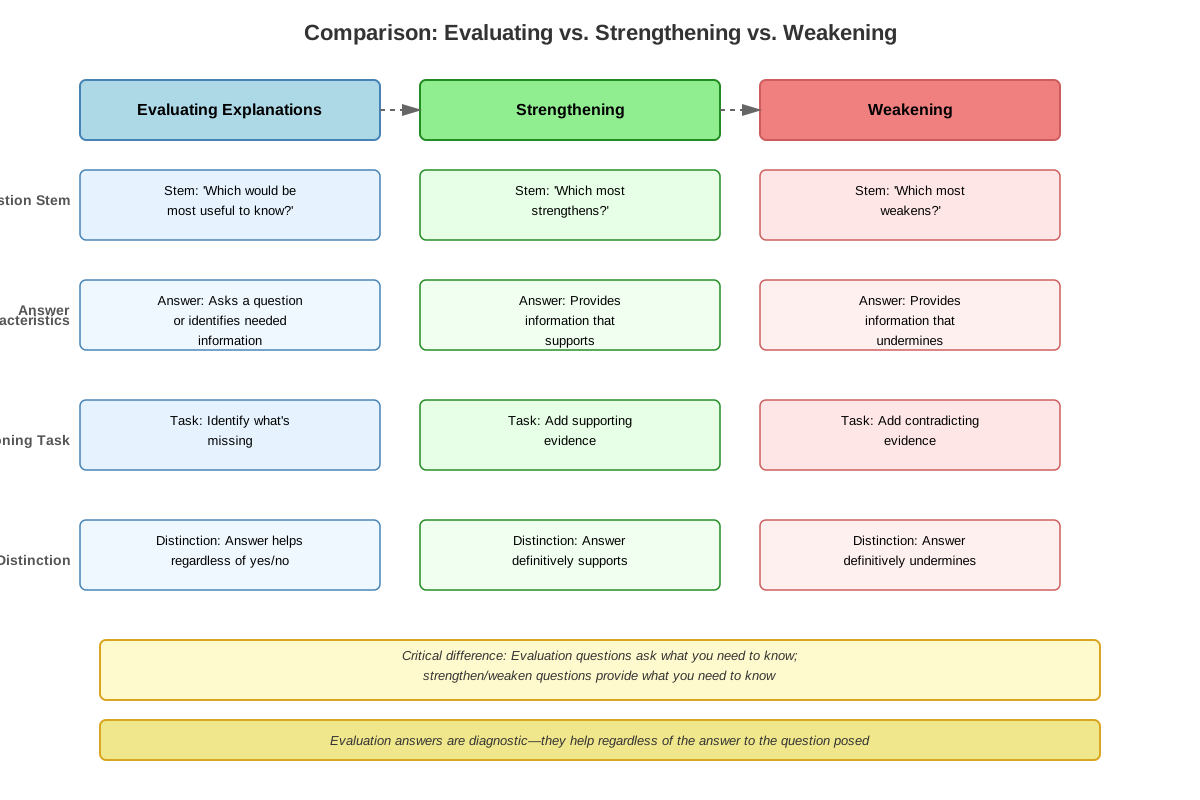
This topic connects directly to prerequisite knowledge of causal reasoning, as most explanations propose causal relationships. The skills developed here enhance understanding of strengthen and weaken questions because evaluation questions essentially ask what information could strengthen or weaken the argument depending on how it's answered. The topic also relates to assumption questions since identifying what needs to be evaluated requires recognizing what the argument assumes.
The relationship map flows as follows: Explanatory Argument Structure → Identifies Assumptions → Reveals Gaps in Reasoning → Suggests Alternative Explanations → Generates Evaluation Questions → Discriminates Between Relevant and Irrelevant Information → Enables Accurate Assessment of Explanation Quality.
High-Yield Facts
⭐ Evaluation questions ask what information would be most useful in assessing an explanation, not whether the explanation is correct or incorrect.
⭐ The best evaluation questions create a binary fork: different answers lead to different conclusions about the explanation's strength.
⭐ Alternative cause questions are the most common type, testing whether other factors could explain the observed phenomenon.
⭐ Correct answers must be relevant to the specific explanation offered, not just to the general topic or phenomenon.
⭐ Temporal sequence matters: causes must precede or coincide with effects for causal explanations to be valid.
- Evaluation questions often target the gap between correlation and causation in explanatory arguments.
- Information about necessary conditions for the proposed explanation to work is highly relevant for evaluation.
- Wrong answers frequently offer information that would be interesting but doesn't help assess the specific explanation.
- The scope of an explanation (whether it applies broadly or narrowly) can be crucial for evaluation.
- Mechanism questions test whether the proposed causal pathway is plausible and actually occurred.
- Evaluation questions differ from strengthen/weaken questions by asking what you'd need to know rather than providing that information.
- The presence or absence of the proposed cause in similar situations where the effect did or didn't occur is highly relevant.
Quick check — test yourself on Evaluating explanations so far.
Try Flashcards →Common Misconceptions
Misconception: Evaluation questions ask you to determine whether the explanation is correct.
Correction: Evaluation questions ask what information would be most helpful in making that determination. You're identifying what needs to be known, not making the final judgment yourself.
Misconception: Any information related to the topic is relevant for evaluation.
Correction: Only information that would actually help assess the specific explanation offered is relevant. Related but tangential information doesn't help evaluate the argument's core claim.
Misconception: The correct answer will definitively prove or disprove the explanation.
Correction: The correct answer identifies information that would strengthen or weaken the explanation depending on how the question is answered, creating a meaningful fork in the reasoning.
Misconception: If an explanation is possible, it doesn't need further evaluation.
Correction: Many explanations are possible, but evaluation questions test whether the proposed explanation is the best or most likely account of the phenomenon, requiring consideration of alternatives and supporting evidence.
Misconception: Evaluation questions are the same as assumption questions.
Correction: While related, assumption questions ask what the argument takes for granted, while evaluation questions ask what information would help determine if those assumptions and the overall explanation are justified.
Misconception: The most complex or detailed answer choice is usually correct.
Correction: The correct answer is the one most directly relevant to evaluating the specific explanation, regardless of complexity. Simple, direct evaluation questions are often correct.
Misconception: Background information about the context is always relevant for evaluation.
Correction: Background information is only relevant if it directly bears on whether the proposed explanation accounts for the phenomenon. Much contextual information is interesting but doesn't help evaluate the specific causal claim.
Worked Examples
Example 1: The Coffee Shop Scenario
Argument: "A coffee shop's sales increased by 40% after it began offering free Wi-Fi. The free Wi-Fi explains the sales increase."
Question: Which of the following would be most useful to know in evaluating the explanation?
Answer Choices:
A) Whether the coffee shop's competitors also offer free Wi-Fi
B) Whether a new office building opened nearby around the same time
C) What percentage of customers use the Wi-Fi service
D) Whether the coffee shop advertised its free Wi-Fi offering
E) What the coffee shop's profit margin is on beverage sales
Analysis:
First, identify the explanatory structure: The phenomenon is a 40% sales increase. The proposed explanation is that free Wi-Fi caused this increase.
Next, consider what assumptions this explanation makes. It assumes that free Wi-Fi was the primary or sole cause of increased sales, that no other significant factors changed, and that the Wi-Fi actually attracted customers who made purchases.
Now evaluate each answer:
(A) Whether competitors offer Wi-Fi is somewhat relevant but doesn't directly test whether Wi-Fi caused this shop's increase. Even if competitors have Wi-Fi, this shop's Wi-Fi could still explain its increase.
(B) This is highly relevant because it presents an alternative explanation. If a new office building opened nearby, that could explain the sales increase instead of or in addition to the Wi-Fi. If answered "yes," the Wi-Fi explanation weakens significantly; if "no," it strengthens. This creates the crucial binary fork.
(C) Usage percentage is interesting but doesn't help evaluate whether Wi-Fi caused the sales increase. Even if few customers use it, Wi-Fi might still attract them; even if many use it, something else might have caused the increase.
(D) Advertising might affect how many people know about the Wi-Fi, but this doesn't help determine whether Wi-Fi (versus some other factor) caused the sales increase.
(E) Profit margins are irrelevant to evaluating what caused the sales increase.
Correct Answer: B
This question tests alternative causes—the most common evaluation type. The new office building represents a competing explanation that would significantly affect our assessment of whether Wi-Fi caused the increase.
Example 2: The Archaeological Discovery
Argument: "Archaeologists discovered that pottery styles changed dramatically in a region around 1200 BCE. This change is explained by an invasion of foreign peoples who brought new pottery techniques."
Question: The answer to which of the following questions would be most helpful in evaluating the archaeologists' hypothesis?
Answer Choices:
A) Were there other cultural changes in the region around the same time?
B) Did the pottery techniques require specialized tools?
C) Have similar pottery styles been found in neighboring regions?
D) Did the region experience any natural disasters around 1200 BCE?
E) Were the new pottery styles more aesthetically pleasing than the old ones?
Analysis:
The phenomenon is dramatic pottery style change around 1200 BCE. The proposed explanation is invasion by foreign peoples bringing new techniques.
Key assumptions: The invasion actually occurred, the invaders had different pottery techniques, no other factors caused the style change, and the timing aligns properly.
Evaluating each choice:
(A) Other cultural changes could support or undermine the invasion hypothesis. If many aspects of culture changed simultaneously, this might support invasion; if only pottery changed, invasion seems less likely. However, this is somewhat indirect.
(B) Whether techniques required specialized tools is interesting but doesn't directly test whether an invasion occurred or whether invasion explains the change.
(C) This is highly relevant. If similar pottery styles existed in neighboring regions before 1200 BCE, this supports the invasion hypothesis—the invaders likely came from those regions bringing their pottery traditions. If no similar styles existed elsewhere, the invasion explanation is severely weakened because the invaders would have no source for these "foreign" techniques. This creates a clear binary evaluation.
(D) Natural disasters could provide an alternative explanation if they disrupted pottery production or forced population movements, but this is less direct than testing whether the proposed invasion source actually existed.
(E) Aesthetic quality is irrelevant to evaluating whether invasion caused the style change.
Correct Answer: C
This question tests the mechanism and plausibility of the explanation. For foreign peoples to bring new techniques, those techniques must have existed somewhere else first. Finding similar styles in neighboring regions would strongly support the invasion hypothesis, while their absence would undermine it.
Exam Strategy
When approaching LSAT evaluating explanations questions, begin by clearly identifying the phenomenon that needs explaining and the proposed explanation. Write these down in shorthand if time permits: "Phenomenon: X happened. Explanation: Y caused X." This clarifies what you're evaluating.
Next, identify the key assumptions in the explanatory argument. Ask yourself: What must be true for this explanation to work? What alternative explanations might exist? What conditions are necessary for the proposed cause to produce the observed effect? These questions reveal what needs to be evaluated.
Trigger phrases that signal evaluation questions include:
- "Most useful to know in evaluating"
- "Most helpful in assessing"
- "Answer to which question would be most relevant"
- "Most important to determine"
- "Most useful to establish"
When these phrases appear, you're dealing with an evaluation question, not a strengthen/weaken or assumption question.
Apply the binary fork test to answer choices. For each option, ask: "If this question were answered one way versus another way, would it significantly affect my assessment of the explanation?" If yes, the answer is potentially correct. If the answer to the question wouldn't change your evaluation either way, eliminate that choice.
Process of elimination strategy: Eliminate answers that are:
- Relevant to the general topic but not to the specific explanation
- Interesting background information that doesn't test the causal claim
- About consequences of the explanation rather than its validity
- Too narrow or specific to significantly affect the overall evaluation
- About peripheral details rather than core assumptions
Time allocation: Spend 15-20 seconds identifying the explanatory structure, 30-40 seconds evaluating answer choices using the binary fork test, and 10-15 seconds confirming your answer. These questions reward careful analysis more than speed, so invest the time to think through the logic.
Watch for wrong answer patterns: The LSAT frequently includes answers that would help evaluate a different explanation than the one actually offered, answers that provide information rather than asking what information is needed, and answers that test peripheral assumptions rather than central ones.
Memory Techniques
Use the acronym ATEMS to remember the main types of evaluation questions:
- Alternative causes
- Temporal sequence
- Evidence for mechanism
- Missing necessary conditions
- Scope and generality
Visualize explanatory arguments as bridges: the phenomenon is one side of a river, the explanation is the bridge connecting to the cause on the other side. Evaluation questions ask whether the bridge is sturdy—whether it's the only bridge, whether it's properly constructed, whether it actually connects the two sides, and whether there might be other bridges (alternative explanations).
Remember the "Fork in the Road" principle: The correct answer creates a fork where different responses lead to different destinations (strong explanation vs. weak explanation). If an answer doesn't create this fork, it's not the right evaluation question.
Use the mnemonic CARE for what makes information relevant:
- Causal connection to the specific explanation
- Alternatives addressed or ruled out
- Required conditions tested
- Evidence that discriminates between possibilities
Summary
Evaluating explanations is a sophisticated LSAT skill that requires identifying what information would be most useful in assessing whether a proposed explanation for a phenomenon is correct. These questions test your ability to recognize the assumptions underlying explanatory arguments, identify alternative explanations, and determine what evidence would help distinguish between competing hypotheses. The key to success lies in understanding that you're not judging whether the explanation is correct but rather identifying what you'd need to know to make that judgment. The best evaluation questions create a binary fork where different answers lead to different conclusions about the explanation's strength. Most commonly, these questions test for alternative causes, necessary conditions, temporal relationships, and causal mechanisms. Success requires distinguishing between information that's merely related to the topic and information that directly helps assess the specific explanation offered. This skill connects deeply to other logical reasoning competencies, particularly causal reasoning, assumption identification, and strengthen/weaken questions, making it a high-yield area for focused study.
Key Takeaways
- Evaluation questions ask what information would be most useful for assessment, not whether the explanation is correct
- The correct answer creates a binary fork: different responses lead to different conclusions about the explanation's validity
- Alternative cause questions are the most common type, testing whether other factors could explain the phenomenon
- Relevant information must directly address the specific explanation offered, not just relate to the general topic
- Identifying the assumptions in the explanatory argument reveals what needs to be evaluated
- Temporal sequence, necessary conditions, and causal mechanisms are key areas for evaluation
- Wrong answers often provide interesting but ultimately irrelevant information that doesn't help assess the core explanatory claim
Related Topics
Strengthen and Weaken Questions: These question types are closely related to evaluating explanations because they provide information that affects argument strength, while evaluation questions ask what information would be most useful. Mastering evaluation questions enhances performance on strengthen/weaken questions by developing the ability to identify what matters most in an argument.
Assumption Questions: Understanding assumptions is crucial for evaluation questions because the best evaluation questions target an argument's key assumptions. These question types develop complementary skills in identifying gaps in reasoning.
Causal Reasoning: Since most explanations propose causal relationships, deeper study of causal reasoning patterns, common causal fallacies, and the requirements for establishing causation will strengthen performance on evaluation questions.
Flaw Questions: Recognizing flaws in explanatory reasoning helps identify what needs to be evaluated. Many flaws involve inadequately ruling out alternative explanations or failing to establish necessary conditions.
Parallel Reasoning: Understanding the abstract structure of explanatory arguments helps recognize similar patterns across different content domains, a skill that transfers to parallel reasoning questions.
Practice CTA
Now that you've mastered the core concepts of evaluating explanations, it's time to put your knowledge into practice. Work through the practice questions to apply the binary fork test, identify relevant evaluation questions, and distinguish between information that helps assess explanations versus information that's merely related to the topic. Use the flashcards to reinforce key concepts and common question patterns. Remember, evaluating explanations is a skill that improves dramatically with deliberate practice—each question you work through strengthens your ability to identify what matters most in explanatory reasoning. You're building a critical thinking skill that will serve you not just on the LSAT but throughout your legal career and beyond.
Sign up free to keep reading
Create a free AnvayaPrep account to finish this LSAT guide on Evaluating explanations — plus flashcards and practice questions.