Overview
Evaluating plans is a critical question type within the LSAT's Logical Reasoning section that tests a student's ability to identify what information would be most useful in determining whether a proposed course of action will achieve its intended goal. These questions present a plan, proposal, or recommendation designed to solve a problem or achieve an objective, then ask which piece of additional information would be most helpful in assessing whether the plan will succeed. Unlike assumption questions that ask what must be true for an argument to work, or strengthen/weaken questions that provide new information, evaluating plans questions require identifying what you need to know to make an informed judgment about a plan's viability.
This question type appears regularly on the LSAT and represents a sophisticated form of critical thinking that goes beyond simple argument analysis. Students must understand not only the plan's structure and goal but also recognize the gaps in reasoning, potential obstacles, and unstated dependencies that could determine success or failure. The ability to evaluate and complete the argument by identifying crucial missing information demonstrates advanced analytical skills that law schools value highly, as legal practice frequently involves assessing proposed strategies, anticipating challenges, and determining what additional facts are needed before making recommendations.
Mastering evaluating plans questions strengthens overall performance in Logical Reasoning because it develops skills that transfer to other question types. The analytical framework used here—identifying goals, understanding mechanisms, spotting assumptions, and recognizing relevant factors—applies broadly to assumption, strengthen/weaken, flaw, and inference questions. This topic sits at the intersection of multiple reasoning skills, making it both challenging and high-yield for exam preparation.
Learning Objectives
- [ ] Identify how Evaluating plans appears in LSAT questions
- [ ] Explain the reasoning pattern behind Evaluating plans
- [ ] Apply Evaluating plans to solve LSAT-style problems accurately
- [ ] Distinguish between relevant and irrelevant information for plan evaluation
- [ ] Recognize the structural components of plans (goal, mechanism, assumptions)
- [ ] Predict potential obstacles and dependencies that affect plan success
- [ ] Differentiate evaluating plans questions from strengthen/weaken questions
Prerequisites
- Basic argument structure: Understanding premises, conclusions, and how evidence supports claims is essential because plans are specialized arguments proposing that certain actions will produce desired outcomes.
- Assumption identification: Recognizing unstated premises helps identify gaps in reasoning that evaluation questions target, as plans always rest on assumptions about how actions lead to results.
- Causal reasoning: Plans inherently involve causal claims (action X will cause outcome Y), so understanding causal relationships and their vulnerabilities is fundamental to evaluating whether proposed mechanisms will work.
- Strengthen and weaken questions: Familiarity with how additional information affects argument strength provides context for understanding what makes information relevant to plan evaluation.
Why This Topic Matters
Evaluating plans questions appear in approximately 8-12% of Logical Reasoning questions across typical LSAT administrations, making them a regular feature that students cannot afford to ignore. These questions test practical reasoning skills that extend far beyond standardized testing—the ability to assess proposals critically, identify information gaps, and determine what facts would resolve uncertainty is essential in legal practice, business decision-making, policy analysis, and everyday problem-solving.
On the LSAT, these questions typically appear with stem language like "Which of the following would be most useful to know in evaluating the plan?" or "The answer to which of the following questions would be most helpful in determining whether the proposal will achieve its goal?" The passages present diverse scenarios: business strategies, public policy initiatives, environmental interventions, educational reforms, or personal decisions. What unifies them is the structure of proposing an action to achieve a goal while leaving critical information unstated.
The practical significance extends to law school and legal practice, where attorneys constantly evaluate proposed strategies, settlement offers, litigation approaches, and policy recommendations. The skill of identifying what additional information would resolve uncertainty about a course of action—rather than simply advocating for or against it—reflects the analytical rigor expected in legal reasoning. Students who master this question type develop a more sophisticated approach to argument analysis that serves them throughout the exam and beyond.
Core Concepts
The Structure of Plans
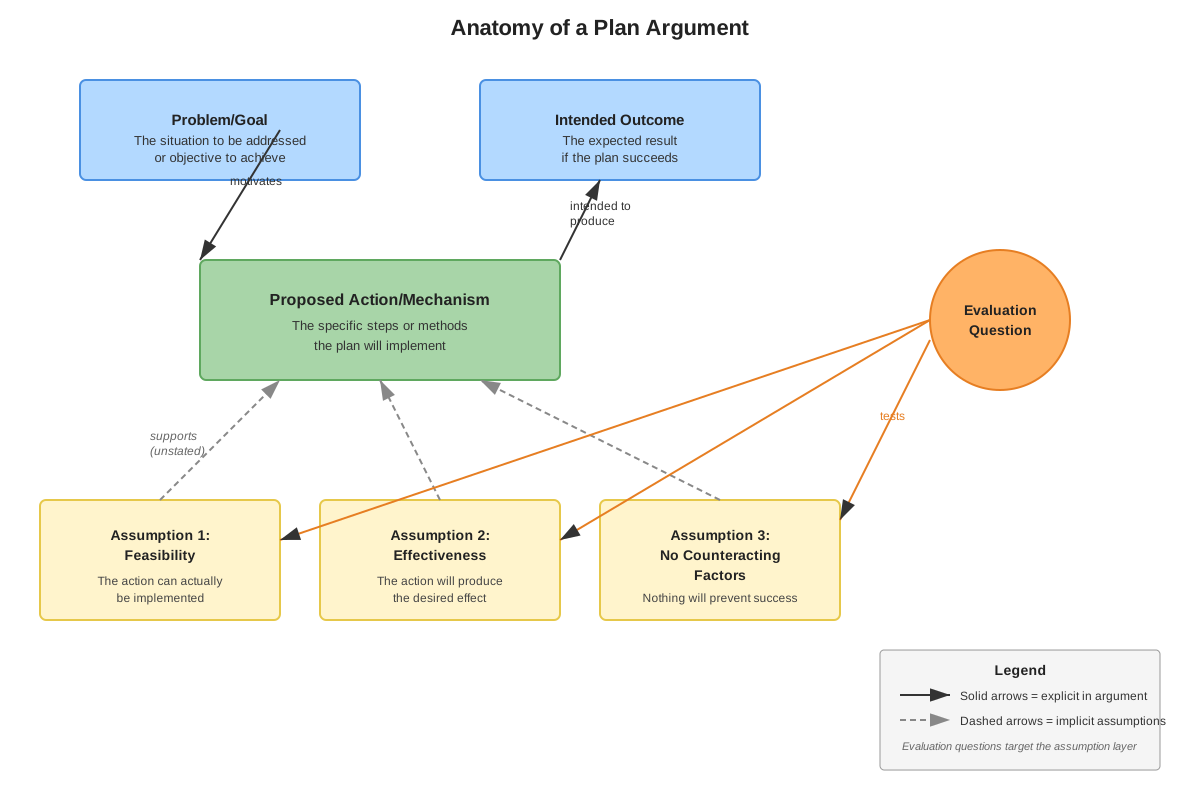
Every plan evaluated on the LSAT contains three essential components that must be identified for successful analysis. The goal represents the desired outcome or objective the plan aims to achieve—this might be increasing profits, reducing pollution, improving test scores, or solving any identified problem. The mechanism describes the specific actions or steps proposed to achieve the goal—the "how" of the plan. Finally, every plan rests on assumptions about how the mechanism will produce the goal, including beliefs about causal relationships, the absence of obstacles, and the presence of necessary conditions.
Consider this structure: "To reduce traffic congestion (goal), the city will add a new bus line (mechanism)." This plan assumes that people will use the bus, that the bus won't add to congestion itself, that the route serves congested areas, and that alternative transportation will actually reduce car usage. Identifying these components allows systematic evaluation of what information would determine success or failure.
The Gap Between Action and Outcome
The fundamental challenge in evaluating plans lies in the gap between proposed action and intended outcome. Plans present a causal claim: doing X will lead to Y. However, numerous factors can disrupt this causal chain. The action might not be implemented as intended, the mechanism might not work as assumed, unintended consequences might arise, or external factors might interfere. Evaluating plans questions target this gap by asking what information would help determine whether the causal chain will hold.
This gap manifests in several ways. There may be implementation questions: Can the action actually be carried out? Are necessary resources available? There may be mechanism questions: Will the proposed action actually produce the intermediate effects assumed? There may be sufficiency questions: Even if the action works as intended, will it be enough to achieve the goal? And there may be side effect questions: Will the action produce unintended consequences that undermine the goal?
Relevant vs. Irrelevant Information
A critical skill in evaluating plans questions involves distinguishing relevant information from attractive distractors. Relevant information directly bears on whether the plan's mechanism will produce its goal. It addresses assumptions the plan makes, potential obstacles to success, or necessary conditions for the causal chain to work. Irrelevant information might be interesting, related to the topic, or even true, but it doesn't help determine whether this specific plan will achieve this specific goal.
| Relevant Information | Irrelevant Information |
|---|---|
| Addresses whether the mechanism will work | Provides background context without evaluative power |
| Tests a necessary assumption | Discusses alternative plans not proposed |
| Identifies potential obstacles | Offers information about past unrelated efforts |
| Determines sufficiency of the action | Presents tangential facts about the topic |
| Reveals unintended consequences | Describes the problem without addressing the solution |
The Question Format and What It Asks
LSAT evaluating plans questions use distinctive stem language that signals the task. Common phrasings include: "Which of the following would be most useful to know in evaluating the argument?" "The answer to which question would most help in determining whether the plan will succeed?" "Which of the following would it be most important to determine in evaluating the proposal?" These stems all ask the same thing: what information would help assess the plan's likelihood of success?
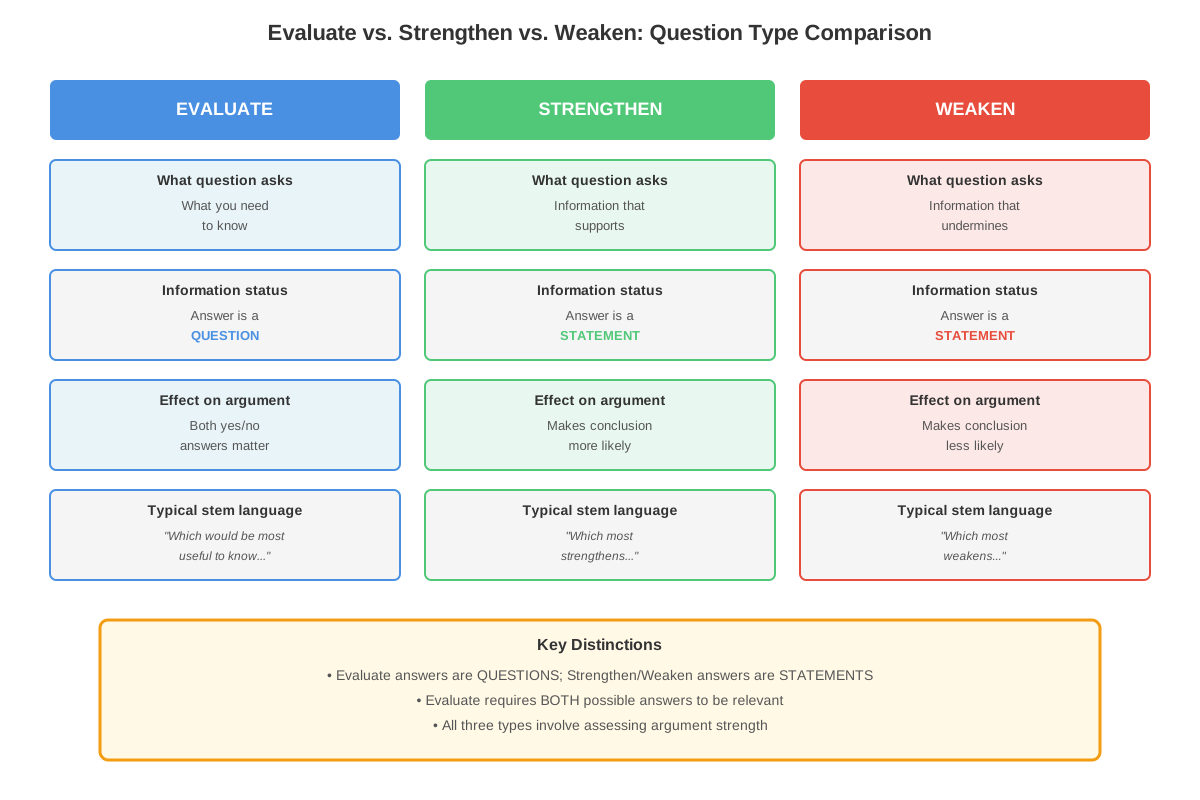
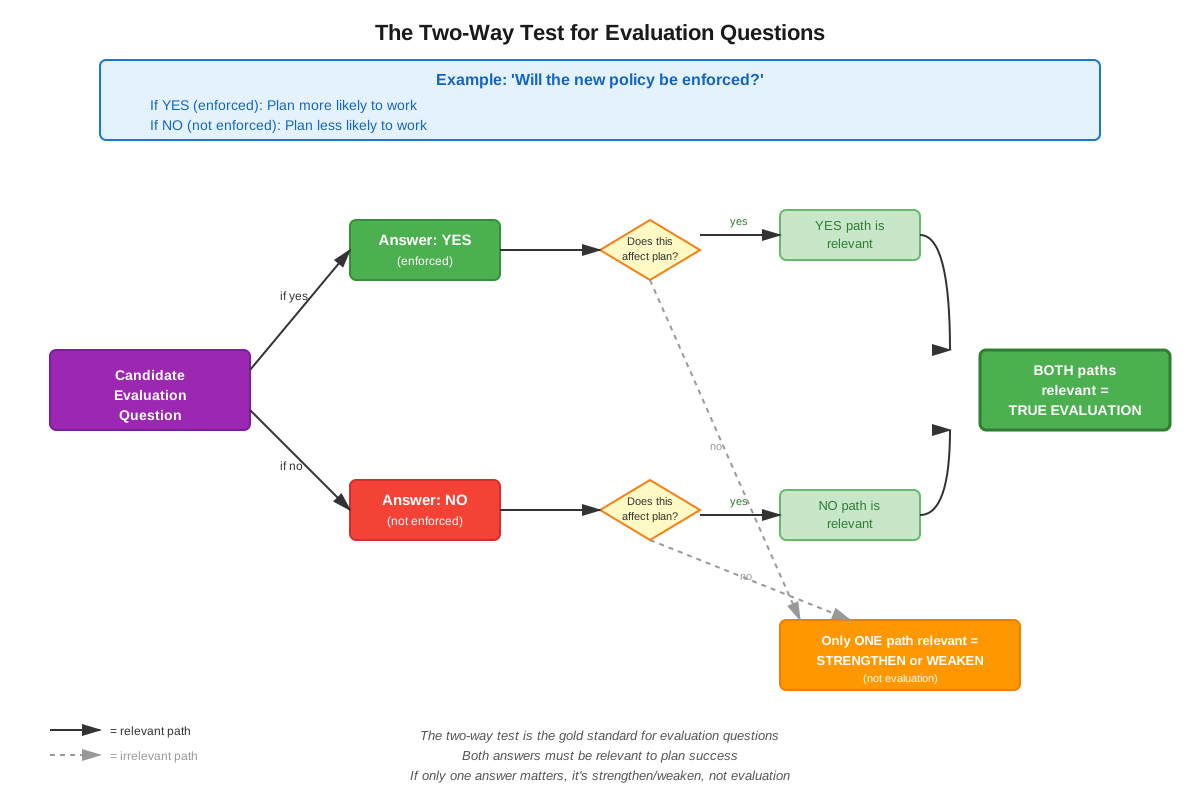
Crucially, these questions don't ask you to strengthen or weaken the plan—they ask what you'd need to know to make that judgment. The correct answer typically takes the form of a yes/no question where one answer would support the plan and the other would undermine it. If knowing the answer either way doesn't affect your assessment of the plan, the information isn't relevant for evaluation.
Types of Evaluation Criteria
Several categories of information commonly appear as correct answers in evaluating plans questions. Feasibility information addresses whether the plan can actually be implemented—are necessary resources available, is the action physically or economically possible, do required conditions exist? Effectiveness information concerns whether the mechanism will work as intended—will the proposed action actually produce the assumed intermediate effects? Sufficiency information asks whether the action, even if effective, will be enough to achieve the goal—is the scale adequate, will it address the full scope of the problem?
Comparative information may be relevant when the plan assumes that the proposed action is better than alternatives or the status quo. Side effect information addresses whether unintended consequences will undermine the goal. Assumption-testing information directly examines whether unstated premises the plan relies upon are actually true. Recognizing these categories helps predict what type of information will be most relevant for any given plan.
The Evaluation Framework
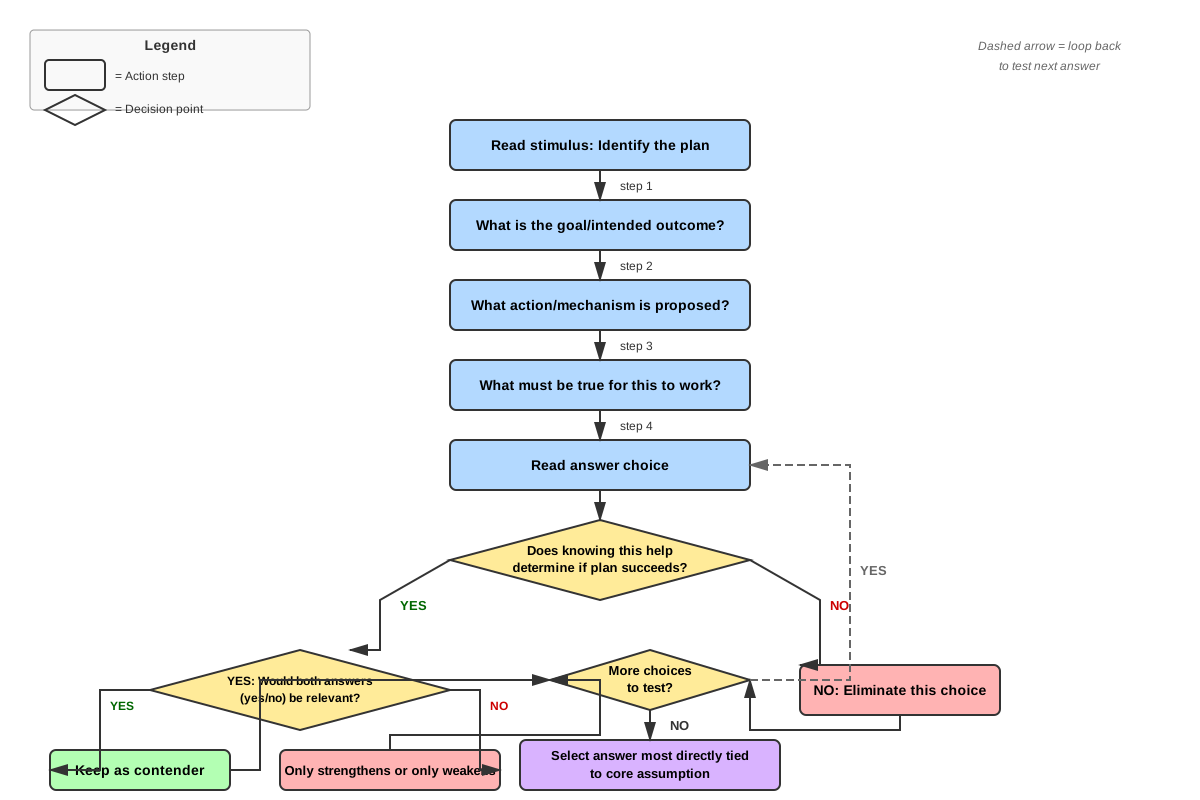
A systematic approach to evaluating plans involves several steps. First, identify the plan's goal clearly—what specific outcome is intended? Second, identify the mechanism—what action is proposed to achieve this goal? Third, articulate the implicit causal claim—how is the action supposed to produce the outcome? Fourth, identify assumptions—what must be true for this causal chain to work? Fifth, consider potential obstacles—what could prevent the mechanism from working or the goal from being achieved?
This framework generates questions that would be useful to answer: Does the necessary condition exist? Will the assumed effect actually occur? Are there countervailing factors? Is the scale sufficient? Will there be unintended consequences? The correct answer to an evaluating plans question will typically address one of these generated questions, providing information that would genuinely help determine whether the plan will succeed.
Concept Relationships
The concepts within evaluating plans are hierarchically related. Understanding plan structure (goal, mechanism, assumptions) is foundational and enables identification of the gap between action and outcome. Recognizing this gap leads to generating relevant evaluation criteria (feasibility, effectiveness, sufficiency, side effects). The ability to distinguish relevant from irrelevant information depends on understanding all these prior concepts. Finally, applying the evaluation framework systematically integrates all components into a practical approach for answering questions.
These concepts connect to prerequisite knowledge in important ways. Assumption identification skills transfer directly to recognizing what plans assume about how mechanisms produce goals. Causal reasoning understanding illuminates why certain information would help evaluate whether proposed actions will cause intended outcomes. Strengthen/weaken question experience provides intuition about what types of information affect argument strength, though evaluating plans questions ask a distinct question about what information would be useful rather than providing that information.
The relationship map flows as follows: Plan Structure → Identifies → Gap Between Action and Outcome → Generates → Potential Evaluation Criteria → Requires → Distinguishing Relevant from Irrelevant Information → Achieved Through → Systematic Evaluation Framework → Produces → Correct Answer Selection.
High-Yield Facts
- ⭐ Evaluating plans questions ask what information would be useful to know, not what information strengthens or weakens the plan
- ⭐ The correct answer typically takes the form of a yes/no question where different answers would lead to different assessments of the plan
- ⭐ Relevant information must directly address whether the plan's mechanism will achieve its stated goal
- ⭐ Every plan contains three components: a goal (desired outcome), a mechanism (proposed action), and assumptions (unstated premises about how action leads to outcome)
- ⭐ Information about alternative plans or past unrelated efforts is typically irrelevant unless it directly bears on whether this specific plan will work
- Common evaluation criteria include feasibility, effectiveness, sufficiency, side effects, and assumption-testing
- If knowing the answer to a question wouldn't change your assessment of the plan either way, that information is irrelevant
- Plans always involve implicit causal claims that certain actions will produce certain outcomes
- The gap between proposed action and intended outcome is where evaluation questions focus
- Information that merely provides context or background without evaluative power is a common wrong answer type
- Correct answers often test whether a necessary condition for the plan's success actually exists
- The scale or scope of the proposed action relative to the problem is frequently relevant
- Unintended consequences that might undermine the goal are important evaluation considerations
- Information about whether the target population will respond as assumed is often crucial
- Comparative information is only relevant when the plan explicitly or implicitly relies on being better than alternatives
Quick check — test yourself on Evaluating plans so far.
Try Flashcards →Common Misconceptions
Misconception: Evaluating plans questions are the same as strengthen/weaken questions. → Correction: While related, these question types are distinct. Strengthen/weaken questions provide new information and ask how it affects the argument. Evaluating plans questions ask what information would be useful to know—they don't provide the information itself. The correct answer identifies what you'd need to know, not what you do know.
Misconception: Any information related to the topic is relevant for evaluation. → Correction: Relevance is specific and narrow. Information must directly address whether the plan's mechanism will achieve its goal. Background context, interesting tangential facts, or general information about the problem area doesn't help evaluate this specific plan unless it bears on the causal chain from action to outcome.
Misconception: The correct answer will always support or oppose the plan. → Correction: The correct answer is typically neutral—it's a question where different answers would lead to different assessments. If a choice clearly strengthens or weakens the plan rather than identifying what would be useful to know, it's likely wrong. The task is identifying what information would resolve uncertainty, not resolving it.
Misconception: Information about alternative plans is always relevant. → Correction: Alternative plans are only relevant if the argument explicitly or implicitly compares the proposed plan to alternatives or claims it's the best option. If the plan simply proposes an action to achieve a goal without comparative claims, information about other approaches doesn't help evaluate whether this plan will work.
Misconception: More information is always better, so the most detailed answer choice is correct. → Correction: The correct answer provides the most relevant information, not the most information. A detailed answer about tangential matters is worse than a focused answer about a critical assumption. Quality and relevance trump quantity.
Misconception: If a plan has multiple steps, information about any step is equally relevant. → Correction: Some steps are more critical than others. Information about potential bottlenecks, necessary conditions, or steps where assumptions are most vulnerable is more relevant than information about straightforward or less crucial steps. Focus on where the plan is most likely to fail or where uncertainty is greatest.
Worked Examples
Example 1: The Library Reading Program
Passage: "To increase children's reading comprehension scores, the public library will offer a free summer reading program that provides books and weekly discussion groups. This program will improve reading skills and thereby raise comprehension test scores when students return to school in the fall."
Question: Which of the following would be most useful to know in evaluating whether the plan will achieve its goal?
Answer Choices:
A) Whether the library has offered similar programs in the past
B) Whether children who participate will read more books than they would have otherwise
C) Whether reading comprehension is the most important academic skill
D) Whether other libraries in the state offer summer programs
E) Whether the library has sufficient funding for the program
Analysis:
First, identify the plan's components:
- Goal: Increase children's reading comprehension scores
- Mechanism: Offer free summer reading program with books and discussion groups
- Implicit causal claim: Participation in the program → improved reading skills → higher test scores
Next, identify key assumptions:
- Children will participate in the program
- Participation will lead to more reading than would occur otherwise
- The additional reading will improve skills
- Improved skills will translate to higher test scores
Now evaluate each answer:
(A) Past programs provide context but don't directly address whether this program will work. Even if past programs failed, this one might succeed, and vice versa. Not directly relevant to the causal chain.
(B) This is crucial. If children would read the same amount anyway (perhaps they already read extensively in summer), the program wouldn't cause additional reading and thus wouldn't improve skills beyond what would happen naturally. If they read more because of the program, it could work. This tests a key assumption about the mechanism's effectiveness. This is the correct answer.
(C) Whether reading comprehension is most important is irrelevant to whether this plan will increase it. The goal is stated; we're evaluating whether the plan achieves it, not whether it's the right goal.
(D) What other libraries do doesn't affect whether this library's program will work. This is tangential information without evaluative power.
(E) Funding addresses feasibility—whether the program can be implemented—but the question assumes implementation and asks whether it will achieve the goal. If funding were insufficient, the program wouldn't happen, but that's different from evaluating whether it would work if implemented.
Connection to Learning Objectives: This example demonstrates identifying how evaluating plans appears in LSAT questions (objective 1), explaining the reasoning pattern by breaking down the causal chain (objective 2), and applying the framework to select the correct answer (objective 3).
Example 2: The Traffic Reduction Plan
Passage: "City officials plan to reduce traffic congestion on Main Street by converting one traffic lane to a dedicated bus lane. They reason that this will encourage more commuters to take the bus instead of driving, thereby reducing the total number of vehicles on Main Street."
Question: The answer to which of the following questions would be most helpful in determining whether the plan will succeed?
Answer Choices:
A) Is Main Street the most congested street in the city?
B) Will the reduction in general traffic lanes cause remaining lanes to become more congested?
C) Do other cities use dedicated bus lanes to reduce congestion?
D) How many commuters currently use Main Street?
E) Are there alternative routes that drivers could use instead of Main Street?
Analysis:
Plan components:
- Goal: Reduce traffic congestion on Main Street
- Mechanism: Convert one lane to dedicated bus lane
- Implicit causal claim: Dedicated bus lane → more people take bus → fewer cars → less congestion
Key assumptions:
- The bus lane will actually increase bus ridership
- Increased bus ridership will come from people who currently drive on Main Street
- The reduction in cars will outweigh the loss of a traffic lane
- The remaining lanes can handle the traffic that continues to drive
Evaluate each answer:
(A) Whether Main Street is the most congested is irrelevant to whether this plan will reduce its congestion. The goal is stated; we're not choosing which street to address.
(B) This is critical. The plan assumes that fewer cars will more than compensate for one fewer lane. But if losing a lane concentrates the same (or nearly the same) number of cars into fewer lanes, congestion could actually worsen. If the bus lane significantly reduces car traffic, congestion might improve despite fewer lanes. This directly tests whether the mechanism will achieve the goal. This is the correct answer.
(C) What other cities do provides context but doesn't determine whether this plan in this city will work. Different cities have different conditions, and success elsewhere doesn't guarantee success here.
(D) The total number of current commuters is background information but doesn't help evaluate whether the plan will work. What matters is whether behavior will change in response to the bus lane.
(E) Alternative routes might be relevant if the plan assumed drivers have no alternatives, but the plan's logic is about encouraging bus use, not about whether drivers have other options. This doesn't directly address the causal chain from bus lane to reduced congestion.
Connection to Learning Objectives: This example shows how to distinguish between relevant and irrelevant information (objective 4), recognize structural components and assumptions (objective 5), and predict potential obstacles—in this case, that the solution might create the problem it aims to solve (objective 6).
Exam Strategy
When approaching lsat evaluating plans questions, begin by reading the question stem first to confirm you're dealing with an evaluation question rather than strengthen/weaken or assumption. Look for key phrases like "most useful to know," "most helpful in determining," or "most important to determine." This primes your mind to identify what information is missing rather than what information is provided.
As you read the passage, actively identify the three components: goal, mechanism, and assumptions. Underline or mentally note the desired outcome and the proposed action. Then articulate the implicit causal claim: "The author believes that doing X will lead to Y." Ask yourself: "What must be true for this to work? What could go wrong? What am I not being told?"
Trigger words and phrases that signal evaluating plans questions include:
- "most useful to know"
- "most helpful in determining"
- "most important to determine"
- "would be most relevant"
- "the answer to which question"
- "in evaluating the plan/proposal/argument"
Before looking at answer choices, generate your own question that would help evaluate the plan. What's the biggest gap in reasoning? What assumption seems most vulnerable? What information would you want if you had to decide whether to implement this plan? Your predicted answer may not match exactly, but it focuses your thinking on relevant considerations.
Exam Tip: The correct answer often tests whether a necessary condition for the plan's success actually exists. Ask: "What does this plan need to be true to work?"
When evaluating answer choices, apply the "so what?" test. For each option, ask: "If I knew the answer to this question, would it change my assessment of whether the plan will succeed?" If the answer is no—if knowing this information either way wouldn't affect your evaluation—eliminate it. The correct answer should be such that different answers to the question would lead to different assessments of the plan.
Process of elimination tips:
- Eliminate choices about alternative plans unless the argument makes comparative claims
- Eliminate background information that doesn't address the causal chain
- Eliminate information about past unrelated efforts
- Eliminate choices that would only strengthen or only weaken rather than being genuinely evaluative
- Eliminate information about whether the goal is worthwhile rather than whether the plan will achieve it
Time allocation: These questions typically require 60-90 seconds. Spend 20-30 seconds understanding the plan's structure and generating your prediction, then 30-60 seconds evaluating answer choices. If you're stuck between two answers, ask which one more directly addresses the gap between action and outcome.
Memory Techniques
Use the acronym GAMES to remember key evaluation criteria:
- Goal clarity: Is the intended outcome clearly defined and measurable?
- Assumptions: What unstated premises does the plan rely on?
- Mechanism: Will the proposed action actually work as intended?
- Effectiveness: Is the action sufficient to achieve the goal?
- Side effects: Will unintended consequences undermine the goal?
For remembering the three components of every plan, use GAM:
- Goal (what you want to achieve)
- Action (what you'll do)
- Mechanism (how action leads to goal)
Visualize evaluating plans questions as a bridge with missing planks. The plan proposes building a bridge from current situation (one side) to desired outcome (other side). The mechanism is the bridge structure. Your job is identifying which plank (piece of information) is missing and would be most important to know whether the bridge will hold. This visualization helps focus on structural gaps rather than tangential information.
For distinguishing evaluation from strengthen/weaken questions, remember: Evaluation asks for a QUESTION, strengthen/weaken provides an ANSWER. If you're identifying what you need to know, it's evaluation. If you're assessing how provided information affects the argument, it's strengthen/weaken.
Summary
Evaluating plans questions test the ability to identify what information would be most useful in determining whether a proposed course of action will achieve its intended goal. These questions require understanding the plan's structure—its goal, mechanism, and underlying assumptions—then recognizing the gap between proposed action and intended outcome. Success depends on distinguishing genuinely relevant information that addresses whether the causal chain will hold from attractive but irrelevant information that merely provides context or discusses tangential matters. The correct answer typically takes the form of a yes/no question where different answers would lead to different assessments of the plan's likelihood of success. Mastering this question type requires systematic analysis: identify components, articulate the implicit causal claim, recognize assumptions, predict potential obstacles, and select information that would resolve the most significant uncertainty about whether the plan will work. This skill integrates assumption identification, causal reasoning, and practical judgment, making it both challenging and high-yield for LSAT preparation.
Key Takeaways
- Evaluating plans questions ask what information would be useful to know, not what information strengthens or weakens the argument
- Every plan has three components: a goal (desired outcome), a mechanism (proposed action), and assumptions (unstated premises about causation)
- Relevant information must directly address whether the plan's mechanism will achieve its stated goal
- The correct answer is typically a question where different answers would lead to different assessments of the plan
- Information about alternative plans, past efforts, or background context is usually irrelevant unless it directly bears on this plan's causal chain
- Apply the systematic framework: identify goal and mechanism, articulate the causal claim, recognize assumptions, predict obstacles, and select information addressing the biggest gap
- Common evaluation criteria include feasibility, effectiveness, sufficiency, side effects, and assumption-testing
Related Topics
Assumption Questions: Understanding what must be true for an argument to work builds directly on skills developed in evaluating plans, as both require identifying unstated premises and gaps in reasoning. Mastering plan evaluation makes assumption questions more intuitive.
Strengthen and Weaken Questions: These question types provide information and ask how it affects an argument, while evaluating plans asks what information would be useful. The skills are complementary—understanding what information would be relevant (evaluation) helps recognize how provided information affects arguments (strengthen/weaken).
Flaw Questions: Identifying logical flaws requires recognizing gaps in reasoning similar to those targeted in evaluating plans questions. Plans often contain common flaws like assuming sufficiency, ignoring alternatives, or overlooking side effects.
Causal Reasoning: Since plans inherently involve causal claims (action X will cause outcome Y), deeper study of causal reasoning patterns, vulnerabilities, and alternative explanations enhances plan evaluation skills.
Necessary and Sufficient Conditions: Understanding the distinction between necessary conditions (what must be true) and sufficient conditions (what's enough to guarantee an outcome) clarifies what information is most relevant for evaluating whether plans will succeed.
Practice CTA
Now that you've mastered the conceptual framework for evaluating plans, it's time to apply these skills to actual LSAT questions. The practice questions and flashcards will reinforce your ability to quickly identify plan components, recognize relevant evaluation criteria, and distinguish correct answers from attractive distractors. Remember that this question type rewards systematic analysis—use the framework consistently, and your accuracy will improve with each practice set. These skills transfer broadly across Logical Reasoning, making your investment in mastering evaluating plans questions particularly high-yield. You've built the foundation; now strengthen it through deliberate practice!
Sign up free to keep reading
Create a free AnvayaPrep account to finish this LSAT guide on Evaluating plans — plus flashcards and practice questions.