Overview
Evaluating predictions is a critical skill within LSAT Logical Reasoning that tests a student's ability to assess the strength, validity, and underlying assumptions of predictive arguments. On the LSAT, prediction-based arguments appear frequently in various question types, particularly in Evaluate the Argument, Strengthen/Weaken, and Assumption questions. These arguments typically involve someone forecasting a future outcome based on current evidence, past trends, or causal relationships. The test-maker expects students to identify what additional information would be most relevant to determining whether the prediction is likely to be accurate.
This topic sits at the intersection of causal reasoning, conditional logic, and assumption identification—three pillars of logical reasoning on the LSAT. When evaluating predictions, students must recognize that predictions inherently involve uncertainty and depend on assumptions about continuity, causation, and the absence of interfering factors. The ability to evaluate and complete the argument by identifying what would make a prediction more or less reliable is essential for achieving a competitive score, as these questions test sophisticated analytical thinking rather than mere pattern recognition.
Mastering prediction evaluation enhances performance across multiple Logical Reasoning question types because it develops the fundamental skill of identifying what matters most in an argument. This skill transfers directly to real-world legal reasoning, where attorneys must assess the likely outcomes of legal strategies, predict judicial decisions based on precedent, and evaluate the strength of opposing counsel's claims about future events. The LSAT uses prediction evaluation to test whether candidates possess the analytical rigor necessary for law school and legal practice.
Learning Objectives
- [ ] Identify how Evaluating predictions appears in LSAT questions
- [ ] Explain the reasoning pattern behind Evaluating predictions
- [ ] Apply Evaluating predictions to solve LSAT-style problems accurately
- [ ] Distinguish between relevant and irrelevant factors when assessing predictive arguments
- [ ] Recognize the common assumption patterns that underlie predictions on the LSAT
- [ ] Formulate questions that would most effectively test the validity of a given prediction
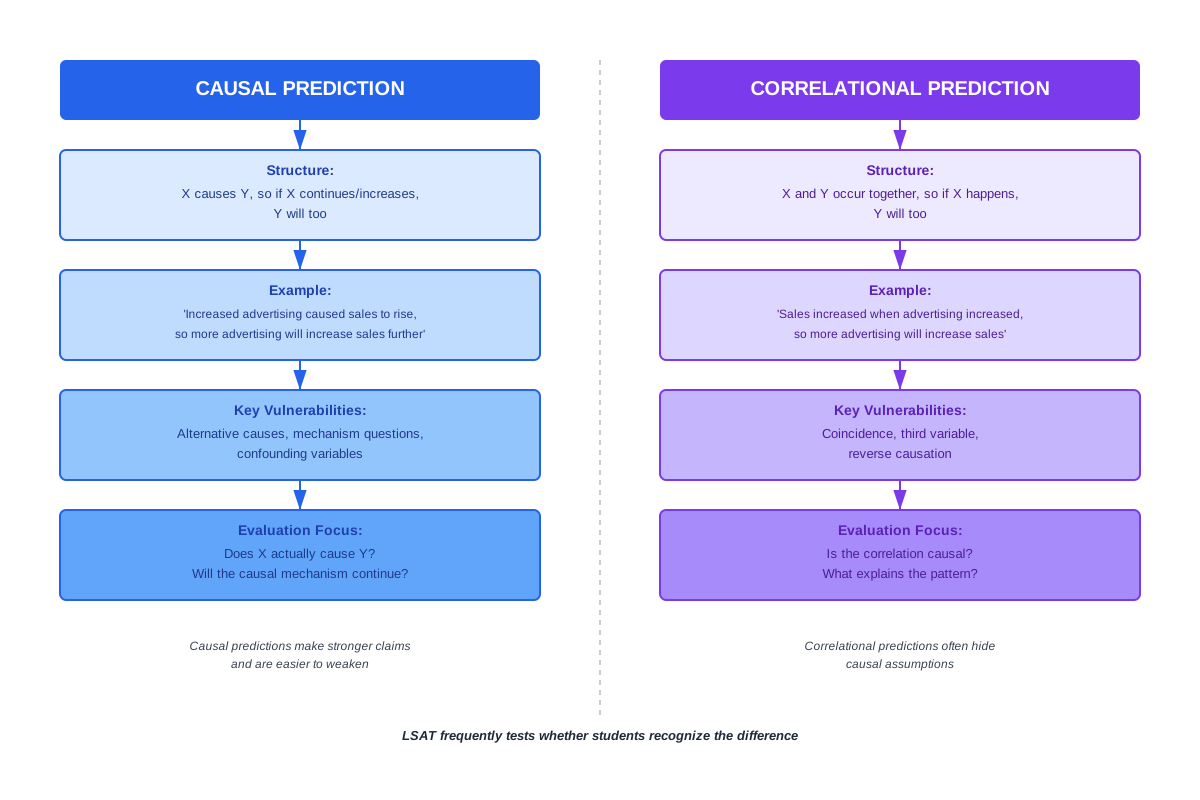
- [ ] Differentiate between predictions based on causation versus correlation
Prerequisites
- Basic argument structure: Understanding premises, conclusions, and how evidence supports claims is essential because predictions are a specific type of conclusion that must be evaluated based on the quality of supporting evidence.
- Causal reasoning fundamentals: Recognizing cause-and-effect relationships matters because most predictions assume that past causal patterns will continue into the future.
- Conditional logic basics: Understanding sufficient and necessary conditions helps identify what must be true for a prediction to hold.
- Assumption identification: Recognizing unstated premises is crucial because predictions always rest on assumptions about future conditions remaining similar to past or present conditions.
Why This Topic Matters
In legal practice, attorneys constantly make and evaluate predictions: Will this settlement offer be accepted? How will a judge rule on a motion? What precedent will the appellate court follow? The LSAT tests prediction evaluation because it directly measures the analytical skills lawyers use daily. Law students must assess competing predictions about case outcomes, legislative impacts, and client decisions, making this skill foundational to legal education.
On the LSAT, prediction-based arguments appear in approximately 15-20% of Logical Reasoning questions across all administrations. They most commonly appear in Evaluate the Argument questions (where students must identify what information would be most useful in assessing the prediction), Strengthen/Weaken questions (where students must find evidence that makes the prediction more or less likely), and Assumption questions (where students must identify what the prediction takes for granted). Less frequently, they appear in Flaw questions when a prediction rests on faulty reasoning.
These questions typically present scenarios involving business forecasts, policy predictions, scientific projections, or behavioral expectations. Common contexts include: a company predicting sales based on past performance, a researcher forecasting experimental results based on preliminary data, a policy analyst predicting the effects of proposed legislation, or an expert projecting future trends based on current patterns. The LSAT favors predictions that depend on multiple unstated assumptions, creating opportunities to test whether students can identify the most critical factors affecting the prediction's accuracy.
Core Concepts
The Structure of Predictive Arguments
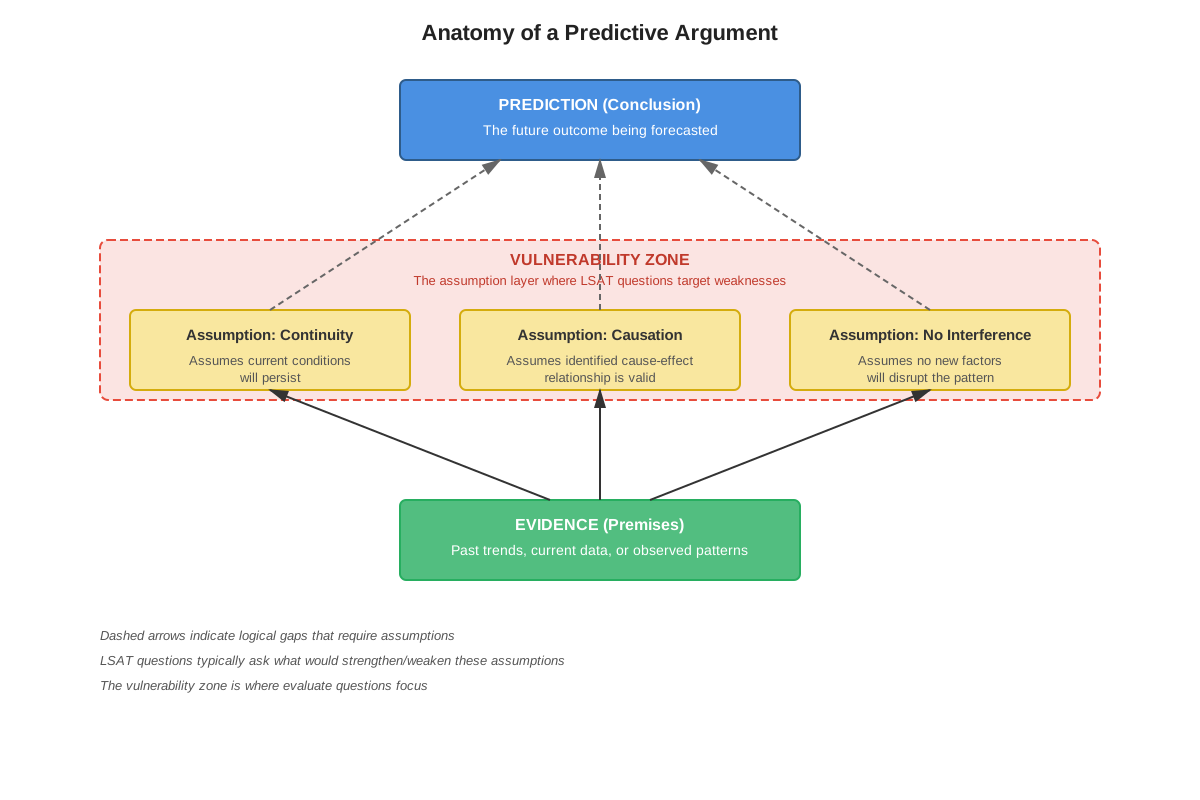
A predictive argument on the LSAT follows a specific structure: evidence about past or present conditions leads to a conclusion about what will happen in the future. The prediction itself is always the conclusion, while the premises provide the basis for that forecast. Understanding this structure is essential for lsat evaluating predictions because it reveals where vulnerabilities lie.
Every prediction contains three key components:
- The baseline evidence: Current facts, past trends, or established patterns that serve as the foundation
- The predictive leap: The logical jump from what has been or is to what will be
- Implicit assumptions: Unstated beliefs about continuity, causation, or the absence of change
The strength of any prediction depends entirely on whether the assumptions bridging the evidence to the forecast are reasonable. LSAT questions exploit this gap by asking what additional information would most help evaluate whether those assumptions hold.
Common Assumption Patterns in Predictions
Predictions on the LSAT typically rest on one or more of these standard assumption patterns:
Continuity assumptions: The prediction assumes that current conditions will remain stable or that past trends will continue unchanged. For example, if a company predicts increased profits based on last year's growth, it assumes market conditions, competition, and consumer preferences will remain similar.
Causal assumptions: The prediction assumes a causal relationship exists and will persist. If a policy maker predicts that raising taxes will reduce consumption, the argument assumes taxation causes consumption changes and that this causal relationship will hold in the future context.
Absence of interference assumptions: The prediction assumes no new factors will emerge to disrupt the expected outcome. A forecast that a new product will succeed based on focus group data assumes no competitor will release a superior product, no economic downturn will occur, and no unforeseen obstacles will arise.
Representativeness assumptions: The prediction assumes that the sample or situation used as evidence is representative of the future scenario. If a researcher predicts experimental results based on preliminary trials, the argument assumes those trials accurately represent what will happen in the full experiment.
Evaluating Prediction Strength
When evaluating predictions on the LSAT, students must assess how much confidence the evidence warrants. Strong predictions have:
- Multiple independent lines of supporting evidence
- Explicit acknowledgment of potential interfering factors
- Evidence that the predictive mechanism has worked reliably in similar past situations
- Limited scope (predicting specific, near-term outcomes rather than broad, distant ones)
Weak predictions exhibit:
- Reliance on a single data point or narrow evidence base
- Failure to consider alternative explanations or outcomes
- Assumptions about complex causal chains with multiple potential breaking points
- Overgeneralization from limited or unrepresentative samples
The Evaluate Question Type
In Evaluate the Argument questions specifically focused on predictions, the correct answer identifies information that would be most useful in determining whether the prediction will prove accurate. The question stem typically asks: "Which of the following would be most useful to know in evaluating the argument?" or "The answer to which of the following questions would most help in assessing the prediction?"
The correct answer to these questions always identifies a factor that:
- Directly relates to a key assumption underlying the prediction
- Could significantly strengthen or weaken the prediction depending on the answer
- Is not already addressed by the evidence provided in the stimulus
Wrong answers often identify factors that are: irrelevant to the prediction's core assumptions, already established by the stimulus, or only marginally related to the prediction's likelihood.
Temporal Considerations in Predictions
The time horizon of a prediction significantly affects its vulnerability to challenge. Near-term predictions (next week, next month) require fewer assumptions about stability and continuity than long-term predictions (next decade, next century). LSAT questions often exploit this by presenting predictions that span significant time periods, creating multiple opportunities for interfering factors to emerge.
Additionally, predictions about one-time events differ from predictions about ongoing trends. A prediction that "the company will be profitable next quarter" makes different assumptions than "the company will experience sustained profitability growth." The former requires only short-term stability, while the latter assumes persistent favorable conditions.
Concept Relationships
The concepts within prediction evaluation form an interconnected system. The structure of predictive arguments provides the framework for identifying the assumption patterns that underlie any given prediction. These assumptions, in turn, determine what factors are most relevant when evaluating prediction strength. Understanding temporal considerations helps identify which assumptions are most vulnerable based on the prediction's time horizon.
This topic connects directly to prerequisite knowledge of causal reasoning because most predictions assume causal relationships will persist. It also builds on assumption identification skills, applying them specifically to future-oriented claims. The connection to conditional logic appears when predictions take the form "if X continues, then Y will occur," requiring students to evaluate whether the sufficient condition will indeed obtain and whether it truly guarantees the necessary condition.
Relationship map: Argument Structure → Identifies → Conclusion Type (Prediction) → Depends on → Unstated Assumptions → Fall into → Common Patterns → Determine → Evaluation Criteria → Vary by → Temporal Scope → Affects → Prediction Strength
Mastering prediction evaluation also prepares students for related topics like Parallel Reasoning (recognizing similar predictive structures), Principle questions (applying general rules to specific predictions), and Paradox questions (where unexpected outcomes contradict predictions).
High-Yield Facts
- ⭐ Predictions always contain assumptions about future conditions resembling past or present conditions in relevant ways
- ⭐ The correct answer in Evaluate questions identifies information that could significantly strengthen OR weaken the prediction depending on what that information reveals
- ⭐ Continuity assumptions (that trends will continue) are the most common vulnerability in LSAT prediction arguments
- ⭐ Information already stated or clearly implied in the stimulus cannot be the correct answer to an Evaluate question
- ⭐ The strength of a prediction decreases as the time horizon increases and as the number of required assumptions grows
- Predictions based on correlation without established causation are inherently weaker than those based on proven causal mechanisms
- The representativeness of the evidence sample directly affects prediction reliability
- Predictions about complex systems with many variables are more vulnerable than predictions about simple, controlled situations
- Alternative explanations for the baseline evidence weaken predictions that assume a single causal pathway
- Scope shifts between evidence and prediction (different populations, contexts, or time periods) create assumption vulnerabilities
Quick check — test yourself on Evaluating predictions so far.
Try Flashcards →Common Misconceptions
Misconception: Any information related to the topic of the prediction is relevant to evaluating it. → Correction: Only information that directly tests a key assumption underlying the prediction is relevant. Tangentially related facts that don't affect whether the prediction will prove accurate are incorrect answers.
Misconception: The correct answer to an Evaluate question must weaken the prediction. → Correction: The correct answer identifies information that would be useful regardless of what that information turns out to be. It should have the potential to either strengthen or weaken the prediction depending on the answer.
Misconception: If the evidence is true, the prediction must be reliable. → Correction: True evidence can support unreliable predictions if the assumptions connecting evidence to forecast are flawed. The quality of the predictive leap matters as much as the accuracy of the baseline facts.
Misconception: Longer, more detailed predictions are stronger than simple ones. → Correction: Complexity often introduces additional assumptions and vulnerabilities. A prediction requiring multiple conditions to hold is generally weaker than one depending on fewer factors.
Misconception: Past success of similar predictions guarantees future accuracy. → Correction: While past success provides some support, it doesn't guarantee future accuracy unless conditions remain relevantly similar. The LSAT frequently tests whether students recognize that changed circumstances can invalidate previously reliable predictive patterns.
Misconception: Statistical evidence always makes predictions stronger. → Correction: Statistics strengthen predictions only when the sample is representative, the methodology is sound, and the statistical relationship reflects a genuine causal connection rather than mere correlation or coincidence.
Worked Examples
Example 1: Business Forecast Prediction
Stimulus: "TechCorp's new smartphone model received enthusiastic responses from focus group participants, with 85% stating they would purchase the device when it launches. Based on this feedback, TechCorp's CEO predicts that the new model will achieve record-breaking sales in its first quarter."
Question: Which of the following would be most useful to know in evaluating the CEO's prediction?
Answer Choices:
(A) Whether TechCorp's previous smartphone models also received positive focus group responses
(B) Whether the focus group participants are representative of TechCorp's target market
(C) Whether TechCorp has sufficient manufacturing capacity to meet potential demand
(D) Whether competing companies are planning to release new smartphone models
(E) Whether TechCorp's marketing budget for the new model exceeds previous campaigns
Analysis:
First, identify the prediction: "the new model will achieve record-breaking sales in its first quarter." The evidence is the 85% positive response from focus group participants.
The key assumption is that focus group responses accurately predict actual purchasing behavior in the broader market. This requires that: (1) focus group participants represent the target market, (2) stated intentions translate to actual purchases, and (3) no interfering factors will prevent the predicted sales.
Evaluate each answer:
(A) Past focus group accuracy would be relevant, but this asks about responses, not whether those responses predicted actual sales. This doesn't directly test the key assumption.
(B) CORRECT. This directly tests the representativeness assumption. If the focus group participants aren't representative of the target market, their responses don't reliably predict broader market behavior. If they are representative, the prediction is stronger. This information could significantly strengthen or weaken the prediction.
(C) Manufacturing capacity affects whether TechCorp can fulfill demand, not whether demand will exist. This is relevant to business success but not to evaluating whether the sales prediction is accurate.
(D) Competitor actions could affect sales, but this is one of many potential interfering factors. It's less central than whether the evidence itself (focus group data) is reliable.
(E) Marketing budget might affect sales, but again, this is just one factor among many. The more fundamental question is whether the focus group evidence supports the prediction.
Connection to Learning Objectives: This example demonstrates how to identify the core assumption (representativeness) and select information that directly tests that assumption rather than tangentially related factors.
Example 2: Policy Impact Prediction
Stimulus: "City Council Member Rodriguez argues that implementing a new bike lane network will reduce traffic congestion downtown. She points to a recent study showing that in neighborhoods where bike lanes were added, bicycle commuting increased by 40%. Rodriguez predicts that if the city builds the proposed downtown bike lane network, traffic congestion will decrease significantly within one year."
Question: The answer to which of the following questions would be most helpful in evaluating Rodriguez's prediction?
Answer Choices:
(A) Whether the neighborhoods studied have similar characteristics to the downtown area
(B) Whether City Council has the budget to complete the bike lane network
(C) Whether other cities have successfully reduced congestion through bike lanes
(D) Whether downtown businesses support the bike lane proposal
(E) Whether the study measured bicycle commuting during all seasons
Analysis:
The prediction is that downtown traffic congestion will decrease significantly within one year. The evidence is that bike lanes in other neighborhoods increased bicycle commuting by 40%.
The argument assumes: (1) increased bicycle commuting will translate to reduced car traffic, (2) the studied neighborhoods are relevantly similar to downtown, and (3) the 40% increase is sufficient to significantly impact congestion.
Evaluate each answer:
(A) CORRECT. This directly tests the representativeness assumption. If the studied neighborhoods differ significantly from downtown (perhaps they're residential while downtown is commercial, or they have different population densities), the evidence doesn't reliably predict downtown outcomes. If they're similar, the prediction is stronger. This is the most fundamental question.
(B) Budget affects implementation, not whether the prediction is accurate if implementation occurs. The prediction is conditional on building the network.
(C) Other cities' experiences would provide additional evidence but doesn't test the core assumption about whether this specific evidence (the local study) supports this specific prediction (downtown congestion reduction).
(D) Business support affects political feasibility, not the accuracy of the prediction about congestion reduction.
(E) Seasonal variation in the study might matter, but this is less fundamental than whether the studied areas are comparable to downtown at all. Even year-round data from non-comparable neighborhoods wouldn't support the prediction.
Connection to Learning Objectives: This example illustrates how predictions based on evidence from one context applied to another context depend critically on the similarity between contexts. It also shows how to distinguish between factors affecting implementation versus factors affecting prediction accuracy.
Exam Strategy
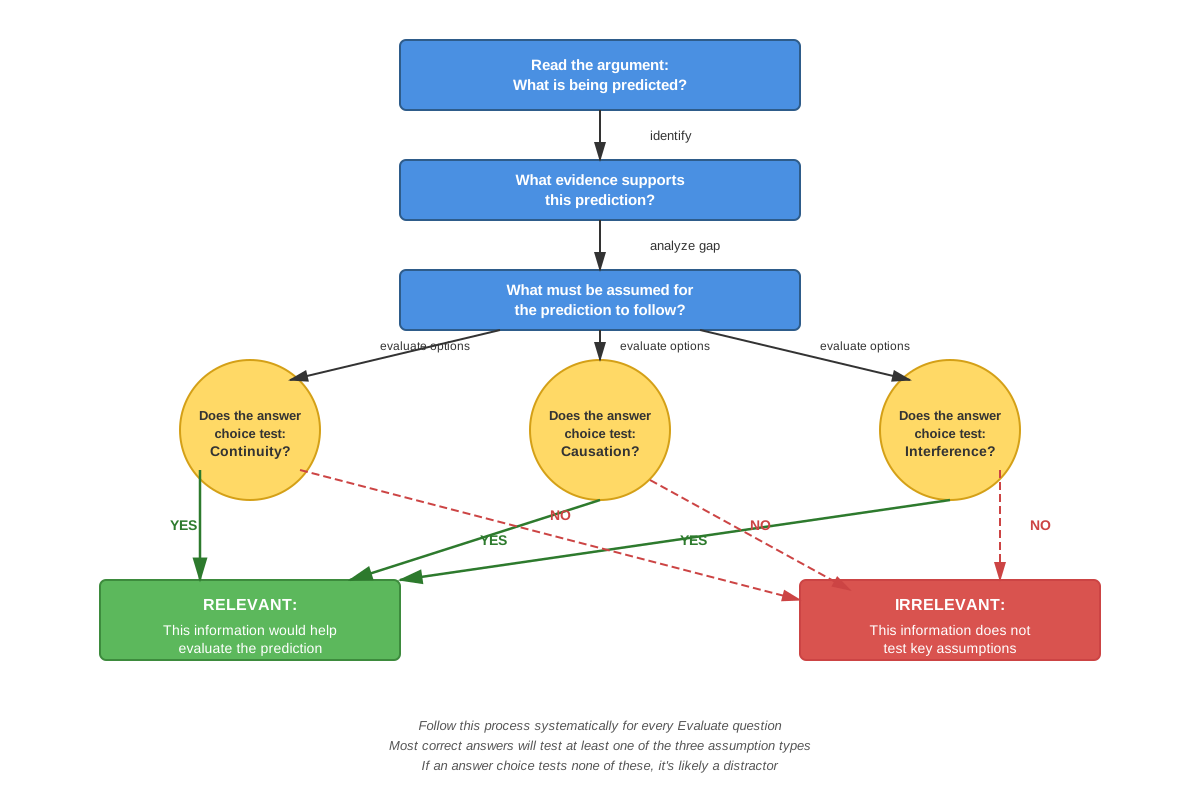
When approaching lsat evaluating predictions questions, follow this systematic process:
Step 1: Identify the prediction clearly. Look for future-tense language ("will," "is likely to," "should," "is expected to") and mark the specific claim about what will happen. Distinguish the prediction from the evidence supporting it.
Step 2: Identify the evidence base. What current facts, past trends, or existing data support the prediction? Understanding what the prediction rests on reveals what assumptions bridge evidence to forecast.
Step 3: Articulate the key assumptions. Ask yourself: "What must be true for this evidence to support this prediction?" Common assumptions include continuity (conditions won't change), causation (the relationship is causal, not merely correlational), and representativeness (the evidence applies to the predicted situation).
Step 4: Predict what information would test those assumptions. Before looking at answer choices, formulate your own answer: "It would be useful to know whether [key assumption] holds."
Step 5: Eliminate answers that are:
- Already addressed in the stimulus
- Irrelevant to the prediction's core assumptions
- Only tangentially related to the prediction
- About implementation feasibility rather than prediction accuracy
- Too narrow or specific when a broader assumption is at stake
Exam Tip: In Evaluate questions, the correct answer should matter regardless of what the answer turns out to be. Test each choice by asking: "If the answer were YES, would that affect the prediction? If the answer were NO, would that affect the prediction?" If only one direction matters, it's probably wrong.
Trigger words and phrases that signal prediction evaluation questions:
- "most useful to know in evaluating"
- "most helpful in assessing the prediction"
- "most important to determine"
- "answer to which question would most help"
- "most relevant to evaluating whether"
Time allocation: Spend 1:15-1:30 on these questions. They require careful analysis of assumptions but shouldn't consume excessive time. If you're stuck between two answers, choose the one that tests a more fundamental assumption (usually about whether the evidence is relevant/representative) rather than one that identifies a potential interfering factor.
Memory Techniques
PACE - Remember the four types of assumptions underlying predictions:
- Persistence (continuity assumptions - conditions will remain stable)
- Applicability (representativeness - evidence applies to the predicted situation)
- Causation (causal assumptions - the relationship is causal, not correlational)
- Exclusion (no interference - no new factors will disrupt the outcome)
The "Bridge Question" technique: Visualize the prediction as a bridge from evidence (one shore) to forecast (opposite shore). The assumptions are the bridge supports. Ask: "What could make this bridge collapse?" The answer identifies what to evaluate.
The "Time Traveler" test: Imagine you could travel to the future to check one fact before the prediction comes true. What single piece of information would most help you determine if the prediction will be accurate? This often leads you to the correct answer.
REPS - For evaluating prediction strength, remember:
- Representative evidence
- Established causal mechanism
- Proximate time horizon (near-term, not distant)
- Specific scope (limited, not overgeneralized)
Summary
Evaluating predictions on the LSAT requires identifying what additional information would most help determine whether a forecast will prove accurate. Predictions are conclusions about future events based on current or past evidence, and they always rest on assumptions about continuity, causation, representativeness, or the absence of interference. The key to mastering this topic is recognizing that the strength of a prediction depends not on whether the evidence is true, but on whether the assumptions connecting evidence to forecast are reasonable. In Evaluate questions, the correct answer identifies information that directly tests a core assumption and could significantly strengthen or weaken the prediction depending on what that information reveals. Students must distinguish between factors that affect prediction accuracy versus implementation feasibility, and between fundamental assumptions versus tangential considerations. Success requires systematic analysis: identify the prediction, understand the evidence, articulate the assumptions, and select information that tests those assumptions most directly.
Key Takeaways
- Every prediction on the LSAT depends on unstated assumptions that bridge current/past evidence to future forecasts
- The correct answer in Evaluate questions tests a core assumption and matters regardless of what the answer turns out to be
- Continuity assumptions (that conditions will remain stable) are the most frequently tested vulnerability in prediction arguments
- Information already stated or clearly implied in the stimulus cannot be the correct answer
- Distinguish between factors affecting whether the prediction is accurate versus whether it can be implemented
- Representativeness of evidence to the predicted situation is often the most fundamental assumption to test
- Longer time horizons and more complex causal chains create weaker predictions with more vulnerabilities
- Focus on assumptions about whether the evidence is relevant, not on identifying every possible interfering factor
Related Topics
Causal Reasoning: Evaluating predictions builds directly on causal reasoning skills, as most predictions assume causal relationships will persist. Mastering prediction evaluation enhances the ability to assess causal claims more generally.
Strengthen and Weaken Questions: The skills developed in evaluating predictions transfer directly to identifying evidence that strengthens or weakens arguments, particularly those involving future-oriented claims.
Assumption Questions: Prediction evaluation requires identifying unstated assumptions, making it excellent preparation for Necessary Assumption and Sufficient Assumption questions.
Flaw Questions: Understanding common vulnerabilities in predictions helps identify flawed reasoning when arguments make unjustified predictive leaps.
Parallel Reasoning: Recognizing the structure of predictive arguments enables students to identify parallel argument structures more efficiently.
Practice CTA
Now that you understand the core concepts and strategies for evaluating predictions, it's time to apply this knowledge to actual LSAT questions. Work through the practice questions systematically, using the PACE framework to identify assumptions and the step-by-step strategy outlined above. Pay special attention to questions where you're torn between two answers—these reveal the subtle distinctions that separate good from great LSAT performance. Remember that mastery comes through deliberate practice: analyze not just why the correct answer is right, but why each wrong answer fails to test the most fundamental assumption. The flashcards will help reinforce the key concepts and assumption patterns you'll encounter repeatedly on test day. You've built the foundation—now strengthen it through focused practice!
Sign up free to keep reading
Create a free AnvayaPrep account to finish this LSAT guide on Evaluating predictions — plus flashcards and practice questions.