Overview
Inference completion questions represent one of the most frequently tested question types in LSAT Logical Reasoning sections, appearing in approximately 15-20% of all Logical Reasoning questions. These questions present an incomplete argument or set of statements and ask test-takers to identify which answer choice most logically completes the passage. Unlike assumption questions that ask what must be true for an argument to work, or strengthen/weaken questions that evaluate argument quality, inference completion questions require identifying what conclusion or statement follows most naturally from the given premises.
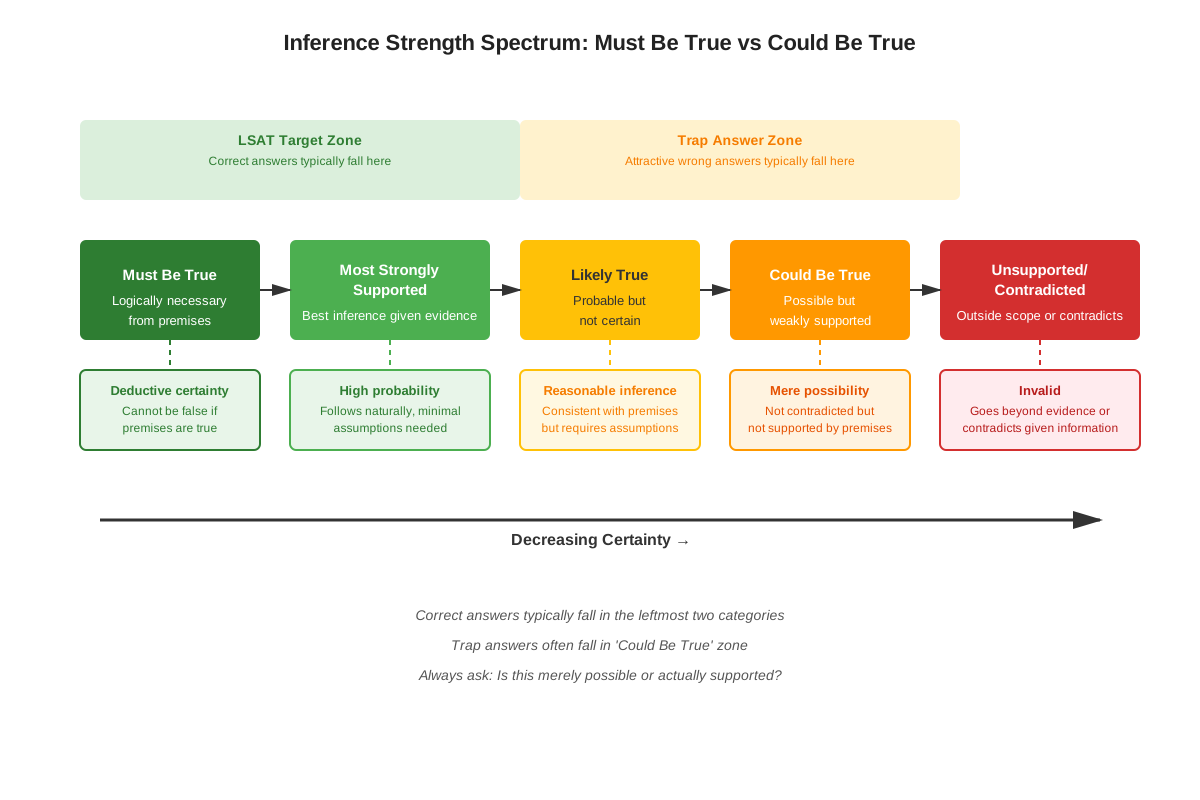
The fundamental challenge of lsat inference completion lies in distinguishing between what could be true versus what must be true or is most strongly supported by the evidence. Test-takers must engage in careful logical reasoning to trace the logical pathway from premises to conclusion, avoiding the temptation to bring in outside knowledge or make unwarranted logical leaps. These questions test the ability to recognize valid logical patterns, understand the scope and limitations of given information, and select conclusions that stay within the boundaries established by the premises.
Within the broader framework of evaluate and complete the argument questions, inference completion occupies a unique position. While evaluation questions ask test-takers to assess what information would help determine an argument's validity, completion questions require constructing the logical endpoint of a reasoning chain. Mastering inference completion builds essential skills for all Logical Reasoning question types, including strengthening arguments, identifying assumptions, and recognizing flaws. The ability to trace logical implications and recognize what follows from given information forms the foundation of analytical reasoning tested throughout the LSAT.
Learning Objectives
- [ ] Identify how Inference completion appears in LSAT questions
- [ ] Explain the reasoning pattern behind Inference completion
- [ ] Apply Inference completion to solve LSAT-style problems accurately
- [ ] Distinguish between strongly supported inferences and mere possibilities
- [ ] Recognize common logical patterns that signal correct inference completions
- [ ] Evaluate answer choices for scope, strength, and logical validity
- [ ] Identify and avoid common trap answers in inference completion questions
Prerequisites
- Basic formal logic concepts: Understanding conditional statements, necessary and sufficient conditions, and logical connectors is essential for tracing inference patterns.
- Argument structure recognition: The ability to identify premises, conclusions, and evidence helps determine what logically follows from given information.
- Reading comprehension skills: Accurate interpretation of complex passages ensures correct identification of what the premises actually state versus what they imply.
- Scope awareness: Understanding the boundaries of claims prevents overreaching beyond what the evidence supports.
Why This Topic Matters
Inference completion questions test a fundamental skill required not only for LSAT success but for legal reasoning itself: the ability to determine what logically follows from established facts. Attorneys must constantly draw valid conclusions from evidence, statutes, and precedents without overstepping the bounds of what the information actually supports. This same skill applies to judicial decision-making, contract interpretation, and legal argumentation.
On the LSAT, inference completion questions typically appear 3-5 times per Logical Reasoning section, making them one of the highest-yield question types to master. They commonly appear with question stems such as "Which one of the following most logically completes the argument?" or "The statements above, if true, most strongly support which one of the following?" These questions can appear in various contexts, from scientific reasoning to social policy debates to everyday scenarios.
The strategic importance of mastering inference completion extends beyond these specific questions. The analytical skills developed—recognizing valid logical patterns, staying within appropriate scope, and distinguishing strong from weak support—transfer directly to assumption questions, must-be-true questions, and even Reading Comprehension inference questions. Students who excel at inference completion typically see score improvements across multiple question types because they've developed the core logical reasoning skills that underpin the entire exam.
Core Concepts
The Nature of Logical Inference
A logical inference is a conclusion that follows from given premises with a degree of support ranging from absolute necessity to strong probability. In LSAT inference completion questions, the correct answer must be the statement most strongly supported by the premises, even if not absolutely required. This differs from formal deductive logic, where conclusions must follow with certainty. The LSAT tests "everyday" reasoning where conclusions can be well-supported without being logically inevitable.
The key principle governing inference completion is the support relationship: the premises must provide genuine evidential support for the conclusion, not merely be consistent with it. Many trap answers are possible given the premises but receive no actual support from them. For example, if premises state "All lawyers in the firm work long hours, and Sarah is a lawyer in the firm," the inference "Sarah works long hours" is strongly supported. However, "Sarah enjoys her work" might be possible but receives no support from the given information.
Scope Matching in Inference Completion
Scope refers to the breadth and specificity of a claim. Correct inference completions must match the scope established by the premises. This involves three dimensions:
- Quantitative scope: If premises discuss "some" members of a group, the conclusion cannot validly claim "all" or "most" without additional support
- Subject matter scope: The conclusion must address the same topics and entities discussed in the premises
- Strength scope: The degree of certainty in the conclusion must not exceed what the premises warrant
| Premise Scope | Valid Inference Scope | Invalid Inference Scope |
|---|---|---|
| "Some students study daily" | "At least one student studies daily" | "Most students study daily" |
| "The policy reduced costs by 15%" | "The policy had a cost-reducing effect" | "The policy was highly successful" |
| "No evidence supports the theory" | "The theory lacks evidential support" | "The theory is false" |
Common Logical Patterns in Inference Completion
Several recurring logical structures appear frequently in LSAT inference completion questions:
Conditional Chain Completion: When premises establish a series of conditional relationships (if A then B, if B then C), the inference often completes the chain (therefore, if A then C). Test-takers must carefully track the direction of conditional statements and avoid the fallacy of affirming the consequent or denying the antecedent.
Contrast and Comparison: When premises establish differences or similarities between two entities, the inference often draws a conclusion about one based on information about the other. These questions test the ability to recognize when comparisons support inferences and when they don't.
Causal Reasoning: Premises may establish correlations, temporal sequences, or mechanisms that suggest causal relationships. Valid inferences respect the difference between correlation and causation, avoiding unwarranted causal claims while recognizing when causal conclusions are supported.
Quantitative Reasoning: Premises involving numbers, percentages, or proportions often lead to inferences about relationships between quantities. These questions test mathematical reasoning and the ability to avoid common errors like confusing absolute numbers with percentages or rates with totals.
The Process of Elimination in Inference Completion
Effective inference completion requires systematic evaluation of answer choices against specific criteria:
- Evidence test: Does the passage provide actual evidence for this claim, or is it merely consistent with the passage?
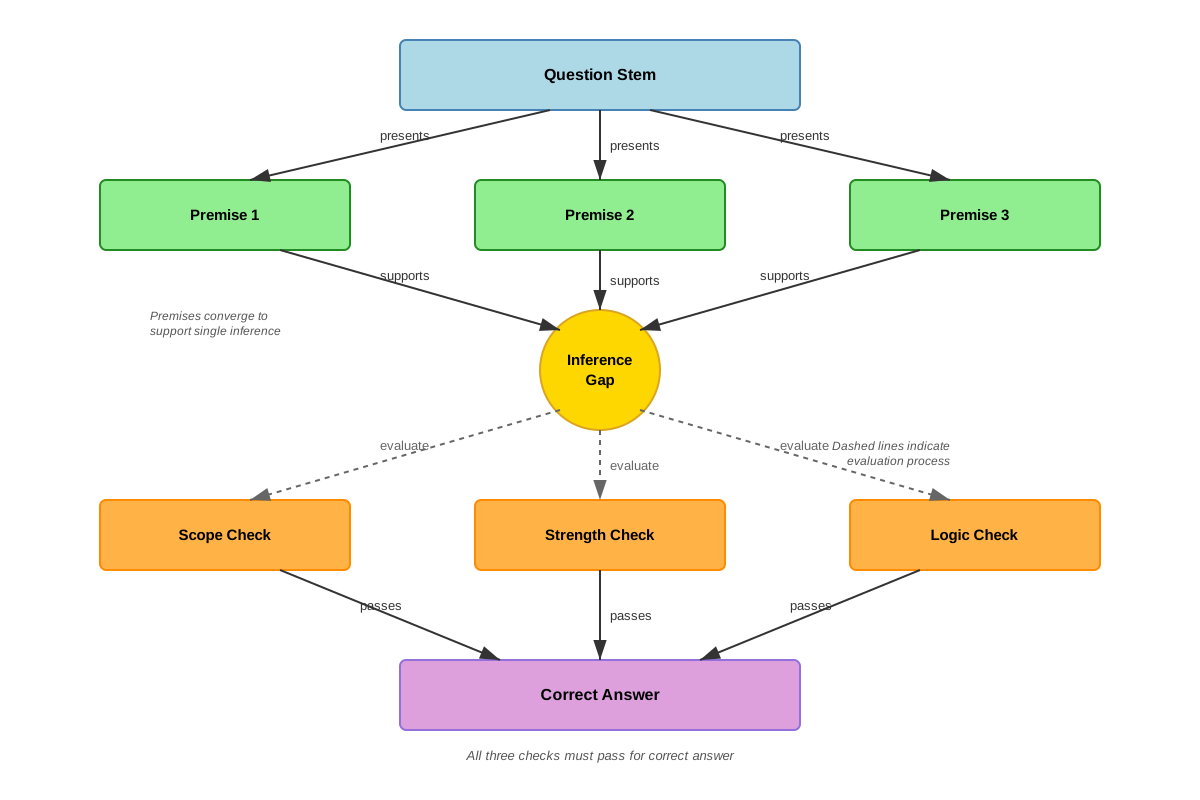
- Scope test: Does the answer choice stay within the quantitative, subject matter, and strength boundaries established by the premises?
- Assumption test: Does the answer choice require additional assumptions beyond what the premises provide?
- Extreme language test: Does the answer use absolute terms (always, never, only, all) that go beyond what the premises support?
The correct answer will pass all four tests, while trap answers typically fail one or more. Recognizing which test an answer choice fails helps eliminate options efficiently.
Distinguishing Must-Be-True from Most-Strongly-Supported
LSAT inference completion questions use varying language in their question stems, and understanding these distinctions is crucial:
Must-be-true questions require answers that follow with logical necessity from the premises. If the premises are true, the correct answer cannot be false. These questions demand the strictest logical standards.
Most-strongly-supported questions allow for answers that are highly probable or well-evidenced by the premises without being absolutely required. The correct answer has more support than any alternative, even if it's not logically necessary.
Most-logically-completes questions ask for the answer that best fits the logical flow and purpose of the argument. These questions consider not just logical support but also rhetorical coherence and argumentative structure.
Understanding which standard applies helps calibrate how strictly to evaluate answer choices and what degree of certainty to require.
Concept Relationships
The concepts within inference completion form an interconnected logical framework. Scope matching serves as the foundation for all other concepts—without proper scope awareness, test-takers cannot accurately assess whether an inference is valid. This foundational concept connects directly to the support relationship, as scope violations typically indicate insufficient support.
The relationship flows as follows: Understanding the nature of logical inference → enables recognition of common logical patterns → which facilitates the process of elimination → leading to accurate distinction between must-be-true and most-strongly-supported standards.
These inference completion concepts connect to prerequisite knowledge of argument structure by building on the ability to identify premises and conclusions. They extend to related topics like assumption questions (which ask what's needed to complete an argument) and strengthen/weaken questions (which ask what would affect an argument's validity). The logical reasoning skills developed through inference completion also transfer to Reading Comprehension inference questions and Analytical Reasoning (Logic Games) deductions.
The progression can be mapped as: Basic Logic → Argument Structure → Inference Completion → Assumption Identification → Argument Evaluation. Each stage builds on the previous, with inference completion occupying the crucial middle position that bridges understanding arguments to evaluating them.
High-Yield Facts
⭐ Inference completion questions appear 3-5 times per Logical Reasoning section, making them among the highest-frequency question types.
⭐ The correct answer must be supported by the premises, not merely consistent with them—many trap answers are possible but unsupported.
⭐ Scope violations are the most common reason an answer choice is incorrect—watch for quantitative, subject matter, and strength mismatches.
⭐ Extreme language (all, none, only, always, never) in answer choices often signals incorrect answers unless the premises explicitly support such absolute claims.
⭐ The correct answer typically stays very close to what the premises explicitly state, avoiding logical leaps or additional assumptions.
- Conditional reasoning patterns (if-then chains) appear frequently in inference completion questions and require careful tracking of logical direction.
- Causal language in premises (causes, leads to, results in) often signals that the inference will involve causal relationships, but correlation alone doesn't support causal inferences.
- When premises provide information about percentages or proportions, be cautious about inferences involving absolute numbers, and vice versa.
- Contrast words (however, but, although, despite) in premises often signal that the inference will involve recognizing differences or limitations.
- The correct answer in "most logically completes" questions often serves a specific argumentative function, such as providing a conclusion, explaining a phenomenon, or resolving an apparent contradiction.
Quick check — test yourself on Inference completion so far.
Try Flashcards →Common Misconceptions
Misconception: If an answer choice could be true given the premises, it's a valid inference. → Correction: Possibility is insufficient; the premises must provide actual evidential support for the inference. Many trap answers are consistent with the premises but receive no support from them.
Misconception: The correct answer must restate information explicitly mentioned in the premises. → Correction: Valid inferences often go beyond what's explicitly stated, drawing conclusions that follow logically from the premises without merely repeating them. The key is that the logical step must be supported, not that it must be obvious.
Misconception: Longer, more detailed answer choices are more likely to be correct because they're more specific. → Correction: Length and detail often indicate scope violations or additional unsupported claims. Correct answers are often more concise and stay closer to what the premises actually support.
Misconception: If most of an answer choice is supported by the premises, it's correct even if one part isn't fully supported. → Correction: Every component of the correct answer must be supported by the premises. An answer that's 80% supported and 20% unsupported is incorrect—the unsupported portion makes it wrong.
Misconception: Background knowledge about the topic should inform answer selection. → Correction: Only information provided in the passage can support the inference. Real-world knowledge, even if accurate, is irrelevant unless it appears in the premises. The LSAT tests logical reasoning, not subject matter expertise.
Misconception: "Most strongly supported" means the answer needs only weak support as long as it has more than other options. → Correction: While "most strongly supported" allows for degrees of support, the correct answer still needs substantial, clear support from the premises. It's not merely about being slightly better than alternatives but about having genuine evidential backing.
Worked Examples
Example 1: Conditional Chain Completion
Passage: "All members of the debate team have strong public speaking skills. Everyone with strong public speaking skills has overcome a fear of audiences. Therefore, ___________."
Analysis Process:
Step 1: Identify the logical structure. This presents a conditional chain:
- If debate team member → then strong public speaking skills
- If strong public speaking skills → then overcome fear of audiences
Step 2: Determine what logically follows. Conditional chains allow us to connect the first condition to the final consequence:
- If debate team member → then overcome fear of audiences
Step 3: Evaluate answer choices against this logical structure:
- (A) "all debate team members have overcome a fear of audiences" ✓ This directly completes the conditional chain with proper scope
- (B) "most people who have overcome a fear of audiences are on the debate team" ✗ This reverses the logical direction (affirming the consequent fallacy)
- (C) "some debate team members still fear audiences" ✗ This contradicts the logical chain
- (D) "strong public speaking skills are necessary for debate team membership" ✗ This reverses the conditional relationship
- (E) "overcoming fear of audiences guarantees debate team membership" ✗ This reverses the logical direction
Correct Answer: (A)
Connection to Learning Objectives: This example demonstrates identifying inference completion patterns (conditional chains), explaining the reasoning pattern (transitive property of conditionals), and applying the pattern to solve the problem accurately.
Example 2: Scope-Matching with Quantitative Reasoning
Passage: "A recent survey found that 60% of the company's employees who work remotely report higher job satisfaction than they did when working in the office. Only 30% of employees work remotely. The company is considering expanding remote work options. Therefore, ___________."
Analysis Process:
Step 1: Identify the quantitative information and its scope:
- 60% of remote workers (not 60% of all employees) report higher satisfaction
- Remote workers represent 30% of total employees
- This means approximately 18% of all employees (60% of 30%) are satisfied remote workers
Step 2: Identify scope limitations:
- We know nothing about the satisfaction of the 70% who work in the office
- We don't know if remote work caused higher satisfaction or if already-satisfied people chose remote work
- We don't know how the remaining 40% of remote workers feel
Step 3: Evaluate answer choices for scope matching:
- (A) "expanding remote work will increase overall company job satisfaction" ✗ Causal claim unsupported; we don't know if remote work causes satisfaction
- (B) "most employees would be more satisfied working remotely" ✗ "Most" (>50%) is unsupported; we only know about current remote workers
- (C) "some employees who currently work remotely report higher job satisfaction than they previously did" ✓ This stays within the scope—"some" is supported by the 60% figure
- (D) "employees who work in the office are less satisfied than remote workers" ✗ No information provided about office workers' satisfaction levels
- (E) "the majority of employees prefer remote work" ✗ Preference is different from satisfaction, and "majority" is unsupported
Correct Answer: (C)
Connection to Learning Objectives: This example illustrates distinguishing between strongly supported inferences and mere possibilities, evaluating answer choices for scope and logical validity, and identifying common trap answers (causal claims, quantitative overreach).
Exam Strategy
Approaching Inference Completion Questions
When encountering an inference completion question, follow this systematic approach:
- Read the question stem first to identify whether it's asking for what "must be true," what's "most strongly supported," or what "most logically completes" the argument. This determines how strictly to evaluate answer choices.
- Read the passage carefully, noting quantitative terms (all, some, most, few), conditional indicators (if, then, only if), and contrast words (but, however, although). These signal the logical structure.
- Predict the inference before looking at answer choices when possible. Ask: "What must follow from these premises?" or "What would logically complete this thought?" Having a prediction helps resist attractive trap answers.
- Evaluate each answer choice systematically using the four tests: evidence, scope, assumptions, and extreme language.
Trigger Words and Phrases
Question Stem Triggers:
- "Which one of the following most logically completes the argument?"
- "If the statements above are true, which one of the following must also be true?"
- "The statements above most strongly support which one of the following?"
- "Which one of the following can be properly inferred from the passage?"
Passage Triggers for Logical Patterns:
- Conditional indicators: "if," "only if," "when," "whenever," "all," "any"
- Causal language: "causes," "leads to," "results in," "because," "due to"
- Contrast markers: "however," "but," "although," "despite," "while"
- Quantitative terms: "most," "some," "few," "many," "percentage," "proportion"
Process-of-Elimination Tips
Eliminate answers that:
- Use extreme language unsupported by the premises (all, none, only, never, always)
- Introduce new topics or concepts not mentioned in the premises
- Reverse conditional relationships or commit other logical fallacies
- Require additional assumptions beyond what the premises provide
- Exceed the quantitative scope (claiming "most" when premises support only "some")
Keep answers that:
- Stay close to the language and concepts in the premises
- Match the scope and strength of the premises
- Follow logically from the given information without additional assumptions
- Use qualified language that reflects appropriate uncertainty
Time Allocation Advice
Inference completion questions typically require 60-90 seconds each. Allocate time as follows:
- 15-20 seconds: Read and understand the passage
- 10-15 seconds: Predict or anticipate the inference
- 30-45 seconds: Evaluate answer choices systematically
- 5-10 seconds: Confirm the selected answer
If stuck between two answers, return to the passage and check which answer has more direct textual support. Avoid spending more than 2 minutes on any single question—mark it and return if time permits.
Memory Techniques
SCOPE Acronym for Evaluating Answer Choices:
- Support: Does the passage provide actual evidence?
- Consistency: Does it align with all premises?
- Overreach: Does it claim more than premises warrant?
- Precision: Does it match the specificity of premises?
- Extreme: Does it use absolute language unsupported by premises?
The "Stay Close" Visualization: Picture the premises as a home base and answer choices as paths leading away from it. The correct answer stays on the path closest to home, while trap answers venture too far into unsupported territory. Visualize yourself checking how far each answer strays from the textual support.
Conditional Chain Mnemonic: "First to Last, Skip the Middle" - In conditional chains, you can connect the first condition directly to the last consequence, skipping intermediate steps. If A→B and B→C, then A→C.
The Support vs. Consistency Test: Remember "SUPPORT needs EVIDENCE, CONSISTENCY needs only POSSIBILITY." Many trap answers are merely consistent (possible) but lack evidential support. Always ask: "Does the passage give me a reason to believe this, or is it just not contradicted?"
Summary
Inference completion questions test the fundamental logical reasoning skill of determining what follows from given premises. Success requires understanding that correct answers must be supported by—not merely consistent with—the premises, and that scope matching across quantitative, subject matter, and strength dimensions is essential. The most common errors involve selecting answers that are possible but unsupported, that use extreme language beyond what premises warrant, or that introduce new concepts not grounded in the passage. Effective approach involves systematic evaluation using the evidence, scope, assumptions, and extreme language tests, while recognizing common logical patterns like conditional chains, causal reasoning, and quantitative relationships. The key distinction between must-be-true and most-strongly-supported questions affects how strictly to evaluate answer choices, but both require genuine evidential backing from the premises. Mastering inference completion builds foundational skills that transfer to all Logical Reasoning question types and significantly impacts overall LSAT performance.
Key Takeaways
- Inference completion questions appear 3-5 times per Logical Reasoning section and test the ability to identify what logically follows from premises
- The correct answer must be supported by evidence in the premises, not merely consistent or possible
- Scope violations—especially quantitative overreach and extreme language—are the most common reason answer choices are incorrect
- Systematic evaluation using the SCOPE framework (Support, Consistency, Overreach, Precision, Extreme) helps eliminate trap answers efficiently
- Common logical patterns include conditional chains, causal reasoning, contrast structures, and quantitative relationships
- Staying close to the language and concepts in the premises, avoiding additional assumptions, and matching the strength of claims to the evidence provided are keys to success
- The skills developed through inference completion—recognizing valid logical patterns and distinguishing strong from weak support—transfer directly to other Logical Reasoning question types
Related Topics
Assumption Questions: Building on inference completion, assumption questions ask what unstated premise is necessary for an argument to work. Mastering inference completion provides the foundation for identifying logical gaps that assumptions fill.
Must-Be-True Questions: These questions are essentially inference completion questions with stricter logical standards, requiring answers that follow with necessity rather than strong support. The same analytical skills apply with heightened precision.
Strengthen and Weaken Questions: Understanding what inferences follow from premises helps identify what additional information would make an argument stronger or weaker. The scope-matching skills from inference completion directly apply to evaluating strengthening and weakening evidence.
Parallel Reasoning Questions: Recognizing logical patterns in inference completion—conditional chains, causal structures, quantitative relationships—prepares students to identify parallel logical structures in different contexts.
Reading Comprehension Inference Questions: The same principles of staying within textual support, matching scope, and distinguishing strong from weak support apply to inference questions in the Reading Comprehension section.
Practice CTA
Now that you've mastered the core concepts of inference completion, it's time to put your knowledge into practice. Attempt the practice questions to reinforce your understanding of logical patterns, scope matching, and systematic answer evaluation. Use the flashcards to memorize high-yield facts and common trap patterns. Remember: inference completion is a skill that improves dramatically with deliberate practice. Each question you work through strengthens your ability to recognize valid logical patterns and avoid common pitfalls. Your investment in mastering this high-frequency question type will pay dividends across your entire LSAT performance. Start practicing now to build the confidence and automaticity that leads to test-day success!
Sign up free to keep reading
Create a free AnvayaPrep account to finish this LSAT guide on Inference completion — plus flashcards and practice questions.