Overview
Transition in completion questions represent a sophisticated question type within LSAT Logical Reasoning that tests a student's ability to recognize logical flow and complete an argument with the most appropriate concluding statement. These questions present an incomplete argument and ask test-takers to identify which answer choice best completes the reasoning pattern established in the stimulus. Unlike assumption questions that ask what must be true for an argument to work, or strengthen/weaken questions that modify argument strength, completion questions require identifying the logical endpoint that naturally follows from the premises provided.
Understanding transition in completion questions is essential for LSAT success because they assess multiple reasoning skills simultaneously: recognizing argument structure, identifying logical relationships between premises, predicting conclusions based on established patterns, and evaluating which completion maintains logical consistency. These questions typically appear 2-4 times per Logical Reasoning section, making them a high-yield topic that can significantly impact overall scores. The ability to complete arguments demonstrates mastery of logical flow—a fundamental skill tested throughout the LSAT.
Within the broader Evaluate and Complete the Argument unit, transition in completion questions occupy a unique position. They bridge the gap between understanding argument structure (a foundational skill) and evaluating argument quality (an advanced skill). Mastering these questions strengthens performance on other question types because the same skills—tracking logical progression, identifying conclusion indicators, and maintaining argumentative consistency—apply across Logical Reasoning sections. The "transition" aspect specifically refers to how the argument moves from premises to conclusion, requiring students to identify the appropriate logical bridge that completes the reasoning chain.
Learning Objectives
- [ ] Identify how Transition in completion questions appears in LSAT questions
- [ ] Explain the reasoning pattern behind Transition in completion questions
- [ ] Apply Transition in completion questions to solve LSAT-style problems accurately
- [ ] Distinguish transition in completion questions from other argument completion question types
- [ ] Predict the logical direction of incomplete arguments before reviewing answer choices
- [ ] Evaluate answer choices for logical consistency with established premises and argument structure
Prerequisites
- Basic argument structure: Understanding premises, conclusions, and how they relate is essential because completion questions require identifying what logically follows from given premises
- Conclusion indicators: Recognizing words like "therefore," "thus," "consequently," and "so" helps identify where the completion fits within the argument structure
- Premise indicators: Familiarity with "because," "since," "given that," and similar terms enables proper tracking of the argument's foundation
- Logical connectors: Understanding how ideas link together (causation, correlation, contrast) is necessary for predicting appropriate completions
- Argument patterns: Basic familiarity with common reasoning structures (conditional, causal, analogical) provides the framework for recognizing which completion fits
Why This Topic Matters
Transition in completion questions matter because they test the fundamental ability to think logically—a skill that extends far beyond standardized testing into legal reasoning, professional communication, and critical thinking in daily life. In legal practice, attorneys must constantly complete arguments by drawing appropriate conclusions from established facts and precedents. The ability to recognize what logically follows from given information is central to legal analysis, making this question type particularly relevant to law school preparation.
On the LSAT, completion questions appear with notable frequency, typically comprising 8-12% of all Logical Reasoning questions across both sections. This translates to approximately 4-6 questions per test—enough to significantly impact scores, especially considering that these questions often appear at medium to medium-high difficulty levels where they effectively differentiate between score ranges. Test-makers favor these questions because they efficiently assess multiple competencies: structural analysis, logical prediction, and evaluative judgment.
These questions commonly appear in several formats within LSAT passages. The most frequent presentation includes an argument with the final sentence incomplete, followed by answer choices that provide different potential endings. Another common format presents multiple premises followed by a conclusion indicator (like "therefore") with the actual conclusion missing. Some variations include arguments where the completion appears mid-argument rather than at the end, testing whether students can track logical flow regardless of position. The questions typically use stem language such as "Which one of the following most logically completes the argument?" or "The conclusion of the argument is most strongly supported if which one of the following completes the passage?"
Core Concepts
Understanding Transition in Completion Questions
Transition in completion questions specifically test the ability to identify how an argument moves from its premises to its conclusion through logical progression. The term "transition" emphasizes that these questions focus on the movement or flow of reasoning—how one idea leads to another. Unlike simple fill-in-the-blank exercises, these questions require understanding the logical relationship between what has been stated and what must follow.
The fundamental structure involves an argument with established premises that create a logical trajectory pointing toward a specific type of conclusion. The test-taker must identify which completion maintains the argument's logical integrity, matches its scope, and follows naturally from the reasoning pattern established. This requires recognizing not just what could possibly follow, but what must follow given the specific logical structure presented.
The Anatomy of Completion Questions
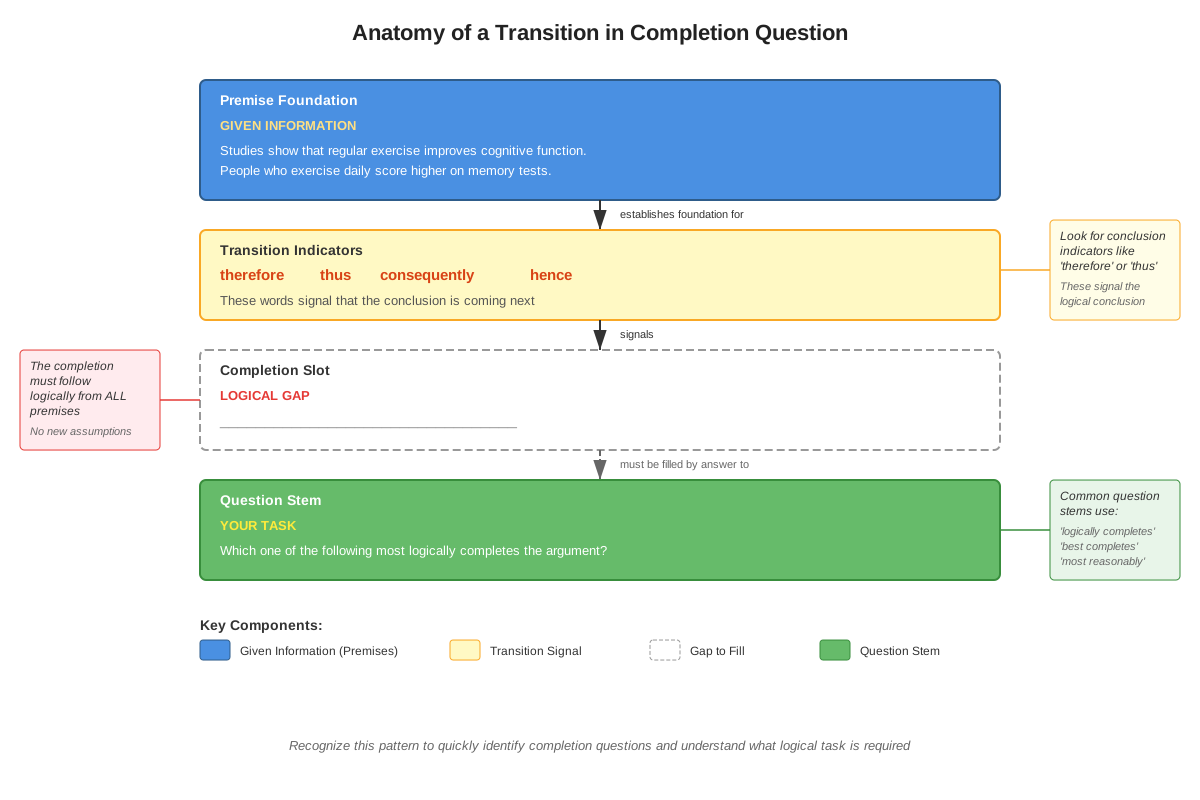
Every transition in completion question contains three essential components:
- The Setup Premises: These establish facts, claims, or scenarios that form the argument's foundation
- The Logical Trajectory: The reasoning pattern or direction established by how premises relate to each other
- The Completion Point: The location where the argument requires finishing, marked by the blank or incomplete statement
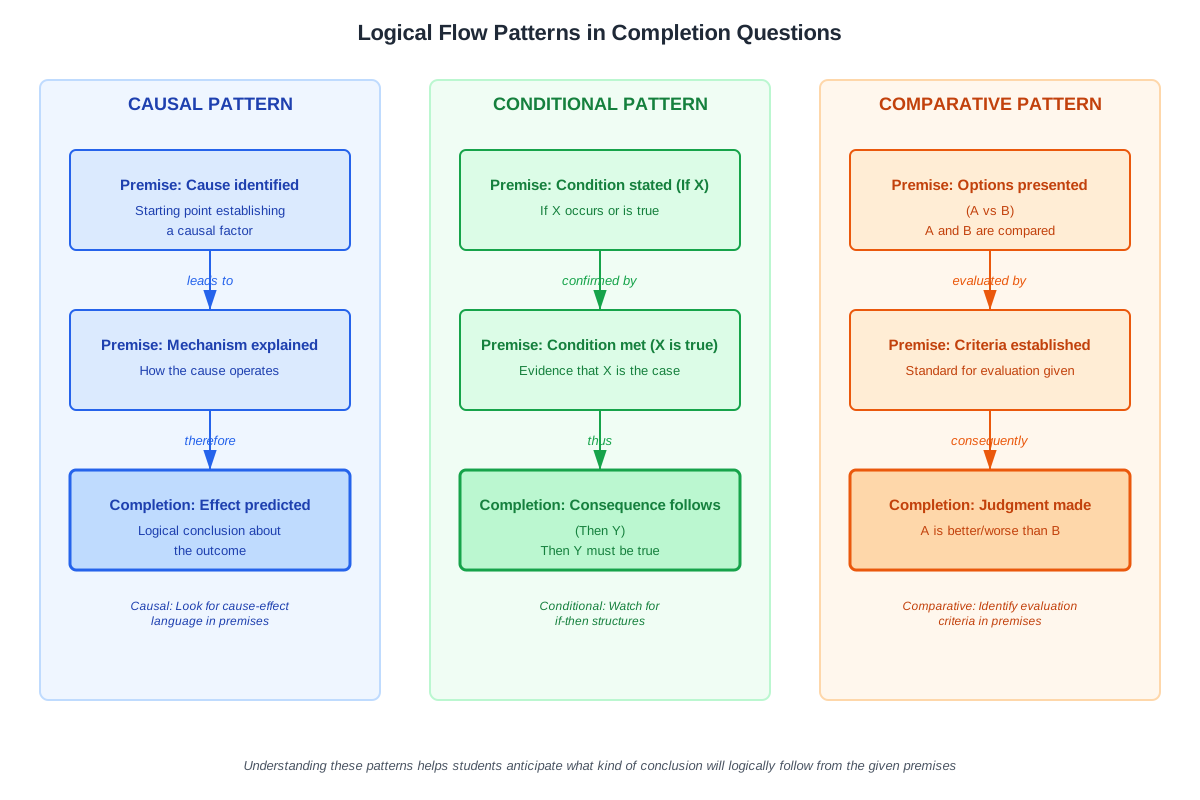
Understanding these components helps systematically approach each question. The setup premises provide the raw material—the information that must be worked with. The logical trajectory indicates the direction the argument is heading, which can be causal (X causes Y), conditional (if X then Y), comparative (X is better than Y), or follow other patterns. The completion point shows where the logical chain needs its final link.
Recognizing Logical Patterns
Successful completion requires recognizing the underlying logical pattern. Common patterns include:
Causal Reasoning: When premises establish a cause-and-effect relationship, the completion typically extends this causal chain or draws a conclusion about effects. For example, if premises state "Increased rainfall leads to more vegetation" and "More vegetation supports larger animal populations," the completion should logically conclude something about animal populations in relation to rainfall.
Conditional Reasoning: When premises establish if-then relationships, the completion must respect these conditional structures. If premises state "All lawyers must pass the bar exam" and "Sarah is a lawyer," the completion must acknowledge that Sarah passed the bar exam.
Comparative Reasoning: When premises compare two or more things, the completion should draw an appropriate comparative conclusion. If premises establish that Option A is superior to Option B in every measured dimension, the completion should reflect A's overall superiority.
Evidence-to-Conclusion: When premises present evidence or data, the completion should state the conclusion this evidence supports, maintaining appropriate scope and strength.
Scope Matching
One of the most critical skills in completion questions is scope matching—ensuring the completion matches the breadth and specificity of the premises. If premises discuss "some politicians," the completion cannot suddenly reference "all politicians." If premises address a specific time period, the completion must maintain that temporal scope.
| Premise Scope | Appropriate Completion Scope | Inappropriate Completion Scope |
|---|---|---|
| Some X are Y | Some X are Y / At least one X is Y | All X are Y / No X are Y |
| Most X are Y | Probably, a given X is Y | Definitely, any X is Y |
| X in 2020 | X in 2020 / X during that period | X always / X in general |
| X causes Y in condition Z | When Z occurs, X causes Y | X always causes Y |
Tone and Strength Consistency
The completion must match the argument's tone (tentative vs. definitive) and strength (qualified vs. absolute). If premises use hedging language like "suggests," "may," or "could," the completion should maintain this tentative tone. If premises make strong, unqualified claims, the completion can be correspondingly strong—but only if the logic supports it.
Transition Words as Signals
Completion questions often include transition words immediately before the blank, providing crucial clues about the logical relationship:
- "Therefore," "Thus," "Hence," "Consequently": Signal that the completion is the main conclusion drawn from preceding premises
- "However," "But," "Yet," "Nevertheless": Indicate the completion will contrast with or qualify what came before
- "Moreover," "Furthermore," "Additionally": Suggest the completion will add supporting information in the same direction
- "For example," "For instance": Indicate the completion will provide a specific illustration of a general point
Pre-Phrasing Strategy
Before examining answer choices, effective test-takers pre-phrase—mentally predict what type of completion the argument requires. This involves:
- Identifying the argument's logical structure
- Recognizing the pattern (causal, conditional, comparative, etc.)
- Determining what scope and strength the completion must have
- Predicting the general content or direction of the completion
Pre-phrasing prevents being swayed by attractive but incorrect answer choices and makes the correct answer more recognizable when encountered.
Concept Relationships
The concepts within transition in completion questions form an interconnected system where each element supports and depends on others. Recognizing logical patterns serves as the foundation that enables scope matching and tone consistency—you cannot match scope appropriately without first understanding what logical pattern the argument follows. The anatomy of completion questions (setup, trajectory, completion point) provides the framework within which all other concepts operate.
Pre-phrasing strategy represents the practical application of understanding logical patterns, scope matching, and tone consistency. It synthesizes these analytical skills into a predictive tool used before evaluating answer choices. Transition words serve as signposts that help identify both the logical pattern and the relationship between the completion and what precedes it.
The relationship map flows as follows:
Argument Structure Recognition → Logical Pattern Identification → Scope and Tone Analysis → Pre-Phrasing → Answer Evaluation
This topic connects to prerequisite knowledge by building on basic argument structure understanding. While prerequisites cover identifying premises and conclusions in complete arguments, transition in completion questions require applying this knowledge to incomplete arguments—predicting what must come rather than analyzing what already exists. The connection to the broader "Evaluate and Complete the Argument" unit is direct: these questions represent one specific way the LSAT tests argument completion skills, alongside other question types that ask for assumptions, principles, or supporting statements.
Mastering transition in completion questions strengthens performance on assumption questions (both require understanding what's needed for logical completeness), strengthen/weaken questions (both require recognizing logical relationships), and parallel reasoning questions (both require identifying logical patterns).
High-Yield Facts
⭐ Transition in completion questions typically appear 2-4 times per Logical Reasoning section, making them a high-frequency question type worth mastering.
⭐ The correct completion must match the scope of the premises—if premises discuss "some," the completion cannot reference "all."
⭐ Transition words immediately before the blank (therefore, however, moreover) provide critical clues about the logical relationship required.
⭐ Pre-phrasing the completion before reviewing answer choices significantly improves accuracy and speed.
⭐ The completion must maintain consistency with the argument's tone—tentative premises require tentative completions.
- Completion questions test multiple skills simultaneously: structure recognition, pattern identification, and logical prediction.
- Causal reasoning patterns are among the most common in completion questions, requiring understanding of cause-effect chains.
- Conditional reasoning completions must respect the logical structure of if-then relationships established in premises.
- Scope violations are the most common trap in incorrect answer choices—they extend beyond what premises support.
- The completion point can appear at the end of the argument, mid-argument, or even at the beginning in some variations.
- Comparative reasoning completions must maintain the same basis of comparison established in the premises.
- Strength mismatches between premises and completion are a frequent wrong answer pattern—absolute conclusions from qualified premises.
- The correct completion often feels "inevitable" once the logical pattern is recognized—it's what must follow, not just what could follow.
Quick check — test yourself on Transition in completion questions so far.
Try Flashcards →Common Misconceptions
Misconception: Any answer choice that is factually true or reasonable is correct. → Correction: The correct completion must be what logically follows from the specific premises given, not just what is generally true or plausible. The completion must be supported by the argument's internal logic, regardless of external truth.
Misconception: The longest or most detailed answer choice is usually correct. → Correction: Completion questions reward precision and logical fit, not verbosity. The correct answer is often concise and directly addresses what the logical pattern requires. Longer answers frequently include scope violations or irrelevant details.
Misconception: If premises are tentative ("may," "could," "suggests"), the completion must be equally tentative. → Correction: While tone consistency matters, tentative premises can sometimes support definitive conclusions if the logic is strong enough. The key is whether the premises, even if individually tentative, collectively support the completion's strength.
Misconception: The completion must introduce new information not mentioned in the premises. → Correction: The completion should follow logically from the premises but doesn't necessarily introduce entirely new concepts. Often, the correct completion synthesizes or draws conclusions from information already present, though it may express this in new ways.
Misconception: Transition words like "therefore" always indicate the completion is the main conclusion. → Correction: While "therefore" typically signals a conclusion, the completion's role depends on its position in the argument structure. A "therefore" statement mid-argument might be an intermediate conclusion, with the actual main conclusion following later.
Misconception: All answer choices are equally plausible, making completion questions largely guesswork. → Correction: When approached systematically—identifying the logical pattern, matching scope and tone, and pre-phrasing—completion questions have definitively correct answers. The LSAT designs these questions to have one clearly superior choice when proper analysis is applied.
Misconception: Completion questions are just vocabulary tests requiring sophisticated word choice. → Correction: These questions test logical reasoning, not vocabulary. The correct completion is determined by logical fit, not linguistic sophistication. Simple, clear language that matches the logical pattern beats complex language that doesn't.
Worked Examples
Example 1: Causal Reasoning Completion
Stimulus: "Studies show that regular exercise reduces stress hormones in the bloodstream. Lower stress hormone levels are associated with improved immune function. Additionally, people who exercise regularly report fewer sick days than sedentary individuals. Therefore, _______________."
Analysis Process:
Step 1 - Identify the logical pattern: This argument establishes a causal chain: exercise → reduced stress hormones → improved immune function. It also provides supporting evidence (fewer sick days).
Step 2 - Determine scope and tone: The premises use definitive language ("reduces," "are associated with") and make general claims about "regular exercise" and "people who exercise regularly."
Step 3 - Recognize the transition word: "Therefore" signals this is the main conclusion that should synthesize the causal chain.
Step 4 - Pre-phrase: The completion should conclude that exercise improves immune function or health outcomes, maintaining the causal relationship and general scope.
Evaluating Answer Choices:
(A) "everyone should exercise daily to eliminate all illness" - INCORRECT: Scope violation ("everyone" vs. "people who exercise regularly") and strength violation ("eliminate all illness" is too strong; premises only support improved immune function, not illness elimination).
(B) "stress hormones are the primary cause of immune system problems" - INCORRECT: Introduces a new claim not supported by premises (that stress hormones are the "primary" cause) and doesn't complete the causal chain about exercise.
(C) "regular exercise likely contributes to better immune system function" - CORRECT: Matches the scope (regular exercise, general population), maintains appropriate strength ("likely contributes" matches the associative language in premises), and completes the causal chain logically.
(D) "sedentary lifestyles cause increased illness" - INCORRECT: While related, this reverses the focus from exercise's benefits to sedentary lifestyle's harms, which isn't what the argument's trajectory supports.
(E) "immune function depends entirely on exercise habits" - INCORRECT: Extreme scope violation ("entirely" is too strong; premises only show exercise is associated with improved immune function, not that it's the sole factor).
Connection to Learning Objectives: This example demonstrates identifying how completion questions appear (with "therefore" signaling the completion point), explaining the reasoning pattern (causal chain), and applying the concepts to select the correct answer through systematic analysis.
Example 2: Conditional Reasoning Completion
Stimulus: "All members of the city council must reside within city limits. Anyone who resides within city limits is subject to the city's property tax. Chen is a member of the city council. It follows that _______________."
Analysis Process:
Step 1 - Identify the logical pattern: This is conditional reasoning with a clear logical chain:
- If city council member → then resides in city limits
- If resides in city limits → then subject to property tax
- Chen is a city council member
Step 2 - Map the logical chain:
- Chen is a city council member (given)
- Therefore, Chen resides in city limits (from first conditional)
- Therefore, Chen is subject to property tax (from second conditional)
Step 3 - Determine scope and tone: The premises use absolute language ("all," "must," "anyone") creating definitive conditionals. The conclusion should be equally definitive.
Step 4 - Recognize the transition phrase: "It follows that" signals a conclusion that must logically follow from the conditional chain.
Step 5 - Pre-phrase: The completion must conclude that Chen is subject to the city's property tax, as this is what necessarily follows from the conditional chain.
Evaluating Answer Choices:
(A) "Chen probably pays property tax to the city" - INCORRECT: Weakens the certainty inappropriately; the conditional logic supports a definitive conclusion, not a probabilistic one.
(B) "Chen is subject to the city's property tax" - CORRECT: This necessarily follows from the conditional chain and maintains the definitive tone established by the premises.
(C) "most city council members pay property tax" - INCORRECT: Shifts from the specific case (Chen) to a general claim (most members), changing the scope inappropriately.
(D) "Chen owns property within city limits" - INCORRECT: Confuses residing in city limits with owning property; the premises establish Chen resides there but don't address property ownership.
(E) "anyone subject to property tax is a city council member" - INCORRECT: Illegally reverses the conditional logic; the premises don't support that everyone who pays property tax is a council member.
Connection to Learning Objectives: This example shows how to identify conditional reasoning patterns in completion questions, explain how the logical chain must be completed, and apply conditional logic rules to eliminate incorrect answers and select the logically necessary completion.
Exam Strategy
Approaching Completion Questions Systematically
When encountering a transition in completion question, follow this strategic approach:
First 15-20 seconds: Read the stimulus carefully, identifying premises and noting where the completion point occurs. Mark any transition words that signal the logical relationship required.
Next 10-15 seconds: Identify the logical pattern (causal, conditional, comparative, evidence-to-conclusion) and determine the scope and tone of the premises. Create a mental pre-phrase of what type of completion is needed.
Next 30-40 seconds: Evaluate answer choices against your pre-phrase, eliminating choices that violate scope, tone, or logical pattern. The correct answer should feel like the natural completion of the thought.
Trigger Words and Phrases to Watch For
Question Stem Triggers:
- "Which one of the following most logically completes the argument?"
- "The conclusion of the argument is most strongly supported if which one of the following completes the passage?"
- "Which one of the following best completes the passage?"
In-Stimulus Triggers:
- Blank lines or underscores indicating the completion point
- Transition words immediately before the blank (therefore, however, moreover, thus)
- Conclusion indicators followed by incomplete statements
- Arguments that feel unfinished or lack a final synthesizing statement
Process-of-Elimination Tips
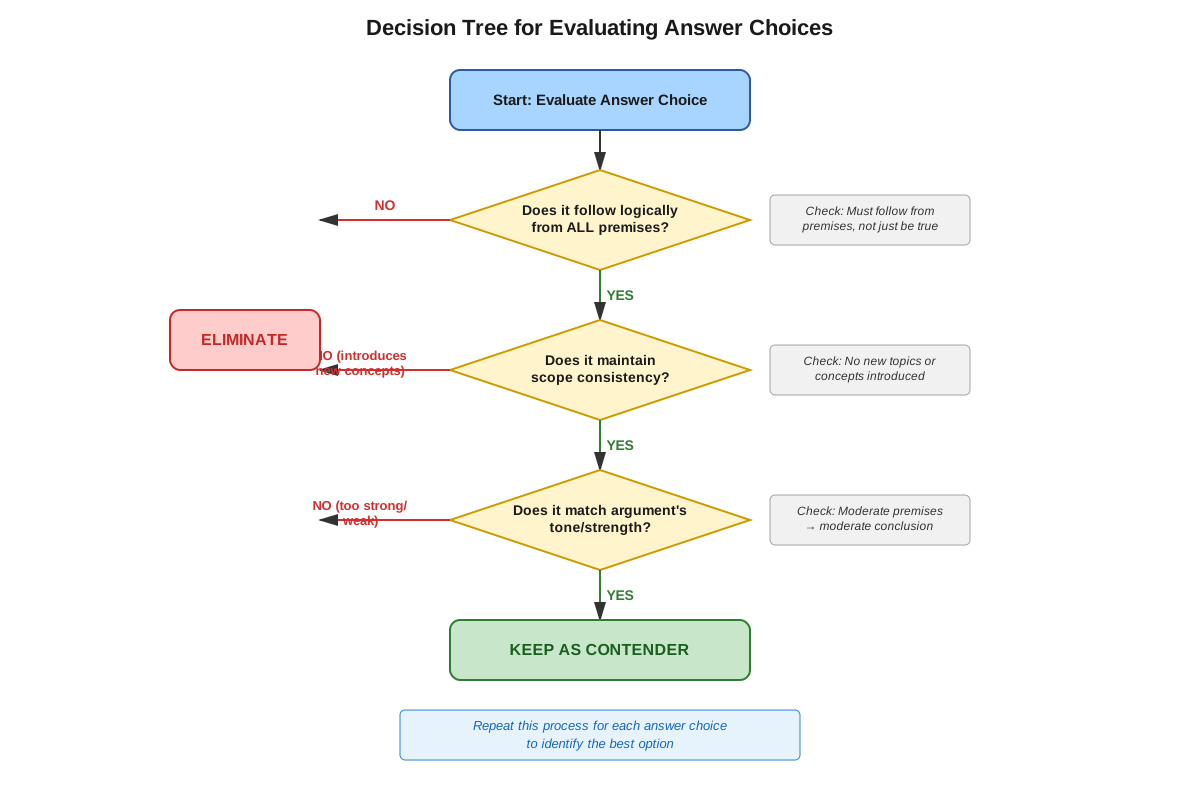
Eliminate first: Answer choices that violate scope by being too broad or too narrow compared to premises. This typically eliminates 1-2 choices immediately.
Eliminate second: Choices that mismatch tone or strength—tentative completions for definitive premises or vice versa. This often eliminates another 1-2 choices.
Eliminate third: Choices that don't follow the logical pattern established (e.g., conditional completions for causal arguments, or comparative completions for evidence-based arguments).
Choose from remaining: Between the final 1-2 choices, select the one that most directly and simply completes the logical trajectory without introducing unnecessary complications or new unsupported claims.
Time Allocation Advice
Completion questions should take approximately 1:15-1:30 minutes on average. They're typically faster than assumption or strengthen/weaken questions because the logical relationship is more constrained—you're looking for what must follow, not what could support or undermine.
If stuck after 90 seconds: Make your best elimination-based guess and move on. These questions reward pattern recognition, so if the pattern isn't clear quickly, additional time often doesn't help proportionally.
Strategic timing: Because completion questions are often medium difficulty and relatively quick, they're good candidates for answering early in a section to build confidence and bank time for harder questions later.
Exam Tip: The correct completion often feels "obvious" once you've correctly identified the logical pattern. If you're struggling to choose between answers, return to pattern identification—you may have misidentified the argument's structure.
Memory Techniques
SCOPE Mnemonic for evaluating completions:
- Strength: Does the completion match the strength of the premises?
- Consistency: Is the completion consistent with the logical pattern?
- Orientation: Does the completion follow the direction established by transition words?
- Precision: Does the completion match the specific scope of the premises?
- Evidence: Is the completion supported by the evidence provided?
The "Therefore Test": When unsure if a completion is correct, mentally insert "therefore" before it and ask: "Do the premises genuinely support this conclusion?" If the answer isn't a clear yes, the completion is likely incorrect.
Pattern Recognition Acronym - CCCE:
- Causal: Look for cause-effect relationships
- Conditional: Look for if-then structures
- Comparative: Look for comparisons between options
- Evidence: Look for data supporting a conclusion
Visualization Strategy: Picture the argument as a bridge with the premises as support pillars and the completion as the final span. The completion must connect naturally to the existing structure—if you have to force it or add extra support, it's probably wrong.
The "Scope Box" Technique: Mentally draw a box around the scope established by premises (who/what/when/where/how many). The correct completion must fit entirely within this box without extending beyond its boundaries.
Summary
Transition in completion questions test the ability to recognize logical flow and complete arguments with appropriate concluding statements that maintain consistency with established premises. These questions require identifying the logical pattern (causal, conditional, comparative, or evidence-based), matching the scope and tone of premises, and selecting the completion that naturally follows from the argument's trajectory. Success depends on systematic analysis: recognizing the argument structure, identifying the logical pattern, determining appropriate scope and strength, pre-phrasing the expected completion, and evaluating answer choices against these criteria. The most common errors involve scope violations (completions that are too broad or narrow), strength mismatches (definitive completions from tentative premises or vice versa), and pattern misidentification (selecting completions that don't follow the established logical structure). Mastering these questions requires understanding that the correct answer isn't just plausible or true—it's what must logically follow from the specific premises given, maintaining the argument's internal coherence and respecting all logical constraints established by the stimulus.
Key Takeaways
- Transition in completion questions require identifying what must logically follow from premises, not just what could possibly follow or what is generally true
- The correct completion always matches the scope, tone, and strength of the premises—violations of these elements are the most common wrong answer patterns
- Pre-phrasing the completion before reviewing answer choices significantly improves accuracy by preventing distraction from attractive but incorrect options
- Logical pattern recognition (causal, conditional, comparative, evidence-based) is the foundation for predicting appropriate completions
- Transition words immediately before the completion point provide critical clues about the required logical relationship
- Systematic elimination based on scope violations, tone mismatches, and pattern inconsistencies efficiently narrows choices to the correct answer
- These questions typically take 1:15-1:30 minutes and appear 2-4 times per Logical Reasoning section, making them high-yield for score improvement
Related Topics
Assumption Questions: Understanding what's required to complete an argument logically connects directly to identifying unstated assumptions. Mastering completion questions strengthens assumption question performance by developing the skill of recognizing what's missing from arguments.
Strengthen and Weaken Questions: These question types require understanding how additional information affects argument strength. Completion questions build the foundational skill of recognizing logical relationships that strengthen/weaken questions then manipulate.
Parallel Reasoning Questions: Both question types require identifying logical patterns and structures. The pattern recognition skills developed through completion questions directly transfer to recognizing parallel argument structures.
Inference Questions: While inference questions ask what must be true based on given information, completion questions ask what must follow to finish an argument. Both require careful attention to scope and logical necessity.
Principle Questions: Some principle questions ask which principle completes an argument, combining completion question skills with principle identification. Mastering basic completion questions prepares for these more complex variations.
Practice CTA
Now that you've mastered the core concepts of transition in completion questions, it's time to apply this knowledge through deliberate practice. Attempt the practice questions associated with this topic, focusing on implementing the systematic approach outlined in the exam strategy section. As you work through problems, consciously apply the SCOPE mnemonic and pre-phrasing strategy before evaluating answer choices. Review the flashcards to reinforce pattern recognition and scope-matching skills. Remember: completion questions reward systematic analysis over intuition—trust the process, and your accuracy will improve with consistent practice. Each question you analyze strengthens your ability to recognize logical patterns and predict appropriate completions, skills that will serve you throughout the Logical Reasoning sections and beyond.
Sign up free to keep reading
Create a free AnvayaPrep account to finish this LSAT guide on Transition in completion questions — plus flashcards and practice questions.