Overview
The analogy flaw represents one of the most frequently tested reasoning errors on the LSAT Logical Reasoning section. This flaw occurs when an argument draws a comparison between two situations, entities, or cases and concludes that because they share some similarities, they must share additional characteristics—without adequately establishing that the similarities are relevant or that the differences are insignificant. Understanding this flaw is essential because analogical reasoning appears throughout legal thinking, and the LSAT tests whether students can identify when such comparisons are logically sound versus when they commit critical reasoning errors.
On the LSAT, flaw questions ask test-takers to identify the specific logical error in an argument's reasoning. Among the various flaw types, the lsat analogy flaw appears with remarkable consistency, typically showing up in 2-4 questions per test. These questions require students to recognize that while analogies can strengthen arguments when the compared situations are genuinely similar in relevant respects, they become fallacious when the argument ignores crucial differences or relies on superficial similarities. The ability to spot analogy flaws directly impacts performance on approximately 10-15% of all Logical Reasoning questions.
Within the broader landscape of logical reasoning, the analogy flaw connects to fundamental principles of inductive reasoning, comparative analysis, and the evaluation of evidence strength. Mastering this concept enables students to better understand related flaw types such as false equivalence, hasty generalization, and faulty use of evidence. The analogy flaw also appears in other LSAT question types beyond flaw questions, including strengthen/weaken questions, parallel reasoning questions, and method of reasoning questions, making it a high-yield topic that provides returns across multiple question formats.
Learning Objectives
- [ ] Identify how Analogy flaw appears in LSAT questions
- [ ] Explain the reasoning pattern behind Analogy flaw
- [ ] Apply Analogy flaw to solve LST-style problems accurately
- [ ] Distinguish between valid analogical reasoning and flawed analogical reasoning
- [ ] Recognize the specific language patterns that signal potential analogy flaws
- [ ] Evaluate whether compared situations share relevant similarities sufficient to support the conclusion
- [ ] Articulate why particular differences between compared cases undermine analogical arguments
Prerequisites
- Basic argument structure: Understanding premises, conclusions, and how evidence supports claims is necessary because analogy flaws involve evaluating whether comparative evidence adequately supports a conclusion.
- Conditional reasoning fundamentals: Recognizing sufficient and necessary conditions helps identify when analogies inappropriately transfer characteristics from one case to another.
- General flaw question format: Familiarity with how flaw questions are phrased and what they ask enables efficient recognition of when an analogy flaw is the correct answer.
- Inductive vs. deductive reasoning: Distinguishing these reasoning types clarifies why analogies provide probabilistic rather than certain support, making them vulnerable to specific weaknesses.
Why This Topic Matters
The analogy flaw matters profoundly for legal reasoning because lawyers constantly argue by analogy, comparing current cases to precedents and drawing conclusions about how legal principles should apply. The LSAT tests this skill because law school and legal practice require the ability to evaluate whether case comparisons are legitimate or whether they overlook critical distinctions. In real-world legal contexts, recognizing weak analogies prevents faulty legal arguments and helps attorneys distinguish their cases from unfavorable precedents.
On the LSAT, analogy flaws appear with high frequency across multiple question types. Statistical analysis of recent LSATs reveals that pure analogy flaw questions appear 2-4 times per test in the Logical Reasoning sections, while analogical reasoning more broadly appears in 8-12 questions when including strengthen/weaken and parallel reasoning questions. This represents approximately 10-15% of all Logical Reasoning questions, making it one of the highest-yield flaw types to master. The LSAT particularly favors analogy flaws in questions testing critical thinking about comparative evidence and the limits of inductive reasoning.
Common manifestations include arguments comparing business practices across different industries, drawing parallels between historical events and current situations, comparing scientific studies with different methodologies, and analogizing between policy implementations in different contexts. The test writers frequently construct arguments that compare situations sharing some surface-level similarities while differing in crucial respects that undermine the comparison's validity. Recognizing these patterns enables rapid identification and elimination of incorrect answer choices.
Core Concepts
Definition of Analogy Flaw
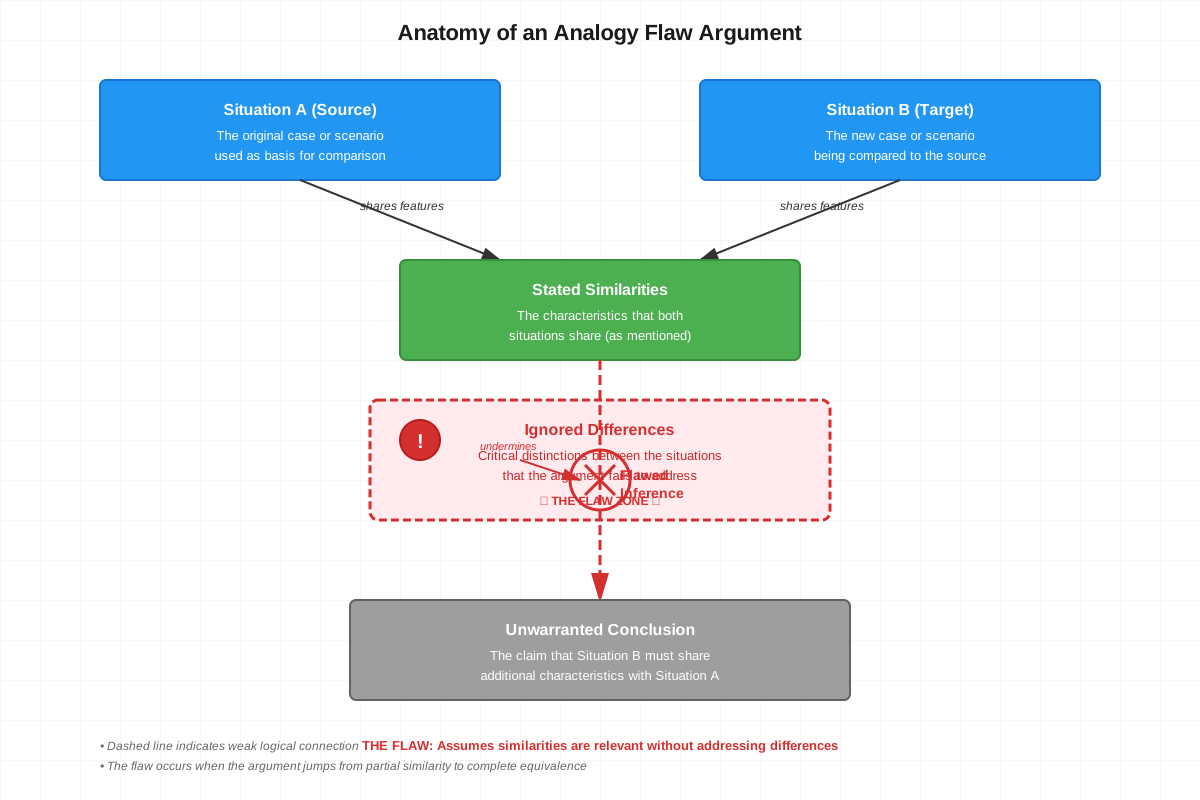
An analogy flaw occurs when an argument reasons that because two things are similar in some respects, they must be similar in another respect, without adequately establishing that the known similarities are relevant to the inferred similarity or that the differences between the compared cases are insignificant. This flaw represents a failure of analogical reasoning—a form of inductive argument that draws conclusions based on comparisons.
The logical structure follows this pattern:
- Case A has characteristics X, Y, and Z
- Case B has characteristics X and Y
- Therefore, Case B probably has characteristic Z
The reasoning becomes flawed when the argument fails to establish that characteristics X and Y are actually relevant to whether something has characteristic Z, or when significant differences between Case A and Case B make the comparison inappropriate despite the shared characteristics.
Valid vs. Flawed Analogical Reasoning
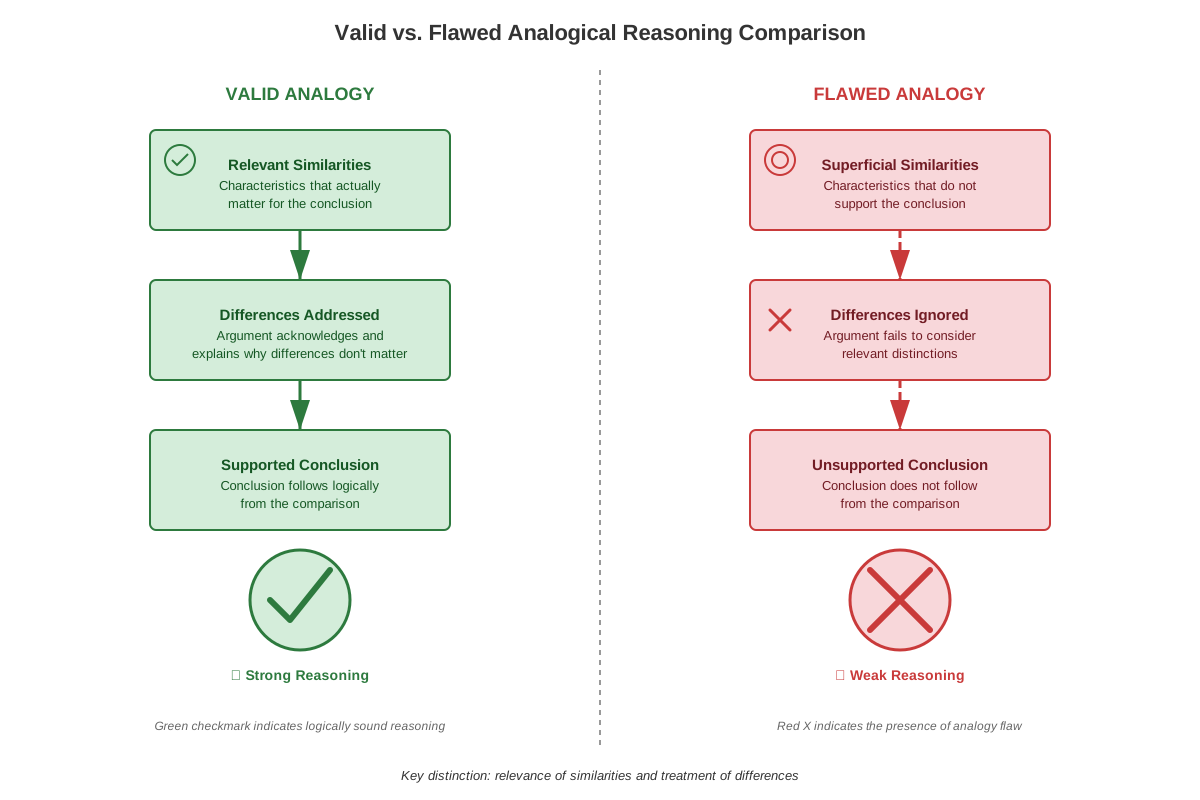
Not all analogical reasoning is flawed. Valid analogical arguments establish that:
- The compared cases share similarities in relevant respects
- The similarities outweigh or are more significant than the differences
- No crucial differences exist that would undermine the comparison
- The characteristic being inferred relates logically to the shared characteristics
| Valid Analogy | Flawed Analogy |
|---|---|
| Compares cases similar in relevant respects | Compares cases similar only in superficial ways |
| Acknowledges and addresses key differences | Ignores or minimizes crucial differences |
| Establishes logical connection between shared and inferred traits | Assumes connection without justification |
| Provides sufficient basis for the comparison | Relies on insufficient similarities |
The Relevance Requirement
The most critical element in evaluating analogies is relevance. Two cases might share numerous characteristics, but if those shared characteristics don't relate to the conclusion being drawn, the analogy fails. For example, arguing that because both dolphins and sharks live in the ocean and have fins, dolphins must be fish like sharks commits an analogy flaw—the shared characteristics (habitat and fins) are not the relevant factors for determining biological classification.
On the LSAT, test-takers must evaluate whether the stated similarities between compared cases actually bear on the conclusion. An argument might compare two cities' transportation policies, noting they have similar populations and geographic sizes, then conclude that a policy successful in City A will succeed in City B. This reasoning is flawed if other factors—such as existing infrastructure, climate, or commuting patterns—are more relevant to transportation policy success than population and size.
The Difference Problem
Even when compared cases share relevant similarities, significant differences can undermine analogical reasoning. The analogy flaw often involves overlooking or dismissing differences that actually matter more than the similarities. The LSAT frequently tests this by presenting arguments that acknowledge some similarity but fail to consider whether differences outweigh those similarities.
Consider an argument comparing two medical treatments: "Treatment A worked for Disease X, and Disease Y shares some symptoms with Disease X, so Treatment A should work for Disease Y." This commits an analogy flaw if the diseases differ in underlying causes, mechanisms, or other factors relevant to treatment effectiveness, even if they share some symptoms.
Common Analogy Flaw Patterns on the LSAT
The LSAT employs several recurring patterns:
- Historical analogies: Comparing past events to current situations while ignoring changed circumstances
- Cross-domain analogies: Comparing situations from different fields (business to education, science to policy) without establishing transferability
- Scale analogies: Comparing small-scale to large-scale implementations without addressing scaling challenges
- Temporal analogies: Comparing past performance to future expectations without accounting for changed conditions
- Partial similarity analogies: Noting one or two shared features while ignoring numerous relevant differences
Identifying Analogy Flaws in Answer Choices
When analogy flaws appear in answer choices, they typically use language such as:
- "Presumes, without justification, that what is true in one case must be true in another"
- "Overlooks the possibility that the cases being compared differ in relevant respects"
- "Fails to establish that the similarities between the cases are relevant to the conclusion"
- "Ignores important differences between the situations being compared"
- "Draws a conclusion based on an inappropriate comparison"
The correct answer will specifically identify that the flaw involves reasoning from similarity without adequate justification, rather than describing other logical errors.
Concept Relationships
The analogy flaw connects directly to several other logical reasoning concepts. It represents a specific type of weak evidence flaw, where the evidence provided (the similarity between cases) is insufficient to support the conclusion. This relationship means that skills in evaluating evidence strength transfer directly to identifying analogy flaws.
The analogy flaw also relates closely to hasty generalization, as both involve drawing conclusions from insufficient information. However, while hasty generalization involves inferring a general rule from too few instances, analogy flaw involves inferring similarity in one respect from similarity in other respects. The distinction matters for selecting correct answer choices.
Additionally, analogy flaws connect to causal reasoning errors. When an argument uses an analogy to suggest that because X caused Y in one situation, X will cause Y in another situation, it combines analogical reasoning with causal reasoning. Understanding both concepts enables recognition of compound flaws.
The relationship map flows as follows:
Inductive Reasoning → branches into → Analogical Reasoning → can commit → Analogy Flaw → which is a type of → Insufficient Evidence Flaw → and relates to → Hasty Generalization and False Equivalence
Understanding these relationships helps students recognize that answer choices describing "insufficient evidence" or "unwarranted assumption" might be describing analogy flaws in different language, while answer choices describing "causal confusion" or "circular reasoning" describe different flaw types.
High-Yield Facts
⭐ The analogy flaw occurs when an argument assumes that similarity in some respects guarantees similarity in another respect without establishing relevance.
⭐ The most common form involves comparing two situations that share superficial characteristics while differing in crucial ways that undermine the comparison.
⭐ Valid analogies require that shared characteristics be relevant to the characteristic being inferred, not merely present in both cases.
⭐ Answer choices identifying analogy flaws typically mention "overlooks differences," "presumes similarity," or "fails to establish relevance of the comparison."
⭐ The LSAT frequently tests analogy flaws by presenting arguments that acknowledge some similarity but ignore whether differences outweigh those similarities.
- Analogy flaws appear in approximately 10-15% of all Logical Reasoning questions across various question types.
- Historical comparisons are particularly susceptible to analogy flaws because circumstances change over time.
- Cross-domain analogies (comparing different fields or contexts) require stronger justification than within-domain analogies.
- The presence of some similarities does not automatically make an analogy valid; relevance and significance matter more than quantity.
- Analogy flaws can appear in both the stimulus (for flaw questions) and in answer choices (for strengthen/weaken questions).
- Scale differences often undermine analogies, such as comparing small pilot programs to large-scale implementations.
- The LSAT rarely presents completely absurd analogies; instead, it tests subtle cases where the comparison has some plausibility but ultimately fails.
- Recognizing analogy flaws requires active evaluation of whether stated similarities actually relate to the conclusion.
- Many incorrect answer choices on analogy flaw questions describe other flaw types like circular reasoning or ad hominem attacks.
- Temporal factors frequently undermine analogies when arguments compare past situations to present or future ones without accounting for changed conditions.
Quick check — test yourself on Analogy flaw so far.
Try Flashcards →Common Misconceptions
Misconception: Any argument that uses a comparison commits an analogy flaw.
Correction: Analogical reasoning is legitimate when the compared cases share relevant similarities and lack significant relevant differences. Only flawed analogies that ignore relevance or overlook crucial differences commit the analogy flaw.
Misconception: If two cases share any similarities, the analogy is valid.
Correction: The similarities must be relevant to the conclusion being drawn. Two cases might share numerous characteristics, but if those characteristics don't relate to the inferred characteristic, the analogy fails. Relevance, not mere similarity, determines validity.
Misconception: Pointing out any difference between compared cases proves an analogy flaw.
Correction: Not all differences matter. Valid analogies can exist despite some differences if the similarities in relevant respects outweigh the differences. The key question is whether the differences are significant enough to undermine the comparison for the specific conclusion being drawn.
Misconception: Analogy flaws only appear in flaw questions.
Correction: While analogy flaws are explicitly identified in flaw questions, analogical reasoning appears throughout the LSAT in strengthen/weaken questions (where you might strengthen or weaken an analogy), parallel reasoning questions (where you match analogical structures), and method of reasoning questions (where you describe analogical reasoning).
Misconception: Historical analogies are always flawed because times change.
Correction: Historical analogies can be valid if the relevant factors remain constant despite temporal differences. The flaw occurs only when the argument ignores changed circumstances that are relevant to the conclusion. Some historical patterns do repeat when underlying conditions remain similar.
Misconception: The longer the list of similarities, the stronger the analogy.
Correction: Quality matters more than quantity. One highly relevant similarity can support a stronger analogy than ten irrelevant similarities. The LSAT tests whether students focus on relevance rather than being impressed by numerous superficial similarities.
Misconception: If the argument acknowledges a difference, it hasn't committed an analogy flaw.
Correction: Merely acknowledging a difference doesn't address whether that difference undermines the comparison. An argument can mention differences but still commit an analogy flaw if it dismisses those differences without adequate justification or if it ignores other crucial differences.
Worked Examples
Example 1: Business Policy Analogy
Stimulus: "Company X implemented a four-day workweek and saw productivity increase by 15%. Company Y should implement a four-day workweek because, like Company X, it is a mid-sized company with approximately 200 employees. Therefore, Company Y will likely see similar productivity gains."
Question: The reasoning in the argument is flawed because it:
Analysis:
- Identify the argument structure: The argument compares Company X and Company Y, notes they share some characteristics (mid-sized, similar employee count), and concludes that a policy successful at Company X will succeed at Company Y.
- Identify the comparison: The shared characteristics are company size and employee count. The inferred characteristic is that the four-day workweek will produce similar productivity gains.
- Evaluate relevance: Are company size and employee count the relevant factors for whether a four-day workweek increases productivity? Other factors might matter more: the nature of the work, existing work culture, employee preferences, industry type, client expectations, or operational requirements.
- Identify the flaw: The argument assumes that because the companies share some characteristics, they will respond similarly to the policy, without establishing that the shared characteristics are the relevant ones for predicting policy success. The argument overlooks that the companies might differ in ways that matter more for productivity outcomes.
- Predict the answer: The correct answer should identify that the argument fails to establish that the similarities are relevant or that it overlooks potentially important differences.
Correct Answer Type: "Overlooks the possibility that the two companies differ in respects relevant to the likely effect of implementing a four-day workweek."
Connection to Learning Objectives: This example demonstrates how to identify analogy flaws (Objective 1), explains the reasoning pattern of assuming similarity without adequate justification (Objective 2), and shows the application process for LSAT questions (Objective 3).
Example 2: Medical Treatment Analogy
Stimulus: "A recent study found that Drug A effectively treats bacterial infections in laboratory mice. Since humans, like mice, are mammals with similar cellular structures, Drug A should be effective in treating bacterial infections in humans."
Question: Which one of the following most accurately describes a flaw in the argument's reasoning?
Analysis:
- Identify the comparison: The argument compares mice and humans, noting they share characteristics (both mammals, similar cellular structures).
- Identify the conclusion: Drug A will be effective in humans because it was effective in mice.
- Evaluate the shared characteristics: Are being mammals and having similar cellular structures sufficient to predict drug effectiveness? Many factors affect drug response: metabolism rates, immune system differences, body size, drug absorption and distribution, potential side effects, and species-specific biological variations.
- Identify relevant differences: Mice and humans differ significantly in ways that affect drug response. Drugs that work in mice frequently fail in human trials due to these differences. The argument's shared characteristics (mammalian status, cellular similarity) are too general to support the specific conclusion about drug effectiveness.
- Articulate the flaw: The argument treats superficial biological similarities as sufficient to predict drug effectiveness without establishing that these similarities are the relevant factors or that the significant differences don't undermine the comparison.
- Predict the answer: The correct answer should identify that the argument fails to establish that the similarities are relevant to drug effectiveness or that it ignores important differences between mice and humans regarding drug response.
Correct Answer Type: "Fails to establish that the physiological similarities between mice and humans are sufficient to warrant the conclusion that a drug effective in mice will be effective in humans" or "Presumes, without providing justification, that mice and humans respond to drug treatments in sufficiently similar ways."
Connection to Learning Objectives: This example shows how analogy flaws appear in scientific contexts (Objective 1), demonstrates the pattern of inferring similarity from insufficient shared characteristics (Objective 2), and illustrates evaluation of whether similarities are relevant (Objective 6).
Exam Strategy
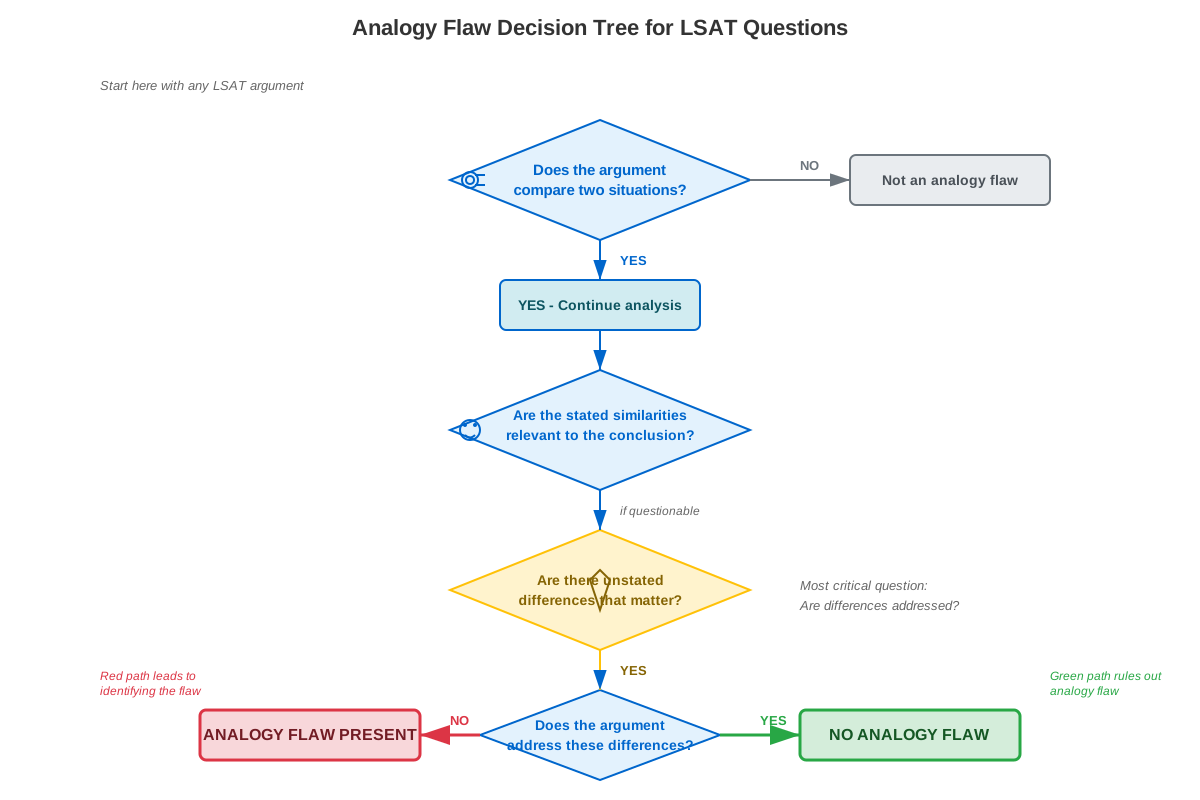
When approaching LSAT questions involving potential analogy flaws, employ this systematic process:
Step 1: Identify comparative language. Watch for trigger words and phrases such as "similarly," "likewise," "just as," "like," "analogous to," "comparable to," or "in the same way." These signal that the argument relies on analogical reasoning.
Step 2: Map the comparison explicitly. Identify what is being compared to what, what similarities are stated, and what conclusion is drawn from those similarities. Write this out mentally or on scratch paper: "A has X and Y; B has X and Y; therefore B has Z."
Step 3: Evaluate relevance. Ask whether the stated similarities actually relate to the conclusion. Are these the factors that would determine whether the conclusion follows? Or might other factors be more important?
Step 4: Consider differences. Think about how the compared cases might differ in ways that matter for the conclusion. Even if not explicitly stated in the stimulus, relevant differences might exist that undermine the comparison.
Step 5: Predict the answer. Before looking at answer choices, articulate the flaw: "This argument assumes that because A and B are similar in [stated ways], they'll be similar in [concluded way], but it doesn't establish that [stated similarities] are relevant to [conclusion], and it ignores that they might differ in [relevant ways]."
Exam Tip: On flaw questions, eliminate answer choices describing flaws that aren't present before selecting the analogy flaw answer. Common wrong answers include circular reasoning, ad hominem attacks, or causal confusion—none of which describe analogy flaws.
Time allocation: Spend 1:15-1:30 on questions involving analogy flaws. These questions require careful analysis of the comparison but shouldn't consume excessive time once you've identified the pattern.
Process of elimination tips specific to analogy flaws:
- Eliminate answers describing causal reasoning errors unless the analogy involves causal claims
- Eliminate answers about sampling or statistical reasoning unless the analogy involves data
- Eliminate answers about necessary/sufficient condition confusion unless the analogy involves conditional logic
- Keep answers mentioning "comparison," "similarity," "overlooks differences," or "fails to establish relevance"
Common trap answers: The LSAT often includes wrong answers that describe the argument's content rather than its flaw, such as "fails to consider that Company Y might not want to implement a four-day workweek." This describes a possible objection but not the logical flaw in the reasoning.
Memory Techniques
ANALOGY Acronym for evaluating analogical reasoning:
- Are the cases being compared?
- Note what similarities are claimed
- Ask if similarities are relevant
- Look for overlooked differences
- Outweigh: Do similarities outweigh differences?
- Generalization: Is the inference justified?
- Yield: Does the comparison support the conclusion?
Visualization Strategy: Picture two objects side by side. The argument points to features they share (color them the same). Then ask: Are these shared features the ones that matter for the conclusion? What features are different (color them differently)? Do the different features matter more?
The "Apples and Oranges" Reminder: When you see a comparison, ask "Is this comparing apples and oranges?" Even though both are fruit (some similarity), they differ in relevant ways for many purposes. This simple question triggers evaluation of whether the comparison is appropriate.
Relevance Mantra: "Similar in some ways doesn't mean similar in the way that matters." Repeat this when evaluating analogies to maintain focus on relevance rather than being distracted by any similarities.
The Three R's of Analogy Evaluation:
- Recognize the comparison
- Relevance of similarities
- Relevant differences overlooked
Summary
The analogy flaw represents a critical reasoning error where arguments conclude that because two cases share some characteristics, they must share additional characteristics, without adequately establishing that the known similarities are relevant or that differences are insignificant. This flaw appears frequently on the LSAT because analogical reasoning is fundamental to legal thinking, and the test assesses whether students can distinguish valid from flawed comparisons. Mastering analogy flaws requires understanding that valid analogies depend on relevance—the shared characteristics must actually relate to the conclusion being drawn—and that significant differences can undermine comparisons despite some similarities. The LSAT tests this concept across multiple question types, with pure analogy flaw questions appearing 2-4 times per test and analogical reasoning appearing more broadly in 10-15% of Logical Reasoning questions. Success requires systematic evaluation: identify the comparison, assess whether stated similarities are relevant to the conclusion, consider whether overlooked differences undermine the analogy, and recognize the characteristic language patterns in answer choices that describe analogy flaws.
Key Takeaways
- The analogy flaw occurs when arguments assume similarity in one respect based on similarity in other respects without establishing relevance or addressing significant differences
- Valid analogies require that shared characteristics be relevant to the inferred characteristic, not merely present in both cases
- The LSAT tests analogy flaws by presenting comparisons with some plausibility but crucial overlooked differences or irrelevant similarities
- Answer choices identifying analogy flaws typically mention "overlooks differences," "fails to establish relevance," or "presumes similarity without justification"
- Systematic evaluation involves identifying the comparison, assessing relevance of similarities, considering overlooked differences, and predicting the answer before reviewing choices
- Analogy flaws appear in approximately 10-15% of Logical Reasoning questions across flaw, strengthen/weaken, and parallel reasoning question types
- Focus on relevance rather than quantity—one relevant similarity outweighs numerous irrelevant similarities
Related Topics
False Equivalence: This flaw treats two things as interchangeable when they differ in important ways. Mastering analogy flaws provides the foundation for recognizing false equivalence, which represents a more extreme version of inappropriate comparison.
Hasty Generalization: While analogy flaws involve inferring similarity from comparison, hasty generalization involves inferring general rules from insufficient instances. Understanding both helps distinguish between different types of insufficient evidence flaws.
Causal Reasoning Flaws: When arguments use analogies to support causal claims ("X caused Y in Case A, so X will cause Y in Case B"), they combine analogical and causal reasoning. Mastering analogy flaws enables recognition of these compound errors.
Strengthen and Weaken Questions: These question types often involve evaluating or undermining analogies. Understanding analogy flaws helps identify answer choices that strengthen analogies by establishing relevance or weaken them by highlighting differences.
Parallel Reasoning: These questions require matching argument structures, including analogical reasoning patterns. Recognizing valid versus flawed analogies helps select correct parallel arguments.
Practice CTA
Now that you understand the analogy flaw—how it appears, why it's flawed, and how to identify it—you're ready to apply this knowledge to practice questions. The concepts covered here will appear repeatedly throughout your LSAT preparation, and each practice question you attempt will reinforce your ability to spot inappropriate comparisons quickly and accurately. Approach the practice questions systematically, using the evaluation framework and strategies outlined above. Remember that mastering analogy flaws improves performance not just on flaw questions but across multiple Logical Reasoning question types. Your investment in understanding this high-yield topic will pay dividends throughout the test. Challenge yourself with the practice questions and flashcards to cement your mastery and build the pattern recognition that leads to rapid, confident answers on test day.
Sign up free to keep reading
Create a free AnvayaPrep account to finish this LSAT guide on Analogy flaw — plus flashcards and practice questions.