Overview
The appeal to popularity fallacy, also known as argumentum ad populum or the bandwagon fallacy, represents one of the most frequently tested reasoning flaws on the LSAT. This logical reasoning error occurs when an argument concludes that something must be true, good, or correct simply because many people believe it or practice it. The fundamental mistake lies in treating widespread acceptance as evidence of truth or merit, when popularity alone provides no logical support for a claim's validity.
Understanding this flaw is essential for LSAT success because it appears across multiple question types within the Logical Reasoning section, particularly in flaw questions, assumption questions, and strengthen/weaken questions. The LSAT tests this concept because it reflects a common pattern of faulty reasoning that appears in legal arguments, policy debates, and everyday discourse. Recognizing when an argument inappropriately relies on popular opinion rather than substantive evidence is a critical skill for legal reasoning and analysis.
The appeal to popularity connects to broader themes in LSAT Logical Reasoning, including the distinction between evidence and opinion, the evaluation of argument structure, and the identification of gaps between premises and conclusions. Mastering this topic strengthens the ability to analyze argument validity systematically and recognize when conclusions rest on insufficient logical foundations. This flaw often appears alongside other reasoning errors, making it crucial to understand both its standalone characteristics and how it interacts with other logical fallacies tested on the exam.
Learning Objectives
- [ ] Identify how Appeal to popularity appears in LSAT questions
- [ ] Explain the reasoning pattern behind Appeal to popularity
- [ ] Apply Appeal to popularity to solve LSAT-style problems accurately
- [ ] Distinguish appeal to popularity from legitimate uses of consensus evidence
- [ ] Recognize variations and disguised forms of the appeal to popularity fallacy
- [ ] Evaluate when popular opinion might constitute relevant (though not conclusive) evidence
- [ ] Predict answer choices that correctly describe this flaw in formal LSAT language
Prerequisites
- Basic argument structure: Understanding premises, conclusions, and the relationship between them is essential because identifying the appeal to popularity requires recognizing when popularity serves as the sole or primary premise supporting a conclusion.
- Distinction between facts and opinions: Recognizing the difference between objective evidence and subjective beliefs enables students to spot when an argument inappropriately treats widespread opinion as factual support.
- Familiarity with flaw question formats: Knowing how the LSAT phrases flaw questions ("The reasoning in the argument is flawed because...") helps students efficiently identify and articulate the specific error.
- Understanding of sufficient vs. necessary conditions: This logical foundation helps distinguish between when popularity might be relevant versus when it fails to provide adequate support for a conclusion.
Why This Topic Matters
The appeal to popularity appears in approximately 10-15% of Logical Reasoning questions across typical LSAT administrations, making it one of the highest-yield flaw patterns to master. This frequency reflects the LSAT's focus on testing critical thinking skills essential for legal practice, where attorneys must distinguish between persuasive rhetoric and sound logical reasoning. Legal arguments often invoke public opinion, precedent, or common practice, and lawyers must evaluate whether such appeals constitute legitimate evidence or logical fallacies.
In real-world contexts, the appeal to popularity manifests in advertising ("America's #1 choice"), political discourse ("Most voters support this policy, so it must be right"), and social pressure ("Everyone's doing it"). Legal professionals encounter this reasoning pattern in jury arguments, policy debates, and contract negotiations. The ability to identify and counter such arguments represents a fundamental lawyering skill that the LSAT directly assesses.
On the exam, this topic appears most commonly in flaw questions, where students must identify the reasoning error, but it also surfaces in assumption questions (where the assumption bridges the gap between popularity and validity), strengthen/weaken questions (where evidence about popularity or its irrelevance affects argument strength), and parallel reasoning questions (where students must match the flawed structure). The LSAT presents this flaw in various contexts—from consumer behavior and scientific claims to moral judgments and policy recommendations—requiring students to recognize the underlying pattern regardless of subject matter.
Core Concepts
The Basic Structure of Appeal to Popularity
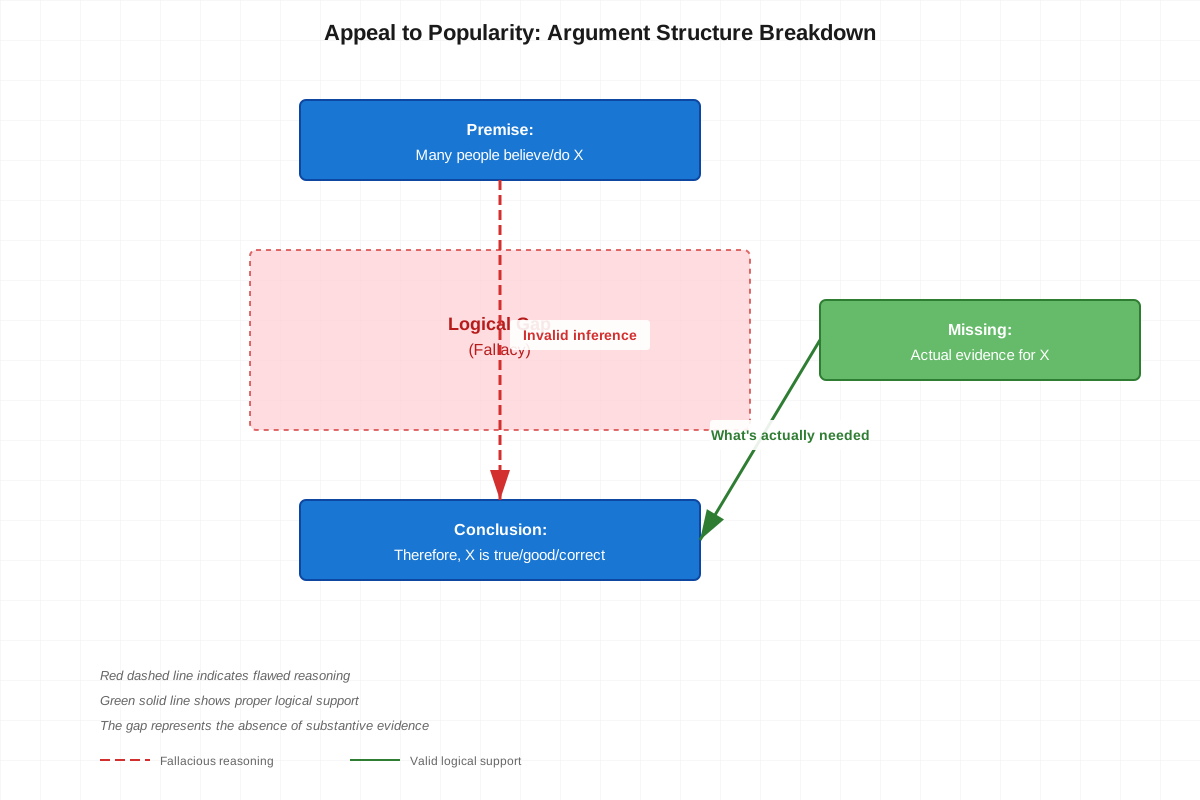
An appeal to popularity follows a predictable logical structure that students must internalize. The argument presents evidence that many people (or most people, or everyone) believes something, practices something, or accepts something as true. From this premise about widespread belief or behavior, the argument concludes that the belief must be true, the practice must be correct, or the thing must be good or valuable.
The formal structure appears as:
- Premise: Many/most people believe X or do Y
- Conclusion: Therefore, X is true or Y is correct/good
The critical flaw lies in the unstated assumption that popularity correlates with truth, correctness, or value. This assumption fails because widespread belief does not constitute logical evidence for a claim's validity. History provides countless examples of popular beliefs later proven false—from geocentrism to various medical misconceptions—demonstrating that consensus alone cannot establish truth.
Distinguishing Features and Trigger Language
The LSAT appeal to popularity manifests through specific linguistic markers that signal the flaw's presence. Common trigger phrases include:
- "Most people believe/think/agree that..."
- "Everyone knows that..."
- "It's widely accepted that..."
- "The majority of [group] practices/endorses..."
- "This has become increasingly popular..."
- "Few people would dispute that..."
- "Common sense tells us..."
- "Conventional wisdom holds that..."
These phrases indicate that the argument relies on widespread acceptance rather than substantive evidence. However, students must remain vigilant because the LSAT often disguises this flaw by embedding it within more complex arguments or by using less obvious language about consensus or common practice.
When Popularity IS Relevant vs. When It Isn't
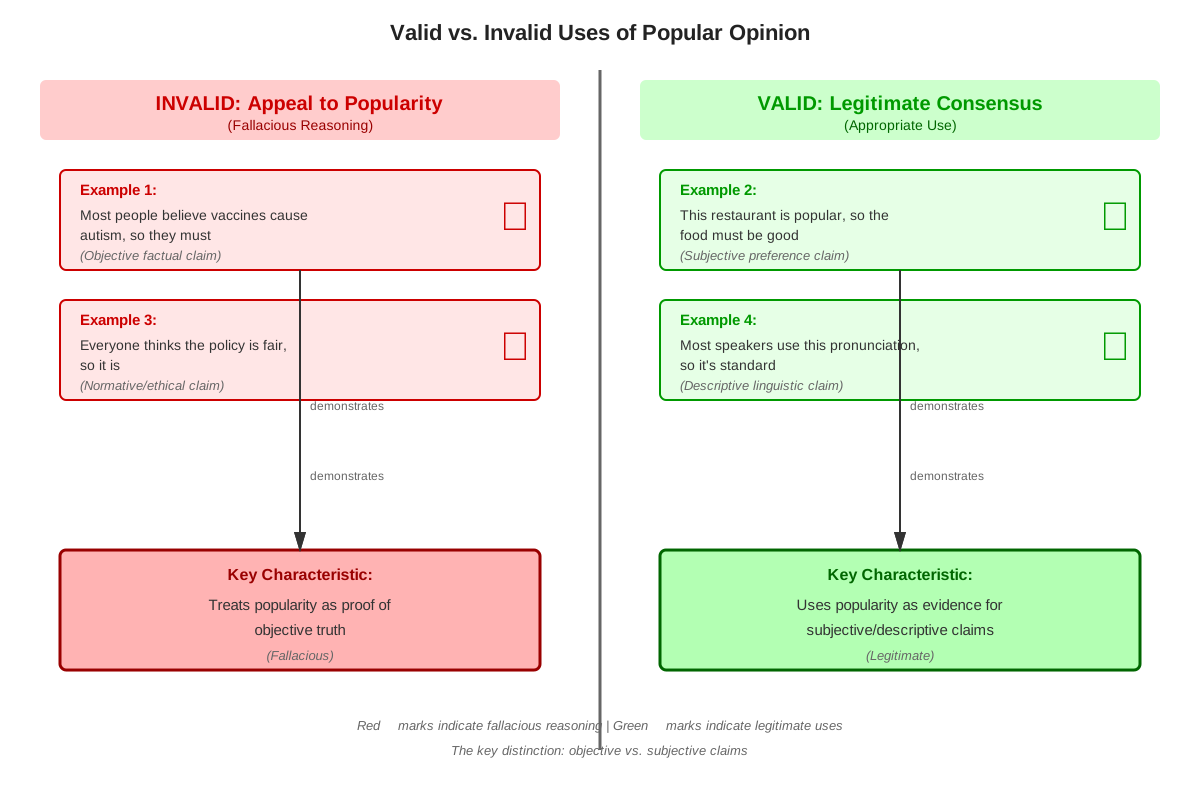
A crucial distinction that the LSAT frequently tests involves recognizing contexts where popular opinion might constitute relevant evidence versus contexts where it remains logically irrelevant. This nuance prevents students from over-applying the fallacy label.
| Context | Popularity Relevant? | Explanation |
|---|---|---|
| Factual/Scientific Claims | No | Truth is independent of belief (e.g., "Most people believe the earth is flat" doesn't make it flat) |
| Moral/Ethical Claims | No | Moral truth isn't determined by majority vote (e.g., historical injustices once had popular support) |
| Matters of Taste/Preference | Sometimes | Popularity may indicate quality in subjective domains, but doesn't prove superiority |
| Market Success/Consumer Behavior | Contextual | Popularity explains market position but doesn't prove product quality or value |
| Expert Consensus | Potentially | When "people" means qualified experts, consensus carries evidential weight (though still not conclusive) |
The LSAT exploits this distinction by presenting arguments where popularity might seem relevant but ultimately fails to support the specific conclusion drawn. For example, an argument might note that a restaurant is popular (relevant to its market success) but conclude it serves the healthiest food (a factual claim unsupported by popularity alone).
Variations and Disguised Forms
The appeal to popularity appears in several variations that students must recognize:
The Bandwagon Appeal: "Join everyone else" reasoning that emphasizes not being left out rather than explicitly stating popularity proves correctness. Example: "Don't be the only one still using outdated technology—switch to our product like everyone else has."
The Traditional Wisdom Appeal: Arguments that invoke long-standing practices or beliefs as self-justifying. Example: "This practice has been followed for centuries, so it must be the right approach." This variation substitutes temporal popularity (across time) for contemporary popularity.
The Reverse Appeal to Popularity: Arguments that conclude something must be wrong or false because few people believe it. Example: "Only a small fringe group accepts this theory, so it's clearly incorrect." This commits the same error in reverse—unpopularity doesn't disprove claims any more than popularity proves them.
The Implicit Appeal: Arguments that describe widespread behavior or belief without explicitly stating "therefore it's correct," but where the conclusion clearly depends on treating popularity as validation. The LSAT frequently uses this subtler form to test deeper understanding.
The Logical Gap
Understanding the logical reasoning gap in appeal to popularity arguments helps students articulate the flaw precisely. The gap exists between:
- What the evidence shows: Many people believe/do X
- What the conclusion claims: X is true/correct/good
This gap could only be bridged by an additional premise establishing that popular belief reliably indicates truth—a premise that would itself require justification and that generally doesn't hold. The LSAT tests whether students recognize this unbridged gap and can identify it as the argument's central weakness.
Context-Specific Applications
The LSAT presents appeal to popularity across diverse contexts:
Consumer Products: "This smartphone is the best-selling model, so it must be the highest quality phone available." The popularity indicates market success but doesn't prove superior quality—price, marketing, availability, and other factors influence sales.
Scientific/Medical Claims: "Most people believe that this supplement improves health, so it must be effective." Widespread belief about medical efficacy doesn't constitute scientific evidence—controlled studies do.
Policy Arguments: "The majority of citizens support this law, so it must be just and fair." Democratic support doesn't logically prove a policy's justice or effectiveness, though it may provide political legitimacy.
Aesthetic Judgments: "This is the most-watched show on television, so it's the best show." Popularity indicates broad appeal but doesn't establish artistic merit or quality by any objective standard.
Concept Relationships
The appeal to popularity connects to several other logical reasoning concepts tested on the LSAT. Understanding these relationships deepens mastery and helps students recognize when multiple flaws appear in a single argument.
Appeal to Popularity → Correlation vs. Causation: Both fallacies involve drawing unwarranted conclusions from insufficient evidence. While correlation/causation errors confuse temporal or statistical relationships with causal ones, appeal to popularity confuses widespread belief with truth. Arguments sometimes combine these flaws by assuming that because many people believe X causes Y, X actually does cause Y.
Appeal to Popularity ↔ Appeal to Authority: These fallacies represent opposite ends of a spectrum. Appeal to authority inappropriately relies on expert opinion without sufficient justification, while appeal to popularity relies on non-expert majority opinion. The key distinction lies in whether the "people" referenced possess relevant expertise. When an argument cites "most scientists agree," it may commit appeal to authority (if the scientists' expertise isn't established) rather than appeal to popularity.
Appeal to Popularity → Necessary vs. Sufficient Assumptions: Identifying the appeal to popularity flaw requires recognizing that the argument treats popularity as sufficient evidence for truth when it isn't. The necessary assumption underlying such arguments is that popularity indicates truth—an assumption that, when negated, destroys the argument.
Appeal to Popularity ← Sampling Flaws: Sometimes arguments commit both errors simultaneously—they rely on popularity (flaw #1) based on an unrepresentative sample (flaw #2). For example: "Everyone in this wealthy neighborhood drives luxury cars, so luxury cars must be the best vehicles." This combines appeal to popularity with a sampling error.
Relationship Map:
Argument Structure → Identifies Premises and Conclusion → Reveals Gap Between Popularity and Truth → Recognizes Appeal to Popularity Flaw → Connects to Broader Category of Insufficient Evidence Flaws → Relates to Other Evidence-Based Reasoning Errors
High-Yield Facts
⭐ The appeal to popularity fallacy treats widespread belief or practice as sufficient evidence for truth or correctness, which it logically is not.
⭐ This flaw appears in approximately 10-15% of Logical Reasoning questions, making it one of the highest-yield patterns to master.
⭐ Trigger phrases include "most people believe," "widely accepted," "everyone knows," "increasingly popular," and "common sense tells us."
⭐ The LSAT often disguises this flaw by embedding it within complex arguments or using subtle language about consensus rather than explicit popularity claims.
⭐ The critical distinction involves recognizing when popularity might be relevant (expert consensus, matters of taste) versus when it's logically irrelevant (factual claims, moral truths).
- The reverse form (concluding something is false because few believe it) commits the same logical error as the standard form.
- Appeal to popularity differs from appeal to authority in that it relies on general public opinion rather than expert opinion.
- Historical examples of popular but false beliefs (geocentrism, flat earth, medical misconceptions) demonstrate why popularity cannot establish truth.
- The flaw appears across multiple question types: flaw questions, assumption questions, strengthen/weaken questions, and parallel reasoning questions.
- Arguments may combine appeal to popularity with other flaws, such as sampling errors or correlation/causation confusion.
- The LSAT expects students to articulate this flaw using formal language like "treats popular acceptance as sufficient evidence for truth" or "confuses widespread belief with factual accuracy."
- Context matters: an argument about market success supported by popularity evidence may be valid, while a factual claim supported only by popularity commits the fallacy.
- The logical gap exists between "many people believe X" (the evidence) and "X is true" (the conclusion)—a gap that popularity alone cannot bridge.
Quick check — test yourself on Appeal to popularity so far.
Try Flashcards →Common Misconceptions
Misconception: Any mention of popularity or widespread belief in an argument means the argument commits the appeal to popularity fallacy.
Correction: The fallacy only occurs when the argument uses popularity as the primary or sole evidence for a conclusion about truth, correctness, or value. Arguments may mention popularity for other purposes (explaining market success, describing social trends) without committing the fallacy. The key is whether popularity serves as evidence for an inappropriate conclusion.
Misconception: Expert consensus represents an appeal to popularity and should always be rejected as fallacious.
Correction: Expert consensus differs fundamentally from general popularity. When qualified experts in a relevant field reach consensus based on evidence and analysis, their agreement carries evidential weight (though it remains defeasible). The appeal to popularity fallacy specifically involves treating non-expert majority opinion as proof. The LSAT tests this distinction by presenting arguments that cite either general public opinion or expert consensus.
Misconception: If something is popular, it cannot be true or good—popularity always indicates the opposite.
Correction: The fallacy doesn't claim that popular beliefs are false; it claims that popularity alone doesn't prove truth. Many popular beliefs are true, and many popular products are high-quality. The error lies in using popularity as the logical justification rather than substantive evidence. Students must avoid overcorrecting by assuming popularity disproves claims.
Misconception: The appeal to popularity only appears in obvious forms with explicit phrases like "everyone believes."
Correction: The LSAT frequently presents subtle versions where the reliance on popularity is implicit rather than explicit. An argument might describe widespread adoption or common practice without directly stating "therefore it's correct," but the conclusion clearly depends on treating popularity as validation. Students must recognize the underlying logical structure even when the language is indirect.
Misconception: In matters of taste or preference, popularity proves quality or superiority.
Correction: Even in subjective domains, popularity indicates broad appeal but doesn't logically prove superiority. A popular restaurant may appeal to many people's tastes without being "the best" by any objective or even subjective standard—preferences vary, and popularity may reflect factors other than quality (location, price, marketing). The LSAT tests whether students recognize that popularity provides weak evidence even in contexts where it seems most relevant.
Worked Examples
Example 1: Consumer Product Argument
Argument: "The Zenith smartphone has become the best-selling phone in the country, with more units sold than any competitor. Therefore, the Zenith must be the highest-quality smartphone available on the market."
Analysis:
Step 1 - Identify the Conclusion: The conclusion is that the Zenith is "the highest-quality smartphone available." This is a factual claim about product quality.
Step 2 - Identify the Premises: The premise is that the Zenith is the best-selling phone, meaning it's the most popular choice among consumers.
Step 3 - Examine the Logical Connection: The argument moves from evidence about popularity (best-selling) to a conclusion about quality (highest-quality). Does popularity logically establish quality?
Step 4 - Identify the Flaw: This commits the appeal to popularity fallacy. The argument treats market success (popularity) as sufficient evidence for superior quality. However, many factors influence sales beyond quality: price point, marketing effectiveness, brand loyalty, retail availability, carrier partnerships, and timing of release. A phone could be best-selling despite having lower quality than competitors if it's significantly cheaper or more heavily marketed.
Step 5 - Articulate in LSAT Language: "The argument treats widespread consumer choice as sufficient evidence for superior product quality" or "The reasoning fails to consider that factors other than quality might explain the product's popularity."
Connection to Learning Objectives: This example demonstrates how appeal to popularity appears in consumer contexts and illustrates the reasoning pattern of treating popularity as proof of an unrelated quality (market success ≠ product quality).
Example 2: Medical Claim Argument
Argument: "A recent survey found that 73% of adults believe that taking vitamin C supplements prevents colds. Given this widespread belief, we can conclude that vitamin C supplementation is indeed an effective method for cold prevention."
Analysis:
Step 1 - Identify the Conclusion: The conclusion is that vitamin C supplementation "is indeed an effective method for cold prevention"—a factual claim about medical efficacy.
Step 2 - Identify the Premises: The premise is that 73% of adults believe vitamin C prevents colds—evidence about popular belief.
Step 3 - Examine the Logical Connection: The argument moves from what people believe to what is actually true about medical effectiveness. The word "indeed" suggests the popular belief confirms or proves the medical claim.
Step 4 - Identify the Flaw: This is a clear appeal to popularity. Medical efficacy is determined by scientific evidence (controlled studies, clinical trials, biological mechanisms), not by popular belief. History shows numerous examples of widely-held medical beliefs later disproven by research. The percentage of people believing something has no logical bearing on whether it's medically accurate.
Step 5 - Consider Alternative Evidence: The argument would be stronger if it cited clinical studies, meta-analyses, or expert medical consensus based on research rather than general public belief.
Step 6 - Articulate in LSAT Language: "The argument inappropriately treats popular belief as evidence for a factual claim about medical effectiveness" or "The reasoning fails to distinguish between what people believe about medical efficacy and what scientific evidence demonstrates."
Connection to Learning Objectives: This example shows how the LSAT tests appeal to popularity in scientific/medical contexts and demonstrates why the reasoning pattern fails—factual claims require factual evidence, not opinion polls.
Exam Strategy
Systematic Approach to Flaw Questions
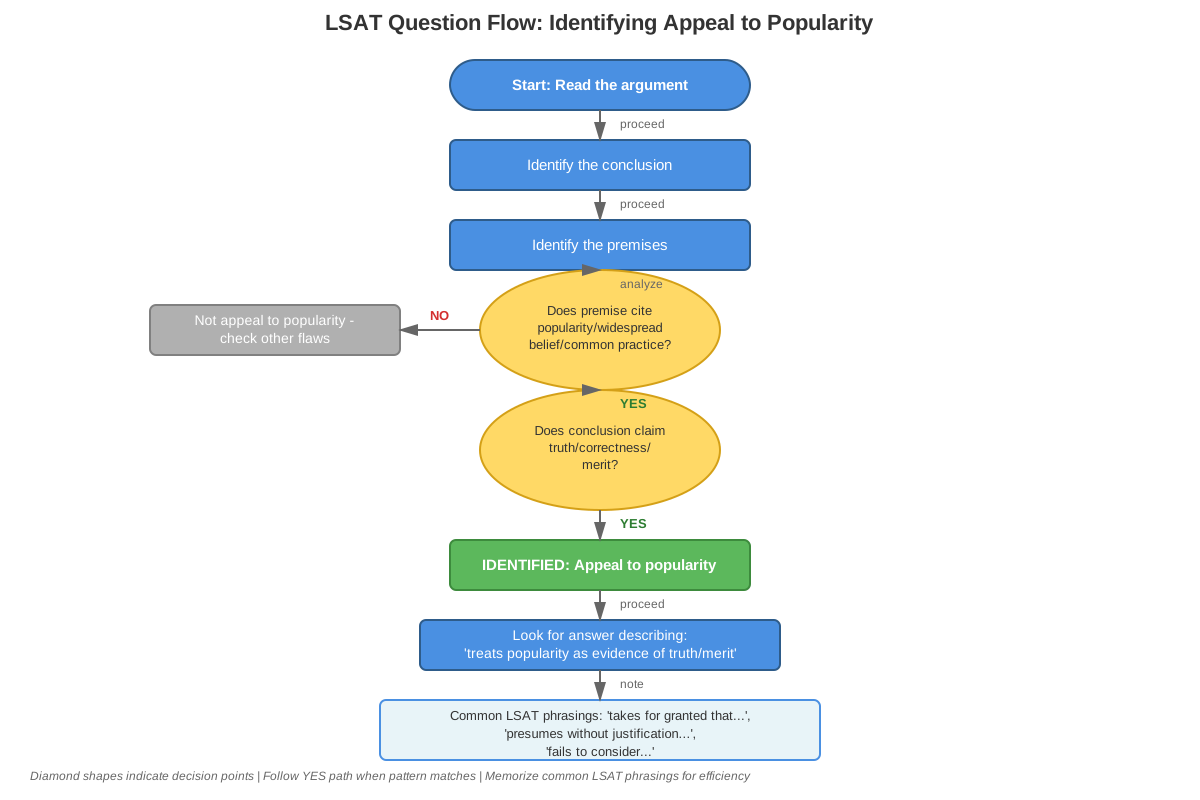
When encountering a potential appeal to popularity in flaw questions, follow this systematic process:
- Read the conclusion first: Identify what the argument is trying to prove. Is it a factual claim, a value judgment, a prediction, or a recommendation?
- Identify the evidence type: Look for premises that describe what people believe, what's popular, what's widely accepted, or what's commonly practiced.
- Check the logical gap: Ask whether the evidence about popularity actually supports the specific conclusion. Could the conclusion be false even if the popularity claim is true?
- Predict the flaw description: Before looking at answer choices, articulate the flaw in your own words: "This treats popularity as proof of [truth/quality/correctness]."
- Eliminate wrong answers: Remove choices that describe flaws not present in the argument, that mischaracterize the argument's structure, or that describe the argument's reasoning accurately rather than identifying a flaw.
Trigger Words and Recognition Patterns
Develop automatic recognition of these high-frequency triggers:
Direct popularity indicators: "most people," "majority," "widespread," "commonly," "generally accepted," "popular," "everyone," "few would dispute"
Implicit popularity indicators: "traditional," "conventional wisdom," "common sense," "time-tested," "proven by history," "long-standing practice"
Quantitative popularity: Specific percentages or numbers of people believing or doing something, best-seller status, market share data, survey results showing majority opinion
Exam Tip: When you see these triggers, immediately ask: "Is the argument using this popularity to prove something that popularity can't prove?" If yes, you've likely found an appeal to popularity flaw.
Answer Choice Patterns
The LSAT describes the appeal to popularity flaw using various formulations. Familiarize yourself with these common phrasings:
- "treats popular acceptance as sufficient evidence for truth"
- "confuses widespread belief with factual accuracy"
- "assumes that what is commonly believed must be true"
- "fails to consider that popularity doesn't establish correctness"
- "takes for granted that majority opinion indicates validity"
- "presumes that common practice justifies itself"
Incorrect answer choices often describe other flaws (circular reasoning, false dichotomy, correlation/causation) or describe the argument's reasoning without identifying it as flawed.
Time Management
Appeal to popularity questions typically require 60-90 seconds once you've mastered recognition:
- 15-20 seconds: Read and identify the argument structure
- 10-15 seconds: Recognize the appeal to popularity pattern
- 10-15 seconds: Predict the flaw description
- 20-30 seconds: Evaluate answer choices and eliminate
- 5-10 seconds: Confirm your selection
If you don't immediately recognize the flaw, don't spend more than 2 minutes total. Mark the question and return if time permits.
Memory Techniques
The "Popularity ≠ Proof" Mnemonic
Remember: P.O.P. - Popularity Offers Poor Proof
This acronym reminds you that widespread belief, no matter how universal, doesn't constitute logical evidence for truth claims.
The Historical Examples Anchor
Memorize 2-3 historical examples of popular but false beliefs to anchor your understanding:
- Geocentrism: For centuries, nearly everyone believed Earth was the center of the universe—popularity didn't make it true.
- Medical Bloodletting: Once the most popular medical treatment, later proven harmful—widespread practice didn't establish effectiveness.
- Flat Earth: Obvious example of popular belief contradicted by reality.
When you encounter an appeal to popularity on the exam, quickly recall one of these examples to confirm your identification of the flaw.
The "Crowd vs. Evidence" Visualization
Visualize two scales:
- Left scale: A crowd of people (representing popularity)
- Right scale: Scientific instruments, documents, data (representing actual evidence)
When an argument uses the left scale to prove something that requires the right scale, it commits appeal to popularity. This visual helps distinguish between opinion and evidence.
The Question Framework
Train yourself to automatically ask: "Would this conclusion still need proof if nobody believed it?"
If the answer is yes (factual claims always need evidence regardless of belief), then using popularity as proof commits the fallacy. If the answer is no (the conclusion is specifically about what people believe or prefer), then popularity may be relevant evidence.
Summary
The appeal to popularity represents a critical flaw pattern that appears frequently across LSAT Logical Reasoning questions. This fallacy occurs when arguments treat widespread belief, common practice, or popular acceptance as sufficient evidence for truth, correctness, or value—a logical error because popularity alone cannot establish validity. Mastering this concept requires understanding its basic structure (premise about what many people believe → conclusion that it must be true), recognizing its various forms and trigger language, and distinguishing contexts where popularity might be relevant from those where it's logically insufficient. The LSAT tests this concept across multiple question types, often disguising it within complex arguments or using subtle language about consensus. Success requires systematic analysis: identifying the conclusion type, recognizing popularity-based evidence, checking for the logical gap between belief and truth, and articulating the flaw using precise LSAT language. Students must avoid both under-applying the concept (missing subtle forms) and over-applying it (incorrectly flagging legitimate uses of consensus evidence, particularly expert agreement). The key insight is that factual claims require factual evidence, not opinion polls, regardless of how widespread the opinion may be.
Key Takeaways
- Appeal to popularity treats widespread belief or practice as proof of truth or correctness—a logical error because popularity doesn't establish validity
- This flaw appears in 10-15% of Logical Reasoning questions across multiple question types, making it essential for LSAT success
- Recognize trigger phrases like "most people believe," "widely accepted," "everyone knows," and "common sense tells us" as potential indicators
- The critical distinction involves whether popularity serves as evidence for an inappropriate conclusion (factual claims, moral truths) versus potentially relevant contexts (expert consensus, market success explanations)
- The LSAT frequently disguises this flaw through subtle language or implicit reliance on popularity rather than explicit statements
- Systematic analysis requires identifying the conclusion type, recognizing popularity-based premises, and checking whether the logical gap between belief and truth undermines the argument
- Articulate the flaw using precise LSAT language: "treats popular acceptance as sufficient evidence for truth" or "confuses widespread belief with factual accuracy"
Related Topics
Appeal to Authority: Understanding how arguments inappropriately rely on expert opinion without sufficient justification helps distinguish between different types of insufficient evidence flaws. While appeal to popularity relies on general public opinion, appeal to authority relies on expert opinion—both can be fallacious depending on context.
Sampling Flaws: Arguments sometimes combine appeal to popularity with sampling errors, using an unrepresentative group's beliefs to claim widespread acceptance. Mastering both concepts enables recognition of compound flaws.
Necessary vs. Sufficient Assumptions: The appeal to popularity rests on treating popularity as sufficient evidence when it isn't. Understanding assumption questions deepens recognition of the unstated premises underlying this flaw.
Strengthen and Weaken Questions: Once you've mastered identifying the appeal to popularity flaw, you can better evaluate what evidence would strengthen or weaken arguments that rely on popularity—typically by providing or undermining substantive evidence beyond mere consensus.
Correlation vs. Causation: Both fallacies involve drawing unwarranted conclusions from insufficient evidence. Understanding their relationship helps recognize when arguments commit multiple reasoning errors simultaneously.
Practice CTA
Now that you've mastered the theoretical foundation of appeal to popularity, it's time to cement your understanding through active practice. Attempt the practice questions to test your ability to identify this flaw in various contexts and question types. Use the flashcards to reinforce trigger phrases and key distinctions. Remember: recognizing this pattern quickly and accurately will save you valuable time on test day and significantly boost your Logical Reasoning score. The more you practice identifying appeal to popularity in different forms, the more automatic your recognition will become—transforming this high-yield concept into consistent points on exam day.
Sign up free to keep reading
Create a free AnvayaPrep account to finish this LSAT guide on Appeal to popularity — plus flashcards and practice questions.