Overview
The comparison flaw is one of the most frequently tested logical fallacies on the LSAT Logical Reasoning section. This flaw occurs when an argument draws a conclusion by comparing two or more things, but the comparison itself is flawed, incomplete, or based on insufficient information. Understanding this flaw is essential because it appears in approximately 10-15% of all flaw questions on the LSAT, making it a high-yield topic that can significantly impact your score.
At its core, the lsat comparison flaw exploits our natural tendency to accept comparisons at face value without scrutinizing whether the things being compared are truly comparable or whether the comparison provides adequate support for the conclusion. Arguments containing this flaw might compare dissimilar things, fail to provide a relevant basis for comparison, or draw conclusions that go beyond what the comparison actually establishes. Recognizing these patterns requires careful attention to what is being compared, on what basis, and whether that comparison legitimately supports the argument's conclusion.
Within the broader landscape of logical reasoning, comparison flaws connect closely to other common reasoning errors such as sampling flaws, causal reasoning errors, and necessary/sufficient condition confusion. Mastering comparison flaws strengthens your ability to identify structural weaknesses in arguments generally, as many LSAT arguments combine multiple flaws. The analytical skills developed through studying comparison flaws—particularly the ability to identify missing information and unwarranted assumptions—transfer directly to other question types including Strengthen, Weaken, and Assumption questions.
Learning Objectives
- [ ] Identify how Comparison flaw appears in LSAT questions
- [ ] Explain the reasoning pattern behind Comparison flaw
- [ ] Apply Comparison flaw to solve LSAT-style problems accurately
- [ ] Distinguish between valid and invalid comparisons in argumentative contexts
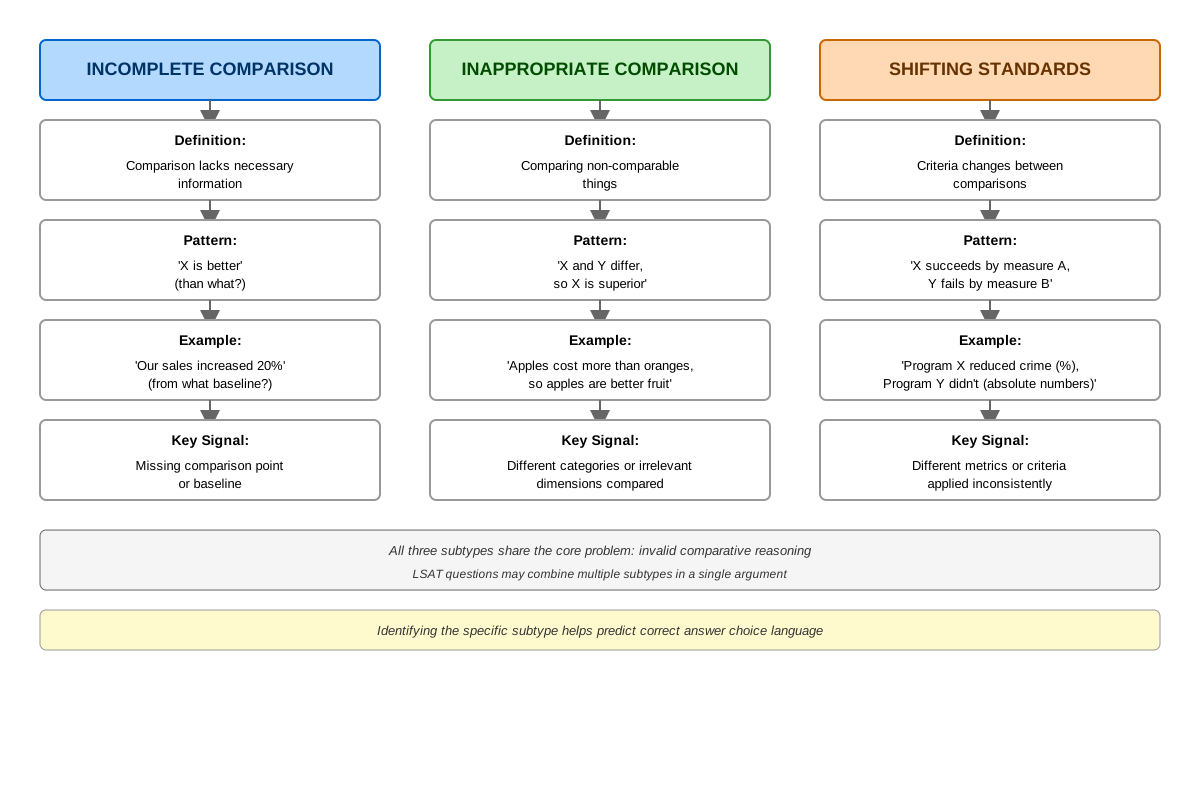
- [ ] Recognize the specific subtypes of comparison flaws (incomplete comparisons, inappropriate comparisons, and shifting standards)
- [ ] Predict answer choice language that correctly describes comparison flaws
- [ ] Evaluate whether additional information would remedy a comparison flaw
Prerequisites
- Basic argument structure: Understanding premises and conclusions is essential because comparison flaws involve evaluating whether comparative premises adequately support comparative conclusions
- Conditional reasoning fundamentals: Many comparison flaws involve confusing necessary and sufficient conditions when drawing comparative conclusions
- Understanding of what constitutes a logical flaw: Students must recognize that a flaw represents a gap between premises and conclusion, not merely a false premise
- Familiarity with LSAT question stems: Recognizing flaw question stems helps students know when to actively search for comparison flaws
Why This Topic Matters
Comparison flaws appear throughout everyday reasoning, from advertising claims ("Our product is better!") to policy debates ("Country X's approach is superior to ours"). The LSAT tests this concept because legal reasoning constantly requires evaluating analogies, precedents, and comparative arguments. Attorneys must assess whether one case truly resembles another, whether statistical comparisons are meaningful, and whether proposed solutions that worked in one context will transfer to another.
On the LSAT specifically, comparison flaws appear in 15-20% of all flaw questions, which themselves constitute approximately 15% of Logical Reasoning questions. This means that in a typical Logical Reasoning section with 25-26 questions, you can expect to encounter 2-4 questions where recognizing a comparison flaw is either the primary task or a valuable elimination tool. These questions appear across all difficulty levels, from relatively straightforward incomplete comparisons to sophisticated arguments involving multiple comparative claims.
The comparison flaw manifests in several common patterns on the LSAT: arguments comparing survey results without establishing comparable samples, arguments comparing past and present situations without accounting for relevant differences, arguments comparing two options while ignoring other alternatives, and arguments drawing conclusions about relative superiority based on a single dimension of comparison. Test-makers favor comparison flaws because they can be disguised in various contexts—scientific studies, business decisions, historical analyses, and policy recommendations—making pattern recognition essential.
Core Concepts
The Basic Structure of a Comparison Flaw
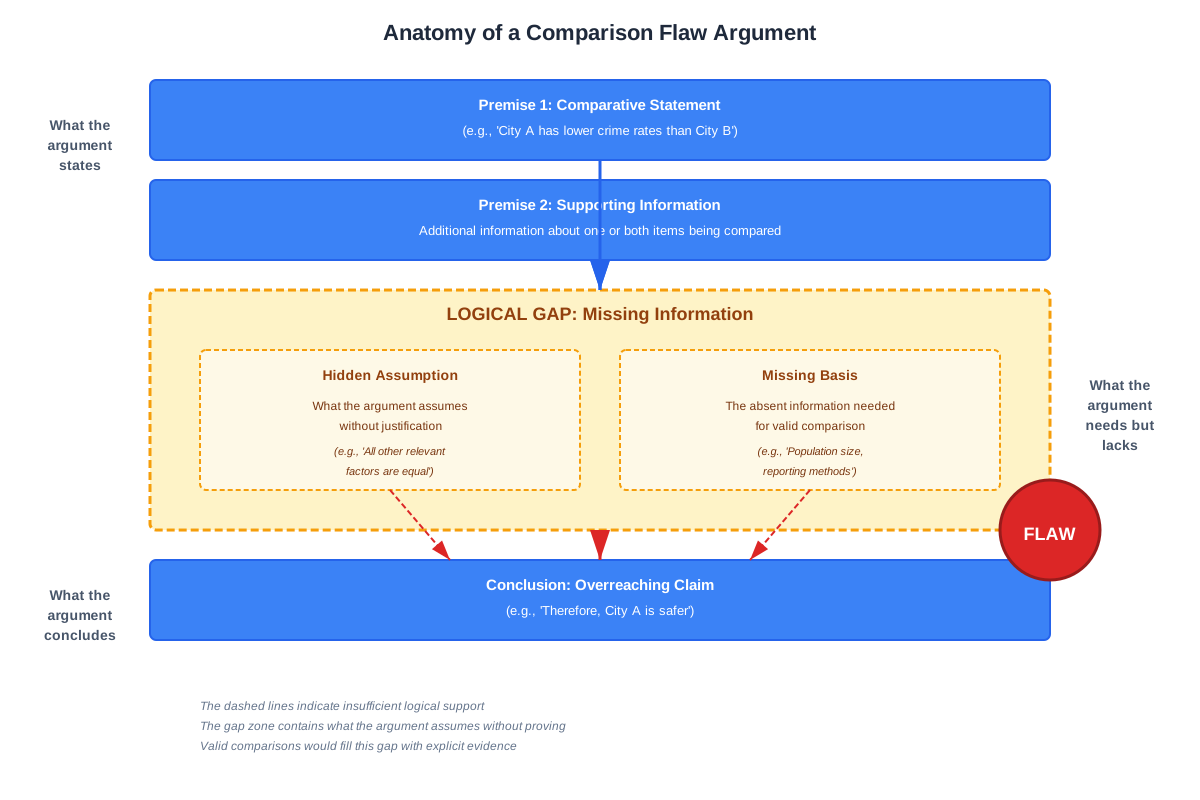
A comparison flaw occurs when an argument's conclusion depends on a comparison, but the comparison itself is inadequate to support that conclusion. The fundamental pattern involves:
- Premise(s): Information about two or more things being compared
- Conclusion: A claim about the relative superiority, similarity, or difference between those things
- Flaw: The comparison fails to establish what the conclusion claims
The flaw typically arises because the argument assumes that the things being compared are comparable in relevant respects, or because the comparison is incomplete in ways that undermine the conclusion. Unlike arguments with false premises, comparison flaw arguments may have entirely true premises—the problem lies in the logical relationship between those premises and the conclusion.
Types of Comparison Flaws
Incomplete Comparisons
The most common subtype involves comparisons that lack crucial information needed to draw the stated conclusion. The argument presents data about one thing but fails to provide corresponding data about the thing(s) it's being compared to.
Example pattern: "Company A's profits increased by 20% last year. Therefore, Company A performed better than Company B."
The flaw: We have no information about Company B's performance. Perhaps Company B's profits increased by 40%, or perhaps Company B operates in a different industry where 20% growth would be exceptional. The comparison is incomplete because it provides information about only one of the two things being compared.
Inappropriate Comparisons
These flaws involve comparing things that differ in relevant respects that undermine the comparison's validity. The argument treats two situations, groups, or entities as comparable when significant differences make the comparison problematic.
Example pattern: "Drug X reduced symptoms in laboratory mice. Therefore, Drug X will be effective for humans with the same condition."
The flaw: Mice and humans differ in physiologically relevant ways. The comparison assumes that results in one population transfer to another without establishing that the populations are similar in respects relevant to the conclusion.
Shifting Standards or Bases of Comparison
Some comparison flaws involve changing what aspect is being compared or applying different standards to different things being compared.
Example pattern: "Restaurant A serves larger portions than Restaurant B. Restaurant B uses higher-quality ingredients than Restaurant A. Therefore, Restaurant A provides better value."
The flaw: The conclusion about "value" shifts between different bases of comparison (portion size vs. ingredient quality) without establishing which standard is appropriate or how to weigh these different factors.
The Comparison Flaw vs. Valid Comparative Reasoning
Understanding what makes a comparison valid helps identify when comparisons are flawed:
| Valid Comparison | Flawed Comparison |
|---|---|
| Provides relevant data about all things being compared | Provides data about only some things being compared |
| Compares things similar in relevant respects | Compares things that differ in ways that matter to the conclusion |
| Uses consistent standards/criteria | Shifts standards or applies different criteria |
| Acknowledges limitations of the comparison | Treats the comparison as definitively establishing the conclusion |
| Conclusion follows from what the comparison establishes | Conclusion goes beyond what the comparison shows |
Common Comparison Flaw Scenarios on the LSAT
Temporal Comparisons: Arguments comparing past and present (or present and future) without accounting for relevant changes in circumstances. Example: "This policy worked in the 1950s, so it will work now."
Statistical Comparisons: Arguments comparing percentages, rates, or proportions without providing absolute numbers or relevant context. Example: "City A has a higher crime rate than City B, so City A is more dangerous" (without considering that City A might be much larger).
Selective Comparisons: Arguments that compare on one dimension while ignoring other relevant dimensions. Example: "Car X gets better gas mileage than Car Y, so Car X is the better vehicle" (ignoring safety, reliability, cost, etc.).
Sample Comparisons: Arguments comparing results from different samples without establishing that the samples are comparable. Example: "In our survey, 60% preferred Brand A, while a competitor's survey found only 40% preferred Brand A, so our survey is more accurate" (without considering differences in survey methodology, sample selection, etc.).
Identifying Comparison Flaws in Arguments
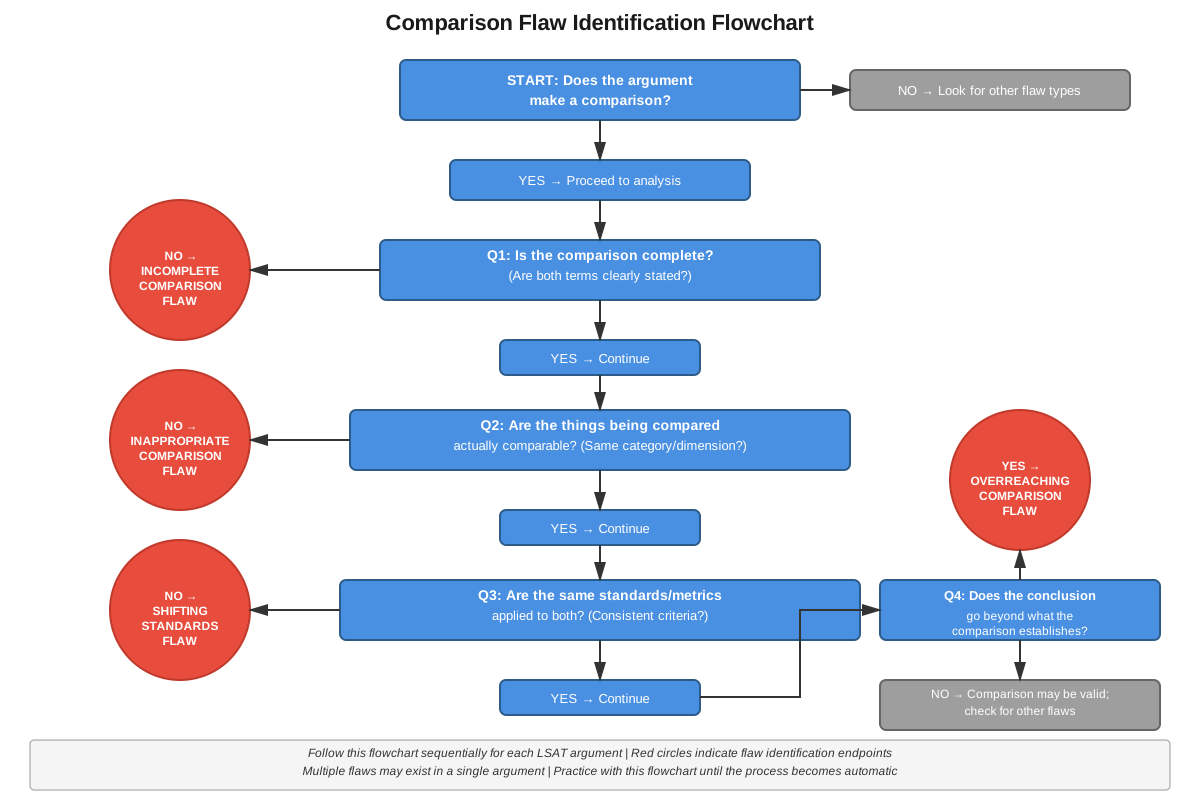
When analyzing an argument for potential comparison flaws, apply this systematic approach:
- Identify the conclusion: What comparative claim is being made?
- Locate the comparison: What things are being compared, and on what basis?
- Check for completeness: Is information provided about all things being compared?
- Assess comparability: Are the things being compared similar in relevant respects?
- Evaluate the standard: Is a consistent standard being applied?
- Test the inference: Does the comparison actually support the conclusion, or does the conclusion go beyond what the comparison establishes?
Concept Relationships
The comparison flaw connects to several other logical reasoning concepts in important ways. Incomplete comparisons often overlap with sampling flaws, particularly when arguments compare survey results or study findings without establishing that the samples are comparable. For instance, an argument might commit both a comparison flaw (failing to provide information about both things being compared) and a sampling flaw (using an unrepresentative sample).
Comparison flaws → relate to → Causal reasoning errors when arguments compare two situations and conclude that a difference in outcomes must be due to a particular factor, without ruling out other relevant differences. The comparison flaw involves treating the situations as comparable, while the causal error involves inferring causation from correlation.
Inappropriate comparisons → connect to → Analogy evaluation because both involve assessing whether two things are sufficiently similar to draw conclusions from one to the other. The skills used to identify comparison flaws transfer directly to Parallel Reasoning and Parallel Flaw questions.
Shifting standards in comparisons → relate to → Equivocation because both involve using terms or concepts inconsistently. When an argument shifts what basis of comparison it uses, it commits a type of equivocation error.
The relationship map: Argument structure → enables identification of → Comparison in premises/conclusion → analysis reveals → Type of comparison flaw (incomplete/inappropriate/shifting) → which connects to → Other flaw types (sampling, causation, etc.) → all supporting → Answer choice prediction and elimination.
High-Yield Facts
⭐ Comparison flaws appear in 15-20% of all flaw questions on the LSAT, making them one of the most frequently tested flaw types.
⭐ The most common comparison flaw involves incomplete comparisons where the argument provides information about one thing but not the thing(s) it's being compared to.
⭐ Correct answer choices for comparison flaw questions typically use language like "fails to establish that the things compared are comparable," "provides information about only one of the things being compared," or "overlooks the possibility that the comparison is based on dissimilar cases."
⭐ Temporal comparisons (past vs. present or present vs. future) are especially common and typically fail to account for relevant changes in circumstances over time.
⭐ Statistical comparison flaws often involve comparing percentages without providing absolute numbers or comparing rates without considering relevant differences in the populations being measured.
- Comparison flaws can appear in any argument type (causal, conditional, statistical, analogical), making them versatile for test-makers.
- Arguments with comparison flaws often use trigger words like "better," "worse," "more," "less," "superior," "inferior," "similarly," and "likewise."
- Valid comparisons require that things be similar in respects relevant to the conclusion, not necessarily similar in all respects.
- Comparison flaws differ from false premises—the information provided may be entirely true, but insufficient to support the comparative conclusion.
- Many comparison flaw arguments commit multiple flaws simultaneously, so identifying the comparison flaw doesn't mean other flaws aren't present.
- Answer choices that merely state "the premises are false" or "the conclusion is false" do not correctly identify comparison flaws, which are structural problems.
Quick check — test yourself on Comparison flaw so far.
Try Flashcards →Common Misconceptions
Misconception: Any argument that makes a comparison contains a comparison flaw.
Correction: Comparisons are valid when they provide sufficient information about all things being compared, compare things similar in relevant respects, and draw conclusions that follow from what the comparison establishes. Only inadequate comparisons constitute flaws.
Misconception: If two things differ in any way, comparing them is automatically flawed.
Correction: What matters is whether the things being compared are similar in respects relevant to the conclusion. Two things can differ in many ways while still being appropriately comparable for a specific purpose. For example, comparing two cities' public transportation systems is valid even though the cities differ in climate, culture, and history—those differences aren't relevant to transportation system effectiveness.
Misconception: Comparison flaws only occur when an argument explicitly uses comparative language like "better" or "more."
Correction: Comparison flaws can be implicit. An argument might conclude "We should adopt Policy X" based on "Policy X worked in Country Y," which involves an implicit comparison between the current situation and Country Y without explicitly using comparative language.
Misconception: Pointing out that an argument "doesn't consider other options" always identifies a comparison flaw.
Correction: Failing to consider alternatives is a separate flaw type. A comparison flaw specifically involves problems with how two or more things are compared, not merely the failure to consider additional options. However, some arguments commit both flaws.
Misconception: If an argument provides some information about both things being compared, the comparison is complete.
Correction: A comparison is complete only when it provides information about both things on the same relevant dimension. An argument might tell us that Company A's profits increased and that Company B hired new employees, but this doesn't provide a complete comparison of their financial performance because it doesn't tell us about Company B's profits.
Misconception: Statistical comparisons are automatically flawed if they don't provide every possible piece of information.
Correction: The question is whether the comparison provides sufficient information to support the conclusion, not whether it provides all possible information. A comparison can be valid even if additional information would be helpful, as long as the information provided adequately supports the conclusion drawn.
Worked Examples
Example 1: Incomplete Statistical Comparison
Argument: "A recent study found that 15% of patients taking Drug A experienced side effects. This shows that Drug A is safer than Drug B."
Analysis:
Step 1 - Identify the conclusion: Drug A is safer than Drug B (a comparative claim).
Step 2 - Identify the comparison: The argument compares Drug A and Drug B in terms of safety.
Step 3 - Examine the evidence: We're told that 15% of Drug A patients experienced side effects. What about Drug B? The argument provides no information about Drug B's side effect rate.
Step 4 - Identify the flaw: This is a classic incomplete comparison. To conclude that Drug A is safer than Drug B, we need information about both drugs' safety profiles. Perhaps 10% of Drug B patients experience side effects (making Drug B safer), or perhaps 30% do (making Drug A safer), or perhaps the side effects differ in severity. Without information about Drug B, the comparison cannot support the conclusion.
Step 5 - Predict answer choice language: The correct answer will likely say something like "fails to provide information about the side effects of Drug B" or "provides evidence about only one of the drugs being compared."
Connection to learning objectives: This example demonstrates how to identify a comparison flaw (incomplete comparison), explains the reasoning pattern (drawing a comparative conclusion without information about all things being compared), and shows how to apply this knowledge to predict correct answer choices.
Example 2: Inappropriate Comparison with Shifting Standards
Argument: "City Council Member: We should reduce funding for the arts program and increase funding for road maintenance. Last year, the arts program served 5,000 residents, while poor road conditions affected 50,000 residents. Clearly, road maintenance should be our priority."
Analysis:
Step 1 - Identify the conclusion: Road maintenance should be prioritized over the arts program (implied: road maintenance is more important/valuable).
Step 2 - Identify the comparison: The argument compares the arts program and road maintenance.
Step 3 - Examine the basis of comparison: The argument compares these programs based on the number of people affected—5,000 vs. 50,000.
Step 4 - Identify the flaw: This argument commits multiple comparison-related errors. First, it's an inappropriate comparison because it compares "served" (for arts) with "affected by poor conditions" (for roads)—these aren't parallel measures. Being "served" by an arts program is positive, while being "affected by poor road conditions" is negative. Second, the argument assumes that the number of people affected is the only relevant factor in determining priority, ignoring other considerations like severity of impact, cost-effectiveness, long-term benefits, or the city's obligations. Third, it treats these as the only two options without considering whether both could be funded or whether other programs should be cut instead.
Step 5 - Predict answer choice language: The correct answer might say "bases a comparison on evidence that is not parallel" or "assumes that the number of people affected is the only relevant consideration in determining funding priorities" or "fails to establish that the two programs are comparable in relevant respects."
Connection to learning objectives: This example shows how comparison flaws can be more sophisticated, involving inappropriate comparisons and shifting standards. It demonstrates the importance of examining not just whether information is provided about both things being compared, but whether the comparison is made on an appropriate and consistent basis.
Exam Strategy
Recognizing Comparison Flaw Questions
When you see a flaw question stem ("The reasoning in the argument is flawed because it..."), immediately scan the argument for comparative language. Trigger words include: better, worse, more, less, superior, inferior, greater, smaller, higher, lower, similarly, likewise, in contrast, compared to, than, as...as, and relative to.
However, don't rely solely on explicit comparative language. Watch for implicit comparisons, such as:
- Recommendations based on what worked elsewhere ("Country X did this, so we should too")
- Conclusions about one thing based on evidence about something else
- Arguments that something is "good" or "bad" based on a single data point (implicitly comparing to an unstated standard)
Systematic Approach to Comparison Flaw Questions
- Identify what's being compared: Write down or mentally note the two (or more) things being compared.
- Identify the basis of comparison: On what dimension or criterion are they being compared? (cost, effectiveness, safety, popularity, etc.)
- Check for information about all items: Does the argument provide relevant information about everything being compared?
- Assess comparability: Are the things being compared similar enough in relevant respects to make the comparison valid?
- Evaluate the conclusion: Does the conclusion follow from what the comparison actually establishes, or does it go beyond the evidence?
Process of Elimination Tips
Eliminate answer choices that:
- Describe flaws the argument doesn't commit (even if they're real flaw types)
- Focus on the truth of the premises rather than the logical structure
- Are too vague to specifically identify the comparison problem
- Describe the argument's reasoning accurately (these aren't flaws)
Keep answer choices that:
- Use language about "failing to establish comparability"
- Point out missing information about one of the things being compared
- Identify that the comparison is based on dissimilar cases
- Note that different standards are applied to different things being compared
- Indicate that the conclusion goes beyond what the comparison establishes
Time Management
Comparison flaw questions are typically medium difficulty and should take 1:00-1:30 minutes. If you quickly identify the comparison flaw, you can often eliminate wrong answers rapidly because they'll describe entirely different flaws. However, if the argument commits multiple flaws, you may need extra time to determine which flaw the answer choices focus on.
Exam Tip: If you're stuck between two answer choices on a comparison flaw question, ask yourself: "Does this answer choice specifically address the comparison, or is it describing a different aspect of the argument?" The correct answer will directly address the comparative reasoning.
Memory Techniques
The "COMPARE" Acronym
Use COMPARE to remember what to check in comparative arguments:
- Completeness: Is information provided about all things being compared?
- On what basis: What dimension or criterion is used for comparison?
- Matching standards: Are consistent standards applied?
- Parallel information: Is the same type of information provided about each thing?
- Appropriate subjects: Are the things being compared similar in relevant respects?
- Relevant to conclusion: Does the comparison support the specific conclusion drawn?
- Evidence sufficient: Is the comparative evidence adequate for the comparative claim?
Visualization Strategy
Picture a balance scale when evaluating comparisons. To conclude that one side is "heavier" (better, more, superior), you need:
- Something on both sides of the scale (information about both things)
- The same type of items on each side (parallel, comparable information)
- A fair scale (consistent standards)
If any of these elements is missing, the comparison is flawed.
The "Missing Twin" Mnemonic
For incomplete comparisons, think of the "missing twin": The argument talks about one twin but draws a conclusion about how that twin compares to the other twin without telling us anything about the missing twin. This image helps you remember that comparative conclusions require information about all things being compared.
Summary
The comparison flaw is a high-yield LSAT concept that appears in 15-20% of flaw questions. It occurs when an argument draws a comparative conclusion but the comparison itself is inadequate—either because it's incomplete (lacking information about all things being compared), inappropriate (comparing things that differ in relevant respects), or based on shifting standards. Recognizing comparison flaws requires systematically checking whether the argument provides sufficient, parallel information about all things being compared, whether those things are comparable in respects relevant to the conclusion, and whether the conclusion follows from what the comparison actually establishes. The key insight is that comparison flaws are structural problems: even if all the premises are true, the comparison doesn't adequately support the conclusion. Mastering this concept requires practice identifying the various forms comparison flaws take—from incomplete statistical comparisons to inappropriate temporal comparisons to shifting bases of comparison—and learning to predict answer choice language that accurately describes these flaws.
Key Takeaways
- Comparison flaws occur when an argument's comparative conclusion isn't adequately supported by the comparison in the premises—the comparison is incomplete, inappropriate, or based on inconsistent standards.
- The most common subtype is the incomplete comparison, where information is provided about one thing but not the thing(s) it's being compared to, yet a comparative conclusion is drawn.
- Valid comparisons require information about all things being compared, on the same relevant dimension, using consistent standards, and the things compared must be similar in respects relevant to the conclusion.
- Trigger words like "better," "more," "superior," and "than" signal potential comparison flaws, but comparisons can also be implicit in arguments about what worked elsewhere or recommendations based on analogies.
- Correct answer choices typically use language about "failing to establish comparability," "providing information about only one thing," or "basing a comparison on dissimilar cases."
- Comparison flaws differ from false premises—the information provided may be entirely accurate, but insufficient to support the comparative conclusion drawn.
- Systematic analysis using the COMPARE acronym helps identify comparison flaws: check Completeness, basis, Matching standards, Parallel information, Appropriate subjects, Relevance, and Evidence sufficiency.
Related Topics
Sampling Flaws: Understanding sampling flaws deepens your ability to recognize comparison flaws involving surveys or studies, as arguments often compare results from different samples without establishing that the samples are comparable. Mastering comparison flaws provides a foundation for recognizing when sample differences undermine comparative conclusions.
Causal Reasoning Errors: Many causal arguments involve implicit comparisons (comparing situations with and without the alleged cause), so comparison flaw skills transfer directly to evaluating causal claims. Understanding comparison flaws helps you recognize when causal arguments fail to establish that compared situations are similar in relevant respects.
Necessary vs. Sufficient Conditions: Some comparison flaws involve confusing necessary and sufficient conditions when drawing comparative conclusions. The logical reasoning skills developed through studying comparison flaws strengthen your ability to evaluate conditional reasoning generally.
Strengthen and Weaken Questions: Once you understand comparison flaws, you can more effectively identify what information would strengthen or weaken arguments containing comparisons. Many Strengthen questions ask you to provide missing comparative information, while Weaken questions often introduce relevant differences between things being compared.
Parallel Reasoning: Parallel Reasoning questions require evaluating whether two arguments have the same logical structure, which often involves assessing whether both make similar types of comparisons. Understanding comparison flaws helps you recognize when arguments are structurally parallel in their comparative reasoning.
Practice CTA
Now that you've mastered the core concepts of comparison flaws, it's time to put your knowledge into practice. Work through the practice questions to reinforce your ability to identify incomplete comparisons, inappropriate comparisons, and shifting standards in real LSAT-style arguments. Use the flashcards to drill the key concepts and trigger words until recognizing comparison flaws becomes automatic. Remember: comparison flaws appear in 15-20% of flaw questions, so every minute you invest in mastering this topic directly translates to points on test day. You've built a strong foundation—now strengthen it through deliberate practice!
Sign up free to keep reading
Create a free AnvayaPrep account to finish this LSAT guide on Comparison flaw — plus flashcards and practice questions.