Overview
The division fallacy represents one of the most frequently tested logical errors on the LSAT, appearing regularly in flaw questions throughout the Logical Reasoning section. This fallacy occurs when an argument incorrectly assumes that what is true of a whole must also be true of its individual parts or members. Understanding this reasoning error is crucial because it tests a fundamental principle of logic: properties that apply to groups or collections do not automatically transfer to individual components.
On the LSAT, the lsat division fallacy appears in various disguises, making it essential for test-takers to recognize its underlying structure rather than memorizing specific examples. The fallacy exploits our natural tendency to make intuitive leaps about relationships between wholes and parts. For instance, just because a sports team is the best in the league doesn't mean each individual player is the best at their position. The LSAT frequently constructs arguments that make precisely this type of flawed inference, and recognizing this pattern can help students quickly identify correct answers in flaw questions, strengthen/weaken questions, and assumption questions.
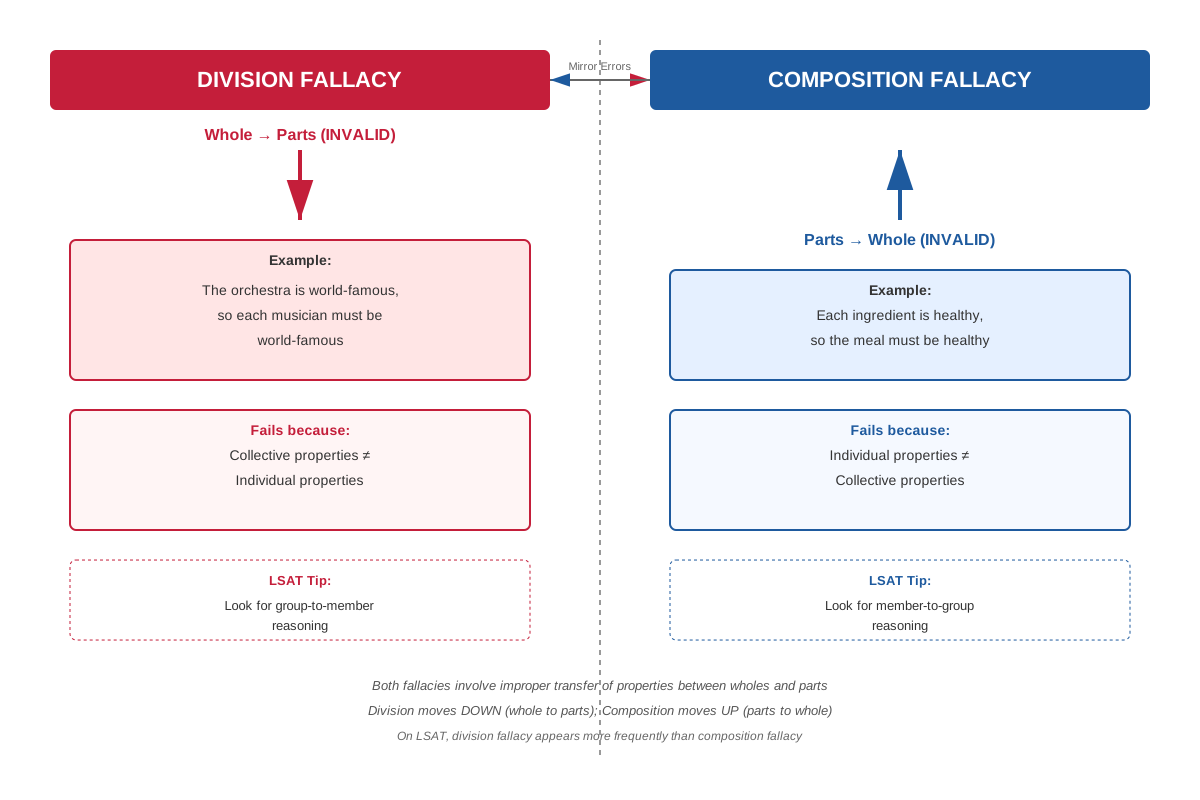
The division fallacy sits within a broader family of composition and division errors in logical reasoning. While the composition fallacy moves incorrectly from parts to whole, the division fallacy moves incorrectly from whole to parts. Mastering this distinction and recognizing both patterns enhances overall performance on LSAT Logical Reasoning sections, as these fallacies often appear alongside other common reasoning errors such as hasty generalizations, sampling errors, and equivocation. Understanding the division fallacy also strengthens analytical skills needed for Reading Comprehension passages that present flawed arguments about groups and their members.
Learning Objectives
- [ ] Identify how Division fallacy appears in LSAT questions
- [ ] Explain the reasoning pattern behind Division fallacy
- [ ] Apply Division fallacy to solve LSAT-style problems accurately
- [ ] Distinguish between division fallacy and composition fallacy in complex arguments
- [ ] Recognize subtle variations of division fallacy across different question types
- [ ] Predict common wrong answer choices that exploit misunderstanding of the division fallacy
- [ ] Construct valid counterexamples to arguments containing the division fallacy
Prerequisites
- Basic logical structure: Understanding premises and conclusions is necessary to identify where the flawed reasoning occurs in an argument
- Whole-part relationships: Recognizing how groups relate to their members provides the foundation for understanding why properties don't automatically transfer
- Flaw question format: Familiarity with how the LSAT asks about reasoning errors helps students apply division fallacy knowledge effectively
- Categorical reasoning: Understanding how properties apply to categories versus individuals enables recognition of improper transfers of attributes
Why This Topic Matters
The division fallacy appears in approximately 3-5 questions per LSAT administration, making it one of the higher-frequency logical errors tested. Beyond its direct appearance in flaw questions, understanding this fallacy helps students evaluate arguments in strengthen/weaken questions, assumption questions, and even parallel reasoning questions where similar logical structures appear.
In real-world contexts, the division fallacy underlies many common reasoning errors in policy debates, business decisions, and everyday arguments. When someone argues that because a company is profitable, every department must be profitable, or that because a country is wealthy, all its citizens must be wealthy, they commit the division fallacy. Recognizing this error pattern develops critical thinking skills applicable far beyond the LSAT.
On the exam, the division fallacy most commonly appears in:
- Flaw questions asking students to identify the reasoning error (40% of division fallacy appearances)
- Assumption questions where the correct answer bridges the gap between group and individual properties (30%)
- Weaken questions where counterexamples show individual members lacking the group property (20%)
- Parallel reasoning questions requiring identification of similar logical structures (10%)
The LSAT particularly favors division fallacy questions involving statistical properties (averages, percentages), collective properties (being large, being successful), and evaluative properties (being good, being efficient). Test-makers know these contexts naturally invite the fallacy because students intuitively but incorrectly transfer these properties from groups to individuals.
Core Concepts
Definition and Structure of Division Fallacy
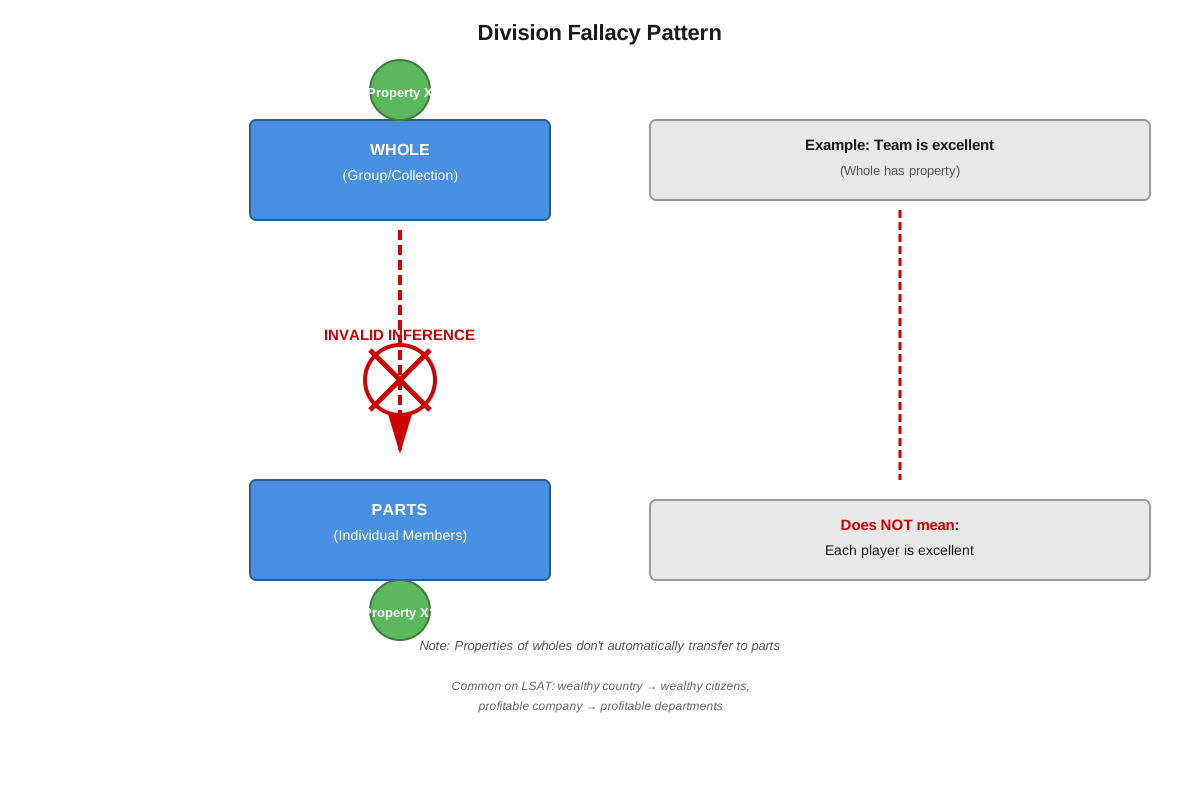
The division fallacy is a formal logical error that occurs when an argument assumes that a property true of a whole entity, group, or collection must necessarily be true of its individual parts or members. The fallacy's name derives from the act of "dividing" a group property and incorrectly distributing it to individuals.
The basic logical structure follows this pattern:
- Group X has property P
- Individual Y is a member/part of group X
- Therefore, individual Y has property P (INVALID INFERENCE)
This reasoning pattern fails because many properties are collective properties—characteristics that apply to groups as unified entities but not to their constituent parts. These properties emerge from the relationships, arrangements, or aggregations of parts rather than existing in each part independently.
Types of Properties That Cannot Be Divided
Understanding which properties can and cannot transfer from wholes to parts is crucial for identifying the division fallacy on the LSAT.
Collective Properties (cannot be divided):
- Statistical properties: averages, medians, percentages
- Size-related properties: being large, being numerous, being widespread
- Relational properties: being diverse, being balanced, being distributed
- Emergent properties: being successful (as an organization), being powerful (as a group)
Distributive Properties (can be divided):
- Intrinsic physical properties: being made of carbon, being organic
- Essential characteristics: being human (if the group is "all humans")
- Necessary conditions: being alive (for a group of living things)
| Property Type | Example | Can Divide? | Explanation |
|---|---|---|---|
| Average/Statistical | Team's average height is 6'2" | No | Individual players may be shorter or taller |
| Collective Success | Company is profitable | No | Individual departments may lose money |
| Size | Orchestra is large | No | Individual musicians are not large |
| Material Composition | Statue is bronze | Yes | Each part of the statue is bronze |
| Necessary Condition | All members are certified | Yes | Each individual must be certified |
Common LSAT Contexts for Division Fallacy
The LSAT presents division fallacy in several recurring contexts that students should recognize immediately:
Economic/Business Context: Arguments claiming that because a company, industry, or economy has certain financial characteristics, individual businesses, workers, or transactions must share those characteristics.
Example: "The technology sector generated record profits last year. Therefore, TechStart Inc., a technology company, must have been profitable last year."
Statistical Context: Arguments that apply group averages, percentages, or aggregate data to individual cases without justification.
Example: "Students at this university have an average GPA of 3.5. Therefore, Maria, who attends this university, likely has a GPA around 3.5."
Organizational Context: Arguments assuming that qualities of institutions, teams, or organizations automatically apply to individual members.
Example: "The research team won the prestigious award for groundbreaking work. Each researcher on the team must have made a groundbreaking contribution."
Evaluative Context: Arguments transferring value judgments or quality assessments from groups to individuals.
Example: "This is the best orchestra in the country. Therefore, each musician in this orchestra must be the best at their instrument in the country."
Distinguishing Division from Composition Fallacy
The division fallacy has a mirror image called the composition fallacy, which moves incorrectly in the opposite direction—from parts to whole. Understanding both helps students avoid confusion:
Division Fallacy: Whole → Parts (incorrectly)
- "The team is excellent, so each player is excellent"
Composition Fallacy: Parts → Whole (incorrectly)
- "Each player is excellent, so the team is excellent"
The LSAT sometimes tests whether students can distinguish these related but opposite errors. The key is identifying the direction of inference: Does the argument start with a claim about the group and conclude something about individuals (division), or start with claims about individuals and conclude something about the group (composition)?
Valid Whole-Part Reasoning
Not all reasoning from wholes to parts is fallacious. Valid whole-part inferences occur when:
- The property is genuinely distributive: "All members of the committee are lawyers, so Jennifer, a committee member, is a lawyer"
- The argument includes proper qualification: "The company's average salary is $75,000, so most employees earn somewhere in that range, though individual salaries vary"
- The reasoning acknowledges exceptions: "The team generally performs well, suggesting that most players are competent, though some may be weaker"
The division fallacy occurs specifically when arguments treat collective properties as if they were distributive without justification or qualification.
Concept Relationships
The division fallacy connects to several other logical reasoning concepts, forming a network of related ideas:
Division Fallacy ↔ Composition Fallacy: These are inverse errors, both involving improper transfer of properties between wholes and parts. Mastering one helps identify the other by recognizing the direction of flawed inference.
Division Fallacy → Sampling Errors: Both involve improper generalizations. Division fallacy assumes a specific individual matches group characteristics; sampling errors assume a sample represents a population. The division fallacy can be viewed as an extreme sampling error where group data is applied to a single case.
Division Fallacy → Equivocation: Some division fallacies involve subtle shifts in meaning. A term might refer to a collective property in the premise but an individual property in the conclusion, creating an equivocation that enables the fallacy.
Division Fallacy → Necessary vs. Sufficient Conditions: Understanding this distinction helps identify when whole-part reasoning is valid. If being part of a group is sufficient for having a property, the inference is valid; if it's merely necessary or neither, the inference may be fallacious.
Statistical Reasoning → Division Fallacy: Many division fallacies involve misapplication of statistical concepts like averages, percentages, and distributions. Strong statistical reasoning helps students recognize when aggregate data cannot be applied to individuals.
The relationship map:
Statistical Properties → Division Fallacy ← Composition Fallacy
                              ↓
                    Improper Generalization
                              ↓
                    Sampling Errors & Hasty Generalization
High-Yield Facts
⭐ The division fallacy assumes properties of a whole automatically apply to its parts without justification
⭐ Statistical properties (averages, percentages, totals) are the most common type of collective property that cannot be divided
⭐ The division fallacy appears in 3-5 questions per LSAT, making it a high-frequency error pattern
⭐ Flaw questions are the most common question type featuring division fallacy, followed by assumption questions
⭐ The division fallacy moves from general (group) to specific (individual), while composition fallacy moves from specific to general
- Collective properties emerge from relationships among parts rather than existing in each part independently
- Valid whole-part reasoning requires that the property be genuinely distributive or that the argument includes appropriate qualifications
- The LSAT often disguises division fallacy by using complex organizational structures (companies, teams, institutions)
- Recognizing trigger phrases like "therefore each," "every member must," and "all individuals in" helps identify potential division fallacies
- The division fallacy can appear in conditional reasoning when the argument incorrectly assumes group membership is sufficient for having a property
- Counterexamples showing individual members lacking the group property effectively demonstrate the division fallacy
- Some properties are context-dependent: "being heavy" might be collective (a heavy team) or distributive (heavy equipment where each piece is heavy)
Quick check — test yourself on Division fallacy so far.
Try Flashcards →Common Misconceptions
Misconception: All reasoning from groups to individuals is fallacious → Correction: Only reasoning that transfers collective properties to individuals without justification is fallacious. Distributive properties (like material composition or necessary membership conditions) can validly transfer from wholes to parts.
Misconception: The division fallacy only involves statistical data like averages → Correction: While statistical properties are common examples, the division fallacy applies to any collective property, including size, success, quality, diversity, and organizational characteristics.
Misconception: If most members of a group have a property, then any individual member probably has that property → Correction: This reasoning is not automatically a division fallacy, but it requires explicit justification. The original division fallacy involves assuming an individual has a property simply because the group has it, without considering distribution or probability.
Misconception: Division fallacy and composition fallacy are the same error → Correction: These are opposite errors. Division incorrectly moves from whole to parts; composition incorrectly moves from parts to whole. The direction of inference is crucial for identification.
Misconception: Saying "the team is good, so the players are good" is always fallacious → Correction: Context matters. If "good team" means "team with good players," the reasoning is valid (though possibly circular). The fallacy occurs when "good team" refers to collective performance or achievement that doesn't necessarily reflect individual quality.
Misconception: The division fallacy only appears in flaw questions → Correction: While most common in flaw questions, the division fallacy also appears in assumption questions (where the assumption bridges the gap), weaken questions (where counterexamples exploit the gap), and parallel reasoning questions (where similar structures must be identified).
Misconception: If an argument mentions both a group and an individual, it must involve division or composition fallacy → Correction: Many valid arguments discuss both groups and individuals. The fallacy requires specifically that a collective property be improperly transferred to individuals without justification.
Worked Examples
Example 1: Classic Division Fallacy in Business Context
Argument: "TechCorp's annual revenue increased by 15% last year, making it one of the fastest-growing companies in the industry. Sarah works in TechCorp's marketing department. Therefore, Sarah's department must have experienced significant growth last year."
Question: The reasoning in the argument is flawed because it:
Analysis:
Step 1: Identify the structure
- Premise: TechCorp (whole) experienced 15% revenue growth
- Premise: Sarah's department is part of TechCorp
- Conclusion: Sarah's department experienced significant growth
Step 2: Identify the property being transferred
- The property is "experiencing significant growth" or "15% revenue increase"
- This is a collective property of the entire company
Step 3: Determine if the transfer is valid
- Company-wide revenue growth is an aggregate measure
- Individual departments could have grown, stayed flat, or even declined while the company overall grew
- The growth could have been concentrated in other departments
- Therefore, the transfer is invalid
Step 4: Recognize the fallacy
- This is a division fallacy: assuming that because the whole (company) has a property (growth), a part (department) must have that property
Correct Answer Pattern: "assumes without justification that what is true of a company as a whole must be true of each of its departments"
Connection to Learning Objectives: This example demonstrates how to identify division fallacy in LSAT questions (Objective 1) and explains the reasoning pattern of improperly transferring collective properties to parts (Objective 2).
Example 2: Statistical Division Fallacy
Argument: "A recent study found that households in Riverside County have an average of 2.3 children. The Martinez family lives in Riverside County. Therefore, the Martinez family likely has between two and three children."
Question: Which of the following most accurately describes a flaw in the argument's reasoning?
Analysis:
Step 1: Identify the statistical property
- The property is "average of 2.3 children"
- This is a statistical measure calculated across all households
Step 2: Examine the inference
- The argument concludes that an individual household (Martinez family) likely has a number of children close to the average
- This assumes the average is representative of individual cases
Step 3: Identify why this is problematic
- Averages can mask significant variation
- The distribution could be bimodal (many families with 0-1 children and many with 4-5 children, averaging to 2.3)
- The Martinez family could be anywhere in the distribution
- Knowing only the average provides no information about any specific household
Step 4: Recognize the fallacy type
- This is a division fallacy involving statistical properties
- The argument treats a collective statistical measure as if it applies to an individual case
Correct Answer Pattern: "treats a statistical property of a group as if it must hold for each individual member of that group"
Alternative Valid Reasoning: The argument could be strengthened by adding information about distribution: "Most households in Riverside County have 2-3 children, with the average being 2.3. Therefore, the Martinez family likely has 2-3 children." This would still be probabilistic but wouldn't commit the division fallacy.
Connection to Learning Objectives: This example shows how to apply division fallacy knowledge to solve LSAT-style problems (Objective 3) and demonstrates the reasoning pattern in a statistical context (Objective 2).
Exam Strategy
Identification Triggers
Watch for these phrases that often signal potential division fallacy:
- "therefore, each member..."
- "every individual in the group must..."
- "so any [individual] in [group]..."
- "it follows that [specific case] also..."
- "thus, [individual] shares this characteristic..."
Question Stem Recognition
Division fallacy most commonly appears with these question stems:
- "The reasoning in the argument is flawed because it..."
- "The argument is vulnerable to criticism on the grounds that it..."
- "Which one of the following most accurately describes a flaw in the argument?"
- "The argument requires the assumption that..."
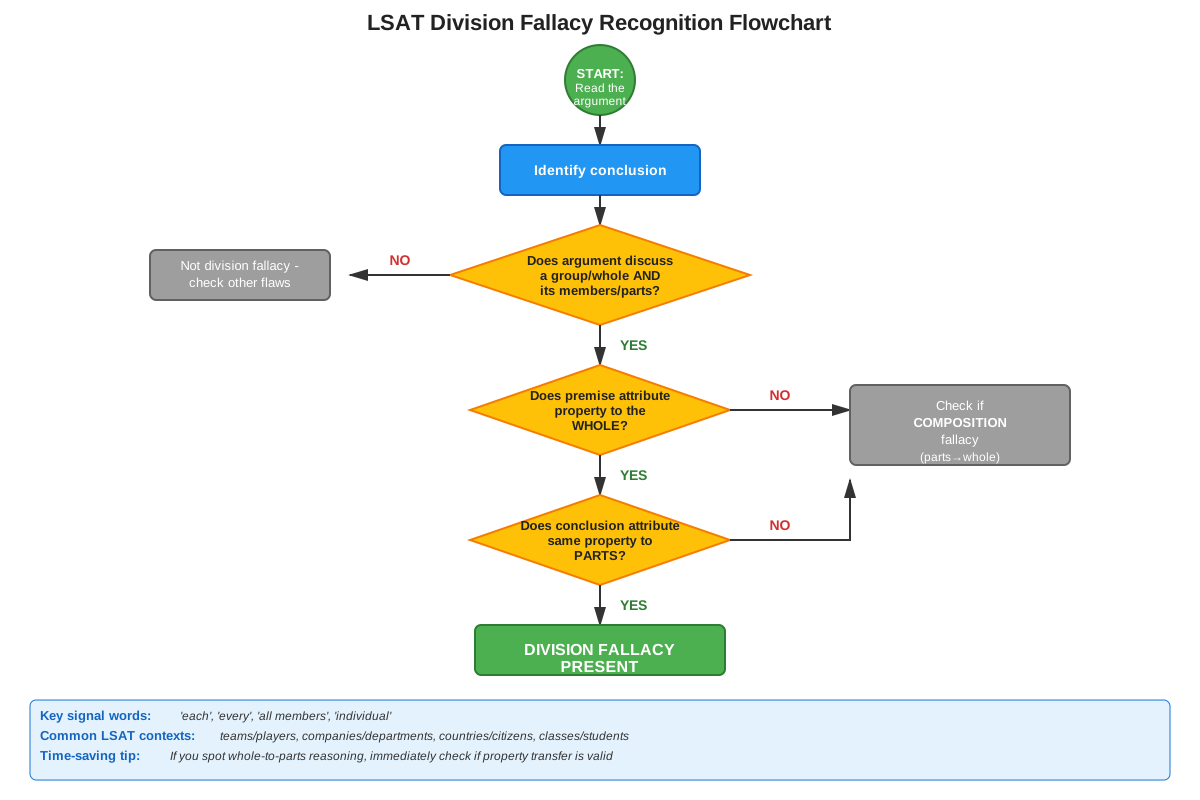
Systematic Approach
Step 1 (5 seconds): Identify whether the argument moves from group to individual or individual to group
- Group → Individual suggests possible division fallacy
- Individual → Group suggests possible composition fallacy
Step 2 (10 seconds): Determine what property is being transferred
- Is it statistical (average, percentage, total)?
- Is it evaluative (good, successful, efficient)?
- Is it size-related (large, numerous, widespread)?
Step 3 (10 seconds): Ask whether the property is collective or distributive
- Can each individual part have this property independently?
- Or does the property only make sense for the group as a whole?
Step 4 (10 seconds): Evaluate answer choices
- Eliminate answers describing other fallacies
- Look for language about "assuming what is true of the whole is true of the parts"
- Prefer answers that specifically mention the type of property involved
Process of Elimination Tips
Eliminate answers that:
- Describe composition fallacy (parts to whole) when the argument goes whole to parts
- Mention circular reasoning unless the argument actually assumes its conclusion
- Reference causal reasoning unless the argument makes a causal claim
- Discuss sampling issues unless the argument explicitly draws from a sample
Keep answers that:
- Mention "group" and "individual" or "whole" and "parts"
- Use phrases like "assumes without justification"
- Specifically identify the type of property being improperly transferred
- Describe the logical gap between collective and individual properties
Time Management
Allocate approximately 1:15-1:30 for division fallacy questions:
- 30 seconds: Read and understand the argument
- 35 seconds: Identify the fallacy structure
- 25 seconds: Evaluate answer choices
- 10 seconds: Confirm and move on
Division fallacy questions are typically medium difficulty, so they should not consume excessive time. If struggling to identify the fallacy after 45 seconds, mark for review and move on.
Exam Tip: When you see aggregate data (averages, totals, percentages) applied to a specific case without qualification, immediately consider division fallacy as a strong possibility.
Memory Techniques
Primary Mnemonic: "DIVIDE"
Direction matters: Whole to parts (not parts to whole)
Individuals don't inherit collective properties
Verify if the property can actually transfer
Identify statistical or evaluative properties as red flags
Distributive properties CAN transfer validly
Exceptions exist: not all whole-to-part reasoning is fallacious
Visualization Strategy
Picture a pizza (whole) that is "large" (collective property):
- The pizza is large ✓
- Each individual slice is large ✗
- Each slice is made of the same ingredients ✓
This concrete image helps distinguish collective properties (size of the whole) from distributive properties (composition of parts).
Acronym for Collective Properties: "SSER"
Statistical (averages, percentages)
Size-related (large, numerous)
Evaluative (successful, good)
Relational (diverse, balanced)
These property types cannot be automatically divided from wholes to parts.
Contrast Pair Memory Device
Remember the pair:
- Division: "Divide the whole, but properties don't divide"
- Composition: "Compose the parts, but properties don't compose"
The irony helps cement the distinction: division fallacy doesn't actually divide properties successfully, and composition fallacy doesn't actually compose properties successfully.
Summary
The division fallacy represents a critical reasoning error that LSAT test-takers must master to succeed on Logical Reasoning sections. This fallacy occurs when arguments improperly assume that properties true of groups, collections, or wholes must also be true of their individual members or parts. The key insight is recognizing that collective properties—particularly statistical measures, size-related characteristics, evaluative judgments, and relational properties—emerge from the group as a unified entity and cannot be automatically transferred to individuals. Valid whole-to-part reasoning requires that properties be genuinely distributive or that arguments include appropriate qualifications acknowledging variation among individuals. The LSAT tests this concept across multiple question types, most commonly in flaw questions but also in assumption, weaken, and parallel reasoning questions. Success requires systematic identification of the direction of inference (whole to parts), recognition of the property type being transferred, and evaluation of whether that transfer is logically justified. Understanding the division fallacy also requires distinguishing it from its mirror image, the composition fallacy, which moves incorrectly from parts to whole.
Key Takeaways
- The division fallacy assumes collective properties of groups automatically apply to individual members without justification
- Statistical properties (averages, percentages, totals) are the most frequently tested collective properties that cannot be divided
- The fallacy appears in 3-5 questions per LSAT, making it essential for competitive scores
- Valid whole-to-part reasoning requires distributive properties or explicit qualifications about individual variation
- Trigger phrases like "therefore each member" and "every individual must" signal potential division fallacy
- Distinguishing division (whole→parts) from composition (parts→whole) is crucial for accurate identification
- Systematic analysis involves identifying direction, property type, and logical validity of the transfer
Related Topics
Composition Fallacy: The inverse of division fallacy, where arguments incorrectly assume that properties of parts must apply to the whole. Mastering division fallacy makes composition fallacy easier to recognize by understanding the bidirectional nature of whole-part reasoning errors.
Hasty Generalization: While division fallacy moves from group to individual, hasty generalization moves from limited examples to broad conclusions. Both involve improper inference scope, making them conceptually related.
Statistical Reasoning: Understanding measures of central tendency, variation, and distribution strengthens ability to recognize when statistical properties are being improperly applied to individual cases.
Necessary and Sufficient Conditions: This topic helps clarify when group membership validly implies individual properties (when membership is sufficient) versus when it doesn't (when membership is merely necessary or neither).
Sampling Errors: Understanding how samples relate to populations provides additional context for recognizing when group-level data cannot be applied to specific cases.
Practice CTA
Now that you understand the division fallacy's structure, common manifestations, and identification strategies, you're ready to apply this knowledge to actual LSAT questions. The practice questions and flashcards will reinforce your ability to spot this fallacy quickly and accurately under timed conditions. Remember: recognizing division fallacy becomes automatic with practice, transforming a potential source of confusion into a reliable opportunity to gain points. Each practice question you complete strengthens your pattern recognition and builds the confidence needed for test day success. Start practicing now to cement your mastery of this high-yield topic!
Sign up free to keep reading
Create a free AnvayaPrep account to finish this LSAT guide on Division fallacy — plus flashcards and practice questions.