Overview
The composition fallacy represents one of the most frequently tested logical errors on the LSAT Logical Reasoning section. This fallacy occurs when an argument incorrectly assumes that what is true of the parts must also be true of the whole, or that properties of individual members of a group necessarily apply to the group as a collective entity. Understanding this reasoning flaw is essential for success on flaw questions, which consistently appear in both Logical Reasoning sections of the exam.
The composition fallacy is particularly important because it tests a fundamental principle of logical reasoning: the relationship between parts and wholes is not always straightforward or transferable. The LSAT frequently exploits this conceptual gap by presenting arguments that sound plausible on the surface but commit this subtle error. Students who can quickly identify when an argument illegitimately transfers properties from individual elements to a collective whole gain a significant advantage on test day.
Within the broader landscape of Logical Reasoning, the lsat composition fallacy connects to other common flaws such as hasty generalization, division fallacy (its inverse), and faulty analogy. Mastering this topic strengthens overall analytical skills and improves performance across multiple question types, including Flaw, Strengthen/Weaken, and Assumption questions. The ability to recognize composition errors also enhances critical thinking skills applicable to Parallel Reasoning and Method of Reasoning questions.
Learning Objectives
- [ ] Identify how Composition fallacy appears in LSAT questions
- [ ] Explain the reasoning pattern behind Composition fallacy
- [ ] Apply Composition fallacy to solve LSAT-style problems accurately
- [ ] Distinguish composition fallacy from its inverse, the division fallacy
- [ ] Recognize the specific linguistic markers that signal potential composition errors
- [ ] Evaluate whether properties are legitimately transferable from parts to wholes in complex arguments
Prerequisites
- Basic argument structure: Understanding premises, conclusions, and how they connect is necessary to identify where the logical gap occurs in composition fallacies
- Concept of logical fallacies: Familiarity with the idea that arguments can be structurally flawed helps contextualize composition as one type of reasoning error
- Part-whole relationships: Basic understanding that groups and their members can have different properties provides the foundation for recognizing composition errors
- LSAT question types: Knowledge of how flaw questions are formatted and what they ask enables efficient application of composition fallacy concepts
Why This Topic Matters
The composition fallacy appears with remarkable frequency on the LSAT, making it one of the highest-yield topics for test preparation. Statistical analysis of recent LSAT administrations reveals that composition-related flaws appear in approximately 8-12% of all Logical Reasoning questions, with particularly high representation in Flaw questions and Descriptive Weakening questions. This frequency makes composition fallacy knowledge essential for achieving competitive scores.
Beyond test performance, understanding composition fallacies develops critical thinking skills directly applicable to legal reasoning. Attorneys regularly encounter arguments about whether characteristics of individual cases, precedents, or parties apply to broader legal principles or collective entities. The ability to identify when such inferences are warranted—and when they commit the composition fallacy—is fundamental to legal analysis.
On the LSAT, composition fallacies typically appear in several contexts: arguments about organizational behavior based on individual member traits, economic reasoning that transfers individual financial principles to national economies, scientific arguments that assume molecular properties apply to larger structures, and social policy arguments that generalize from individual cases to systemic conclusions. The test writers craft these arguments to sound convincing, making pattern recognition essential for efficient question solving.
Core Concepts
Definition and Structure of Composition Fallacy
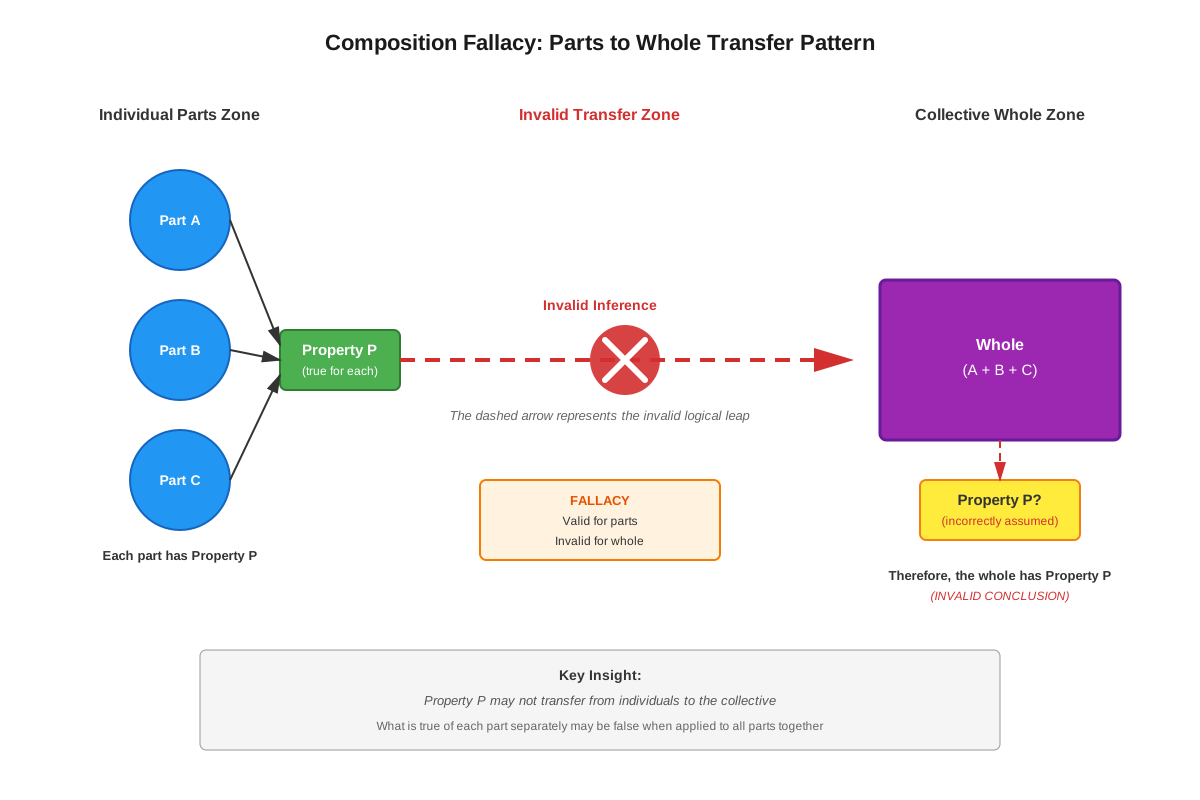
The composition fallacy is a formal logical error that occurs when an argument assumes that a property true of the parts of something must also be true of the whole, or that characteristics of individual members of a group necessarily characterize the group itself. This fallacy exploits the intuitive but incorrect assumption that properties are always "additive" or transferable across levels of organization.
The basic structure follows this pattern:
- Each part/member has property X
- Therefore, the whole/group has property X
- (Implicit assumption: Property X transfers from parts to whole)
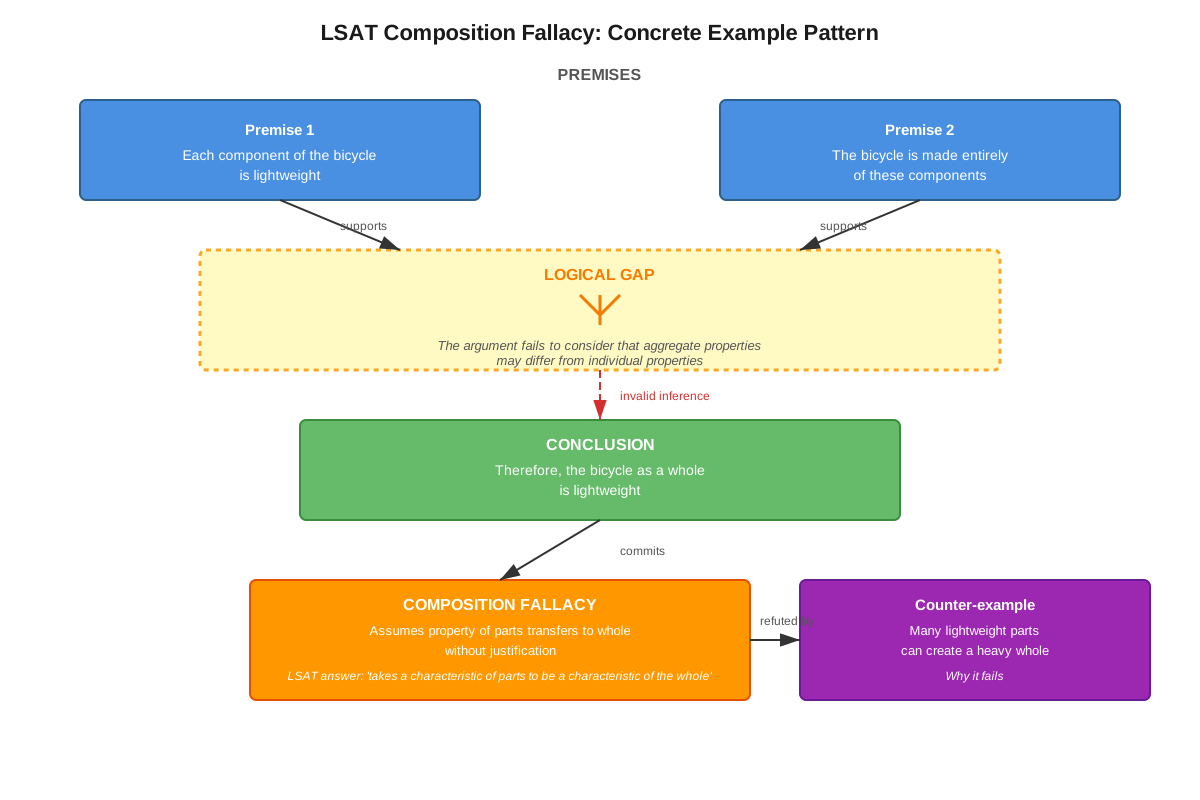
The critical error lies in step 3—many properties do not transfer in this manner. Weight, for example, does transfer (if each part weighs one pound, ten parts weigh ten pounds), but other properties like "lightweight," "inexpensive," or "easy to understand" do not necessarily scale.
Types of Properties: Transferable vs. Non-Transferable
Understanding which properties legitimately transfer from parts to wholes is crucial for identifying composition fallacies. Properties fall into several categories:
Quantitative additive properties (typically transferable):
- Mass, weight, volume
- Count or number
- Total cost (in simple cases)
Qualitative properties (typically non-transferable):
- Complexity or simplicity
- Beauty or aesthetic value
- Understandability
- Efficiency or effectiveness
- Moral character
Relational properties (context-dependent):
- Size (relative to what?)
- Cost-effectiveness
- Importance or significance
The LSAT exploits the non-transferable category most frequently, presenting arguments that assume qualitative or relational properties scale from individuals to collectives.
Common Manifestations on the LSAT
| Context | Part Property | Whole Property (Incorrectly Inferred) | Why It Fails |
|---|---|---|---|
| Team/Organization | Each member is talented | The team is talented | Coordination, chemistry, and structure matter |
| Economics | Individual saving is good | National saving is good | Paradox of thrift; what helps individuals may harm economy |
| Complexity | Each component is simple | The system is simple | Interactions create emergent complexity |
| Quality | Each part is high-quality | The product is high-quality | Integration and design matter beyond components |
| Understanding | Each sentence is clear | The document is clear | Organization and coherence affect overall clarity |
Distinguishing Composition from Related Fallacies
The composition fallacy has an inverse relationship with the division fallacy, which assumes properties of the whole must apply to the parts. While composition moves from parts → whole, division moves from whole → parts. Both commit the same fundamental error of assuming automatic property transfer, just in opposite directions.
Composition differs from hasty generalization in that generalization involves inferring a universal rule from limited instances, while composition specifically concerns the part-whole relationship. However, some arguments may commit both fallacies simultaneously.
The fallacy also differs from faulty analogy because composition doesn't compare two different things; rather, it makes an inference within a single entity about the relationship between its levels of organization.
Linguistic Markers and Signal Phrases
LSAT arguments containing composition fallacies often include specific linguistic patterns:
- "Since each..." followed by "...the group/whole/organization..."
- "Every member..." leading to "...therefore the team/company/nation..."
- "All the parts..." concluding "...so the system/product/entity..."
- Shifts from plural individuals to singular collective nouns
- Movement from "individually" to "collectively" or "as a whole"
Recognizing these transitions helps identify potential composition errors quickly during timed test conditions.
The Role of Context and Domain Knowledge
While the LSAT tests logical reasoning rather than content knowledge, understanding common domains where composition fallacies appear helps with pattern recognition. Economic arguments frequently involve composition issues (individual rationality vs. collective outcomes), as do arguments about organizational behavior, system design, and social policy. The test writers deliberately choose contexts where intuition might mislead test-takers into accepting the flawed reasoning.
Concept Relationships
The composition fallacy connects to several other logical reasoning concepts in a hierarchical and lateral network. At the foundational level, understanding argument structure (premises supporting conclusions) enables recognition of where the logical gap occurs—typically between a premise about parts and a conclusion about the whole.
Laterally, composition relates directly to the division fallacy as its logical inverse: Composition (parts → whole) ↔ Division (whole → parts). Both fallacies share the core error of assuming automatic property transfer across organizational levels.
The concept also connects to necessary vs. sufficient conditions: having talented parts may be necessary for a talented whole, but composition fallacy occurs when arguments treat it as sufficient. This relationship appears frequently in Assumption questions where the correct answer bridges the gap between parts and whole.
Moving upward in abstraction, composition fallacy represents one instance of unwarranted assumption errors, which encompass any argument that takes a logical leap without adequate justification. Understanding composition deepens comprehension of how premises can fail to support conclusions even when both are individually true.
The relationship map flows as follows:
Argument Structure → enables identification of → Composition Fallacy ↔ inverse of → Division Fallacy → both are types of → Unwarranted Assumptions → which appear in → Flaw Questions, Assumption Questions, and Weaken Questions → requiring understanding of → Necessary vs. Sufficient Conditions
Quick check — test yourself on Composition fallacy so far.
Try Flashcards →High-Yield Facts
⭐ The composition fallacy assumes properties of parts necessarily transfer to the whole, which is only valid for certain quantitative properties
⭐ Composition fallacies appear in 8-12% of Logical Reasoning questions, making them one of the highest-yield flaw patterns
⭐ Qualitative properties (simplicity, beauty, understandability) typically do NOT transfer from parts to wholes
⭐ The inverse of composition is division; both commit the same fundamental error in opposite directions
⭐ Economic arguments on the LSAT frequently involve composition fallacies (individual rationality vs. collective outcomes)
- Composition fallacy is distinct from hasty generalization, which involves inferring universal rules from limited samples rather than part-whole relationships
- Linguistic markers include shifts from plural individuals to singular collective nouns ("each member" → "the team")
- An argument can be factually correct about both parts and whole yet still commit composition fallacy if the reasoning pattern is flawed
- Emergent properties—characteristics that arise from interaction of parts—cannot be predicted from parts alone, making composition reasoning invalid
- Correct answers to composition flaw questions often explicitly state "assumes that what is true of parts is true of the whole" or similar language
Common Misconceptions
Misconception: If each part has a property and the whole also has that property, the argument doesn't commit composition fallacy → Correction: Composition fallacy is about the reasoning pattern, not the truth of the conclusion. Even if the conclusion happens to be true, the argument commits the fallacy if it assumes automatic transfer without justification.
Misconception: Composition fallacy only applies to physical objects and their components → Correction: The fallacy applies to any part-whole relationship, including individuals and groups, events and trends, cases and patterns, or elements and systems. The LSAT tests composition across diverse contexts.
Misconception: All properties transfer from parts to wholes to some degree → Correction: Many properties are emergent or relational and have no meaningful connection between part-level and whole-level manifestations. Team chemistry, for example, cannot be predicted from individual member properties.
Misconception: Composition and hasty generalization are the same fallacy → Correction: Hasty generalization involves inferring a rule from insufficient instances, while composition specifically concerns whether properties scale from parts to wholes. The logical structure differs fundamentally.
Misconception: If an argument mentions both parts and a whole, it commits composition fallacy → Correction: Only arguments that assume unjustified property transfer commit the fallacy. Many valid arguments discuss parts and wholes without making this error, such as when they properly qualify the relationship or provide evidence for the transfer.
Worked Examples
Example 1: Organizational Performance
Argument: "Each member of the research team is an expert in their field with an outstanding publication record. Therefore, the research team will produce groundbreaking work and function effectively."
Analysis:
Step 1: Identify the argument structure
- Premise: Each individual team member is an expert with strong credentials
- Conclusion: The team (as a collective) will be effective and produce excellent work
Step 2: Recognize the part-whole relationship
The argument moves from properties of individuals (parts) to properties of the team (whole).
Step 3: Evaluate property transferability
"Being an expert" and "having strong credentials" are individual properties. "Functioning effectively" and "producing groundbreaking work" are collective properties that depend on coordination, communication, complementary skills, and team dynamics—not just individual excellence.
Step 4: Identify the fallacy
This commits the composition fallacy by assuming that individual expertise automatically translates to team effectiveness. The argument ignores that teams require additional factors beyond individual talent: compatible working styles, effective leadership, clear communication, and aligned goals.
Step 5: Connect to learning objectives
This example demonstrates how composition fallacy appears in organizational contexts on the LSAT, illustrating the reasoning pattern (individual properties → collective properties) and showing why the inference fails (emergent properties of teams cannot be predicted from individual traits alone).
Example 2: Economic Policy
Argument: "When an individual saves more money, their financial security improves. Therefore, if everyone in the nation saves more money simultaneously, national economic security will improve."
Analysis:
Step 1: Identify the argument structure
- Premise: Individual saving improves individual financial security
- Conclusion: Universal saving improves national economic security
Step 2: Recognize the part-whole relationship
The argument scales from individual economic actors (parts) to the national economy (whole).
Step 3: Evaluate property transferability
This involves the famous "paradox of thrift" from economics. While saving benefits individuals, universal saving reduces aggregate demand, potentially causing economic contraction. What works at the individual level can fail or reverse at the collective level due to systemic interactions.
Step 4: Identify the fallacy
This commits composition fallacy by assuming individual economic rationality scales to collective economic benefit. The argument fails to account for how individual actions interact in economic systems to produce different collective outcomes.
Step 5: LSAT application
On the LSAT, the correct answer to a flaw question about this argument might state: "fails to consider that what benefits individuals may not benefit the group when all individuals act similarly" or "assumes without justification that individual financial principles apply to national economies."
Exam Strategy
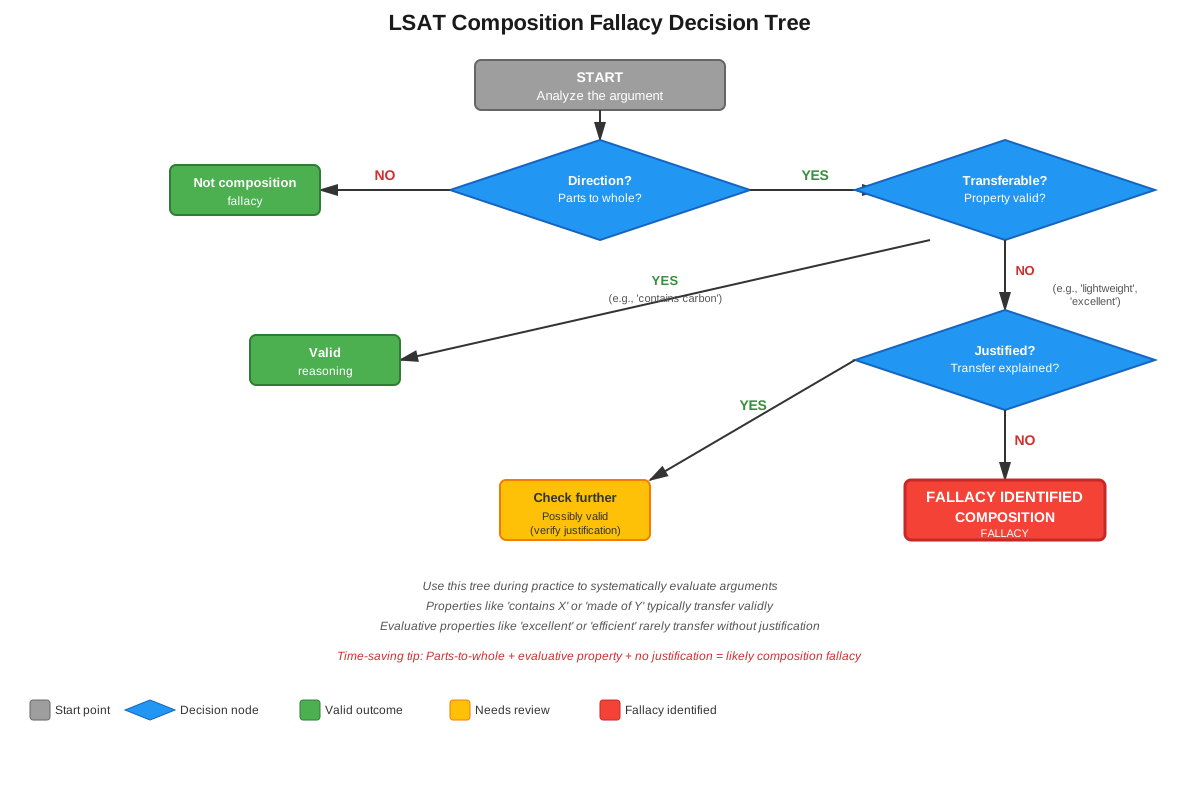
When approaching flaw questions that may involve composition fallacy, employ this systematic process:
Step 1: Identify part-whole language (15-20 seconds)
Scan for transitions from plural/individual terms to singular/collective terms. Look for "each," "every," "all members" followed by "the group," "the organization," "the whole," or "collectively."
Step 2: Map the property transfer (10-15 seconds)
Ask: What property is attributed to the parts? What property is attributed to the whole? Are these the same property or related properties?
Step 3: Evaluate transferability (10-15 seconds)
Determine whether the property type (quantitative, qualitative, relational) typically transfers. Qualitative properties should trigger suspicion.
Step 4: Predict the answer (5-10 seconds)
Before looking at choices, formulate: "This assumes what's true of parts is true of the whole" or similar.
Step 5: Eliminate and select (20-30 seconds)
Eliminate answers that describe different fallacies. Select the answer that explicitly identifies the part-whole assumption error.
Exam Tip: Composition fallacy answers often use phrases like "takes for granted that," "presumes without justification that," or "fails to consider that" followed by language about parts and wholes. Familiarize yourself with these formulations.
Trigger words and phrases to watch for:
- "Each member" → "the team/group/organization"
- "Every component" → "the system/product"
- "All citizens" → "the nation/society"
- "Individually" → "collectively"
- "Per person" → "in total/overall"
Time allocation: Spend no more than 1:20 on composition fallacy identification once you recognize the pattern. These questions reward quick pattern recognition rather than deep analysis.
Process of elimination tips:
- Eliminate answers describing source credibility issues (ad hominem, appeal to authority)
- Eliminate answers about sampling or generalization unless the argument also involves those issues
- Eliminate answers about causation unless the argument makes causal claims
- Keep answers that explicitly mention parts/wholes, individuals/groups, or components/systems
Memory Techniques
Mnemonic: "PART-WHOLE"
- Property transfer assumed
- Additive only for quantities
- Relational properties don't scale
- Team ≠ sum of individuals
- Whole has emergent features
- Hasty to assume transfer
- Organizational context common
- Linguistic markers signal shift
- Economic arguments frequent
Visualization strategy: Picture a jigsaw puzzle. Each piece might be beautiful (part property), but the completed puzzle might be ugly due to how pieces combine (whole property). The beauty doesn't automatically transfer because arrangement and interaction matter.
Acronym for property types: "QQR"
- Quantitative (usually transfers)
- Qualitative (usually doesn't transfer)
- Relational (context-dependent)
Memory hook: "The whole is MORE than the sum of its parts" reminds you that wholes have emergent properties that cannot be predicted from parts alone, making composition reasoning fallacious.
Summary
The composition fallacy represents a critical reasoning error tested extensively on the LSAT, occurring when arguments assume properties of parts necessarily transfer to the whole. This fallacy exploits intuitive but incorrect assumptions about how characteristics scale across organizational levels. Successful identification requires recognizing part-whole language transitions, understanding which property types transfer (quantitative typically do, qualitative typically don't), and distinguishing composition from related fallacies like division and hasty generalization. The LSAT tests composition fallacy across diverse contexts—organizational behavior, economic policy, system design, and social phenomena—making pattern recognition essential. Mastery involves not just identifying the fallacy but understanding why the reasoning fails: emergent properties, interaction effects, and systemic dynamics mean that wholes often possess characteristics unpredictable from their parts. Students who internalize the core principle that part-whole relationships require justification rather than assumption gain significant advantage on flaw questions and related question types.
Key Takeaways
- Composition fallacy assumes unjustified property transfer from parts to wholes, appearing in 8-12% of Logical Reasoning questions
- Qualitative properties (simplicity, effectiveness, beauty) typically do not transfer; quantitative properties (weight, count) typically do
- Linguistic markers include shifts from plural individuals to singular collectives ("each member" → "the team")
- The fallacy appears frequently in economic, organizational, and systems-based arguments on the LSAT
- Correct identification requires recognizing the part-whole structure and evaluating whether the specific property legitimately transfers
- Composition is the inverse of division fallacy but distinct from hasty generalization and other reasoning errors
- Emergent properties—characteristics arising from interaction of parts—cannot be predicted from parts alone, making composition reasoning invalid
Related Topics
Division Fallacy: The logical inverse of composition, assuming properties of wholes transfer to parts. Mastering composition naturally facilitates understanding division, as both involve the same fundamental error in opposite directions.
Hasty Generalization: While distinct from composition, this fallacy often appears alongside it in complex arguments. Understanding the difference strengthens overall flaw identification skills.
Necessary vs. Sufficient Conditions: Composition fallacy often involves treating necessary conditions (talented parts may be necessary for talented whole) as sufficient. This connection appears frequently in Assumption questions.
Causal Reasoning Errors: Some arguments combine composition fallacy with causal errors, assuming that because parts cause individual effects, the whole will cause collective effects. Recognizing these compound flaws improves performance on complex questions.
Strengthen and Weaken Questions: Understanding composition fallacy enables prediction of what would strengthen (evidence that properties do transfer) or weaken (evidence of emergent properties) arguments committing this error.
Practice CTA
Now that you understand the composition fallacy's structure, manifestations, and strategic importance, apply this knowledge to practice questions and flashcards. Focus on identifying the linguistic markers that signal part-whole transitions and distinguishing composition from related fallacies. Each practice question reinforces pattern recognition, building the automaticity needed for efficient performance under timed conditions. Remember: composition fallacy is one of the highest-yield patterns on the LSAT—mastering it directly improves your score. Approach practice with confidence, knowing you now possess the conceptual framework to tackle these questions systematically and accurately.
Sign up free to keep reading
Create a free AnvayaPrep account to finish this LSAT guide on Composition fallacy — plus flashcards and practice questions.