Overview
The evidence absence flaw (also known as the "absence of evidence" fallacy or "argument from ignorance") represents one of the most frequently tested reasoning errors on the LSAT Logical Reasoning section. This flaw occurs when an argument concludes that something is true (or false) simply because there is no evidence proving the opposite. In other words, the arguer treats a lack of evidence for a claim as if it were positive evidence against that claim, or vice versa.
Understanding this flaw is essential for LSAT success because it appears across multiple question types, including Flaw questions, Strengthen/Weaken questions, and Assumption questions. The LSAT evidence absence flaw tests a fundamental principle of sound reasoning: the absence of proof is not the same as proof of absence. Just because we haven't found evidence for something doesn't mean it doesn't exist, and just because we haven't disproven something doesn't mean it's true. This distinction is crucial in logical reasoning because many real-world arguments—and LSAT stimulus passages—exploit this confusion to reach unwarranted conclusions.
Within the broader landscape of flaw questions, the evidence absence flaw sits alongside other common reasoning errors such as causal reasoning flaws, sampling flaws, and circular reasoning. However, the evidence absence flaw is particularly insidious because it often appears reasonable on the surface. The LSAT tests whether students can recognize when an argument inappropriately shifts the burden of proof or mistakes the absence of confirming evidence for disconfirming evidence. Mastering this concept will not only improve performance on direct flaw identification questions but will also sharpen the ability to evaluate argument structure across all Logical Reasoning question types.
Learning Objectives
- [ ] Identify how Evidence absence flaw appears in LSAT questions
- [ ] Explain the reasoning pattern behind Evidence absence flaw
- [ ] Apply Evidence absence flaw to solve LSAT-style problems accurately
- [ ] Distinguish between legitimate uses of negative evidence and fallacious evidence absence reasoning
- [ ] Recognize the different formulations of evidence absence flaws in various argument contexts
- [ ] Predict correct answer choices that accurately describe evidence absence flaws
- [ ] Evaluate when lack of evidence is appropriately used versus when it constitutes a flaw
Prerequisites
- Basic argument structure: Understanding premises, conclusions, and how they connect is essential because identifying the evidence absence flaw requires recognizing what evidence is actually provided versus what is merely assumed from its absence.
- Conditional reasoning fundamentals: Relevant because evidence absence flaws often involve mistaken inferences about what must be true when certain conditions aren't met.
- Understanding of evidence types: Necessary to distinguish between positive evidence, negative evidence, and the complete absence of evidence.
- Familiarity with burden of proof: Important because evidence absence flaws frequently involve inappropriate shifting of who must prove what claim.
Why This Topic Matters
The evidence absence flaw appears in approximately 8-12% of all Logical Reasoning questions on the LSAT, making it one of the top five most frequently tested reasoning errors. This frequency reflects the flaw's prevalence in real-world argumentation—from legal reasoning to scientific discourse to everyday debates. Attorneys must constantly evaluate whether opposing counsel is inappropriately arguing from silence or absence of evidence, making this a practical skill for law school and legal practice.
On the LSAT, this flaw appears most commonly in Flaw questions (where students must identify the reasoning error), but it also surfaces in Strengthen questions (where adding positive evidence would help), Weaken questions (where showing that absence of evidence was expected would undermine the argument), and Necessary Assumption questions (where the argument assumes that lack of evidence is meaningful). The evidence absence flaw can appear in arguments about scientific claims, historical events, policy recommendations, or any domain where evidence might be incomplete.
Understanding this flaw provides practical benefits beyond test performance. In legal reasoning, distinguishing between "we have no evidence the defendant was at the scene" and "we have evidence the defendant was not at the scene" can be the difference between acquittal and conviction. In scientific contexts, recognizing that "we haven't found life on Mars" differs fundamentally from "we've proven there's no life on Mars" prevents premature conclusions. The LSAT tests this reasoning pattern because it's foundational to critical thinking in law and beyond.
Core Concepts
The Basic Structure of Evidence Absence Flaw
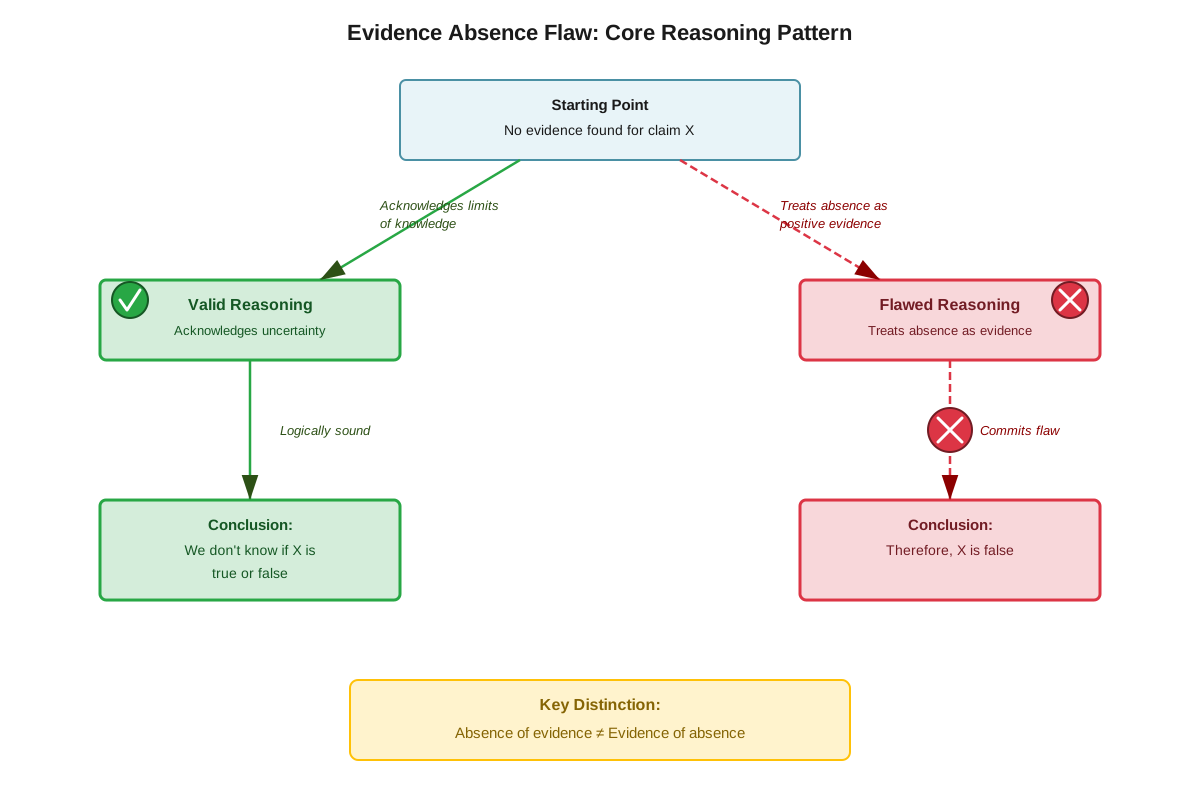
The evidence absence flaw follows a predictable pattern that students must internalize. The argument structure typically looks like this:
- There is no evidence that X is true (or no one has proven X)
- Therefore, X is false (or not-X is true)
Or the inverse:
- There is no evidence that X is false (or no one has disproven X)
- Therefore, X is true
The critical error lies in treating the absence of evidence as if it were evidence of absence. These are fundamentally different logical positions. Absence of evidence means we simply lack information—we're in a state of uncertainty. Evidence of absence means we have positive proof that something doesn't exist or didn't occur.
Why This Reasoning Fails
This reasoning pattern fails because there are numerous reasons why evidence might be absent even when something is true:
- The evidence hasn't been discovered yet
- No one has looked for the evidence
- The evidence was destroyed or lost
- Current methods cannot detect the evidence
- The search for evidence was inadequate or improperly conducted
- The evidence exists but hasn't been made public
When an argument ignores these possibilities and jumps directly from "no evidence found" to "therefore false," it commits the evidence absence flaw. The argument essentially assumes that if something were true, we would necessarily have found evidence for it by now—an assumption that often goes unwarranted.
Distinguishing Legitimate from Fallacious Uses
Not every argument involving absence of evidence commits this flaw. Sometimes, the lack of evidence is legitimately probative. The key distinction lies in whether the absence of evidence is expected or surprising:
| Legitimate Use | Fallacious Use |
|---|---|
| We conducted an exhaustive search where evidence should appear if the claim were true, and found nothing | We haven't found evidence, but we haven't really looked thoroughly |
| The absence of evidence is itself surprising and requires explanation | The absence of evidence is easily explained by lack of investigation |
| We have positive evidence that evidence should exist if the claim were true | We simply lack information either way |
| The search methodology was appropriate and sufficient | The search was limited, preliminary, or inappropriate |
For example, if archaeologists conduct a thorough excavation of a site where a major city supposedly existed and find no artifacts, pottery, or structural remains, the absence of evidence becomes meaningful. However, if no one has ever searched for the city, its absence from current records proves nothing.
Common Formulations on the LSAT
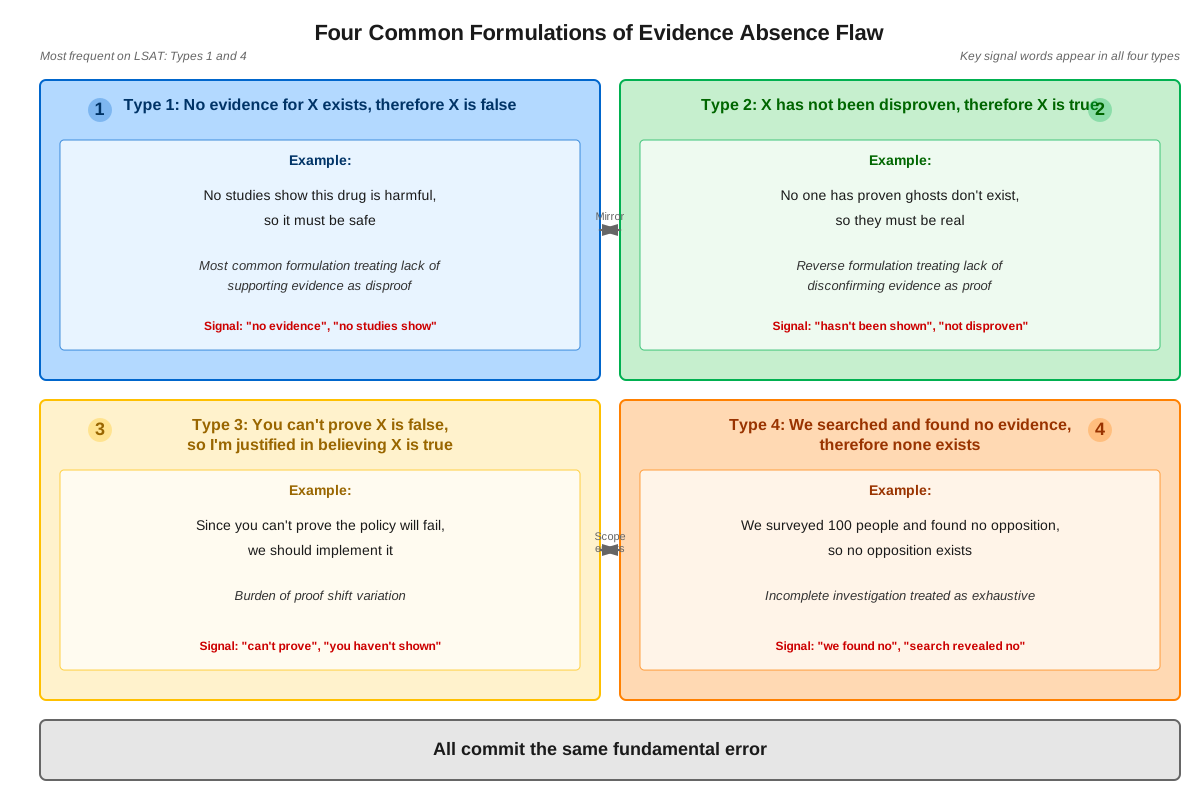
The LSAT presents evidence absence flaws in several distinct formulations:
Type 1: Direct Absence to Falsity
"No study has shown that X causes Y, so X doesn't cause Y."
Type 2: Absence to Truth
"No one has proven that the theory is wrong, so it must be correct."
Type 3: Historical/Temporal Absence
"There are no records of X happening in ancient times, so X never happened."
Type 4: Negative Proof Burden Shift
"You can't prove I'm wrong, so I must be right."
Type 5: Absence in Specific Context
"We found no evidence of contamination in our sample, so the entire water supply is safe."
The Burden of Proof Dimension
Evidence absence flaws often involve an inappropriate shift in the burden of proof. In sound reasoning, the person making a positive claim bears the burden of providing evidence for that claim. The evidence absence flaw reverses this: it places the burden on others to disprove the claim, and treats their failure to do so as confirmation.
This is particularly problematic because it's often impossible to prove a universal negative. How would one prove that something has never happened anywhere at any time? The difficulty of disproving a claim doesn't make the claim true; it simply means the original claimant hasn't met their burden of proof.
Relationship to Scientific and Legal Reasoning
In scientific methodology, the evidence absence flaw violates the principle that absence of evidence is not evidence of absence. Scientists distinguish between:
- Negative results: An experiment was conducted and found no effect (this is data)
- No results: No experiment was conducted (this is absence of information)
Similarly, in legal reasoning, the prosecution must prove guilt; the defense need not prove innocence. An evidence absence flaw would occur if someone argued: "The defendant hasn't proven they were elsewhere, so they must have been at the crime scene."
Recognizing Answer Choices
When the correct answer describes an evidence absence flaw, it typically uses language such as:
- "treats the absence of evidence for a claim as evidence against the claim"
- "takes the lack of proof for a proposition as proof that the proposition is false"
- "concludes that something is false merely because it has not been proven true"
- "mistakes the failure to establish a claim for the establishment of the opposite claim"
- "assumes that a lack of evidence for X constitutes evidence for not-X"
Concept Relationships
The evidence absence flaw connects to several other logical reasoning concepts in important ways. First, it relates closely to necessary assumptions—arguments committing this flaw necessarily assume that if something were true, evidence for it would have been found. This assumption is often unwarranted and can be attacked in Weaken questions or must be supplied in Assumption questions.
Second, the evidence absence flaw connects to conditional reasoning through the contrapositive relationship. The flaw often involves incorrectly assuming: "If X is true → we would have evidence" and then concluding from "no evidence" that "X is false." However, this reasoning only works if the conditional is actually true and if we've genuinely looked for evidence.
Third, this flaw relates to sampling and generalization errors. An argument might commit both flaws simultaneously: "We found no evidence in our limited sample, so the phenomenon doesn't exist anywhere" (combining evidence absence with overgeneralization).
The relationship map flows as follows:
Incomplete Evidence → Mistaken Inference → Evidence Absence Flaw → Unwarranted Conclusion
This flaw also connects to causal reasoning: "We have no evidence that X causes Y" is different from "We have evidence that X doesn't cause Y." Many causal arguments on the LSAT commit evidence absence flaws by treating the former as if it were the latter.
High-Yield Facts
⭐ The evidence absence flaw treats lack of proof for a claim as proof against the claim, or vice versa.
⭐ Absence of evidence and evidence of absence are logically distinct concepts that cannot be conflated.
⭐ This flaw appears in 8-12% of Logical Reasoning questions, making it one of the most frequently tested reasoning errors.
⭐ The flaw often involves an inappropriate shift in the burden of proof from the claimant to the skeptic.
⭐ Not all uses of "no evidence" are fallacious—the key is whether the absence of evidence is expected and meaningful.
- The flaw can appear in both directions: from "no evidence for X" to "X is false" OR from "no evidence against X" to "X is true."
- Evidence absence flaws frequently appear in arguments about historical claims, scientific theories, and policy effectiveness.
- The correct answer choice often includes phrases like "treats the absence of evidence as evidence of absence" or "mistakes lack of proof for disproof."
- This flaw is distinct from circular reasoning, causal flaws, and sampling errors, though arguments can commit multiple flaws simultaneously.
- Strengthen questions may ask for evidence that would help an argument committing this flaw—the correct answer typically provides positive evidence rather than just addressing the absence.
- In Necessary Assumption questions, arguments with this flaw assume that adequate investigation has been conducted or that evidence would necessarily have been found.
- The flaw becomes more egregious when the absence of evidence is easily explained by lack of investigation, limited methodology, or insufficient time.
Quick check — test yourself on Evidence absence flaw so far.
Try Flashcards →Common Misconceptions
Misconception: Any argument that mentions "no evidence" commits the evidence absence flaw.
Correction: The flaw only occurs when the argument inappropriately concludes something is false (or true) merely because evidence is lacking. If the argument provides other reasons or acknowledges uncertainty, it may not commit the flaw.
Misconception: Evidence absence flaw and circular reasoning are the same thing.
Correction: These are distinct flaws. Circular reasoning assumes what it's trying to prove; evidence absence flaw treats lack of proof as disproof. An argument can commit one without committing the other.
Misconception: If an argument says "no evidence has been found," it must be committing the evidence absence flaw.
Correction: The flaw depends on what conclusion is drawn from this fact. Simply stating that no evidence exists isn't fallacious; concluding that something is therefore false or true is the error.
Misconception: Evidence absence flaws only work in one direction (from no evidence to false).
Correction: The flaw works bidirectionally. Arguments can fallaciously conclude something is true because it hasn't been disproven, or false because it hasn't been proven.
Misconception: Any time an argument relies on negative evidence, it's committing the evidence absence flaw.
Correction: Negative evidence (evidence that something didn't happen or doesn't exist) can be legitimate when it comes from thorough investigation. The flaw is specifically about treating absence of investigation as if it were negative evidence.
Misconception: The evidence absence flaw is the same as an unwarranted assumption.
Correction: While arguments committing this flaw do make unwarranted assumptions (specifically, that evidence would have been found if the claim were true), not all unwarranted assumptions involve evidence absence. This is a specific type of reasoning error.
Misconception: If experts haven't found evidence for something, that's always a legitimate reason to doubt it.
Correction: It depends on whether the experts have actually looked, how thoroughly they've searched, and whether current methods could detect the evidence. Expert failure to find evidence is only meaningful when the search has been adequate.
Worked Examples
Example 1: Archaeological Argument
Stimulus: "Archaeologist: Ancient texts describe a great battle that supposedly took place at the site we've been excavating. However, we have found no weapons, armor, or skeletal remains that would indicate a battle occurred here. Therefore, the ancient texts are unreliable, and no such battle ever took place."
Question: The archaeologist's reasoning is most vulnerable to criticism on the grounds that it...
Analysis:
Let's break down the argument structure:
- Premise: Ancient texts describe a battle at this site
- Premise: The excavation found no battle evidence (weapons, armor, remains)
- Conclusion: The texts are unreliable and no battle occurred
This is a classic evidence absence flaw. The archaeologist concludes that the battle didn't happen merely because the current excavation hasn't found evidence of it. However, there are numerous reasons why evidence might be absent even if the battle occurred:
- The excavation might not have covered the actual battle site
- The excavation might not have been deep enough or extensive enough
- Weapons and armor might have been collected after the battle
- Bodies might have been buried elsewhere or cremated
- Environmental factors might have destroyed organic remains
- The excavation methods might not be suitable for detecting the evidence
The argument treats the absence of evidence (we haven't found battle remains) as evidence of absence (the battle didn't happen). The archaeologist assumes that if a battle had occurred, the current excavation would necessarily have found evidence—an unwarranted assumption.
Correct Answer Pattern: "fails to consider that the excavation may not have been extensive enough to find evidence of the battle" or "treats the failure to find evidence for the battle as conclusive evidence that the battle did not occur"
Connection to Learning Objectives: This example demonstrates how to identify the evidence absence flaw in LSAT questions (Objective 1) and shows the reasoning pattern where lack of discovered evidence is mistaken for proof of non-occurrence (Objective 2).
Example 2: Medical Research Argument
Stimulus: "No published study has demonstrated that the new medication causes liver damage. Furthermore, the pharmaceutical company has stated that their internal testing revealed no liver problems. Therefore, patients can be confident that this medication poses no risk of liver damage."
Question: Which one of the following most accurately describes a flaw in the reasoning above?
Analysis:
Argument structure:
- Premise: No published study shows the medication causes liver damage
- Premise: Company's internal testing found no liver problems
- Conclusion: The medication poses no risk of liver damage
This argument commits the evidence absence flaw by moving from "no evidence of harm has been found" to "there is no harm." The reasoning is flawed for several reasons:
First, "no published study has demonstrated" harm doesn't mean studies have proven safety—it might mean:
- Not enough time has passed for long-term effects to appear
- Studies haven't been conducted or published yet
- Studies were conducted but not published (publication bias)
- Studies lacked sufficient sample size or duration to detect rare effects
- The right studies haven't been designed yet
Second, the company's internal testing showing "no liver problems" is different from proving the medication is safe. The testing might have been:
- Too short in duration
- Conducted on too few subjects
- Not designed to detect subtle liver damage
- Conducted on unrepresentative populations
The argument assumes that absence of evidence for liver damage equals evidence of absence of liver damage. This is particularly problematic in medical contexts where rare side effects might not appear until widespread use, and where the absence of detected problems in limited testing doesn't guarantee safety.
Correct Answer Pattern: "takes the absence of evidence that the medication causes liver damage as evidence that the medication does not cause liver damage" or "fails to consider that the lack of published evidence of harm may be due to insufficient research rather than the medication's safety"
Connection to Learning Objectives: This example shows how to apply the evidence absence flaw concept to solve LSAT-style problems (Objective 3) and illustrates how to distinguish between negative evidence (proof of no harm) and absence of evidence (lack of proof of harm) (Objective 4).
Exam Strategy
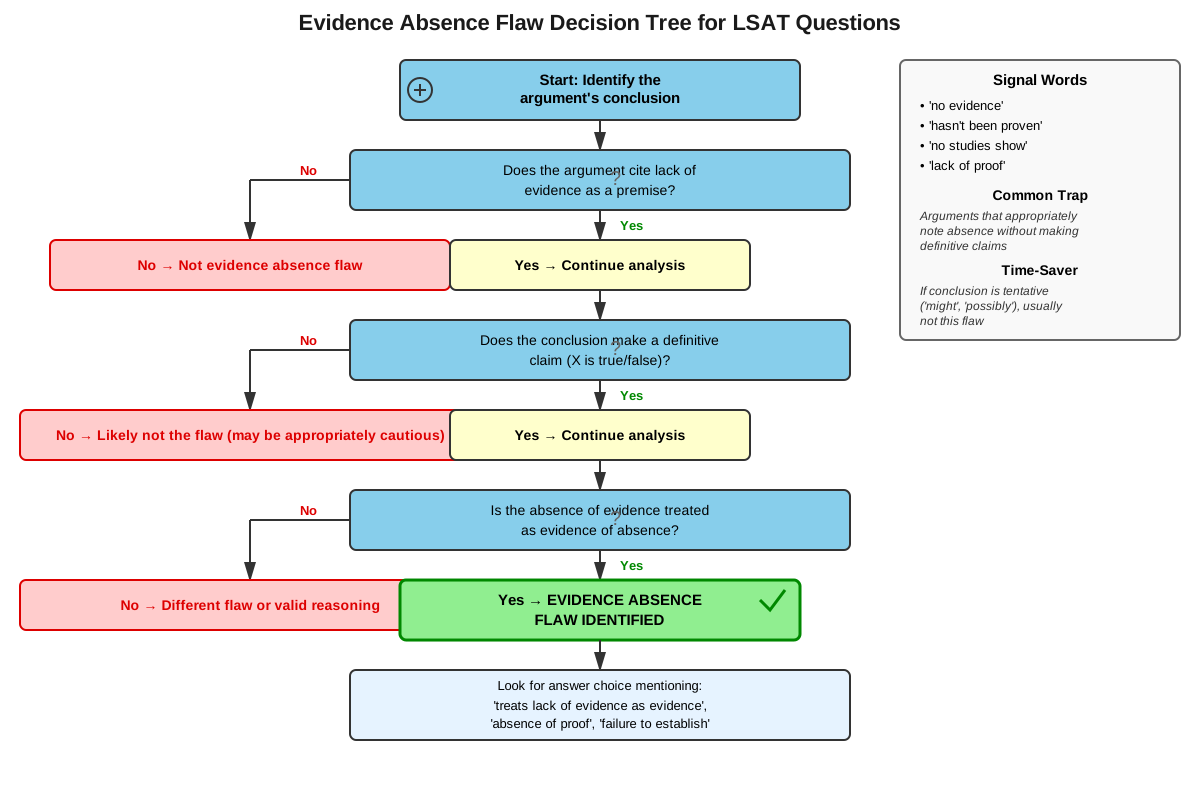
When approaching flaw questions that might involve evidence absence, follow this systematic process:
Step 1: Identify the Evidence Gap
Look for language indicating what evidence is lacking: "no study has shown," "no evidence exists," "has not been proven," "no one has demonstrated," "there are no records of," or "we found nothing to suggest."
Step 2: Identify the Conclusion
Determine what the argument concludes from this absence. Does it conclude something is false? True? Safe? Ineffective? The conclusion should be stronger than "we don't know" or "it's uncertain."
Step 3: Ask the Critical Question
"Does the argument treat the absence of evidence as if it were evidence of absence?" If yes, you've likely identified an evidence absence flaw.
Step 4: Consider Alternative Explanations
Think about why evidence might be absent even if the claim were true. If there are plausible explanations for the evidence gap, the argument is vulnerable.
Exam Tip: Trigger phrases for evidence absence flaws include "no evidence," "has not been proven," "no one has shown," "there are no records," "we found nothing," and "no study demonstrates." When you see these phrases followed by a definitive conclusion, immediately consider whether the argument commits this flaw.
Process of Elimination Strategy:
- Eliminate answers describing flaws the argument doesn't commit (circular reasoning, ad hominem, false dichotomy)
- Eliminate answers that describe the argument's structure without identifying a flaw
- Look for answers using "absence of evidence" language or describing the gap between "not proven" and "proven false"
- Be wary of answers that are too broad or too narrow in scope
Time Allocation:
For flaw questions involving evidence absence, spend:
- 30 seconds reading and understanding the stimulus
- 15 seconds identifying the flaw before looking at answers
- 45 seconds evaluating answer choices
- Total: approximately 90 seconds per question
This timing allows for careful analysis while maintaining pace for the section.
Memory Techniques
Primary Mnemonic - "ABSENCE":
- Absence of evidence
- Burden of proof shifted
- Search may be inadequate
- Evidence of absence is different
- Not proven ≠ proven false
- Conclusion too strong
- Explanations for the gap exist
Visualization Strategy:
Picture a detective searching a room for evidence. Finding nothing doesn't prove nothing was ever there—it might mean:
- The detective looked in the wrong places
- The evidence was removed
- The detective's tools couldn't detect it
- The detective didn't search thoroughly enough
This mental image helps distinguish between "didn't find" and "proven not there."
Acronym for Answer Choice Recognition - "TALA":
- Treats absence as evidence
- Assumes evidence would be found
- Lacks proof but concludes anyway
- Absence mistaken for disproof
When evaluating answer choices, check if they match any TALA component.
Contrast Phrase to Remember:
"Absence of evidence is not evidence of absence" - repeat this phrase when you see "no evidence" language in a stimulus. It immediately triggers recognition of the potential flaw.
Summary
The evidence absence flaw represents a critical reasoning error where arguments inappropriately conclude that something is false (or true) merely because evidence for it hasn't been found or proven. This flaw appears frequently on the LSAT because it tests a fundamental principle of sound reasoning: the distinction between lacking information and having negative information. Arguments committing this flaw typically move from premises stating "no evidence exists" or "hasn't been proven" to conclusions asserting definitive truth or falsity. The reasoning fails because evidence might be absent for numerous reasons unrelated to the truth of the claim—inadequate investigation, limitations of current methods, insufficient time, or simple lack of effort. Recognizing this flaw requires identifying when arguments treat the absence of evidence as if it were evidence of absence, and understanding that these are logically distinct concepts. Success on LSAT questions involving this flaw depends on distinguishing legitimate uses of negative evidence (where thorough investigation found nothing) from fallacious reasoning (where lack of investigation is treated as proof). Mastering this concept improves performance across multiple question types and develops critical thinking skills essential for legal reasoning.
Key Takeaways
- The evidence absence flaw treats lack of proof for a claim as proof against the claim, conflating "not proven" with "proven false"
- This flaw appears in approximately 8-12% of Logical Reasoning questions, making it one of the highest-yield concepts to master
- Absence of evidence and evidence of absence are fundamentally different: the former indicates uncertainty, the latter indicates proof of non-existence
- Not all arguments mentioning "no evidence" commit this flaw—the error lies in drawing definitive conclusions from the absence rather than acknowledging uncertainty
- The flaw often involves inappropriate burden of proof shifting, where failure to disprove a claim is treated as confirmation of the claim
- Trigger phrases include "no evidence," "has not been proven," "no study has shown," and "there are no records"—followed by definitive conclusions
- Correct answer choices typically use language like "treats absence of evidence as evidence of absence" or "mistakes lack of proof for disproof"
Related Topics
Necessary Assumptions: Arguments committing evidence absence flaws make necessary assumptions about the adequacy of investigation or the likelihood that evidence would have been found. Understanding necessary assumptions helps identify what these arguments take for granted.
Strengthen/Weaken Questions: Evidence absence flaws appear in these question types where adding positive evidence strengthens the argument, or showing why evidence might be absent despite truth weakens it. Mastering evidence absence flaws improves performance on these related question types.
Causal Reasoning Flaws: Many causal arguments commit evidence absence flaws by treating "no evidence of causation" as "evidence of no causation." Understanding both flaw types together provides comprehensive coverage of reasoning errors.
Conditional Logic: The evidence absence flaw often involves mistaken conditional reasoning, particularly confusion about when absence of a sufficient condition proves absence of a necessary condition. Studying these together strengthens overall logical reasoning skills.
Sampling and Generalization: Arguments can commit both evidence absence flaws and sampling errors simultaneously, such as concluding something is universally false because limited investigation found no evidence. Understanding both concepts enables recognition of compound flaws.
Practice CTA
Now that you've mastered the evidence absence flaw, it's time to put your knowledge into practice. Work through the practice questions to test your ability to identify this flaw in various contexts and formulations. The flashcards will help reinforce the key distinctions between absence of evidence and evidence of absence, ensuring you can quickly recognize this flaw under timed conditions. Remember: recognizing this single flaw type can help you correctly answer multiple questions on test day, making your study time here a high-yield investment in your LSAT score. Approach each practice question systematically, using the strategies outlined above, and you'll develop the pattern recognition skills that separate good LSAT scores from great ones.
Sign up free to keep reading
Create a free AnvayaPrep account to finish this LSAT guide on Evidence absence flaw — plus flashcards and practice questions.