Overview
A false analogy is one of the most frequently tested logical flaws on the LSAT Logical Reasoning section. This flaw occurs when an argument draws a comparison between two situations, objects, or concepts and concludes that because they share some similarities, they must share additional characteristics—without adequately establishing that the similarities are relevant to the conclusion being drawn. The reasoning assumes that if two things are alike in certain respects, they must be alike in other respects, even when the differences between them may be more significant than their similarities.
Understanding false analogies is essential for LSAT success because these flaws appear regularly in flaw questions, strengthen/weaken questions, and parallel reasoning questions. The LSAT tests whether students can identify when an analogy breaks down due to relevant differences between the compared items. Mastering this concept requires recognizing not just that a comparison is being made, but whether that comparison is logically sound given the argument's conclusion. Students must develop the ability to spot when an argument relies too heavily on surface-level similarities while ignoring crucial distinctions.
Within the broader landscape of Logical Reasoning, false analogy connects to fundamental principles of argument evaluation. It relates closely to other common flaws such as hasty generalizations, unrepresentative samples, and causal reasoning errors. All these flaws share a common thread: they involve drawing conclusions that go beyond what the evidence actually supports. False analogy specifically involves comparative reasoning, making it a distinct pattern that requires targeted practice to identify and analyze effectively on test day.
Learning Objectives
- [ ] Identify how false analogy appears in LSAT questions
- [ ] Explain the reasoning pattern behind false analogy
- [ ] Apply false analogy to solve LSAT-style problems accurately
- [ ] Distinguish between valid analogies and false analogies based on relevance of similarities
- [ ] Recognize trigger language that signals analogical reasoning in LSAT arguments
- [ ] Evaluate whether differences between compared items undermine an analogical argument
- [ ] Predict correct answer choices for flaw questions involving false analogies
Prerequisites
- Basic argument structure: Understanding premises and conclusions is necessary because false analogy involves evaluating how well premises support conclusions through comparison
- Conditional reasoning fundamentals: Recognizing sufficient and necessary conditions helps identify when analogies inappropriately transfer conditional relationships
- Understanding of logical flaws generally: Familiarity with what constitutes a logical flaw provides the framework for recognizing false analogy as a specific type of reasoning error
- Strengthen and weaken question types: These question types frequently test false analogy by asking what would make an analogical argument better or worse
Why This Topic Matters
False analogy appears in real-world reasoning constantly, from political debates comparing current situations to historical events, to business decisions based on what worked in different contexts, to legal arguments drawing parallels between cases. Recognizing when comparisons are logically sound versus when they overlook crucial differences is a critical thinking skill that extends far beyond standardized testing. In professional contexts, the ability to evaluate analogical reasoning prevents costly mistakes based on superficial similarities.
On the LSAT specifically, false analogy appears in approximately 10-15% of Logical Reasoning questions across various question types. Flaw questions most directly test this concept, asking test-takers to identify the reasoning error in an argument that relies on a faulty comparison. However, false analogy also appears in strengthen/weaken questions (where answer choices might point out relevant differences or similarities), parallel reasoning questions (where matching the analogical structure is required), and even some assumption questions (where the assumption bridges gaps in the comparison).
The LSAT presents false analogies in diverse contexts: comparing business strategies, scientific studies, policy proposals, historical situations, and everyday scenarios. The test-makers deliberately craft arguments where the comparison seems initially plausible, requiring careful analysis to identify why the analogy fails. Common presentations include comparing two companies and assuming what worked for one will work for the other, comparing two studies with different methodologies, or comparing past and present situations while ignoring changed circumstances.
Core Concepts
The Structure of Analogical Reasoning
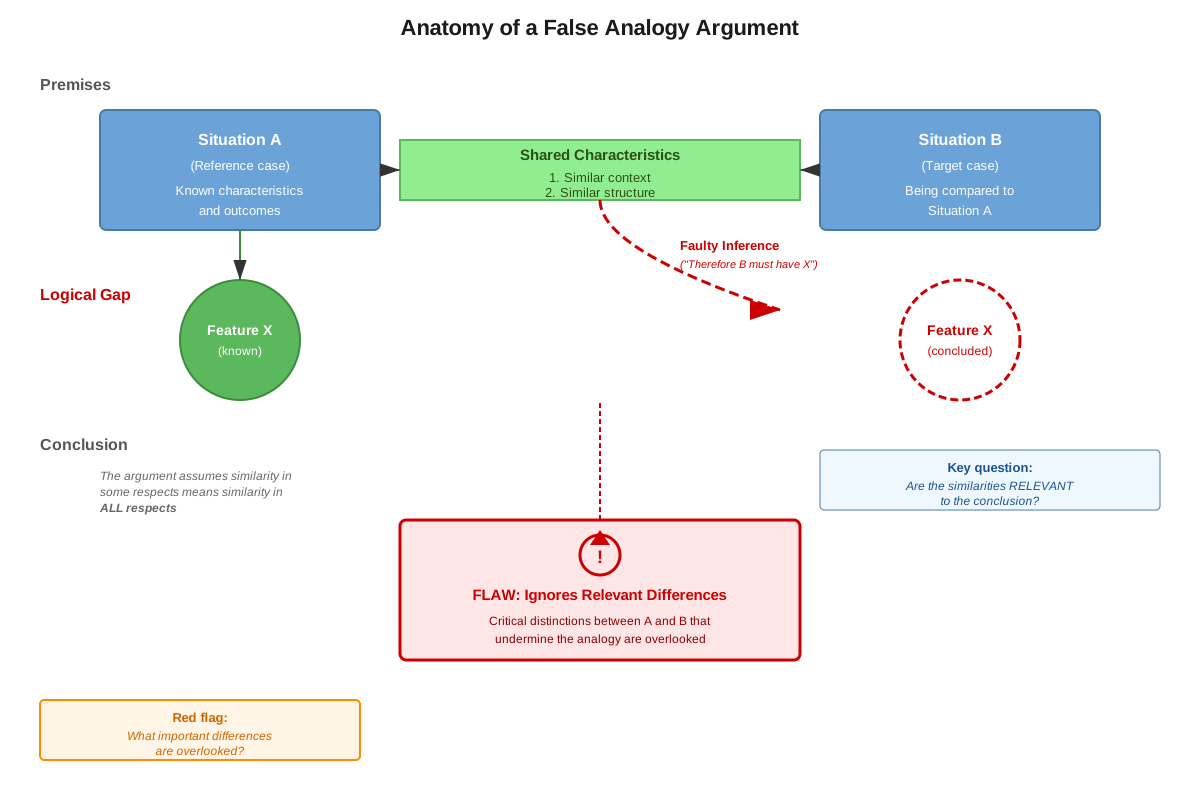
Analogical reasoning forms the foundation for understanding false analogy. In valid analogical reasoning, an argument identifies similarities between two cases (Case A and Case B), notes that Case A has a particular characteristic, and concludes that Case B likely has that characteristic as well. The logical strength depends on whether the similarities are relevant to the characteristic being inferred and whether the differences are insignificant enough to ignore.
The basic structure follows this pattern:
- Case A and Case B share characteristics X, Y, and Z
- Case A has characteristic Q
- Therefore, Case B probably has characteristic Q
For this reasoning to be strong, characteristics X, Y, and Z must be relevant to whether something has characteristic Q, and any differences between the cases must not affect the likelihood of having characteristic Q.
What Makes an Analogy False
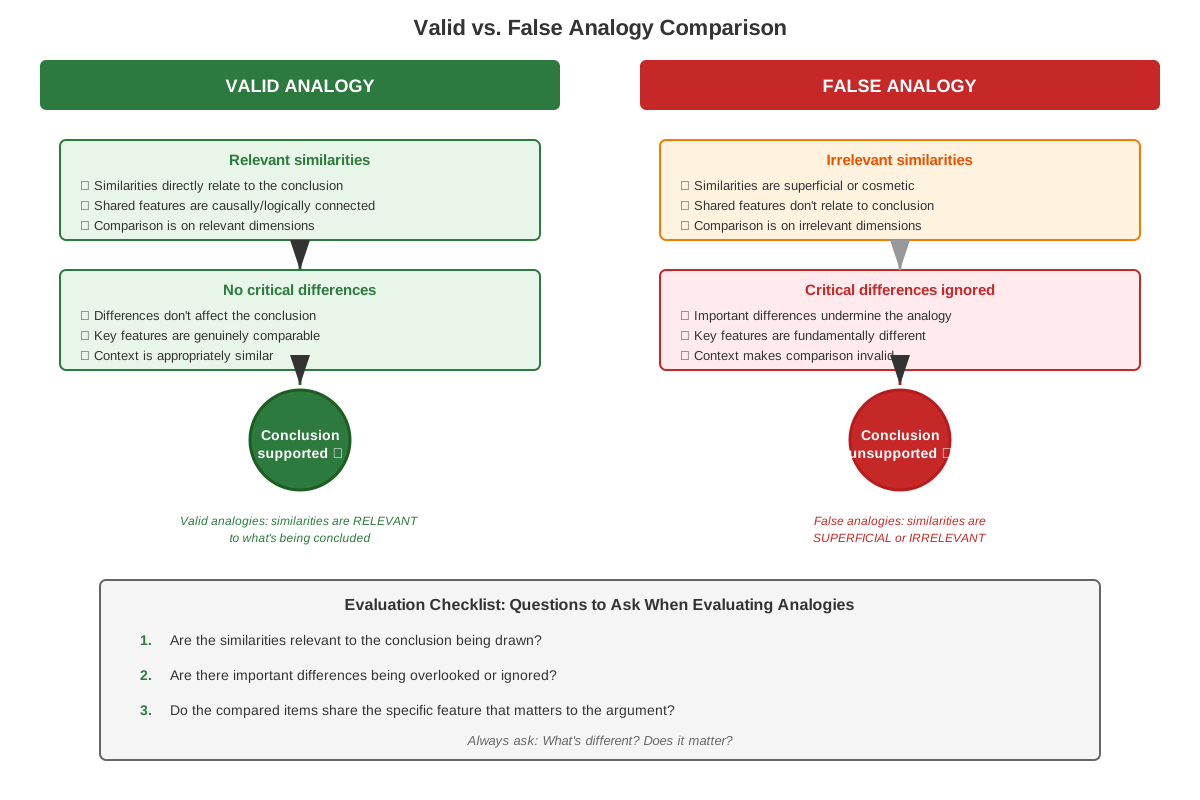
A false analogy occurs when the compared items differ in ways that are relevant to the conclusion, or when the cited similarities are not actually relevant to what's being concluded. The flaw lies not in making a comparison per se, but in treating the comparison as stronger evidence than it actually provides. Three primary ways an analogy can fail include:
Relevant differences: The two cases differ in ways that directly affect the conclusion. For example, comparing a successful restaurant in a tourist area to one in a residential neighborhood ignores location differences that significantly impact success factors.
Irrelevant similarities: The cited similarities don't actually bear on the conclusion. Comparing two medications because both are pills and both are blue doesn't establish they'll have similar effects—the relevant factors are chemical composition and mechanism of action.
Overlooked complexity: The analogy oversimplifies by treating multifaceted situations as comparable based on limited shared features. Comparing a small family business to a multinational corporation might ignore scale, resources, market position, and organizational complexity.
Identifying False Analogy in LSAT Arguments
On the LSAT, false analogy arguments typically present a comparison that seems reasonable on the surface but contains a critical flaw. The argument will explicitly or implicitly claim that because two things are similar in certain ways, they will be similar in another way. Key indicators include:
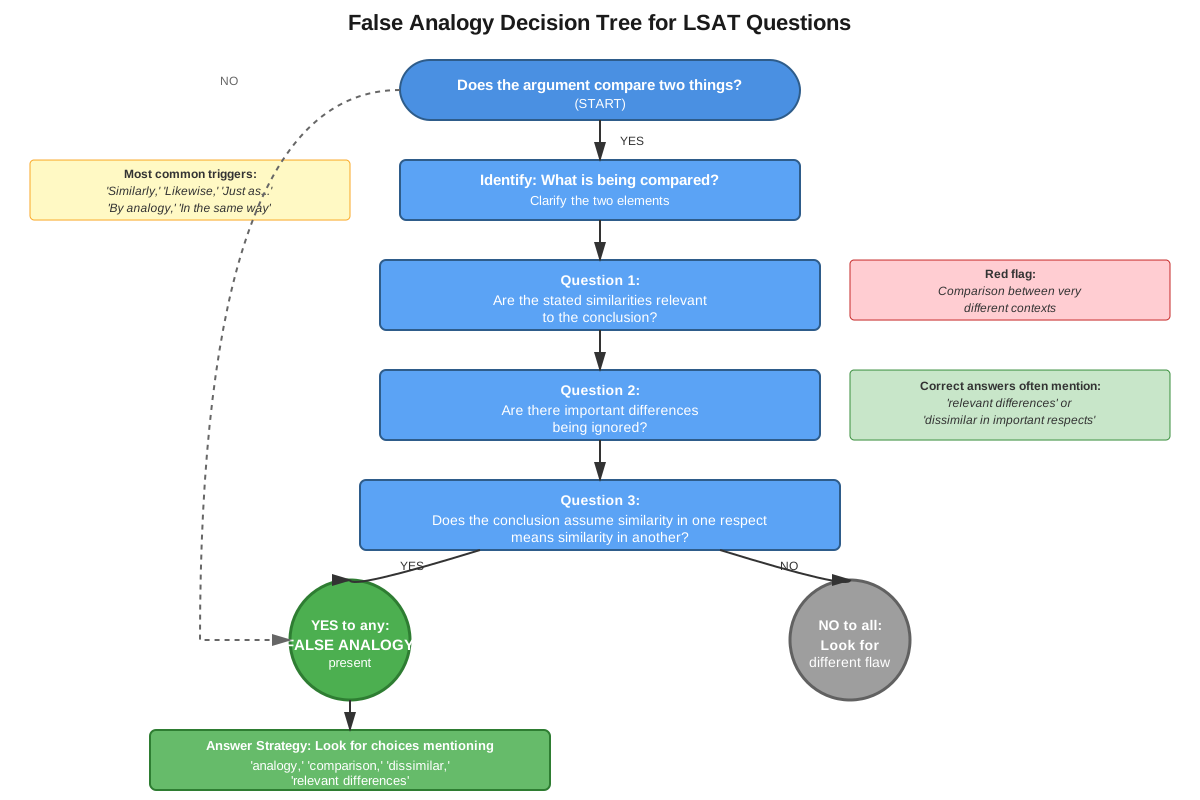
- Comparative language: "similarly," "likewise," "just as," "in the same way," "analogous to"
- Historical comparisons: "when X happened before, Y resulted, so..."
- Cross-domain comparisons: applying principles from one field to another
- Case-to-case reasoning: "it worked for them, so it will work for us"
The flaw becomes apparent when examining whether the comparison holds up under scrutiny. The LSAT tests whether students can identify that the argument assumes without justification that the similarities outweigh the differences.
The Role of Relevance
Relevance is the critical concept in evaluating analogies. Not all differences matter, and not all similarities provide support. An analogy can withstand many differences if those differences don't affect the conclusion. Conversely, even one relevant difference can undermine an entire analogical argument.
Consider comparing two students' study methods. If both students study the same subject, use similar materials, and have comparable backgrounds, the analogy is strong for predicting similar outcomes. However, if one student has a learning disability and the other doesn't, this difference is highly relevant to outcomes, making the analogy weak. Meanwhile, differences in their favorite foods or music preferences are irrelevant to academic performance.
Degrees of Analogical Strength
Analogies exist on a spectrum from very strong to very weak. The LSAT often presents arguments with moderately weak analogies—not completely absurd comparisons, but ones with significant enough flaws to be logically problematic. Understanding this spectrum helps in:
| Analogy Strength | Characteristics | LSAT Relevance |
|---|---|---|
| Strong | Many relevant similarities, few relevant differences | Rarely the focus of flaw questions |
| Moderate | Some relevant similarities, some relevant differences | Common in strengthen/weaken questions |
| Weak | Few relevant similarities, many relevant differences | Typical in flaw questions |
| Absurd | No meaningful similarities | Too obvious; rarely tested |
The LSAT targets the moderate-to-weak range where the flaw requires analysis to detect.
Common Contexts for False Analogy
The LSAT presents false analogies across predictable contexts:
Business analogies: Comparing companies, markets, or strategies while ignoring differences in size, industry, timing, or competitive environment
Scientific analogies: Comparing studies with different methodologies, sample sizes, or conditions
Policy analogies: Comparing jurisdictions or time periods while overlooking demographic, economic, or cultural differences
Causal analogies: Assuming that because two situations share some features, they share causal relationships
Predictive analogies: Using past cases to predict future outcomes without accounting for changed circumstances
Concept Relationships
False analogy connects to broader logical reasoning concepts through multiple pathways. At its core, it represents a failure of sufficient evidence—the premises don't adequately support the conclusion because the comparison doesn't establish what the argument claims it does. This connects false analogy to the fundamental principle that conclusions must be warranted by their premises.
The relationship map flows as follows:
Argument Structure → Comparative Reasoning → False Analogy → Insufficient Evidence → Flawed Conclusion
False analogy also relates to hasty generalization because both involve drawing conclusions that go beyond what limited evidence supports. While hasty generalization involves inferring a general rule from too few instances, false analogy involves inferring similarity in one respect from similarity in other respects. Both flaws stem from overlooking relevant differences or limitations in the evidence.
Additionally, false analogy connects to causal reasoning errors. When an argument uses analogy to establish a causal claim ("X caused Y in Case A, so X will cause Y in Case B"), it combines analogical reasoning with causal reasoning. If the analogy is false, the causal claim fails. This intersection appears frequently on the LSAT in questions about policy effectiveness or scientific predictions.
The concept also relates to necessary versus sufficient conditions. A strong analogy requires that the similarities be sufficient to establish the conclusion, but false analogies often present similarities that are merely necessary (or not even that) without being sufficient. Understanding this distinction helps identify why an analogy fails.
High-Yield Facts
⭐ False analogy occurs when an argument assumes that because two things are similar in some respects, they must be similar in another respect, without establishing that the similarities are relevant to the conclusion
⭐ The critical question for evaluating any analogy is whether the cited similarities are relevant to the conclusion and whether the differences are significant enough to undermine the comparison
⭐ On flaw questions, correct answers describing false analogy often use language like "overlooks relevant differences," "assumes without justification that the cases are comparable," or "treats superficial similarities as sufficient evidence"
⭐ Trigger words for analogical reasoning include "similarly," "likewise," "just as," "in the same way," "analogous," and "comparable"
⭐ Not all differences between compared items matter—only relevant differences that affect the conclusion constitute a false analogy flaw
⭐ Strengthen questions about analogical arguments are often answered by pointing out additional relevant similarities or showing that apparent differences don't actually matter
- Weaken questions about analogical arguments are typically answered by identifying relevant differences between the compared cases
- Historical analogies (comparing present to past) are particularly vulnerable to false analogy because circumstances, technology, and context change over time
- Cross-domain analogies (applying principles from one field to another) require careful evaluation of whether the domains are relevantly similar
- The LSAT rarely presents completely absurd analogies; instead, it tests moderately weak analogies that require analysis to identify the flaw
- False analogy can appear in the argument's main reasoning or in subsidiary reasoning used to support a premise
- Parallel reasoning questions sometimes require matching the structure of an analogical argument, including matching whether the analogy is strong or weak
Quick check — test yourself on False analogy so far.
Try Flashcards →Common Misconceptions
Misconception: Any argument that makes a comparison commits a false analogy flaw.
Correction: Comparisons are not inherently flawed. An analogy is false only when the differences between the compared items are relevant to the conclusion or when the similarities cited are irrelevant. Many valid arguments rely on sound analogical reasoning.
Misconception: If two things differ in any way, the analogy between them is false.
Correction: All analogies involve items that differ in some respects—that's why they're analogies rather than identical cases. The question is whether the differences are relevant to the specific conclusion being drawn. Irrelevant differences don't undermine an analogy.
Misconception: False analogy only appears in flaw questions.
Correction: While flaw questions directly test the ability to identify false analogy, this reasoning pattern also appears in strengthen/weaken questions (where you must evaluate what would improve or undermine the analogy), assumption questions (where the assumption might be that the cases are relevantly similar), and parallel reasoning questions.
Misconception: The more similarities cited, the stronger the analogy.
Correction: Analogical strength depends on the relevance of similarities, not their quantity. Ten irrelevant similarities provide no support, while one highly relevant similarity might provide strong support. Quality matters more than quantity.
Misconception: Historical analogies are always false analogies because times change.
Correction: While historical analogies require careful evaluation, they're not automatically false. If the relevant factors remain constant despite other changes, the historical comparison can be valid. The key is whether the changes affect the specific conclusion being drawn.
Misconception: Scientific analogies between studies are always strong because science is objective.
Correction: Scientific studies can differ in methodology, sample selection, conditions, and numerous other factors that affect whether results transfer from one study to another. Comparing studies requires evaluating whether these differences are relevant to the conclusion.
Worked Examples
Example 1: Business Strategy Analogy
Argument: "TechStart Inc. should adopt the same aggressive expansion strategy that MegaCorp used to dominate the software market. Both companies develop innovative software products, and both have talented engineering teams. Since MegaCorp's expansion strategy led to market dominance, TechStart should expect similar results."
Analysis:
Step 1 - Identify the conclusion: TechStart should adopt MegaCorp's expansion strategy and expect similar results.
Step 2 - Identify the premises: Both companies develop innovative software and have talented engineers; MegaCorp's strategy led to dominance.
Step 3 - Recognize the analogical structure: The argument compares TechStart to MegaCorp based on product type and engineering talent, then concludes that TechStart will achieve similar results with the same strategy.
Step 4 - Evaluate relevance of similarities: While both companies work in software, the cited similarities (innovative products, talented engineers) may not be the factors that made MegaCorp's expansion strategy successful.
Step 5 - Consider potential relevant differences: The argument overlooks potential differences such as:
- Company size and available capital for expansion
- Market conditions when each company expanded (timing)
- Existing market position and brand recognition
- Specific market segments targeted
- Competition levels in their respective markets
Step 6 - Identify the flaw: The argument commits a false analogy by assuming that because the companies share some characteristics, a strategy that worked for one will work for the other, without establishing that the similarities are relevant to expansion success or that the differences don't matter.
Correct flaw description: "The argument overlooks potentially relevant differences between TechStart and MegaCorp that might affect whether the expansion strategy would be successful."
This example demonstrates how false analogy appears in business contexts and shows the systematic approach to identifying the flaw: recognize the comparison, evaluate whether the similarities support the conclusion, and identify relevant differences the argument ignores.
Example 2: Scientific Study Analogy
Argument: "A recent study found that students who took notes by hand performed better on conceptual questions than students who typed notes on laptops. Therefore, professionals attending business meetings should take handwritten notes rather than using laptops, as this will improve their understanding of the material discussed."
Analysis:
Step 1 - Identify the conclusion: Professionals should take handwritten notes in meetings to improve understanding.
Step 2 - Identify the premises: A study showed students taking handwritten notes performed better on conceptual questions than those typing.
Step 3 - Recognize the analogical structure: The argument applies findings from a student study to professional meeting contexts, assuming the same relationship will hold.
Step 4 - Evaluate relevance of similarities: Both situations involve note-taking and information processing, which provides some basis for comparison.
Step 5 - Consider potential relevant differences:
- Students were tested on conceptual questions; professionals may have different goals (action items, decisions, relationship building)
- Academic lectures differ from business meetings in structure, purpose, and interaction level
- Students and professionals may have different note-taking skills and purposes
- The study measured performance on tests, not real-world application or meeting effectiveness
- Professional meetings often require real-time information sharing (emailing notes, accessing documents) that handwriting doesn't facilitate
Step 6 - Identify the flaw: The argument commits a false analogy by assuming that findings from a controlled study of students in academic settings will transfer directly to professionals in business meetings, without establishing that the contexts are relevantly similar or that the differences don't affect the conclusion.
Correct flaw description: "The argument assumes without justification that the factors affecting student learning in academic settings are the same as those affecting professional comprehension in business meetings."
This example illustrates how false analogy appears when applying research findings across different contexts and demonstrates the importance of evaluating whether study conditions match the application context.
Exam Strategy
When approaching LSAT false analogy questions, employ a systematic strategy that maximizes accuracy while managing time effectively:
Recognition Phase (5-10 seconds):
- Scan for comparative language: "similarly," "likewise," "just as," "in the same way"
- Identify when the argument references another case, historical example, or different context
- Note when conclusions about one thing are based on information about something else
Analysis Phase (20-30 seconds):
- Clearly identify what two things are being compared
- List the stated similarities the argument relies on
- Determine what conclusion the argument draws from the comparison
- Ask: "Are these similarities relevant to this conclusion?"
- Consider: "What differences might matter here?"
Answer Choice Evaluation (30-40 seconds):
For flaw questions, correct answers typically:
- Use phrases like "overlooks relevant differences," "assumes comparability without justification," "treats dissimilar cases as similar"
- Point out that the argument fails to establish that the similarities are relevant
- Note that the argument ignores potentially important differences
Eliminate answers that:
- Describe flaws not present in the argument
- Focus on irrelevant differences (the LSAT sometimes includes trap answers mentioning differences that don't actually matter)
- Claim the argument makes no comparison when it clearly does
For strengthen questions involving analogies:
- Look for answers that provide additional relevant similarities
- Consider answers that show apparent differences are actually not relevant
- Evaluate answers that establish the cited similarities are indeed relevant to the conclusion
For weaken questions involving analogies:
- Prioritize answers that identify relevant differences between the compared cases
- Look for answers showing the cited similarities are irrelevant
- Consider answers that provide alternative explanations for the outcome in the original case
Exam Tip: When you identify an analogical argument, immediately ask yourself: "What could be different between these cases that would matter for this conclusion?" This proactive thinking often leads directly to the correct answer.
Time Management: Allocate approximately 1:20 for false analogy questions. They require careful analysis but shouldn't consume excessive time. If you're struggling to identify relevant differences, move on and return if time permits—sometimes other questions help clarify your thinking.
Common Trap Patterns:
- Answers that mention differences that exist but aren't relevant to the conclusion
- Answers that are too extreme ("assumes the cases are identical" when the argument only assumes they're similar enough)
- Answers that describe different flaws (causal, conditional) when the primary flaw is analogical
Memory Techniques
COMPARE Acronym for evaluating analogies:
- Cases: Identify what two things are being compared
- Outcome: What conclusion is drawn from the comparison?
- Matching features: What similarities does the argument cite?
- Pertinent: Are these similarities relevant to the conclusion?
- Alternative differences: What differences might matter?
- Relevance check: Do the differences affect the conclusion?
- Evaluate: Is the analogy strong or false?
Visualization Strategy: Picture the two compared items side by side. Mentally draw arrows connecting their similarities, then imagine a spotlight highlighting the conclusion. Ask whether the arrows (similarities) actually point toward the spotlight (support the conclusion), or whether there's a gap between them.
The "Different Enough?" Question: Create a mental habit of asking "Are these things different enough to matter?" whenever you see a comparison. This simple question triggers the analytical thinking needed to identify false analogies.
Similarity vs. Relevance Distinction: Remember the phrase "Similar doesn't mean sufficient." Two things can be similar in many ways without those similarities being sufficient to support the conclusion. This helps avoid the trap of thinking any comparison is automatically valid.
Historical Analogy Red Flag: When you see past-to-present comparisons, mentally add the phrase "but times have changed" to trigger consideration of temporal differences. This helps identify when historical analogies overlook changed circumstances.
Summary
False analogy represents a critical logical flaw tested extensively on the LSAT Logical Reasoning section. This flaw occurs when arguments draw conclusions based on comparisons between two cases without adequately establishing that the similarities are relevant to the conclusion or that the differences don't undermine it. Mastering false analogy requires understanding that not all comparisons are created equal—the strength of an analogy depends entirely on whether the cited similarities actually support the specific conclusion being drawn and whether relevant differences are being overlooked. On the LSAT, false analogy appears most prominently in flaw questions but also surfaces in strengthen/weaken questions and other question types. Success requires systematic analysis: identify the comparison, evaluate the relevance of similarities, consider potential relevant differences, and determine whether the analogical reasoning is sound. The key insight is that analogies can fail either because the similarities aren't relevant or because the differences are significant, and the LSAT tests the ability to distinguish between valid comparative reasoning and false analogy through careful, critical analysis.
Key Takeaways
- False analogy occurs when an argument treats two cases as comparable without establishing that their similarities are relevant to the conclusion or that their differences don't matter
- The critical evaluation question is always: "Are the cited similarities relevant to this specific conclusion, and are there relevant differences being overlooked?"
- Trigger language includes "similarly," "likewise," "just as," "in the same way," and references to other cases, historical examples, or different contexts
- Not all differences matter—only relevant differences that affect the conclusion constitute a false analogy flaw
- On flaw questions, correct answers typically describe the argument as "overlooking relevant differences," "assuming without justification that the cases are comparable," or "treating dissimilar cases as similar"
- Strengthen and weaken questions involving analogies focus on additional similarities (strengthen) or relevant differences (weaken)
- Systematic analysis—identifying the comparison, evaluating similarity relevance, and considering potential differences—is essential for accuracy on false analogy questions
Related Topics
Hasty Generalization: This flaw involves drawing broad conclusions from insufficient examples and connects to false analogy because both involve reasoning that goes beyond what the evidence supports. Mastering false analogy provides a foundation for understanding how arguments can fail by overlooking important distinctions.
Causal Reasoning Flaws: Many false analogies involve causal claims ("X caused Y here, so X will cause Y there"), making causal reasoning skills essential for fully evaluating analogical arguments. Understanding false analogy helps identify when causal relationships don't transfer across contexts.
Necessary and Sufficient Conditions: Evaluating whether similarities are sufficient (not merely necessary) to support a conclusion requires understanding conditional logic. This connection deepens comprehension of why some analogies succeed while others fail.
Strengthen and Weaken Questions: These question types frequently test analogical reasoning by asking what would make a comparison stronger or weaker. Mastery of false analogy directly improves performance on these high-frequency question types.
Parallel Reasoning: Some parallel reasoning questions require matching the structure of analogical arguments, including whether the analogy is strong or weak. Understanding false analogy helps identify structural parallels in comparative reasoning.
Practice CTA
Now that you understand false analogy comprehensively, it's time to apply this knowledge to actual LSAT questions. The practice questions and flashcards will reinforce your ability to identify false analogies quickly and accurately under test conditions. Remember that recognizing false analogy is a skill that improves with deliberate practice—each question you analyze strengthens your pattern recognition and analytical speed. Approach the practice materials systematically, using the COMPARE framework and evaluation strategies outlined in this guide. Your investment in mastering this high-yield topic will pay dividends across multiple Logical Reasoning question types. You've built the foundation—now solidify it through targeted practice!
Sign up free to keep reading
Create a free AnvayaPrep account to finish this LSAT guide on False analogy — plus flashcards and practice questions.