Overview
The false dilemma is one of the most frequently tested logical flaws on the LSAT Logical Reasoning section. This reasoning error occurs when an argument presents only two options as if they are the only possibilities, when in fact additional alternatives exist. Also known as a false dichotomy or black-and-white thinking, this flaw appears when an arguer artificially restricts the range of possible solutions, outcomes, or explanations without justification. For example, an argument might claim "Either we implement this policy or face complete disaster," ignoring moderate alternatives or partial solutions that could address the problem.
Understanding how to identify and analyze lsat false dilemma patterns is crucial for success on flaw questions, which consistently appear in every LSAT administration. These questions ask test-takers to identify the specific reasoning error that undermines an argument's logic. The false dilemma represents a failure in the argument's structure: the conclusion doesn't follow from the premises because the premises artificially limit options without adequate support. Recognizing this pattern requires understanding both what the argument explicitly states and what possibilities it improperly excludes.
Within the broader landscape of logical reasoning, the false dilemma connects to several fundamental concepts. It relates to conditional reasoning (by oversimplifying if-then relationships), to necessary and sufficient conditions (by treating one path as the only path), and to the general principle that strong arguments must consider relevant alternatives. Mastering false dilemma identification strengthens overall critical thinking skills and provides a foundation for understanding other common flaws like hasty generalizations, false causation, and appeals to ignorance. This topic serves as a gateway to recognizing how arguments can fail by being too narrow in scope or insufficiently comprehensive in their consideration of possibilities.
Learning Objectives
- [ ] Identify how False dilemma appears in LSAT questions
- [ ] Explain the reasoning pattern behind False dilemma
- [ ] Apply False dilemma to solve LSAT-style problems accurately
- [ ] Distinguish false dilemmas from legitimate binary choices
- [ ] Recognize the specific language patterns that signal false dilemma reasoning
- [ ] Evaluate whether an argument has adequately ruled out alternative possibilities
- [ ] Construct correct answer choices that accurately describe the false dilemma flaw
Prerequisites
- Basic argument structure: Understanding premises and conclusions is essential because false dilemmas occur in how premises support (or fail to support) conclusions
- Conditional logic fundamentals: Recognizing if-then relationships helps identify when arguments incorrectly present conditions as the only options
- Flaw question format: Familiarity with how the LSAT asks about reasoning errors enables efficient application of false dilemma recognition
- Necessary vs. sufficient conditions: This distinction clarifies when arguments wrongly treat one sufficient condition as necessary or exclusive
Why This Topic Matters
False dilemma reasoning appears throughout everyday discourse, from political debates ("You're either with us or against us") to marketing claims ("Either buy our premium product or settle for inferior quality") to personal decision-making. Recognizing this flaw enables more sophisticated evaluation of arguments in professional, academic, and civic contexts. Legal reasoning, in particular, requires careful consideration of multiple possibilities, making false dilemma identification directly relevant to law school success and legal practice.
On the LSAT, false dilemma questions appear with remarkable consistency. Approximately 10-15% of all flaw questions involve some form of false dilemma reasoning, making it one of the top five most common logical flaws tested. These questions appear across all three scored Logical Reasoning sections (in tests that include multiple LR sections) and occasionally surface in Reading Comprehension passages when analyzing an author's argumentative strategy. The LSAT tests this concept because it assesses a fundamental lawyering skill: recognizing when an argument has failed to consider relevant alternatives or has artificially narrowed the scope of analysis.
False dilemma questions typically appear in several formats: direct flaw identification questions ("The reasoning in the argument is flawed because it..."), descriptive flaw questions ("The argument is vulnerable to criticism on the grounds that it..."), and parallel flaw questions (where the correct answer exhibits the same false dilemma structure). The LSAT particularly favors scenarios where the false dilemma seems plausible at first glance, requiring careful analysis to recognize the excluded middle ground. Common contexts include policy debates, causal explanations, predictions about outcomes, and evaluations of competing theories or approaches.
Core Concepts
Definition and Structure of False Dilemma
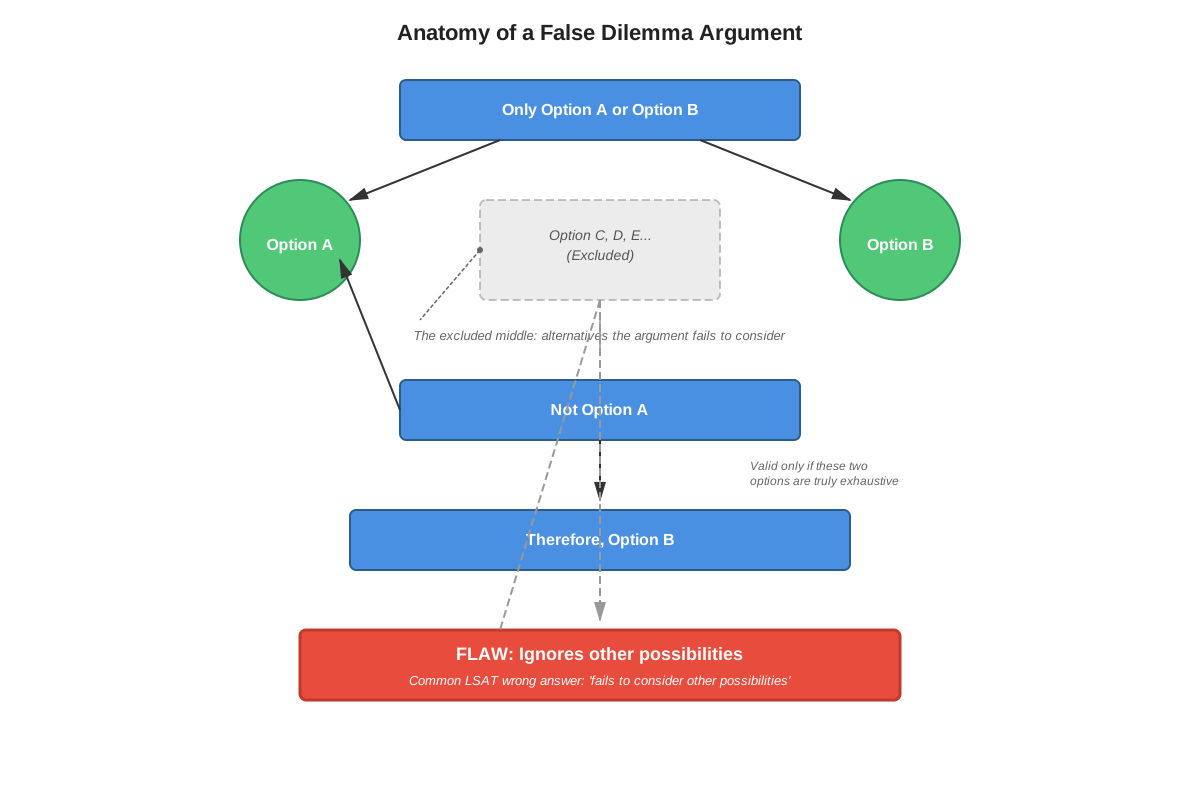
A false dilemma occurs when an argument presents two alternatives as exhaustive (covering all possibilities) when additional options actually exist. The logical structure follows this pattern: "Either X or Y" (stated or implied), followed by "Not X" (or evidence against X), therefore "Y" (or vice versa). The flaw lies in the unstated assumption that X and Y represent the only possibilities. This reasoning error is also called a false dichotomy, false binary, or excluded middle fallacy.
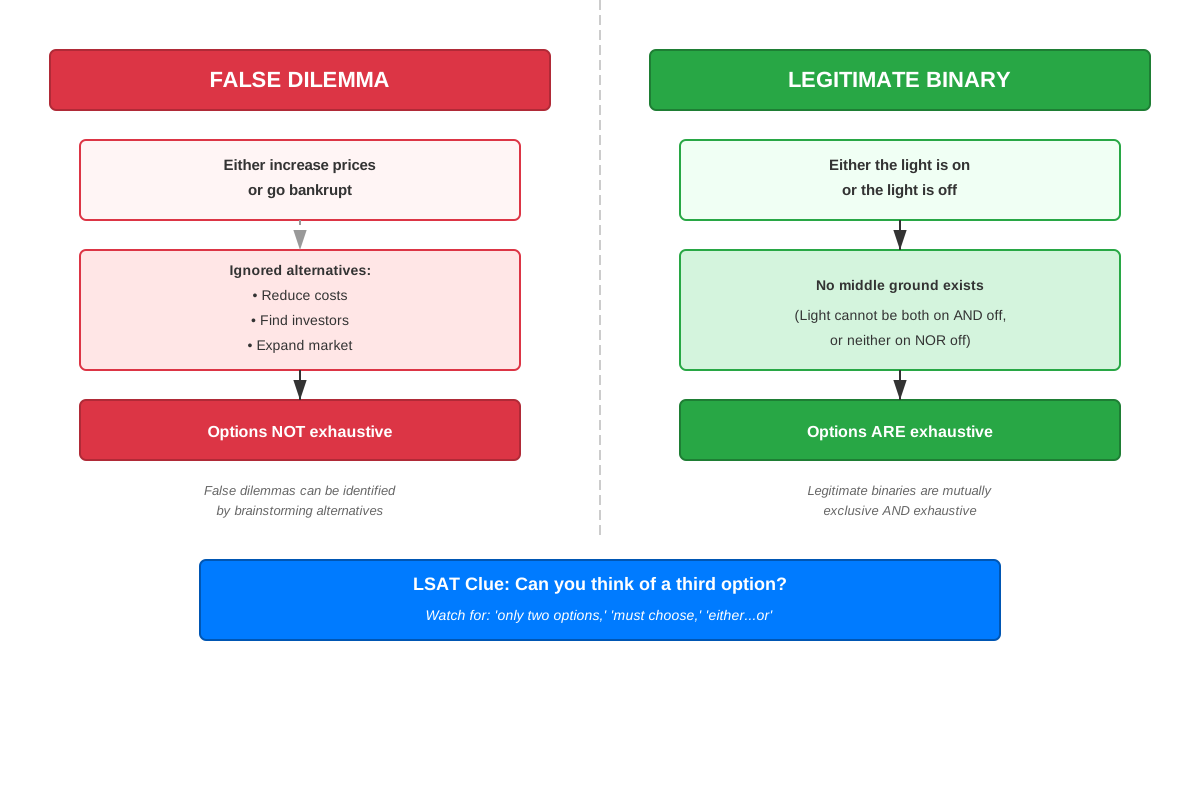
The critical element distinguishing a false dilemma from valid reasoning is whether the two options genuinely exhaust all possibilities. Some binary choices are legitimate: "Either the light switch is on or it is off" presents a true dichotomy with no middle ground. However, most real-world situations involve spectrums, multiple alternatives, or combinations of factors. An argument commits the false dilemma fallacy when it treats a complex situation as if it were a simple binary without justification.
Recognition Patterns
False dilemmas manifest through specific linguistic markers and structural patterns. The most explicit form uses "either...or" constructions: "Either we adopt this plan or we face failure." However, many false dilemmas appear in subtler forms. An argument might state "The only way to achieve X is Y," implicitly excluding other methods. Alternatively, it might present "If we don't do X, then Y will occur," suggesting X is the sole preventive measure.
Conditional statements often mask false dilemmas. When an argument says "If we want outcome A, we must do B," it may be committing a false dilemma by suggesting B is the only means to achieve A. The flaw becomes apparent when considering whether alternative paths to A exist. Similarly, arguments using "unless" constructions ("We will fail unless we do X") can embed false dilemmas by implying X is the only success factor.
Types of False Dilemmas
Outcome-based false dilemmas present two possible results as if no intermediate or alternative outcomes exist. Example: "Either this medication will cure the disease completely or it will have no effect at all," ignoring partial improvement or symptom management. These are particularly common in LSAT questions about predictions and policy consequences.
Method-based false dilemmas suggest only two approaches exist for achieving a goal. Example: "To reduce crime, we must either hire more police officers or accept higher crime rates," overlooking alternatives like community programs, economic development, or judicial reform. The LSAT frequently tests this type in policy recommendation arguments.
Explanation-based false dilemmas present two competing theories or causes as if one must be entirely correct and the other entirely wrong. Example: "The company's success is due either to superior products or effective marketing," ignoring that both factors (or others) might contribute. These appear in LSAT questions analyzing causal relationships or competing hypotheses.
Value-based false dilemmas frame choices as absolute trade-offs between competing values. Example: "We must choose between environmental protection and economic growth," suggesting these goals are mutually exclusive rather than potentially compatible. While less common on the LSAT, these appear in arguments about priorities and resource allocation.
The Spectrum Reality
Most situations exist on spectrums rather than as binary choices. Between "complete success" and "total failure" lie degrees of partial success. Between "doing nothing" and "implementing the full program" exist scaled or modified approaches. Between "Theory A is correct" and "Theory B is correct" lies the possibility that both contribute, neither is correct, or a third explanation applies. Recognizing this spectrum reality is essential for identifying false dilemmas.
The LSAT tests whether students can recognize when an argument has artificially collapsed a spectrum into a binary. Strong critical thinkers automatically ask: "What other options exist? What middle ground has been excluded? Could multiple factors be relevant rather than just one?" This questioning approach reveals false dilemmas even when they're presented persuasively.
Distinguishing False from True Dilemmas
Not every presentation of two options constitutes a false dilemma. Some situations genuinely involve binary choices with no middle ground. The key distinction lies in whether the two options are logically exhaustive and mutually exclusive.
| True Dilemma | False Dilemma |
|---|---|
| Options are logically exhaustive (cover all possibilities) | Additional options exist beyond those presented |
| Options are mutually exclusive (cannot both be true) | Options may not be mutually exclusive or may exist on a spectrum |
| The binary nature is justified by logic or definition | The binary nature is assumed without justification |
| Example: "Either it will rain tomorrow or it will not rain" | Example: "Either we increase the budget or the project will fail" |
The LSAT occasionally includes answer choices that incorrectly accuse an argument of a false dilemma when the binary choice is actually justified. Careful analysis of whether alternatives genuinely exist separates correct from incorrect answers.
Concept Relationships
The false dilemma connects to multiple logical reasoning concepts in a hierarchical and functional network. At the foundational level, understanding argument structure (premises supporting conclusions) enables recognition that false dilemmas represent a gap between premises and conclusion—specifically, the premises don't establish that only two options exist, yet the conclusion proceeds as if they do.
False dilemma reasoning relates closely to conditional logic. Many false dilemmas can be reformulated as conditional statements: "If not X, then Y" implies "X or Y." When this conditional is unwarranted (because "not X" doesn't guarantee Y), the argument commits a false dilemma. This connection flows: Conditional Logic → Sufficient/Necessary Confusion → False Dilemma.
The concept also connects to overlooked possibilities, a broader category of logical flaws. False dilemma is a specific type of overlooked possibility where the argument explicitly or implicitly presents options but fails to consider others. This relationship maps as: Overlooked Possibilities (general) → False Dilemma (specific form) → Particular instances in arguments.
Within flaw questions specifically, false dilemma relates to other common flaws through the principle of incomplete reasoning. Just as false dilemmas fail to consider all options, hasty generalizations fail to consider all evidence, and false cause arguments fail to consider alternative explanations. The unifying principle is that strong arguments must be comprehensive in their consideration of relevant factors.
Understanding false dilemmas also enhances performance on strengthen/weaken questions. An answer that introduces a third option often weakens arguments vulnerable to false dilemma criticism. Conversely, an answer establishing that only two options exist strengthens such arguments. This bidirectional relationship means mastering false dilemmas improves performance across multiple question types.
High-Yield Facts
⭐ A false dilemma presents two options as exhaustive when additional alternatives exist, creating an unjustified either-or framework.
⭐ The most common signal phrases include "either...or," "the only way," "must choose between," and "unless," though false dilemmas can be implied without explicit markers.
⭐ False dilemmas appear in approximately 10-15% of all LSAT flaw questions, making them one of the five most frequently tested logical flaws.
⭐ Correct answer choices for false dilemma questions typically include language like "fails to consider," "overlooks the possibility," "assumes without justification," or "treats as exhaustive."
⭐ Not every either-or statement is a false dilemma; the flaw only exists when additional genuine alternatives are possible but ignored.
- False dilemmas often appear in policy arguments where the arguer suggests only two courses of action exist (action X or inaction/disaster).
- The LSAT frequently tests false dilemmas in causal reasoning, where arguments suggest only two possible explanations for a phenomenon.
- Many false dilemmas involve spectrum collapse, treating continuous variables (like degree of success) as binary outcomes (complete success or total failure).
- Arguments can commit false dilemmas implicitly by strongly implying only two options exist without using explicit either-or language.
- False dilemma questions often include wrong answer choices that describe other flaws (like circular reasoning or ad hominem attacks) to test precise flaw identification.
- The excluded middle in false dilemmas can be a compromise position, a third alternative, a combination of the stated options, or a spectrum of intermediate possibilities.
- Recognizing false dilemmas requires active questioning: "What other options might exist? Has the argument justified this binary framework?"
Quick check — test yourself on False dilemma so far.
Try Flashcards →Common Misconceptions
Misconception: Every argument presenting two options commits a false dilemma.
Correction: False dilemmas only occur when additional genuine alternatives exist. Some situations involve true binaries (either the defendant is guilty or not guilty; either the switch is on or off). The flaw exists only when the binary framework is unjustified and excludes real possibilities.
Misconception: False dilemmas always use explicit "either...or" language.
Correction: Many false dilemmas are implied through phrases like "the only way," "we must," or "unless," or through the argument's structure without any explicit binary language. The logical structure matters more than specific wording.
Misconception: If an argument mentions two options, any answer choice saying it "fails to consider alternatives" is correct.
Correction: The correct answer must accurately describe the specific flaw. If the argument's problem isn't that it presents a false binary but rather that it makes a different error (like assuming causation), then "fails to consider alternatives" would be incorrect even if only two options are mentioned.
Misconception: False dilemmas are always easy to spot because they seem obviously wrong.
Correction: The LSAT crafts false dilemmas that seem plausible on first reading. The two options presented often represent the most salient or extreme possibilities, making it easy to overlook middle ground or alternative approaches without careful analysis.
Misconception: Pointing out that an argument "assumes only two options exist" is always sufficient for identifying a false dilemma.
Correction: The correct answer must match the specific false dilemma in the argument. If the argument presents options A and B while ignoring C, an answer choice about options X and Y would be incorrect even if it correctly identifies false dilemma reasoning in abstract terms.
Misconception: False dilemmas only occur in arguments about actions or decisions.
Correction: False dilemmas appear in explanatory arguments (only two possible causes), predictive arguments (only two possible outcomes), evaluative arguments (only two criteria for judgment), and theoretical arguments (only two competing theories), not just in arguments about what to do.
Worked Examples
Example 1: Policy Recommendation
Argument: "The city's traffic congestion has reached crisis levels. Either we build a new highway to accommodate more vehicles, or we must accept that commute times will continue to increase indefinitely. Since environmental concerns make building a new highway impractical, we have no choice but to accept longer commute times."
Analysis Process:
Step 1: Identify the conclusion
The conclusion is "we have no choice but to accept longer commute times."
Step 2: Identify the premises
- Premise 1: Either build a new highway or accept increasing commute times
- Premise 2: Building a new highway is impractical due to environmental concerns
Step 3: Examine the logical structure
The argument uses elimination reasoning: It presents two options (highway or longer commutes), eliminates one option (highway is impractical), and concludes the other must be accepted (longer commutes).
Step 4: Question the either-or framework
Are these really the only two options? What alternatives might exist?
- Public transportation expansion (light rail, bus rapid transit)
- Incentives for carpooling or remote work
- Congestion pricing to reduce peak-hour traffic
- Bicycle infrastructure improvements
- Staggered work hours across industries
Step 5: Identify the flaw
The argument commits a false dilemma by presenting highway construction and accepting longer commutes as the only options, when numerous alternative approaches to reducing traffic congestion exist.
Correct Answer Choice Would State: "The argument fails to consider that there may be alternatives to building a new highway that could reduce commute times."
Connection to Learning Objectives: This example demonstrates how false dilemmas appear in policy contexts (Objective 1), shows the either-or reasoning pattern with elimination structure (Objective 2), and illustrates the analysis process for LSAT questions (Objective 3).
Example 2: Causal Explanation
Argument: "The Riverside Company's profits increased by 40% last year. This increase was due either to the new marketing campaign launched in January or to the improved product quality resulting from the manufacturing changes. Since customer surveys indicate that awareness of the company's products did not increase significantly, the marketing campaign was not responsible for the profit increase. Therefore, the improved product quality must have caused the increased profits."
Analysis Process:
Step 1: Identify the conclusion
"The improved product quality must have caused the increased profits."
Step 2: Map the reasoning structure
- Two possible causes presented: marketing campaign OR improved quality
- Evidence against marketing: awareness didn't increase
- Conclusion by elimination: must be improved quality
Step 3: Evaluate the either-or assumption
Does the argument justify that these are the only two possible causes? What else might explain increased profits?
- Competitor went out of business
- Economic conditions improved in the company's market
- Price increases
- Expansion into new markets
- Cost reductions increasing profit margins
- Both factors (marketing AND quality) contributing together
- Seasonal variations or cyclical industry trends
Step 4: Identify the specific flaw
The argument presents a false dilemma by treating marketing and product quality as the only possible explanations for increased profits, when multiple other factors could be responsible, or multiple factors could work in combination.
Step 5: Recognize the double flaw
This argument actually contains two related flaws: (1) false dilemma in presenting only two causes, and (2) the assumption that if marketing didn't increase awareness, it couldn't have contributed to profits (perhaps it improved brand perception among existing aware customers).
Correct Answer Choice Would State: "The argument fails to consider that factors other than the marketing campaign and improved product quality might have caused the profit increase."
Alternative Correct Answer: "The argument assumes without justification that only two factors could have contributed to the increased profits."
Connection to Learning Objectives: This example shows false dilemma in causal reasoning contexts (Objective 1), demonstrates the elimination-based reasoning pattern (Objective 2), illustrates how to systematically analyze arguments for this flaw (Objective 3), and shows how false dilemmas can combine with other reasoning errors (extended objective).
Exam Strategy
Systematic Approach to False Dilemma Questions
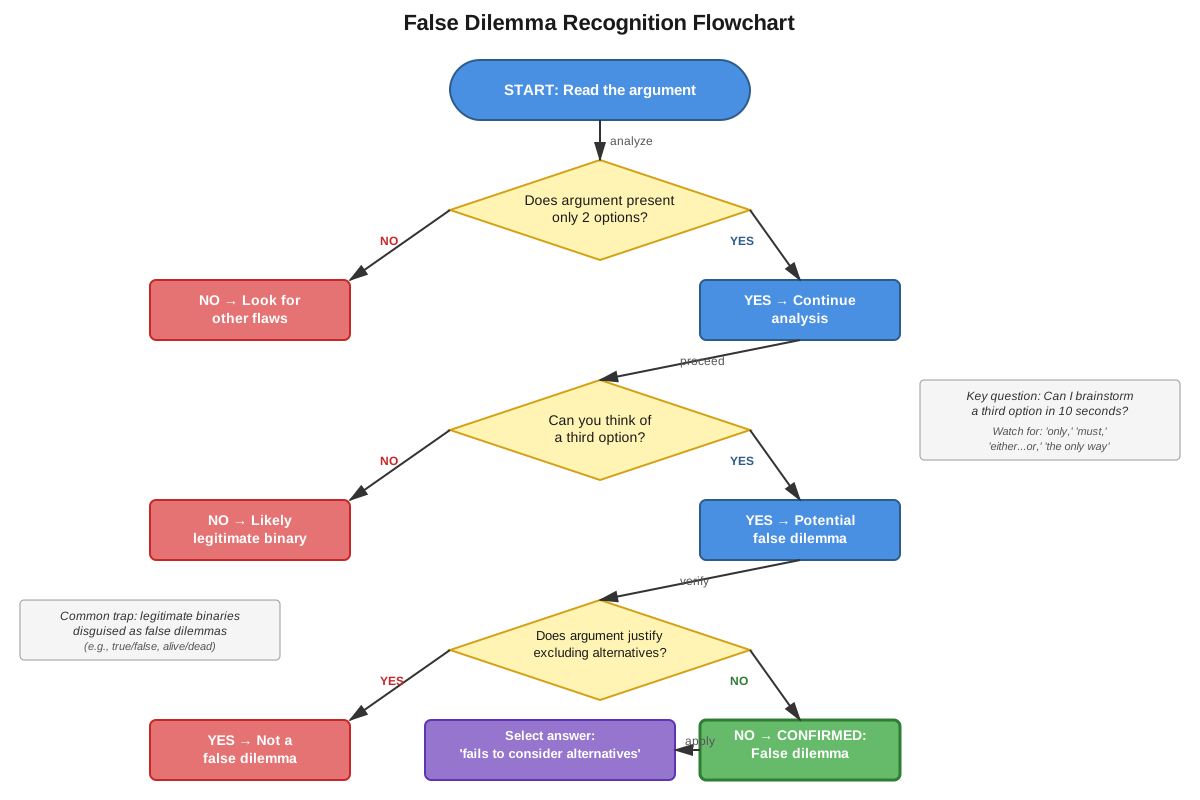
When approaching a potential false dilemma question, follow this process:
- Identify explicit or implicit either-or frameworks: Look for "either...or," "only," "must," "unless," or reasoning that proceeds by eliminating one option to conclude another.
- List the options presented: Write down (mentally or on scratch paper) what alternatives the argument explicitly considers.
- Brainstorm excluded possibilities: Spend 5-10 seconds actively thinking "What else could be true? What middle ground exists? What combinations are possible?"
- Evaluate whether the binary is justified: Ask whether the argument provides reasons why only these options exist, or simply assumes it.
- Match to answer choices precisely: The correct answer must describe the specific false dilemma in the argument, not just identify false dilemma reasoning in general terms.
Trigger Words and Phrases
High-probability false dilemma indicators:
- "Either...or"
- "The only way"
- "Must choose between"
- "Unless"
- "If not X, then Y"
- "No alternative but to"
- "The choice is between"
- "Cannot both" (when applied to things that actually could coexist)
Exam Tip: When you see these phrases, immediately ask yourself: "Has the argument justified that these are the only options, or is it assuming a binary framework?"
Answer Choice Patterns
Correct answers for false dilemma questions typically include:
- "fails to consider that..."
- "overlooks the possibility that..."
- "treats as exhaustive what may not be"
- "assumes without justification that only..."
- "ignores the possibility of..."
- "presumes, without providing justification, that..."
Wrong answer traps often:
- Describe different flaws (circular reasoning, ad hominem, etc.)
- Correctly identify false dilemma reasoning but mischaracterize the specific options in the argument
- Suggest the argument overlooks possibilities that aren't actually relevant or genuine alternatives
- Claim the argument presents a false dilemma when the binary is actually justified
Process of Elimination Strategy
- Eliminate answers describing flaws that clearly don't occur: If an answer mentions circular reasoning but the argument doesn't repeat its conclusion as a premise, eliminate it immediately.
- Eliminate answers that mischaracterize the argument's content: If the argument discusses marketing and quality but an answer choice mentions price and distribution, eliminate it.
- Distinguish between "fails to consider" answers: Multiple answers might use this language. The correct one will specify the relevant overlooked possibility.
- Verify the flaw actually weakens the argument: The correct answer should identify something that, if true, would undermine the argument's reasoning.
Time Allocation
False dilemma questions typically require 60-90 seconds:
- 20-30 seconds: Read and understand the argument
- 10-15 seconds: Identify the either-or structure and brainstorm alternatives
- 20-30 seconds: Read answer choices
- 10-15 seconds: Eliminate wrong answers and verify the correct choice
If you're spending more than 90 seconds, you may be overthinking. Trust your initial identification of the false dilemma and move forward.
Memory Techniques
The "SPECTRUM" Mnemonic
Use SPECTRUM to remember that false dilemmas artificially collapse ranges into binaries:
- Simplifies complex situations
- Presents only two options
- Excludes middle ground
- Collapses continuous variables
- Treats as exhaustive
- Restricts without justification
- Unjustified binary
- Missing alternatives
The "Third Option" Visualization
When reading an argument, visualize a triangle. The argument presents two corners (Option A and Option B). Your job is to mentally place a point in the middle or add a third corner, representing the excluded possibilities. This visual reminder prompts you to actively search for what's missing.
The "What Else?" Habit
Train yourself to automatically ask "What else?" whenever you encounter either-or language. This two-word question becomes an automatic trigger:
- "Either X or Y" → "What else?"
- "The only way is X" → "What else?"
- "Must choose between A and B" → "What else?"
The False Dilemma Formula
Remember: FD = 2 Options Presented + More Options Exist + No Justification for Binary
All three elements must be present. If the argument justifies why only two options exist, it's not a false dilemma. If more options don't actually exist, it's not a false dilemma. If the argument doesn't present or imply a binary choice, it's not a false dilemma.
Summary
The false dilemma represents a critical logical flaw where arguments present two alternatives as exhaustive when additional options genuinely exist. This reasoning error appears consistently on the LSAT, particularly in flaw questions, making it essential for test success. Recognizing false dilemmas requires understanding both explicit either-or constructions and implicit binary frameworks created through phrases like "the only way" or "unless." The key to identification lies in actively questioning whether the presented options truly exhaust all possibilities or whether middle ground, alternative approaches, or combinations exist. Not every binary choice constitutes a false dilemma—some situations involve legitimate dichotomies—so careful analysis distinguishes justified from unjustified either-or reasoning. Mastering this concept requires systematic practice: identifying the either-or structure, brainstorming excluded possibilities, and matching the specific false dilemma to precisely worded answer choices. Success on false dilemma questions translates to broader logical reasoning skills, as the same critical questioning approach applies to evaluating arguments in law school, legal practice, and everyday decision-making.
Key Takeaways
- False dilemmas present two options as exhaustive when additional genuine alternatives exist, creating an unjustified either-or framework that undermines the argument's logic.
- Recognition requires active questioning: whenever an argument presents limited options, immediately ask "What else could be true? What middle ground exists?"
- Signal phrases include "either...or," "the only way," "must choose between," and "unless," but false dilemmas can also be implied through the argument's structure.
- Not every binary choice is a false dilemma; the flaw only exists when the two-option framework is unjustified and excludes real possibilities.
- Correct answer choices typically include language like "fails to consider," "overlooks the possibility," or "assumes without justification that only," and must precisely match the specific false dilemma in the argument.
- False dilemmas appear across multiple argument types: policy recommendations, causal explanations, predictions, and theoretical debates, making this a versatile and high-yield concept.
- Systematic analysis—identifying the binary structure, listing excluded options, and evaluating justification—enables consistent, accurate identification even in complex arguments.
Related Topics
Conditional Logic and Sufficient/Necessary Conditions: False dilemmas often involve misunderstanding conditional relationships, particularly treating one sufficient condition as necessary or exclusive. Mastering conditional logic deepens understanding of how false dilemmas emerge from logical structure.
Overlooked Possibilities (General Category): False dilemma is a specific type of the broader "overlooked possibilities" flaw. Studying this general category reveals how arguments can fail by being insufficiently comprehensive in various ways.
Strengthen and Weaken Questions: Understanding false dilemmas enhances performance on strengthen/weaken questions, where introducing third options often weakens arguments and establishing binary frameworks often strengthens them.
Parallel Reasoning and Parallel Flaw: False dilemma patterns appear in parallel flaw questions, where recognizing the abstract structure (presenting two options as exhaustive when more exist) enables matching to structurally similar arguments.
Causal Reasoning Flaws: Many false dilemmas appear in causal contexts, where arguments present only two possible causes. Studying causal reasoning flaws provides additional context for this application.
Practice CTA
Now that you understand the false dilemma reasoning pattern, it's time to cement your mastery through active practice. Attempt the practice questions associated with this topic, focusing on applying the systematic analysis process: identify the either-or structure, brainstorm excluded possibilities, and match to precisely worded answer choices. Use the flashcards to reinforce recognition of signal phrases and common false dilemma patterns. Remember that each practice question you analyze strengthens your ability to spot these flaws quickly and accurately under timed conditions. The investment you make in deliberate practice now will pay dividends throughout your LSAT preparation and beyond. You've built the foundation—now apply it to achieve mastery.
Sign up free to keep reading
Create a free AnvayaPrep account to finish this LSAT guide on False dilemma — plus flashcards and practice questions.