Overview
Overgeneralization represents one of the most frequently tested logical flaws on the LSAT Logical Reasoning section. This reasoning error occurs when an argument draws a broad, sweeping conclusion from insufficient or limited evidence. The arguer takes a small sample, specific instance, or narrow set of observations and extends the findings inappropriately to a much larger population, broader context, or universal claim. Understanding this flaw is essential because it appears across multiple question types, including Flaw questions, Weaken questions, Strengthen questions, and Assumption questions.
The LSAT tests overgeneralization because it mirrors a common reasoning pattern in everyday discourse, legal arguments, and policy debates. Attorneys must recognize when opposing counsel draws conclusions that exceed what the evidence supports, and judges must evaluate whether precedents apply too broadly. The ability to identify when evidence justifies only a limited conclusion—but the arguer claims something more expansive—is fundamental to critical thinking and legal reasoning. This flaw often appears subtly, requiring careful attention to the scope of both the evidence presented and the conclusion drawn.
Within the broader landscape of logical reasoning and flaw questions, overgeneralization connects closely to other scope-related errors such as unwarranted assumptions, hasty generalizations, and sampling flaws. Mastering this topic requires understanding the relationship between premises and conclusions, recognizing when quantifiers shift inappropriately (from "some" to "all," or from "one case" to "every case"), and identifying the precise boundaries of what evidence can legitimately support. This foundational skill enhances performance across the entire Logical Reasoning section and strengthens overall analytical abilities essential for law school success.
Learning Objectives
- [ ] Identify how Overgeneralization appears in LSAT questions
- [ ] Explain the reasoning pattern behind Overgeneralization
- [ ] Apply Overgeneralization to solve LSAT-style problems accurately
- [ ] Distinguish overgeneralization from other scope-related flaws
- [ ] Recognize the specific language patterns that signal overgeneralization in arguments
- [ ] Evaluate whether given evidence is sufficient to support the scope of a conclusion
- [ ] Construct effective answer choices that correctly identify overgeneralization flaws
Prerequisites
- Basic argument structure: Understanding premises, conclusions, and how they connect is essential because overgeneralization involves a mismatch between the scope of evidence and the scope of the conclusion.
- Quantifiers and scope: Familiarity with terms like "all," "some," "most," "many," and "few" is necessary because overgeneralization often involves inappropriate shifts between these quantifiers.
- Conditional reasoning fundamentals: Basic understanding of sufficient and necessary conditions helps recognize when arguments inappropriately extend conditional relationships beyond their proper scope.
- Evidence evaluation: Ability to assess the strength and relevance of evidence is crucial for determining whether a conclusion is appropriately supported or overgeneralized.
Why This Topic Matters
Overgeneralization appears in approximately 15-20% of all Logical Reasoning questions on the LSAT, making it one of the highest-yield topics for test preparation. This flaw type appears most frequently in Flaw questions (where test-takers must identify the reasoning error), but also surfaces regularly in Weaken questions (where the correct answer often shows the generalization doesn't hold universally), Strengthen questions (where correct answers extend the sample or show representativeness), and Assumption questions (where the argument assumes a limited sample represents a broader population).
In real-world legal practice, recognizing overgeneralization is critical for evaluating precedent, assessing statistical evidence, and constructing persuasive arguments. Attorneys must determine whether a ruling in one case applies broadly or whether distinguishing factors limit its scope. Policy arguments frequently commit this flaw by extrapolating from pilot programs to nationwide implementation or from one demographic to all populations. The ability to identify when conclusions exceed evidentiary support is fundamental to sound legal reasoning and effective advocacy.
On the LSAT, overgeneralization typically appears in arguments that: (1) draw universal conclusions from limited samples, (2) extend findings from one context to all contexts, (3) conclude something about an entire category based on one or few examples, (4) apply temporal findings (what happened once or recently) to all times, or (5) generalize from exceptional cases to typical situations. Test-makers craft these arguments to appear superficially reasonable, requiring careful analysis to detect the scope mismatch between evidence and conclusion.
Core Concepts
The Fundamental Pattern of Overgeneralization
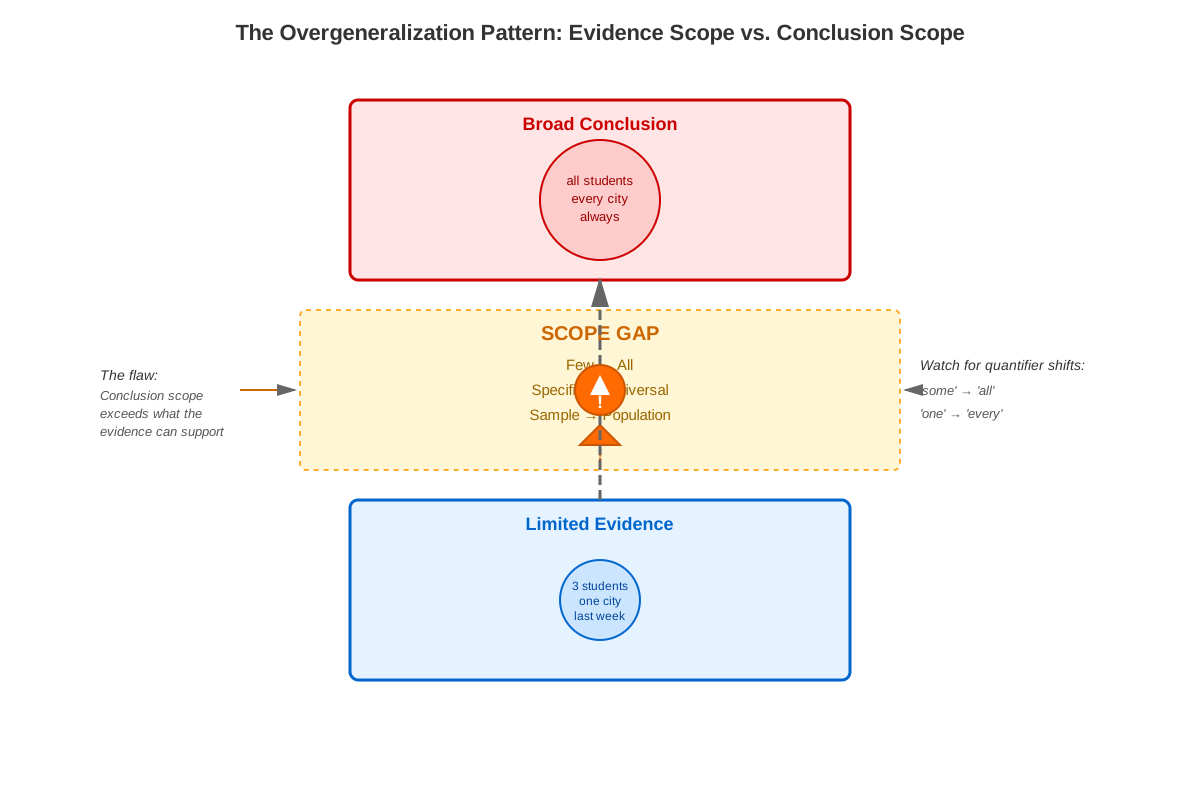
Overgeneralization occurs when an argument's conclusion makes a claim that is broader in scope than what the premises can legitimately support. The core logical error involves a mismatch between the limited scope of the evidence and the expansive scope of the conclusion. This creates a gap in reasoning that the LSAT frequently tests across multiple question types.
The basic structure follows this pattern:
- Premise: Evidence about a limited sample, specific case, or narrow context
- Conclusion: A broad claim about a larger population, general principle, or universal truth
- Flaw: The evidence is insufficient to support the breadth of the conclusion
For example, if an argument observes that three restaurants in a neighborhood serve excellent food and concludes that "all restaurants in this city serve excellent food," the conclusion's scope (all restaurants in the city) far exceeds the evidence's scope (three restaurants in one neighborhood). The argument has overgeneralized from insufficient data.
Types of Scope Expansion
LSAT overgeneralization manifests in several distinct patterns, each involving a different dimension of scope expansion:
| Type of Expansion | Evidence Scope | Conclusion Scope | Example |
|---|---|---|---|
| Sample to Population | Few instances | All or most instances | "Three students improved with tutoring" → "Tutoring helps all students" |
| Specific to Universal | Particular context | All contexts | "This drug works in clinical trials" → "This drug works in real-world conditions" |
| Temporal | One time period | All time periods | "Sales increased last quarter" → "Sales will always increase" |
| Categorical | One subgroup | Entire category | "Luxury sedans are reliable" → "All cars are reliable" |
| Exceptional to Typical | Unusual cases | Normal cases | "Olympic athletes benefit from this diet" → "Everyone benefits from this diet" |
Quantifier Shifts
A critical feature of overgeneralization involves inappropriate shifts in quantifiers. The LSAT tests whether students recognize when arguments move from:
- "Some" or "many" in the evidence → "All" or "most" in the conclusion
- "One" or "a few" in the evidence → "Every" or "typically" in the conclusion
- "Often" in the evidence → "Always" in the conclusion
- Specific numbers in the evidence → Universal claims in the conclusion
These shifts represent logical leaps that create vulnerability in the argument. The conclusion claims more than the evidence establishes, leaving the argument susceptible to counterexamples and alternative explanations.
Sample Representativeness
Many overgeneralization flaws involve unrepresentative samples. The argument assumes that a particular sample accurately reflects the characteristics of a larger population without establishing that the sample is truly representative. Key issues include:
- Sample size: Too few observations to support broad conclusions
- Sample selection: Biased selection methods that don't capture population diversity
- Sample characteristics: The sample differs systematically from the target population
- Context differences: Conditions in the sample differ from conditions in the broader application
For instance, concluding that "most voters support the policy" based on a survey of 20 people at a political rally commits overgeneralization because rally attendees likely differ systematically from the general voting population.
Contextual Overgeneralization
Arguments frequently overgeneralize by extending conclusions from one context to different contexts without justification. The evidence may establish something true in specific circumstances, but the conclusion applies it to circumstances with potentially relevant differences. This includes:
- Geographic overgeneralization (one location to all locations)
- Temporal overgeneralization (one time period to all time periods)
- Conditional overgeneralization (specific conditions to all conditions)
- Demographic overgeneralization (one group to all groups)
The flaw lies in assuming that factors that might affect the conclusion remain constant across contexts when the argument provides no evidence for this assumption.
The Role of Exceptions and Counterexamples
Overgeneralized conclusions are particularly vulnerable to counterexamples—instances that fall within the conclusion's scope but don't exhibit the claimed characteristic. Because the conclusion claims something about all or most cases, finding even a few exceptions can significantly weaken arguments that overgeneralize. This explains why:
- Weaken questions often present counterexamples to overgeneralized conclusions
- Strengthen questions often eliminate potential counterexamples or show the sample is representative
- Assumption questions often require assuming no relevant exceptions exist
Understanding this vulnerability helps test-takers predict correct answer patterns across question types.
Concept Relationships
The concepts within overgeneralization connect hierarchically and functionally. The fundamental pattern (scope mismatch between evidence and conclusion) serves as the foundation, while quantifier shifts, sample representativeness, and contextual overgeneralization represent specific manifestations of this core error. Each type of scope expansion demonstrates the fundamental pattern in different dimensions—numerical, categorical, temporal, or contextual.
Overgeneralization connects to prerequisite knowledge of argument structure because identifying the flaw requires first recognizing what the premises establish versus what the conclusion claims. The concept builds on understanding of quantifiers because detecting inappropriate quantifier shifts is often the key to spotting overgeneralization. The relationship to conditional reasoning emerges when arguments overgeneralize conditional relationships, applying sufficient or necessary conditions more broadly than warranted.
Within the broader category of flaw questions, overgeneralization relates closely to:
- Unrepresentative sample (a specific type of overgeneralization)
- Hasty generalization (essentially synonymous with overgeneralization)
- Scope shift (overgeneralization is one type of scope shift)
- Unwarranted assumption (overgeneralization assumes the sample represents the population)
The relationship map flows as follows:
Limited Evidence → Inappropriate Scope Expansion → Overgeneralized Conclusion → Vulnerability to Counterexamples
This chain explains why overgeneralization appears across multiple question types: the same flaw that makes an argument vulnerable to counterexamples (Weaken questions) also represents a reasoning error (Flaw questions) and requires assumptions about representativeness (Assumption questions).
High-Yield Facts
⭐ Overgeneralization occurs when a conclusion's scope exceeds what the premises can support, creating a gap between limited evidence and broad claims.
⭐ Approximately 15-20% of Logical Reasoning questions involve overgeneralization, making it one of the most frequently tested flaws on the LSAT.
⭐ Quantifier shifts from "some/many" in premises to "all/most" in conclusions signal potential overgeneralization.
⭐ Overgeneralization appears in Flaw, Weaken, Strengthen, and Assumption questions, requiring recognition across multiple question types.
⭐ Arguments that generalize from small samples, specific contexts, or exceptional cases to broad populations are particularly vulnerable to overgeneralization.
- Temporal overgeneralization extends conclusions from one time period to all time periods without justification.
- Unrepresentative samples create overgeneralization when the sample differs systematically from the target population.
- Contextual differences between evidence and conclusion often indicate overgeneralization across geographic, demographic, or situational boundaries.
- Counterexamples effectively weaken overgeneralized conclusions because such conclusions claim to apply broadly.
- Correct answer choices in Flaw questions often use phrases like "generalizes from an unrepresentative sample" or "draws a universal conclusion from limited evidence."
- Overgeneralization differs from other flaws in that the evidence may be accurate but simply insufficient in scope to support the conclusion.
- Arguments can overgeneralize even with large samples if those samples are biased or unrepresentative of the target population.
- The LSAT often disguises overgeneralization by using moderate language in conclusions while still exceeding evidentiary scope.
Quick check — test yourself on Overgeneralization so far.
Try Flashcards →Common Misconceptions
Misconception: Overgeneralization only occurs when an argument uses the word "all" in its conclusion.
Correction: Overgeneralization can occur with any conclusion that exceeds evidentiary scope, including those using "most," "typically," "generally," or even implied universal claims without explicit quantifiers. The flaw depends on the relationship between evidence and conclusion, not specific words.
Misconception: If an argument provides multiple examples, it cannot be overgeneralizing.
Correction: The number of examples matters less than whether those examples are representative and sufficient for the conclusion's scope. Three examples from the same narrow context still constitute overgeneralization when extended to a broad, diverse population.
Misconception: Overgeneralization and hasty generalization are completely different flaws.
Correction: These terms describe essentially the same logical error—drawing conclusions that exceed evidentiary support. The LSAT may use either term, and both refer to inappropriate scope expansion from limited evidence to broad claims.
Misconception: An argument only overgeneralizes if the evidence is false or unreliable.
Correction: Overgeneralization is a scope error, not an accuracy error. The evidence can be completely true and reliable, but still insufficient to support a conclusion of broader scope. The flaw lies in the logical relationship, not the factual content.
Misconception: Strengthening an overgeneralized argument requires adding more examples of the same type.
Correction: Effective strengthening typically requires showing the sample is representative, addressing potential differences between sample and population, or eliminating relevant exceptions—not merely adding more examples from the same narrow context.
Misconception: If an argument acknowledges limitations, it cannot commit overgeneralization.
Correction: An argument can acknowledge some limitations while still overgeneralizing in its conclusion. The test is whether the conclusion's scope exceeds what the evidence supports, regardless of partial qualifications elsewhere in the argument.
Misconception: Overgeneralization only applies to statistical or numerical evidence.
Correction: Arguments can overgeneralize from any type of evidence—anecdotal examples, case studies, historical instances, or theoretical scenarios—whenever the conclusion claims more broadly than the evidence establishes.
Worked Examples
Example 1: Classic Sample-to-Population Overgeneralization
Argument: "A recent survey of 50 employees at TechCorp's headquarters found that 80% were satisfied with their work-life balance. Therefore, most employees at technology companies enjoy good work-life balance."
Question: The reasoning in the argument is flawed because it:
Analysis:
- Identify the evidence: Survey of 50 employees at one company's headquarters showing 80% satisfaction
- Identify the conclusion: Most employees at technology companies (broadly) enjoy good work-life balance
- Compare scopes:
- Evidence scope: 50 employees, one company (TechCorp), one location (headquarters)
- Conclusion scope: Most employees, all technology companies, all locations
- Identify the gap: The argument extends findings from a very limited sample (one company, one location) to an entire industry
Reasoning Pattern: This exemplifies sample-to-population overgeneralization. The evidence establishes something about a specific, small group but the conclusion claims something about a vastly larger, more diverse population. TechCorp's headquarters employees may differ systematically from technology employees generally in terms of company culture, geographic location, job roles, company size, or numerous other factors.
Correct Answer Pattern: "generalizes from a sample that may not be representative of technology company employees as a whole" or "takes evidence about one company's employees to support a conclusion about an entire industry"
Connection to Learning Objectives: This example demonstrates how to identify overgeneralization (Objective 1), explains the reasoning pattern of inappropriate scope expansion (Objective 2), and shows how to analyze the relationship between evidence and conclusion to solve the problem (Objective 3).
Example 2: Contextual Overgeneralization with Temporal Dimension
Argument: "The new traffic management system reduced commute times by 15% during its first month of implementation in downtown Springfield. City planners should implement this system throughout the metropolitan area, as it will significantly reduce traffic congestion everywhere."
Question: Which of the following identifies a flaw in the argument's reasoning?
Analysis:
- Identify the evidence: 15% reduction in commute times, one month, downtown area only
- Identify the conclusion: The system will significantly reduce congestion throughout the metropolitan area (implied: generally, not just initially)
- Identify multiple scope expansions:
- Geographic: downtown → entire metropolitan area
- Temporal: first month → ongoing/permanent
- Contextual: one traffic pattern → all traffic patterns
- Evaluate assumptions: The argument assumes downtown conditions represent metropolitan conditions, initial results predict long-term results, and factors affecting downtown traffic apply everywhere
Reasoning Pattern: This demonstrates contextual overgeneralization across multiple dimensions. The evidence comes from a specific context (downtown, initial implementation period) but the conclusion applies to different contexts (entire metro area, ongoing operation) without establishing that relevant factors remain constant. Downtown areas often have different traffic patterns, infrastructure, and commuter behaviors than suburban or peripheral areas. Initial implementation periods may show temporary effects (novelty, incomplete adaptation, or initial compliance) that don't persist.
Correct Answer Pattern: "assumes without justification that what is true of one area during an initial period will be true of different areas over time" or "fails to consider that conditions in downtown Springfield may differ in relevant ways from conditions elsewhere in the metropolitan area"
Why This Matters: This example shows how overgeneralization can involve multiple dimensions simultaneously (geographic, temporal, contextual) and demonstrates the importance of considering whether evidence from one context legitimately extends to another. This pattern appears frequently in LSAT questions involving policies, programs, or interventions tested in limited circumstances but proposed for broader application.
Exam Strategy
Recognition Triggers
Watch for these trigger phrases that often signal overgeneralization in LSAT arguments:
- Evidence about "some," "several," "many," or "a few" followed by conclusions about "all," "most," or "typically"
- Evidence from "one study," "a recent survey," or "research shows" followed by broad claims
- Evidence about specific locations, times, or groups followed by general conclusions
- Phrases like "this proves," "this shows," or "therefore" connecting limited evidence to expansive conclusions
- Evidence about "recent" or "current" situations followed by predictions about "always" or "generally"
Question Type Strategies
For Flaw Questions:
- Identify the scope of the evidence (how many? which ones? when? where?)
- Identify the scope of the conclusion (all? most? generally? everywhere? always?)
- Compare scopes and look for expansion
- Predict: "The argument generalizes from [limited evidence] to [broad conclusion]"
- Eliminate answers that describe different flaws or mischaracterize the scope relationship
For Weaken Questions:
When you suspect overgeneralization, look for answers that:
- Provide counterexamples within the conclusion's scope
- Show the sample is unrepresentative
- Identify relevant differences between evidence context and conclusion context
- Demonstrate that the pattern doesn't hold more broadly
For Strengthen Questions:
When the argument overgeneralizes, correct answers often:
- Show the sample is representative
- Eliminate relevant differences between contexts
- Provide additional examples from diverse contexts
- Establish that the pattern holds broadly
For Assumption Questions:
Overgeneralized arguments typically assume:
- The sample represents the population
- No relevant differences exist between evidence and conclusion contexts
- The pattern observed continues or applies broadly
Process of Elimination
Eliminate answers that:
- Describe the argument as ignoring evidence (overgeneralization accepts the evidence but extends it too far)
- Claim the argument confuses correlation and causation (unless that's also present)
- State the argument attacks the source rather than the reasoning (ad hominem)
- Suggest the argument is circular (overgeneralization moves from premises to conclusion, not in a circle)
Keep answers that:
- Use language about "unrepresentative samples," "insufficient evidence," or "limited basis"
- Describe conclusions as "too broad," "universal," or "general"
- Mention assuming "what is true of some is true of all" or similar scope shifts
- Reference "generalizing from" specific to general contexts
Time Management
Overgeneralization questions typically require 60-90 seconds:
- 15-20 seconds: Read and identify argument structure
- 15-20 seconds: Compare evidence scope to conclusion scope
- 10-15 seconds: Predict the flaw or answer type
- 20-30 seconds: Evaluate answer choices
- 5-10 seconds: Confirm and select
If you quickly identify clear scope mismatch, you can often eliminate wrong answers rapidly and confirm the correct answer efficiently, making these questions relatively time-efficient despite their frequency.
Memory Techniques
The SCOPE Acronym
Use SCOPE to remember key dimensions where overgeneralization occurs:
- Sample size (too small to support broad conclusion)
- Context differences (specific context to different contexts)
- One to all (single or few instances to universal claims)
- Population mismatch (sample doesn't represent target population)
- Exceptional to typical (unusual cases to normal cases)
The Scope Comparison Visualization
Visualize evidence and conclusion as circles:
- Evidence circle: Small, specific, limited
- Conclusion circle: Large, encompassing much more
- Overgeneralization: When the conclusion circle extends far beyond the evidence circle
When reading arguments, mentally draw these circles and check whether the conclusion circle exceeds the evidence circle. If it does, you've likely found overgeneralization.
The "Some to All" Red Flag
Remember the simple phrase: "Some does not mean all." When you see evidence about "some," "several," "many," or specific examples, immediately check whether the conclusion claims "all," "most," "generally," or "typically." This quantifier shift is the most common and recognizable form of overgeneralization.
The Three Questions Method
Ask yourself three questions in sequence:
- What exactly does the evidence show? (Be specific about scope)
- What exactly does the conclusion claim? (Be specific about scope)
- Does #1 fully support #2? (If no, likely overgeneralization)
This systematic approach prevents missing scope mismatches and ensures you evaluate the logical relationship rather than just the surface plausibility of the argument.
Summary
Overgeneralization represents a fundamental logical flaw where arguments draw conclusions broader in scope than their evidence can support. This high-yield topic appears in 15-20% of LSAT Logical Reasoning questions across multiple question types, making it essential for test success. The core pattern involves a mismatch between limited evidence (small samples, specific contexts, particular instances) and expansive conclusions (broad populations, general principles, universal claims). Recognizing overgeneralization requires careful attention to the scope of both premises and conclusions, particularly watching for inappropriate quantifier shifts from "some" to "all" or from specific to universal. The flaw manifests in several forms: sample-to-population generalizations, contextual overgeneralizations across time or location, and extensions from exceptional to typical cases. Mastering this topic requires understanding that evidence can be accurate yet insufficient in scope, that representativeness matters more than sample size alone, and that conclusions vulnerable to counterexamples often reflect overgeneralization. Success on LSAT questions involving this flaw depends on systematically comparing evidence scope to conclusion scope, predicting answer patterns based on the type of overgeneralization present, and recognizing the characteristic language that signals this reasoning error.
Key Takeaways
- Overgeneralization occurs when conclusions exceed the scope of supporting evidence, creating a logical gap between what premises establish and what conclusions claim.
- Scope comparison is the essential skill: systematically identify what the evidence shows versus what the conclusion claims, then evaluate whether the evidence adequately supports that scope.
- Quantifier shifts from "some/many" to "all/most" are the most recognizable signal of overgeneralization and should trigger immediate scrutiny of the argument's reasoning.
- This flaw appears across multiple question types (Flaw, Weaken, Strengthen, Assumption), requiring flexible application of the same core concept in different contexts.
- Sample representativeness matters more than sample size—even large samples can support overgeneralized conclusions if they're biased or unrepresentative.
- Context matters critically: evidence from one time, place, or circumstance doesn't automatically apply to different times, places, or circumstances without additional justification.
- Overgeneralization is a scope error, not an accuracy error—the evidence can be completely true but still insufficient to support a broader conclusion.
Related Topics
Unrepresentative Sample: A specific type of overgeneralization where the sample used as evidence differs systematically from the population about which the conclusion is drawn. Mastering overgeneralization provides the foundation for recognizing when samples fail to represent target populations.
Hasty Generalization: Essentially synonymous with overgeneralization, this term emphasizes the insufficient evidence basis for broad conclusions. Understanding overgeneralization fully prepares you for questions using this alternative terminology.
Scope Shifts: A broader category of logical flaws involving mismatches between premise and conclusion scope, including overgeneralization but also other scope-related errors. Mastering overgeneralization develops the scope-analysis skills needed for this broader category.
Sampling Errors: Statistical and methodological issues in how samples are selected and used to support conclusions. Understanding overgeneralization provides the logical foundation for recognizing these more technical sampling problems.
Causal Overgeneralization: A specific application where arguments overgeneralize causal relationships, extending causal claims beyond what the evidence supports. This combines overgeneralization with causal reasoning, requiring mastery of both topics.
Conditional Logic Scope Issues: Problems where conditional relationships are applied more broadly than warranted. Understanding overgeneralization enhances ability to recognize when conditional statements are extended beyond their proper scope.
Practice CTA
Now that you understand the reasoning patterns behind overgeneralization and can identify this high-yield flaw across multiple question types, it's time to apply these skills to actual LSAT-style problems. Work through the practice questions systematically, using the SCOPE framework and three-question method to analyze each argument. Pay special attention to comparing evidence scope with conclusion scope, and practice predicting answer choices before evaluating options. The flashcards will reinforce recognition of trigger phrases and common overgeneralization patterns. Consistent practice with these materials will build the automatic recognition skills needed to quickly and accurately identify overgeneralization under timed conditions, significantly improving your Logical Reasoning performance. Remember: mastering this single flaw type can improve your score on nearly one-fifth of all Logical Reasoning questions—making your focused practice here exceptionally high-yield for test day success.
Sign up free to keep reading
Create a free AnvayaPrep account to finish this LSAT guide on Overgeneralization — plus flashcards and practice questions.