Overview
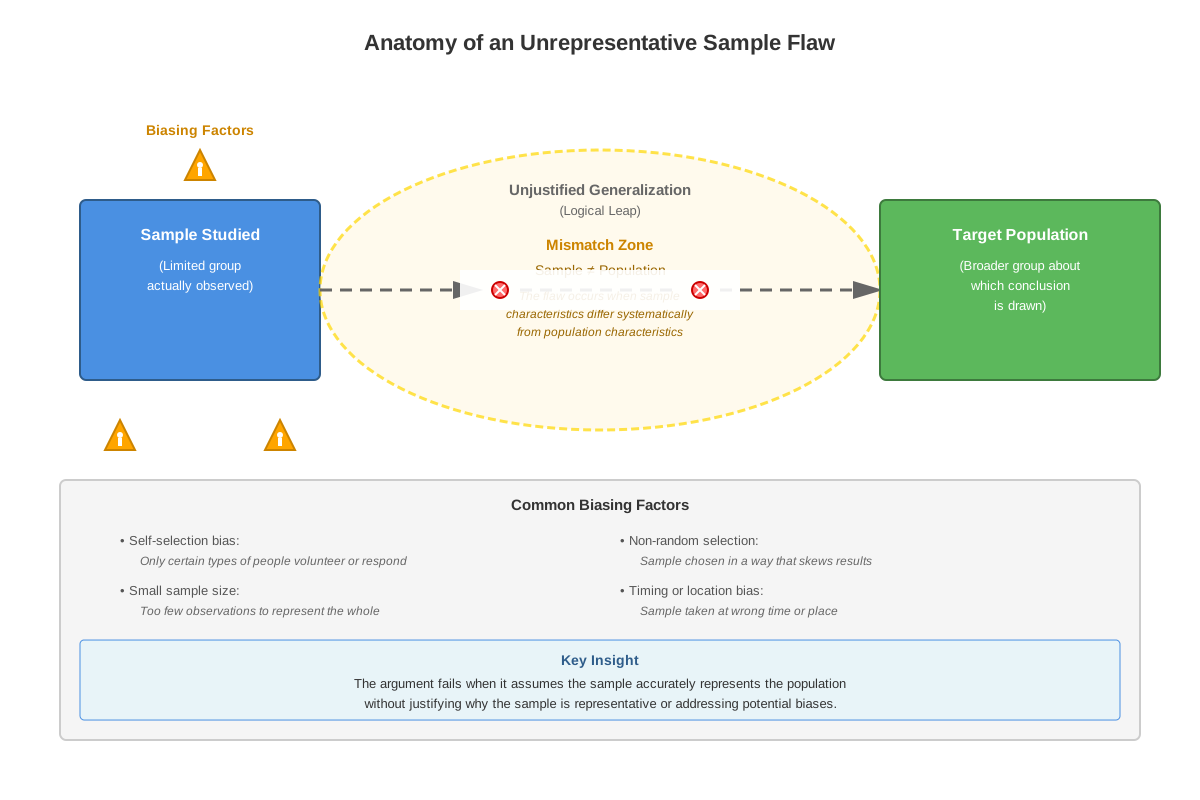
The unrepresentative sample flaw is one of the most frequently tested reasoning errors on the LSAT Logical Reasoning section. This flaw occurs when an argument draws a conclusion about a larger population based on evidence from a sample that does not accurately reflect the characteristics of that population. The sample may be too small, biased in its selection, or skewed in ways that make it unsuitable for generalization. Understanding this flaw is critical because it appears across multiple question types, including Flaw questions, Weaken questions, and Strengthen questions.
On the LSAT, recognizing an unrepresentative sample requires careful attention to how evidence is gathered and whether the sample used truly represents the group about which conclusions are drawn. Test-makers frequently construct arguments where survey respondents, study participants, or observed cases differ systematically from the broader population in question. The ability to identify these sampling problems separates high-scoring test-takers from those who struggle with logical reasoning passages.
This topic connects fundamentally to broader principles of inductive reasoning and statistical argumentation that appear throughout the LSAT. While flaw questions explicitly ask test-takers to identify reasoning errors, the unrepresentative sample concept also underlies questions about argument evaluation, assumption identification, and logical structure. Mastering this topic strengthens overall performance on the Logical Reasoning section and builds critical thinking skills applicable to Reading Comprehension passages that discuss studies, surveys, and empirical claims.
Learning Objectives
- [ ] Identify how Unrepresentative sample appears in LSAT questions
- [ ] Explain the reasoning pattern behind Unrepresentative sample
- [ ] Apply Unrepresentative sample to solve LSAT-style problems accurately
- [ ] Distinguish between representative and unrepresentative samples in complex argument structures
- [ ] Recognize the various forms of sampling bias that create unrepresentative samples
- [ ] Evaluate whether a given sample size and selection method support a generalization
- [ ] Predict how answer choices will describe the unrepresentative sample flaw in technical language
Prerequisites
- Basic argument structure: Understanding premises and conclusions is essential because identifying sampling flaws requires recognizing what evidence supports what claim
- Inductive vs. deductive reasoning: The unrepresentative sample flaw specifically affects inductive arguments that generalize from specific observations
- Population vs. sample concepts: Distinguishing between the group studied and the group discussed in the conclusion is fundamental to spotting this flaw
- Causation and correlation: Many unrepresentative sample arguments also involve causal claims, making it important to understand how evidence supports causal conclusions
Why This Topic Matters
In real-world contexts, the unrepresentative sample flaw underlies countless flawed arguments in media, politics, business, and scientific reporting. When a news article claims "Americans prefer X" based on an online poll of website visitors, or when a company makes marketing decisions based on feedback from its most loyal customers, unrepresentative sampling creates misleading conclusions. Legal reasoning, which the LSAT is designed to assess, frequently involves evaluating evidence quality, making this skill directly relevant to law school and legal practice.
On the LSAT specifically, unrepresentative sample flaws appear in approximately 10-15% of Logical Reasoning questions across all administrations. This flaw type appears most commonly in:
- Flaw questions (asking what reasoning error the argument commits)
- Weaken questions (where correct answers often point out sampling problems)
- Strengthen questions (where correct answers establish sample representativeness)
- Assumption questions (where the argument assumes the sample is representative)
The LSAT tests this concept through various scenarios: surveys with self-selected respondents, studies using convenience samples, generalizations based on extreme cases, and conclusions about all members of a group based on observations of a subset. Test-makers particularly favor arguments where the sample differs from the population in subtle but important ways, requiring careful analysis to detect the flaw.
Core Concepts
Definition of Unrepresentative Sample
An unrepresentative sample is a subset of a population that does not accurately reflect the characteristics, diversity, or distribution of the larger group from which it is drawn. When an argument uses evidence from an unrepresentative sample to draw conclusions about a broader population, it commits a logical flaw because the sample cannot support valid generalizations.
The core reasoning pattern follows this structure:
- Evidence is gathered from a specific sample (subset of a population)
- The sample has characteristics that differ systematically from the broader population
- A conclusion is drawn about the entire population based on this flawed sample
- The conclusion is therefore inadequately supported
Types of Sampling Bias
Several distinct mechanisms can create unrepresentative samples on the LSAT:
Self-Selection Bias: Occurs when participants choose whether to be included in the sample. People who voluntarily respond to surveys, call-in polls, or online questionnaires often have stronger opinions or different characteristics than non-respondents. For example, an argument concluding that "most restaurant customers are dissatisfied" based on comment cards commits this error because only customers with strong feelings (usually negative) typically complete such cards.
Convenience Sampling: Involves selecting participants based on ease of access rather than representativeness. An argument that surveys only college students to draw conclusions about all adults, or that studies only patients at a single hospital to make claims about all patients with a condition, uses convenience sampling that may not represent the broader group.
Temporal Bias: Occurs when a sample is drawn from a specific time period that differs from the time period about which conclusions are drawn. Surveying shoppers only during weekday mornings to conclude what "typical shoppers" prefer fails to account for working people who shop evenings and weekends.
Geographic Bias: Involves sampling from one location to draw conclusions about other locations or broader regions. Studying traffic patterns in one city to make claims about urban traffic generally, or surveying residents of one neighborhood to conclude what city residents believe, exemplifies this bias.
Extreme Case Bias: Occurs when a sample consists of unusual, exceptional, or extreme cases rather than typical members of the population. Studying only the most successful companies to determine what makes businesses succeed, or examining only the most severe cases of a medical condition to draw conclusions about all cases, creates unrepresentative samples.
Sample Size vs. Sample Representativeness
A critical distinction on the LSAT involves understanding that sample size and sample representativeness are separate issues. A large sample can still be unrepresentative if it is systematically biased, while a small but well-selected sample may be more representative than a large biased one.
| Characteristic | Representative Sample | Unrepresentative Sample |
|---|---|---|
| Selection Method | Random or stratified to match population | Biased, self-selected, or convenience-based |
| Diversity | Reflects population variation | Skewed toward certain subgroups |
| Relevance | Characteristics match those relevant to conclusion | Differs in ways that affect the conclusion |
| Generalizability | Supports inferences about population | Cannot validly support generalizations |
The Generalization Structure
Arguments with unrepresentative sample flaws follow a predictable structure:
Premise: [Sample group] has characteristic X
Conclusion: Therefore, [broader population] has characteristic X
The flaw lies in the gap between the sample and the population. The argument assumes without justification that the sample accurately represents the population, when in fact the sample differs in relevant ways.
Identifying Relevant Differences
Not all differences between a sample and population create unrepresentative sample flaws. The key question is whether the difference is relevant to the conclusion being drawn. For example:
- If an argument concludes that "most Americans support Policy X" based on a survey of only men, the gender difference is relevant because men and women may have different policy preferences
- If an argument concludes that "most Americans prefer chocolate ice cream" based on a survey of only people under 6 feet tall, the height difference is likely irrelevant to ice cream preferences
LSAT questions often test whether students can distinguish relevant from irrelevant differences between samples and populations.
Common LSAT Scenarios
The LSAT presents unrepresentative sample flaws through recurring scenarios:
- Survey-based arguments: Conclusions about public opinion based on surveys with problematic sampling methods
- Study generalizations: Scientific or medical studies with limited participant pools used to support broad claims
- Customer feedback: Business decisions based on feedback from non-representative customer subsets
- Historical comparisons: Arguments using past data to predict future outcomes when conditions have changed
- Expert opinions: Conclusions about general populations based on observations from specialized or expert groups
Concept Relationships
The unrepresentative sample flaw connects to several other logical reasoning concepts in important ways:
Unrepresentative Sample → Hasty Generalization: An unrepresentative sample is a specific type of hasty generalization where the problem is not just insufficient quantity of evidence but poor quality due to bias. While hasty generalization focuses on sample size, unrepresentative sample focuses on sample composition.
Unrepresentative Sample ← Selection Bias: Selection bias is the mechanism that creates unrepresentative samples. Understanding how samples become biased (through self-selection, convenience, etc.) explains why they fail to represent populations.
Unrepresentative Sample ↔ Necessary Assumption: Many arguments with unrepresentative samples rely on the unstated assumption that the sample IS representative. Assumption questions may ask students to identify this gap.
Unrepresentative Sample → Weakening Strategy: Pointing out that a sample is unrepresentative is one of the most common ways to weaken an argument on the LSAT. Conversely, establishing representativeness strengthens arguments.
Statistical Reasoning → Unrepresentative Sample: Broader statistical reasoning principles encompass sampling issues. Understanding how statistics can mislead helps identify when samples fail to support conclusions.
The relationship map:
Population Characteristics → Sample Selection Method → Sample Characteristics →
Generalization Validity → Conclusion Strength
When the sample selection method introduces bias, sample characteristics diverge from population characteristics, making generalizations invalid and weakening conclusions.
High-Yield Facts
⭐ The unrepresentative sample flaw occurs when an argument generalizes from a biased sample to a broader population without justification
⭐ Self-selection bias is the most common form of unrepresentative sampling on the LSAT, appearing in survey and feedback scenarios
⭐ A large sample size does not guarantee representativeness; a biased large sample is still unrepresentative
⭐ The key question is whether the sample differs from the population in ways RELEVANT to the conclusion being drawn
⭐ Correct answer choices often use technical language like "generalizes from an atypical case" or "draws a conclusion about a group based on an unrepresentative sample"
- Convenience samples (studying only easily accessible subjects) frequently create unrepresentative sample flaws
- Temporal and geographic limitations often make samples unrepresentative of broader populations
- Arguments that conclude "most" or "all" members of a group have a characteristic based on limited observations are particularly vulnerable to this flaw
- Extreme cases (studying only the best or worst examples) cannot support conclusions about typical cases
- The flaw can appear in both descriptive arguments (what is true) and prescriptive arguments (what should be done)
- Volunteer participants in studies often differ systematically from non-volunteers in ways that affect research conclusions
- Historical data may constitute an unrepresentative sample for predicting future outcomes if conditions have changed
- Expert or specialized populations often make poor samples for drawing conclusions about general populations
Quick check — test yourself on Unrepresentative sample so far.
Try Flashcards →Common Misconceptions
Misconception: Any small sample is automatically unrepresentative → Correction: Sample size and representativeness are distinct issues. A small but randomly selected sample can be representative, while a large biased sample remains unrepresentative. The LSAT tests whether students focus on selection method rather than just size.
Misconception: If a sample includes some diversity, it must be representative → Correction: A sample must reflect the population's diversity in the right proportions and relevant characteristics. Including a few members of underrepresented groups doesn't make a fundamentally biased sample representative.
Misconception: The unrepresentative sample flaw only applies to surveys and polls → Correction: This flaw appears in any argument that generalizes from observations of a subset to conclusions about a whole, including scientific studies, historical examples, case studies, and anecdotal evidence.
Misconception: Any difference between sample and population makes the sample unrepresentative → Correction: Only differences relevant to the conclusion matter. A sample of tall people can represent the general population for conclusions about political preferences (height is irrelevant) but not for conclusions about clothing sizes (height is relevant).
Misconception: Unrepresentative sample and hasty generalization are identical flaws → Correction: While related, hasty generalization emphasizes insufficient quantity of evidence, while unrepresentative sample emphasizes poor quality due to bias. An argument can have adequate quantity but still use an unrepresentative sample.
Misconception: If the argument acknowledges the sample is limited, the flaw disappears → Correction: Merely acknowledging a limitation doesn't fix the logical flaw. The argument still commits an error if it draws strong conclusions about a population from an unrepresentative sample, even if it mentions the sample's limitations.
Misconception: Random sampling always produces representative samples → Correction: While random sampling is generally better than biased selection, even random samples can be unrepresentative due to chance, especially with small samples, or if the sampling frame itself is biased.
Worked Examples
Example 1: Customer Satisfaction Survey
Argument:
"A restaurant chain distributed comment cards to all customers and received 500 responses. Of these, 350 expressed dissatisfaction with service speed. Therefore, most of the restaurant chain's customers are dissatisfied with service speed."
Analysis:
Step 1 - Identify the conclusion: "Most of the restaurant chain's customers are dissatisfied with service speed"
Step 2 - Identify the evidence: 350 out of 500 comment card respondents expressed dissatisfaction
Step 3 - Identify the population and sample:
- Population: All of the restaurant chain's customers
- Sample: The 500 customers who chose to return comment cards
Step 4 - Evaluate representativeness: The sample consists only of customers who voluntarily completed and returned comment cards. This creates self-selection bias because:
- Customers with strong negative feelings are more likely to complete comment cards
- Satisfied customers typically don't bother providing feedback
- The 500 respondents may represent only a tiny fraction of total customers
- Those motivated to respond likely differ systematically from non-respondents
Step 5 - Identify the flaw: The argument generalizes from a self-selected sample (comment card respondents) to all customers without justification. The sample is unrepresentative because it oversamples dissatisfied customers.
Step 6 - Connect to learning objectives: This example demonstrates how unrepresentative samples appear in LSAT questions (customer feedback scenario), explains the reasoning pattern (self-selection bias leading to invalid generalization), and shows how to identify the flaw systematically.
How this would appear in answer choices:
- Correct: "generalizes from a sample that is likely to be unrepresentative"
- Correct: "overlooks the possibility that customers with complaints are more likely to respond"
- Incorrect: "relies on a sample that is too small" (size isn't the primary issue)
- Incorrect: "assumes that customer satisfaction cannot change over time" (different flaw)
Example 2: Medical Study Generalization
Argument:
"A study of patients at a specialized cardiac care center found that 80% of heart attack patients had high cholesterol levels. Therefore, high cholesterol is present in approximately 80% of all heart attack cases."
Analysis:
Step 1 - Identify the conclusion: High cholesterol is present in approximately 80% of all heart attack cases
Step 2 - Identify the evidence: 80% of patients at a specialized cardiac care center had high cholesterol
Step 3 - Identify the population and sample:
- Population: All heart attack patients (everywhere, all types)
- Sample: Patients at one specialized cardiac care center
Step 4 - Evaluate representativeness: The sample comes from a specialized center, which creates multiple biases:
- Specialized centers treat more severe or complex cases
- Patients at specialized centers may have been referred because of multiple risk factors
- Geographic location may affect patient demographics
- Specialized centers may attract patients with specific characteristics
- The center's patient population may differ from general heart attack patients in age, severity, comorbidities, or other relevant factors
Step 5 - Identify the flaw: The argument treats patients at a specialized center as representative of all heart attack patients when they likely constitute a biased sample of more severe or complex cases.
Step 6 - Apply to LSAT strategy: This exemplifies convenience sampling (studying easily accessible patients at one location) and demonstrates why specialized or extreme cases cannot support conclusions about typical cases.
Correct answer choice language:
- "treats a sample drawn from an atypical subgroup as representative of a larger population"
- "generalizes from cases that may differ in relevant respects from the broader group"
- "fails to establish that the patients studied are typical of heart attack patients generally"
Exam Strategy
Recognition Triggers
Watch for these trigger words and phrases that signal potential unrepresentative sample flaws:
- "A survey of [specific group] found that..."
- "Based on responses from those who..."
- "Studies of patients at [specific location]..."
- "Feedback from customers who contacted..."
- "A poll of [easily accessible group]..."
- "Observations of [extreme or specialized cases]..."
- "Data from [limited time period or location]..."
Systematic Approach
When encountering a potential unrepresentative sample argument, follow this process:
- Identify the conclusion's scope: What group is the conclusion about? (All customers? Most people? Typical cases?)
- Identify the sample: What specific group provided the evidence? How were they selected?
- Compare sample to population: Does the sample differ from the population in potentially relevant ways?
- Assess selection method: Was the sample randomly selected, self-selected, convenience-based, or otherwise biased?
- Evaluate relevance: Are the differences between sample and population relevant to the conclusion?
Answer Choice Patterns
In Flaw questions, correct answers describing unrepresentative samples often use this language:
- "generalizes from a sample that is likely to be unrepresentative"
- "treats an unrepresentative sample as representative"
- "draws a conclusion about a group based on a sample that may not be typical"
- "overlooks the possibility that the sample differs from the population in relevant respects"
In Weaken questions, correct answers often:
- Point out specific ways the sample differs from the population
- Provide evidence that the sample was self-selected or biased
- Show that the sample consists of extreme or atypical cases
In Strengthen questions, correct answers often:
- Establish that the sample was randomly selected
- Show that the sample matches the population in relevant characteristics
- Demonstrate that potential sources of bias were controlled
Process of Elimination
Eliminate answer choices that:
- Focus on sample size alone without addressing representativeness
- Identify irrelevant differences between sample and population
- Describe different flaws (causation, necessary/sufficient conditions, etc.)
- Mischaracterize the argument's conclusion or evidence
Time Management
Unrepresentative sample questions typically require 60-90 seconds:
- 20-30 seconds: Read and understand the argument
- 20-30 seconds: Identify the sample and population, assess representativeness
- 20-30 seconds: Evaluate answer choices
If you quickly recognize the unrepresentative sample pattern, you can often eliminate wrong answers rapidly because they'll describe different flaws entirely.
Memory Techniques
SAMPLE Acronym
Use SAMPLE to remember key questions for evaluating representativeness:
- Selection method: How were participants chosen?
- Access: Who had access to participate?
- Motivation: Who was motivated to participate?
- Population match: Does the sample match the population?
- Limitations: What geographic, temporal, or demographic limitations exist?
- Extreme cases: Does the sample consist of unusual or extreme examples?
The "Who's Missing?" Technique
When evaluating a sample, visualize asking "Who's missing from this sample?" If you can identify significant groups excluded from the sample who might differ in their characteristics, the sample is likely unrepresentative.
The Self-Selection Red Flag
Create a mental red flag for any argument involving:
- Voluntary surveys or polls
- Customer feedback or comment cards
- Call-in responses
- Online polls
- Complaints or testimonials
These almost always involve self-selection bias, making them unrepresentative.
Visual Metaphor
Picture a sample as a "snapshot" of a population. An unrepresentative sample is like a photograph that captures only one corner of a room and claims to show what the entire room looks like. The photo isn't wrong about what it shows, but it can't support conclusions about the whole room.
Summary
The unrepresentative sample flaw is a critical concept in LSAT logical reasoning that appears frequently in flaw questions and related question types. This error occurs when an argument draws conclusions about a broader population based on evidence from a sample that does not accurately reflect that population's characteristics. The sample may be biased through self-selection, convenience sampling, temporal or geographic limitations, or by consisting of extreme cases rather than typical members. The key to identifying this flaw is recognizing the gap between the sample studied and the population discussed in the conclusion, then evaluating whether differences between them are relevant to the conclusion. Success on LSAT questions involving unrepresentative samples requires distinguishing sample size from sample quality, understanding various forms of sampling bias, and recognizing that only relevant differences between sample and population create logical flaws. Mastering this concept strengthens performance across multiple Logical Reasoning question types and builds essential critical thinking skills for evaluating empirical arguments.
Key Takeaways
- An unrepresentative sample flaw occurs when arguments generalize from a biased sample to a broader population without adequate justification
- Self-selection bias (voluntary participation) is the most common form of unrepresentative sampling on the LSAT and creates samples that differ systematically from populations
- Sample size and sample representativeness are distinct issues; large samples can still be unrepresentative if selection methods are biased
- Only differences between sample and population that are relevant to the conclusion create logical flaws; irrelevant differences don't matter
- Recognizing trigger phrases like "survey of those who responded," "feedback from customers who contacted," and "study at a specialized center" helps identify potential unrepresentative sample arguments
- Correct answer choices use technical language like "generalizes from an atypical case" or "treats an unrepresentative sample as representative"
- Systematic evaluation involves identifying the population, identifying the sample, comparing them, assessing selection methods, and evaluating relevance of differences
Related Topics
Hasty Generalization: While unrepresentative sample focuses on sample quality and bias, hasty generalization emphasizes insufficient quantity of evidence. Understanding both concepts helps distinguish between arguments that fail due to too little evidence versus biased evidence.
Causation Flaws: Many arguments with unrepresentative samples also make causal claims. Mastering sampling issues enhances the ability to evaluate whether evidence adequately supports causal conclusions.
Necessary Assumptions: Arguments with unrepresentative samples typically assume (without stating) that their samples are representative. Understanding this connection helps with Assumption questions.
Strengthen and Weaken Questions: The principles of representative sampling directly apply to evaluating what would strengthen (establishing representativeness) or weaken (showing bias) arguments throughout Logical Reasoning.
Survey and Study Methodology: Deeper understanding of research design principles, while not explicitly tested, provides context for evaluating sampling arguments more effectively.
Practice CTA
Now that you understand the unrepresentative sample flaw, you're ready to apply this knowledge to practice questions. Work through LSAT-style problems focusing on identifying sampling biases, distinguishing relevant from irrelevant differences, and recognizing the technical language used in answer choices. Use flashcards to reinforce the various types of sampling bias and trigger phrases that signal this flaw. Remember: consistent practice with immediate feedback is the key to mastering this high-yield LSAT concept. Each question you analyze strengthens your pattern recognition and builds the confidence needed to quickly identify and correctly answer unrepresentative sample questions on test day. You've got this!
Sign up free to keep reading
Create a free AnvayaPrep account to finish this LSAT guide on Unrepresentative sample — plus flashcards and practice questions.