Overview
The possibility versus certainty flaw is one of the most frequently tested reasoning errors in LSAT Logical Reasoning sections. This flaw occurs when an argument treats something that is merely possible as if it were certain, or conversely, when it assumes that because something is not certain, it cannot be possible. Understanding this distinction is crucial because the LSAT consistently tests whether students can recognize when arguments make unwarranted leaps from what might happen to what will happen, or from what could be true to what must be true.
This reasoning pattern appears across multiple question types, but it is especially prevalent in flaw questions, where test-takers must identify the logical error in an argument's structure. The LSAT writers craft arguments that sound persuasive on the surface but commit this fundamental error by conflating different degrees of certainty. For instance, an argument might conclude that a policy will definitely fail because there's a possibility it could fail, or it might reject a hypothesis entirely because it hasn't been proven with absolute certainty.
Mastering the lsat possibility versus certainty distinction connects directly to broader Logical Reasoning skills, including understanding conditional logic, recognizing sufficient versus necessary conditions, and evaluating the strength of evidence. This flaw often appears alongside other reasoning errors such as hasty generalizations, causal reasoning flaws, and appeals to ignorance. By developing a keen eye for when arguments inappropriately shift between possibility and certainty, students build a foundational skill that enhances their ability to analyze arguments across all Logical Reasoning question types, including Strengthen, Weaken, Assumption, and Parallel Reasoning questions.
Learning Objectives
- [ ] Identify how possibility versus certainty appears in LSAT questions
- [ ] Explain the reasoning pattern behind possibility versus certainty
- [ ] Apply possibility versus certainty to solve LSAT-style problems accurately
- [ ] Distinguish between modal qualifiers (might, could, must, will) in argument conclusions
- [ ] Recognize when evidence supports only possibility but the conclusion claims certainty
- [ ] Evaluate whether an argument's rejection of a claim is justified based on lack of certainty
- [ ] Construct accurate descriptions of the possibility versus certainty flaw in answer choices
Prerequisites
- Basic argument structure: Understanding premises and conclusions is essential because the possibility versus certainty flaw specifically concerns the relationship between evidence and conclusion strength
- Conditional reasoning fundamentals: Recognizing the difference between sufficient and necessary conditions helps distinguish what must happen from what might happen
- Flaw question format: Familiarity with how flaw questions are structured and what they ask enables efficient identification of this specific reasoning error
- Modal logic basics: Understanding terms like "possible," "probable," "certain," and "necessary" provides the vocabulary framework for recognizing this flaw
Why This Topic Matters
The possibility versus certainty flaw represents a fundamental error in reasoning that extends far beyond standardized testing. In real-world contexts, this reasoning pattern appears in policy debates (rejecting a solution because it's not guaranteed to work), scientific discussions (dismissing theories that haven't achieved absolute proof), business decisions (treating potential risks as inevitable outcomes), and legal arguments (confusing what could have happened with what did happen). Recognizing this flaw enables critical evaluation of arguments in professional, academic, and civic contexts.
On the LSAT specifically, this flaw appears in approximately 8-12% of all Logical Reasoning questions, making it one of the top ten most frequently tested reasoning errors. It appears most commonly in Flaw questions but also surfaces in Weaken questions (where the correct answer might show that something claimed as certain is merely possible), Strengthen questions (where distinguishing degrees of support matters), and Necessary Assumption questions (where the argument depends on treating possibility as certainty).
The LSAT tests this concept through several common patterns: arguments that conclude a plan will fail because failure is possible; arguments that reject a hypothesis because it hasn't been proven with certainty; arguments that treat a potential explanation as the definite explanation; and arguments that assume something cannot happen because it's not guaranteed to happen. Test writers often disguise this flaw with complex subject matter or embed it within longer argument chains, making pattern recognition essential for efficient and accurate performance.
Core Concepts
The Fundamental Distinction
Possibility versus certainty refers to the logical error of conflating different degrees of likelihood or proof. A statement of possibility indicates that something can occur, might be true, or is consistent with available evidence. A statement of certainty indicates that something will occur, must be true, or is proven by available evidence. The flaw occurs when an argument's conclusion claims a higher degree of certainty than the premises actually support.
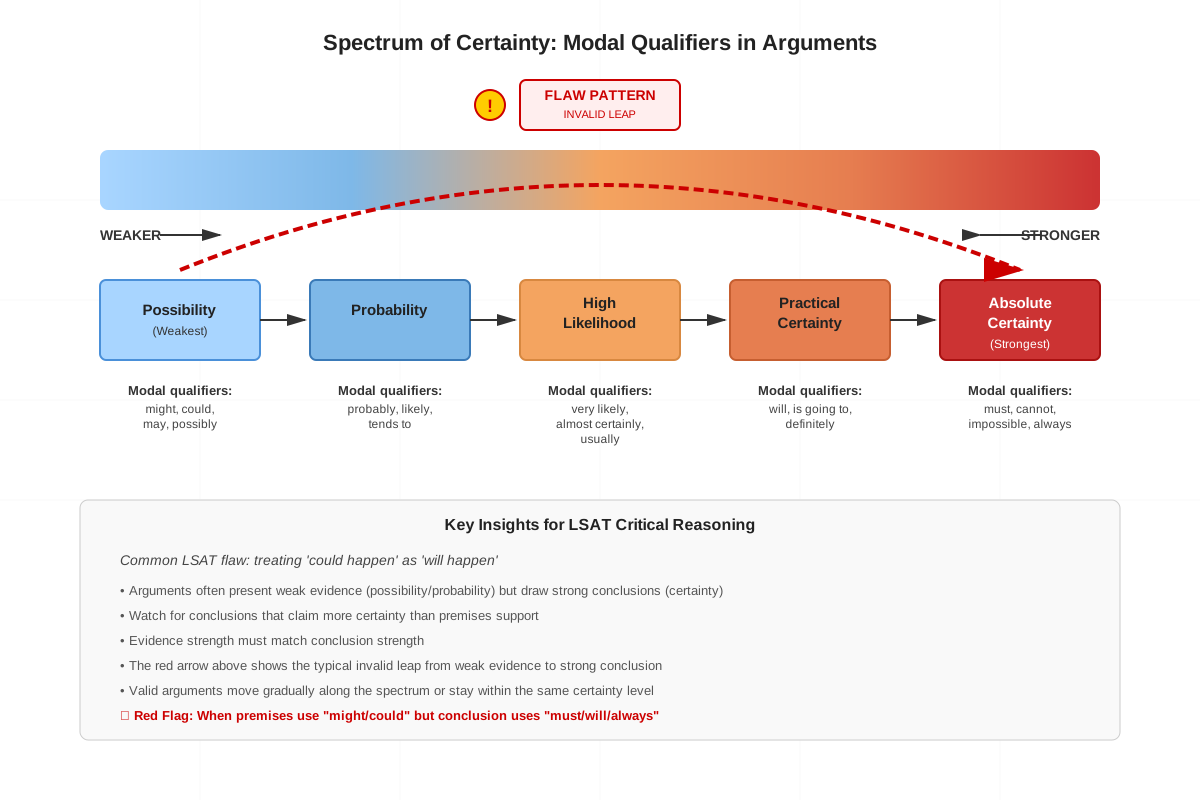
Consider the spectrum of certainty in logical reasoning:
| Degree of Certainty | Modal Indicators | Logical Status |
|---|---|---|
| Impossible | Cannot, impossible, will not | Ruled out completely |
| Possible | Could, might, may, possibly | Not ruled out; consistent with evidence |
| Probable | Likely, probably, tends to | More likely than not |
| Certain | Must, will, definitely, necessarily | Logically required or guaranteed |
The lsat possibility versus certainty flaw typically involves jumping from the "possible" or "probable" categories directly to "certain," or conversely, treating something as "impossible" merely because it isn't "certain."
The Positive Form: Treating Possibility as Certainty
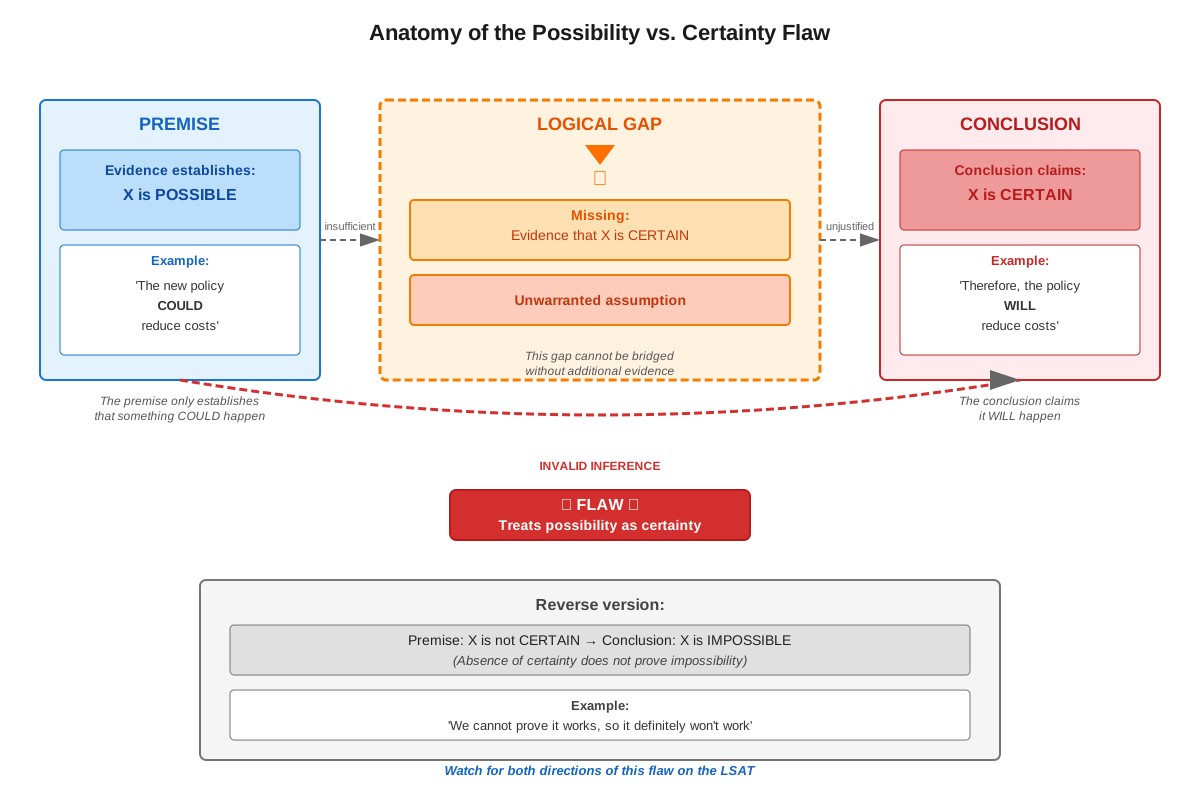
The most common manifestation of this flaw occurs when an argument presents evidence that something could happen or might be true, then concludes that it will happen or is true. The premises establish possibility, but the conclusion asserts certainty.
Structure:
- Premise: X is possible (or: there's a chance X could occur)
- Conclusion: Therefore, X will happen (or: X is true)
Example argument:
"The new highway construction could cause traffic delays in the downtown area during rush hour. Therefore, commuters should expect significant delays for the next six months."
The flaw: The premise establishes that delays are possible, but the conclusion treats them as certain ("should expect" implies they will definitely occur). The argument fails to consider that the possibility might not materialize, or that delays might be minimal or temporary.
The Negative Form: Rejecting Claims Due to Lack of Certainty
The inverse form of this flaw occurs when an argument rejects a claim, hypothesis, or possibility simply because it hasn't been proven with absolute certainty. This represents a misunderstanding of how evidence and proof work—most claims in the real world cannot be proven with 100% certainty, yet they may still be well-supported or likely true.
Structure:
- Premise: X has not been proven with certainty (or: we cannot be sure X is true)
- Conclusion: Therefore, X is false (or: we should reject X)
Example argument:
"Scientists have not definitively proven that the new medication is completely safe for all patients. Therefore, the medication should not be approved for public use."
The flaw: The absence of absolute certainty doesn't justify complete rejection. The argument ignores that the medication might be safe even without definitive proof, or that sufficient evidence of safety might exist even if absolute certainty is impossible.
Modal Qualifiers and Argument Strength
Modal qualifiers are words and phrases that indicate the degree of certainty or possibility in a statement. Recognizing these qualifiers is essential for identifying the possibility versus certainty flaw:
Possibility indicators:
- Could, might, may, can
- Possibly, perhaps, potentially
- It is possible that, there is a chance that
- Not impossible, cannot rule out
Certainty indicators:
- Must, will, shall
- Definitely, certainly, necessarily
- It is certain that, it is guaranteed that
- Cannot fail to, inevitably
Probability indicators (middle ground):
- Probably, likely, tends to
- More often than not, usually
- It is probable that, chances are
When analyzing arguments, track the modal qualifiers in both premises and conclusion. A mismatch—where premises use possibility language but the conclusion uses certainty language—signals a potential flaw.
The Evidential Gap
The possibility versus certainty flaw creates what can be called an evidential gap: the space between what the evidence actually supports and what the conclusion claims. Understanding this gap helps explain why the reasoning fails:
- Evidence showing possibility supports conclusions about possibility
- Evidence showing probability supports conclusions about probability
- Evidence showing certainty supports conclusions about certainty
When an argument leaps across these categories (possibility → certainty, or not-certain → impossible), it fails to provide sufficient justification for its conclusion. The premises might be true, and the conclusion might even be true, but the reasoning doesn't establish the conclusion based on the premises provided.
Common Variations and Disguises
The LSAT presents this flaw in various disguised forms:
Risk-based arguments: "Because there's a risk of X, we should assume X will occur" (treating possible risk as certain outcome)
Precautionary principle misapplication: "We cannot be certain this action is safe, so we must not take it" (treating lack of certainty as proof of danger)
Potential explanation as definite explanation: "Y could explain X, therefore Y does explain X" (treating one possible explanation as the certain explanation)
Absence of proof as proof of absence: "We haven't proven X exists, therefore X doesn't exist" (treating lack of certainty as impossibility)
Concept Relationships
The possibility versus certainty flaw connects intimately with several other logical reasoning concepts. It relates directly to conditional logic because conditional statements establish what must be true given certain conditions, while the flaw involves treating what might be true as what must be true. Understanding sufficient versus necessary conditions helps distinguish between "if X, then definitely Y" (conditional certainty) and "if X, then possibly Y" (conditional possibility).
This flaw also connects to strength of evidence evaluation. Arguments commit the possibility versus certainty flaw when they overstate what their evidence proves. This relationship extends to Strengthen and Weaken questions: an answer choice might weaken an argument by showing that something claimed as certain is merely possible, or strengthen an argument by moving evidence from possibility toward certainty.
The concept relates to causal reasoning flaws as well. When an argument identifies a possible cause and treats it as the definite cause, it commits both a causal reasoning error and a possibility versus certainty error. Similarly, hasty generalization flaws often involve treating limited evidence (which makes something possible or probable) as if it establishes certainty.
Relationship map:
- Conditional Logic → provides framework for → Certainty Claims (what must follow)
- Possibility versus Certainty → is a type of → Overgeneralization (claiming more than evidence supports)
- Modal Qualifiers → signal the presence of → Possibility versus Certainty distinctions
- Evidential Strength → determines whether → Possibility or Certainty is justified
- Possibility versus Certainty → appears in → Flaw, Weaken, Strengthen, and Assumption questions
High-Yield Facts
⭐ The possibility versus certainty flaw occurs when an argument treats what might happen as what will happen, or treats lack of certainty as impossibility
⭐ Modal qualifiers (could, might, must, will) are the primary textual signals for identifying this flaw
⭐ Evidence that something is possible does not prove it is actual or certain
⭐ Lack of proof for certainty does not constitute proof of impossibility
⭐ This flaw appears in approximately 8-12% of Logical Reasoning questions, making it highly testable
- The flaw can work in both directions: possibility treated as certainty, or non-certainty treated as impossibility
- Arguments may disguise this flaw by using complex subject matter or embedding it in longer reasoning chains
- Correct answer choices for flaw questions often use phrases like "treats a mere possibility as a certainty" or "takes lack of evidence for a claim as evidence against it"
- The conclusion's modal qualifier is typically stronger (more certain) than what the premises support
- This flaw is distinct from but related to causal reasoning errors and hasty generalizations
- Real-world examples include risk assessment errors, scientific reasoning mistakes, and policy evaluation failures
- The flaw represents a fundamental misunderstanding of how evidence relates to conclusions
- Recognizing this flaw requires careful attention to the precise language used in both premises and conclusions
Quick check — test yourself on Possibility versus certainty so far.
Try Flashcards →Common Misconceptions
Misconception: If something is possible, it's reasonable to plan as if it will definitely happen.
Correction: Possibility indicates that something can occur, not that it will occur. Reasonable planning considers the likelihood and magnitude of possible outcomes, not just their possibility. An argument that treats mere possibility as certainty commits a logical flaw, even if being cautious seems prudent.
Misconception: If we can't prove something with certainty, we should reject it as false.
Correction: Absence of certainty is not evidence of falsity. Most real-world claims cannot be proven with absolute certainty, yet they may be well-supported by evidence. The standard for acceptance should be sufficient evidence, not absolute certainty. Rejecting claims solely due to lack of certainty commits the possibility versus certainty flaw in its negative form.
Misconception: The possibility versus certainty flaw only appears in flaw questions.
Correction: While most common in flaw questions, this reasoning pattern appears across multiple question types. In Weaken questions, correct answers might show that something claimed as certain is merely possible. In Strengthen questions, correct answers might move a claim from possibility toward certainty. In Assumption questions, the argument might depend on treating possibility as certainty.
Misconception: Any argument that mentions possibility commits this flaw.
Correction: The flaw occurs only when there's a mismatch between the degree of certainty in the premises and the degree of certainty in the conclusion. An argument can appropriately conclude that something is possible based on evidence showing possibility. The flaw requires an inappropriate leap from one level of certainty to another.
Misconception: Probability and possibility are the same thing for LSAT purposes.
Correction: The LSAT distinguishes between these concepts. "Possible" means something can occur or is not ruled out. "Probable" means something is likely or more likely than not. An argument might appropriately conclude something is probable based on strong evidence, but would commit a flaw if it concluded something is certain based only on evidence of probability.
Misconception: If an argument's conclusion uses the word "should," it's making a certainty claim.
Correction: "Should" can indicate recommendation, obligation, or expectation, and its strength depends on context. However, arguments that conclude "X should happen" based only on "X might happen" often commit the possibility versus certainty flaw by treating a potential outcome as an expected or inevitable one.
Worked Examples
Example 1: Identifying the Flaw
Argument:
"Recent studies have shown that consuming large amounts of processed sugar could contribute to increased inflammation in the body. Inflammation has been linked to various chronic diseases. Therefore, anyone who regularly consumes processed sugar will develop chronic disease."
Analysis:
Step 1: Identify the conclusion
The conclusion is: "anyone who regularly consumes processed sugar will develop chronic disease." Note the certainty language: "will develop."
Step 2: Identify the premises
- Premise 1: Processed sugar could contribute to inflammation (possibility language)
- Premise 2: Inflammation has been linked to chronic diseases (correlation, not certainty)
Step 3: Evaluate the evidential gap
The premises establish that sugar could contribute to inflammation, and inflammation is linked to disease. Neither premise establishes certainty. The conclusion, however, claims that sugar consumption will result in disease—a certainty claim.
Step 4: Identify the flaw
This argument commits the possibility versus certainty flaw. It treats a possible causal chain (sugar → inflammation → disease) as a certain outcome. The evidence shows only that this pathway is possible, not that it will definitely occur for everyone who consumes sugar.
Step 5: Predict answer choice language
A correct answer might say: "treats a potential outcome as an inevitable result" or "concludes that something will occur based merely on evidence that it could occur."
Connection to learning objectives: This example demonstrates how to identify the flaw (Objective 1), explains the reasoning pattern of treating possibility as certainty (Objective 2), and shows the analytical process for solving such problems (Objective 3).
Example 2: Complex Application
Argument:
"The archaeological team has not found definitive proof that the ancient civilization had a written language. Several artifacts with markings have been discovered, but experts cannot say with certainty that these markings constitute a writing system. We must therefore conclude that this civilization was preliterate and communicated only through oral traditions."
Analysis:
Step 1: Identify the conclusion
The conclusion is: "this civilization was preliterate and communicated only through oral traditions." This is a definitive negative claim (certainty that writing did not exist).
Step 2: Identify the premises
- Premise 1: No definitive proof of written language has been found
- Premise 2: Markings exist but cannot be confirmed with certainty as writing
Step 3: Evaluate the modal qualifiers
The premises use uncertainty language: "not found definitive proof," "cannot say with certainty." The conclusion makes a certain claim: "was preliterate" and "only through oral traditions."
Step 4: Identify the flaw
This is the negative form of the possibility versus certainty flaw. The argument treats the absence of certain proof as proof of absence. Just because experts cannot confirm with certainty that the markings are writing doesn't mean the civilization definitely lacked writing. The markings might be writing even without definitive proof, or writing evidence might exist but hasn't been discovered yet.
Step 5: Consider what the evidence actually supports
The evidence supports only: "We cannot be certain this civilization had writing" or "Writing has not been definitively proven." It does not support: "The civilization definitely did not have writing."
Step 6: Predict answer choice language
A correct answer might say: "treats the absence of proof for a claim as proof that the claim is false" or "concludes that something did not exist merely because its existence has not been established with certainty."
Connection to learning objectives: This example shows the negative form of the flaw (Objective 1), explains how lack of certainty is inappropriately treated as impossibility (Objective 2), demonstrates evaluation of modal qualifiers (Objective 4), and shows how to recognize when evidence supports only uncertainty rather than definite rejection (Objective 6).
Exam Strategy
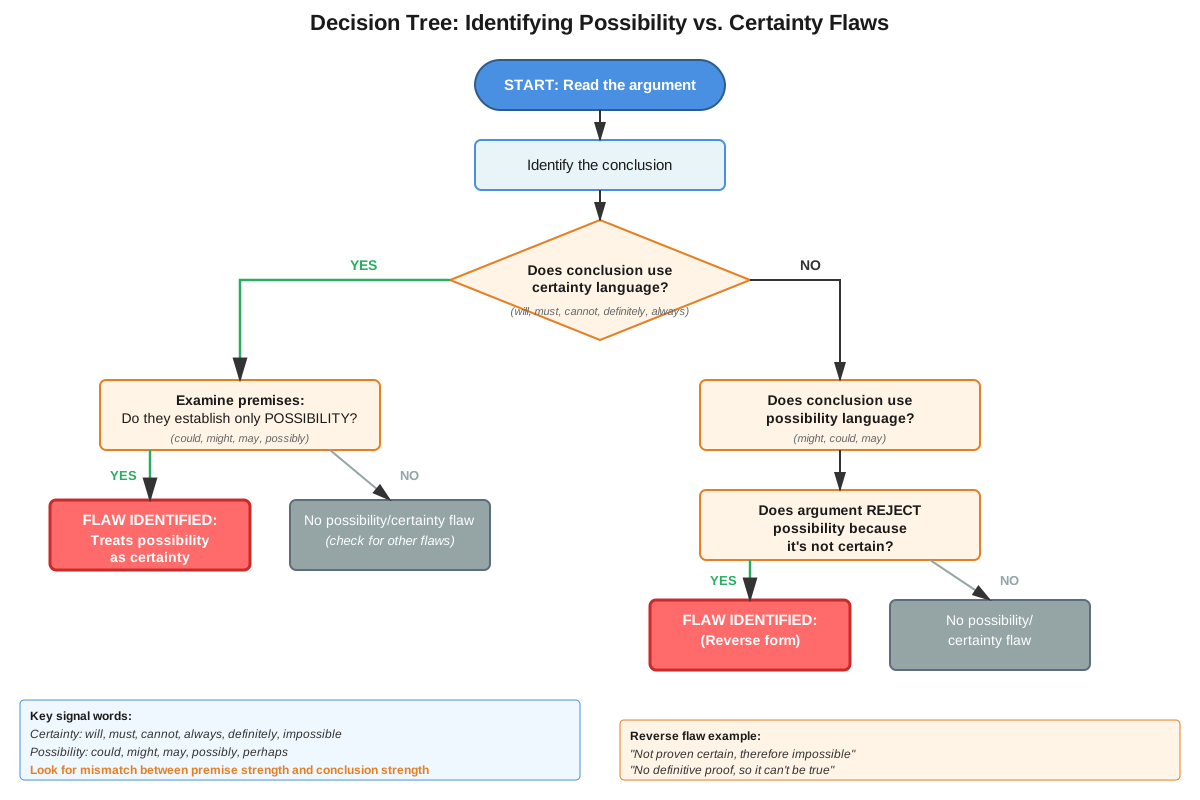
When approaching flaw questions that might involve possibility versus certainty, follow this systematic process:
Step 1: Read the conclusion first and identify modal qualifiers
Before reading the entire argument, locate the conclusion and note whether it uses certainty language (will, must, definitely) or possibility language (might, could, possibly). This primes recognition of potential mismatches.
Step 2: Read premises and track their strength
As you read each premise, note whether it establishes possibility, probability, or certainty. Mark or mentally note modal qualifiers.
Step 3: Compare premise strength to conclusion strength
Ask: "Do the premises support the degree of certainty claimed in the conclusion?" If premises show possibility but the conclusion claims certainty, you've likely found the flaw.
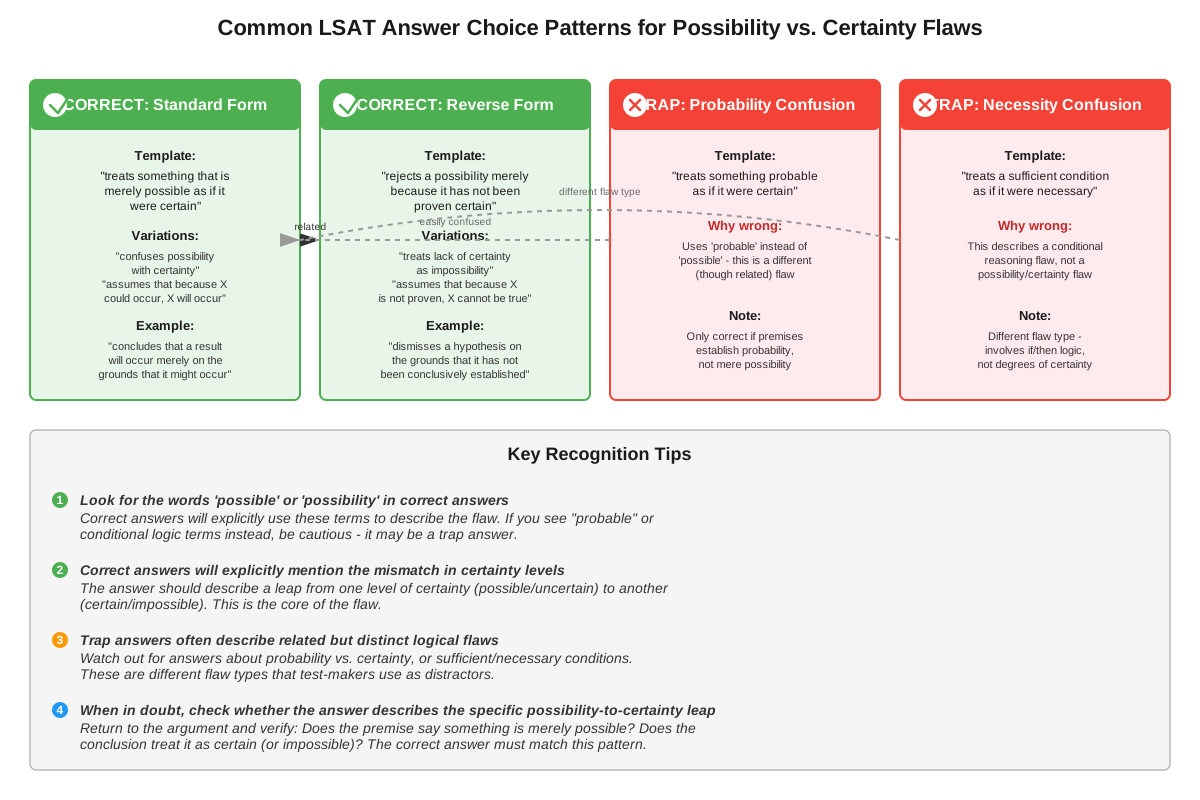
Step 4: Watch for trigger phrases in answer choices
High-yield trigger phrases for correct answers: - "treats a mere possibility as a certainty" - "takes something that could occur as something that will occur" - "mistakes the absence of proof for proof of absence" - "treats lack of evidence for a claim as evidence against it" - "confuses a potential explanation with the actual explanation" - "assumes that what is possible is therefore actual"
Step 5: Eliminate answers that describe different flaws
Use process of elimination to remove answers describing causal flaws, sampling errors, or other reasoning patterns that don't match the possibility versus certainty structure.
Time allocation advice:
Spend 15-20 seconds identifying the conclusion and its modal qualifiers, 30-40 seconds reading and analyzing the full argument, and 40-50 seconds evaluating answer choices. Don't rush the initial analysis—correctly identifying the flaw saves time on answer choice evaluation.
Common trap answers:
- Answers that describe the argument's content rather than its reasoning flaw
- Answers that identify a flaw the argument doesn't commit (e.g., describing a causal flaw when the issue is possibility versus certainty)
- Answers that are too vague (e.g., "relies on insufficient evidence") when a more specific description is available
Memory Techniques
Mnemonic: "MODAL"
- Match the strength: premises and conclusion should match in certainty level
- Observe qualifiers: watch for could, might, will, must
- Distinguish degrees: possible ≠ probable ≠ certain
- Avoid leaps: don't jump from possibility to certainty
- Lack of proof ≠ proof of lack
Visualization strategy:
Picture a ladder with three rungs labeled "Possible" (bottom), "Probable" (middle), and "Certain" (top). The flaw occurs when an argument tries to jump from the bottom rung directly to the top rung without climbing through the middle. Visualize arguments "falling" when they make this leap.
Acronym for answer choice triggers: "TMAP"
- Treats possibility as certainty
- Mistakes absence of proof for proof of absence
- Assumes possible means actual
- Presumes what could occur will occur
Memory phrase:
"Just because it might rain doesn't mean you will get wet; just because we can't prove it won't rain doesn't mean it definitely will."
Summary
The possibility versus certainty flaw represents a fundamental error in logical reasoning where arguments inappropriately shift between different degrees of certainty. This flaw appears in two primary forms: treating what is merely possible as if it were certain (the positive form), and treating the absence of certainty as proof of impossibility (the negative form). Recognizing this flaw requires careful attention to modal qualifiers—words like "could," "might," "will," and "must"—that signal the degree of certainty in both premises and conclusions. The LSAT tests this concept frequently across multiple question types, with flaw questions being the most common venue. Mastery requires understanding that evidence supporting possibility justifies only conclusions about possibility, not certainty, and that lack of definitive proof does not constitute proof of falsity. Students must develop the ability to track the strength of claims throughout an argument and identify when conclusions claim more certainty than the premises actually support. This skill connects to broader logical reasoning competencies including conditional logic, evidence evaluation, and argument structure analysis, making it essential for high performance across the Logical Reasoning section.
Key Takeaways
- Possibility versus certainty is one of the most frequently tested flaws on the LSAT, appearing in 8-12% of Logical Reasoning questions
- The flaw occurs when arguments treat what might happen as what will happen, or treat lack of certainty as impossibility
- Modal qualifiers (could, might, must, will) are the primary textual signals for identifying this flaw
- Evidence that establishes only possibility cannot justify conclusions claiming certainty without committing a logical error
- The flaw appears in both positive form (possibility → certainty) and negative form (not certain → impossible)
- Correct answer choices often use specific trigger phrases like "treats a mere possibility as a certainty" or "mistakes absence of proof for proof of absence"
- Mastering this concept requires distinguishing between different degrees of certainty: impossible, possible, probable, and certain
Related Topics
Conditional Logic and Sufficient/Necessary Conditions: Understanding how conditional statements establish what must be true (certainty) versus what might be true (possibility) deepens comprehension of the possibility versus certainty distinction. Mastering this topic enables more sophisticated analysis of when conclusions are logically required versus merely possible.
Causal Reasoning Flaws: Many arguments that commit possibility versus certainty flaws also involve causal reasoning errors, particularly when treating a possible cause as the definite cause. Studying causal reasoning enhances ability to identify compound flaws.
Strengthen and Weaken Questions: The possibility versus certainty distinction appears frequently in these question types, where correct answers might move claims from possibility toward certainty (strengthen) or from certainty toward mere possibility (weaken).
Necessary Assumption Questions: Arguments that commit the possibility versus certainty flaw often depend on unstated assumptions that bridge the gap between possibility and certainty. Understanding this flaw helps identify these hidden assumptions.
Formal Logic and Quantifiers: Advanced study of logical quantifiers (all, some, none) and their relationship to certainty claims provides deeper theoretical grounding for recognizing possibility versus certainty errors.
Practice CTA
Now that you've mastered the core concepts of possibility versus certainty, it's time to put your knowledge into practice. Attempt the practice questions and flashcards designed specifically for this topic. Focus on identifying modal qualifiers, tracking the strength of premises and conclusions, and recognizing the characteristic patterns of this flaw. Remember: consistent practice with immediate feedback is the most effective way to transform conceptual understanding into test-day performance. Each practice question you complete strengthens your pattern recognition and builds the confidence needed to tackle even the most challenging LSAT Logical Reasoning questions. You've built a solid foundation—now apply it!
Sign up free to keep reading
Create a free AnvayaPrep account to finish this LSAT guide on Possibility versus certainty — plus flashcards and practice questions.