Overview
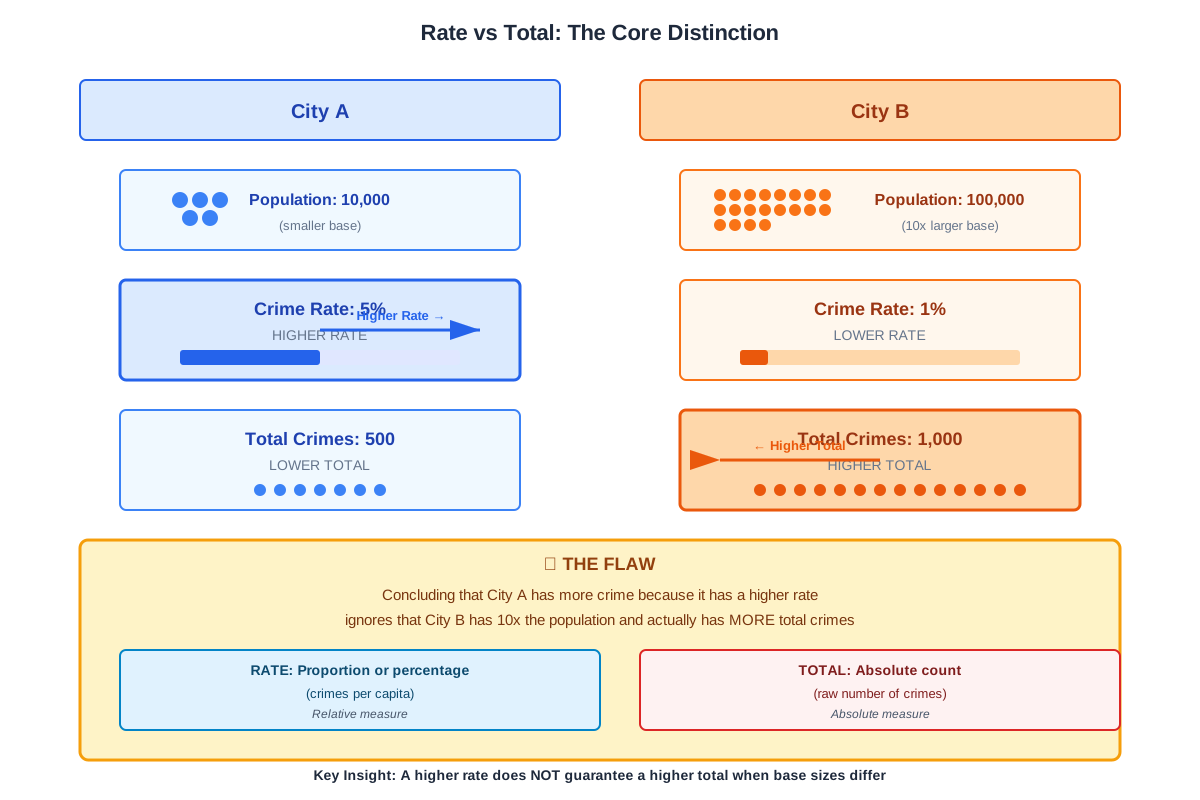
The rate versus total flaw represents one of the most frequently tested reasoning errors on the LSAT Logical Reasoning section. This flaw occurs when an argument confuses a rate (a proportion or percentage) with an absolute total (a raw number or count), or vice versa. For example, an argument might conclude that because City A has a higher crime rate than City B, City A must have more total crimes—ignoring that City B might have a much larger population and therefore more total crimes despite its lower rate. This type of flawed reasoning appears across multiple question types and requires careful attention to distinguish between proportional and absolute quantities.
Understanding this flaw is essential for LSAT success because it tests a fundamental aspect of quantitative reasoning that appears in legal, policy, and analytical contexts. The LSAT frequently presents arguments that shift between discussing percentages, rates, or proportions on one hand, and raw numbers or totals on the other. Students who can quickly identify this confusion gain a significant advantage, as this flaw appears in approximately 5-8% of all Logical Reasoning questions and shows up in various disguises across different content domains.
Within the broader landscape of flaw questions in logical reasoning, the rate versus total flaw belongs to a family of quantitative reasoning errors that also includes sampling flaws, statistical reasoning errors, and numerical comparison mistakes. Mastering this particular flaw strengthens overall analytical skills and provides a framework for evaluating any argument that involves numerical or proportional claims. The ability to spot rate versus total confusion also enhances performance on Strengthen, Weaken, and Assumption questions where this reasoning pattern appears implicitly.
Learning Objectives
- [ ] Identify how Rate versus total flaw appears in LSAT questions
- [ ] Explain the reasoning pattern behind Rate versus total flaw
- [ ] Apply Rate versus total flaw to solve LSAT-style problems accurately
- [ ] Distinguish between rate-based claims and total-based claims in complex arguments
- [ ] Recognize common linguistic markers that signal potential rate versus total confusion
- [ ] Evaluate answer choices that correctly describe rate versus total reasoning errors
- [ ] Predict how changes in population or base size affect the relationship between rates and totals
Prerequisites
- Basic understanding of percentages and proportions: The rate versus total flaw fundamentally involves distinguishing between relative measures (percentages, ratios) and absolute measures (counts, totals), requiring comfort with these mathematical concepts.
- Familiarity with LSAT argument structure: Students must be able to identify premises and conclusions to spot where the shift between rate and total occurs within an argument's logical flow.
- Knowledge of flaw question formats: Understanding how the LSAT asks about flaws (e.g., "The reasoning is flawed in that it...") helps students recognize what they're looking for and how to evaluate answer choices.
- Experience with causal and statistical reasoning: Rate versus total flaws often appear alongside other reasoning patterns, so recognizing basic statistical concepts helps isolate this specific error.
Why This Topic Matters
The lsat rate versus total flaw has profound real-world significance beyond test preparation. Legal professionals regularly encounter arguments involving crime statistics, economic data, health outcomes, and demographic trends—all domains where confusing rates with totals can lead to flawed policy decisions or misguided legal arguments. For instance, a prosecutor might argue that a particular neighborhood is more dangerous because it has a higher crime rate, while defense counsel might counter that the total number of crimes is actually lower due to smaller population. Understanding this distinction is crucial for evaluating evidence and constructing sound arguments in legal practice.
On the LSAT itself, this flaw appears with remarkable frequency and versatility. Approximately 5-8% of Logical Reasoning questions involve rate versus total confusion, making it one of the top ten most common flaw types. The flaw appears most frequently in:
- Flaw questions (direct identification of the reasoning error)
- Weaken questions (where the correct answer exploits the rate/total confusion)
- Strengthen questions (where closing the rate/total gap supports the argument)
- Assumption questions (where the argument depends on rates and totals moving together)
- Parallel Flaw questions (where students must match the rate/total pattern)
Common manifestations in LSAT passages include arguments about business performance (market share versus total revenue), health statistics (disease rates versus total cases), educational outcomes (graduation rates versus total graduates), environmental data (pollution concentrations versus total pollution), and comparative studies (per capita measures versus aggregate measures). The LSAT test writers particularly favor scenarios where population size, sample size, or base quantities differ between compared groups, creating opportunities for rate/total confusion.
Core Concepts
The Fundamental Distinction: Rates vs. Totals
A rate is a relative measure that expresses one quantity as a proportion, percentage, or ratio of another quantity. Rates include percentages (e.g., 15% of students), per capita measures (e.g., crimes per 1,000 residents), ratios (e.g., 3 out of 10 applicants), and proportions (e.g., one-quarter of the budget). Rates are inherently comparative and depend on a base or denominator.
A total is an absolute measure representing a complete count or sum without reference to a base. Totals include raw numbers (e.g., 500 students), aggregate amounts (e.g., $2 million in revenue), and complete counts (e.g., 47 crimes). Totals stand alone and do not require a denominator for interpretation.
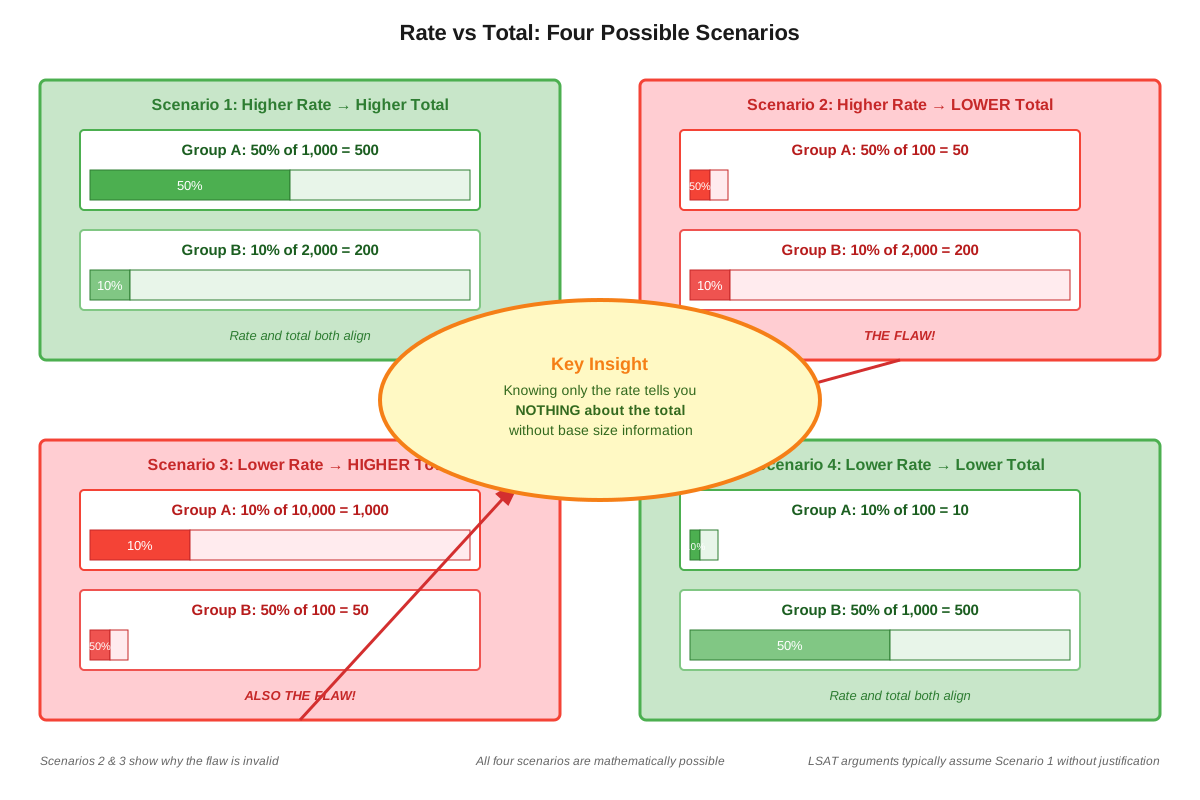
The critical insight is that rates and totals can move in opposite directions or remain independent of each other depending on changes in the base quantity. A group can have a higher rate but lower total, or vice versa, when the populations or base sizes differ significantly.
The Core Logical Error
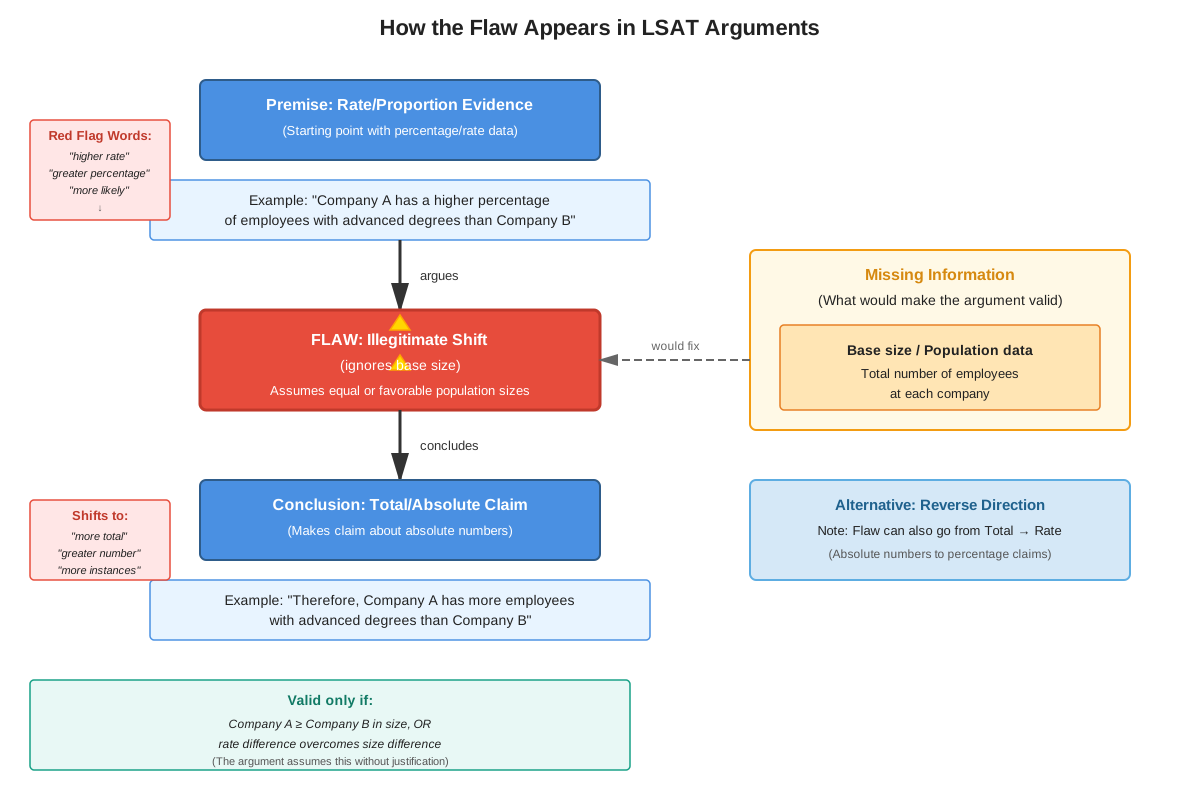
The rate versus total flaw occurs when an argument:
- Presents evidence about a rate (or total)
- Draws a conclusion about a total (or rate)
- Fails to account for the base quantity that connects them
This flaw represents an unjustified shift between two different types of quantitative measures. The argument treats rates and totals as if they were interchangeable or necessarily correlated, ignoring that their relationship depends entirely on the size of the base population or denominator.
Mathematical Relationship
The relationship between rate, total, and base follows this formula:
Rate = Total / Base
Total = Rate × Base
Base = Total / Rate
This relationship reveals why rates and totals can diverge:
- If Base A > Base B, then even if Rate A < Rate B, Total A might still exceed Total B
- A small rate applied to a large base can yield a larger total than a large rate applied to a small base
- Changes in the base can cause rates and totals to move in opposite directions
Common Argument Patterns
Pattern 1: Rate to Total
- Premise: Group A has a higher rate of X than Group B
- Conclusion: Group A has more total X than Group B
- Flaw: Ignores that Group B might have a larger base population
Pattern 2: Total to Rate
- Premise: Group A has more total X than Group B
- Conclusion: Group A has a higher rate of X than Group B
- Flaw: Ignores that Group A might have a larger base population
Pattern 3: Temporal Rate/Total Confusion
- Premise: The rate of X increased from Year 1 to Year 2
- Conclusion: The total amount of X increased
- Flaw: Ignores that the base population might have decreased
Pattern 4: Comparative Rate/Total Confusion
- Premise: Company A's market share (rate) decreased
- Conclusion: Company A's sales (total) decreased
- Flaw: Ignores that the total market might have grown
Identifying the Flaw in Arguments
| Element | Rate-Based Claim | Total-Based Claim |
|---|---|---|
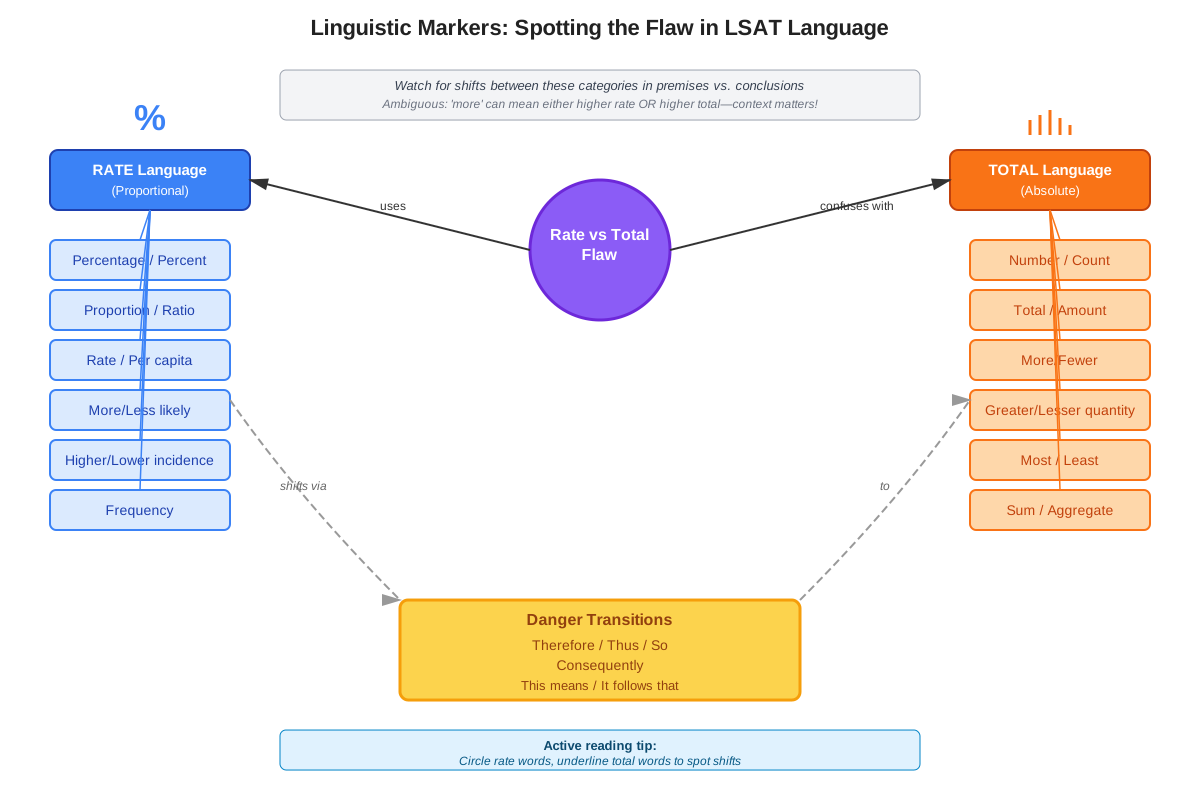
| Language markers | "percentage," "proportion," "per capita," "rate," "ratio," "share" | "number," "amount," "total," "count," "sum," "quantity" |
| Comparison type | Relative to a base | Absolute measure |
| Dependency | Requires denominator | Stands alone |
| Example | "15% of residents" | "3,000 residents" |
When analyzing arguments, students should:
- Identify quantitative claims in both premises and conclusion
- Classify each claim as rate-based or total-based
- Check for shifts between rate and total
- Consider the base and whether it's held constant or might vary
- Evaluate whether the shift is justified by explicit information about the base
Context-Specific Manifestations
Business/Economics Context:
- Market share (rate) versus total revenue (total)
- Profit margin (rate) versus total profit (total)
- Growth rate (rate) versus absolute growth (total)
Public Health Context:
- Disease incidence rate (rate) versus total cases (total)
- Mortality rate (rate) versus total deaths (total)
- Vaccination rate (rate) versus total vaccinated (total)
Crime/Safety Context:
- Crime rate per capita (rate) versus total crimes (total)
- Accident rate (rate) versus total accidents (total)
- Risk percentage (rate) versus total affected (total)
Education Context:
- Graduation rate (rate) versus total graduates (total)
- Acceptance rate (rate) versus total accepted (total)
- Test score average (rate) versus total points (total)
Concept Relationships
The rate versus total flaw connects to several other logical reasoning concepts in a hierarchical and complementary manner:
Within Quantitative Reasoning Flaws:
Rate versus total flaw → is a specific type of → Quantitative reasoning error → which includes → Sampling flaws, Statistical reasoning errors, and Survey methodology flaws. These flaws share the common feature of mishandling numerical or statistical information.
Connection to Comparison Flaws:
Rate versus total flaw → often appears alongside → Improper comparison flaws → because comparing rates from different populations or totals from different bases represents flawed comparative reasoning. The rate/total confusion is essentially a specific type of comparison error where the units of comparison shift inappropriately.
Relationship to Necessary Assumptions:
When an argument commits the rate versus total flaw → it depends on the unstated assumption that → the base quantities are equivalent or that rates and totals move together → which can be tested through Assumption questions. Understanding this connection helps students recognize the flaw in multiple question types.
Link to Strengthen/Weaken Questions:
Arguments vulnerable to rate versus total confusion → can be strengthened by → evidence that the bases are similar or that rates and totals align → and can be weakened by → evidence that bases differ significantly or that rates and totals diverge. This relationship explains why the same logical pattern appears across different question types.
Foundation for Complex Arguments:
Simple rate versus total flaw → combines with other flaws to create → Multi-layered arguments → such as those involving causal reasoning about rates or sampling issues affecting totals. Mastering the basic rate/total distinction enables recognition of these more complex patterns.
High-Yield Facts
⭐ The rate versus total flaw occurs when an argument shifts between proportional measures (rates) and absolute measures (totals) without justification.
⭐ A higher rate does not necessarily mean a higher total; the relationship depends entirely on the size of the base population.
⭐ Common linguistic markers for rates include: "percentage," "proportion," "per capita," "rate," "ratio," and "share."
⭐ Common linguistic markers for totals include: "number," "amount," "total," "count," "sum," and "quantity."
⭐ The mathematical relationship is: Total = Rate × Base, meaning changes in the base can cause rates and totals to move in opposite directions.
- Rate versus total confusion appears in approximately 5-8% of all LSAT Logical Reasoning questions.
- The flaw can work in both directions: rate to total or total to rate.
- Temporal arguments (comparing Year 1 to Year 2) frequently involve rate versus total confusion when population sizes change over time.
- Market share arguments almost always involve rate versus total issues, as market share is a rate while revenue is a total.
- When two groups have different population sizes, the group with the smaller rate can still have the larger total if its base is sufficiently larger.
⭐ The correct answer choice describing this flaw typically mentions "confuses," "overlooks the possibility," "fails to consider," or "ignores the distinction between" rates and totals.
- Arguments about risk (a rate) versus total harm (a total) represent a particularly common manifestation of this flaw.
- Per capita measures are rates, so any argument moving from per capita data to conclusions about totals is vulnerable to this flaw.
- The flaw becomes more difficult to spot when the argument uses synonyms or related terms rather than explicitly stating "rate" or "total."
- In Parallel Flaw questions, matching the rate versus total pattern requires identifying which element represents the rate, which represents the total, and which represents the base in both arguments.
Quick check — test yourself on Rate versus total flaw so far.
Try Flashcards →Common Misconceptions
Misconception: If a rate increases, the total must also increase.
Correction: Rates and totals can move in opposite directions if the base population changes. For example, if a company's market share (rate) increases from 10% to 15%, but the total market shrinks by 60%, the company's actual sales (total) will decrease despite the higher rate.
Misconception: Comparing two rates is the same as comparing two totals.
Correction: Rates and totals provide fundamentally different information. A city with a higher crime rate (crimes per 1,000 residents) might have fewer total crimes than a city with a lower rate but much larger population. The comparison depends on what question is being asked.
Misconception: The rate versus total flaw only appears in mathematical or statistical contexts.
Correction: This flaw appears across diverse content areas including business, law, medicine, education, and social policy. The LSAT disguises the flaw in various contexts, and students must recognize the underlying logical pattern regardless of subject matter.
Misconception: If an argument mentions both a rate and a total, it must be committing the rate versus total flaw.
Correction: The flaw only occurs when the argument inappropriately shifts between rate and total without justification. An argument can legitimately discuss both rates and totals if it properly accounts for the base quantity or doesn't draw conclusions that require the shift.
Misconception: The rate versus total flaw is the same as a sampling flaw.
Correction: While related, these are distinct flaws. A sampling flaw involves drawing conclusions about a population from an unrepresentative sample. The rate versus total flaw involves confusing proportional and absolute measures. An argument can commit one without committing the other.
Misconception: Larger numbers always represent totals and smaller numbers always represent rates.
Correction: The distinction between rate and total depends on the type of measure, not the magnitude. A rate can be expressed as a large number (e.g., 850 crimes per 100,000 residents) while a total can be small (e.g., 12 total crimes in a small town).
Misconception: If the argument doesn't use the words "rate" or "total," the flaw cannot be present.
Correction: The LSAT frequently uses synonyms and related terms. Rates might be expressed as "percentage," "proportion," "share," "per capita," or "ratio," while totals might be "number," "amount," "count," or "quantity." Students must recognize the concept regardless of specific terminology.
Worked Examples
Example 1: Business Revenue Argument
Argument: "TechCorp's market share in the smartphone industry increased from 8% to 12% over the past year. Meanwhile, CompetitorCo's market share decreased from 15% to 13%. Therefore, TechCorp now sells more smartphones than CompetitorCo."
Analysis:
Step 1: Identify the quantitative claims
- Premise 1: TechCorp's market share (rate) increased from 8% to 12%
- Premise 2: CompetitorCo's market share (rate) decreased from 15% to 13%
- Conclusion: TechCorp sells more smartphones (total) than CompetitorCo
Step 2: Classify each claim
- Market share = rate (percentage of total market)
- Smartphones sold = total (absolute number)
Step 3: Identify the shift
The argument moves from comparing market shares (rates) in the premises to comparing total smartphones sold (totals) in the conclusion.
Step 4: Evaluate the reasoning
The argument commits the rate versus total flaw. Even though TechCorp's market share increased to 12% and CompetitorCo's decreased to 13%, CompetitorCo still has a higher market share (13% > 12%). More importantly, even if TechCorp had the higher market share, we cannot conclude it sells more total smartphones without knowing the size of the total market and how it changed.
Step 5: Consider what would make the argument valid
The argument would be valid if: (1) we knew the total market size, (2) we could calculate actual units sold (Total = Rate × Base), and (3) TechCorp's total exceeded CompetitorCo's total. The argument fails because it jumps from rate comparison to total comparison without this information.
Answer Choice Analysis:
- Correct answer: "The argument overlooks the possibility that despite having a lower market share, CompetitorCo might still sell more smartphones than TechCorp."
- This directly identifies the rate versus total flaw by noting that the rate (market share) doesn't determine the total (smartphones sold).
Example 2: Public Health Argument
Argument: "In 2020, State A reported 5,000 cases of influenza, while State B reported 8,000 cases. A public health official concluded that residents of State B face a higher risk of contracting influenza than residents of State A."
Analysis:
Step 1: Identify the quantitative claims
- Premise: State A had 5,000 cases (total); State B had 8,000 cases (total)
- Conclusion: State B residents face higher risk (rate) than State A residents
Step 2: Classify each claim
- Cases reported = total (absolute count)
- Risk = rate (probability or proportion of population affected)
Step 3: Identify the shift
The argument moves from comparing total cases in the premises to comparing risk rates in the conclusion.
Step 4: Evaluate the reasoning
The argument commits the rate versus total flaw in the total-to-rate direction. While State B had more total cases (8,000 > 5,000), we cannot conclude that State B residents face higher risk without knowing the populations of each state. If State B has a much larger population, its risk rate (cases per capita) might actually be lower than State A's.
Step 5: Calculate to illustrate
Suppose State A has 500,000 residents and State B has 4,000,000 residents:
- State A risk rate: 5,000 / 500,000 = 1% (or 10 per 1,000)
- State B risk rate: 8,000 / 4,000,000 = 0.2% (or 2 per 1,000)
Despite having more total cases, State B actually has a much lower risk rate because of its larger population base.
Step 6: Identify the missing information
The argument needs population data for both states to validly move from total cases to risk rates. The formula Risk Rate = Total Cases / Population shows that we cannot determine rates from totals alone.
Answer Choice Analysis:
- Correct answer: "The argument fails to consider that State B might have a significantly larger population than State A, which would affect the relative risk."
- This identifies the missing base quantity (population) that connects totals (cases) to rates (risk).
Exam Strategy
Recognition Triggers
When approaching LSAT Logical Reasoning questions, watch for these trigger words and phrases that signal potential rate versus total confusion:
Rate indicators: percentage, proportion, per capita, rate, ratio, share, fraction, likelihood, probability, risk, incidence, prevalence, concentration
Total indicators: number, amount, total, count, sum, quantity, volume, aggregate, overall
Comparison phrases: "more than," "less than," "higher than," "lower than," "increased," "decreased," "greater," "fewer"
Exam Tip: When you see an argument comparing two groups using quantitative terms, immediately ask yourself: "Is this comparing rates or totals? Does the conclusion match the type of evidence provided?"
Systematic Approach
Step 1: Identify all quantitative claims (15 seconds)
- Underline or mentally note every numerical or quantitative statement
- Mark whether each is a rate or total
Step 2: Check for shifts (10 seconds)
- Compare the type of evidence (premises) to the type of conclusion
- If they differ (rate → total or total → rate), suspect the flaw
Step 3: Consider the base (10 seconds)
- Ask: "What's the denominator or population?"
- Determine if the base is stated, assumed constant, or potentially variable
Step 4: Evaluate answer choices (25 seconds)
- Eliminate choices that don't address the rate/total distinction
- Look for language about "overlooking," "failing to consider," or "ignoring" population/base differences
- Correct answers often mention "possibility that" different bases could explain the pattern
Process of Elimination Tips
Eliminate answer choices that:
- Discuss causal relationships when the flaw is purely quantitative
- Focus on sampling or representation issues rather than rate/total confusion
- Mention irrelevant factors that don't address the base quantity
- Describe the argument as assuming something is sufficient/necessary when the issue is rate/total
Keep answer choices that:
- Explicitly mention rates, totals, proportions, or absolute numbers
- Reference population size, base quantities, or denominators
- Use phrases like "overlooks the possibility that" followed by an explanation of how bases might differ
- Describe the argument as "confusing" or "failing to distinguish between" two types of measures
Time Allocation
For a typical rate versus total flaw question:
- Reading the argument: 20-30 seconds
- Identifying the flaw: 15-20 seconds
- Evaluating answer choices: 30-40 seconds
- Total time: 65-90 seconds
This flaw is relatively quick to identify once mastered, so students should aim for the lower end of this range with practice.
Common Answer Choice Patterns
Correct answers describing the rate versus total flaw typically follow these patterns:
- "The argument overlooks the possibility that [group with higher rate] might have [smaller total] due to [smaller base]."
- "The reasoning fails to consider that [group with more total] might have [lower rate] because of [larger base]."
- "The argument confuses [rate measure] with [total measure]."
- "The reasoning ignores the distinction between [proportional measure] and [absolute measure]."
Memory Techniques
The "Pizza Party" Mnemonic
Remember: Rate And Total Equal Base Awareness
Think of a pizza party: If Group A ate 50% of their pizza (rate) and Group B ate 30% of their pizza (rate), you cannot conclude which group ate more total pizza without knowing the size of each pizza (base). Group B might have had a much larger pizza and therefore eaten more total pizza despite the lower rate.
The RaTe Formula Visualization
Visualize the relationship as a triangle:
        Total
       /    \
      /      \
Rate × Base- If you know any two elements, you can find the third
- If you only know one element, you cannot determine the others
- Arguments that jump from one corner to another without considering the third commit the flaw
The "Per" Test
When you see "per" in an argument (per capita, per student, per 1,000 residents), you're dealing with a rate. The word "per" literally means "for each," indicating a ratio or proportion. If the conclusion doesn't include "per," it's likely discussing a total, and you should check for the flaw.
The Population Pivot
Create a mental image of a seesaw with "Rate" on one side and "Total" on the other, balanced on a fulcrum labeled "Population/Base." This visual reminds you that:
- Rates and totals can move in opposite directions
- The base/population is the pivot point that determines their relationship
- Ignoring the pivot (base) causes the argument to collapse
Acronym: SPOT the Flaw
Shift - Is there a shift between rate and total?
Population - Is the base population mentioned or assumed?
Overlooks - Does the argument overlook that bases might differ?
Type - What type of measure (rate or total) appears in premises vs. conclusion?
Summary
The rate versus total flaw represents a fundamental quantitative reasoning error where arguments inappropriately shift between proportional measures (rates, percentages, ratios) and absolute measures (totals, counts, sums) without accounting for the base quantity that connects them. This flaw exploits the mathematical relationship Total = Rate × Base, recognizing that rates and totals can move independently or even in opposite directions when base populations differ. On the LSAT, this flaw appears across multiple question types—particularly Flaw, Weaken, Strengthen, and Assumption questions—and manifests in diverse contexts including business performance, public health statistics, crime data, and educational outcomes. Successful identification requires recognizing linguistic markers for rates (percentage, proportion, per capita, share) versus totals (number, amount, count, quantity), systematically checking whether arguments shift between these measure types, and evaluating whether the base quantity is held constant or might vary. Mastering this flaw provides a significant advantage on test day, as it appears frequently and, once recognized, can be identified quickly and reliably.
Key Takeaways
- The rate versus total flaw occurs when arguments shift between proportional measures and absolute measures without justification, ignoring that their relationship depends on the base quantity.
- Higher rates do not necessarily mean higher totals; a group with a lower rate but larger base can have a greater total than a group with a higher rate but smaller base.
- Linguistic markers are crucial: "percentage," "proportion," "per capita," and "share" signal rates, while "number," "amount," "count," and "total" signal absolute measures.
- The mathematical relationship Total = Rate × Base reveals why rates and totals can diverge: changes in the base cause them to move independently or in opposite directions.
- This flaw appears in approximately 5-8% of LSAT Logical Reasoning questions across multiple question types, making it one of the highest-yield patterns to master.
- Correct answer choices typically use language like "overlooks the possibility," "fails to consider," or "ignores the distinction between" when describing this flaw.
- Systematic analysis involves identifying all quantitative claims, classifying them as rates or totals, checking for shifts, and evaluating whether the base is accounted for.
Related Topics
Sampling Flaws: Understanding rate versus total confusion provides a foundation for recognizing sampling errors, where conclusions about population rates are drawn from unrepresentative samples. Both involve careful attention to the relationship between parts and wholes.
Causal Reasoning Errors: Many causal arguments involve quantitative claims about rates or totals. Mastering rate versus total distinctions enables recognition of more complex flaws where causal conclusions depend on misunderstood quantitative relationships.
Necessary Assumption Questions: Arguments vulnerable to rate versus total confusion depend on assumptions about base quantities remaining constant or rates and totals moving together. Understanding this flaw enhances performance on assumption questions.
Strengthen and Weaken Questions: The rate versus total pattern appears frequently in these question types, where correct answers either provide missing base information (strengthen) or reveal base discrepancies (weaken).
Parallel Reasoning and Parallel Flaw: Matching rate versus total patterns across different arguments requires deep understanding of the logical structure, making this topic essential for parallel question success.
Practice CTA
Now that you understand the rate versus total flaw, it's time to cement your mastery through deliberate practice. Attempt the practice questions associated with this topic, focusing on identifying the shift between rates and totals, recognizing linguistic markers, and evaluating answer choices systematically. Use the flashcards to reinforce key concepts and test your ability to quickly distinguish between rate-based and total-based claims. Remember: this flaw appears frequently on the LSAT, and with focused practice, you can learn to spot it reliably within seconds, giving you a significant competitive advantage on test day. Every practice question you work through builds the pattern recognition that transforms this challenging concept into one of your strongest skills.
Sign up free to keep reading
Create a free AnvayaPrep account to finish this LSAT guide on Rate versus total flaw — plus flashcards and practice questions.